- Market Value (2025): USD 246.5 Mn
- Estimated Value (2026): USD 282.8 Mn
- Forecast Value (2036): USD 1117.5 Mn
- CAGR (2026-2036): 14.7%
Sensory Feedback Insoles Market Forecast and Outlook 2026 to 2036
According to the Fact.MR analysis, the global sensory feedback insoles market crossed a valuation of USD 246.5 million in 2025 and is estimated to be valued at USD 282.8 million in 2026 and is projected to reach USD 1,117.5 million by 2036. Demand for sensory feedback insoles is likely to grow at a CAGR of 14.7% over the forecast period.
Demand for sensory feedback insoles is increasing as consumers and healthcare professionals seek more detailed information about foot pressure, gait patterns and movement quality. Manufacturers are integrating pressure sensors and inertial measurement units (IMUs) into insole systems to support real-time monitoring and personalized feedback. These technologies are finding applications in sports performance and rehabilitation as well as diabetic foot care. For example, Orpyx introduced a next-generation sensory insole program in August 2025 that monitors plantar pressure and temperature alongside activity data. The system connects with a mobile application and home hub to support remote monitoring. Similar product developments are expected to expand sales of connected insoles across clinical and consumer markets.
Key Takeaways from the Sensory Feedback Insoles Market
- Sensory Feedback Insoles Market Value (2025): USD 246.5 million
- Sensory Feedback Insoles Market Value (2026): USD 282.8 million
- Sensory Feedback Insoles Market Forecast Value (2036): USD 1,117.5 million
- Sensory Feedback Insoles Market Forecast CAGR (2026–2036): 14.7%
- Leading Insole Sensory Modality: Multisensor fusion (24.2%)
- Leading Device Form Factor: Foot / body wearable (27.2%)
- Leading Data Processing Segment: On-device algorithm (30.5%)
- Leading Sales Channel: Pharmacy / wellness retail (28.4%)
- Key Market Participants: Walk With Path, Moticon, Orpyx Medical Technologies, STRIV, ORPHE and Noraxon
- Key Growth Regions: China, South Korea, United States, Germany and Japan
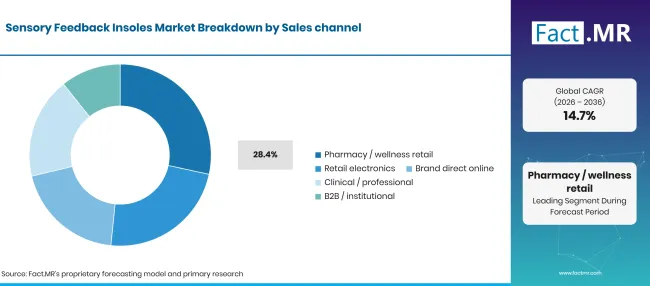
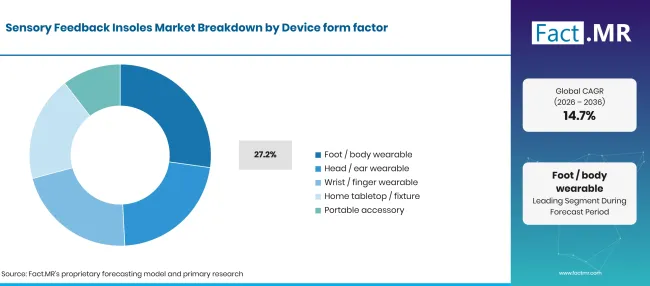
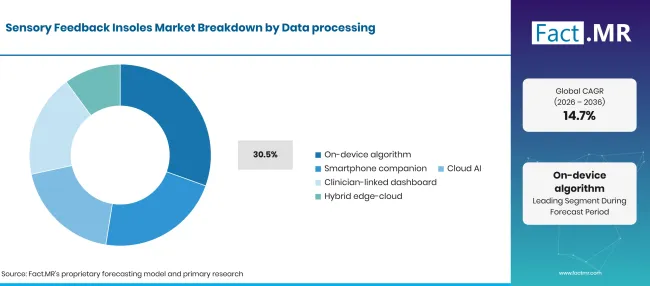
Multisensor fusion leads insole sensory modality demand with 24.2% of the market in 2026. Foot and body wearables hold the largest device form factor share at 27.2%, while on-device algorithms lead data processing with 30.5%. Pharmacy and wellness retail is the leading sales channel at 28.4%. Product development is also expanding beyond pressure measurement toward integrated feedback and gait coaching. For example, ORPHE introduced its ORPHE INSOLE with inertial and pressure sensing capabilities and presented the product at CES 2026, where it received a Best of Innovation distinction. These developments are expected to strengthen demand for insoles that combine movement measurement with actionable feedback.
Sensory Feedback Insoles Market
| Metric | Value |
|---|---|
| Estimated Value in 2026 | USD 282.8 million |
| Forecast Value in 2036 | USD 1,117.5 million |
| Forecast CAGR (2026 to 2036) | 14.7% |
| Market Value in 2025 | USD 246.56 million |
Source: Fact.MR analysis. Updated Nov 18, 2026
Source: Fact.MR analysis.
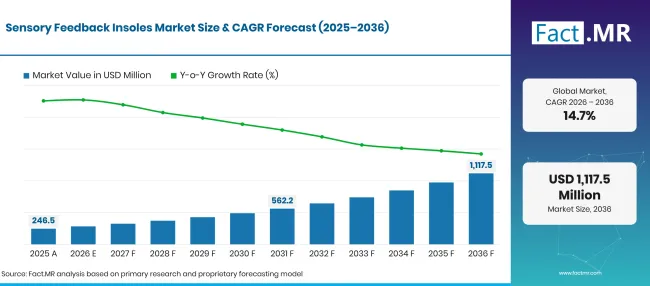
Sensory Feedback Insoles Market Forecast Global | Source: Fact.MR
Category
| Category | Segments |
|---|---|
| Insole Sensory Modality | Multisensor fusion, Vibrotactile feedback, Temperature sensing, IMU gait feedback, Plantar pressure mapping |
| Device Form Factor | Foot / body wearable, Head / ear wearable, Wrist / finger wearable, Home tabletop / fixture, Portable accessory |
| Data Processing | On-device algorithm, Smartphone companion, Cloud AI, Clinician-linked dashboard, Hybrid edge-cloud |
| Sales Channel | Pharmacy / wellness retail, Retail electronics, Brand direct online, Clinical / professional, B2B / institutional |
| Region | China, South Korea, United States, Germany, Japan |
Source: Fact.MR analysis. Updated Nov 18, 2026
Source: Fact.MR analysis.
Segmental Analysis
Why does multisensor fusion lead demand in the Sensory Feedback Insoles Market?
Sensory Feedback Insoles Market Breakdown Sales Channel 1 | Source: Fact.MR
The growing need to evaluate movement from multiple angles is supporting the adoption of insoles that combine pressure measurement with motion tracking and temperature sensing. This approach can reveal changes in plantar loading and gait mechanics that a single sensor may not capture. Multisensor fusion holds a 24.2% share in 2026, about USD 68.44 million in revenue. Moticon's OpenGo system illustrates this approach by combining 16 plantar pressure sensors with a six-axis IMU for foot-motion analysis. In April 2026, the U.S. Centers for Disease Control and Prevention reported that 47.2% of adults aged 18 and older met federal aerobic physical activity guidelines in 2024. This measures general activity participation rather than sensory-insole use. As sports and rehabilitation providers seek more detailed measurements, integrated sensing is expected to support demand for advanced insole systems.
Which factors make the foot and body wearables lead the device form factor segment?
Sensory Feedback Insoles Market Breakdown Device Form Factor | Source: Fact.MR
Demand for foot- and body-wearable systems is projected to increase over the forecast period. Capturing data directly from the foot allows users to monitor pressure distribution and movement without relying on laboratory-based equipment. This practical advantage is supporting the leading position of foot and body wearables, which account for 27.2% of device form factor demand in 2026, about USD 76.92 million. Orpyx's sensory insole system combines embedded sensors with a mobile application and home hub to support ongoing foot monitoring. The relevance of such wearable monitoring extends to older adults and people with mobility concerns. In September 2026, the CDC reported that more than one in four U.S. adults aged 65 and older experiences a fall each year, while falls lead to approximately 4.5 million emergency department visits annually among older adults. These figures highlight the need for technologies that help assess mobility and foot-related movement patterns.
What makes on-device algorithms lead data processing demand?
Sensory Feedback Insoles Market Breakdown Data Processing | Source: Fact.MR
Sales of on-device data processing solutions are supported by the need for immediate interpretation of sensor readings when users require feedback during walking or rehabilitation exercises. Processing data within the device can reduce reliance on continuous internet connectivity and enable faster access to gait measurements. On-device algorithms represent 30.5% share of data processing demand in 2026, about USD 86.25 million. The healthcare need for more consistent monitoring is also reflected in Indian government screening data. According to the Ministry of Health and Family Welfare, by February 2026, approximately 40.69 crore people had been screened for diabetes under India's national NCD screening program, with around 4.68 crore diagnosed. These national screening figures describe broader diabetes-care needs rather than adoption of insole-based monitoring. Sensor-equipped insoles can separately support plantar-pressure monitoring in appropriate clinical foot-care settings.
Why does pharmacy and wellness retail lead sales channel demand?
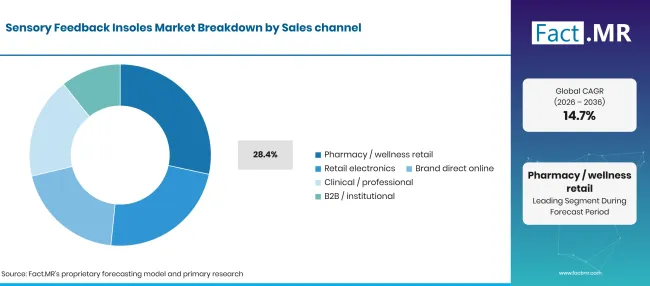
Sensory Feedback Insoles Market Breakdown Sales Channel | Source: Fact.MR
Access through pharmacies and wellness retailers can help consumers discover foot-care products and seek guidance on solutions for mobility and diabetes-related concerns. This channel leads the market with a 28.4% share in 2026, about USD 80.32 million. Orpyx's sensory insole program illustrates how wearable foot monitoring can be linked with mobile applications and remote healthcare support. India's Department of Pharmaceuticals reported that sales through Pradhan Mantri Bhartiya Janaushadhi Kendras reached INR 2,252.19 crore in FY 2025–26. The program's product basket also included 315 medical devices and surgical consumables, demonstrating the role of pharmacy-based networks in distributing healthcare products. Although these figures are not specific to sensory insoles, they indicate the scale of an established healthcare retail channel. Similar distribution partnerships could improve access to connected foot-care solutions.
Sensory Feedback Insoles Market – Drivers, Restraints and Trends
Driver
Rising demand for gait monitoring and rehabilitation technologies. Demand for sensory feedback insoles is increasing as rehabilitation professionals seek practical tools to assess walking patterns and monitor changes in patient mobility. Instrumented insoles can collect plantar pressure and movement data during real-world activities, helping clinicians evaluate gait mechanics beyond laboratory environments. Noraxon's instrumented insoles provide wireless pressure and gait measurements that can be integrated with its MR software for clinical and sports applications. Similar adoption is expected to drive sales of connected insoles across rehabilitation centers and sports assessment facilities.
Restraint
High device costs and technical complexity. Sensory feedback insoles require embedded sensors, wireless communication components and supporting software. These features can increase product costs and create challenges for manufacturers seeking to reach price-sensitive consumers. Clinical systems may also require calibration and professional interpretation to ensure that collected measurements are used appropriately. Similar cost and usability concerns are expected to limit adoption among consumers who do not require detailed movement assessment. Manufacturers need to balance sensor accuracy with comfort and affordability.
Opportunity
Integration of real-time haptic and personalized feedback. Insole developers are moving beyond passive data collection toward systems that provide feedback users can act on during daily activity. Walk With Path's Path Feel system combines pressure and temperature monitoring with haptic feedback and a clinician-facing dashboard. The company describes the system as a connected insole solution intended to support foot-health monitoring and balance-related feedback. As a result, developments are expected to drive sales of sensory feedback insoles that combine measurement with personalized guidance.
Trend:
AI-enabled running and movement coaching. Manufacturers are incorporating motion sensors and AI-based analysis to help users understand changes in running form and training load. STRIV's smart insoles use 128 pressure sensors under each foot and motion sensors in compact pods. Its platform provides movement profiles and coaching cues based on step-level measurements. The company lists its founding-member product batches for shipment in November 2026. Similar product launches are expected to expand consumer demand for performance-oriented sensory insoles.
Sensory Feedback Insoles Market by Analysis by Key Country
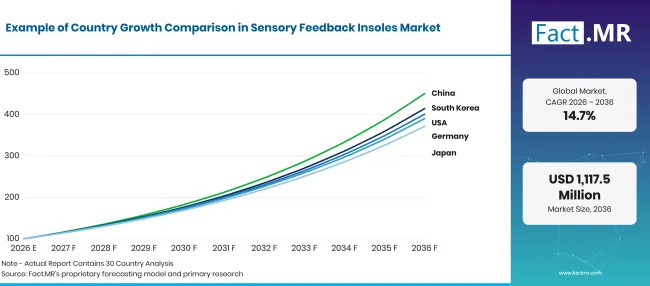
Sensory Feedback Insoles Market Growth Index | Source: Fact.MR
| Country | CAGR (2026–2036) |
|---|---|
| China | 16.2% |
| South Korea | 15.3% |
| United States | 14.9% |
| Germany | 14.6% |
| Japan | 14.0% |
Source: Fact.MR analysis. Updated Nov 18, 2026
Source: Fact.MR analysis.
What is accelerating sensory feedback insole sales in China?
Demand and sales of sensory feedback insoles in China are expected to grow at the fastest CAGR of 16.2% through 2036 among the five key countries.
Adoption is supported by the country's extensive electronics manufacturing base and growing consumer interest in connected fitness technologies. Established capabilities in sensor production and wearable electronics allow domestic developers to introduce compact movement-monitoring solutions. Increasing adoption of digital fitness platforms is creating opportunities for smart insoles that measure plantar pressure distribution and gait patterns. These developments are expected to expand sales through e-commerce platforms and specialist sports technology retailers.
How is sports technology adoption shaping sensory feedback insole demand in South Korea?
South Korea's sensory feedback insoles market is estimated to register a CAGR of 15.3% through 2036.
Demand is supported by consumer interest in wearable technology and the country's established electronics and digital-device industries. Connected insoles can complement other wearable products by providing foot-level information that wrist-based devices cannot directly measure. Manufacturers can target sports training and rehabilitation users with products that combine pressure sensing and movement analysis. Similar developments are expected to drive sales through specialist wellness retailers and online channels.
How will clinical applications and running technologies influence the United States market?
Demand for sensory feedback insoles in the United States is expected to rise at a CAGR of 14.9% through 2036.
Adoption is increasing across diabetic foot-care management and performance monitoring among runners. In August 2025, Orpyx introduced a next-generation sensory insole program designed to monitor plantar pressure and temperature alongside activity data. In November 2025, the company announced that its sensory insoles and digital health platform would be used in an NIH-funded clinical trial led by Johns Hopkins University to study diabetic foot-ulcer prevention. These clinical applications and growing consumer interest in running analytics are expected to strengthen product adoption and sales.
What role does Germany's biomechanics industry play in market expansion?
Sales and adoption of sensory feedback insoles in Germany are forecast to increase at a CAGR of 14.6% through 2036.
Demand is supported by the country's established biomechanics research ecosystem and medical technology industry. Sports science institutions, rehabilitation providers and research organizations are adopting instrumented insoles to evaluate plantar pressure distribution and gait mechanics. Moticon offers OpenGo and ReGo systems featuring plantar pressure sensors and six-axis IMUs to measure foot loading and movement. Increasing use of wearable measurement systems in sports performance research and rehabilitation is expected to create further sales opportunities.
Where will future sensory feedback insole demand emerge in Japan?
Demand and sales of sensory feedback insoles in Japan are anticipated to grow at a CAGR of 14.0% through 2036.
Adoption is supported by rising interest in smart footwear and technologies that assess movement during everyday activities. ORPHE offers smart footwear sensors and ORPHE INSOLE, which combines inertial measurement with pressure sensing to visualize balance and weight transfer. Its software and development tools also support gait analysis and movement assessment. Continued adoption of smart footwear technologies and integration of movement-monitoring capabilities into consumer products are expected to support market expansion.
Competitive Landscape for Sensory Feedback Insoles Market
Competition in the sensory feedback insoles market includes specialized sensor-insole manufacturers and wearable technology developers such as Walk With Path, Moticon, Orpyx Medical Technologies, STRIV, ORPHE and Noraxon. Companies compete through sensor accuracy and product comfort as well as the quality of their data analytics and feedback capabilities. Product differentiation increasingly depends on combining plantar pressure measurement with motion sensing and user-facing software.
The market includes several distinct commercial approaches. Moticon and Noraxon provide instrumented insoles for gait analysis and research applications. Orpyx focuses on foot-health monitoring through sensory insoles and remote patient support, while Walk With Path is developing Path Feel with pressure monitoring and haptic feedback. STRIV is targeting runners with AI-supported movement analysis, and ORPHE is expanding its smart-footwear technology into dedicated sensor insoles.
Companies that combine reliable sensing hardware with easy-to-use applications and actionable feedback are positioned to strengthen their presence. Expansion into clinical monitoring and consumer sports applications is likely to widen the competitive landscape over the forecast period.
Recent Developments
- In November 2026, STRIV listed its fourth founding-member product batch, with shipping scheduled to begin on November 25, 2026. Its smart insoles combine pressure sensors and motion sensors with app-based running analysis and coaching.
- In August 2025, Orpyx announced a next-generation sensory insole program that monitors plantar pressure and temperature as well as step count and wear time. The system connects with a mobile application and home hub for remote monitoring.
Key Players in Sensory Feedback Insoles Market
Key companies profiled include Walk with Path; Moticon; Orpyx Medical Technologies; STRIV; ORPHE; and Noraxon.
- Walk with Path
- Moticon
- Orpyx Medical Technologies
- STRIV
- ORPHE
- Noraxon
Bibliography
- Centers for Disease Control and Prevention. (2026, September 8). Facts about older adult falls.
- Department of Pharmaceuticals, Ministry of Chemicals and Fertilizers. (2026, July 28). Pradhan Mantri Bhartiya Janaushadhi Pariyojana. Press Information Bureau, Government of India.
- Elgaddal, N., & Kramarow, E. A. (2026, April). Aerobic physical activity among adults age 18 and older: United States, 2024 (NCHS Data Brief No. 555). National Center for Health Statistics.
- Ministry of Health and Family Welfare. (2026, March 23). Update on NP-NCD. Press Information Bureau, Government of India.
- Moticon ReGo AG. (2026, July). OpenGo Release Note – #1 2026.
- Moticon ReGo AG. (2026, September). OpenGo Release Note – #2 2026.
- Noraxon. (2026, May 20). Pressure products [Brochure].
- ORPHE Inc. (2026, October 15).ORPHE INSOLE 2026[ORPHE INSOLE gait-analysis smart insole receives the 2026 Good Design Award].
- Orpyx Medical Technologies Inc. (2025a, August 7). Orpyx launches sensory insole program to combat >$80B annual cost of diabetic foot complications.
- Orpyx Medical Technologies Inc. (2025b, November 13). Orpyx Medical Technologies supplies digital health platform for NIH-funded and Johns Hopkins Medicine-led clinical trial on diabetic foot ulcer prevention.
- STRIV. (2026, October). Smart insoles vs foot pods.
Segmentation
Scope of Report
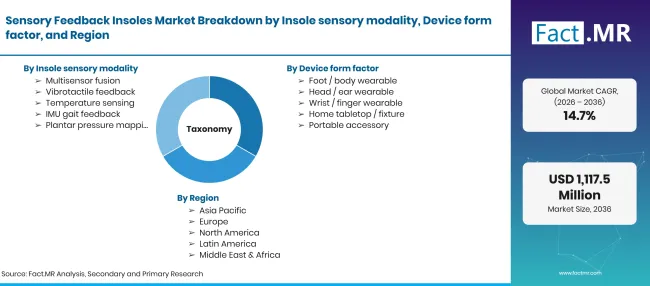
Sensory Feedback Insoles Market Taxonomy | Source: Fact.MR
| Items | Values |
|---|---|
| Quantitative Units (2026) | USD 282.8 million |
| Insole Sensory Modality | Multisensor fusion, Vibrotactile feedback, Temperature sensing, IMU gait feedback, Plantar pressure mapping |
| Device Form Factor | Foot / body wearable, Head / ear wearable, Wrist / finger wearable, Home tabletop / fixture, Portable accessory |
| Data Processing | On-device algorithm, Smartphone companion, Cloud AI, Clinician-linked dashboard, Hybrid edge-cloud |
| Sales Channel | Pharmacy / wellness retail, Retail electronics, Brand direct online, Clinical / professional, B2B / institutional |
| Regions Covered | North America, Latin America, Europe, East Asia, South Asia and Pacific, Middle East and Africa |
| Countries Covered | United States, China, Germany, Japan, South Korea and other countries |
| Key Companies Profiled | Walk With Path, Moticon, Orpyx Medical Technologies, STRIV, ORPHE, Noraxon |
| Additional Attributes | Market revenue is segmented by insole sensory modality, device form factor, data processing, sales channel and region. |
Source: Fact.MR analysis. Updated Nov 18, 2026
Sensory Feedback Insoles Market by Segments
-
Insole Sensory Modality
- Multisensor fusion
- Vibrotactile feedback
- Temperature sensing
- IMU gait feedback
- Plantar pressure mapping
-
Device Form Factor
- Foot / body wearable
- Head / ear wearable
- Wrist / finger wearable
- Home tabletop / fixture
- Portable accessory
-
Data Processing
- On-device algorithm
- Smartphone companion
- Cloud AI
- Clinician-linked dashboard
- Hybrid edge-cloud
-
Sales Channel
- Pharmacy / wellness retail
- Retail electronics
- Brand direct online
- Clinical / professional
- B2B / institutional
-
Region
- North America
- United States
- Canada
- Mexico
- Europe
- Germany
- United Kingdom
- France
- Italy
- Spain
- Rest of Europe
- Asia Pacific
- China
- India
- Japan
- South Korea
- Australia
- Rest of Asia Pacific
- Latin America
- Brazil
- Mexico
- Argentina
- Rest of Latin America
- Middle East & Africa
- GCC Countries
- South Africa
- Rest of Middle East & Africa
- North America
Frequently Asked Questions
How big is the global Sensory Feedback Insoles Market in 2026?
What will be the size of the Sensory Feedback Insoles Market by 2036?
How fast will the Sensory Feedback Insoles Market grow during the forecast period?
Which insole sensory modality segment holds the largest share of the Sensory Feedback Insoles Market?
Which device form factor leads the Sensory Feedback Insoles Market?
Which data processing segment holds the largest share?
Which sales channel leads the Sensory Feedback Insoles Market?
Who are the key companies operating in the Sensory Feedback Insoles Market?
Who worked on this report


Preview the report firsthand - request a free sample
Free SampleGet the brochure for pricing and purchase details
Download PDF