- Market Value (2025): USD 670.1 Mn
- Estimated Value (2026): USD 788.0 Mn
- Forecast Value (2036): USD 3986.6 Mn
- CAGR (2026-2036): 17.6%
What is the Shelf-Stable Mycoprotein Powders Market forecast to be worth by 2036?
USD 788.0 million in 2026 to USD 3986.6 million by 2036 at a 17.6% CAGR.
- The Shelf-Stable Mycoprotein Powders Market reached USD 670.1 million in 2025.
- Demand is projected to increase from USD 788.0 million in 2026 to USD 3986.6 million by 2036.
- The market is forecast to record 17.6% CAGR from 2026 to 2036 as food brands and nutrition formulators qualify dry fungal protein.
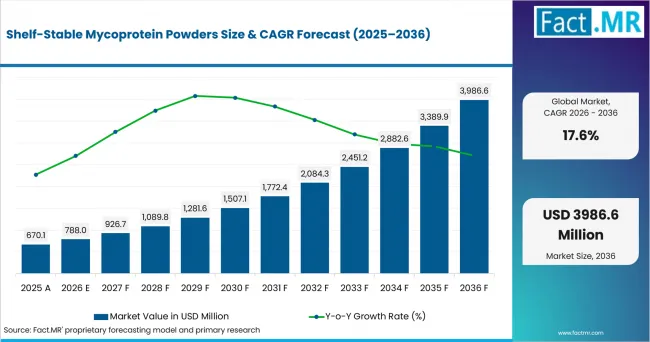
Shelf Stable Mycoprotein Powders Value Analysis | Source: Fact.MR
What are the defining numbers behind Shelf-Stable Mycoprotein Powders Market growth?
An absolute opportunity of USD 3198.6 million is expected between 2026 and 2036.
- Demand Drivers in the Market
- Alternative-meat developers need dry protein inputs that carry texture and protein content without chilled handling.
- Nutrition-food formulators need compact ingredients for powders and bars as USDA Economic Research Service recorded inflation-adjusted U.S. food spending of USD 2.51 trillion in 2025, measured in 2025 dollars.
- Fermentation developers need drying control because shelf-stable powders depend on repeatable moisture removal and stable particle size.
- Key Segments Analyzed
- By Fungi Source: Fusarium is expected to hold 31.0% share in 2026 owing to its established use in Quorn mycoprotein.
- By Product Form: Dry powder is projected to account for 29.0% share in 2026 as ambient storage and dosing flexibility support ingredient blending.
- By Application: Meat alternatives are anticipated to capture 36.0% share in 2026 because fibrous texture remains central to mycoprotein use.
- By Processing: Biomass fermentation is estimated to represent 34.0% share in 2026 since controlled fungal growth creates the protein-rich base material.
- Analyst Opinion at Fact.MR
- Shambhu Nath Jha, Principal Consultant at Fact.MR, states, “Powder format solves a commercial problem that wet biomass leaves open. Food manufacturers are expected to use shelf-stable mycoprotein when they need dry dosing, verified species identity and repeatable protein performance. Supplier selection should combine validated strains, drying control and application support.”
- Strategic Implications
- Ingredient suppliers should document strain identity, allergen controls and protein content before customer trials begin.
- Food manufacturers should test hydration behavior and flavor carryover before moving powder into full recipe scale-up.
- Fermentation operators should monitor water activity after drying because shelf stability depends on the final powder condition.
- Commercial teams should target meat alternatives and nutrition foods before entering broad food categories.
- Regulatory teams should align dossiers with Europe and the USA because labeling and novel-food review affect launch timing.
China is anticipated to advance at 18.5% CAGR through 2036 as online food retail widens dry ingredient testing. France is projected to post 18.4% CAGR through protein-diversification programs. The USA is expected to record 18.0% CAGR through food spending scale and labeling clarity. Germany is forecast to hold 17.8% CAGR through meat-alternative production visibility. Japan is estimated to reach 16.9% CAGR as shelf-stable foods support compact protein use.
How does the Shelf-Stable Mycoprotein Powders Market break down by segment?
Meat alternatives lead Application at 36.0% share in 2026; biomass fermentation leads Processing at 34.0% share.
Which Fungi Source dominates?
Fusarium is expected to hold 31.0% share in 2026.
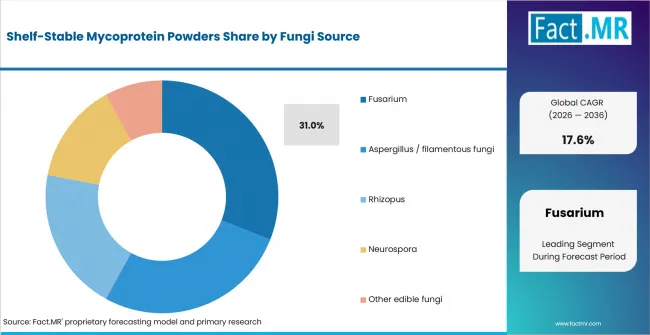
Shelf Stable Mycoprotein Powders Analysis By Fungi Source | Source: Fact.MR
Fusarium leads due to its established commercial use in food-grade mycoprotein. Quorn updated its production explanation in February 2026 and identified Fusarium venenatum as the organism behind Quorn mycoprotein. That history gives formulators a familiar fungal platform when they design meat-style products.
What leads the Product Form segment?
Dry powder is projected to account for 29.0% share in 2026.
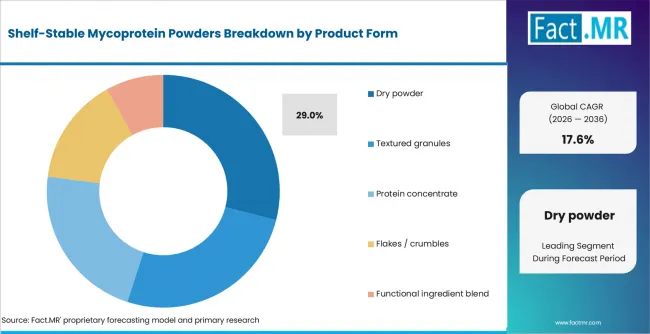
Shelf Stable Mycoprotein Powders Analysis By Product Form | Source: Fact.MR
Dry powder leads because it fits storage, shipping and dosing routines used by ingredient buyers. The format lets formulators blend fungal protein with starches, fibers, seasonings and plant proteins during dry processing. This makes pilot work easier for bars, dry mixes and meat-alternative bases. The format also helps product development teams run stability checks before larger fermentation orders are placed.
How does Application shape demand?
Meat alternatives are anticipated to capture 36.0% share in 2026.
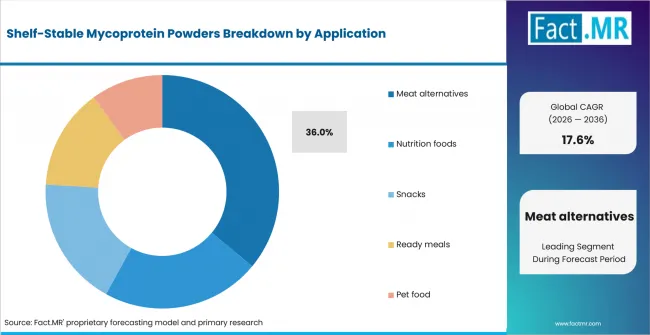
Shelf Stable Mycoprotein Powders Analysis By Application | Source: Fact.MR
Meat alternatives lead as mycoprotein can deliver bite and protein density in burgers, mince-style products and ready meals. FDA’s January 2025 draft guidance provides non-binding recommendations for naming and labeling certain plant-based alternatives. That guidance supports label planning before trial products move into retail or foodservice. Formulators also use powder trials to check hydration speed before moving recipes into frozen or shelf-stable formats.
What supports Processing demand?
Biomass fermentation is estimated to represent 34.0% share in 2026.
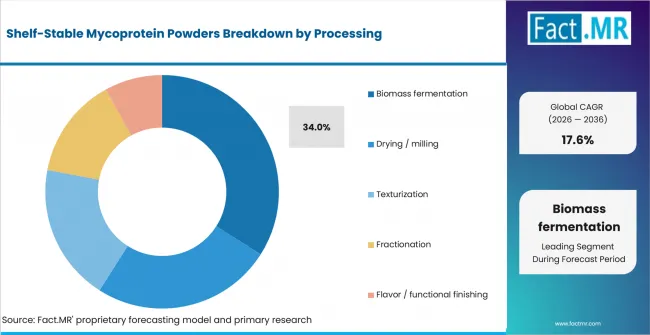
Shelf Stable Mycoprotein Powders Analysis By Processing | Source: Fact.MR
Biomass fermentation leads since commercial value starts with controlled fungal growth. EFSA issued a safety opinion in December 2025 for Rhizomucor pusillus biomass powder under the EU novel-food framework. The review shows why organism identity, composition and intended use remain central to powder qualification.
What is accelerating Shelf-Stable Mycoprotein Powders Market adoption, and what is holding it back?
Demand is expected to rise through dry-format protein needs and verified fungal fermentation. Growth is limited by authorization costs, scale-up economics and sensory validation.
Drivers Impact Analysis
| DRIVER (~) | % IMPACT ON CAGR | GEOGRAPHIC RELEVANCE | IMPACT TIMELINE |
|---|---|---|---|
| Dry-format protein use in nutrition foods | +2.0% | North America, Europe, East Asia | Short term (<= 2 years) |
| Meat-alternative texture and protein targets | +1.7% | United States, Germany, China | Medium term (2-4 years) |
| Novel-food and labeling clarity | +1.2% | Europe, United States, Japan | Medium term (2-4 years) |
| Fermentation capacity and strain documentation | +1.0% | Global | Long term (>= 4 years) |
Opportunity Impact Analysis
| OPPORTUNITY | % IMPACT ON CAGR | GEOGRAPHIC RELEVANCE | IMPACT TIMELINE |
|---|---|---|---|
| Shelf-stable protein blends for sports and wellness foods | +1.3% | United States, Japan, France | Short term (<= 2 years) |
| Powdered meat-alternative mixes for foodservice and private label | +1.0% | Europe, China, United States | Medium term (2-4 years) |
| Pet food and hybrid protein formulations | +0.8% | China, Europe, Japan | Long term (>= 4 years) |
Restraints Impact Analysis
| RESTRAINT | % IMPACT ON CAGR | GEOGRAPHIC RELEVANCE | IMPACT TIMELINE |
|---|---|---|---|
| Novel-food approval and label review costs | -0.7% | Europe, United States, Japan | Short term (<= 2 years) |
| Sensory and flavor finishing requirements | -0.5% | Global | Medium term (2-4 years) |
| Drying cost and scale-up consistency | -0.4% | Global | Long term (>= 4 years) |
Which countries are scaling the Shelf-Stable Mycoprotein Powders Market through 2036?
- The country comparison spans 1.6 percentage points across the forecast period.
- China remains 0.1 percentage point above France through online food retail and functional-food launches.
- France remains 0.4 percentage point above the USA through food manufacturing depth and protein programs.
- The USA remains 0.2 percentage point above Germany through food spending scale and labeling clarity.
- Germany remains 0.9 percentage point above Japan through meat-alternative production visibility.
Comparable CAGRs create different entry conditions because regulation, retail behavior, processing capacity and price sensitivity vary by country. Full report coverage includes North America, Latin America, Western Europe, Eastern Europe, East Asia, South Asia & Pacific, Middle East & Africa.
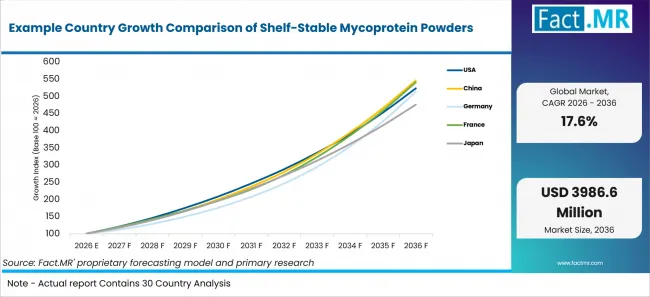
Example Country Growth Comparison Of Shelf Stable Mycoprotein Powders | Source: Fact.MR
| Country | CAGR |
|---|---|
| China | 18.5% |
| France | 18.4% |
| United States | 18.0% |
| Germany | 17.8% |
| Japan | 16.9% |
How is China scaling demand?
18.5% CAGR, supported by online food retail and functional protein product development.
China gives dry mycoprotein suppliers a route through food manufacturing and digital retail. The National Bureau of Statistics reported that online food sales among physical goods rose 14.5% in 2025. The country is anticipated to advance at 18.5% CAGR through 2036 as brands test fungal protein powders for nutrition foods and snacks.
How is France supporting growth?
18.4% CAGR, backed by food manufacturing depth and protein diversification.
France offers a processing base where dry mycoprotein can enter nutrition foods, ready meals and meat-alternative recipes. France’s Ministry of Agriculture announced in July 2025 that EUR 11.7 million in planned support would go to 10 selected territorial projects in legume value chains under its protein-sovereignty policy. The country is projected to post 18.4% CAGR through 2036 as food developers widen protein inputs.
What supports USA adoption?
18.0% CAGR, led by food spending scale and plant-based labeling clarity.
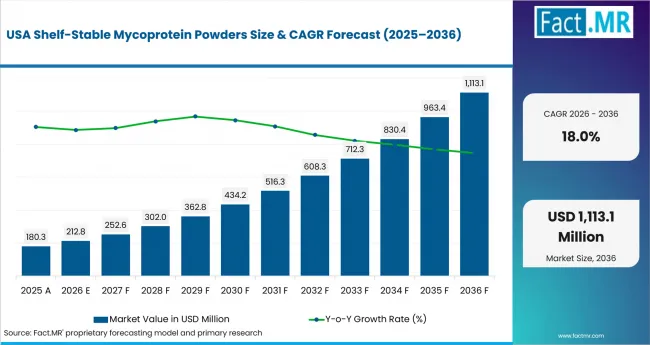
Shelf Stable Mycoprotein Powders Country Value Analysis | Source: Fact.MR
The USA combines large packaged-food demand with active alternative-protein development. USDA Economic Research Service reported inflation-adjusted U.S. food spending of USD 2.51 trillion in 2025, measured in 2025 dollars. The market is expected to record 18.0% CAGR through 2036 as brands evaluate fungal protein for meat alternatives, bars and dry meal mixes.
What is supporting Germany’s adoption?
17.8% CAGR, backed by meat-alternative production and ingredient qualification.
Germany remains a practical European entry point because meat alternatives already have manufacturing visibility. Destatis reported 124,900 tonnes of vegetarian and vegan meat-alternative production in 2025. The market is forecast to hold 17.8% CAGR through 2036 as dry fungal protein enters textured foods and nutrition applications.
How does Japan perform?
16.9% CAGR, led by shelf-stable foods and health-oriented protein use.
Japan’s opportunity is tied to compact nutrition, convenience foods and shelf-stable product development. USDA Foreign Agricultural Service reported Japan’s food processing sector at USD 174.0 billion in 2025. The country is estimated to reach 16.9% CAGR through 2036 as companies test fungal powders for health foods and ready meals.
Who leads the Shelf-Stable Mycoprotein Powders Market?
The Protein Brewery is active through Fermotein®, a mycelium-based ingredient produced from Rhizomucor pusillus. Commission Implementing Regulation (EU) 2026/1507 of July 3, 2026 authorised the placing on the EU market of Rhizomucor pusillus mycelium as a novel food following EFSA’s safety assessment, which identified the production strain as R. pusillus CBS 143028. The Protein Brewery also announced an EUR 18 million Series B extension in June 2026 to expand production capacity and support commercial growth in Europe.
Nosh.bio develops Koji Protein for applications including meat analogues, health and wellness foods, and pet food. Naplasol, a member of the VEOS Group, acquired Mycorena and incorporated its Promyc® mycoprotein portfolio into its operations.
Competition centers on validated strain identity, powder functionality, drying control and application support. Suppliers that prove stable composition and help customers manage taste, texture and labeling are expected to hold stronger positions. Application support is part of competition because customers need help converting fungal biomass into repeatable recipes.
Which companies are the key providers?
Key companies include Enifer; The Protein Brewery; Naplasol / Promyc; and Nosh.bio.
- Enifer
- The Protein Brewery
- Naplasol / Promyc
- Nosh.bio
Bibliography
- European Commission. (2026, July 3). Commission Implementing Regulation (EU) 2026/1507 of 3 July 2026 authorising the placing on the market of Rhizomucor pusillus mycelium as a novel food and amending Implementing Regulation (EU) 2017/2470. Official Journal of the European Union.
- U.S. Food and Drug Administration. (2025, January). Draft guidance for industry: Labeling of plant-based alternatives to animal-derived foods.
- Zeballos, E., & Sinclair, W. (2026, June 11). Total U.S. food spending reached $2.51 trillion in 2025. U.S. Department of Agriculture, Economic Research Service.
- National Bureau of Statistics of China. (2026, January 20). Total retail sales of consumer goods in December 2025.
- Ministère de l’Agriculture et de la Souveraineté alimentaire. (2025, July 2). Planification écologique : 11,7 millions d’euros d’aides en faveur de la souveraineté protéique en France [Ecological planning: €11.7 million in aid for protein sovereignty in France].
- Statistisches Bundesamt (Destatis). (2026, May 18). Nach jahrelangem Anstieg: Fleischersatz-Produktion sinkt 2025 um 1,2 % gegenüber dem Vorjahr [After years of growth: Meat-substitute production fell by 1.2% in 2025 compared with the previous year].
- U.S. Department of Agriculture, Foreign Agricultural Service. (2026, April 1). Food processing ingredients annual (Report No. JA2026-0012) [Japan].
- The Protein Brewery. (2025, December 16). The Protein Brewery secures €2.3 million EU LIFE grant to bring next-gen nutritious mycoprotein powder to dairy alternatives [Press release].
- The Protein Brewery. (2026, June 17). First whole-food mycelium authorised under the EU Novel Food regulation [Press release].
- The Protein Brewery. (2026, June 29). The Protein Brewery closes €18 million Series B extension, led by ABN AMRO Sustainable Impact Fund, ahead of European commercial launch [Press release].
- Quorn. (2026, February 17). How is Quorn made?
This Report Answers
- The report explains where shelf-stable mycoprotein powders are used across fungi source and product form.
- Segment analysis identifies the leading subsegments and the practical reasons formulators prioritize them.
- Country analysis examines food-processing, retail and regulatory mechanisms supporting powder use.
- Competitive analysis reviews current providers across mycoprotein, fungal biomass and application support.
- Application analysis assesses how texture, protein content, flavor control and shelf stability influence purchasing decisions.
What does the Shelf-Stable Mycoprotein Powders Market cover?
The market covers dry mycoprotein ingredients made from edible fungi or mycelial biomass. It includes powders, granules, concentrates, flakes and blends used in food, nutrition and pet-food formulations where ambient storage is part of the value proposition. The scope focuses on ingredient systems sold to food manufacturers and nutrition brands before finished food production.
The assessment covers Fusarium, Aspergillus / filamentous fungi, Rhizopus, Neurospora and other edible fungi. It also reviews biomass fermentation, drying / milling, texturization, fractionation and flavor / functional finishing.
What is included in the scope?
The scope includes shelf-stable ingredients that overlap with mycoprotein products when dry handling is central to commercial use. Application overlap appears in mycoprotein fibrous ingredients used for meat-style texture.
Food developers compare dry formats with mycelium meat fibers in texture-led recipes. Microbial protein sourcing links the scope with protein extracts from single cell protein. Adjacent high-protein formats include fermented yeast proteins where fermentation creates food-grade protein inputs.
What is excluded from the scope?
Fresh mushrooms, culinary mushroom powders and general plant-based meat products fall outside the scope when the protein input is outside fungal mycoprotein. Dairy protein analogues belong in precision fermentation dairy alternatives where the product boundary is different.
Plant-source texturates belong in fermented fava protein texturates when the input is pulse based. Finished retail foods are covered under meat substitutes when the ingredient is sold as a finished food. Flavor systems are adjacent to protein flavor masking agents where the product is a taste-correction system.
How Was the Analysis Built?
The analysis draws on 120+ sources, 35+ company portfolios, 25+ countries, and more than 20 industry interviews.
- Primary Research: Discussions with ingredient manufacturers, fermentation developers, food brands, contract manufacturers, distributors and end users examined purchasing priorities and approval needs.
- Desk Research: Research covered government statistics, regulatory publications, company releases, technical studies, associations, standards and public policy.
- Market Sizing and Forecasting: Estimates combine demand indicators, segment shares, company activity, country growth, investment patterns and barriers. The approach keeps core market values intact and uses public indicators only to strengthen the surrounding explanation.
- Data Validation and Update Cycle: Findings are checked against public data, company activity, regulatory changes, trade patterns and product launches.
What is the report's scope and coverage?
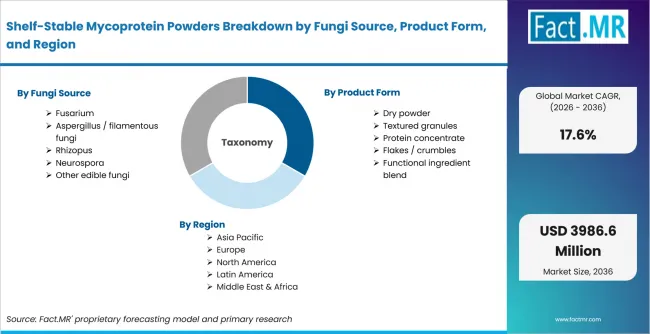
Shelf Stable Mycoprotein Powders Breakdown By Fungi Source, Product Form, And Region | Source: Fact.MR
| Attribute | Details |
|---|---|
| Quantitative Units | USD million |
| Market Definition | Dry fungal protein ingredients produced from edible fungi or mycelial biomass and designed for ambient storage, blending, texturization and food formulation. |
| Fungi Source | Fusarium; Aspergillus / filamentous fungi; Rhizopus; Neurospora; Other edible fungi |
| Product Form | Dry powder; Textured granules; Protein concentrate; Flakes / crumbles; Functional ingredient blend |
| Application | Meat alternatives; Nutrition foods; Snacks; Ready meals; Pet food |
| Processing | Biomass fermentation; Drying / milling; Texturization; Fractionation; Flavor / functional finishing |
| Regions Covered | North America; Latin America; Western Europe; Eastern Europe; East Asia; South Asia & Pacific; Middle East & Africa |
| Countries Covered | China; France; United States; Germany; Japan |
| Key Companies Profiled | Enifer; The Protein Brewery; Naplasol / Promyc; Nosh.bio |
| Forecast Period | 2026 to 2036 |
| Approach | Hybrid top-down and bottom-up approach using fermentation capacity, food-processing indicators, country demand signals, segment shares, provider activity and application-level adoption. |
How is the market segmented?
-
By Fungi Source
- Fusarium
- Aspergillus / filamentous fungi
- Rhizopus
- Neurospora
- Other edible fungi
-
By Product Form
- Dry powder
- Textured granules
- Protein concentrate
- Flakes / crumbles
- Functional ingredient blend
-
By Application
- Meat alternatives
- Nutrition foods
- Snacks
- Ready meals
- Pet food
-
By Processing
- Biomass fermentation
- Drying / milling
- Texturization
- Fractionation
- Flavor / functional finishing
-
By Region
- North America
- Latin America
- Western Europe
- Eastern Europe
- East Asia
- South Asia & Pacific
- Middle East & Africa