- Market Value (2025): USD 160.7 Mn
- Estimated Value (2026): USD 180 Mn
- Forecast Value (2036): USD 559.1 Mn
- CAGR (2026-2036): 12.0%
What is the shore power cable reels market forecast to be worth by 2036?
USD 180 million in 2026 to USD 559.1 million by 2036, at 12.00% CAGR.
- The shore power cable reels market was valued at USD 160.7 million in 2025.
- It is expected to reach USD 180 million in 2026 before rising to USD 559.1 million by 2036.
- The market is projected to expand at 12.0% CAGR during the forecast period as ports accelerate electrification projects and vessel operators adopt cleaner berthing practices.
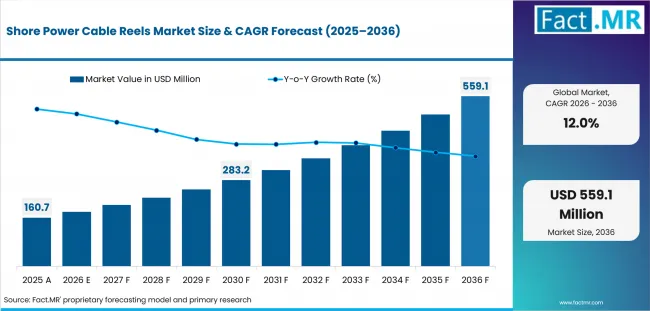
Shore Power Cable Reels Market Market Value Analysis | Source: Fact.MR
What are the defining numbers behind shore power cable reels market growth?
USD 379 million absolute opportunity by 2036, supported by port electrification and low emission shipping.
- Demand Drivers in the Market
- Shore power programs are increasing demand for advanced cable management systems.
- Ports are investing in cleaner berth operations through electrical infrastructure.
- Vessel operators seek safer cable handling during shore connections.
- Environmental policies continue supporting marine electrification projects.
- Key Segments Analyzed
- By Voltage Class: Medium voltage systems are expected to account for 37.0% share in 2026 because they support most commercial shore power installations.
- By Mounting: Quay mounted systems are projected to hold 35.0% share in 2026 as they remain the preferred choice for permanent port infrastructure.
- By End Vessel: Cruise ships are forecast to represent 31.0% share in 2026 because they spend extended periods alongside busy passenger terminals.
- By Buyer Type: Ports are expected to capture 40.0% share in 2026 as they lead investment in shore connection infrastructure.
- By Geography: The United States is projected to record 12.7% CAGR through 2036 as marine electrification projects continue expanding.
- Analyst Opinion at Fact.MR
- Shambhu Nath Jha, Senior Analyst at Fact.MR, states, "Shore power cable reels are becoming an important part of port electrification because reliable cable handling improves safety while reducing connection time. Equipment that combines automation with dependable operation will remain well positioned as shore power networks expand."
- Strategic Implications
- Equipment manufacturers should develop modular reel systems for retrofit projects.
- Ports should integrate cable reels with long term electrification plans.
- Shipyards should support standardized shore connection designs.
- Technology developers should improve remote diagnostics for maintenance teams.
Shore power cable reels manage high capacity electrical cables between vessels and onshore power infrastructure. They improve cable handling while reducing manual effort during vessel connection and disconnection. Reliable cable management also supports safer operations across busy marine terminals.
Demand is rising as environmental regulations encourage ports to reduce emissions from ships at berth. Cruise terminals, ferry ports and container facilities are increasing investment in shore connection infrastructure. Automation features and remote monitoring are further improving equipment performance across modern installations.
The United States is projected to record 12.7% CAGR through 2036 because port electrification projects continue expanding. Germany is expected to register 12.3% CAGR as clean port infrastructure receives greater investment. Japan is likely to achieve 12.0% CAGR through 2036 through continued marine electrification. China is forecast to grow at 11.7% CAGR as coastal ports strengthen shore power capacity. India is anticipated to record 11.3% CAGR as green port initiatives continue developing.
How does the shore power cable reels market break down by segment?
Medium voltage leads at 37.0%. Cruise ships lead at 31.0%.
Which voltage class dominates?
Medium voltage holds 37.0% share in 2026.
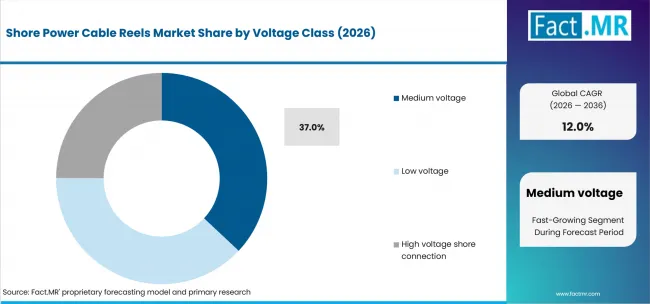
Shore Power Cable Reels Market Analysis By Voltage Class | Source: Fact.MR
Medium voltage systems are expected to account for 37.0% share in 2026 because they match the power requirements of many commercial terminals. They also support reliable vessel connections across different port layouts. Low voltage systems remain common for smaller vessels. High voltage shore connection systems serve large ships with greater power demand. Cavotec secured a EUR 1.5 million order to supply shore power equipment for the expansion of a cruise terminal in Southern California, including PowerMove, PowerFeed, and PowerCover systems for vessel-to-shore electrical connections. [1]
Which mounting dominates?
Quay mounted systems lead with 35.0% share in 2026.
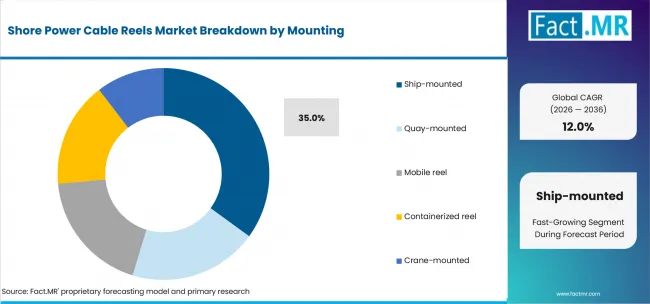
Shore Power Cable Reels Market Analysis By Mounting | Source: Fact.MR
Quay mounted cable reels are projected to capture 35.0% share in 2026 because they provide permanent cable management at busy berths. Fixed installations reduce handling effort during repeated vessel calls. Ship mounted systems improve operational flexibility. Mobile reels support temporary connections. Containerized reels simplify relocation. Crane mounted designs suit specialized terminals. Conductix-Wampfler and APM Terminals signed their third collaboration agreement for RTG crane electrification projects, supplying energy management solutions including cable reel technologies used in port electrification. [2]
Which end vessel dominates?
Cruise ships hold 31.0% share in 2026.
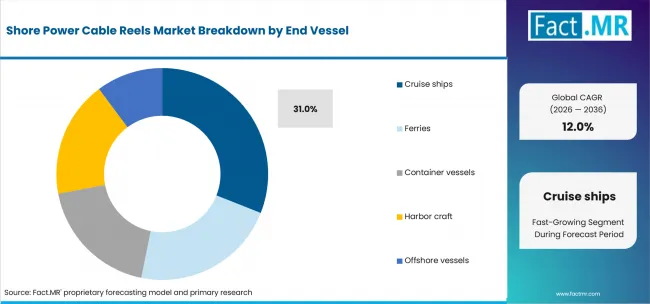
Shore Power Cable Reels Market Analysis By End Vessel | Source: Fact.MR
Cruise ships remain the largest application because they consume substantial electrical power while berthed. The segment is expected to account for 31.0% share in 2026. Ferries benefit from rapid connection systems. Container vessels support wider deployment through major ports. Harbor craft adopt compact reel systems. Offshore vessels expand demand across energy terminals. Cavotec secured an EUR 8.1 million order from a leading global container shipping company to supply complete shore power systems, including cable management reels and weatherproof enclosures for newly built container vessels. [3]
Which control feature dominates?
Automatic reeling leads market demand.
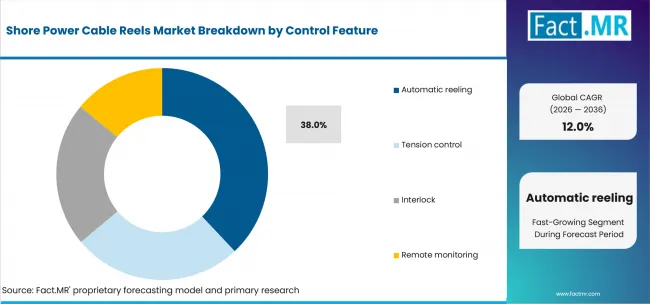
Shore Power Cable Reels Market Analysis By Control Feature | Source: Fact.MR
Automatic reeling is expected to account for 38.0% share in 2026 because it improves operational safety and reduces manual cable handling. Automated movement also shortens vessel connection time. Tension control protects power cables. Interlock functions improve operating safety. Remote monitoring supports maintenance planning.
Which buyer type dominates?
Ports lead with 40.0% share in 2026.
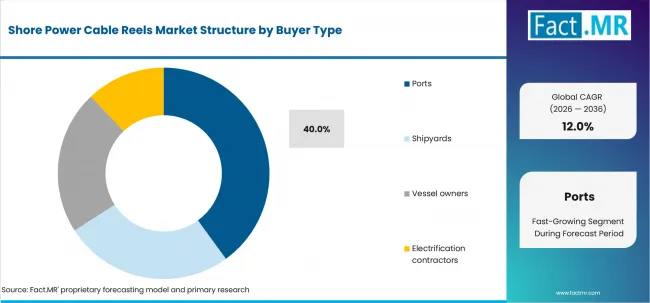
Shore Power Cable Reels Market Analysis By Buyer Type | Source: Fact.MR
Ports remain the largest customer group because they finance shore power infrastructure across commercial terminals. The segment is expected to account for 40.0% share in 2026. Shipyards install cable reels during vessel construction. Vessel owners upgrade fleets to meet environmental standards. Electrification contractors manage installation projects. Cavotec received a USD 5.7 million contract from a major European shipping line to retrofit container vessels with shore power solutions, including cable management systems and switchboard modifications. Deliveries were scheduled throughout 2024. [4]
Which region dominates?
Europe holds 39.0% share in 2026.
Europe leads because environmental regulations continue encouraging shore power deployment across commercial ports. The region is expected to account for 39.0% share in 2026. North America expands through infrastructure funding. East Asia strengthens demand through coastal electrification. South Asia gains momentum as new port projects include cleaner energy systems.
What is accelerating Shore Power Cable Reels Market and what is holding back?
Port electrification supports market growth while high installation costs slow adoption.
Shore Power Cable Reels Market Drivers, Restraints, and Opportunities
Drivers Impact Analysis
| DRIVER | (~) % IMPACT ON CAGR | GEOGRAPHIC RELEVANCE | IMPACT TIMELINE |
|---|---|---|---|
| Expansion of shore power infrastructure | +1.0% | Global | Medium term (2-4 years) |
| Stricter emission reduction policies | +0.9% | Europe, North America | Medium term (2-4 years) |
| Rising investment in green ports | +0.8% | Global | Long term (≥4 years) |
| Growth in vessel electrification | +0.6% | Asia Pacific, Europe | Medium term (2-4 years) |
| Automation of port operations | +0.4% | Global | Short term (≤2 years) |
Source: Fact.MR analysis. Updated Jul 6, 2026
- Shore power infrastructure
- Ports are expanding electrical connections to reduce emissions from berthed vessels. Cable reels remain essential for safe power transfer.
- Emission reduction policies
- Environmental regulations encourage operators to replace onboard generators during port stays. Shore power supports cleaner operations.
- Green ports
- Port authorities continue investing in low emission infrastructure. Electrification projects increase demand for cable handling equipment.
- Vessel electrification
- More vessels are being prepared for shore power compatibility. This supports long term equipment demand.
- Port automation
- Automation improves cable handling efficiency and operational safety. Smart control functions also reduce maintenance effort.
Opportunity Impact Analysis
| OPPORTUNITY | (~) % IMPACT ON CAGR | GEOGRAPHIC RELEVANCE | IMPACT TIMELINE |
|---|---|---|---|
| Cruise terminal electrification | +0.8% | Europe, North America | Medium term (2-4 years) |
| Retrofit of existing ports | +0.7% | Global | Medium term (2-4 years) |
| Smart monitoring platforms | +0.5% | Global | Long term (≥4 years) |
| Expansion of offshore shore power | +0.4% | Europe, Asia Pacific | Short term (≤2 years) |
Source: Fact.MR analysis. Updated Jul 6, 2026
- Cruise terminal electrification
- Passenger ports continue replacing conventional power supply with shore connections. Cable reels improve operational efficiency.
- Port retrofits
- Existing terminals increasingly install electrification equipment without major reconstruction. Retrofit demand supports market expansion.
- Smart monitoring
- Remote monitoring improves equipment reliability and maintenance scheduling. Operators gain better visibility into cable performance.
- Offshore applications
- Offshore support vessels are gradually adopting shore power where infrastructure becomes available. This creates additional project opportunities.
Restraints Impact Analysis
| RESTRAINT | (~) % IMPACT ON CAGR | GEOGRAPHIC RELEVANCE | IMPACT TIMELINE |
|---|---|---|---|
| High infrastructure costs | -0.7% | Global | Medium term (2-4 years) |
| Complex retrofit requirements | -0.5% | Older ports | Medium term (2-4 years) |
| Grid capacity limitations | -0.4% | Developing regions | Long term (≥4 years) |
| Long project approval cycles | -0.3% | Public infrastructure | Medium term (2-4 years) |
Source: Fact.MR analysis. Updated Jul 6, 2026
- High infrastructure costs
- Shore power systems require substantial electrical upgrades before cable reels can be installed. This increases project budgets.
- Retrofit requirements
- Older terminals often require structural modification before electrification equipment can be integrated successfully.
- Grid capacity
- Some ports require utility upgrades before supporting large shore power installations. This delays deployment.
- Project approvals
- Large public infrastructure projects often move through lengthy planning and approval stages before installation begins.
Which countries are expanding shore power cable reel deployment fastest?
United States 12.7%; Germany 12.3%; Japan 12.0%; China 11.7%; India 11.3%.
Based on regional analysis, the shore power cable reels market is segmented into North America, Europe, East Asia, South Asia, Latin America and Middle East and Africa.
| Country | CAGR |
|---|---|
| United States | 12.7% |
| Germany | 12.3% |
| Japan | 12.0% |
| China | 11.7% |
| India | 11.3% |
Source: Fact.MR analysis. Updated Jul 6, 2026
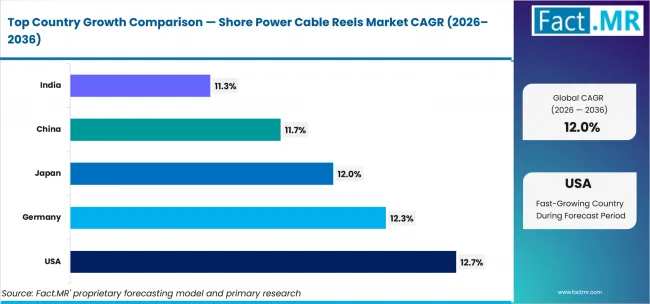
Shore Power Cable Reels Market Cagr Analysis By Country | Source: Fact.MR
What is strengthening demand across the United States?
12.7% CAGR, supported by cleaner port operations and vessel electrification.
The United States is projected to record 12.7% CAGR from 2026 to 2036 as major ports continue replacing diesel powered berth operations with shore supplied electricity. Infrastructure funding supports new shore connection projects across commercial terminals. Cruise facilities and container ports are giving greater priority to emission reduction. Suppliers with reliable cable handling technology are expected to benefit from long term investment.
Why is Germany building market momentum?
12.3% CAGR, driven by environmental compliance and port modernization.
Germany is expected to achieve 12.3% CAGR through 2036 because ports continue expanding shore connection infrastructure across busy waterfronts. Electrification projects are becoming part of broader terminal modernization plans. Reliable cable management equipment remains essential for dependable daily operation.
What supports market expansion in Japan?
12.0% CAGR, encouraged by efficient harbor infrastructure.
Japan is likely to register 12.0% CAGR as ports improve electrical infrastructure for commercial shipping. Operators continue investing in technologies that reduce connection time and improve operational safety. Compact equipment designs remain attractive where available installation space is limited.
Why does China remain a significant market?
11.7% CAGR, supported by coastal port upgrades.
China is forecast to expand at 11.7% CAGR through 2036 as coastal ports increase investment in cleaner marine infrastructure. Growing vessel traffic encourages wider deployment of shore power facilities. New terminal construction also creates opportunities for integrated cable reel systems.
How is India creating future demand?
11.3% CAGR, driven by green port development.
India is expected to record 11.3% CAGR by 2036 as commercial ports gradually strengthen electrification capability. Infrastructure projects continue improving environmental performance across major shipping hubs. New installations are expected to support long term equipment demand.
Who leads the shore power cable reels market?
Engineering capability and electrification experience shape competition across the market.
The market includes manufacturers with expertise in electrical infrastructure, cable management and marine automation. Cavotec has established a strong position through dedicated shore power equipment used across commercial ports. Conductix-Wampfler remains an important supplier with motorized cable reel technology developed for demanding industrial environments.
Stemmann-Technik supports the market through specialized shore connection equipment backed by Wabtec engineering resources. ABB and Schneider Electric contribute complete electrification solutions that integrate cable handling with power management systems. igus provides cable guidance technology that improves durability in continuous motion applications.
Customers increasingly evaluate long term service support alongside equipment performance. Installation flexibility, maintenance access and compatibility with future port expansion plans have become important purchasing factors. Suppliers able to deliver complete project support from design to commissioning are expected to remain competitive.
Which companies are the key providers?
Cavotec and Conductix-Wampfler are leading providers. Stemmann-Technik and ABB remain established participants. Schneider Electric, igus and Wabtec complete the competitive landscape.
- Cavotec
- igus
- Stemmann-Technik
- Conductix-Wampfler
- Wabtec
- Schneider Electric
- ABB
Bibliography
- [1] Container News. (2026, June 26). Cavotec secures shore power order for Southern California cruise terminal.
- [2] Conductix-Wampfler. (2025). APM Terminals and Conductix-Wampfler sign third collaboration agreement.
- [3] Cavotec. (2025). Cavotec signs EUR 8.1 million shore power order with leading global container shipping company. Mynewsdesk.
- [4] Cavotec. (2024). Cavotec receives shore power retrofit order from major European shipping line worth USD 5.7 million. Mynewsdesk.
This Report Address
- Strategic assessment of shore power cable reels across marine electrification and port infrastructure.
- Segment evaluation covering Medium Voltage Systems and Cruise Ships.
- Country outlook for the United States, Germany, Japan, China and India.
- Competitive review of Cavotec, igus, Stemmann-Technik, Conductix-Wampfler, Wabtec, Schneider Electric and ABB.
- Technology review covering automatic reeling, tension control, remote monitoring, interlock functions and high capacity cable handling.
- Operational assessment covering cruise terminals, ferry ports, container terminals, harbor operations and offshore vessel electrification.
- Market estimates supported by engineering studies, infrastructure tracking and industry interviews.
What does the shore power cable reels market cover?
Cable management systems designed for shore to ship electrical connections.
The market includes low voltage, medium voltage and high voltage shore connection cable reels. It also covers ship mounted systems, quay mounted installations, mobile reels, containerized reels and crane mounted equipment.
The study focuses on cable reel systems used with shore power infrastructure. Standard industrial cable reels and non marine cable handling equipment are outside the market scope.
What is included in the scope?
Cable reel equipment developed for marine electrification.
The assessment includes automatic reeling systems, tension control, interlock functions and remote monitoring features. It also covers installations supplied to ports, shipyards, vessel owners and electrification contractors.
Applications include cruise ships, ferries, container vessels, harbor craft and offshore vessels operating with shore power connections.
What is excluded from the scope?
General electrical equipment without cable reel functionality is excluded.
The study excludes onboard generators, marine switchboards, power converters and charging systems that do not include dedicated cable reel assemblies. Conventional industrial cable management products are also outside the scope.
How was the analysis built?
108+ sources, 41+ company portfolios, 29+ countries, 23+ interviews.
- Primary Research: Port engineers, shipyard managers, electrification specialists and equipment manufacturers provided technical and commercial insights. Utility consultants and marine project developers also contributed industry perspectives.
- Desk Research: The study reviewed company publications, port electrification programs, engineering standards and maritime sustainability initiatives. Product launches and infrastructure announcements supported market assessment.
- Market Sizing and Forecasting: Estimates were developed using port electrification spending, vessel retrofit activity, shore power installations and equipment replacement trends across major maritime regions.
- Data Validation and Update Cycle: Forecasts were verified through supplier discussions, infrastructure tracking and expert review. Project pipelines and procurement activity supported the final market estimates.
Segmentation
What is the report's scope and coverage?
| Attribute | Details |
|---|---|
| Quantitative Units | USD million |
| Market Definition | Cable reel systems used for shore to ship electrical power connections |
| Voltage Class | Low voltage; medium voltage; high voltage shore connection |
| Mounting | Ship-mounted; quay-mounted; mobile reel; containerized reel; crane-mounted |
| End Vessel | Cruise ships; ferries; container vessels; harbor craft; offshore vessels |
| Control Feature | Automatic reeling; tension control; interlock; remote monitoring |
| Buyer Type | Ports; shipyards; vessel owners; electrification contractors |
| Regions Covered | North America; Europe; East Asia; South Asia; Latin America; Middle East and Africa |
| Countries Covered | United States; Germany; Japan; China; India |
| Key Companies Profiled | Cavotec; igus; Stemmann-Technik; Conductix-Wampfler; Wabtec; Schneider Electric; ABB |
| Forecast Period | 2026 to 2036 |
| Approach | Hybrid top down and bottom up approach using port electrification projects, vessel retrofit activity, infrastructure spending and expert validation |
Source: Fact.MR analysis. Updated Jul 6, 2026
How is the market segmented?
-
By Voltage Class:
- Low voltage
- Medium voltage
- High voltage shore connection
-
By Mounting:
- Ship-mounted
- Quay-mounted
- Mobile reel
- Containerized reel
- Crane-mounted
-
By End Vessel:
- Cruise ships
- Ferries
- Container vessels
- Harbor craft
- Offshore vessels
-
By Control Feature:
- Automatic reeling
- Tension control
- Interlock
- Remote monitoring
-
By Buyer Type:
- Ports
- Shipyards
- Vessel owners
- Electrification contractors
-
Region:
- North America
- United States
- Canada
- Europe
- Germany
- United Kingdom
- France
- Italy
- Spain
- Asia Pacific
- China
- Japan
- South Korea
- India
- Singapore
- Latin America
- Brazil
- Mexico
- Argentina
- Middle East & Africa
- GCC Countries
- South Africa
- Israel
- North America
Frequently Asked Questions
Which voltage class leads the Shore Power Cable Reels Market?
Which mounting type leads the Shore Power Cable Reels Market?
Which end vessel leads the Shore Power Cable Reels Market?
Which control feature leads the Shore Power Cable Reels Market?
Which buyer type leads the Shore Power Cable Reels Market?
Which region leads the Shore Power Cable Reels Market?
Which country expands fastest in the Shore Power Cable Reels Market?
How does Germany perform in the Shore Power Cable Reels Market?
Who worked on this report


Preview the report firsthand - request a free sample
Free SampleGet the brochure for pricing and purchase details
Download PDF