- Market Value (2025): USD 305.2 Mn
- Estimated Value (2026): USD 325.0 Mn
- Forecast Value (2036): USD 610.0 Mn
- CAGR (2026-2036): 6.5%
What is the Silane Metal Pretreatments Market forecast to be worth by 2036?
USD 325.0 million in 2026 to USD 610.0 million by 2036, a 6.5% CAGR.
- The market surpassed USD 305.2 million in 2025. Metal finishing companies are continuing to test and approve new silane treatments.
- Demand is projected to rise from USD 325.0 million in 2026 to USD 610.0 million by 2036. Aluminum parts and amino silane products are expected to see wider use in metal treatment.
- The market is forecast to record 6.5% CAGR. Companies are looking for treatments that work on existing production lines, improve coating strength, and pass corrosion tests.
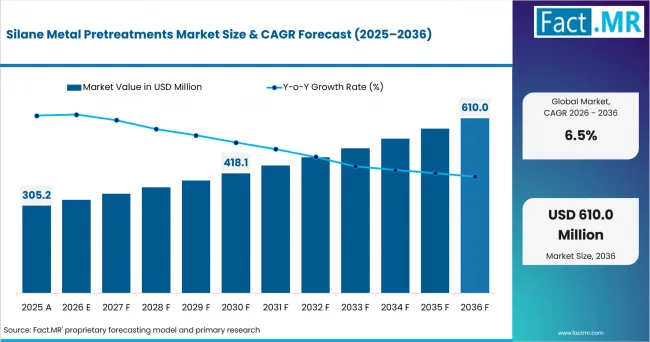
Silane Metal Pretreatments Market Value Analysis | Source: Fact.MR
What are the defining numbers behind Silane Metal Pretreatments Market growth?
USD 285.0 million in absolute opportunity through 2036.
- Demand Drivers in the Market
- Aluminum parts need proper surface treatment before coating. The new product must fit the current line and give a clean, even finish without adding extra steps.
- Amino silane does not perform the same way on every metal. Each product needs testing with the actual coating process before it receives approval.
- Daily handling also affects product choice. Plants prefer materials that are easier to manage and do not create extra concerns around acid use or worker safety.
- Dip treatment gains more attention when it helps lower rework, reduce waste, or improve production speed. Clear factory results make approval easier.
- Powder coating must remain smooth and strong after pretreatment. Acid use, rinse water, and final coating quality are all checked before the treatment is used on a wider scale.
- Key Segments Analyzed
- By Metal Type: Aluminum is expected to hold 35% share in 2026 due to its wide use in parts that need strong coating hold and protection against rust.
- By Chemistry: Amino silane is projected to account for 30% share in 2026 because it works well in many metal treatment steps and can deliver steady results during factory use.
- By Application: Automotive is anticipated to capture 29% share in 2026 supported by regular use in vehicle parts that need reliable coating performance.
- By Process: Dip is estimated to represent 33% share in 2026 owing to its simple use, easy control, and limited changes to existing production lines.
- By Coating System: Powder coating is forecast to account for 33% share in 2026 driven by its use in metal parts that need a smooth finish and long-lasting surface protection.
- Analyst Opinion at Fact.MR
- Shambhu Nath Jha, Senior Analyst at Fact.MR, states, “Automotive companies give preference to pretreatment products that perform well during regular production and do not create extra work on the line. Strong coating results, clear records, and quick help during testing can make approval easier. Long-term use depends on whether the product continues to give the same result from one batch to the next.”
- Strategic Implications
- Aluminum treatments should be tested on the actual production line. A direct comparison with the current product gives a clearer view of coating quality and surface performance.
- Before replacing an approved product, plants should test both options under the same conditions. This makes it easier to see whether any change comes from the new treatment or another part of the process.
- Safety records should be prepared before product testing begins. Clear information on worker safety, acid use, and chromium-free options can prevent delays during approval.
Germany is anticipated to expand at a 7.5% CAGR by 2036. Brazil is forecast to register a 6.8% CAGR over the same period. The United States is expected to post a 6.2% CAGR through 2036.
How does the Silane Metal Pretreatments Market break down by segment?
Aluminum leads with 35% share by metal type, while amino silane holds 30% share in chemistry.
What leads the Metal Type segment?
Aluminum holds 35% share in 2026.
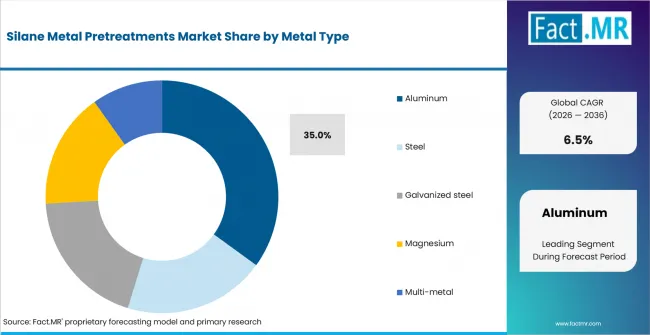
Silane Metal Pretreatments Market Analysis By Metal Type | Source: Fact.MR
Aluminum leads because it is widely used in parts that need a clean surface and strong coating performance. Companies often start with a small test to check whether the treatment works well without changing the full production process. Wider use usually follows only after the finished parts show steady corrosion protection and coating strength.
Steel, galvanized steel, magnesium, and multi-metal make up the rest of the segment. Each metal reacts differently during treatment, so the same product cannot be approved for every surface without testing. Cost, handling, and final coating needs also vary from one metal to another.
How does Chemistry shape demand?
Amino silane accounts for 30% share in 2026.
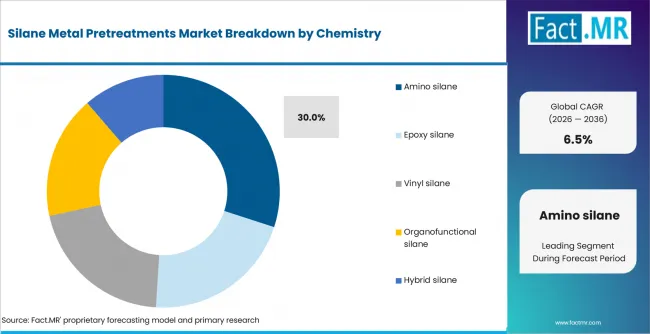
Silane Metal Pretreatments Market Analysis By Chemistry | Source: Fact.MR
Its use depends on how well it performs during daily production. Metal finishing companies look at storage life, mixing, bath condition, and the final coating result before using it on a larger scale. Simple product instructions are also useful because the treatment is handled by both technical staff and line workers.
Other options include epoxy silane, vinyl silane, organofunctional silane, and hybrid silane. The choice changes with the type of metal, the coating applied later, the cost of the product, and the way it is handled in the plant. Each option needs separate testing before regular use.
Where is Application demand strongest?
Automotive leads with 29% share in 2026.
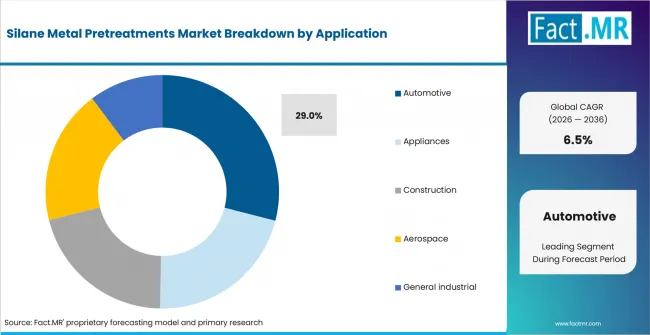
Silane Metal Pretreatments Market Analysis By Application | Source: Fact.MR
Vehicle makers use pretreatment products to help coatings stick better and protect metal parts from rust. New products are usually tested on a small number of parts first. Wider use follows only when the results remain steady and the change does not cause problems elsewhere on the production line. Automotive also contributes a large part of the USD 285.0 million growth opportunity through 2036.
Appliances, construction, aerospace, and general industrial uses make up the rest of the segment. Each area has different needs for cost, handling, coating strength, and rust protection. The product must be tested for the actual use before it is approved.
What supports Process adoption?
Dip treatment holds 33% share in 2026.
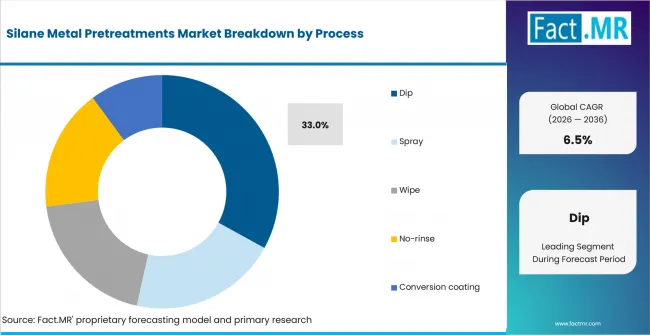
Silane Metal Pretreatments Market Analysis By Process | Source: Fact.MR
This method remains common because it is easy to add to an existing production line. Companies also look at whether it helps lower rework and reduce operating costs. Before using it on a wider scale, they check whether the treatment gives the same result after storage and during regular production.
Spray, wipe, no-rinse, and conversion coating make up the rest of the segment. The right method depends on how the treatment is applied and where it fits in the production process. Each option needs separate testing to confirm that the metal surface is ready for the next coating step.
Which Coating System dominates?
Powder coating accounts for 33% share in 2026.
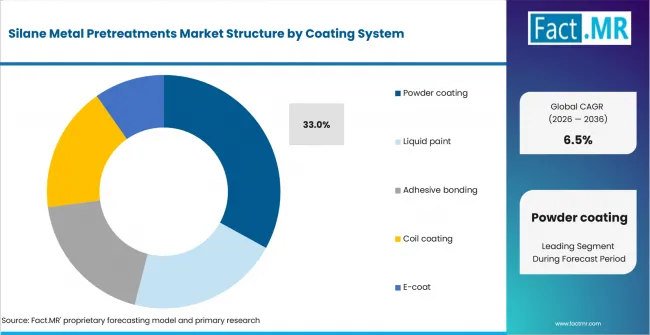
Silane Metal Pretreatments Market Analysis By Coating System | Source: Fact.MR
Companies often choose this option when they want better surface protection without changing the whole production setup. Tests focus on the finished metal part, including coating strength, surface quality, and resistance to rust. Use increases after the same results are seen across regular production runs. Other coating systems include liquid paint, adhesive bonding, coil coating, and e-coat. Each one works differently, so the surface treatment must match the coating applied later in the process.
What is accelerating Silane Metal Pretreatments Market adoption, and what is holding it back?
Worker safety concerns support demand. High testing costs and production changes slow approval. Growth improves when products pass corrosion tests and vehicle checks. Clear records and quick technical help also support wider use.
Drivers Impact Analysis
| DRIVER | (~) % IMPACT ON CAGR | GEOGRAPHIC RELEVANCE | IMPACT TIMELINE |
|---|---|---|---|
| Worker exposure control in Aluminum | +0.8% | China and export suppliers | Medium term (2-4 years) |
| Corrosion control testing | +0.6% | Europe and North America | Short term (<= 2 years) |
| Automotive pretreatment approval programs | +0.5% | Asia Pacific | Medium term (2-4 years) |
| Local support near maintenance teams | +0.4% | Global | Long term (>= 4 years) |
Source: Fact.MR analysis. Updated Jul 16, 2026
- Worker safety in aluminum treatment: Companies check whether the product lowers contact with harmful chemicals during regular use. This adds 0.8% to CAGR in China and export markets over 2–4 years.
- Corrosion testing: Test results show whether the treatment protects metal parts for the required period. This adds 0.6% to CAGR in Europe and North America within 2 years.
- Automotive pretreatment approvals: Vehicle makers test new treatments before using them across more production lines. These programs add 0.5% to CAGR in Asia Pacific over 2-4 years.
- Local technical support: Nearby technical staff can help fix production problems and support product approval. This adds 0.4% to CAGR worldwide over 4 years or more.
Opportunity Impact Analysis
| OPPORTUNITY | (~) % IMPACT ON CAGR | GEOGRAPHIC RELEVANCE | IMPACT TIMELINE |
|---|---|---|---|
| Grades tuned for Automotive pretreatment | +0.5% | Global | Medium term (2-4 years) |
| Application labs for Amino silane | +0.4% | Asia Pacific and Europe | Short term (<= 2 years) |
| Rule-ready documentation | +0.4% | Europe and United Kingdom | Medium term (2-4 years) |
| Local trials with plant safety leads | +0.3% | Brazil | Long term (>= 4 years) |
Source: Fact.MR analysis. Updated Jul 16, 2026
- Automotive pretreatment products: Products made for vehicle parts add 0.5% to CAGR worldwide over 2–4 years. The opportunity improves when factory tests give the same result as early lab tests.
- Amino silane testing centers: Testing centers add 0.4% to CAGR in Asia Pacific and Europe within 2 years. Their value increases when the product works well without extra handling.
- Clear approval records: Proper test records add 0.4% to CAGR in Europe and the United Kingdom over 2–4 years. Companies need simple records they can use during their own checks.
- Local safety trials: Factory trials add 0.3% to CAGR in India and Brazil over 4 years or more. This opportunity grows when companies receive results they can confirm on their own production lines.
Restraints Impact Analysis
| RESTRAINT | (~) % IMPACT ON CAGR | GEOGRAPHIC RELEVANCE | IMPACT TIMELINE |
|---|---|---|---|
| Qualification cost | -0.4% | Global processors | Medium term (2-4 years) |
| Fit limits in Amino silane | -0.3% | Global | Short term (<= 2 years) |
| Documentation burden | -0.3% | Europe and North America | Medium term (2-4 years) |
| Scale-up risk | -0.2% | High-volume plants | Long term (>= 4 years) |
Source: Fact.MR analysis. Updated Jul 16, 2026
- High testing cost: Testing and approval reduce CAGR by 0.4% worldwide over 2–4 years. Many plants delay product changes until enough budget and production time are available.
- Amino silane fit: Poor product fit lowers CAGR by 0.3% worldwide within 2 years. Rework can occur when the treatment does not match the metal type or coating method.
- More approval records: Record requirements reduce CAGR by 0.3% in Europe and North America over 2–4 years. Safety details, test steps, and coating results are needed before wider use.
- Problems during wider use: Moving from a small test to full production lowers CAGR by 0.2% at large plants over 4 years or more. Plant staff need steady results before expanding use across more production lines.
Which countries are scaling Silane Metal Pretreatments Market fastest?
Germany at 7.5%, Brazil at 6.8%, and the United States at 6.2%. Production activity, sales access, and product testing support the country outlook through 2036.
.webp "Top Country Growth Comparison Silane Metal Pretreatments Market Cagr (2026 2036)")
Top Country Growth Comparison Silane Metal Pretreatments Market Cagr (2026 2036) | Source: Fact.MR
| COUNTRY | CAGR |
|---|---|
| Germany | 7.5% |
| Brazil | 6.8% |
| United States | 6.2% |
Source: Fact.MR analysis. Updated Jul 16, 2026
How is Germany developing demand?
Germany is projected to record at 7.5% CAGR through 2036.
Local production and regular product testing are helping silane treatments reach wider use. Corrosion testing adds 0.6% to CAGR in the short term. Record requirements reduce CAGR by 0.3% over 2–4 years. Clear results and complete documents can make approval easier.
What underpins Brazil's growth?
Brazil is forecast to expand at 6.8% CAGR through 2036.
Local metal plants are testing silane treatments during regular production. Nearby technical help allows staff to review safety, handling, and coating results. It also helps plants fix problems before the product is used on more lines.
What is driving United States' growth through 2036?
The United States is set to post 6.2% CAGR through 2036.
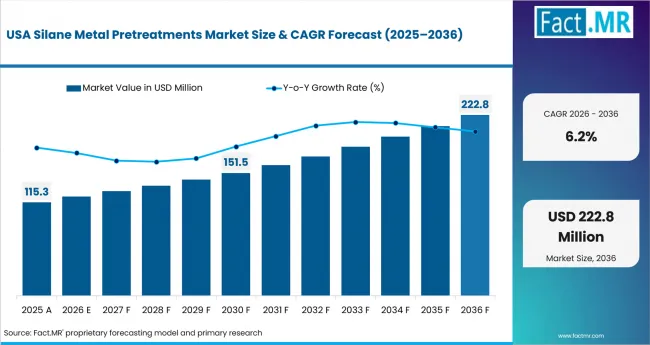
Silane Metal Pretreatments Market Country Value Analysis | Source: Fact.MR
Large metal plants carefully review any change to an approved treatment. Corrosion tests can move the process forward, while incomplete records often cause delays. Products with clear instructions and steady coating results have a better chance of wider use.
Who leads the Silane Metal Pretreatments Market?
Momentive Performance Materials Inc., Evonik, Wacker Chemie AG, Shin-Etsu Chemical Co., Ltd., and Chemetall GmbH form the main company group in this market. Product choice depends on clear test results, steady product supply, and quick help during factory trials.
A wide product range alone is not enough. Each silane treatment must match the metal, the way it is applied, and the coating used afterward. Clear instructions and proper test records help plants compare the new product with the one already in use.
Local help also affects repeat orders. Fast answers during a trial can prevent delays, while complete safety and test documents make review easier. Companies that provide both are better placed to win regular automotive pretreatment business.
Which companies are the key providers?
Momentive Performance Materials Inc. and Evonik are key providers. Wacker Chemie AG is also profiled. Shin-Etsu Chemical Co., Ltd. and Chemetall GmbH complete the company set.
- Momentive Performance Materials Inc.
- Evonik
- Wacker Chemie AG
- Shin-Etsu Chemical Co., Ltd.
- Chemetall GmbH
Bibliography
- Department of Chemicals and Petrochemicals. (2026, February 6). Annual report 2025–26. Ministry of Chemicals and Fertilizers, Government of India.
- Federal Statistical Office of Germany. (2026, February 5). New orders in manufacturing in December 2025: 7.8% on the previous month.
- Instituto Brasileiro de Geografia e Estatística. (2026, June 3). Brazilian industrial production changed 0.7% in April.
- National Bureau of Statistics of China. (2026, February 28). Statistical communiqué of the People’s Republic of China on the 2025 national economic and social development.
This Report Addresses
- Review of Metal Type and Chemistry, with Aluminum and Amino silane leading their segments in 2026.
- Analysis of five options under Metal Type, Chemistry, Application, Process, and Coating System.
- Country outlook covering China, India, Germany, Brazil, and the United States.
- Company review of Momentive Performance Materials Inc., Evonik Industries AG, Wacker Chemie AG, Shin-Etsu Chemical Co., Ltd., and Chemetall GmbH.
- Review of Automotive pretreatment and other uses of silane products in metal treatment.
What does the Silane Metal Pretreatments Market cover?
Aluminum, amino silane, and automotive pretreatment products used before metal coating.
The Silane Metal Pretreatments Market covers products applied to metal surfaces before coating. These treatments help the coating stick better and protect the metal from rust. Coverage also includes other metal types, silane products, uses, application methods, and coating systems listed in the report.
The market does not include every chemical that contains silane. A product is counted only when it is sold for metal pretreatment before coating. General coating chemicals and unrelated silane products stay outside the market.
What is included in the scope?
Silane-based pretreatment products used on metal surfaces before coating.
The scope includes treatments for aluminum, steel, galvanized steel, magnesium, and multi-metal parts. It also covers the listed Chemistry, Application, Process, and Coating System options. Products are included when their main purpose is to help coatings stick better and protect metal from rust.
Sales from approved products, repeat orders, and related technical help are also covered. These services are counted only when they are directly linked to testing, approval, and regular use of the treatment.
What is excluded from the scope?
Equipment and chemicals that do not perform the defined metal pretreatment role are outside the scope.
The scope excludes equipment sold for use on metal treatment lines. General chemicals are also excluded unless they are sold to improve coating hold and protect metal from rust before coating. Materials used only for cleaning or coating control are not counted unless they perform the stated pretreatment function.
How was the analysis built?
120+ sources, 40+ company portfolios, 25+ countries, 20+ interviews.
- Primary Research: Primary research includes discussions with manufacturers, service providers, technology developers, distributors, end users, procurement teams, and subject-matter experts. These conversations examine purchasing priorities, product adoption, operational challenges, approval requirements, competitive positioning, and the factors that influence wider market acceptance.
- Desk Research: Desk research covers government statistics, regulatory publications, company filings, trade data, technical studies, industry associations, standards, public policy, and other authoritative sources. Every source used in the analysis is documented in the bibliography.
- Market Sizing and Forecasting: Market estimates combine historical performance, demand indicators, pricing and volume trends, segment shares, company participation, country-level growth, adoption patterns, investment activity, and barriers to market expansion.
- Data Validation and Update Cycle: Findings are validated by comparing primary interviews with public data, company activity, regulatory changes, trade patterns, and industry developments. Regular updates review new product launches, capacity changes, partnerships, approvals, procurement trends, and shifts in commercial adoption.
Segmentation
What is the report's scope and coverage?
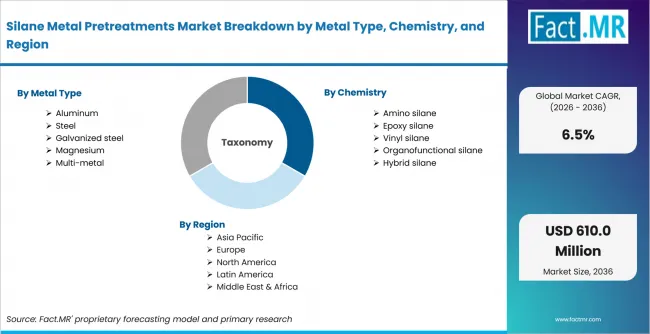
Silane Metal Pretreatments Market Breakdown By Metal Type, Chemistry, And Region | Source: Fact.MR
| Attribute | Details |
|---|---|
| Quantitative Units | USD Million in 2026 to USD Million by 2036 at CAGR |
| Market Definition | Silane-based pretreatment chemicals used to improve adhesion and corrosion resistance on metal surfaces before coating. |
| Metal Type | Aluminum, Steel, Galvanized steel, Magnesium, Multi-metal |
| Chemistry | Amino silane, Epoxy silane, Vinyl silane, Organofunctional silane, Hybrid silane |
| Application | Automotive, Appliances, Construction, Aerospace, General industrial |
| Process | Dip, Spray, Wipe, No-rinse, Conversion coating |
| Coating System | Powder coating, Liquid paint, Adhesive bonding, Coil coating, E-coat |
| Regions Covered | North America, Europe, Asia Pacific, Central and South America, Middle East and Africa |
| Countries Covered | Germany, Brazil, United States |
| Key Companies Profiled | Momentive Performance Materials Inc., Evonik, Wacker Chemie AG, Shin-Etsu Chemical Co., Ltd., Chemetall GmbH |
| Forecast Period | 2026 to 2036 |
| Approach | Hybrid top-down and bottom-up approach using Silane Coupling Agents / Metal Pretreatment Chemicals, segment shares, country growth,and technical validation |
Source: Fact.MR analysis. Updated Jul 16, 2026
How is the market segmented?
-
By Metal Type:
- Aluminum
- Steel
- Galvanized steel
- Magnesium
- Multi-metal
-
By Chemistry:
- Amino silane
- Epoxy silane
- Vinyl silane
- Organofunctional silane
- Hybrid silane
-
By Application:
- Automotive
- Appliances
- Construction
- Aerospace
- General industrial
-
By Process:
- Dip
- Spray
- Wipe
- No-rinse
- Conversion coating
-
By Coating System:
- Powder coating
- Liquid paint
- Adhesive bonding
- Coil coating
- E-coat
-
By Region:
- North America
- United States
- Canada
- Europe
- Germany
- United Kingdom
- France
- Italy
- Spain
- Asia Pacific
- India
- China
- Japan
- South Korea
- Australia
- Central & South America
- Brazil
- Argentina
- Mexico
- Chile
- Middle East & Africa
- UAE
- Saudi Arabia
- South Africa
- North America
Frequently Asked Questions
Which Metal Type leads the Silane Metal Pretreatments Market?
Which Chemistry leads the Silane Metal Pretreatments Market?
Which Application leads the Silane Metal Pretreatments Market?
Which Process leads the Silane Metal Pretreatments Market?
Which Coating System leads the Silane Metal Pretreatments Market?
What is the primary driver in the Silane Metal Pretreatments Market?
What is the main restraint in the Silane Metal Pretreatments Market?
Why do buyers continue testing Silane Metal Pretreatments Market?
Who worked on this report


Preview the report firsthand - request a free sample
Free SampleGet the brochure for pricing and purchase details
Download PDF