- Market Value (2025): USD 81.6 Mn
- Estimated Value (2026): USD 100.0 Mn
- Forecast Value (2036): USD 760.0 Mn
- CAGR (2026-2036): 22.5%
What is the Silicon Anode Elastomers Market forecast to be worth by 2036?
USD 100.0 million in 2026, USD 760.0 million by 2036, at a 22.5% CAGR.
- The silicon anode elastomers market reached USD 81.6 million in 2025 as cell developers expanded qualification work for silicon-containing anodes.
- Demand is projected to increase from USD 100.0 million in 2026 to USD 760.0 million by 2036.
- Growth is forecast to average a 22.5% CAGR from 2026 to 2036 as electrode teams address swelling, cracking, adhesion loss, and repeat-cycle durability.
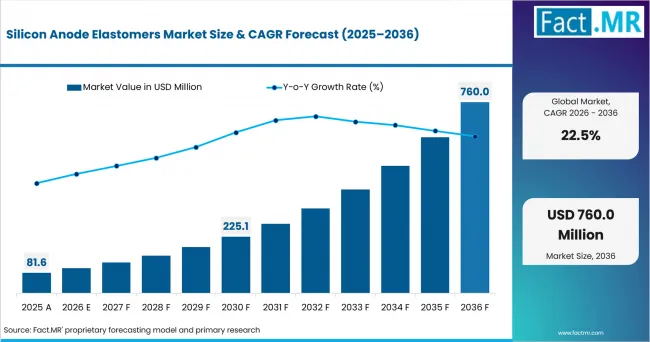
Silicon Anode Elastomers Market Market Value Analysis | Source: Fact.MR
What are the defining numbers behind Silicon Anode Elastomers Market growth?
USD 660.0 million in absolute opportunity is expected through 2036.
- Demand Drivers in the Market
- Electrode engineers need binders that preserve particle contact and copper-foil adhesion after repeated silicon expansion and contraction.
- Water-based processing keeps SBR under review where plants seek stable slurry behavior without introducing a new solvent-recovery step.
- Electric-vehicle cell programs require proof across peel strength, electrode thickness, impedance, and capacity retention at realistic silicon loading.
- Nearby application support shortens failure analysis when coating speed, drying temperature, calendaring pressure, or formation settings change trial results.
- Key Segments Analyzed
- By Polymer Type: SBR is expected to hold 33% share in 2026, supported by water-based handling and established anode-processing experience.
- By Anode Type: Silicon-graphite is projected to account for 61% share in 2026 as it preserves part of the conventional graphite framework.
- By Function: Volume expansion control is anticipated to capture 35% share in 2026, reflecting the mechanical strain created by silicon swelling.
- By Battery Application: EV is estimated to represent 29% share in 2026 owing to high loading, fast-charge, warranty, and pack-safety requirements.
- By Sales Route: Direct to cell makers is forecast to account for 37% share in 2026, given the confidential recipes and shared trial data involved in approval.
- Analyst Opinion at Fact.MR
- Shambhu Nath Jha, Senior Analyst at Fact.MR, states, “Silicon anode elastomers are evaluated as part of an electrode system, not as stand-alone polymers. Adoption is expected to favor grades that hold adhesion after repeated swelling and remain stable during coating, drying, and formation. Commercial progress is projected to depend on application support as much as polymer chemistry.”
- Strategic Implications
- Binder manufacturers should test each grade at a defined silicon-to-graphite ratio, electrode loading, drying profile, and cycle target before presenting performance claims.
- Cell makers should compare peel strength, thickness growth, impedance, and capacity retention before replacing an approved binder in a production recipe.
- Anode material producers should co-test polymers against particle size, surface treatment, and silicon content, since one formulation rarely transfers unchanged across active materials.
- Regional commercial teams should pair sample supply with local troubleshooting so pilot-line failures receive a documented response before the next production trial.
Commercial approval improves when the binder and active material are tested as one formulation. Cell engineers need evidence at realistic temperatures, coating weights, and cycling conditions before moving a grade into repeat supply. The test plan should state the silicon-to-graphite ratio, electrode density, drying profile, and formation protocol so results can be reproduced. This keeps the evidence comparable across silicon-graphite and high-silicon anodes while recognizing that each recipe needs separate validation.
China is projected to record a 30.4% CAGR through 2036 as its large battery-cell production base shortens trial cycles. India is expected to post a 28.1% CAGR as domestic advanced-chemistry cell projects move forward. Germany is anticipated to advance at 25.9% CAGR through its automotive testing base, while Brazil is estimated at 23.6% CAGR as electrified-vehicle demand broadens. The USA is forecast to post 21.4% CAGR as silicon-anode production approaches commercial scale.
How does the Silicon Anode Elastomers Market break down by segment?
SBR leads with 33%, while silicon-graphite accounts for 61%.
Which Polymer Type dominates?
SBR is expected to hold 33% share in 2026.
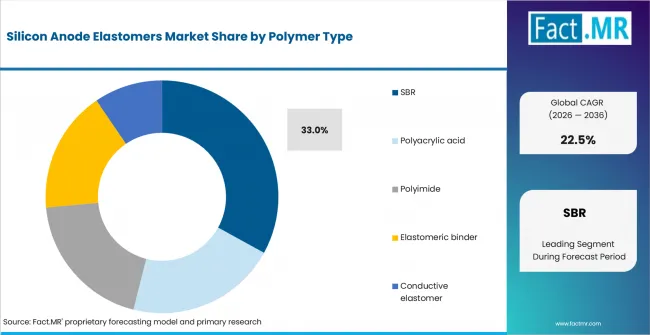
Silicon Anode Elastomers Market Analysis By Polymer Type | Source: Fact.MR
Water-based latex systems keep SBR at the front of early qualification by fitting established anode-slurry equipment and allowing formulators to tune elasticity. Electrode teams often pair the polymer with cellulose-based thickeners to balance coating stability and adhesion. Polyacrylic acid offers stronger interaction with silicon surfaces, while polyimide supports higher-temperature designs. Elastomeric binders and conductive elastomers remain under review where recovery, electrical contact, or lower binder loading carries more weight than process familiarity.
What leads the Anode Type segment?
Silicon-graphite is projected to account for 61% share in 2026.
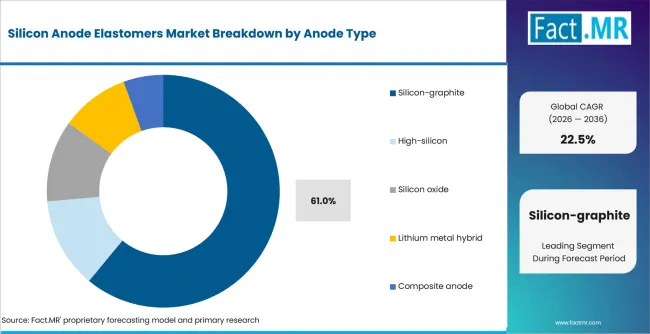
Silicon Anode Elastomers Market Analysis By Anode Type | Source: Fact.MR
Blending silicon with graphite offers a staged route beyond conventional graphite without forcing an immediate move to a high-silicon electrode. The familiar graphite framework lowers the qualification burden and gives engineers more control over first-cycle loss. Silicon content is expected to rise gradually as coating and formation data improve. Silicon oxide, lithium metal hybrid, and composite anode formats offer different energy-density paths, yet each places tighter demands on expansion recovery and interface stability.
How does Function shape demand?
Volume expansion control is anticipated to lead with 35% share in 2026.
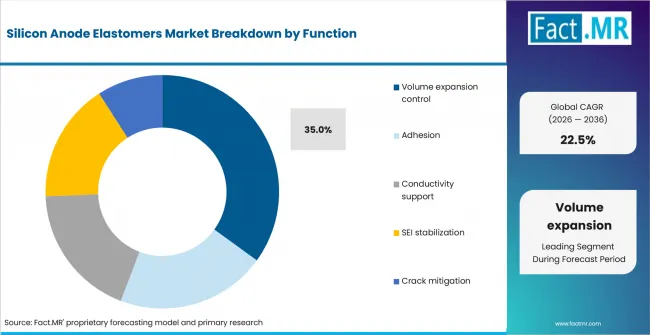
Silicon Anode Elastomers Market Analysis By Function | Source: Fact.MR
Repeated lithiation and delithiation place direct strain on the polymer network, which keeps volume expansion control at the center of qualification. A suitable elastomer stretches with the active material and recovers without losing contact with the current collector. Adhesion, conductivity support, SEI stabilization, and crack mitigation remain linked to the same cycling problem. Expansion control offers the clearest test route through thickness change, peel strength, capacity retention, and post-cycle electrode inspection.
What supports EV within Battery Application?
EV is estimated to hold 29% share in 2026.
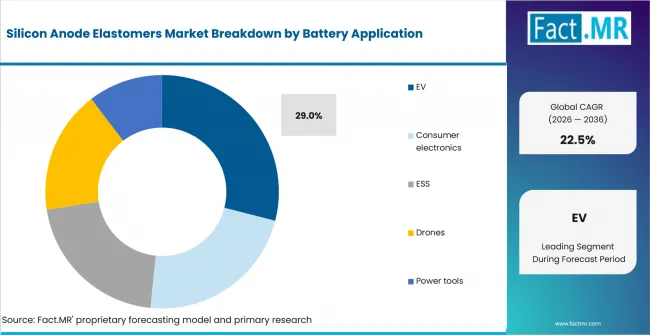
Silicon Anode Elastomers Market Analysis By Battery Application | Source: Fact.MR
Traction-cell programs combine high electrode loading with demanding warranty and fast-charge targets, giving EV applications the broadest commercial test case. Program teams also require clear evidence on gas generation, impedance, calendar aging, and pack safety. The International Energy Agency reported in May 2026 that EV battery deployment reached around 1.2 TWh in 2025. Consumer electronics and drones offer narrower entry routes, while ESS and power tools emphasize cycle life, power delivery, and operating stability.
What leads the Sales Route segment?
Direct to cell makers is forecast to hold 37% share in 2026.
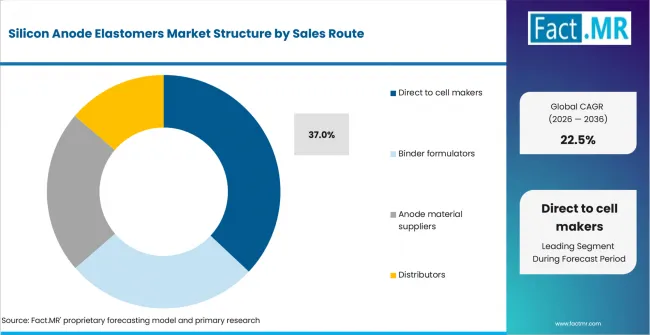
Silicon Anode Elastomers Market Analysis By Sales Route | Source: Fact.MR
Cell makers retain the lead in purchasing decisions as approval is tied closely to each confidential electrode recipe. Polymer producers need access to silicon content, slurry solids, coating speed, drying temperature, calendaring pressure, and formation results before recommending a grade. Direct engagement also speeds failure analysis when pilot data changes on a plant line. Binder formulators, anode material suppliers, and distributors remain useful for regional access, but the cell maker carries the qualification and warranty exposure.
What is accelerating Silicon Anode Elastomers Market adoption, and what is holding it back?
Mechanical recovery and water-based processing are anticipated to accelerate adoption, whereas qualification cost, recipe-specific performance, and pilot-to-line variation are expected to slow commercial conversion.
Drivers Impact Analysis
| DRIVER | (~) % IMPACT ON CAGR | GEOGRAPHIC RELEVANCE | IMPACT TIMELINE |
|---|---|---|---|
| Silicon expansion and adhesion retention | +0.8% | East Asia and export cell plants | Medium term (2-4 years) |
| Water-based anode processing | +0.7% | Western Europe and North America | Medium term (2-4 years) |
| EV battery deployment and high-energy cell programs | +0.5% | China, Germany, and USA | Medium term (2-4 years) |
| Battery durability and thermal review | +0.4% | Western Europe and North America | Short term (up to 2 years) |
| Technical support near cell plants | +0.3% | India, Brazil, and East Asia | Long term (above 4 years) |
Source: Fact.MR analysis. Updated Jul 13, 2026
- Expansion recovery: Silicon particles place repeated mechanical strain on the polymer network and copper interface. Electrode teams compare peel strength, thickness growth, and capacity retention before approving a grade. Demand is expected to expand where the binder preserves contact without adding excess impedance or coating defects.
- Water-based processing: SBR dispersions fit plants that already coat graphite anodes through aqueous systems. Familiar mixing and drying steps reduce the number of process changes needed during early trials. Adoption is projected to move faster where slurry stability remains controlled as silicon loading increases.
- High-energy cell programs: Traction batteries link energy density with fast charging, warranty life, and pack safety. Those requirements place more qualification tests on the binder than a low-loading laboratory electrode. Polymer producers are anticipated to gain ground when their data reflects commercial coating weight and formation conditions.
- Durability review: Battery durability is moving deeper into vehicle approval work and long-term performance documentation. In November 2025, the United Nations Economic Commission for Europe adopted a regulation covering durability requirements for heavy-duty electric-vehicle batteries. Elastomer demand is estimated to benefit where stable electrode structure supports capacity retention and failure analysis.
- Technical proximity: Binder failures often emerge after coating, drying, calendaring, or formation changes that a distant laboratory struggles to reproduce. Local application teams shorten the feedback loop between the plant and polymer producer. Market access is forecast to improve where technical support sits near major cell clusters.
Opportunity Impact Analysis
| OPPORTUNITY | (~) % IMPACT ON CAGR | GEOGRAPHIC RELEVANCE | IMPACT TIMELINE |
|---|---|---|---|
| Silicon-specific water-based grades | +0.5% | Global | Medium term (2-4 years) |
| Binder and active-material co-validation | +0.4% | North America and Western Europe | Short term (up to 2 years) |
| Local application laboratories | +0.4% | East Asia and Western Europe | Medium term (2-4 years) |
| Scale-up supply near cell clusters | +0.3% | China, USA, and India | Long term (above 4 years) |
Source: Fact.MR analysis. Updated Jul 13, 2026
- Silicon-specific grades: Higher silicon loading creates room for water-based binders tuned to larger thickness change and tougher adhesion targets. Opportunity is expected to widen as producers publish data at stated silicon content and electrode density.
- Matched formulation data: Polymer performance changes with particle morphology, surface chemistry, and the graphite-to-silicon ratio. Joint testing between binder and active-material teams gives cell engineers a more complete starting recipe. Commercial acceptance is projected to improve where coating, drying, and cycling results are documented as one system.
- Application laboratories: Customer-like mixing, coating, and cycling equipment helps reproduce failures before another plant trial begins. Nearby laboratories reduce sample delays and make formulation changes easier to track. Demand is anticipated to widen where technical centers support major battery clusters with repeatable test methods.
- Regional scale-up: Qualification lots and troubleshooting move faster when commercial supply is located near the customer. Zeon announced a China joint venture for lithium-ion battery anode binders in March 2025, creating a local route for sales and technical response. Opportunity is forecast to strengthen where production and application support expand together.
Restraints Impact Analysis
| RESTRAINT | (~) % IMPACT ON CAGR | GEOGRAPHIC RELEVANCE | IMPACT TIMELINE |
|---|---|---|---|
| Qualification cost and trial time | -0.5% | Global | Medium term (2-4 years) |
| Recipe-specific performance limits | -0.4% | Global cell programs | Short term (up to 2 years) |
| Pilot-to-line scale-up variation | -0.3% | High-volume battery plants | Medium term (2-4 years) |
| Price pressure in high-volume programs | -0.2% | China and export markets | Long term (above 4 years) |
Source: Fact.MR analysis. Updated Jul 13, 2026
- Qualification cost: A binder change touches slurry preparation, coating, drying, calendaring, formation, and cycle testing. Each stage consumes material and engineering time before procurement receives an approval package. Adoption is expected to remain measured where an existing graphite-anode recipe already meets product targets.
- Recipe dependence: One elastomer rarely performs identically across silicon oxide, silicon-graphite, and high-silicon active materials. A grade that improves adhesion in one recipe sometimes raises impedance or drying sensitivity in another. Market growth is projected to depend on narrower claims backed by formulation-specific evidence.
- Scale-up variation: Laboratory coatings run at different speeds, widths, and drying conditions from commercial lines. Small rheology changes become larger defects as coating area and throughput rise. Qualification is anticipated to slow when production-scale data or customer-equipment replication is unavailable.
- Price pressure: Cell manufacturers compare binder cost with yield, cycle life, and the expense of repeating a full approval program. Low-price offers gain little traction without technical support, while specialty grades face resistance when benefits are not measured. Margins are estimated to remain tight in high-volume export programs.
Which countries are scaling Silicon Anode Elastomers Market fastest?
China 30.4%, India 28.1%, Germany 25.9%, Brazil 23.6%, USA 21.4%.
Regional analysis covers North America, Latin America, Western Europe, Eastern Europe, East Asia, South Asia and Pacific, and Middle East & Africa. Mexico is covered within Latin America, while Türkiye sits within Middle East & Africa.
.webp "Top Country Growth Comparison Silicon Anode Elastomers Market Cagr (2026 2036)")
Top Country Growth Comparison Silicon Anode Elastomers Market Cagr (2026 2036) | Source: Fact.MR
| COUNTRY | CAGR |
|---|---|
| China | 30.4% |
| India | 28.1% |
| Germany | 25.9% |
| Brazil | 23.6% |
| USA | 21.4% |
Source: Fact.MR analysis. Updated Jul 13, 2026
What is driving China growth through 2036?
30.4% CAGR, driven by battery-cell manufacturing scale and local anode-material development.
China combines extensive cell-manufacturing capacity with local access to active materials and pilot-scale production infrastructure. In February 2026, the National Bureau of Statistics reported new-energy vehicle output of 16.524 million units during 2025. The market is expected to record a 30.4% CAGR through 2036 supported by faster production feedback and repeated qualification opportunities. Local sourcing strengthens development access while pricing pressure and localization requirements continue to raise the commercial entry threshold.
How is India scaling Silicon Anode Elastomers demand?
28.1% CAGR, supported by domestic cell manufacturing programs and new material qualification requirements.
India is developing a local qualification base as new battery plants move beyond dependence on imported finished cells. In March 2026, the Ministry of Heavy Industries reported that four firms had received awards covering 40 GWh of capacity. The market is projected to expand at a 28.1% CAGR through 2036 as pilot coating and formation work increase. Reliable samples and local technical support will remain important as battery projects move from construction into production learning.
What supports Germany outlook?
25.9% CAGR, owing to automotive testing depth and electric-vehicle production capabilities.
Germany combines automakers and cell developers with testing laboratories that support demanding battery-material qualification programs. In February 2026, the German Association of the Automotive Industry reported battery-electric passenger-car output of 1.22 million units during 2025. Demand is anticipated to post a 25.9% CAGR through 2036 as binder suppliers enter vehicle-focused testing and validation programs. Strong documentation requirements may lengthen approval timelines even as laboratory interest and production activity continue expanding.
What underpins Brazil growth?
23.6% CAGR, driven by electrified-vehicle demand and expanding battery-material evaluation activity.
Brazil is building demand through electrified-vehicle adoption and regional programs that create opportunities for battery-material evaluation. In January 2026, the Brazilian Electric Vehicle Association reported 223,912 electrified light-vehicle sales during 2025. The market is estimated to record a 23.6% CAGR through 2036 as technical partnerships support regional trials and qualification activity. Sample coordination and technical follow-up remain important because domestic cell-scale testing capacity is still comparatively limited.
How is demand developing in the USA?
21.4% CAGR, supported by silicon-anode production development and domestic battery-material manufacturing programs.
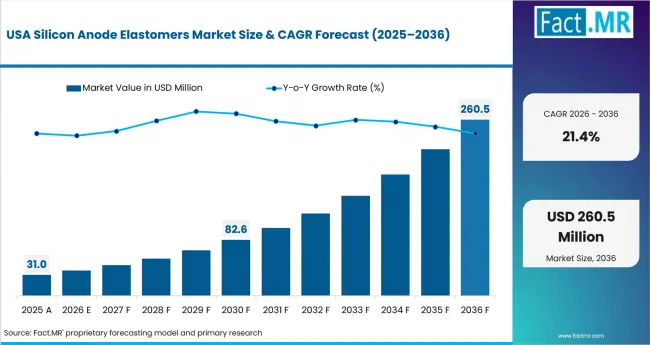
Silicon Anode Elastomers Market Country Value Analysis | Source: Fact.MR
The USA is extending battery manufacturing support beyond cell assembly into anode materials and related production inputs. In January 2025, the U.S. Department of Energy stated that a planned funding round could support up to 14 grants. The market is forecast to post a 21.4% CAGR through 2036 as silicon-anode materials enter broader domestic qualification programs. Recipe support and production traceability are expected to influence grade selection as manufacturing programs move closer to automotive scale.
Who leads the Silicon Anode Elastomers Market?
Zeon Corporation stand out for direct silicon-anode binder offerings, while Syensqo, ENEOS Materials, and LG Chem add broader electrode-polymer capabilities.
Zeon Corporation brings water-based SBR expertise and commercial anode-binder supply. ENEOS Materials adds research and formulation knowledge for silicon-anode binders and electrode expansion. These companies compete on adhesion retention, slurry stability, cycle performance, and the speed of technical response during customer qualification.
LG Chem then detailed the stabilizing role of anode binders during repeated charging in February 2026. Competition is projected to center on recipe-specific evidence, local application laboratories, and reliable supply during scale-up.
Which companies are the key players?
Zeon Corporation offer dedicated silicon-anode binder products. Syensqo and ENEOS Materials add wider electrode-polymer expertise, while LG Chem contribute battery-binder and materials capabilities.
- Zeon Corporation
- Syensqo
- ENEOS Materials
- LG Chem
- Arkema
Bibliography
- U.S. Department of Energy. (2025, January 10). DOE issues notice of intent for funding to strengthen domestic critical materials processing and battery manufacturing. U.S. Department of Energy.
- Brazilian Electric Vehicle Association. (2026, January 6). Annual electrified light-vehicle sales results for 2025. ABVE.
- German Association of the Automotive Industry. (2026, February 3). Battery-electric passenger-car production results for 2025. VDA.
- International Energy Agency. (2026, May 20). Electric vehicle batteries. In Global EV Outlook 2026. IEA.
- LG Chem. (2026, February 20). Anode binder story: The hidden key to EV battery performance. LG Chem.
- Ministry of Heavy Industries. (2026, March 24). Beneficiaries under the Advanced Chemistry Cell Production Linked Incentive Scheme. Government of India.
- National Bureau of Statistics of China. (2026, February 28). Statistical communiqué of the People’s Republic of China on the 2025 national economic and social development. National Bureau of Statistics of China.
- United Nations Economic Commission for Europe. (2025, November 13). New UN regulation for durable batteries in electric trucks. UNECE.
- Zeon Corporation. (2025, March 3). Joint venture for lithium-ion battery anode-binder sales in the domestic market in China. Zeon Corporation.
This Report Addresses
- The report explains how Polymer Type and Anode Type choices affect silicon-electrode qualification.
- The regional outlook covers seven regions. Mexico appears under Latin America, and Türkiye appears under Middle East & Africa.
- The competition section covers Zeon Corporation, Syensqo, ENEOS Materials, and LG Chem.
- The function section examines volume expansion control, adhesion, conductivity support, SEI stabilization, and crack mitigation.
- Application coverage includes EV, consumer electronics, ESS, drones, and power tools through Direct to cell makers, Binder formulators, Anode material suppliers, and Distributors.
What does the Silicon Anode Elastomers Market cover?
The market covers polymer binders and flexible additives used to stabilize silicon-containing battery anodes.
Coverage extends across SBR, polyacrylic acid, polyimide, elastomeric binder, and conductive elastomer systems used with silicon-graphite, high-silicon, silicon oxide, lithium metal hybrid, and composite anodes. These materials support slurry stability, particle cohesion, adhesion to the current collector, and electrode recovery after volume change.
The category is narrower than the full battery-binder market. Revenue is counted only when a product is sold or qualified for a silicon-containing anode and performs one of the listed electrode functions.
What is included in the scope?
The scope includes elastomeric binder systems and polymer additives used in silicon-containing anode formulations across commercial battery applications.
Included revenue covers product sales through direct cell-maker relationships, binder formulators, anode material suppliers, and distributors. Revenue from technical support is included only when it is bundled with product commercialization and repeat supply.
What is excluded from the scope?
The scope excludes graphite-only binders without a stated silicon application, along with complete battery cells and packs.
Silicon active materials sold without a binder function, electrolytes, separators, current collectors, finished electrodes, and general polymer dispersions are outside the boundary. Equipment revenue is also excluded unless it is inseparable from the sale of the defined binder product.
How was the analysis built?
120+ sources, 40+ company portfolios, 25+ countries, 20+ interviews.
- Primary Research: Primary research includes interviews with binder manufacturers, anode-material developers, cell engineers, battery procurement teams, and regional distributors. Discussions examine qualification time, silicon loading, application support, pricing, and the route from pilot lots to repeat commercial supply.
- Desk Research: Desk research reviews official vehicle and battery statistics, company disclosures, technical data sheets, manufacturing announcements, regulation updates, and public battery strategies. Each external figure is checked for date, scope, and direct relevance to silicon-containing anode binders.
- Market-Sizing and Forecasting: Forecasting uses battery-cell deployment, silicon-anode qualification activity, estimated binder use per electrode, application mix, regional manufacturing capacity, and producer capacity plans. The forecast also considers polymer availability, cell-development pathways, and how customers purchase material.
- Data Validation and Update Cycle: Forecast assumptions are reviewed through technical interviews, comparison with official data, and cross-checking of company disclosures. Updates reflect qualification cost, production readiness, regional supply changes, and new evidence on silicon-anode performance.
Segmentation
What is the report’s scope and coverage?
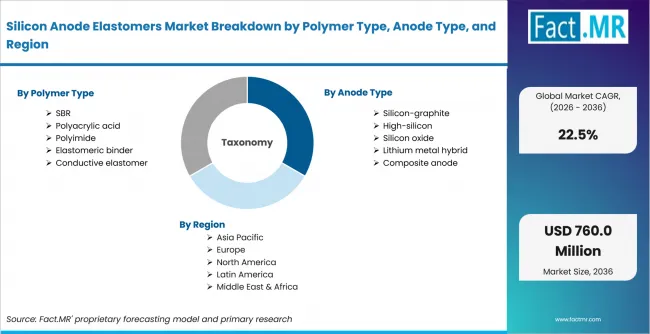
Silicon Anode Elastomers Market Breakdown By Polymer Type, Anode Type, And Region | Source: Fact.MR
| Attribute | Details |
|---|---|
| Quantitative Units | USD million in 2026 to USD million by 2036 at CAGR |
| Market Definition | Polymer binders and elastomeric additives designed to manage expansion, adhesion loss, and cycling stress in silicon-containing battery anodes |
| Polymer Type | SBR; Polyacrylic acid; Polyimide; Elastomeric binder; Conductive elastomer |
| Anode Type | Silicon-graphite; High-silicon; Silicon oxide; Lithium metal hybrid; Composite anode |
| Function | Volume expansion control; Adhesion; Conductivity support; SEI stabilization; Crack mitigation |
| Battery Application | EV; Consumer electronics; ESS; Drones; Power tools |
| Sales Route | Direct to cell makers; Binder formulators; Anode material suppliers; Distributors |
| Regions Covered | North America; Latin America; Western Europe; Eastern Europe; East Asia; South Asia and Pacific; Middle East & Africa |
| Countries Covered | USA; Canada; Brazil; Mexico; Chile; Rest of Latin America; Germany; UK; Italy; Spain; France; Nordic; BENELUX; Rest of Western Europe; Russia; Poland; Hungary; Balkan & Baltic; Rest of Eastern Europe; China; Japan; South Korea; India; ASEAN; Australia & New Zealand; Rest of South Asia and Pacific; Kingdom of Saudi Arabia; Other GCC Countries; Türkiye; South Africa; Other African Union; Rest of Middle East & Africa |
| Key Companies Profiled | Zeon Corporation; Syensqo; ENEOS Materials; LG Chem |
| Forecast Period | 2026 to 2036 |
| Approach | Hybrid top-down and bottom-up analysis using battery deployment, anode qualification activity, segment structure, regional manufacturing evidence, company disclosures, and primary interviews |
Source: Fact.MR analysis. Updated Jul 13, 2026
How is the market segmented?
-
By Polymer Type:
- SBR
- Polyacrylic acid
- Polyimide
- Elastomeric binder
- Conductive elastomer
-
By Anode Type:
- Silicon-graphite
- High-silicon
- Silicon oxide
- Lithium metal hybrid
- Composite anode
-
By Function:
- Volume expansion control
- Adhesion
- Conductivity support
- SEI stabilization
- Crack mitigation
-
By Battery Application:
- EV
- Consumer electronics
- ESS
- Drones
- Power tools
-
By Sales Route:
- Direct to cell makers
- Binder formulators
- Anode material suppliers
- Distributors
-
By Region:
- North America
- USA
- Canada
- Latin America
- Brazil
- Mexico
- Chile
- Rest of Latin America
- Western Europe
- Germany
- UK
- Italy
- Spain
- France
- Nordic
- BENELUX
- Rest of Western Europe
- Eastern Europe
- Russia
- Poland
- Hungary
- Balkan & Baltic
- Rest of Eastern Europe
- East Asia
- China
- Japan
- South Korea
- South Asia and Pacific
- India
- ASEAN
- Australia & New Zealand
- Rest of South Asia and Pacific
- Middle East & Africa
- Kingdom of Saudi Arabia
- Other GCC Countries
- Türkiye
- South Africa
- Other African Union
- Rest of Middle East & Africa
- North America
Frequently Asked Questions
Which Polymer Type leads the Silicon Anode Elastomers Market?
Which Anode Type leads the Silicon Anode Elastomers Market?
Which Function leads the Silicon Anode Elastomers Market?
Which Battery Application leads the Silicon Anode Elastomers Market?
Which Sales Route leads the Silicon Anode Elastomers Market?
Which country records the highest CAGR in the Silicon Anode Elastomers Market?
How does India perform in the Silicon Anode Elastomers Market?
How does Germany perform in the Silicon Anode Elastomers Market?
How does Brazil perform in the Silicon Anode Elastomers Market?
How does the USA perform in the Silicon Anode Elastomers Market?
What is the primary driver in the Silicon Anode Elastomers Market?
What is the main restraint in the Silicon Anode Elastomers Market?
Why do cell makers test silicon anode elastomers?
Who worked on this report


Preview the report firsthand - request a free sample
Free SampleGet the brochure for pricing and purchase details
Download PDF