Single-Use Syringe Polymers Market

Single-Use Syringe Polymers Market Size and Share Forecast Outlook 2026 to 2036

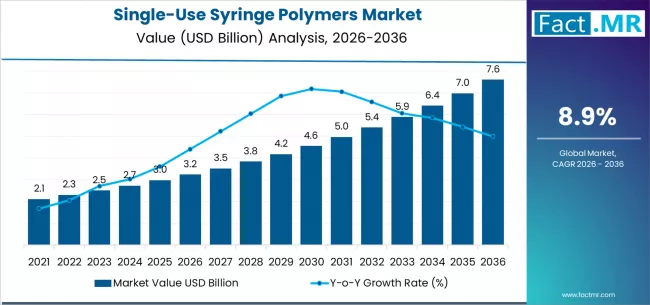
Single-use syringe polymers market is projected to grow from USD 3.2 billion in 2026 to USD 7.6 billion by 2036, at a CAGR of 8.9%. Polypropylene will dominate with a 47.8% market share, while medical & healthcare will lead the application segment with a 61.3% share.

Single-Use Syringe Polymers Market Forecast and Outlook 2026 to 2036

The global market for single-use syringe polymers is a critical component of modern healthcare infrastructure, projected to expand from USD 3.24 billion in 2026 to USD 7.60 billion by 2036, advancing at an 8.9% CAGR.

Key Takeaways from the Single-Use Syringe Polymers Market

  • Market Value for 2026: USD 3.24 Billion
  • Market Value for 2036: USD 7.60 Billion
  • Forecast CAGR (2026-2036): 8.9%
  • Leading Polymer Type Segment (2026): Polypropylene (48%)
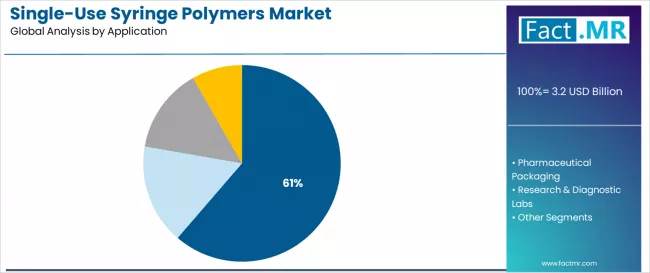
  • Leading Application Segment (2026): Medical & Healthcare (61%)
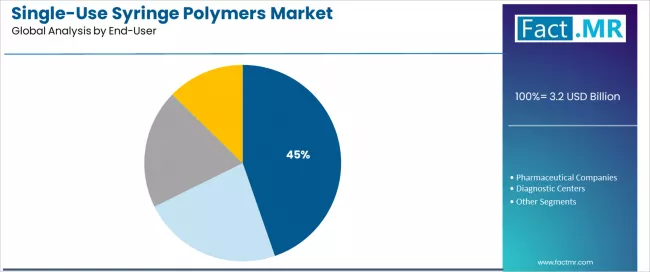
  • Leading End-User Segment (2026): Hospitals & Clinics (45%)
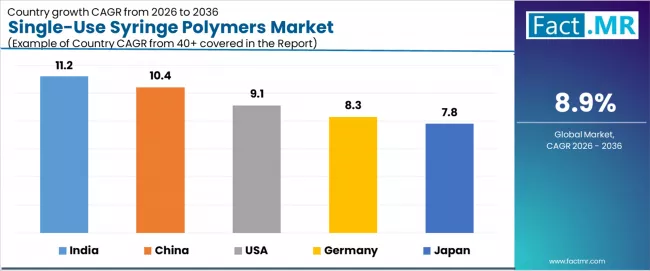
  • Key Growth Countries: India (11.20% CAGR), China (10.40% CAGR), USA (9.10% CAGR), Germany (8.30% CAGR), Japan (7.80% CAGR)
  • Key Players in the Market: Becton, Dickinson & Company, Terumo Corporation, Nipro Medical Corporation, B. Braun Melsungen AG, Smiths Medical

Single Use Syringe Polymers Market Market Value Analysis

Expansion is sustained by the non-negotiable demand for sterile, reliable, and cost-effective drug delivery systems worldwide, amplified by mass vaccination programs and rising chronic disease management. Polypropylene dominates the polymer landscape with a 48% share, prized for its clarity, chemical resistance, and suitability for high-speed manufacturing.

The medical and healthcare application segment commands a decisive 61% share, encompassing everything from routine immunizations to advanced biologic delivery. Hospitals and clinics are the primary end-users (45%), representing the largest point of consumption.

Market evolution is characterized by the dual pressure of cost-containment and performance enhancement, driving innovation in polymer grades that offer improved break resistance, smoother plunger glide, and compatibility with a widening array of sensitive drugs, including high-concentration biologics and mRNA-based therapeutics.

The integration of polymer science with device design, such as enabling safety-engineered features and connectivity, is becoming vital. India (11.20% CAGR) and China (10.40% CAGR) are pivotal growth engines, fueled by expanding healthcare access, large-scale government procurement, and the establishment of these regions as global manufacturing hubs for medical devices.

Metric

Metric Value
Market Value (2026) USD 3.24 Billion
Market Forecast Value (2036) USD 7.60 Billion
Forecast CAGR (2026-2036) 8.9%

Category

Category Segments
Polymer Type Polypropylene, Polyethylene, Polycarbonate, Styrene Ethylene Butylene Styrene, Others
Application Medical & Healthcare, Pharmaceutical Packaging, Research & Diagnostic Labs, Others
End-User Hospitals & Clinics, Pharmaceutical Companies, Diagnostic Centers, Others
Region North America, Latin America, Western Europe, Eastern Europe, East Asia, South Asia & Pacific, MEA

Segmental Analysis

By Polymer Type, Which Material is the Uncontested Industry Standard?

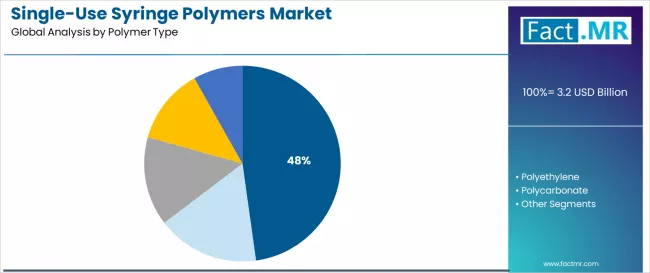
Single Use Syringe Polymers Market Analysis By Polymer Type

Polypropylene holds a commanding 48% market share, establishing itself as the quintessential material for syringe barrels and plungers. Its dominance is rooted in an optimal balance of properties: excellent clarity for dose visualization, high chemical resistance to a broad range of pharmaceuticals, sufficient rigidity for structural integrity, and a favorable cost profile for high-volume disposable manufacturing. Continuous innovations in clarified, high-flow, and low-leachate PP grades ensure its continued preeminence in meeting evolving regulatory and performance standards.

By Application, Which Segment Encompasses the Core Clinical Use?

Single Use Syringe Polymers Market Analysis By Application

The medical and healthcare application segment is overwhelmingly dominant, accounting for 61% of the market. This encompasses all syringes used for direct human administration of therapeutics, vaccines, and fluids in clinical settings.

The critical requirements for sterility, reliability, and biocompatibility in this segment drive the most stringent material specifications and quality controls, making it the primary driver of polymer performance innovation and volume consumption globally.

By End-User, Where is the Highest Volume Consumption?

Single Use Syringe Polymers Market Analysis By End User

Hospitals and clinics constitute the leading end-user segment with a 45% share. These facilities represent the frontline of patient care and are the largest direct purchasers of pre-filled and empty syringes for daily clinical procedures.

Their procurement decisions are heavily influenced by clinical performance, safety features to prevent needlestick injuries, and total cost of ownership, creating demand for polymer solutions that enable devices meeting these complex value equations.

What are the Drivers, Restraints, and Key Trends of the Single-Use Syringe Polymers Market?

The primary market driver is the persistent global increase in healthcare expenditure, vaccination coverage, and the volume of injectable drugs, particularly biologics for chronic conditions.

Stringent global regulations mandating safety-engineered devices to prevent needlestick injuries create continuous refresh cycles for syringe designs, requiring compatible polymers. The globalization of pharmaceutical manufacturing and the push for supply chain resilience further stimulate demand for standardized, high-quality polymer resins from secure sources.

A significant market restraint is the intense cost pressure on healthcare providers and device manufacturers, which limits the adoption of premium polymer grades and can compress margins.

The complexity of ensuring compatibility with an ever-growing portfolio of sensitive drug formulations requires extensive and costly testing. Environmental concerns regarding plastic medical waste are also prompting scrutiny of single-use models, though recyclability remains a major technical challenge for contaminated devices.

Key trends include the development of specialty drug-ready polymers with ultra-low leachables and extractables for biologics and gene therapies. There is growing use of cyclic olefin copolymers and other advanced materials in specialized applications requiring superior clarity and barrier properties.

Polymer science is enabling integrated features, such as built-in friction modifiers for smoother plunger action. Furthermore, the adoption of connected syringes with embedded sensors is driving demand for polymers compatible with overmolding and electronics integration.

Analysis of the Single-Use Syringe Polymers Market by Key Countries

Single Use Syringe Polymers Market Cagr Analysis By Country

Country CAGR (2026-2036)
India 11.20%
China 10.40%
USA 9.10%
Germany 8.30%
Japan 7.80%

How is India's Expanding Healthcare Access and Vaccine Manufacturing Driving Growth?

A massive public health programs fuel India’s leading CAGR of 11.20%, rising private healthcare investment, and its role as the world's largest vaccine manufacturer. The government's focus on universal immunization and the scale of domestic syringe production for both local use and export create enormous, sustained demand for polypropylene and other polymers. The market is highly cost-competitive, driving innovation in local polymer compounding to meet international quality standards at minimal cost.

What is the Impact of China's Medical Device Manufacturing Scale and Domestic Health System Upgrades?

China's 10.40% growth is driven by its unrivaled position as the global workshop for medical devices, including syringes, and substantial domestic healthcare system modernization. Chinese polymer producers are scaling up production of medical-grade resins to supply both vast export-oriented device manufacturing and growing domestic consumption. The market is characterized by rapid adoption of advanced manufacturing techniques and a strong push toward higher-value, safety-engineered syringe production.

Why does the USA's Advanced Healthcare System and Regulatory Framework Sustain Demand?

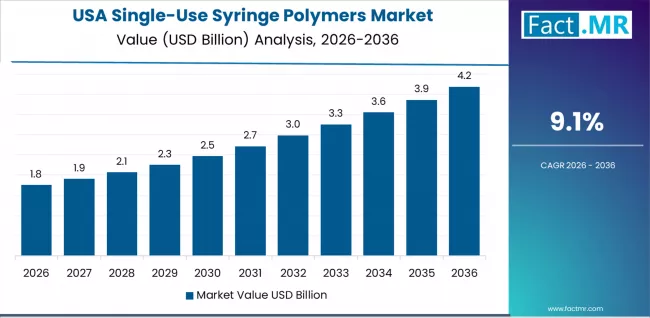
Single Use Syringe Polymers Market Country Value Analysis

The USA's 9.10% growth is anchored in its high-volume, technologically advanced healthcare system and stringent FDA regulations that govern device materials and safety. The market demands polymers with exhaustive regulatory documentation,, such as Master File submissions, and consistent performance for automated filling lines. High adoption of safety syringes and specialized delivery systems for costly biologics drives demand for premium, high-performance polymer grades.

How is Germany's Engineering Precision and MedTech Leadership Shaping the Market?

Germany's 8.30% CAGR reflects its leadership in high-precision medical engineering and strict EU regulatory environment. German device manufacturers and polymer suppliers focus on extreme material consistency, purity, and performance data.

The market favors polymers that enable complex device designs with tight tolerances and reliable functionality, supporting Germany's export-oriented, high-value MedTech sector and its emphasis on quality and reliability.

What Role does Japan's Aging Population and High-Quality Standards Play?

Japan's 7.80% growth occurs within a market defined by a super-aging society requiring extensive chronic care, and exceptionally high standards for product quality and patient safety.

Japanese manufacturers prioritize polymers that offer exceptional clarity, smooth plunger action, and compatibility with home-care and self-administration devices. The demand is for ultra-reliable materials that minimize the risk of device failure and support the country's advanced healthcare delivery models.

Competitive Landscape of the Single-Use Syringe Polymers Market

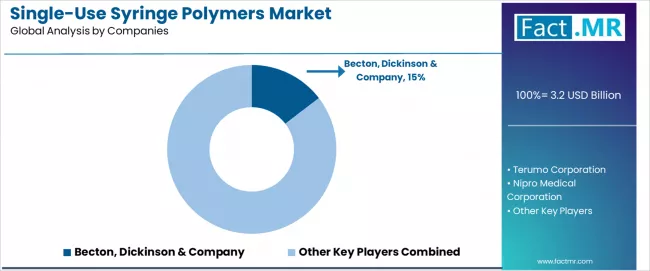
Single Use Syringe Polymers Market Analysis By Company

The competitive landscape is characterized by a unique dynamic where large, vertically integrated medical device manufacturers, who are also major polymer consumers, compete and collaborate with global polymer resin producers.

Competition centers on developing proprietary polymer formulations that offer differentiated performance, securing regulatory approvals for drug-contact applications, and ensuring resilient, global supply chains.

Success for resin producers depends on deep technical partnerships with device makers, while device companies compete on device design, safety features, and manufacturing efficiency enabled by their material choices.

Key Players in the Single-Use Syringe Polymers Market

  • Becton, Dickinson & Company
  • Terumo Corporation
  • Nipro Medical Corporation
  • B. Braun Melsungen AG
  • Smiths Medical

Scope of Report

Items Values
Quantitative Units USD Billion
Polymer Type Polypropylene, Polyethylene, Polycarbonate, Styrene Ethylene Butylene Styrene (SEBS), Others
Application Medical & Healthcare, Pharmaceutical Packaging, Research & Diagnostic Labs, Others
End-User Hospitals & Clinics, Pharmaceutical Companies, Diagnostic Centers, Others
Key Countries India, China, USA, Germany, Japan
Key Companies Becton, Dickinson & Company, Terumo Corporation, Nipro Medical Corporation, B. Braun Melsungen AG, Smiths Medical
Additional Analysis Extractables and leachables profiling for novel biologic drugs; polymer compatibility studies with mRNA vaccines and other advanced therapeutics; impact of polymer processing parameters on syringe mechanical performance and sterility; lifecycle analysis and end-of-life considerations for single-use medical plastics; supply chain risk assessment for critical medical-grade polymers.

Market by Segments

  • Polymer Type :

    • Polypropylene
    • Polyethylene
    • Polycarbonate
    • Styrene Ethylene Butylene Styrene
    • Others
  • Application :

    • Medical & Healthcare
    • Pharmaceutical Packaging
    • Research & Diagnostic Labs
    • Others
  • End-User :

    • Hospitals & Clinics
    • Pharmaceutical Companies
    • Diagnostic Centers
    • Others
  • Region :

    • North America

      • USA
      • Canada
    • Latin America

      • Brazil
      • Mexico
      • Argentina
      • Rest of Latin America
    • Western Europe

      • Germany
      • UK
      • France
      • Spain
      • Italy
      • BENELUX
      • Rest of Western Europe
    • Eastern Europe

      • Russia
      • Poland
      • Czech Republic
      • Rest of Eastern Europe
    • East Asia

      • China
      • Japan
      • South Korea
      • Rest of East Asia
    • South Asia & Pacific

      • India
      • ASEAN
      • Australia
      • Rest of South Asia & Pacific
    • MEA

      • Saudi Arabia
      • UAE
      • Turkiye
      • Rest of MEA

References

  • Barton, A. F., & Booth, S. (2023). Medical plastics: A guide to material selection and applications. Smithers Rapra.
  • DeMaria, A., & Haimovich, A. (2024). Advances in polymer materials for parenteral drug delivery. Advanced Drug Delivery Reviews, 205, 115178.
  • Jenke, D. R. (2023). Compatibility of pharmaceutical products and contact materials: Safety assessments of extractables and leachables. John Wiley & Sons.
  • Kamboj, S., & Singh, H. (2024). Polypropylene in healthcare: Grades, processing, and applications for single-use devices. Journal of Applied Polymer Science, 141(15), e54201.
  • Matsuoka, Y., & Tsuchiya, K. (2023). Evaluation of plunger glide force in pre-filled syringes: The role of syringe barrel polymer and silicone oil lubrication. PDA Journal of Pharmaceutical Science and Technology, 77(2), 98-112.
  • Perez, J. L., & Williams, R. O. (2024). Materials for drug delivery: A review of injectable systems. International Journal of Pharmaceutics, 647, 123525.
  • Shi, Y., & Li, L. C. (2023). Regulatory considerations for polymer selection in primary packaging of injectable products. AAPS PharmSciTech, 24(5), 112.
  • Siew, A. (2024). Examining trends in primary packaging for biologics. Pharmaceutical Technology Europe, 36(3), 12-17.
  • Stability Testing of New Drug Substances and Products Q1A(R2). (2023). International Council for Harmonisation of Technical Requirements for Pharmaceuticals for Human Use.
  • Wong, J., & Burgess, D. J. (2024). Particle formation in biopharmaceutical formulations: Interaction with primary container materials. Journal of Pharmaceutical Sciences, 113(1), 45-59.

Table of Content

  1. Executive Summary
    • Global Market Outlook
    • Demand to side Trends
    • Supply to side Trends
    • Technology Roadmap Analysis
    • Analysis and Recommendations
  2. Market Overview
    • Market Coverage / Taxonomy
    • Market Definition / Scope / Limitations
  3. Market Background
    • Market Dynamics
      • Drivers
      • Restraints
      • Opportunity
      • Trends
    • Scenario Forecast
      • Demand in Optimistic Scenario
      • Demand in Likely Scenario
      • Demand in Conservative Scenario
    • Opportunity Map Analysis
    • Product Life Cycle Analysis
    • Supply Chain Analysis
    • Investment Feasibility Matrix
    • Value Chain Analysis
    • PESTLE and Porter’s Analysis
    • Regulatory Landscape
    • Regional Parent Market Outlook
    • Production and Consumption Statistics
    • Import and Export Statistics
  4. Global Market Analysis 2021 to 2025 and Forecast, 2026 to 2036
    • Historical Market Size Value (USD Million) Analysis, 2021 to 2025
    • Current and Future Market Size Value (USD Million) Projections, 2026 to 2036
      • Y to o to Y Growth Trend Analysis
      • Absolute $ Opportunity Analysis
  5. Global Market Pricing Analysis 2021 to 2025 and Forecast 2026 to 2036
  6. Global Market Analysis 2021 to 2025 and Forecast 2026 to 2036, By Polymer Type
    • Introduction / Key Findings
    • Historical Market Size Value (USD Million) Analysis By Polymer Type, 2021 to 2025
    • Current and Future Market Size Value (USD Million) Analysis and Forecast By Polymer Type, 2026 to 2036
      • Polypropylene
      • Polyethylene
      • Polycarbonate
      • Styrene Ethylene Butylene Styrene
      • Others
    • Y to o to Y Growth Trend Analysis By Polymer Type, 2021 to 2025
    • Absolute $ Opportunity Analysis By Polymer Type, 2026 to 2036
  7. Global Market Analysis 2021 to 2025 and Forecast 2026 to 2036, By Application
    • Introduction / Key Findings
    • Historical Market Size Value (USD Million) Analysis By Application, 2021 to 2025
    • Current and Future Market Size Value (USD Million) Analysis and Forecast By Application, 2026 to 2036
      • Medical & Healthcare
      • Pharmaceutical Packaging
      • Research & Diagnostic Labs
      • Others
    • Y to o to Y Growth Trend Analysis By Application, 2021 to 2025
    • Absolute $ Opportunity Analysis By Application, 2026 to 2036
  8. Global Market Analysis 2021 to 2025 and Forecast 2026 to 2036, By End‑User
    • Introduction / Key Findings
    • Historical Market Size Value (USD Million) Analysis By End‑User, 2021 to 2025
    • Current and Future Market Size Value (USD Million) Analysis and Forecast By End‑User, 2026 to 2036
      • Hospitals & Clinics
      • Pharmaceutical Companies
      • Diagnostic Centers
      • Others
    • Y to o to Y Growth Trend Analysis By End‑User, 2021 to 2025
    • Absolute $ Opportunity Analysis By End‑User, 2026 to 2036
  9. Global Market Analysis 2021 to 2025 and Forecast 2026 to 2036, By Region
    • Introduction
    • Historical Market Size Value (USD Million) Analysis By Region, 2021 to 2025
    • Current Market Size Value (USD Million) Analysis and Forecast By Region, 2026 to 2036
      • North America
      • Latin America
      • Western Europe
      • Eastern Europe
      • East Asia
      • South Asia and Pacific
      • Middle East & Africa
    • Market Attractiveness Analysis By Region
  10. North America Market Analysis 2021 to 2025 and Forecast 2026 to 2036, By Country
    • Historical Market Size Value (USD Million) Trend Analysis By Market Taxonomy, 2021 to 2025
    • Market Size Value (USD Million) Forecast By Market Taxonomy, 2026 to 2036
      • By Country
        • USA
        • Canada
        • Mexico
      • By Polymer Type
      • By Application
      • By End‑User
    • Market Attractiveness Analysis
      • By Country
      • By Polymer Type
      • By Application
      • By End‑User
    • Key Takeaways
  11. Latin America Market Analysis 2021 to 2025 and Forecast 2026 to 2036, By Country
    • Historical Market Size Value (USD Million) Trend Analysis By Market Taxonomy, 2021 to 2025
    • Market Size Value (USD Million) Forecast By Market Taxonomy, 2026 to 2036
      • By Country
        • Brazil
        • Chile
        • Rest of Latin America
      • By Polymer Type
      • By Application
      • By End‑User
    • Market Attractiveness Analysis
      • By Country
      • By Polymer Type
      • By Application
      • By End‑User
    • Key Takeaways
  12. Western Europe Market Analysis 2021 to 2025 and Forecast 2026 to 2036, By Country
    • Historical Market Size Value (USD Million) Trend Analysis By Market Taxonomy, 2021 to 2025
    • Market Size Value (USD Million) Forecast By Market Taxonomy, 2026 to 2036
      • By Country
        • Germany
        • UK
        • Italy
        • Spain
        • France
        • Nordic
        • BENELUX
        • Rest of Western Europe
      • By Polymer Type
      • By Application
      • By End‑User
    • Market Attractiveness Analysis
      • By Country
      • By Polymer Type
      • By Application
      • By End‑User
    • Key Takeaways
  13. Eastern Europe Market Analysis 2021 to 2025 and Forecast 2026 to 2036, By Country
    • Historical Market Size Value (USD Million) Trend Analysis By Market Taxonomy, 2021 to 2025
    • Market Size Value (USD Million) Forecast By Market Taxonomy, 2026 to 2036
      • By Country
        • Russia
        • Poland
        • Hungary
        • Balkan & Baltic
        • Rest of Eastern Europe
      • By Polymer Type
      • By Application
      • By End‑User
    • Market Attractiveness Analysis
      • By Country
      • By Polymer Type
      • By Application
      • By End‑User
    • Key Takeaways
  14. East Asia Market Analysis 2021 to 2025 and Forecast 2026 to 2036, By Country
    • Historical Market Size Value (USD Million) Trend Analysis By Market Taxonomy, 2021 to 2025
    • Market Size Value (USD Million) Forecast By Market Taxonomy, 2026 to 2036
      • By Country
        • China
        • Japan
        • South Korea
      • By Polymer Type
      • By Application
      • By End‑User
    • Market Attractiveness Analysis
      • By Country
      • By Polymer Type
      • By Application
      • By End‑User
    • Key Takeaways
  15. South Asia and Pacific Market Analysis 2021 to 2025 and Forecast 2026 to 2036, By Country
    • Historical Market Size Value (USD Million) Trend Analysis By Market Taxonomy, 2021 to 2025
    • Market Size Value (USD Million) Forecast By Market Taxonomy, 2026 to 2036
      • By Country
        • India
        • ASEAN
        • Australia & New Zealand
        • Rest of South Asia and Pacific
      • By Polymer Type
      • By Application
      • By End‑User
    • Market Attractiveness Analysis
      • By Country
      • By Polymer Type
      • By Application
      • By End‑User
    • Key Takeaways
  16. Middle East & Africa Market Analysis 2021 to 2025 and Forecast 2026 to 2036, By Country
    • Historical Market Size Value (USD Million) Trend Analysis By Market Taxonomy, 2021 to 2025
    • Market Size Value (USD Million) Forecast By Market Taxonomy, 2026 to 2036
      • By Country
        • Kingdom of Saudi Arabia
        • Other GCC Countries
        • Turkiye
        • South Africa
        • Other African Union
        • Rest of Middle East & Africa
      • By Polymer Type
      • By Application
      • By End‑User
    • Market Attractiveness Analysis
      • By Country
      • By Polymer Type
      • By Application
      • By End‑User
    • Key Takeaways
  17. Key Countries Market Analysis
    • USA
      • Pricing Analysis
      • Market Share Analysis, 2025
        • By Polymer Type
        • By Application
        • By End‑User
    • Canada
      • Pricing Analysis
      • Market Share Analysis, 2025
        • By Polymer Type
        • By Application
        • By End‑User
    • Mexico
      • Pricing Analysis
      • Market Share Analysis, 2025
        • By Polymer Type
        • By Application
        • By End‑User
    • Brazil
      • Pricing Analysis
      • Market Share Analysis, 2025
        • By Polymer Type
        • By Application
        • By End‑User
    • Chile
      • Pricing Analysis
      • Market Share Analysis, 2025
        • By Polymer Type
        • By Application
        • By End‑User
    • Germany
      • Pricing Analysis
      • Market Share Analysis, 2025
        • By Polymer Type
        • By Application
        • By End‑User
    • UK
      • Pricing Analysis
      • Market Share Analysis, 2025
        • By Polymer Type
        • By Application
        • By End‑User
    • Italy
      • Pricing Analysis
      • Market Share Analysis, 2025
        • By Polymer Type
        • By Application
        • By End‑User
    • Spain
      • Pricing Analysis
      • Market Share Analysis, 2025
        • By Polymer Type
        • By Application
        • By End‑User
    • France
      • Pricing Analysis
      • Market Share Analysis, 2025
        • By Polymer Type
        • By Application
        • By End‑User
    • India
      • Pricing Analysis
      • Market Share Analysis, 2025
        • By Polymer Type
        • By Application
        • By End‑User
    • ASEAN
      • Pricing Analysis
      • Market Share Analysis, 2025
        • By Polymer Type
        • By Application
        • By End‑User
    • Australia & New Zealand
      • Pricing Analysis
      • Market Share Analysis, 2025
        • By Polymer Type
        • By Application
        • By End‑User
    • China
      • Pricing Analysis
      • Market Share Analysis, 2025
        • By Polymer Type
        • By Application
        • By End‑User
    • Japan
      • Pricing Analysis
      • Market Share Analysis, 2025
        • By Polymer Type
        • By Application
        • By End‑User
    • South Korea
      • Pricing Analysis
      • Market Share Analysis, 2025
        • By Polymer Type
        • By Application
        • By End‑User
    • Russia
      • Pricing Analysis
      • Market Share Analysis, 2025
        • By Polymer Type
        • By Application
        • By End‑User
    • Poland
      • Pricing Analysis
      • Market Share Analysis, 2025
        • By Polymer Type
        • By Application
        • By End‑User
    • Hungary
      • Pricing Analysis
      • Market Share Analysis, 2025
        • By Polymer Type
        • By Application
        • By End‑User
    • Kingdom of Saudi Arabia
      • Pricing Analysis
      • Market Share Analysis, 2025
        • By Polymer Type
        • By Application
        • By End‑User
    • Turkiye
      • Pricing Analysis
      • Market Share Analysis, 2025
        • By Polymer Type
        • By Application
        • By End‑User
    • South Africa
      • Pricing Analysis
      • Market Share Analysis, 2025
        • By Polymer Type
        • By Application
        • By End‑User
  18. Market Structure Analysis
    • Competition Dashboard
    • Competition Benchmarking
    • Market Share Analysis of Top Players
      • By Regional
      • By Polymer Type
      • By Application
      • By End‑User
  19. Competition Analysis
    • Competition Deep Dive
      • Becton, Dickinson & Company
        • Overview
        • Product Portfolio
        • Profitability by Market Segments (Product/Age /Sales Channel/Region)
        • Sales Footprint
        • Strategy Overview
          • Marketing Strategy
          • Product Strategy
          • Channel Strategy
      • Terumo Corporation
      • Nipro Medical Corporation
      • B. Braun Melsungen AG
      • Smiths Medical
      • Others
  20. Assumptions & Acronyms Used
  21. Research Methodology

List Of Table

  • Table 1: Global Market Value (USD Million) Forecast by Region, 2021 to 2036
  • Table 2: Global Market Value (USD Million) Forecast by Polymer Type, 2021 to 2036
  • Table 3: Global Market Value (USD Million) Forecast by Application, 2021 to 2036
  • Table 4: Global Market Value (USD Million) Forecast by End‑User, 2021 to 2036
  • Table 5: North America Market Value (USD Million) Forecast by Country, 2021 to 2036
  • Table 6: North America Market Value (USD Million) Forecast by Polymer Type, 2021 to 2036
  • Table 7: North America Market Value (USD Million) Forecast by Application, 2021 to 2036
  • Table 8: North America Market Value (USD Million) Forecast by End‑User, 2021 to 2036
  • Table 9: Latin America Market Value (USD Million) Forecast by Country, 2021 to 2036
  • Table 10: Latin America Market Value (USD Million) Forecast by Polymer Type, 2021 to 2036
  • Table 11: Latin America Market Value (USD Million) Forecast by Application, 2021 to 2036
  • Table 12: Latin America Market Value (USD Million) Forecast by End‑User, 2021 to 2036
  • Table 13: Western Europe Market Value (USD Million) Forecast by Country, 2021 to 2036
  • Table 14: Western Europe Market Value (USD Million) Forecast by Polymer Type, 2021 to 2036
  • Table 15: Western Europe Market Value (USD Million) Forecast by Application, 2021 to 2036
  • Table 16: Western Europe Market Value (USD Million) Forecast by End‑User, 2021 to 2036
  • Table 17: Eastern Europe Market Value (USD Million) Forecast by Country, 2021 to 2036
  • Table 18: Eastern Europe Market Value (USD Million) Forecast by Polymer Type, 2021 to 2036
  • Table 19: Eastern Europe Market Value (USD Million) Forecast by Application, 2021 to 2036
  • Table 20: Eastern Europe Market Value (USD Million) Forecast by End‑User, 2021 to 2036
  • Table 21: East Asia Market Value (USD Million) Forecast by Country, 2021 to 2036
  • Table 22: East Asia Market Value (USD Million) Forecast by Polymer Type, 2021 to 2036
  • Table 23: East Asia Market Value (USD Million) Forecast by Application, 2021 to 2036
  • Table 24: East Asia Market Value (USD Million) Forecast by End‑User, 2021 to 2036
  • Table 25: South Asia and Pacific Market Value (USD Million) Forecast by Country, 2021 to 2036
  • Table 26: South Asia and Pacific Market Value (USD Million) Forecast by Polymer Type, 2021 to 2036
  • Table 27: South Asia and Pacific Market Value (USD Million) Forecast by Application, 2021 to 2036
  • Table 28: South Asia and Pacific Market Value (USD Million) Forecast by End‑User, 2021 to 2036
  • Table 29: Middle East & Africa Market Value (USD Million) Forecast by Country, 2021 to 2036
  • Table 30: Middle East & Africa Market Value (USD Million) Forecast by Polymer Type, 2021 to 2036
  • Table 31: Middle East & Africa Market Value (USD Million) Forecast by Application, 2021 to 2036
  • Table 32: Middle East & Africa Market Value (USD Million) Forecast by End‑User, 2021 to 2036

List Of Figures

  • Figure 1: Global Market Pricing Analysis
  • Figure 2: Global Market Value (USD Million) Forecast 2021 to 2036
  • Figure 3: Global Market Value Share and BPS Analysis by Polymer Type, 2026 and 2036
  • Figure 4: Global Market Y to o to Y Growth Comparison by Polymer Type, 2026 to 2036
  • Figure 5: Global Market Attractiveness Analysis by Polymer Type
  • Figure 6: Global Market Value Share and BPS Analysis by Application, 2026 and 2036
  • Figure 7: Global Market Y to o to Y Growth Comparison by Application, 2026 to 2036
  • Figure 8: Global Market Attractiveness Analysis by Application
  • Figure 9: Global Market Value Share and BPS Analysis by End‑User, 2026 and 2036
  • Figure 10: Global Market Y to o to Y Growth Comparison by End‑User, 2026 to 2036
  • Figure 11: Global Market Attractiveness Analysis by End‑User
  • Figure 12: Global Market Value (USD Million) Share and BPS Analysis by Region, 2026 and 2036
  • Figure 13: Global Market Y to o to Y Growth Comparison by Region, 2026 to 2036
  • Figure 14: Global Market Attractiveness Analysis by Region
  • Figure 15: North America Market Incremental Dollar Opportunity, 2026 to 2036
  • Figure 16: Latin America Market Incremental Dollar Opportunity, 2026 to 2036
  • Figure 17: Western Europe Market Incremental Dollar Opportunity, 2026 to 2036
  • Figure 18: Eastern Europe Market Incremental Dollar Opportunity, 2026 to 2036
  • Figure 19: East Asia Market Incremental Dollar Opportunity, 2026 to 2036
  • Figure 20: South Asia and Pacific Market Incremental Dollar Opportunity, 2026 to 2036
  • Figure 21: Middle East & Africa Market Incremental Dollar Opportunity, 2026 to 2036
  • Figure 22: North America Market Value Share and BPS Analysis by Country, 2026 and 2036
  • Figure 23: North America Market Value Share and BPS Analysis by Polymer Type, 2026 and 2036
  • Figure 24: North America Market Y to o to Y Growth Comparison by Polymer Type, 2026 to 2036
  • Figure 25: North America Market Attractiveness Analysis by Polymer Type
  • Figure 26: North America Market Value Share and BPS Analysis by Application, 2026 and 2036
  • Figure 27: North America Market Y to o to Y Growth Comparison by Application, 2026 to 2036
  • Figure 28: North America Market Attractiveness Analysis by Application
  • Figure 29: North America Market Value Share and BPS Analysis by End‑User, 2026 and 2036
  • Figure 30: North America Market Y to o to Y Growth Comparison by End‑User, 2026 to 2036
  • Figure 31: North America Market Attractiveness Analysis by End‑User
  • Figure 32: Latin America Market Value Share and BPS Analysis by Country, 2026 and 2036
  • Figure 33: Latin America Market Value Share and BPS Analysis by Polymer Type, 2026 and 2036
  • Figure 34: Latin America Market Y to o to Y Growth Comparison by Polymer Type, 2026 to 2036
  • Figure 35: Latin America Market Attractiveness Analysis by Polymer Type
  • Figure 36: Latin America Market Value Share and BPS Analysis by Application, 2026 and 2036
  • Figure 37: Latin America Market Y to o to Y Growth Comparison by Application, 2026 to 2036
  • Figure 38: Latin America Market Attractiveness Analysis by Application
  • Figure 39: Latin America Market Value Share and BPS Analysis by End‑User, 2026 and 2036
  • Figure 40: Latin America Market Y to o to Y Growth Comparison by End‑User, 2026 to 2036
  • Figure 41: Latin America Market Attractiveness Analysis by End‑User
  • Figure 42: Western Europe Market Value Share and BPS Analysis by Country, 2026 and 2036
  • Figure 43: Western Europe Market Value Share and BPS Analysis by Polymer Type, 2026 and 2036
  • Figure 44: Western Europe Market Y to o to Y Growth Comparison by Polymer Type, 2026 to 2036
  • Figure 45: Western Europe Market Attractiveness Analysis by Polymer Type
  • Figure 46: Western Europe Market Value Share and BPS Analysis by Application, 2026 and 2036
  • Figure 47: Western Europe Market Y to o to Y Growth Comparison by Application, 2026 to 2036
  • Figure 48: Western Europe Market Attractiveness Analysis by Application
  • Figure 49: Western Europe Market Value Share and BPS Analysis by End‑User, 2026 and 2036
  • Figure 50: Western Europe Market Y to o to Y Growth Comparison by End‑User, 2026 to 2036
  • Figure 51: Western Europe Market Attractiveness Analysis by End‑User
  • Figure 52: Eastern Europe Market Value Share and BPS Analysis by Country, 2026 and 2036
  • Figure 53: Eastern Europe Market Value Share and BPS Analysis by Polymer Type, 2026 and 2036
  • Figure 54: Eastern Europe Market Y to o to Y Growth Comparison by Polymer Type, 2026 to 2036
  • Figure 55: Eastern Europe Market Attractiveness Analysis by Polymer Type
  • Figure 56: Eastern Europe Market Value Share and BPS Analysis by Application, 2026 and 2036
  • Figure 57: Eastern Europe Market Y to o to Y Growth Comparison by Application, 2026 to 2036
  • Figure 58: Eastern Europe Market Attractiveness Analysis by Application
  • Figure 59: Eastern Europe Market Value Share and BPS Analysis by End‑User, 2026 and 2036
  • Figure 60: Eastern Europe Market Y to o to Y Growth Comparison by End‑User, 2026 to 2036
  • Figure 61: Eastern Europe Market Attractiveness Analysis by End‑User
  • Figure 62: East Asia Market Value Share and BPS Analysis by Country, 2026 and 2036
  • Figure 63: East Asia Market Value Share and BPS Analysis by Polymer Type, 2026 and 2036
  • Figure 64: East Asia Market Y to o to Y Growth Comparison by Polymer Type, 2026 to 2036
  • Figure 65: East Asia Market Attractiveness Analysis by Polymer Type
  • Figure 66: East Asia Market Value Share and BPS Analysis by Application, 2026 and 2036
  • Figure 67: East Asia Market Y to o to Y Growth Comparison by Application, 2026 to 2036
  • Figure 68: East Asia Market Attractiveness Analysis by Application
  • Figure 69: East Asia Market Value Share and BPS Analysis by End‑User, 2026 and 2036
  • Figure 70: East Asia Market Y to o to Y Growth Comparison by End‑User, 2026 to 2036
  • Figure 71: East Asia Market Attractiveness Analysis by End‑User
  • Figure 72: South Asia and Pacific Market Value Share and BPS Analysis by Country, 2026 and 2036
  • Figure 73: South Asia and Pacific Market Value Share and BPS Analysis by Polymer Type, 2026 and 2036
  • Figure 74: South Asia and Pacific Market Y to o to Y Growth Comparison by Polymer Type, 2026 to 2036
  • Figure 75: South Asia and Pacific Market Attractiveness Analysis by Polymer Type
  • Figure 76: South Asia and Pacific Market Value Share and BPS Analysis by Application, 2026 and 2036
  • Figure 77: South Asia and Pacific Market Y to o to Y Growth Comparison by Application, 2026 to 2036
  • Figure 78: South Asia and Pacific Market Attractiveness Analysis by Application
  • Figure 79: South Asia and Pacific Market Value Share and BPS Analysis by End‑User, 2026 and 2036
  • Figure 80: South Asia and Pacific Market Y to o to Y Growth Comparison by End‑User, 2026 to 2036
  • Figure 81: South Asia and Pacific Market Attractiveness Analysis by End‑User
  • Figure 82: Middle East & Africa Market Value Share and BPS Analysis by Country, 2026 and 2036
  • Figure 83: Middle East & Africa Market Value Share and BPS Analysis by Polymer Type, 2026 and 2036
  • Figure 84: Middle East & Africa Market Y to o to Y Growth Comparison by Polymer Type, 2026 to 2036
  • Figure 85: Middle East & Africa Market Attractiveness Analysis by Polymer Type
  • Figure 86: Middle East & Africa Market Value Share and BPS Analysis by Application, 2026 and 2036
  • Figure 87: Middle East & Africa Market Y to o to Y Growth Comparison by Application, 2026 to 2036
  • Figure 88: Middle East & Africa Market Attractiveness Analysis by Application
  • Figure 89: Middle East & Africa Market Value Share and BPS Analysis by End‑User, 2026 and 2036
  • Figure 90: Middle East & Africa Market Y to o to Y Growth Comparison by End‑User, 2026 to 2036
  • Figure 91: Middle East & Africa Market Attractiveness Analysis by End‑User
  • Figure 92: Global Market - Tier Structure Analysis
  • Figure 93: Global Market - Company Share Analysis

- FAQs -

How big is the single-use syringe polymers market in 2026?

The global single-use syringe polymers market is estimated to be valued at USD 3.2 billion in 2026.

What will be the size of single-use syringe polymers market in 2036?

The market size for the single-use syringe polymers market is projected to reach USD 7.6 billion by 2036.

How much will be the single-use syringe polymers market growth between 2026 and 2036?

The single-use syringe polymers market is expected to grow at a 8.9% CAGR between 2026 and 2036.

What are the key product types in the single-use syringe polymers market?

The key product types in single-use syringe polymers market are polypropylene, polyethylene , polycarbonate, styrene ethylene butylene styrene and others.

Which application segment to contribute significant share in the single-use syringe polymers market in 2026?

In terms of application, medical & healthcare segment to command 61.3% share in the single-use syringe polymers market in 2026.
Single-Use Syringe Polymers Market