- Market Value (2025): USD 11.6 Bn
- Estimated Value (2026): USD 12.9 Bn
- Forecast Value (2036): USD 38.0 Bn
- CAGR (2026-2036): 11.4%
What is the Smart Grid Security Market forecast to be worth by 2036?
USD 12.9 billion in 2026 to USD 38.0 billion by 2036 at 11.4% CAGR.
- The smart grid security market crossed a valuation of USD 11.6 billion in 2025 as utilities protected connected grid assets.
- Demand is projected to increase from USD 12.9 billion in 2026 to USD 38.0 billion by 2036 as grid assets become monitored.
- The market is forecast to record 11.4% CAGR from 2026 to 2036.
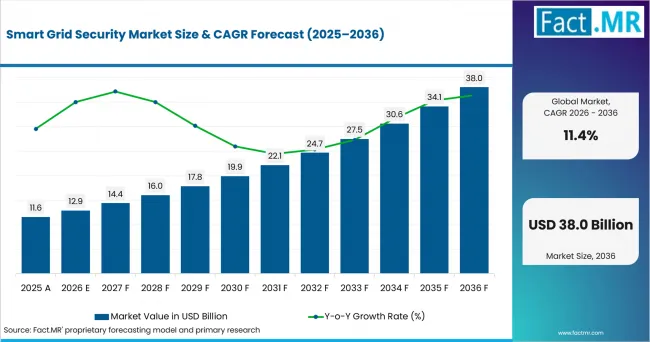
Smart Grid Security Market Value Analysis | Source: Fact.MR
What are the defining numbers behind Smart Grid Security Market growth?
USD 25.1 billion absolute opportunity by 2036.
- Demand Drivers in the Market
- Network security requirements are expected to rise as utilities connect more operational assets to monitored communication networks.
- Electric utilities are likely to prioritize suppliers that protect field assets without delaying routine grid operations.
- Direct enterprise sales remain useful where buyers need support for installation planning and service coverage.
- Key Segments Analyzed
- By Security Type: Network Security is expected to hold 36.9% share in 2026 because grid operators first protect communication paths and access points.
- By Application: Smart Meters are projected to hold 30.7% share in 2026 as metering programs add many connected endpoints under review.
- By End User: Electric Utilities are anticipated to capture 29.7% share in 2026 since regulated grid operators carry the main uptime burden.
- By Distribution Channel: Direct Enterprise Sales are estimated to represent 30.5% share in 2026 where utilities need named accountability before approval.
- By Deployment: On-Premises is forecast to hold 53.0% share in 2026 as many utilities keep operational controls close to local infrastructure.
- Analyst Opinion at Fact.MR
- Shambhu Nath Jha, Principal Consultant at Fact.MR, states, “In the smart grid security market the practical test is whether Network Security reduces operating risk without adding another approval burden. Buyers ask suppliers to connect security claims with integration evidence and support coverage.”
- Strategic Implications
- Utility teams should place Network Security controls around high-risk grid assets. SCADA systems and substation links need clear ownership before wider automation is approved.
- Suppliers can improve proposals by showing how security functions fit utility work routines. Stronger cases explain installation needs and support responsibility.
- Investors should read the country spread through utility readiness. South Korea and USA move faster when procurement teams see proof of local service depth.
South Korea leads at 9.1% CAGR as utilities modernize quickly. The USA follows at 14.8% as smart meter security reviews expand. Canada records 10.3% with stronger service coverage. Germany reaches 12.6% through validation-led buying. Australia grows at 8.0% as dependable service supports approvals. The UK posts 11.4% with governance and life-cycle checks. Japan records 13.7% through reliability-focused utility selection. Across markets, approval depends on secure systems, proof and reliable support.
How does the Smart Grid Security Market break down by segment?
Network Security is expected to lead Security Type at 30.7% share in 2026. Smart Meters are projected to lead Application at 28.0% share in 2026.
Why does Network Security lead Security Type?
Network Security is projected to account for 36.9% share in 2026.
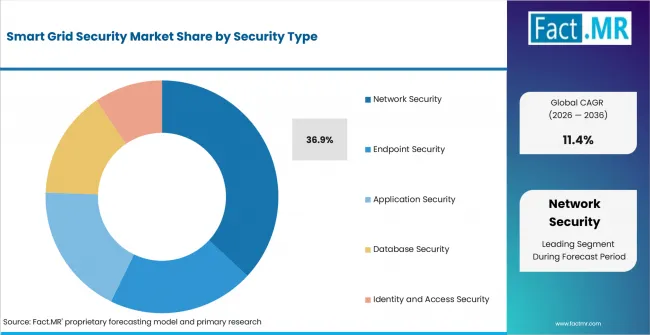
Smart Grid Security Market Analysis By Security Type | Source: Fact.MR
Network Security leads because utilities need protected communication paths before adding more automated grid functions. Firewalls and Network Segmentation remain relevant for boundary control. Intrusion Detection and Prevention supports monitoring. Endpoint Security protects field devices that can become weak points.
Why do Smart Meters lead Application?
Smart Meters are expected to account for 30.7% share in 2026.
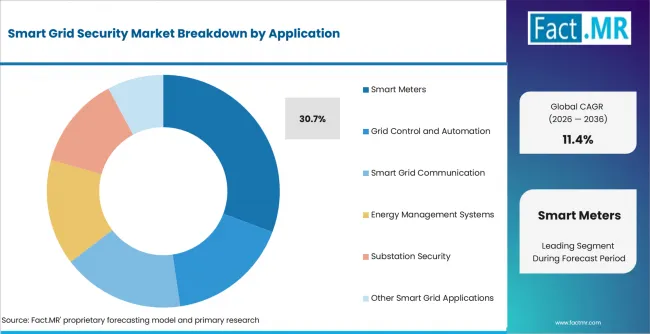
Smart Grid Security Market Analysis By Application | Source: Fact.MR
Smart Meters lead when utilities need secure data capture at the edge of the grid. Meter data security protects billing and usage records. Advanced metering infrastructure remains important when utilities need remote reading and better outage visibility.
Why do Electric Utilities lead End User?
Electric Utilities are anticipated to account for 29.7% share in 2026.
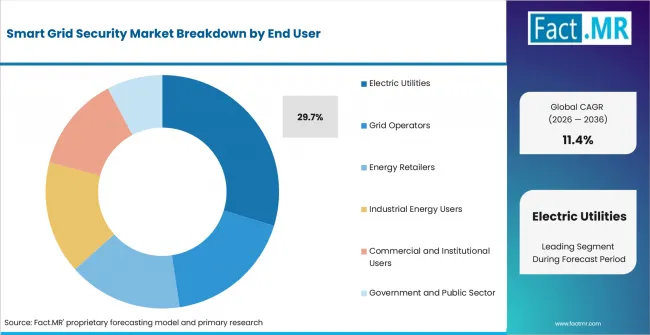
Smart Grid Security Market Analysis By End User | Source: Fact.MR
Electric Utilities lead because they carry direct responsibility for safe and reliable grid operation. Generation utilities and transmission operators need different controls. Most buying decisions start with uptime, service continuity and regulatory assurance.
Why does Direct Enterprise Sales lead Distribution Channel?
Direct Enterprise Sales are estimated to account for 30.5% share in 2026.
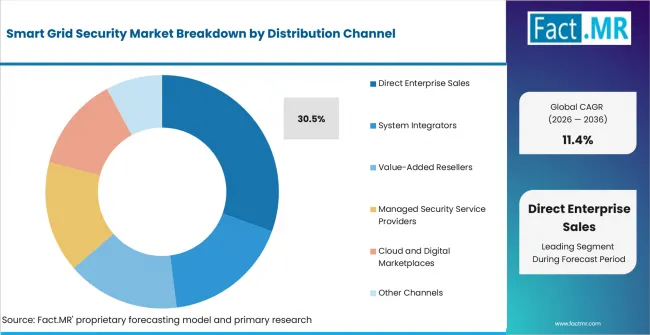
Smart Grid Security Market Analysis By Distribution Channel | Source: Fact.MR
Direct Enterprise Sales lead where procurement teams want direct accountability. System integrators remain useful when projects involve several grid platforms. Managed security services support buyers that need ongoing monitoring after installation.
Why does On-Premises lead Deployment?
On-Premises is forecast to account for 53.0% share in 2026.
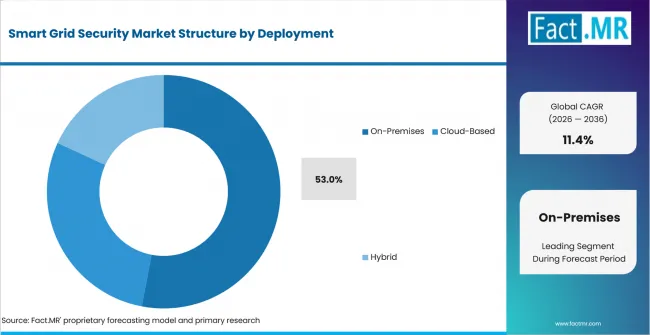
Smart Grid Security Market Analysis By Deployment | Source: Fact.MR
On-Premises leads because critical grid operations often require local control over data and recovery procedures. Cloud-Based and Hybrid models gain attention where cloud security governance can be proven without weakening utility oversight.
What is accelerating Smart Grid Security Market adoption, and what is holding it back?
Demand is expected to rise as utilities strengthen network security and protect smart meters. High integration costs and complex validation of older systems may slow adoption.
Drivers Impact Analysis
| DRIVER | (~) % IMPACT ON CAGR | GEOGRAPHIC RELEVANCE | IMPACT TIMELINE |
|---|---|---|---|
| Network security specification pull | +9.1% | South Korea and USA | Short term (<= 2 years) |
| Smart meter security workload | +10.3% | USA and Canada | Short term (<= 2 years) |
| Utility control-system modernization | +9.1% | South Korea and Germany | Medium term (2-4 years) |
| Direct procurement and service accountability | +1.8% | North America and Europe | Medium term (2-4 years) |
| On-premises control preference | +1.4% | Critical utility sites | Long term (>= 4 years) |
Source: Fact.MR analysis. Updated Jul 31, 2026
- Network security specification pull: Utilities are expected to test suppliers on segmentation and monitoring evidence before wider grid rollouts.
- Smart meter security workload: Meter programs create many endpoints that require identity checks and secure data handling before approval.
- Utility control-system modernization: Connected substations and control rooms are anticipated to raise demand for tools that fit operational workflows.
Opportunity Impact Analysis
| OPPORTUNITY | (~) % IMPACT ON CAGR | GEOGRAPHIC RELEVANCE | IMPACT TIMELINE |
|---|---|---|---|
| Advanced metering security packages | +10.3% | USA and Canada | Medium term (2-4 years) |
| Managed grid security services | +9.1% | South Korea and UK | Medium term (2-4 years) |
| Identity and access hardening | +12.6% | Germany and Japan | Long term (>= 4 years) |
| Hybrid governance models | +8.0% | Australia and UK | Long term (>= 4 years) |
Source: Fact.MR analysis. Updated Jul 31, 2026
- Advanced metering security packages: Suppliers can improve conversion by combining meter identity, data protection and monitoring into one approval case.
- Managed grid security services: Utilities with limited security staff may prefer services that provide monitoring and response without replacing core systems.
- Identity and access hardening: Privileged access management is expected to create demand where many users touch sensitive operational systems.
Restraints Impact Analysis
| RESTRAINT | (~) % IMPACT ON CAGR | GEOGRAPHIC RELEVANCE | IMPACT TIMELINE |
|---|---|---|---|
| Integration complexity and switching cost | -1.5% | Global utility projects | Short term (<= 2 years) |
| Legacy OT compatibility | -1.1% | Mature grid networks | Short term (<= 2 years) |
| Budget scrutiny around smart meters | -10.3% | USA and Canada | Medium term (2-4 years) |
| Supplier validation burden | -9.1% | South Korea, Germany and Japan | Long term (>= 4 years) |
Source: Fact.MR analysis. Updated Jul 31, 2026
- Integration complexity and switching cost: Adoption slows when buyers cannot join new controls with existing grid systems without extra operating risk.
- Legacy OT compatibility: Older control equipment can require careful testing before security tools are allowed to monitor traffic.
- Budget scrutiny around smart meters: Meter security spending faces tighter review when utilities must justify protection costs across large device fleets.
Which countries are scaling Smart Grid Security Market fastest?
The country comparison is led by South Korea and followed by USA and Canada. Germany forms the middle point. The spread between South Korea and Japan is 2.8 percentage points.
- South Korea leads because utilities can align security specifications quickly.
- USA remains above the global rate as smart meter programs raise security review work.
- Canada stays ahead where service coverage lowers deployment uncertainty.
- Germany depends on validation evidence before utilities switch suppliers.
- Australia reflects a service-led route where supplier dependability shapes adoption.
- UK growth is shaped by regulatory fit and life-cycle value checks.
- Japan follows a quality-led path where stable operation influences selection.
Comparable CAGRs can still create different entry conditions. Timing depends on approval speed and support depth.
The full report provides country-level CAGR analysis across all main regions.
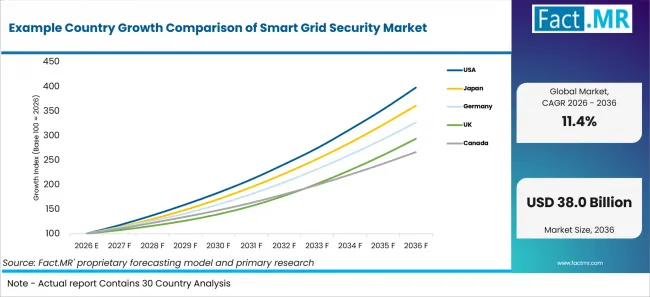
Example Country Growth Comparison Of Smart Grid Security Market | Source: Fact.MR
| Country | CAGR (2026-2036) |
|---|---|
| South Korea | 9.1% |
| USA | 14.8% |
| Canada | 10.3% |
| Germany | 12.6% |
| Australia | 8.0% |
| UK | 11.4% |
| Japan | 13.7% |
Source: Fact.MR analysis. Updated Jul 31, 2026
What supports South Korea adoption?
13.1% CAGR, supported by utility modernization and fast supplier alignment.
South Korea’s utility buyers evaluate security fit before approving new grid controls. Demand is expected to move faster when suppliers provide installation evidence and response support.
How is USA scaling demand?
12.2% CAGR, driven by smart meter protection and service accountability.
In USA, smart meter protection is expected to raise supplier review. Providers gain a clearer route when controls protect meter data and support field teams.
What supports Canada adoption?
11.5% CAGR, backed by remote service needs and grid reliability expectations.
Canada’s large service territories make support coverage part of the buying decision. Providers that reduce deployment uncertainty are expected to gain better access.
How is Germany developing demand?
11.1% CAGR, supported by validation discipline and utility procurement review.
Germany moves through a careful approval route where utilities ask for proof before switching security suppliers. Direct Enterprise Sales remain useful when vendors must explain responsibility clearly.
What shapes Australia’s outlook?
10.8% CAGR, led by service dependability and on-premises control needs.
Distance-sensitive grid operations make supplier dependability central to Australia’s demand path. On-Premises deployment stays relevant when utilities want predictable recovery for sensitive sites.
How does UK perform?
10.6% CAGR, supported by regulatory fit and life-cycle value checks.
UK buyers are expected to review Smart Grid Security through governance and service quality. Managed services may help utilities that need support without replacing core systems.
What supports Japan’s growth?
10.3% CAGR, backed by reliability expectations and compact deployment requirements.
Japan’s approval path reflects a quality-led market where tools must operate reliably. Validation evidence and support depth remain central to scale-up.
Who leads the Smart Grid Security Market?
IBM Corporation and Siemens AG show the direct relevance. Cisco Systems, Inc. and Schneider Electric SE strengthen the wider utility security and grid automation landscape.
IBM Corporation supports the market through cybersecurity services. Siemens AG contributes grid automation depth. Cisco Systems, Inc. adds networking and security capabilities. Schneider Electric SE supports digital grid portfolios. The remaining profiled companies widen provider coverage.
From 2026 to 2036, competition is expected to depend on integration proof and service coverage. Utilities are likely to compare suppliers on protection of smart meters, substations and energy storage systems.
Which companies are the key providers?
Key companies include IBM Corporation, Siemens AG, Cisco Systems, Inc., Schneider Electric SE, Honeywell International Inc., GE Vernova Inc., BAE Systems plc, and Palo Alto Networks, Inc.
- IBM Corporation
- Siemens AG
- Cisco Systems, Inc.
- Schneider Electric SE
- Honeywell International Inc.
- GE Vernova Inc.
- BAE Systems plc
- Palo Alto Networks, Inc.
Bibliography
- U.S. Department of Energy. (2024, January 17). DOE announces $30 million funding for next-generation cybersecurity tools to protect clean energy infrastructure.
- Cybersecurity and Infrastructure Security Agency. (2024, May 1). CISA and partners release fact sheet on defending OT operations against ongoing pro-Russia hacktivist activity.
- Federal Energy Regulatory Commission. (2024, August 26). FERC staff report offers lessons learned from 2024 CIP audits.
- Cybersecurity and Infrastructure Security Agency. (2024, October 1). ASD’s ACSC, CISA, FBI, NSA, and international partners release guidance on principles of OT cybersecurity for critical infrastructure organizations.
This Report Answers
- The report provides strategic intelligence on the Smart Grid Security Market across Security Type and Application choices that shape utility protection programs.
- Segment analysis covers Network Security and Smart Meters as the share leaders within the 2026 market.
- Country outlook evaluates South Korea and USA alongside Canada and Germany. Australia, UK and Japan complete the growth comparison.
- Competitive analysis profiles IBM Corporation and Siemens AG with Cisco Systems, Inc. and Schneider Electric SE. The remaining listed companies complete the provider set.
- Deployment assessment covers On-Premises and Cloud-Based models. Hybrid deployment completes the view.
What does the Smart Grid Security Market cover?
Smart Grid Security covers tools and services that protect connected grid operations, field devices and control systems.
The Smart Grid Security Market covers Network Security, Smart Meters and utility data centers. Coverage extends to grid communication and substations when protection is tied to smart grid operation.
What is included in the scope?
Smart grid security solutions are used across electric utilities and grid operators. Energy-service buyers, industrial users and public-sector buyers are included when they protect connected grid infrastructure.
The scope includes Security Type and Application with End User, Distribution Channel and Deployment. Coverage spans Network Security and Smart Meters. On-Premises and Hybrid deployments follow the same grid-protection rule.
What is excluded from the scope?
General corporate cybersecurity and unrelated infrastructure spending remain outside the scope of this market.
The scope excludes tools that do not protect smart grid assets or utility operational technology. Standalone office endpoint protection is excluded. General cloud security is excluded unless it protects grid control or meter data.
How Was the Analysis Built?
The analysis draws on 120+ sources and 35+ company portfolios. It also reviews 25+ countries and more than 20 industry interviews.
- Primary Research: Primary research includes discussions with manufacturers and service providers. These conversations examine purchasing priorities and approval requirements that influence wider market acceptance.
- Desk Research: Desk research covers government statistics and regulatory publications. Company filings, trade data and standards are reviewed when they support the market boundary. Every retained source is documented in the bibliography.
- Market Sizing and Forecasting: Market estimates combine historical performance and demand indicators. Segment shares, country growth and barriers to market expansion are tested before the final forecast is set.
- Data Validation and Update Cycle: Findings are validated by comparing interviews with public data and company activity. Regular updates review launches, approvals and shifts in commercial adoption.
Segmentation
What is the report’s scope and coverage?
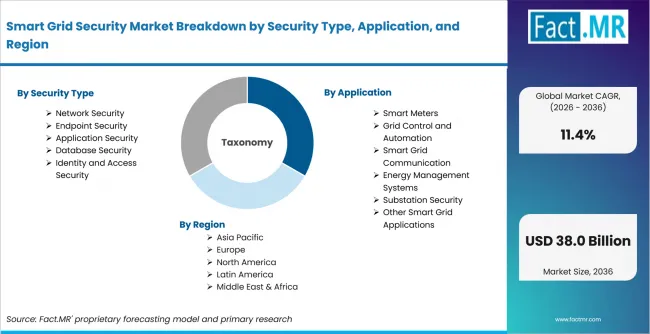
Smart Grid Security Market Breakdown By Security Type, Application, And Region | Source: Fact.MR
| Attribute | Details |
|---|---|
| Quantitative Units | USD billion in 2026 to USD billion by 2036 at CAGR |
| Market Definition | Security software, hardware, and managed services used to protect smart grid assets, meter data, control systems, and utility operational technology |
| Security Type | Network Security; Firewalls and Network Segmentation; Intrusion Detection and Prevention; Endpoint Security; Identity and Access Security |
| Application | Smart Meters; Advanced Metering Infrastructure; Grid Control and Automation; Smart Grid Communication; Substation Security; Microgrid Security |
| End User | Electric Utilities; Electricity Generation Utilities; Transmission and Distribution Utilities; Grid Operators; Energy Retailers; Industrial Energy Users |
| Distribution Channel | Direct Enterprise Sales; Direct Utility Contracts; Long-Term Enterprise Agreements; System Integrators; Managed Security Service Providers; Cloud and Digital Marketplaces |
| Deployment | On-Premises; Utility Data Centers; Local Grid Control Infrastructure; Cloud-Based; Private Cloud Deployment; Hybrid |
| Regions Covered | North America; Latin America; Europe; East Asia; South Asia and Oceania; Middle East and Africa |
| Countries Covered | South Korea; USA; Canada; Germany; Australia; UK; Japan |
| Key Companies Profiled | IBM Corporation; Siemens AG; Cisco Systems, Inc.; Schneider Electric SE; Honeywell International Inc.; GE Vernova Inc.; BAE Systems plc; Palo Alto Networks, Inc. |
| Forecast Period | 2026 to 2036 |
| Approach | Hybrid top-down and bottom-up assessment using utility security demand; smart meter protection needs; country adoption routes; company participation; and public evidence |
Source: Fact.MR analysis. Updated Jul 31, 2026
How is the market segmented?
-
By Security Type
- Network Security
- Firewalls and Network Segmentation
- Intrusion Detection and Prevention
- Endpoint Security
- Endpoint Detection and Response
- Anti-Malware and Device Protection
- Application Security
- Application Security Testing
- Runtime Application Protection
- Database Security
- Database Encryption
- Database Activity Monitoring
- Identity and Access Security
- Identity and Access Management
- Privileged Access Management
- Network Security
-
By Application
- Smart Meters
- Advanced Metering Infrastructure
- Smart Meter Data Security
- Grid Control and Automation
- SCADA and Control Systems
- Distribution Automation Systems
- Smart Grid Communication
- Wide Area Networks
- Field Area Networks
- Energy Management Systems
- Distributed Energy Management
- Demand Response Management
- Substation Security
- Digital Substation Security
- Substation Automation Protection
- Other Smart Grid Applications
- Microgrid Security
- Energy Storage and DER Security
- Smart Meters
-
By End User
- Electric Utilities
- Electricity Generation Utilities
- Transmission and Distribution Utilities
- Grid Operators
- Transmission System Operators
- Distribution System Operators
- Energy Retailers
- Electricity Retail Companies
- Energy Service Providers
- Industrial Energy Users
- Manufacturing Facilities
- Process Industries
- Commercial and Institutional Users
- Commercial Buildings
- Public and Institutional Facilities
- Government and Public Sector
- Municipal Utilities
- Defense and Critical Infrastructure Agencies
- Electric Utilities
-
By Distribution Channel
- Direct Enterprise Sales
- Direct Utility Contracts
- Long-Term Enterprise Agreements
- System Integrators
- Grid Technology Integrators
- Cybersecurity System Integrators
- Value-Added Resellers
- Utility Technology Resellers
- Cybersecurity Solution Resellers
- Managed Security Service Providers
- Managed Detection and Response
- Security Operations Center Services
- Cloud and Digital Marketplaces
- Cloud Security Marketplaces
- Digital Solution Platforms
- Other Channels
- Consulting-Led Procurement
- Government and Public Tenders
- Direct Enterprise Sales
-
By Deployment
- On-Premises
- Utility Data Centers
- Local Grid Control Infrastructure
- Cloud-Based
- Public Cloud Deployment
- Private Cloud Deployment
- Hybrid
- Hybrid IT-OT Security
- Hybrid Cloud Grid Security
- On-Premises
-
By Region
- North America
- Latin America
- Europe
- East Asia
- South Asia and Oceania
- Middle East and Africa
Frequently Asked Questions
Which Security Type leads the market?
Which Application leads the market?
Which End User leads the market?
Which Distribution Channel leads the market?
Which Deployment leads the market?
Which country records the highest listed CAGR?
What is the primary driver in this market?
What is the main restraint?
Who worked on this report


Preview the report firsthand - request a free sample
Free SampleGet the brochure for pricing and purchase details
Download PDF