- Market Value (2025): USD 2.9 Bn
- Estimated Value (2026): USD 3.3 Bn
- Forecast Value (2036): USD 12.5 Bn
- CAGR (2026-2036): 14.2%
What is the Snack-Ready Compostable Laminates Market forecast to be worth by 2036?
USD 3.3 Billion in 2026 to USD 12.5 Billion by 2036 at a 14.2% CAGR.
- The Snack-Ready Compostable Laminates Market reached USD 2.9 billion in 2025.
- Demand is projected to increase from USD 3.3 Billion in 2026 to USD 12.5 Billion by 2036.
- The market is forecast to record 14.2% CAGR from 2026 to 2036 as snack brands and pack makers test pack structures for compostable packs.
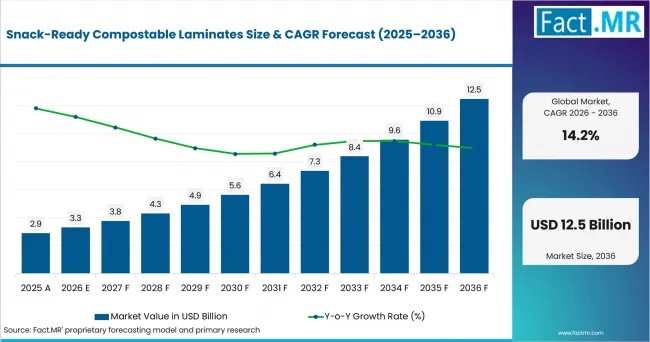
Snack Ready Compostable Laminates Value Analysis | Source: Fact.MR
What are the defining numbers behind Snack-Ready Compostable Laminates Market growth?
An absolute opportunity of USD 9.2 Billion is expected between 2026 and 2036.
- Demand Drivers in the Market
- Snack brands need packs that protect crispness and aroma while supporting a certified compostable waste route. In June 2026, the U.S. Department of Agriculture Economic Research Service reported that inflation-adjusted U.S. food spending reached USD 2.51 trillion in 2025, reflecting the large scale of the domestic food market.
- Packaging converters need resins that seal and run on established pouch or flow-wrap equipment. Testing becomes easier when a compostable web enters existing lamination, printing and sealing steps with limited line adjustment.
- Retail pack teams need a clear waste instruction that matches the full pack structure. Plant compost and home compost use different test paths, so the claim should be set before artwork and pack specs are locked.
- Food manufacturers need steady oxygen, moisture and grease control across small packs. Shelf-life fit carries extra weight in snack formats because a thin pack must protect quality through shipping and shelf storage.
- Key Segments Analyzed
- By Laminate Platform: PLA-based is expected to hold 29.0% share in 2026 owing to established film processing and a broad base of flexible-pack applications.
- By Barrier Level: High oxygen barrier is projected to account for 36.0% share in 2026 because oxidation control is central to snacks containing fats, flavors or aroma-sensitive ingredients.
- By Pack Format: Single-serve sachets are anticipated to capture 31.0% share in 2026 supported by portion control and the low material weight of flexible formats.
- By End-of-Life: Industrial compostable is estimated to represent 37.0% share in 2026 shaped by certified systems that use controlled temperature, moisture and residence time.
- Analyst Opinion at Fact.MR
- Shambhu Nath Jha, Principal Consultant at Fact.MR, states, “A compost claim adds a waste route, while snack brands still need proof on oxygen control, moisture control, seal behavior and line speed. Firms that pair resin know-how with pack design and proof support are expected to cut the number of reformulation steps between a pack trial and market launch.”
- Strategic Implications
- Resin makers should publish barrier and sealing data by pack construction so pack firms can compare fit before committing machine time to trials. In September 2026, ADEME published the English version of its 2024 household packaging and graphic papers report, stating that approximately 4,893 kt were sorted for recycling in France in 2024.
- Snack brands should test oxygen and moisture control against the actual product because chips, nuts, cereal bars and powders have different shelf-life needs.
- Waste-system partners should state which compostable pack formats they accept so brand claims match real collection and treatment settings. Clear guidance helps brands choose the waste route at the design stage and reduces late pack changes.
France is forecast to record 15.1% CAGR through 2036 as food-pack rules and composting access shape resin choice. China is projected at 14.4% backed by large packaged-food and retail channels. The USA and Japan are each anticipated at 13.9%, while Germany is estimated at 13.7% as brands balance compost claims with current reuse rules.
How does the Snack-Ready Compostable Laminates Market break down by segment?
High oxygen barrier leads Barrier Level at 36.0% share in 2026; Industrial compostable leads End-of-Life at 37.0% share.
Which Laminate Platform dominates?
PLA-based is expected to hold 29.0% share in 2026.
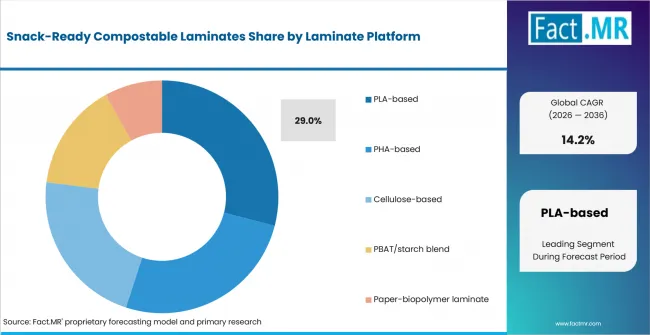
Snack Ready Compostable Laminates Analysis By Laminate Platform | Source: Fact.MR
PLA-based laminates lead because they combine transparency, orientation, and heat-sealable performance in lightweight snack packaging. Their established processing compatibility supports efficient converting, reliable sealing, and flexible pack design, helping brands balance product protection with compostable material requirements across varied formats.
What leads the Barrier Level segment?
High oxygen barrier is projected to account for 36.0% share in 2026.
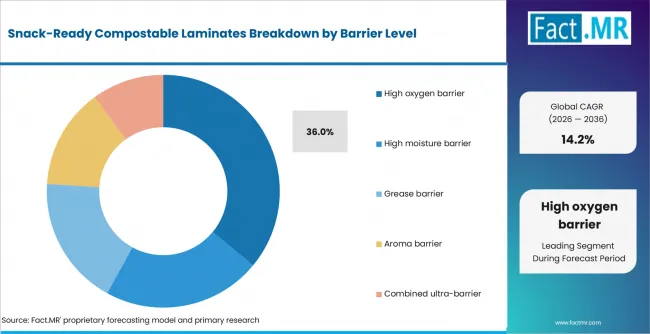
Snack Ready Compostable Laminates Analysis By Barrier Level | Source: Fact.MR
High oxygen barrier is projected to lead because oxidation can change flavor and fat stability before a snack reaches the consumer. Moisture control protects crispness or powder flow, while grease and aroma barriers serve product-specific needs.
How does Pack Format shape demand?
Single-serve sachets are anticipated to capture 31.0% share in 2026.
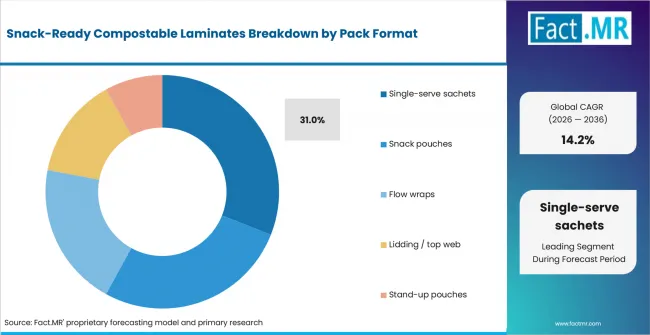
Snack Ready Compostable Laminates Analysis By Pack Format | Source: Fact.MR
Single-serve sachets are anticipated to lead because they use little film per portion and fit powders or snack-size servings. Snack pouches add display space, while flow wraps fit bars and individual pieces.
What supports Industrial compostable within End-of-Life?
Industrial compostable is estimated to represent 37.0% share in 2026.
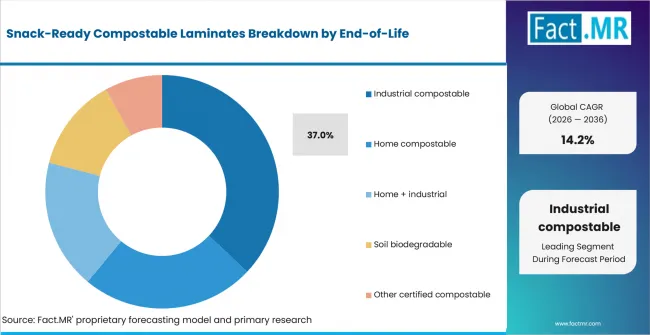
Snack Ready Compostable Laminates Analysis By End Of Life | Source: Fact.MR
Plant-compost packs are estimated to lead because controlled sites provide set heat, moisture and time conditions. Home-compostable formats need a different proof route, while dual home-and-plant claims broaden waste options.
What is accelerating Snack-Ready Compostable Laminates Market adoption, and what is holding it back?
Barrier-qualified snack formats support adoption; disposal-system fit and qualification cost restrain it.
Drivers Impact Analysis
| DRIVER | (~) % IMPACT ON CAGR | GEOGRAPHIC RELEVANCE | IMPACT TIMELINE |
|---|---|---|---|
| Snack-brand conversion to certified compostable flexible packs | +1.8% | North America, Europe | Short term (<= 2 years) |
| Improved oxygen and moisture barrier performance | +1.5% | Global | Medium term (2-4 years) |
| Single-serve and flow-wrap material efficiency | +1.1% | East Asia, North America | Medium term (2-4 years) |
| Broader PLA, PHA and cellulose film qualification | +0.8% | Global | Long term (>= 4 years) |
Source: Fact.MR analysis. Updated Sep 25, 2026
Opportunity Impact Analysis
| OPPORTUNITY | (~) % IMPACT ON CAGR | GEOGRAPHIC RELEVANCE | IMPACT TIMELINE |
|---|---|---|---|
| Home-compostable high-barrier snack laminates | +1.2% | Europe, North America | Medium term (2-4 years) |
| Paper-biopolymer laminates with food-soiling pathways | +0.9% | Europe, Japan | Long term (>= 4 years) |
| Converter-ready structures for existing packaging lines | +0.7% | Global | Short term (<= 2 years) |
Source: Fact.MR analysis. Updated Sep 25, 2026
Restraints Impact Analysis
| RESTRAINT | (~) % IMPACT ON CAGR | GEOGRAPHIC RELEVANCE | IMPACT TIMELINE |
|---|---|---|---|
| Uneven composting acceptance for flexible packaging | -0.9% | Global | Medium term (2-4 years) |
| Shelf-life validation for moisture-sensitive snacks | -0.7% | Global | Short term (<= 2 years) |
| Competition from established recycling systems | -0.5% | Europe, Japan | Long term (>= 4 years) |
Source: Fact.MR analysis. Updated Sep 25, 2026
Which countries are scaling the Snack-Ready Compostable Laminates Market through 2036?
- The country comparison spans 1.4 percentage points across the five profiled markets.
- France is 0.7 percentage point above China as food-pack rules and organics collection keep waste-route design visible to brands.
- China is 0.5 percentage point above the USA as packaged-food retail and output scale support high-volume film-pack trials.
- The USA and Japan both record 13.9%, although firm choice differs because composting access, food output and reuse systems vary.
- Germany closes the displayed range at 13.7% as snack and ready-food demand meets strict pack-reuse and recyclability rules.
Comparable CAGRs create different entry settings because food output, pack rules, collection systems and line needs vary by country. France pairs food output with active waste policy, while China offers scale in retail and pack making. The USA and Japan share a 13.9% CAGR but differ in channel mix. Germany combines a dense food base with strict pack rules.
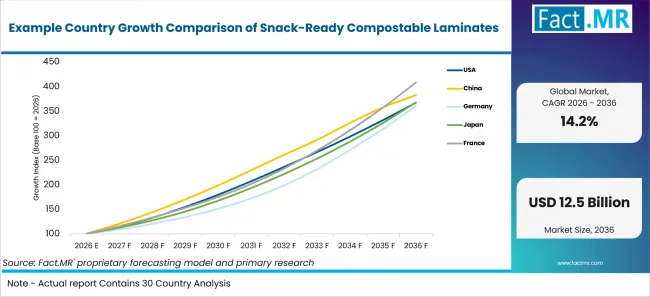
Example Country Growth Comparison Of Snack Ready Compostable Laminates | Source: Fact.MR
| Country | CAGR (2026-2036) |
|---|---|
| France | 15.1% |
| China | 14.4% |
| United States | 13.9% |
| Japan | 13.9% |
| Germany | 13.7% |
Source: Fact.MR analysis. Updated Sep 25, 2026
What supports USA adoption?
13.9% CAGR, supported by snack-pack demand and food-manufacturing scale.
U.S. food manufacturers create a large test base for snack film packs. In September 2026, the U.S. Census Bureau reported that U.S. food manufacturing recorded an estimated USD 1,054.3 billion in value of shipments in 2024. That output scale supports repeated pouch, sachet and flow-wrap runs where pack makers can test compostable structures against shelf-life and seal targets. Adoption therefore depends on proving pack fit on current lines while keeping the waste claim clear for the sales region.
How is China scaling demand?
14.4% CAGR, led by packaged-food retail and processing scale.
China combines high-volume food retail with a large base of film-pack makers. In January 2026, the National Bureau of Statistics of China reported that retail sales of grain, oil and food by enterprises above the designated size reached RMB 2.3991 trillion in 2025. That channel scale gives snack brands room to test light compostable formats across large runs. Firm choice is expected to favor structures that pair reliable seals with sound oxygen and moisture control.
What supports Germany’s adoption?
13.7% CAGR, shaped by ready-food output and packaging recovery rules.
Germany offers a food-pack setting where product care and waste-route design are assessed together. In January 2026, Destatis reported that 1.7 million tonnes of ready meals were produced in Germany in 2024. High-throughput food output supports steady seal and barrier needs across compact film formats. Compostable-pack firms therefore need clear structure data that helps pack makers compare oxygen care, moisture control and the intended reuse route before market testing.
How does Japan perform?
13.9% CAGR, backed by food-industry scale and high packaging functionality.
Japan’s packaged-food base puts a premium on compact formats that retain product quality through shipping and retail storage. In March 2026, Japan’s Ministry of Agriculture, Forestry and Fisheries reported that the domestic production value of the food industry reached JPY 101.48 trillion in 2024. That scale supports continued use of sachets, wraps and small pouches. Compostable structures are expected to progress where barrier fit, print quality and seal behavior match current food-pack workflows.
What supports France’s growth?
15.1% CAGR, driven by food manufacturing and packaging-policy pressure.
France combines a large food-plant base with active pack-reuse policy. In July 2026, INSEE reported that the production value of France’s food, beverage, and tobacco manufacturing industry reached EUR 207 billion in 2025. That base supports frequent demand for snack pouches and portion packs that need steady barrier fit. Compostable packs are expected to gain market fit when brands set the waste route early and test the full printed and laminated structure.
Who leads the Snack-Ready Compostable Laminates Market?
Parkside Flexibles, Grounded Packaging, BASF, Taghleef Industries, TIPA, and Futamura Chemical form the profiled competitive group. Together, they represent different positions across compostable films, biopolymer platforms, cellulose-based materials, and converted flexible-pack structures used for snack applications.
BASF has a clearly documented role through its ecovio portfolio for flexible packaging. Its development work addresses compostable structures with multiple barrier options and routes linked to organic or paper recycling, placing the company close to applications where barrier performance and end-of-life design must be considered together.
Parkside Flexibles, Grounded Packaging, Taghleef Industries, TIPA, and Futamura Chemical broaden the competitive field around snack-ready laminate requirements. Supplier relevance depends on how effectively a material or converted structure can combine oxygen and moisture protection with dependable sealing, printability, machine compatibility, and a clearly defined compostability route.
Which companies are the key providers?
Key companies include Parkside Flexibles; Grounded Packaging; BASF; Taghleef Industries; TIPA; and Futamura Chemical.
- Parkside Flexibles
- Grounded Packaging
- BASF
- Taghleef Industries
- TIPA
- Futamura Chemical
Bibliography
- Zeballos, E., & Sinclair, W. (2026, June 11). Total U.S. food spending reached $2.51 trillion in 2025. U.S. Department of Agriculture, Economic Research Service.
- Van de Voorde, J. (2026, March). Household packaging and graphic papers: Data 2024. ADEME.
- U.S. Census Bureau. (2026, September 3). Census Bureau releases new Annual Integrated Economic Survey data.
- National Bureau of Statistics of China. (2026, January 20). Total retail sales of consumer goods in December 2025.
- Statistisches Bundesamt (Destatis). (2026, January 14). Produktion von Fertiggerichten binnen fünf Jahren mengenmäßig um 25,6 % gestiegen [Production of ready meals increased by 25.6% in volume within five years].
- Institut national de la statistique et des études économiques. (2026, July 21). Indicateurs macroéconomiques de l’industrie manufacturière : Données annuelles de 2010 à 2025.
- BASF. (2026, April 29). New ecovio® portfolio for flexible packaging: Multiple barrier options combined with organic or paper recycling.
This Report Answers
- The report explains where snack-ready compostable laminates fit across laminate platform, barrier level, pack format and end-of-life route.
- Segment analysis identifies the displayed share leaders and the operational reasons brands or converters prioritize them.
- Country analysis compares the United States, China, Germany, Japan and France using food-market scale, packaging systems and country-specific constraints.
- Competitive analysis reviews the profiled providers across PLA, compostable biopolymers, cellulose films and converted compostable laminates.
- Application analysis examines how oxygen barrier, moisture barrier, seal behavior and disposal claims influence supplier and structure selection.
What does the Snack-Ready Compostable Laminates Market cover?
The Snack-Ready Compostable Laminates Market covers flexible multilayer or coated structures designed for snack packaging where compostability forms part of the specified end-of-life route. The assessment connects with compostable laminate packaging materials and compostable PHA film packaging where film layers, barrier functions and certified disposal routes overlap with snack packs.
Material scope includes PLA, PHA, cellulose, PBAT/starch blends and paper-biopolymer combinations. Related material context includes home-compostable PHA polymers and biopolymer films when the film or laminate can be converted into food-contact flexible packaging.
What is included in the scope?
The scope includes snack sachets, pouches, flow wraps, lidding webs and stand-up pouches when the finished structure is designed for a certified compostable or related biodegradable route. Broader context from biodegradable packaging materials and sustainable food packaging is included only where it informs food-contact flexible structures.
Barrier layers remain inside scope when they support oxygen, moisture, grease or aroma protection without moving the finished structure outside its intended compostability claim. Adjacent technology views include bio-based barrier coatings and PHA paper coatings where coatings form part of a snack-ready laminate.
What is excluded from the scope?
The scope excludes conventional non-compostable snack laminates, rigid packaging sold without a compostable flexible component, and standalone resins that sit outside laminate or film applications. biobased PHA coatings is adjacent only when a PHA layer becomes part of the laminate structure.
It also excludes coating systems used solely on non-flexible industrial substrates. PHA extrusion coatings is relevant only when the extrusion-coated layer contributes barrier or seal performance within a food-packaging laminate.
How Was the Analysis Built?
The analysis draws on 120+ sources, 35+ company portfolios, 25+ countries, and more than 20 industry interviews.
- Primary Research: Primary research includes discussions with manufacturers, service providers, technology developers, distributors, end users, and subject-matter experts. These conversations examine purchasing priorities, product adoption, operational challenges, approval requirements, competitive positioning, and the factors that influence wider market acceptance.
- Desk Research: Desk research covers government statistics, regulatory publications, company filings, trade data, technical studies, industry associations, standards, public policy, and other authoritative sources. Every source used in the analysis is documented in the bibliography.
- Market Sizing and Forecasting: Market estimates combine historical performance, demand indicators, pricing and volume trends, segment shares, company participation, country-level growth, adoption patterns, investment activity, and barriers to market expansion.
- Data Validation and Update Cycle: Findings are validated by comparing primary interviews with public data, company activity, regulatory changes, trade patterns, and industry developments. Regular updates review new product launches, capacity changes, partnerships, approvals, and shifts in commercial adoption.
Segmentation
What is the report’s scope and coverage?
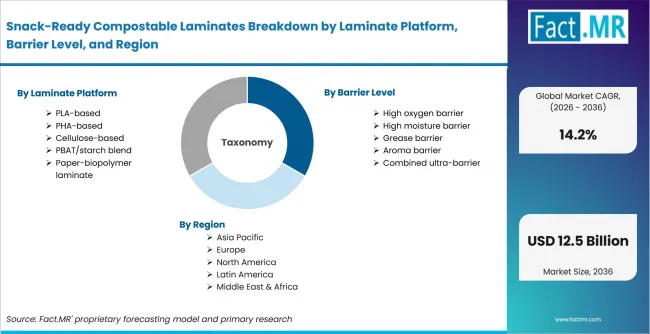
Snack Ready Compostable Laminates Breakdown By Laminate Platform, Barrier Level, And Region | Source: Fact.MR
| Attribute | Details |
|---|---|
| Quantitative Units | USD Billion |
| Market Definition | Compostable multilayer or coated flexible structures designed for snack packaging, combining sealability and barrier performance with a certified compostable or biodegradable end-of-life route. |
| Laminate Platform | PLA-based; PHA-based; Cellulose-based; PBAT/starch blend; Paper-biopolymer laminate |
| Barrier Level | High oxygen barrier; High moisture barrier; Grease barrier; Aroma barrier; Combined ultra-barrier |
| Pack Format | Single-serve sachets; Snack pouches; Flow wraps; Lidding / top web; Stand-up pouches |
| End-of-Life | Industrial compostable; Home compostable; Home + industrial; Soil biodegradable; Other certified compostable |
| Regions Covered | North America; Latin America; Western Europe; Eastern Europe; East Asia; South Asia & Pacific; Middle East & Africa |
| Countries Covered | United States; China; Germany; Japan; France |
| Key Companies Profiled | Parkside Flexibles; Grounded Packaging; BASF; Taghleef Industries; TIPA; Futamura Chemical |
| Forecast Period | 2026 to 2036 |
| Approach | Hybrid top-down and bottom-up approach using flexible packaging applications, barrier requirements, compostability routes, country demand signals and provider portfolio review. |
Source: Fact.MR analysis. Updated Sep 25, 2026
How is the market segmented?
-
By Laminate Platform:
- PLA-based
- PHA-based
- Cellulose-based
- PBAT/starch blend
- Paper-biopolymer laminate
-
By Barrier Level:
- High oxygen barrier
- High moisture barrier
- Grease barrier
- Aroma barrier
- Combined ultra-barrier
-
By Pack Format:
- Single-serve sachets
- Snack pouches
- Flow wraps
- Lidding / top web
- Stand-up pouches
-
By End-of-Life:
- Industrial compostable
- Home compostable
- Home + industrial
- Soil biodegradable
- Other certified compostable
-
By Region:
- North America
- Latin America
- Western Europe
- Eastern Europe
- East Asia
- South Asia & Pacific
- Middle East & Africa
Frequently Asked Questions
How big is the Snack-Ready Compostable Laminates Market in 2026?
What is the CAGR of the Snack-Ready Compostable Laminates Market from 2026 to 2036?
Which barrier level leads the Snack-Ready Compostable Laminates Market?
Which end-of-life route leads the Snack-Ready Compostable Laminates Market?
Who are the leading companies in the Snack-Ready Compostable Laminates Market?
Who worked on this report


Preview the report firsthand - request a free sample
Free SampleGet the brochure for pricing and purchase details
Download PDF