The Snow Chains and Traction Devices Market is analyzed across its key product, application and end-use segments, with the study covering market dynamics, regional trends and demand outlook, forecast 2026 to 2036.
By Fact.MR Automotive DeskLead analyst:
Shubham PatidarPublished :
Updated :
13 min read
Fact-checked under the Fact.MR editorial process
Snow Chains and Traction Devices Market Forecast and Outlook 2026 to 2036
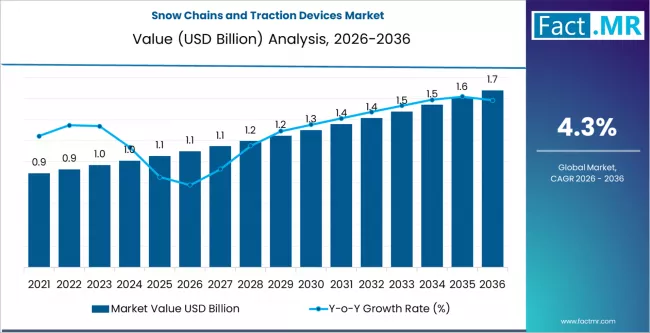
The global snow chains and traction devices market is projected to grow from USD 1.1 billion in 2026 to USD 1.7 billion by 2036, depicting a compound annual growth rate (CAGR) of 4.3% between 2026 and 2036.
Government regulations for snow chains and traction devices are aimed at ensuring road safety, performance, and proper use under winter conditions.
Many countries and regions require vehicles to carry approved traction devices such as snow chains or specific winter tires in designated snowy or icy zones during certain months or when signs indicate their use, with enforcement by traffic authorities.
Snow Chains And Traction Devices Market Market Value Analysis | Source: Fact.MR
Summary of Snow Chains and Traction Devices Market
Market Snapshot
Global snow chains and traction devices market revenue stood atUSD 1.1 billion in 2026and is forecast to reachUSD 1.7 billion by 2036.
The market is projected to expand at a4.3%CAGRfrom 2026 to 2036.
Growth is being driven by increasing focus onwinter driving safety, traction control, and regulatory complianceacross snow-prone regions.
Snow chains and traction devices are becoming essential winter mobility solutions for passenger vehicles, SUVs, and commercial fleetsoperatingin icy and snow-covered road conditions.
Demand and Growth Drivers
Government regulations mandating approved traction devices in snow-prone regions are accelerating market adoption.
Rising winter tourism and increasing vehicle movement across mountainous regions are supporting demand for snow traction systems.
Automotive operators are prioritizing enhanced traction control and operational safety during extreme winter conditions.
Manufacturers are developing lightweight and easy-install traction devices to improve usability and compatibility across vehicle categories.
Expansion of winter road safety initiatives and seasonal tire regulations is supporting long-term market growth.
Product and Segment View
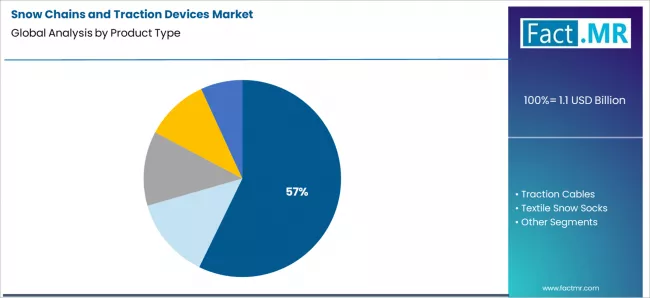
Traditional snow chains hold 57.2% of product type segment share in 2026,emergingas the leading segment due to superior traction reliability and durability.
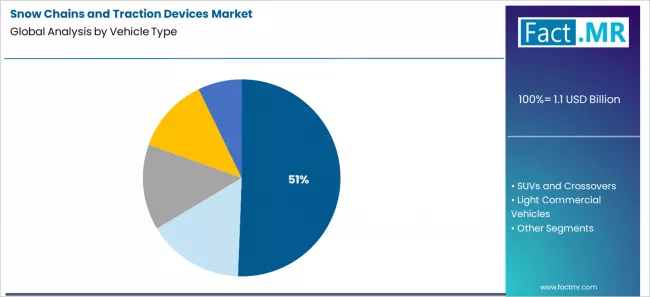
Passenger cars account for 50.6% of vehicle type segment share in 2026, positioning them as the dominant application category.
Key product categories include:
Traditional snow chains
Traction cables
Textile snow socks
Plastic or composite traction aids
Material categories include:
Steel chains
Alloy steel
Composite or polymer
Textile materials
Sales channels include:
Auto parts and winter retail
Online retail
OEM or dealer channels
Tire dealers
Geography and Competitive Outlook
North America, Europe, and Asia Pacificrepresent the key growth regions, supported by strong winter safety regulations and seasonal automotive demand.
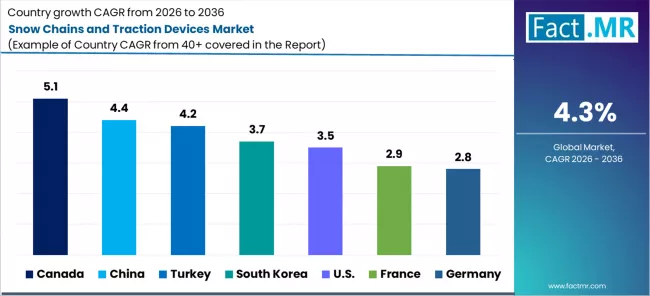
Canada (5.1%CAGR), China (4.4%),Turkey(4.2%), South Korea (3.7%), U.S. (3.5%), France (2.9%), Germany (2.8%), and Japan (2.3%)are key growth markets.
Auto Parts & Winter Retail, Online Retail, OEM/Dealer, Tire Dealers
Segmentation by Region
North America, Latin America, Western Europe, Eastern Europe, East Asia, South Asia & Pacific, Middle East & Africa
Source: Fact.MR analysis. Updated May 12, 2026
Standards set by national transportation agencies or standards bodies define design, durability, and performance criteria that traction devices must meet to be legally sold and used, covering factors like chain strength, link size, and compatibility with vehicle types. In addition, some jurisdictions specify that devices must not damage road surfaces or interfere with vehicle control systems, and they regulate the labeling and instructions provided by manufacturers to ensure correct installation and removal. Failure to comply with these regulations can result in fines or restrictions on road access during adverse weather periods.
Category
Category
Segments
Product Type
Traditional Snow Chains; Traction Cables; Textile Snow Socks; Plastic or Composite Traction Aids; Other
Vehicle Type
Passenger Cars; SUVs and Crossovers; Light Commercial Vehicles; Heavy Commercial Vehicles; Other
Material
Steel Chains; Alloy Steel; Composite or Polymer; Textile
Sales Channel
Auto Parts and Winter Retail; Online Retail; OEM or Dealer; Tire Dealers; Other
Region
North America; Europe; Asia Pacific; Latin America; Middle East & Africa
Source: Fact.MR analysis. Updated May 12, 2026
Segmental Analysis
By Product Type, Which Segment Holds the Dominant Share in the Snow Chains and Traction Devices Market?
Snow Chains And Traction Devices Market Analysis By Product Type | Source: Fact.MR
In terms of product type, the traditional snow chains segment leads the market with 57.2% share. Automotive professionals and safety specialists increasingly utilize traditional snow chains for their superior traction control properties and operational reliability characteristics.
Manufacturing investments in advanced traction technology and automotive infrastructure continue to strengthen adoption among performance-focused automotive facilities.
With automotive professionals prioritizing equipment system performance and operational validation, traditional snow chain modules align with both safety objectives and operational requirements, making them the central component of comprehensive winter driving monitoring strategies.
By Vehicle Type, Which Segment Registers the Highest Share in the Snow Chains and Traction Devices Market?
Snow Chains And Traction Devices Market Analysis By Vehicle Type | Source: Fact.MR
By vehicle type, passenger cars dominates with 50.6% share, underscoring its critical role as the primary application category for consumer markets seeking superior traction control capabilities and enhanced operational safety credentials. Vehicle safety engineers and automotive operators prefer snow chains and traction device solutions for passenger cars due to their established performance validation requirements.
Consumer markets are optimizing equipment selections to support application-specific requirements and comprehensive operational control strategies.
As traction technology continues to advance and operators seek efficient automotive management methods, passenger car applications will continue to drive market growth while supporting operational performance optimization and safety cost reduction strategies.
What are the Drivers, Restraints, and Key Trends of the Snow Chains and Traction Devices Market?
Drivers: Consumer demand for enhanced winter driving performance and advanced safety distribution management initiatives drive mandatory adoption of high-performance snow chains and traction device solutions across automotive markets.
Restraint: High equipment costs and technical complexity of integrating specialized traction protocols into existing automotive management processes limit market penetration.
Trend 1: Shift toward automated traction configurations that minimize operational requirements and reduce deployment costs for automotive management.
Trend 2: Development of specialized multi-parameter compatibility systems supporting multiple automotive applications and operational condition compatibility.
Analysis of the Snow Chains and Traction Devices Market by Key Country
Snow Chains And Traction Devices Market Cagr Analysis By Country | Source: Fact.MR
Country
CAGR 2026 to 2036
Canada
5.1%
Turkey
4.2%
China
4.4%
South Korea
3.7%
U.S.
3.5%
Germany
2.8%
France
2.9%
Japan
2.3%
Source: Fact.MR analysis. Updated May 12, 2026
The report covers an in-depth analysis of 40+ countries; top-performing countries are highlighted below.
What Opportunities Can Snow Chains and Traction Devices Manufacturers Expect in Canada?
Revenue from snow chains and traction devices consumption and sales in Canada is projected to exhibit exceptional growth with a CAGR of 5.1% through 2036, driven by the country's extensive winter driving infrastructure, regulatory frameworks promoting automotive safety initiatives, and initiatives supporting advanced traction technologies across major automotive regions.
Established automotive infrastructure and expanding safety consciousness are driving demand for snow chains and traction device solutions across consumer markets, automotive developments, and comprehensive performance systems throughout Canadian automotive markets.
Strong regulatory development and technology initiatives are supporting the rapid adoption of premium traction services among safety-focused operators seeking to meet evolving operational standards and performance requirements.
What is the Chinese Snow Chains and Traction Devices Market Size?
Revenue from snow chains and traction devices products in China is projected to expand at a CAGR of 4.4%, supported by rising automotive investment, growing operational consciousness, and expanding technology service capabilities. The country's developing infrastructure and increasing investment in automotive management technologies are driving demand for snow chains and traction device solutions across both traditional and modern automotive applications.
Rising infrastructure development and expanding performance capabilities are creating opportunities for traction adoption across automotive management monitoring projects.
Growing operational awareness initiatives and traction technology advancement are driving the adoption of specialized performance equipment and services among automotive users.
What is the Turkish Snow Chains and Traction Devices Market Size?
Revenue from snow chains and traction devices products in Turkey is projected to expand at a CAGR of 4.2%, supported by rising automotive investment, growing operational consciousness, and expanding technology service capabilities. The country's developing infrastructure and increasing investment in automotive management technologies are driving demand for snow chains and traction device solutions across both traditional and modern automotive applications.
Rising infrastructure development and expanding performance capabilities are creating opportunities for traction adoption across automotive management monitoring projects.
Growing operational awareness initiatives and traction technology advancement are driving the adoption of specialized performance equipment and services among automotive users.
What Opportunities Can Snow Chains and Traction Devices Manufacturers Expect in South Korea?
Revenue from snow chains and traction devices consumption and sales in South Korea is projected to exhibit exceptional growth with a CAGR of 3.7% through 2036, driven by the country's rapidly expanding automotive infrastructure, regulatory frameworks promoting safety efficiency initiatives, and initiatives supporting advanced traction technologies across major automotive regions.
Established automotive infrastructure and expanding operational consciousness are driving demand for snow chains and traction device solutions across consumer facilities, automotive developments, and comprehensive performance systems throughout South Korean automotive markets.
Strong regulatory development and technology initiatives are supporting the rapid adoption of premium traction services among safety-focused operators seeking to meet evolving operational standards and performance requirements.
What is the U.S. Snow Chains and Traction Devices Market Size?
Revenue from snow chains and traction devices products in the U.S. is projected to grow at a CAGR of 3.5% through 2036, supported by the country's emphasis on operational precision, safety excellence, and advanced technology integration requiring efficient traction solutions. American automotive operators and performance-focused establishments prioritize performance monitoring and cost efficiency precision, making specialized snow chains and traction device services essential components for both traditional and modern automotive applications.
Advanced precision traction technology capabilities and growing automotive applications are driving demand for snow chains and traction device services across specialty performance applications.
Strong focus on operational precision and safety excellence is encouraging users and service providers to adopt traction solutions.
What Opportunities Can Snow Chains and Traction Devices Manufacturers Expect in Germany?
Revenue from snow chains and traction devices products in Germany is projected to grow at a CAGR of 2.8% through 2036, supported by the country's emphasis on analytical precision, technology excellence, and advanced automotive system integration requiring efficient traction solutions. German automotive system operators and technology-focused establishments prioritize precision performance and operational control, making specialized snow chains and traction device services essential components for both traditional and modern automotive applications.
Advanced precision technology capabilities and growing automotive applications are driving demand for traction services across specialty performance applications.
Strong focus on analytical precision and technology excellence is encouraging users and service providers to adopt snow chains and traction device solutions that support operational objectives.
What is the French Snow Chains and Traction Devices Market Size?
Revenue from snow chains and traction devices products in France is projected to grow at a CAGR of 2.9% through 2036, supported by the country's emphasis on operational precision, safety excellence, and advanced technology integration requiring efficient traction solutions. French automotive operators and performance-focused establishments prioritize performance monitoring and cost efficiency precision, making specialized snow chains and traction device services essential components for both traditional and modern automotive applications.
Advanced precision traction technology capabilities and growing automotive applications are driving demand for snow chains and traction device services across specialty performance applications.
Strong focus on operational precision and safety excellence is encouraging users and service providers to adopt traction solutions.
What is the Japanese Snow Chains and Traction Devices Market Size?
Revenue from snow chains and traction devices products in Japan is projected to grow at a CAGR of 2.3% through 2036, supported by the country's emphasis on operational precision, safety excellence, and advanced technology integration requiring efficient traction solutions. Japanese automotive operators and performance-focused establishments prioritize performance monitoring and cost efficiency precision, making specialized snow chains and traction device services essential components for both traditional and modern automotive applications.
Advanced precision traction technology capabilities and growing automotive applications are driving demand for snow chains and traction device services across specialty performance applications.
Strong focus on operational precision and safety excellence is encouraging users and service providers to adopt traction solutions.
Competitive Landscape of the Snow Chains and Traction Devices Market
The competitive landscape of the snow chains and traction devices market is composed of global tire accessory manufacturers, specialty winter equipment producers, and regional suppliers competing on product reliability, ease of use, durability, and fitment range. Established players such as Thule, Pewag, and Konig leverage long histories in winter traction solutions and broad distribution networks to serve passenger vehicles, light trucks, and commercial fleets across multiple geographies. These companies focus on material strength, intuitive installation mechanisms, and compatibility with a wide range of tire sizes to maintain relevance with both retail and dealer channels.
Alongside these incumbents, smaller and regional manufacturers compete by offering value-oriented products tailored to local winter conditions and regulatory requirements. Competition also includes aftermarket brands that emphasise quick release systems and enhanced traction performance for recreational vehicles and off-road applications. Competitive differentiation comes from innovations in chain design that reduce vibration and noise, integration with modern tire and wheel sizes, and strong customer support through retailers and service partners. Price, availability during peak winter months, and reputation for performance in severe conditions influence buyer decisions in this market.
Key Players in the Snow Chains and Traction Devices Market
Thule Group
Pewag
RUD Ketten
Weissenfels
Michelin
SCC
Peerless Chain
Quality Chain Corp.
Maggi Group
Laclede Chain
Bibliography
International Automotive Technology Association Research Committee. (2023). Automotive technologies and performance optimization in consumer control systems. International Automotive Technology Association.
International Organization for Standardization. (2023). Automotive quality management: Assessment of traction technology, operational efficiency, and quality control of snow chains and traction device systems (ISO Technical Report). ISO.
European Committee for Standardization. (2022). Automotive quality management: Evaluation of traction processing, quality control, and operational compliance in automotive facilities (EN Technical Report). CEN.
Journal of Automotive Technology Editorial Board. (2024). Traction processing, quality control, and performance optimization in modern automotive facilities. Journal of Automotive Technology, 150(4), 245-262.
Automotive Technology Agency, Technical Committee. (2023). Advances in traction processing and quality control technologies for automotive and manufacturing applications. Automotive Technology Agency.
Market Breakdown
Segmentation
Scope of the Report
Items
Values
Quantitative Units (2026)
USD 1.1 Billion
Product Type
Traditional Snow Chains, Traction Cables, Textile Snow Socks, Plastic or Composite Traction Aids, Other
Vehicle Type
Passenger Cars, SUVs and Crossovers, Light Commercial Vehicles, Heavy Commercial Vehicles, Other
Material
Steel Chains, Alloy Steel, Composite or Polymer, Textile
Sales Channel
Auto Parts and Winter Retail, Online Retail, OEM or Dealer, Tire Dealers, Other
Regions Covered
North America, Europe, Asia Pacific, Latin America, Middle East & Africa
Countries Covered
Canada, Turkey, China, South Korea, U.S., Germany, France, Japan, and other countries
Key Companies Profiled
Thule Group, Pewag, RUD Ketten, Weissenfels, Michelin, and other leading automotive companies
Additional Attributes
Dollar revenue by product type, vehicle type, material, sales channel, and region; regional demand trends, competitive landscape, technological advancements in traction technology, operational performance optimization initiatives, automotive enhancement programs, and premium traction development strategies
Source: Fact.MR analysis. Updated May 12, 2026
Snow Chains and Traction Devices Market by Segments
Product Type :
Traditional Snow Chains
Traction Cables
Textile Snow Socks
Plastic or Composite Traction Aids
Other
Vehicle Type :
Passenger Cars
SUVs and Crossovers
Light Commercial Vehicles
Heavy Commercial Vehicles
Other
Material :
Steel Chains
Alloy Steel
Composite or Polymer
Textile
Sales Channel :
Auto Parts and Winter Retail
Online Retail
OEM or Dealer
Tire Dealers
Other
Region :
North America
U.S.
Canada
Mexico
Europe
Germany
UK
France
Italy
Spain
Nordic Countries
BENELUX
Rest of Europe
Asia Pacific
China
Japan
South Korea
India
Australia
Rest of Asia Pacific
Latin America
Brazil
Argentina
Rest of Latin America
Middle East and Africa
Kingdom of Saudi Arabia
United Arab Emirates
South Africa
Rest of Middle East and Africa
Other Regions
Oceania
Central Asia
Other Markets
Questions Answered
Frequently Asked Questions
How big is the snow chains and traction devices market in 2026?
The global snow chains and traction devices market is estimated to be valued at USD 1.1 billion in 2026.
What will be the size of snow chains and traction devices market in 2036?
The market size for the snow chains and traction devices market is projected to reach USD 1.7 billion by 2036.
How much will be the snow chains and traction devices market growth between 2026 and 2036?
The snow chains and traction devices market is expected to grow at a 4.3% CAGR between 2026 and 2036.
What are the key product types in the snow chains and traction devices market?
The key product types in snow chains and traction devices market are traditional snow chains, traction cables , textile snow socks , plastic or composite traction aids and other .
Which vehicle type segment to contribute significant share in the snow chains and traction devices market in 2026?
In terms of vehicle type, passenger cars segment to command 50.6% share in the snow chains and traction devices market in 2026.