- Estimated Value(2026): 1.3 Bn
- Forecast Value (2036): 4.9 Bn
- CAGR (2026 - 2036): 13.6%
Sol-Gel Hard Coating Market Forecast and Outlook 2026 to 2036
Global demand for sol-gel hard coatings is projected to grow from USD 1.3 billion in 2026 to nearly USD 4.9 billion by 2036, advancing at a 13.6% CAGR. This growth reflects the increasing need for advanced surface protection as products become more compact, high-value, and exposed to harsher operating conditions. Sol-gel coatings offer clear advantages over conventional protective layers. They provide superior scratch resistance, chemical durability, and optical clarity while maintaining thin coating thickness. These properties make them ideal for electronics housings, automotive displays, and industrial equipment exposed to repeated wear.
Key Takeaways from the Sol-Gel Hard Coating Market
- Sol-Gel Hard Coating Market Value (2026): USD 1.3 billion
- Sol-Gel Hard Coating Market Forecast Value (2036): USD 4.9 billion
- Sol-Gel Hard Coating Market Forecast CAGR (2026-2036): 13.6%
- Leading Application: Automotive Components (48%)
- Key Players: Sol-Gel Technologies, AkzoNobel, Toray, Asian Paints
- Key Growth Regions: Asia Pacific, North America, Europe, Middle East and Africa
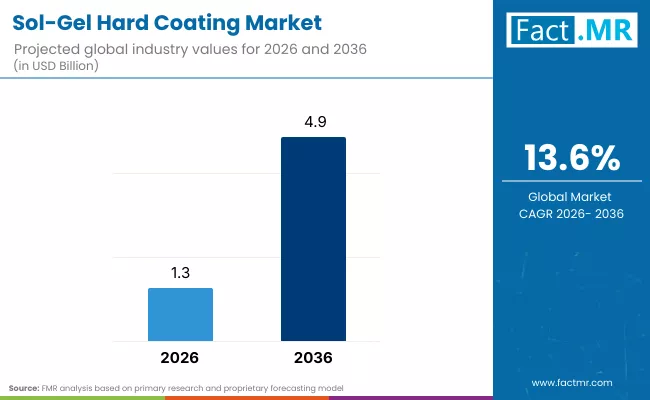
Sol Gel Hard Coating Market By Industry | Source: Fact.MR
According to Dr. Maria Fernandez, Director of Advanced Materials at Sol‑Gel Technologies, sol-gel systems represent a major change in surface engineering. Industries are moving toward coatings that combine mechanical strength with regulatory compliance rather than relying on traditional polymer-based solutions.
Regulatory pressure is also reshaping the market. Environmental mandates aimed at reducing PFAS and fluoropolymer use are accelerating the shift toward ceramic-based sol-gel systems. Manufacturers are responding by developing water-based and low-VOC formulations that meet both performance and sustainability requirements. Innovation remains a key growth driver. Advances in self-crosslinking chemistries, nano-ceramic structures, and faster curing processes are expanding adoption beyond traditional industrial uses.
Sol-Gel Hard Coating Market
| Metric | Value |
|---|---|
| Estimated Value in (2026) | USD 1.3 billion |
| Forecast Value in (2036) | USD 4.9 billion |
| Forecast CAGR (2026 to 2036) | 13.6 % |
Source: Fact.MR analysis. Updated Feb 9, 2026
Category
| Category | Segments |
|---|---|
| Application | Automotive Components, Consumer Electronics, Industrial Machinery, Optical Grades, Wearable Devices |
| Coating Approach | Sol-Gel Layering, Nano-Coatings, Ceramic Nanofilms, UV-Curable Sol-Gel, Self-Crosslinking |
| Base Material | PET Films, PC Films, PE Films, Acrylic Films, Nanocomposite Polymers |
| Region | North America; Europe; Asia Pacific; Latin America; Middle East & Africa |
Source: Fact.MR analysis. Updated Feb 9, 2026
Segmental Analysis
Which application segment dominates the sol-gel hard coating market?
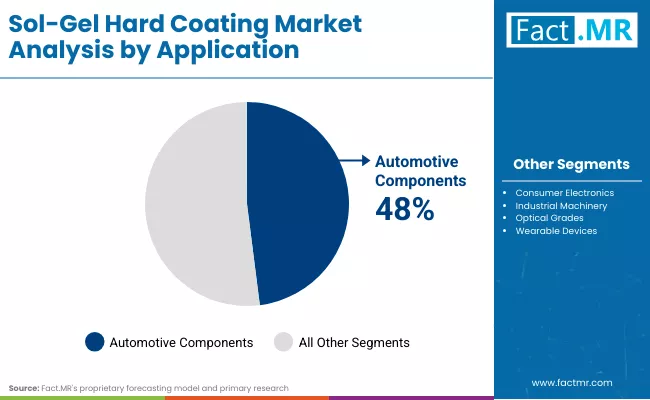
Sol Gel Hard Coating Market By Application | Source: Fact.MR
Automotive components lead the market with 48% of total revenue. This makes them the largest application segment. Demand is driven by the need for scratch-resistant surfaces. Instrument panels, infotainment screens, and exterior trims all require durable protection. Electric vehicle manufacturers add further momentum. Their components must handle thermal cycling while maintaining optical clarity. Sol-gel coatings meet these requirements well. Major automotive suppliers are integrating nano-ceramic coating lines into production. This has reduced defect rates by nearly 35% compared to older polymer coatings. Growth remains strong. Automotive electrification and rising demand for premium vehicles, especially in Asia, continue to support the segment.
What coating approach holds the largest market share?
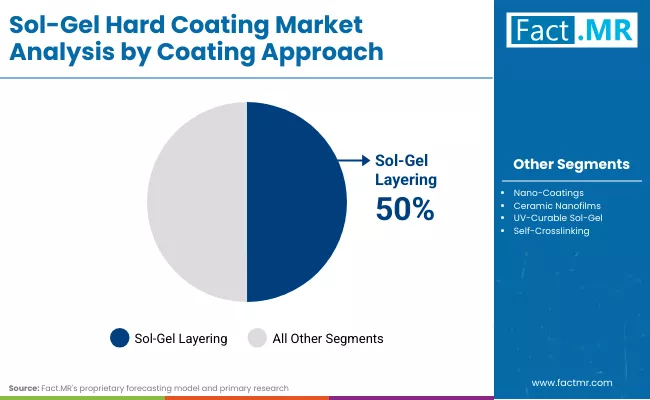
Sol Gel Hard Coating Market By Coating Approach | Source: Fact.MR
Sol-gel layering techniques account for 50% of the coating approach segment. Their success comes from precision and scalability. The process allows tight control over coating thickness. Nanometer-level accuracy is possible. This is critical for optical and hardness performance. Manufacturers favor sol-gel layering because it works well with roll-to-roll equipment. Production speeds can exceed 100 meters per minute for film applications. Recent advances have lowered curing temperatures below 120°C. This makes the process compatible with more polymer substrates. Strong supply chains for silica precursors and operator familiarity help maintain this approach’s leadership.
Market Dynamics
- Drivers: PFAS phase-out regulations are accelerating demand for ceramic sol-gel coatings. Enforcement timelines are tightening in North America and Europe. Fluoropolymer hard coatings are being removed from aerospace and cookware uses. Sol-gel systems offer similar performance without long-term environmental risks. Consumer electronics growth is another major driver. Smartphone manufacturing alone uses about 2.8 billion square meters of coated display films each year. Industrial modernization programs also contribute. China’s large-scale equipment upgrade initiatives require advanced coatings to meet higher quality standards. Together, these forces make sol-gel coatings essential rather than optional.
- Restraints: Sol-gel coating lines require high upfront investment. Automotive-grade systems often cost more than USD 2 million. The process is technically complex. Skilled operators and formulation expertise are required. Precursor materials are expensive. Silica alkoxides cost more than conventional polymer resins due to limited supplier options. Maintaining uniform thickness is challenging. Large-area coatings must stay within 50-nanometer tolerances. Curing times are longer than UV-cured coatings. This limits throughput in high-volume production. Some substrates cannot tolerate curing temperatures. This restricts material compatibility.
- Trend 1: Self-Cleaning Functionality Integration Photocatalytic sol-gel coatings are gaining attention. Titanium dioxide enables surfaces to break down organic dirt under ambient light. Japanese logistics operators report a 40% reduction in cleaning frequency after adopting nano-ceramic systems. This lowers labor costs and supports automation.
- Trend 2: Circular Economy Integration Circular material use is becoming more common. EU-funded programs such as the ZENEX project are proving recycled silica can be reused in sol-gel precursors. Collaborations between Henkel and SCHOTT AG have produced formulations with up to 30% recycled content. These coatings meet performance standards while reducing raw material costs and supporting sustainability goals.
Sol-Gel Hard Coating Market Analysis by Key Country
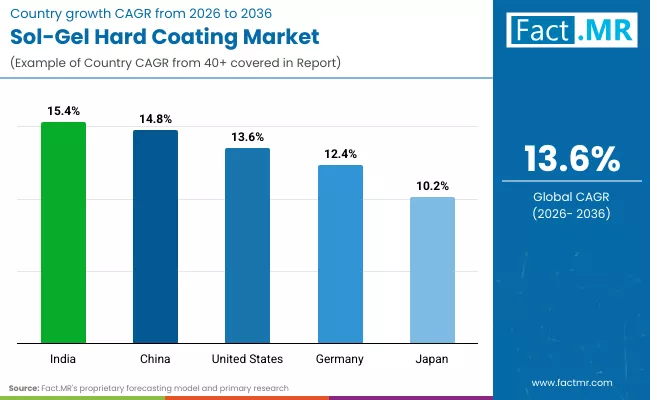
Sol Gel Hard Coating Market By Country | Source: Fact.MR
| Country | CAGR (2026-2036) |
|---|---|
| India | 15.4% |
| China | 14.8% |
| United States | 13.6% |
| Germany | 12.4% |
| Japan | 10.2% |
Source: Fact.MR analysis. Updated Feb 9, 2026
How is India’s sol-gel hard coating market evolving?
India shows the fastest growth at a 15.4% CAGR. Expansion is driven by electronics manufacturing localization under Make in India 2026. The push for global leadership in smart device assembly increases demand for scratch-resistant display films. Garware Hi-Tech has rolled out LamiBak and premium anti-scratch films. These support domestic smartphone and automotive screen production. Government incentives for pharmaceutical manufacturing also benefit specialty chemicals. Domestic sol-gel precursor production is increasing. Mobile phone factories are adding hardcoat lines. Output serves both domestic demand and export markets. India’s growth reflects success in building a full value chain, from precursor synthesis to finished coatings.
Why does China exhibit accelerate sol-gel coating adoption?
China’s market is growing rapidly at a 14.8% CAGR. Growth is driven by state-led industrial modernization. The 200-billion-yuan equipment upgrade program prioritizes coating quality improvements. Sol-gel technologies are listed as a key focus area. Electronics hubs in Guangdong and Jiangsu are installing nano-ceramic coating lines. These serve smartphone and solar panel manufacturers. Surface durability directly affects warranty costs. Market focus is shifting. Growth is moving away from volume-driven architectural coatings toward robotics and renewable energy. These applications support premium pricing. Domestic resin producers are expanding capacity. This strengthens local supply chains and reduces reliance on imported precursors. The China National Coatings Industry Association reports a clear shift toward specialty coatings, with sol-gel systems at the center of this transition.
How is the United States sol-gel hard coating market performing?
The U.S. sol-gel hard coating market is growing steadily at a 13.6% CAGR. Aerospace investment and PFAS elimination mandates are the main drivers. A key milestone is PPG Industries’ USD 380 million facility in North Carolina. The plant has been operational since May 2025 and focuses on aerospace coatings. Ceramic sol-gel systems are replacing older fluoropolymer formulations. Federal procurement rules increasingly require PFAS-free materials. This creates strong demand from defense and commercial aviation programs. Automotive manufacturers are also adopting sol-gel coatings. Electric vehicle battery enclosures need better thermal management than organic coatings can provide. Regulatory pressure is accelerating adoption. EPA enforcement timelines are pushing faster formulation changes across multiple industries.
What drives Germany’s sol-gel hard coating market growth?
Germany is expanding at a 12.4% CAGR, supported by circular economy mandates. Industrial waste reuse programs are also playing a major role. The EU-funded ZENEX initiative enables recycled silica to be used in sol-gel coatings. Pilot facilities reached commercial scale by late 2025. Packaging regulations under the EU PPWR directive favor recyclable coating systems. Sol-gel coatings fit well with mechanical recycling processes. German automotive suppliers are adopting ceramic hardcoats for interior parts. These coatings deliver scratch resistance above 9H pencil hardness, meeting premium vehicle standards. Construction demand is also rising. Sol-gel coatings provide long-lasting, low-maintenance protection on high-traffic surfaces, aligning with Germany’s lifecycle cost focus.
What characterizes Japan’s sol-gel hard coating market trajectory?
Japan is advancing at a 10.2% CAGR, despite by labor shortages and aging demographics. The focus is on reducing maintenance needs. The Logistics 2024-2026 labor crisis has accelerated adoption of self-cleaning nano-ceramic coatings. Fleet maintenance operations face severe worker shortages. Mitsubishi Materials and Soft99 developed fast-bonding SiO₂/SiC formulations. These allow automated application in detailing networks. Automotive aftermarket users report up to 40% reduction in maintenance cycles. This directly addresses labor constraints. Industrial machinery makers are also adopting sol-gel coatings. Contamination-resistant surfaces reduce defects in electronics manufacturing. Japan’s strategy prioritizes labor efficiency over volume expansion. Sol-gel coatings support broader automation goals.
Competitive Landscape
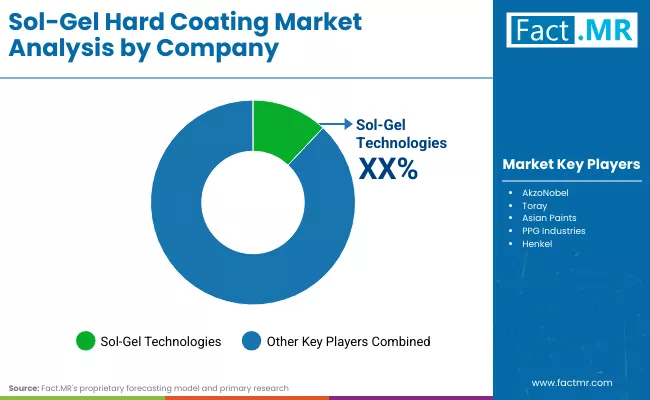
Sol Gel Hard Coating Market By Company | Source: Fact.MR
The sol-gel hard coating market is moderately consolidated. Large chemical companies compete with specialized coating innovators. Sol-Gel Technologies leads through a strong patent portfolio. Its focus on PFAS-free systems supports aerospace and food-contact applications. AkzoNobel leverages global distribution to serve automotive and industrial customers. Integration with existing production lines is a key advantage. Toray is strong in electronics. Its material science expertise enables precise optical and mechanical performance control. Asian Paints is expanding into industrial coatings. The company targets automotive suppliers in India and Southeast Asia with cost-effective formulations.
Competition increasingly centers on technical support. Successful suppliers provide application engineering and process optimization. Partnerships between coating and equipment manufacturers are growing. Turnkey solutions help customers without in-house coating expertise. New entrants focus on niche areas such as wearables and optical films. They compete through specialization rather than scale. Price competition remains limited. High switching costs and long qualification cycles protect established suppliers, especially in automotive and aerospace markets.
Key Market Players in Sol-Gel Hard Coating Market
- Sol-Gel Technologies
- AkzoNobel
- Toray
- Asian Paints
- PPG Industries
- Henkel
Bibliography
- Sol-Gel Technologies. 2026. Ceramic-based sol-gel hard coating systems for automotive, electronics, and industrial applications. Company technical publications and patent disclosures.
- PPG Industries. 2026. Advanced sol-gel and nano-ceramic coating technologies for aerospace, automotive, and electronics markets. Corporate press releases and surface engineering white papers.
- AkzoNobel. 2026. Sustainable hard coating solutions and PFAS-free sol-gel systems for industrial and transportation applications. Corporate innovation and sustainability reports.
- Toray Industries. 2026. High-performance sol-gel hard coatings for optical films, displays, and electronic components. Materials science documentation and product briefs.
- European Union. 2026. PFAS phase-out regulations and circular economy directives impacting advanced coating materials. Official EU regulatory publications and compliance guidelines.
- United States Environmental Protection Agency. 2025. Restrictions on fluoropolymer and PFAS-containing surface coatings. EPA regulatory notices and chemical safety frameworks.
- China National Coatings Industry Association. 2025. Industrial coating modernization initiatives and adoption of nano-ceramic sol-gel technologies. Industry association reports.
Segmentation
Scope of Report
| Items | Values |
|---|---|
| Quantitative Units (2026) | USD 1.3 Billion |
| Application | Automotive Components, Consumer Electronics, Industrial Machinery, Optical Grades, Wearable Devices |
| Coating Approach | Sol-Gel Layering, Nano-Coatings, Ceramic Nanofilms, UV-Curable Sol-Gel, Self-Crosslinking |
| Base Material | PET Films, PC Films, PE Films, Acrylic Films, Nanocomposite Polymers |
| Regions Covered | North America, Europe, Asia Pacific, Latin America, Middle East & Africa |
| Countries Covered | U.S., Canada, Germany, Italy, UK, France, Japan, Australia, and other countries |
| Key Companies Profiled | Sol-Gel Technologies, AkzoNobel, Toray, Asian Paints, PPG Industries |
| Additional Attributes | Dollar revenue in the sol-gel hard coating market is segmented by end-use (automotive components, electronics & displays, aerospace coatings, industrial equipment, construction surfaces), coating function (scratch resistance, anti-corrosion, anti-smudge, thermal protection, optical enhancement), base material (glass substrates, PET films, polycarbonate, acrylics, coated films), and region. |
Source: Fact.MR analysis. Updated Feb 9, 2026
Sol-Gel Hard Coating Market by Segments
-
Application :
- Automotive Components
- Consumer Electronics
- Industrial Machinery
- Optical Grades
- Wearable Devices
-
Coating Approach :
- Sol-Gel Layering
- Nano-Coatings
- Ceramic Nanofilms
- UV-Curable Sol-Gel
- Self-Crosslinking
-
Base Material :
- PET Films
- PC Films
- PE Films
- Acrylic Films
- Nanocomposite Polymers
-
Region :
- Asia Pacific
- China
- India
- Japan
- South Korea
- Australia
- Rest of Asia Pacific
- North America
- United States
- Canada
- Mexico
- Europe
- Germany
- France
- UK
- Italy
- Spain
- Rest of Europe
- Latin America
- Brazil
- Mexico
- Argentina
- Rest of Latin America
- Asia Pacific
Frequently Asked Questions
How big is the global sol-gel hard coating market in 2026?
What will be the size of the sol-gel hard coating market in 2036?
How fast will the sol-gel hard coating market grow between 2026 and 2036?
Which application dominates the sol-gel hard coating market?
Which coating approach holds the largest share in the sol-gel hard coating market?
Who worked on this report


Preview the report firsthand - request a free sample
Free SampleGet the brochure for pricing and purchase details
Download PDF