- Base Value(2026): 0.4 Bn
- Estimated Value(2026): 0.4 Bn
- Forecast Value (2036): 1.3 Bn
- CAGR (2026 - 2036): 12.4%
Precision Orchard Spraying Insecticides Market Forecast and Outlook (2026 to 2036
The global market for precision orchard spraying insecticides is projected to surge from USD 0.44 billion in 2026 to USD 1.28 billion by 2036, growing at a significant 12.4% CAGR. This accelerated growth is driven by the critical convergence of regulatory mandates and economic necessity within high-value perennial crop systems.
The sector is moving decisively away from broadcast application models, which are increasingly untenable due to stringent maximum residue limit regulations, rising chemical costs, and environmental stewardship demands.
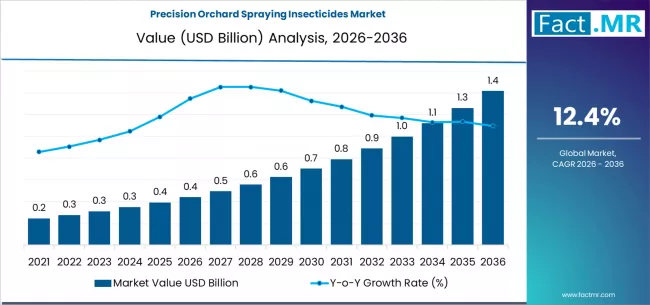
Precision Orchard Spraying Insecticides Market Market Value Analysis | Source: Fact.MR
Summary of Precision Orchard Spraying Insecticides Market
- Market Snapshot
- Global precision orchard spraying insecticides market revenue stood at USD 0.44 billion in 2026 and is forecast to reach USD 1.28 billion by 2036.
- At a 12.4% CAGR from 2026 to 2036, this market is set to expand ~3.2x in value, adding USD 0.98 billion in absolute opportunity.
- Growth is being driven by the convergence of regulatory mandates and the need for efficient pest control in high-value orchard crops.
- Precision spraying is emerging as a critical solution for targeted pesticide application, improving yield while reducing chemical usage and environmental impact.
- Demand and Growth Drivers
- Increasing demand for sustainable and efficient pest control solutions in orchard farming is accelerating adoption.
- Regulatory pressure to reduce pesticide usage and environmental impact is driving precision spraying technologies.
- Adoption of smart farming technologies such as sensor-based spraying and AI-driven systems is enhancing efficiency.
- Need for solutions that provide:
- Targeted pesticide application
- Reduced chemical waste
- Improved crop yield and quality
- Compliance with environmental standards
- Economic necessity to optimize input costs and maximize orchard productivity is further supporting growth.
- Product and Segment View
- Biological/bio-based insecticides hold 36.0% of segment share in 2026, emerging as the leading segment due to sustainability and regulatory alignment.
- Key crop categories include:
- Pome fruits (apple, pear)
- Stone fruits (peach, cherry, plum)
- Citrus fruits
- Nuts (almond, walnut, pistachio)
- Others
- Geography and Competitive Outlook
- Growth is supported across North America, Asia Pacific, and Latin America, driven by adoption of precision agriculture practices.
- Key growth markets and CAGR: India (13.5%), China (12.1%), Brazil (11.3%), United States (10.4%), Italy (9.6%).
- Market expansion is closely tied to:
- Adoption of precision agriculture technologies
- Increasing fruit production and export demand
- Regulatory push for sustainable farming practices
- Key companies active in this market include: Bayer CropScience, Syngenta Group, BASF SE, Corteva Agriscience, UPL Limited.
Precision Orchard Spraying Insecticides Market — At a Glance
| Attribute | Details |
|---|---|
| Market Value 2026 | USD 0.44 billion |
| Market Value 2036 | USD 1.28 billion |
| Absolute Dollar Opportunity 2026–2036 | USD 0.98 billion |
| Total Growth 2026–2036 | 222.7% |
| CAGR 2026–2036 | 12.4% |
| Growth Multiple | ~3.2x |
| Key Demand Theme | Shift toward precision, sustainable, and targeted pest control in orchard farming |
| Leading Segment by Insecticide Type (2026) | Biological/Bio-Based Insecticides |
| Segment Share (2026) | 36.0% |
| Key Growth Regions | North America, Asia Pacific, Latin America |
| Country CAGRs | India 13.5%, China 12.1%, Brazil 11.3%, USA 10.4%, Italy 9.6% |
| Top Companies | Bayer CropScience, Syngenta Group, BASF SE, Corteva Agriscience, UPL Limited |
| Segmentation by Crop Type | Pome Fruits, Stone Fruits, Citrus Fruits, Nuts, Others |
| Segmentation by Technology | Sensor-Based, Drone-Based, AI-Based, Variable Rate Spraying |
| Segmentation by Region | North America, Latin America, Europe, Asia Pacific, MEA |
Source: Fact.MR analysis. Updated Apr 6, 2026
Growth is fueled by the integration of advanced application technologies with a parallel shift in insecticide chemistry. The adoption of sensor-guided and drone-based systems creates a premium market for compatible insecticide formulations that deliver efficacy at reduced volumes and with enhanced on-target deposition.
India’s leading 13.50% CAGR highlights the rapid modernization of its high-value horticulture sector, where precision technology offers a pathway to meet both export quality standards and domestic sustainability goals. This market evolution represents a fundamental reengineering of crop protection in orchards, where the value is created not by the chemical alone, but by the synergistic combination of smart chemistry, data, and precision delivery mechanisms.
Category
| Category | Segments |
|---|---|
| Crop Type | Pome Fruits, Stone Fruits, Citrus Fruits, Nuts, Others |
| Insecticide Type | Biological/Bio-Based Insecticides, Synthetic Pyrethroids, Neonicotinoids, Organophosphates, Others |
| Spraying Technology | Sensor-Based Variable Rate Spraying, Electrostatic Spraying, Drone-Based Precision Spraying, Air-Blast Smart Sprayers, Others |
| Region | North America, Latin America, Western Europe, Eastern Europe, East Asia, South Asia & Pacific, MEA |
Source: Fact.MR analysis. Updated Apr 6, 2026
Segmental Analysis
By Crop Type, Which Segment Demands the Highest Level of Residue Management and Input Efficiency?
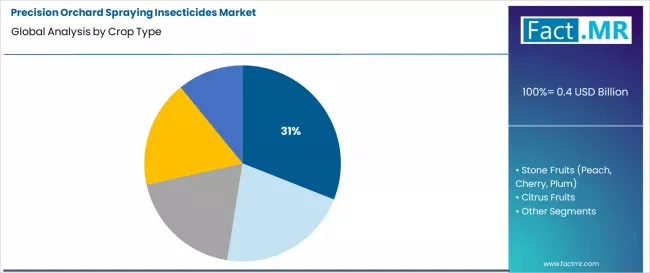
Precision Orchard Spraying Insecticides Market Analysis By Crop Type | Source: Fact.MR
Pome Fruits, particularly apples, lead the segment with a 31% share. This dominance is attributed to the crop’s high consumer visibility, strict global residue standards, and intensive pest pressure that requires frequent applications.
The economic value of pome fruit orchards justifies investment in precision technology to minimize chemical use per hectare while maintaining flawless cosmetic and food safety standards. The need for precise canopy penetration and thorough coverage on complex structures makes this crop a primary testing ground and adopter of advanced spraying systems and compatible insecticides.
By Insecticide Type, Which Chemistry Aligns with the Goals of Reduced Volume and Enhanced Safety?
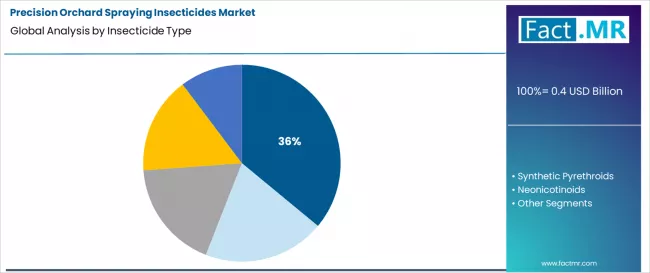
Precision Orchard Spraying Insecticides Market Analysis By Insecticide Type | Source: Fact.MR
Biological and Bio-Based Insecticides are the leading type at 36.0%. Their growth is synergistic with precision application; these products often have shorter re-entry intervals and favorable residue profiles, making them ideal for integrated pest management programs in frequently harvested orchards.
Precision spraying ensures these typically higher-cost products are applied only where needed, improving their economic viability. The market trend reflects a strategic shift where application technology enables the commercial scalability of softer chemistry in large-scale production.
By Spraying Technology, Which System is driving the Most Significant Redefinition of Application Standards?
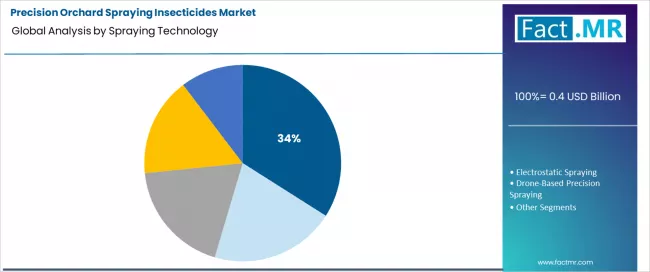
Precision Orchard Spraying Insecticides Market Analysis By Spraying Technology | Source: Fact.MR
Sensor-based variable rate spraying holds a 34.00% share as the foundational precision technology. Using LiDAR or ultrasonic sensors to detect canopy density and volume, these systems adjust spray output in real-time, eliminating application to gaps within and between trees.
This technology delivers immediate and quantifiable reductions in insecticide use, directly addressing cost and environmental imperatives. Its integration with modern air-blast sprayers makes it a scalable upgrade for existing orchard fleets, accelerating adoption and creating demand for insecticides formulated for optimal performance in pulsed, variable-rate systems.
What are the Drivers, Restraints, and Key Trends of the Precision Orchard Spraying Insecticides Market?
The foremost driver is the escalating regulatory and market pressure to reduce pesticide residues on fruit, driven by consumer demand and stringent import regulations from regions like the European Union.
This creates a non-negotiable requirement for application accuracy. Simultaneously, the rising cost of labor, water, and insecticides themselves is forcing growers to seek efficiency gains that directly protect profit margins. Precision spraying offers a direct solution to both pressures by minimizing off-target loss and optimizing chemical utilization.
A primary restraint is the high capital investment required for advanced spraying equipment, which can be prohibitive for small to medium-sized orchardists despite clear long-term savings. The need for technical expertise to operate, maintain, and calibrate these complex systems also presents an adoption barrier.
The efficacy of some insecticide chemistries, particularly contact-acting products, can be challenged by ultra-low volume applications if droplet coverage and deposition are not perfectly managed, requiring specific formulation adjustments.
Key trends include the fusion of spraying technology with digital agriculture platforms, where data on pest pressure, canopy growth, and weather forecasts are integrated to generate predictive application maps. There is a strong movement towards hybrid systems that combine different technologies, such as drones for scouting and spot treatment coupled with sensor-guided ground sprayers for blanket applications.
Another trend is the co-development of insecticides and adjuvants specifically engineered for new application methods, such as formulations that enhance droplet adhesion in electrostatic systems or reduce drift in aerial applications. The market is also seeing the rise of spraying-as-a-service models, where service providers operate advanced equipment, lowering the entry barrier for growers.
Analysis of the Precision Orchard Spraying Insecticides Market by Key Countries
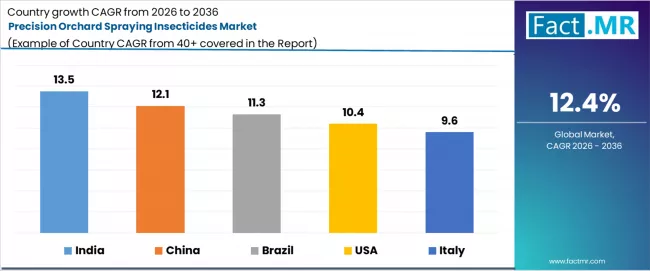
Precision Orchard Spraying Insecticides Market Cagr Analysis By Country | Source: Fact.MR
| Country | CAGR (2026-2036) |
|---|---|
| India | 13.50% |
| China | 12.10% |
| Brazil | 11.30% |
| USA | 10.40% |
| Italy | 9.60% |
Source: Fact.MR analysis. Updated Apr 6, 2026
How is India's Horticulture Export Ambition and Smallholder Challenge Shaping Adoption?
India’s leading 13.50% CAGR stems from a national push to increase high-value fruit exports, which demands compliance with international residue standards unattainable through traditional spraying.
The prevalence of small orchards is driving innovative adoption models, including cooperative ownership of precision equipment and the proliferation of contractor-led spraying services. The market prioritizes versatile, cost-effective technologies and insecticide bundles that can deliver results across diverse smallholder contexts, making precision an instrument of market access.
What is the Impact of China's Scale of Production and Automation Drive?
The vast scale of fruit production and a government-led agenda for agricultural modernization and automation fuels China’s 12.10% growth. Large commercial orchards and state-backed farming enterprises are investing in fully mechanized precision sprayer fleets.
The focus is on system-level solutions that integrate pest monitoring, automated decision-making, and targeted application, often leveraging domestically manufactured drones and sensing equipment. This creates a high-volume market for insecticides compatible with automated, high-throughput application systems.
Why is Brazil's Focus on Tropical Fruit Exports and Resistance Management a Key Factor?
Brazil’s 11.30% growth is linked to its strength in tropical and citrus fruit exports, where pest pressure is intense and resistance management is critical. Precision spraying is valued for its ability to apply insecticide rotations and novel chemistries more effectively and with less environmental load.
The market emphasizes robust technologies and chemistries suited to larger tree canopies and variable weather conditions, with a focus on preserving the efficacy of key molecules through precise application.
How is the USA's Mature Industry and Sustainability Certification Influence Driving Growth?
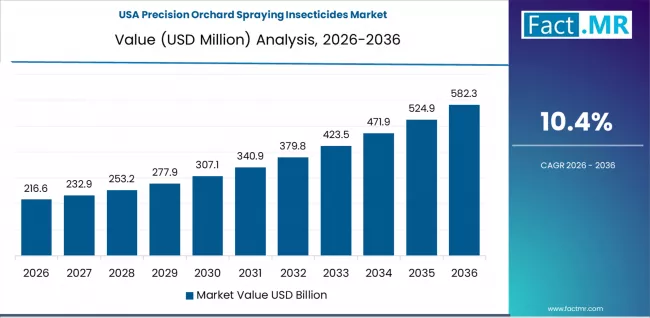
Precision Orchard Spraying Insecticides Market Country Value Analysis | Source: Fact.MR
The USA’s 10.40% growth occurs within a mature industry where sustainability certifications and retailer-driven environmental, social, and governance protocols are major market forces. Precision spraying is a key strategy for growers to achieve the documented chemical reduction metrics required by these programs.
The market is characterized by a high degree of innovation, with a focus on data connectivity, integration with farm management software, and premium insecticides that offer reliable performance at the lower rates enabled by new application technologies.
What Role does Italy's Premium EU Market Access and Topography Play?
Italy’s 9.60% growth is driven by the imperative to maintain premium market access within the EU, where regulatory scrutiny is highest. The often-hilly topography of Italian orchards makes precision technology essential for reducing environmental drift into sensitive areas.
The market favors sophisticated, sensor-based systems that can adapt to uneven terrain and variable tree architecture, paired with insecticide products that have the strongest EU regulatory standing and lowest residue profiles.
Competitive Landscape of the Precision Orchard Spraying Insecticides Market
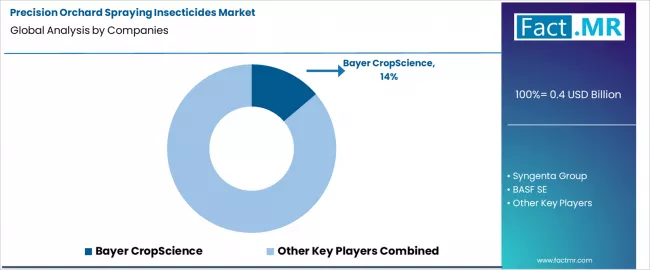
Precision Orchard Spraying Insecticides Market Analysis By Company | Source: Fact.MR
The competitive landscape involves agrochemical companies forging strategic alliances with agricultural technology manufacturers. Success is increasingly dependent on providing integrated solutions rather than standalone products.
Companies compete by developing insecticide formulations optimized for specific precision application methods, generating agronomic data to demonstrate the superior efficacy and economic return of their products when used in these systems, and creating seamless compatibility between their chemistry and leading hardware platforms.
| Company | Key Contribution & Strategic Focus |
|---|---|
| Bayer CropScience | Develops integrated digital agronomy platforms that link pest monitoring data with precise application recommendations for its insecticides, promoting targeted use. |
| Syngenta Group | Focuses on providing insecticide portfolios compatible with low-drift nozzles and drone application, and partners with spraying equipment OEMs. |
| BASF SE | Invests in biological and synthetic insecticide solutions suited for reduced-volume precision applications and emphasizes their role in resistance management. |
| Corteva Agriscience | Leverages its seed and crop protection portfolio to offer holistic orchard management programs, often bundling precision application guidance with its insecticides. |
| UPL Limited | Provides a broad range of post-patent insecticide solutions and focuses on making precision application economical for growers in cost-sensitive growth markets. |
Source: Fact.MR analysis. Updated Apr 6, 2026
Key Players in the Precision Orchard Spraying Insecticides Market
- Bayer CropScience
- Syngenta Group
- BASF SE
- Corteva Agriscience
- UPL Limited
References
- Chen, Y., & Ozkan, E. 2023. Spray Technology in Orchard Applications. Transactions of the ASABE.
- Food and Agriculture Organization. 2024. Integrated Pest Management in Horticulture. FAO Plant Production and Protection Paper.
- Gil, E., & Llorens, J. 2022. Variable Rate Spraying in Perennial Crops. Precision Agriculture Journal.
- Khater, E. G., & Gorial, F. A. 2023. Advances in Drone Application for Crop Protection. Journal of Agricultural Engineering.
- Manktelow, D., & Praat, J. P. 2022. Electrostatic Spraying for Improved Pest Control. International Pesticide Application Research Centre.
- Pergher, G., & Petris, R. 2024. Environmental Impact of Precision Spraying in Orchards. Science of the Total Environment.
- USDA National Institute of Food and Agriculture. 2023. Research on Advanced Application Technologies for Specialty Crops. NIFA Reports.
- Van de Zande, J. C., & Michielsen, J. M. 2022. Sensor-Based Dose Adjustment in Fruit Orchards. Computers and Electronics in Agriculture.
- Wandkar, S. V., & Soni, P. 2023. Precision Agriculture for Sustainable Horticulture. SpringerBriefs in Agriculture.
- Zhu, H., & Li, H. 2024. Automation and Robotics in Orchard Management. Annual Review of Food Science and Technology.
Segmentation
Scope of Report
| Items | Values |
|---|---|
| Quantitative Units | USD Billion |
| Crop Type | Pome Fruits, Stone Fruits, Citrus Fruits, Nuts, Others |
| Insecticide Type | Biological / Bio-Based Insecticides, Synthetic Pyrethroids, Neonicotinoids, Organophosphates, Others |
| Spraying Technology | Sensor-Based Variable Rate Spraying, Electrostatic Spraying, Drone-Based Precision Spraying, Air-Blast Smart Sprayers, Others |
| Key Countries | India, China, Brazil, USA, Italy |
| Key Companies | Bayer CropScience, Syngenta Group, BASF SE, Corteva Agriscience, UPL Limited |
| Additional Analysis | Drift reduction and deposition efficiency studies across different technologies; economic analysis of ROI for precision spraying equipment and compatible insecticides; residue level comparisons between precision and conventional application methods; impact of canopy architecture and density on product choice and application settings; data management and integration challenges in precision orchard systems; regulatory pathways for insecticides labeled for aerial or ultra-low volume application in orchards. |
Source: Fact.MR analysis. Updated Apr 6, 2026
Market by Segments
-
Crop Type :
- Pome Fruits
- Apple
- Pear
- Stone Fruits
- Peach
- Cherry
- Plum
- Citrus Fruits
- Nuts
- Almond
- Walnut
- Pistachio
- Others
-
Insecticide Type :
- Biological/Bio-Based Insecticides
- Synthetic Pyrethroids
- Neonicotinoids
- Organophosphates
- Others
-
Spraying Technology :
- Sensor-Based Variable Rate Spraying
- Electrostatic Spraying
- Drone-Based Precision Spraying
- Air-Blast Smart Sprayers
- Others
-
Region :
- North America
- USA
- Canada
- Latin America
- Brazil
- Argentina
- Mexico
- Rest of Latin America
- Western Europe
- Italy
- UK
- Germany
- France
- Spain
- BENELUX
- Rest of Western Europe
- Eastern Europe
- Poland
- Russia
- Czech Republic
- Rest of Eastern Europe
- East Asia
- China
- Japan
- South Korea
- Rest of East Asia
- South Asia & Pacific
- India
- ASEAN
- Australia
- Rest of South Asia & Pacific
- MEA
- GCC
- South Africa
- Turkiye
- Rest of MEA
- North America
Frequently Asked Questions
How big is the precision orchard spraying insecticides market in 2026?
What will be the size of precision orchard spraying insecticides market in 2036?
How much will be the precision orchard spraying insecticides market growth between 2026 and 2036?
What are the key product types in the precision orchard spraying insecticides market?
Which insecticide type segment to contribute significant share in the precision orchard spraying insecticides market in 2026?
Who worked on this report


Preview the report firsthand - request a free sample
Free SampleGet the brochure for pricing and purchase details
Download PDF