- Market Value (2025): USD 139.2 Mn
- Estimated Value (2026): USD 158 Mn
- Forecast Value (2036): USD 560 Mn
- CAGR (2026-2036): 13.5%
What is the Solder Mask Inkjetters Market forecast to be worth by 2036?
USD 158 million in 2026 to USD 560 million by 2036 at a 13.5% CAGR.
- The solder mask inkjetters market reached USD 139.2 million in 2025.
- Demand is projected to increase from USD 158 million in 2026 to USD 560 million by 2036.
- The market is forecast to record a 13.5% CAGR from 2026 to 2036 as PCB fabricators and substrate makers qualify additive mask deposition for finer board features.
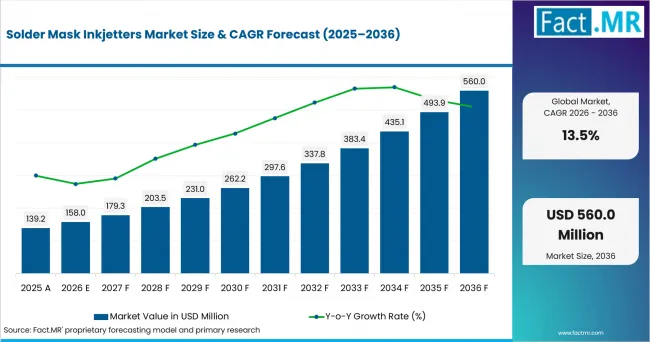
Solder Mask Inkjetters Market Value Analysis | Source: Fact.MR
What are the defining numbers behind Solder Mask Inkjetters Market growth?
USD 402 million absolute opportunity by 2036, led by high-resolution substrate printers, UV-curable acrylate inks and PCB fabricators.
- Demand Drivers in the Market
- HDI board producers need tighter solder-mask registration near pads and microvias. SIA reported in February 2026 that global semiconductor sales reached USD 791.7 billion in 2025.
- IC substrate makers need cleaner selective deposition since package routing density raises the cost of mask bleed, rework and customer rejection.
- Automotive electronics suppliers need repeatable coating and traceability for control boards. That favors digital solder-mask records where automotive printed circuit boards must pass long validation cycles.
- Prototype houses need faster engineering turns because inkjet workflows adjust CAM data without preparing new screens, films or photo tools.
- Electronics manufacturers need lower material exposure during solder-mask work. Additive printing can reduce development and screening steps where customers approve the recipe.
- Key Segments Analyzed
- By Printer Class: High-resolution substrate printers are expected to hold 39.0% share in 2026 due to finer pads, package substrates and HDI boards that need controlled droplet placement across glass-reinforced substrates.
- By Ink Type: UV-curable acrylate is projected to account for 46.0% share in 2026 because inline curing supports stable coating control after digital deposition.
- By Application: HDI boards are anticipated to capture 33.0% share in 2026 owing to higher via density and solder-mask clearance needs in AI servers and 3D semiconductor packaging supply chains.
- By End User: PCB fabricators are estimated to represent 48.0% share in 2026 since volume board shops control qualification budgets and final process records.
- Analyst Opinion at Fact.MR
- Shambhu Nath Jha, Principal Consultant at Fact.MR, states, “Solder-mask inkjetters are judged first by registration control and coating evidence. The market is expected to reward tools that combine clean droplet placement, ink compatibility and repeatable curing over long production runs. Suppliers that document warpage correction, nozzle health and MES connection are better placed for substrate and HDI board accounts.”
- Strategic Implications
- Equipment vendors should publish board-size, warpage and printhead-maintenance data so process engineers can shorten first-lot qualification work.
- Ink suppliers should match viscosity, cure window and adhesion data to named printer platforms. Material files should connect with electronic chemicals controls used in electronics plants.
- PCB fabricators should connect solder-mask print files with PCB design software outputs, since data handoff quality affects registration and revision speed.
- Substrate makers should pair inkjet deposition records with inspection data. Links to in-circuit test and electrical checks can help prove that sharper mask dams do not weaken reliability.
China is projected to record 15.34% CAGR through 2036 due to high electronics output and PCB supply depth. Germany is expected to post 15.02% CAGR as export-oriented electronics and industrial automation sustain equipment purchases. Taiwan is anticipated to advance at 14.97% CAGR owing to IC export scale and substrate investment. The USA is estimated to reach 14.96% CAGR as PCB bookings and advanced packaging programs support qualification activity. Japan is forecast to record 14.95% CAGR as electronic boards and IC output sustain precision process demand. South Korea is projected to post 14.88% CAGR as ICT exports and semiconductor output keep high-density board work active.
How does the Solder Mask Inkjetters Market break down by segment?
High-resolution substrate leads at 39.0%; UV-curable acrylate leads at 46.0%.
Which printer class dominates?
High-resolution substrate holds 39.0% share in 2026.
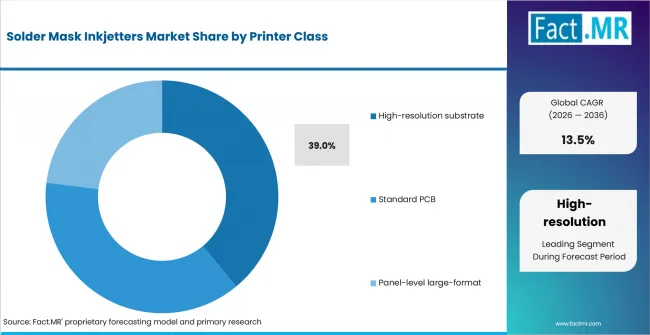
Solder Mask Inkjetters Market Analysis By Printer Class | Source: Fact.MR
High-resolution substrate inkjetters lead because substrate and HDI lines require sharper mask edges around fine-pitch pads. Demand is concentrated where advanced packages depend on precise dielectric and dam structures between chips and boards, making print accuracy, registration control and repeatable deposition important during high-density substrate production.
What leads the ink type segment?
UV-curable acrylate accounts for 46.0% share in 2026.
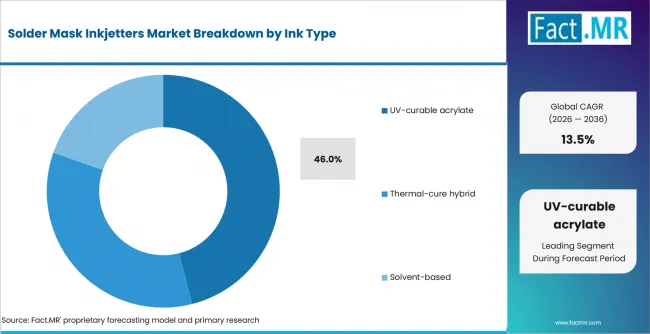
Solder Mask Inkjetters Market Analysis By Ink Type | Source: Fact.MR
UV-curable acrylate leads because inline curing reduces waiting time after deposition and helps preserve droplet geometry before handling. SUSS and Epson announced in February 2025 that Epson PrecisionCore printhead technology would be integrated into the SUSS LP50, supporting continued development of functional-material inkjet printing and printed-electronics applications.
How does application shape demand?
HDI boards capture 33.0% share in 2026.
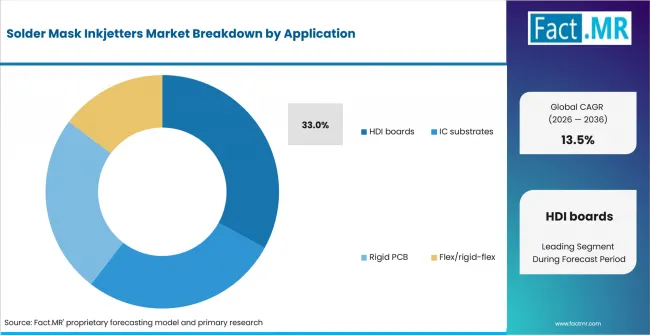
Solder Mask Inkjetters Market Analysis By Application | Source: Fact.MR
HDI boards lead because mask-registration errors become more costly as routing density increases. Dense interconnect structures require accurate selective coating around fine lines, vias and pads. These applications also connect with semiconductor defect inspection equipment where manufacturers verify mask-edge quality before assembly.
What supports PCB fabricators within end user?
PCB fabricators represent 48.0% share in 2026.
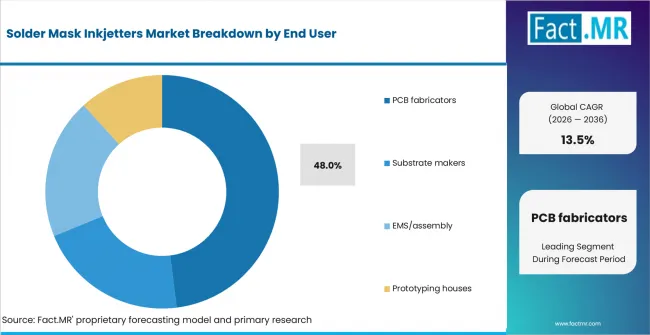
Solder Mask Inkjetters Market Analysis By End User | Source: Fact.MR
PCB fabricators lead end-user demand because they control process settings, production records and final yield performance. Digital solder-mask systems help high-mix facilities manage artwork changes while maintaining repeatable deposition. Fabricators also compare these systems with legend and serialization equipment where digital data trails are required across production lots.
What is accelerating Solder Mask Inkjetters Market adoption, and what is holding it back?
Demand is expected to rise through HDI board density and additive-process economics. Adoption is constrained by qualification cycles, ink compatibility and capital cost.
Drivers Impact Analysis
| DRIVER | (~) % IMPACT ON CAGR | GEOGRAPHIC RELEVANCE | IMPACT TIMELINE |
|---|---|---|---|
| HDI and IC-substrate density requirements | +1.9% | East Asia, North America | Short term (<= 2 years) |
| Digital solder-mask step reduction | +1.4% | Global | Medium term (2-4 years) |
| UV-curable ink and inline cure compatibility | +0.9% | East Asia, Europe | Medium term (2-4 years) |
| Prototype and low-lot personalization | +0.6% | North America, Europe | Long term (>= 4 years) |
Source: Fact.MR analysis. Updated Aug 21, 2026
- HDI and IC-substrate density requirements: Finer features increase the value of controlled droplet placement. Solder-mask inkjetters gain attention when mask-bleed rework becomes expensive and customer inspection rules tighten.
- Digital solder-mask step reduction: Additive coating removes selected screen, film and exposure work. The benefit is expected to rise on frequent design changes, especially where prototype teams revise CAM files between lots.
- UV-curable ink and inline cure compatibility: Integrated curing locks coating behavior after deposition. Each ink still needs thermal-cycle approval, so vendors gain from clear cure windows and named material-platform data.
- Prototype and low-lot personalization: Short production runs are expected to favor digital changeovers. Shops that revise CAM data between batches gain more from fast inkjet setup than long-run commodity board lines.
Opportunity Impact Analysis
| OPPORTUNITY | (~) % IMPACT ON CAGR | GEOGRAPHIC RELEVANCE | IMPACT TIMELINE |
|---|---|---|---|
| High-resolution substrate printers | +1.2% | China, Taiwan, South Korea, Japan | Short term (<= 2 years) |
| Panel-level automated clusters | +0.9% | East Asia, Europe | Medium term (2-4 years) |
| Solder mask and legend workflow convergence | +0.7% | Global | Long term (>= 4 years) |
Source: Fact.MR analysis. Updated Aug 21, 2026
- High-resolution substrate printers: Substrate makers use premium inkjetters where cleaner mask dams support package reliability targets. KLA’s August 2025 Form 10-K describes inkjet and additive printing for PCB and IC substrate manufacturing.
- Panel-level automated clusters: Larger cells fit fabricators that connect pretreatment, print and cure to production records. Those systems appeal most where batch traceability is already part of customer approval.
- Solder mask and legend workflow convergence: Combined digital mask and legend functions improve utilization on high-mix lines. MicroCraft updated CraftPix series information in June 2025, including high-definition printhead models used in its industrial inkjet range.
Restraints Impact Analysis
| RESTRAINT | (~) % IMPACT ON CAGR | GEOGRAPHIC RELEVANCE | IMPACT TIMELINE |
|---|---|---|---|
| Qualification cycles for new ink and equipment | -0.6% | Global | Short term (<= 2 years) |
| Capital intensity against existing exposure lines | -0.5% | North America, Europe, East Asia | Medium term (2-4 years) |
| Printhead, viscosity and curing process control | -0.4% | Global | Long term (>= 4 years) |
Source: Fact.MR analysis. Updated Aug 21, 2026
- Qualification cycles for new ink and equipment: Solder mask affects insulation and solderability, so fabricators test adhesion, cure depth and registration before moving a printer into volume work.
- Capital intensity against existing exposure lines: Legacy coating equipment remains serviceable. IPC reported in January 2025 that 52% of surveyed electronics manufacturers faced rising labor costs and 51% faced rising material costs.
- Printhead, viscosity and curing process control: Nozzle stability and material matching determine uptime. Weak ink-printer pairings reduce expected savings and can extend approval work across multiple customer programs.
Which countries are scaling the Solder Mask Inkjetters Market through 2036?
- The country comparison spans 0.46 percentage point and forms a narrow high-growth band across the forecast period.
- China remains 0.32 percentage point above Germany through electronics output and PCB supply depth that keep tool qualification active.
- Germany remains 0.05 percentage point above Taiwan through export-oriented electronics demand and process documentation needs.
- Taiwan remains 0.01 percentage point above the USA due to IC exports and substrate manufacturing density.
- The USA remains 0.01 percentage point above Japan as PCB bookings and advanced packaging programs support qualification work.
- Japan remains 0.07 percentage point above South Korea through electronic board production and precision process culture.
- South Korea closes the displayed range as ICT exports and semiconductor momentum sustain HDI and substrate demand.
Comparable CAGRs create different entry conditions due to PCB cluster depth, substrate investment, customer qualification rules and local service coverage. Full report coverage includes North America, Latin America, Western Europe, Eastern Europe, East Asia, South Asia & Pacific, Middle East & Africa.
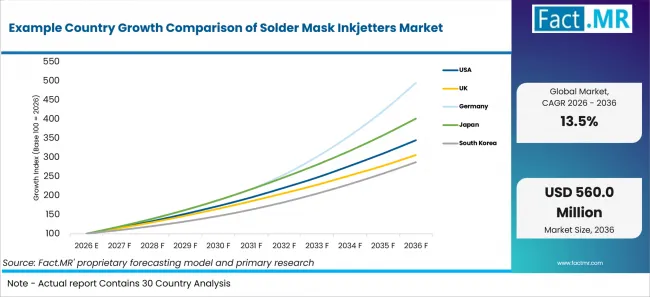
Example Country Growth Comparison Of Solder Mask Inkjetters Market | Source: Fact.MR
| Country | CAGR (2026-2036) |
|---|---|
| China | 15.34% |
| Germany | 15.02% |
| Taiwan | 14.97% |
| USA | 14.96% |
| Japan | 14.95% |
| South Korea | 14.88% |
Source: Fact.MR analysis. Updated Aug 21, 2026
What supports China adoption?
15.34% CAGR through 2036, supported by electronics output scale and digital manufacturing policy.
China’s PCB and substrate fabricators are expected to evaluate solder-mask inkjetters where dense board layouts require cleaner openings and faster job changes. The State Council reported in May 2025 that China targets a numerical-control rate above 85% in key production processes of major electronic information manufacturing enterprises by 2027. MIIT reported in January 2026 that integrated-circuit output reached 484.3 billion units in 2025, up 10.9% year over year.
How is Germany scaling demand?
15.02% CAGR through 2036, backed by electronics exports and process documentation requirements.
Germany’s electronics fabricators are expected to use inkjet solder mask where traceability and coating records help pass customer audits. GTAI reported in February 2026 that German electrical and digital industry exports rose 5.1% in 2025 to around EUR 257.5 billion, while Destatis’ revised data show that German industrial production fell 1.0% month over month in December 2025. Digital solder-mask equipment is therefore expected to advance first on dense boards and regulated industrial electronics where documentation supports the business case.
How is Taiwan scaling demand?
14.97% CAGR through 2036, driven by IC export scale and substrate-related manufacturing density.
Taiwan’s substrate and HDI lines are expected to value high-resolution inkjetters where AI-server and packaging work requires cleaner selective coating. Organic substrate packaging material demand also keeps solder-mask control close to chip-package routing needs. The Ministry of Finance reported in January 2026 that Taiwan’s total exports increased 34.9% in 2025. The Ministry of Economic Affairs reported in January 2026 that electronics component production rose 24.71% in 2025. PCB capital spending and customer qualification rules are expected to keep adoption concentrated among lines with the clearest yield or changeover gain.
What supports USA adoption?
14.96% CAGR through 2036, supported by PCB order strength and packaging-related investment.
U.S. fabricators are expected to adopt inkjetters where quick-turn defense, medical and advanced electronics programs need repeatable solder-mask records. IPC reported in its April 2025 Industry Intelligence Insights that North American PCB bookings surged nearly 18% year over year in February 2025. BEA reported in June 2026 that greenfield spending in computer and electronic products manufacturing reached USD 2.0 billion in 2025. Adoption is still expected to vary by shop because conventional coating lines remain sufficient for lower-density rigid boards.
How does Japan perform?
14.95% CAGR through 2036, led by electronic board output and precision production culture.
Japan’s electronics manufacturers are expected to use solder-mask inkjetters selectively where coating repeatability supports high-reliability boards. Conservative qualification is expected to slow recipe transfer until humidity, insulation and thermal-cycle evidence is complete.
How is South Korea scaling demand?
14.88% CAGR through 2036, supported by ICT export records and semiconductor momentum.
South Korean substrate shops are expected to examine solder-mask inkjetters where finer package and HDI boards need cleaner dam formation. MOTIR and MSIT reported in January 2026 that Korea’s ICT exports reached USD 264.3 billion in 2025, up 12.4%. The ministries also reported that semiconductor exports rose 22.1% during 2025. May 2025 display exports fell 17.5%.
Who leads the Solder Mask Inkjetters Market?
Notion Systems, KLA Corporation and MicroCraft for directly evidenced solder-mask or additive-printing capability, while SUSS MicroTec is included for adjacent functional-material inkjet technology.
Notion Systems is active through its n.jet soldermask platform for digital solder-mask and legend printing. In March 2025, the company demonstrated multi-color solder-mask printing on a PCB at its Notion Advanced Application Center using the n.jet soldermask system.
SUSS MicroTec participates through industrial inkjet technology used for functional materials. Its role is relevant to electronics material evaluation, where ink behavior and printhead compatibility are qualified together. KLA participates through Orbotech Neos additive printing for solder mask and Orbotech Magna inkjet printing for IC packaging dams and insulation layers.
MicroCraft remains active through CraftPix on-demand inkjet systems used for legend, solder resist and etch-resist workflows. Its product range places it near coding and marking systems when fabricators want digital data trails on production lots. Competition is expected to center on registration accuracy, uptime, ink compatibility and service response more than nominal printer speed.
Which companies are the key providers?
Key companies include Notion Systems GmbH; SUSS MicroTec SE; KLA Corporation, including Orbotech PCB activities; and MicroCraft K.K.
- Notion Systems GmbH
- SUSS MicroTec SE
- KLA Corporation, including Orbotech PCB activities
- MicroCraft K.K.
Bibliography
- Federal Statistical Office (Destatis). (2026, February 6). Production in December 2025: -1.9% on the previous month.
- Germany Trade & Invest. (2026, February 23). Germany sets electrical exports record.
- IPC International, Inc. (2025, April). IPC Industry Intelligence Insights: April 2025.
- IPC International, Inc. (2025, January 28). Electronics industry demand reaches neutral ground.
- KLA Corporation. (2025, August 8). Annual report on Form 10-K for the fiscal year ended June 30, 2025. U.S. Securities and Exchange Commission.
- MicroCraft K.K. (2025, June 2). CraftPix series specification has been updated.
- Ministry of Finance, R.O.C. (2026, January 9). Summary of exports and imports for December 2025.
- Ministry of Trade, Industry and Resources, & Ministry of Science and ICT. (2026, January 15). ICT exports post record annual performance in 2025.
- Notion Systems GmbH. (2025, March 25). Colorful revolution: Multicolored solder mask by inkjet now a reality!
- Seiko Epson Corporation. (2025, February 25). Epson partners with SUSS to integrate PrecisionCore printhead technology to print functional materials.
- Semiconductor Industry Association. (2026, February 6). Global annual semiconductor sales increase 25.6% to $791.7 billion in 2025.
- U.S. Bureau of Economic Analysis. (2026, June 10). New foreign direct investment in the United States, 2025.
- U.S. Department of Commerce. (2025, January 16). U.S. Department of Commerce announces $1.4 billion in final awards to support the next generation of U.S. semiconductor advanced packaging.
This Report Answers
- The report explains solder mask inkjetters by printer class, ink type, application and end user.
- Segment analysis identifies the leading subsegments and the operational reasons fabricators prioritize them.
- Country analysis examines China, Germany, Taiwan, the USA, Japan and South Korea.
- Competitive analysis reviews current equipment providers and excludes historical standalone names without current first-party support.
- Application analysis assesses how HDI boards, IC substrates and rigid PCB lines affect printer selection.
What does the Solder Mask Inkjetters Market cover?
The Solder Mask Inkjetters Market covers equipment that digitally deposits solder-mask material on printed circuit boards and substrates. It includes printer hardware, alignment software, curing systems and ink compatibility work used before soldering.
The assessment covers systems used by PCB fabricators, substrate makers, EMS operations and prototyping houses. It treats these tools as functional electronic-material printers.
What is included in the scope?
The scope includes high-resolution substrate inkjetters, standard PCB inkjetters and panel-level large-format systems. It covers UV-curable acrylate, thermal-cure hybrid and solvent-based solder-mask ink workflows.
Included workflows span board loading and alignment. They also cover deposition, curing and production-data transfer. The scope covers HDI boards and IC substrates. It also covers rigid PCB, flex boards and rigid-flex boards.
What is excluded from the scope?
The scope excludes generic office printers, package coding printers and decorative digital printers when they are not engineered for functional solder-mask deposition. Solder paste printers, conformal coating robots and general dispensing systems are also excluded when they do not deposit solder-mask ink by inkjet.
Raw PCB laminates, semiconductor wafers and chemicals sold without a matched inkjet process are outside the boundary. Direct imaging systems are excluded unless the commercial system performs solder-mask deposition through inkjet printing.
How Was the Analysis Built?
The analysis draws on 120+ sources, 35+ company portfolios and 25+ countries. It also uses more than 20 industry interviews.
- Primary Research: Primary research includes discussions with equipment vendors and fabricators. It also includes substrate makers, ink formulators, process engineers and procurement teams. These discussions examine qualification rules, service coverage, ink approvals and uptime needs.
- Desk Research: Desk research covers government statistics and company product releases. It also covers equipment brochures, trade data, industry associations and public policy. Every source used is documented in the bibliography.
- Market Sizing and Forecasting: Market estimates combine historical performance and demand indicators. They also use segment shares, country-level electronics activity, supplier participation and process adoption.
- Data Validation and Update Cycle: Findings are validated against public data and company activity. They also compare equipment launches, trade patterns and procurement signals. Updates review product releases and commercial adoption shifts.
Segmentation
What is the report’s scope and coverage?
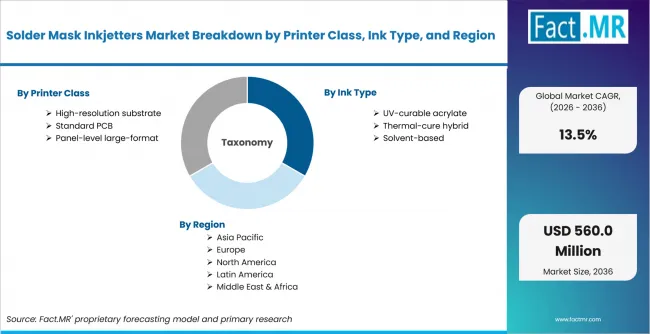
Solder Mask Inkjetters Market Breakdown By Printer Class, Ink Type, And Region | Source: Fact.MR
| Attribute | Details |
|---|---|
| Quantitative Units | USD million |
| Market Definition | Inkjet systems used to deposit solder-mask material on printed circuit boards, HDI boards and IC substrates through controlled digital printing, curing and alignment. |
| Printer Class | High-resolution substrate; Standard PCB; Panel-level large-format |
| Ink Type | UV-curable acrylate; Thermal-cure hybrid; Solvent-based |
| Application | HDI boards; IC substrates; Rigid PCB; Flex/rigid-flex |
| End User | PCB fabricators; Substrate makers; EMS/assembly; Prototyping houses |
| Regions Covered | North America; Latin America; Western Europe; Eastern Europe; East Asia; South Asia & Pacific; Middle East & Africa |
| Countries Covered | China; Germany; Taiwan; USA; Japan; South Korea |
| Key Companies Profiled | Notion Systems GmbH; SUSS MicroTec SE; KLA Corporation, including Orbotech PCB activities; and MicroCraft K.K |
| Forecast Period | 2026 to 2036 |
| Approach | Hybrid top-down and bottom-up approach using PCB output indicators, substrate investment, equipment portfolios, country-level electronics activity and process adoption review. |
Source: Fact.MR analysis. Updated Aug 21, 2026
How is the market segmented?
-
By Printer Class:
- High-resolution substrate
- Standard PCB
- Panel-level large-format
-
By Ink Type:
- UV-curable acrylate
- Thermal-cure hybrid
- Solvent-based
-
By Application:
- HDI boards
- IC substrates
- Rigid PCB
- Flex/rigid-flex
-
By End User:
- PCB fabricators
- Substrate makers
- EMS/assembly
- Prototyping houses
-
By Region:
- North America
- Latin America
- Western Europe
- Eastern Europe
- East Asia
- South Asia & Pacific
- Middle East & Africa
Frequently Asked Questions
What is the Scrim Reinforced Films Market value in 2026?
At what CAGR is the market projected to grow?
What is the projected market value by 2036?
Which Product leads the market?
Which Reinforcement Material leads the market?
Which Application leads the market?
Which End Use Industry leads the market?
Which Film Structure leads the market?
Which Thickness leads the market?
Which country records the highest listed CAGR?
What is the primary driver in this market?
What is the main restraint?
Which companies are included in the market assessment?
Who worked on this report


Preview the report firsthand - request a free sample
Free SampleGet the brochure for pricing and purchase details
Download PDF