- Market Value (2025): USD 7.6 Bn
- Estimated Value (2026): USD 8.3 Bn
- Forecast Value (2036): USD 19.2 Bn
- CAGR (2026-2036): 8.8%
What is the Printed Mono-Material Rollstock Market forecast to be worth by 2036?
USD 8.3 billion in 2026 to USD 19.2 billion by 2036 at an 8.8% CAGR.
- The Printed Mono-Material Rollstock Market was valued at USD 7.6 billion in 2025.
- Demand is projected to rise from USD 8.3 billion in 2026 to USD 19.2 billion by 2036.
- The market is forecast to grow at an 8.8% CAGR from 2026 to 2036. Food brands and converters are testing recyclable printed films.
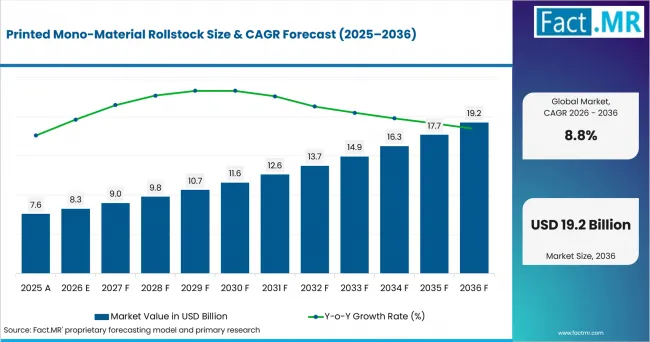
Printed Mono Material Rollstock Value Analysis | Source: Fact.MR
What are the defining numbers behind Printed Mono-Material Rollstock Market growth?
The market offers an absolute opportunity of USD 11.0 billion between 2026 and 2036.
- Demand Drivers in the Market
- Food packers need printable barrier films that run on current form-fill-seal lines. Berry Global reported in January 2025 that Entour MDO-PE/PE films reached about 60 cycles per minute on a new B&B Verpackungstechnik GmbH line.
- Converters value stable web handling as PE films replace stiffer mixed laminates on fast print and pouch lines.
- Pet-food brands need tough mono-material films. The films must keep puncture strength and barrier performance in larger packs.
- Personal-care and household brands can use more mono-material films when print quality and seal performance remain strong.
- Key Segments Analyzed
- By Polymer Platform: PE mono-material is expected to hold 33.0% share in 2026. It offers broad seal windows and established film processing.
- By Barrier Technology: EVOH-compatible barrier is expected to hold 34.0% share in 2026. Thin layers can provide oxygen protection in polyolefin-rich films.
- By Format: Printed rollstock is expected to hold 37.0% share in 2026. It feeds directly into continuous packaging lines.
- By End-use: Snacks are expected to hold 29.0% share in 2026. Snack packs need broad print areas and steady flexible-film volumes.
- Analyst Opinion at Fact.MR
- Shambhu Nath Jha, Principal Consultant at Fact.MR, states: "The main test combines line performance with recycling design. Mono-material films can gain wider use when they keep print quality and seal control. Suppliers should support film design with line trials and barrier tests."
- Strategic Implications
- Film producers should show seal ranges and strength by film gauge. This helps converters compare new films with current laminates.
- Converters should test inks and adhesives as part of the full package. Each layer can affect recycling.
- Brand owners should map packaging redesign against Regulation (EU) 2025/40. The Regulation entered into force on 11 February 2025 and applies from 12 August 2026. Key design-for-recycling rules apply from 2030, with more recyclability rules later.
- Barrier suppliers should use thin functional layers while keeping the oxygen or moisture protection needed for shelf life.
China is forecast to grow at a 10.0% CAGR through 2036, supported by packaged-food retail. The USA follows at 9.5% as food spending supports pack demand. Germany is forecast at 9.3% as recycling rules shape film design. France is estimated at 8.8%. Japan is projected at 7.6%.
How does the Printed Mono-Material Rollstock Market break down by segment?
Printed rollstock leads Format at 37.0% share in 2026. EVOH-compatible barrier leads Barrier Technology at 34.0%.
Which Polymer Platform dominates?
PE mono-material is expected to hold 33.0% share in 2026.
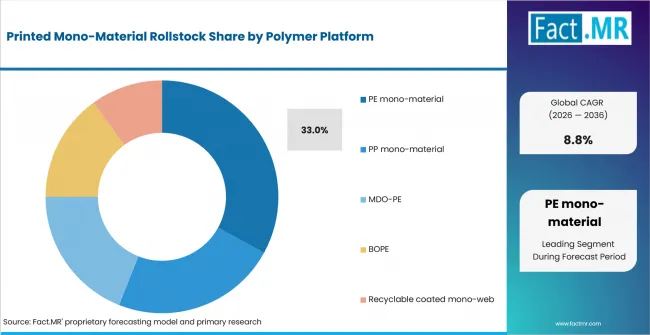
Printed Mono Material Rollstock Analysis By Polymer Platform | Source: Fact.MR
PE mono-material is expected to lead because seal and print layers can stay in one polymer family. MDO-PE adds stiffness and helps web transport. BOPE adds toughness and clarity. PP mono-material suits packs that need more heat resistance. Recyclable coated webs add barrier or print functions. Converters check friction and sealing before approval.
What leads the Barrier Technology segment?
EVOH-compatible barrier is projected to hold 34.0% share in 2026.
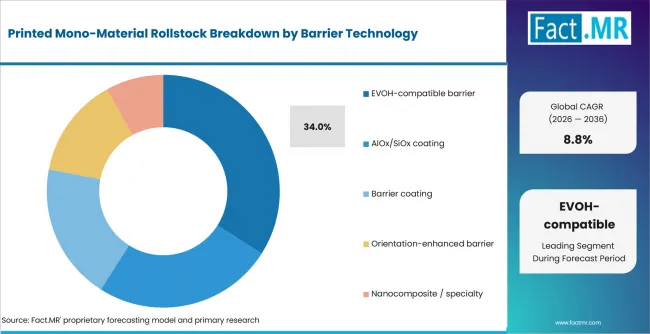
Printed Mono Material Rollstock Analysis By Barrier Technology | Source: Fact.MR
EVOH-compatible structures are expected to lead when a mainly polyolefin pack needs oxygen protection. AlOx and SiOx coatings add clear barrier options. Other coatings can add grease or moisture resistance. Mondi reported in June 2025 that its mono-material re/cycle FlexiBag for Saga Nutrition used high-barrier protection against moisture and odor in dry pet-food packaging. Suppliers aim to keep barrier layers thin while protecting the product.
How does Format shape demand?
Printed rollstock is expected to hold 37.0% share in 2026.
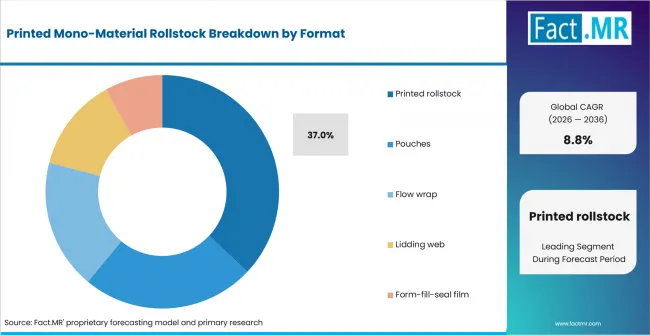
Printed Mono Material Rollstock Analysis By Format | Source: Fact.MR
Printed rollstock is expected to lead because it feeds directly into packaging lines. Pouches use related films for pre-made packs. Flow wrap needs stable web tracking. Lidding web serves trays. Form-fill-seal film links seal temperature with line tension. Rollstock also lets converters change pack length and artwork with limited equipment changes.
What supports Snacks within End-use?
Snacks are expected to hold 29.0% share in 2026.
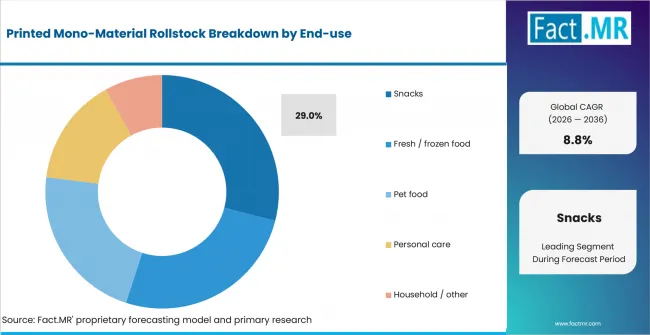
Printed Mono Material Rollstock Analysis By End Use | Source: Fact.MR
Snack packs are expected to lead because printed mono-material films offer large print areas and moisture control. Fresh and frozen foods place more stress on seals. Pet food needs more puncture and barrier strength. Personal-care packs focus on appearance and chemical resistance. Household packs add more uses. Snack lines also value light films that change quickly between formats.
What is accelerating Printed Mono-Material Rollstock Market adoption, and what is holding it back?
Simpler material structures support demand. Barrier needs and line testing can slow conversion.
Drivers Impact Analysis
| DRIVER | (~) % IMPACT ON CAGR | GEOGRAPHIC RELEVANCE | IMPACT TIMELINE |
|---|---|---|---|
| Design-for-recycling conversion. | +1.6% | Europe, North America. | Short term (<= 2 years). |
| Packaged-food throughput. | +1.2% | Global. | Medium term (2-4 years). |
| MDO-PE and BOPE web performance. | +0.9% | North America, Europe, East Asia. | Medium term (2-4 years). |
| Barrier-layer optimization. | +0.7% | Global. | Long term (>= 4 years). |
Source: Fact.MR analysis. Updated Sep 22, 2026
Opportunity Impact Analysis
| OPPORTUNITY | (~) % IMPACT ON CAGR | GEOGRAPHIC RELEVANCE | IMPACT TIMELINE |
|---|---|---|---|
| Recyclable high-barrier food webs. | +1.0% | Europe, North America. | Medium term (2-4 years). |
| Retail-ready pet-food structures. | +0.7% | Global. | Short term (<= 2 years). |
| Printed web downgauging. | +0.5% | Global. | Long term (>= 4 years). |
Source: Fact.MR analysis. Updated Sep 22, 2026
Restraints Impact Analysis
| RESTRAINT | (~) % IMPACT ON CAGR | GEOGRAPHIC RELEVANCE | IMPACT TIMELINE |
|---|---|---|---|
| Barrier-performance trade-offs. | -0.7% | Global. | Short term (<= 2 years). |
| Qualification time on existing lines. | -0.5% | Global. | Medium term (2-4 years). |
| Recycling-rule variation. | -0.4% | Europe, North America, East Asia. | Long term (>= 4 years). |
Source: Fact.MR analysis. Updated Sep 22, 2026
Which countries are scaling the Printed Mono-Material Rollstock Market through 2036?
- The country comparison spans 2.4 percentage points across the forecast period.
- China is 0.5 percentage point above the USA. Packaged-food retail supports growth.
- The USA is 0.2 percentage point above Germany. A large packaged-food base supports demand.
- Germany is 0.5 percentage point above France. Recycling rules support film redesign.
- France is 1.2 percentage points above Japan. Household food spending supports pack demand.
- Japan closes the displayed range. Supermarket activity supports recurring packaged-food formats.
Similar CAGRs can reflect different market conditions. Film approval depends on local recycling rules and line capability. The report covers North America, Latin America, Western Europe, Eastern Europe, East Asia, South Asia & Pacific, and Middle East & Africa.
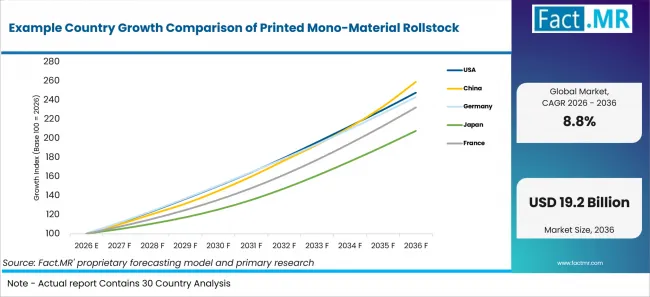
Example Country Growth Comparison Of Printed Mono Material Rollstock | Source: Fact.MR
| Country | CAGR (2026-2036) |
|---|---|
| USA | 9.5% |
| China | 10.0% |
| Germany | 9.3% |
| Japan | 7.6% |
| France | 8.8% |
Source: Fact.MR analysis. Updated Sep 22, 2026
What supports USA adoption?
9.5% CAGR, supported by food spending and steady web-conversion demand.
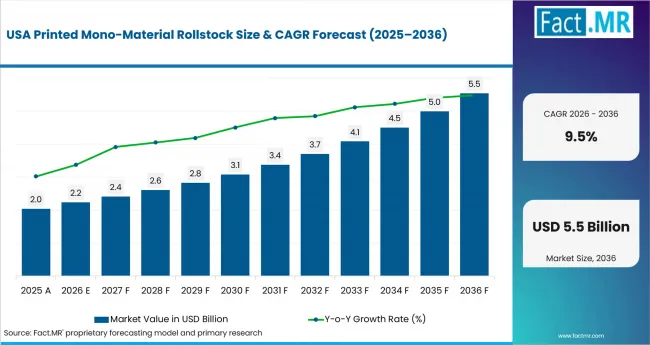
Printed Mono Material Rollstock Country Value Analysis | Source: Fact.MR
U.S. food brands serve large snack and frozen-food markets that use rollstock on automated lines. USDA Economic Research Service reported on June 11, 2026 that U.S. food spending reached USD 2.51 trillion in 2025. That scale supports a broad base for printed flexible packs.
How is China scaling demand?
10.0% CAGR, led by packaged-food retail and high-volume flexible packs.
China's packaged-food market supports printed flexible films across many consumer foods. China's National Bureau of Statistics reported in February 2026 that retail sales of consumer goods reached RMB 50.1 trillion in 2025. Large retail volumes support demand for printed packaging.
What supports Germany's growth?
9.3% CAGR, backed by recycling pressure and design-for-recycling rules.
Germany's packaging system supports structures that can enter cleaner polymer streams after use. The German Environment Agency reported in January 2026 that around 5.5 million tonnes of packaging from dual systems were recycled in 2024. This keeps recycling fit central to film design.
How is France developing demand?
8.8% CAGR, shaped by food spending and flexible-pack redesign.
France's food market supports printed flexible packs for snacks and chilled foods. INSEE reported in May 2026 that household spending on food and non-alcoholic drinks reached EUR 195.3 billion in 2025. This supports steady demand for food packaging.
How does Japan perform?
7.6% CAGR, driven by supermarket activity and careful pack approval.
Japan's retail market supports steady rollstock use in compact food packs and convenience channels. The Ministry of Economy, Trade and Industry reported in February 2026 that supermarket sales reached JPY 18.4 trillion in 2025. This gives printed food films a broad retail base.
Who leads the Printed Mono-Material Rollstock Market?
Amcor plc supplies recyclable flexible-film solutions and includes the former Berry Global business after the combination completed on April 30, 2025. Mondi supplies mono-material barrier films for food packs. Coveris, Constantia Flexibles, and ProAmpac also offer recycle-ready flexible packaging. Buyers compare print quality, seals, barriers, recycling fit, and line performance.
ProAmpac also offers recyclable and recycle-ready flexible packaging. Buyers compare print quality, sealing, barriers, recycling fit, and performance on existing lines.
Which companies are the key providers?
Key companies includes Amcor plc; Mondi plc; Coveris; Constantia Flexibles; and ProAmpac.
- Amcor plc (including former Berry Global portfolio)
- Mondi plc
- Coveris
- Constantia Flexibles
- ProAmpac
Bibliography
- Zeballos, E., & Sinclair, W. (2026, June 11). Total U.S. food spending reached $2.51 trillion in 2025. U.S. Department of Agriculture, Economic Research Service.
- European Parliament & Council of the European Union. (2025, January 22). Regulation (EU) 2025/40 of the European Parliament and of the Council of 19 December 2024 on packaging and packaging waste, amending Regulation (EU) 2019/1020 and Directive (EU) 2019/904, and repealing Directive 94/62/EC. Official Journal of the European Union.
- Berry Global Group, Inc. (2025, January 29). Tailored solutions for Berry’s Entour™ film from B&B conversion line.
- Amcor plc. (2025, April 30). Amcor completes combination with Berry Global; positioned to significantly enhance value for customers and shareholders.
- Mondi. (2025, June 5). Happier pets, smarter packaging: Mondi & Saga Nutrition launch sustainable solution.
- National Bureau of Statistics of China. (2026, February 28). Statistical communiqué of the People’s Republic of China on the 2025 national economic and social development.
- German Environment Agency, & Central Agency Packaging Register. (2026, January 27). Facts against myths: Packaging waste recycling in Germany is working.
- Constantia Flexibles. (2025, August 12). FACHPACK 2025: Constantia Flexibles invests over €100 million and expands product portfolio.
This Report Answers
- The report explains where printed mono-material rollstock is used by polymer platform, barrier technology, format, and end use.
- Segment analysis shows the leading subsegments and why converters select them for packaging lines.
- Country analysis compares the USA, China, Germany, Japan, and France using the supplied 2026-2036 CAGRs.
- Competitive analysis reviews suppliers in film extrusion, printing, barrier systems, and recycle-ready packaging.
- Application analysis reviews sealing, print quality, barrier needs, and recycling fit.
What does the Printed Mono-Material Rollstock Market cover?
The market covers printed flexible films built mainly from one polymer family. Rollstock is supplied as an input for continuous packaging lines. The film must run well through printing and filling. It must also give the packed product the barrier protection it needs.
Coverage includes PE and PP structures with oriented or coated variants. Adjacent material and format trends can be compared with matte polyethylene print films and polyfilm.
What is included in the scope?
The scope includes printed mono-PE and mono-PP rollstock plus MDO-PE and BOPE structures. It includes barrier systems that remain relevant to recyclable film design. Related developments appear across design-for-recycling packaging and sustainable plastic packaging.
Applications cover snacks and fresh or frozen food. Pet food plus personal-care and household formats are included. Barrier context overlaps with bio barrier coatings and recyclable lidding coatings.
What is excluded from the scope?
The market focuses on printed flexible rollstock and closely related converted film. Rigid packs and paper-only structures sit outside the core revenue scope. Related substitution trends are covered only for context.
How Was the Analysis Built?
The analysis draws on 120+ sources, 35+ company portfolios, 25+ countries, and more than 20 industry interviews.
- Primary Research: Primary research includes discussions with manufacturers, service providers, technology developers, distributors, end users, and subject-matter experts. These conversations examine purchasing priorities, product adoption, operational challenges, approval requirements, competitive positioning, and the factors that influence wider market acceptance.
- Desk Research: Desk research covers government statistics, regulatory publications, company filings, trade data, technical studies, industry associations, standards, public policy, and other authoritative sources. Every source used in the analysis is documented in the bibliography.
- Market Sizing and Forecasting: Market estimates combine historical performance, demand indicators, pricing and volume trends, segment shares, company participation, country-level growth, adoption patterns, investment activity, and barriers to market expansion.
- Data Validation and Update Cycle: Findings are validated by comparing primary interviews with public data, company activity, regulatory changes, trade patterns, and industry developments. Regular updates review new product launches, capacity changes, partnerships, approvals, and shifts in commercial adoption.
Segmentation
What is the report's scope and coverage?
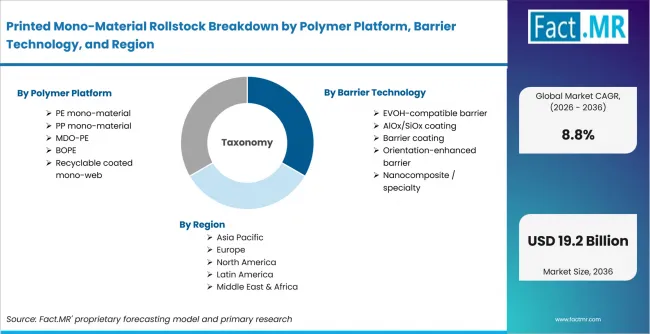
Printed Mono Material Rollstock Breakdown By Polymer Platform, Barrier Technology, And Region | Source: Fact.MR
| Attribute | Details |
|---|---|
| Quantitative Units | USD billion |
| Market Definition | Printed flexible rollstock built mainly from PE or PP for pouches, flow wrap, lidding, and form-fill-seal packs. |
| Polymer Platform | PE mono-material; PP mono-material; MDO-PE; BOPE; Recyclable coated mono-web |
| Barrier Technology | EVOH-compatible barrier; AlOx/SiOx coating; Barrier coating; Orientation-enhanced barrier; Nanocomposite / specialty |
| Format | Printed rollstock; Pouches; Flow wrap; Lidding web; Form-fill-seal film |
| End-use | Snacks; Fresh / frozen food; Pet food; Personal care; Household / other |
| Regions Covered | North America; Latin America; Western Europe; Eastern Europe; East Asia; South Asia & Pacific; Middle East & Africa |
| Countries Covered | USA; China; Germany; Japan; France |
| Key Companies Profiled | Amcor plc; Mondi plc; Coveris; Constantia Flexibles; ProAmpac |
| Forecast Period | 2026 to 2036 |
| Approach | Review of packaging uses, film converting, country demand, rules, and supplier portfolios. |
Source: Fact.MR analysis. Updated Sep 22, 2026
How is the market segmented?
-
By Polymer Platform:
- PE mono-material
- PP mono-material
- MDO-PE
- BOPE
- Recyclable coated mono-web
-
By Barrier Technology:
- EVOH-compatible barrier
- AlOx/SiOx coating
- Barrier coating
- Orientation-enhanced barrier
- Nanocomposite / specialty
-
By Format:
- Printed rollstock
- Pouches
- Flow wrap
- Lidding web
- Form-fill-seal film
-
By End-use:
- Snacks
- Fresh / frozen food
- Pet food
- Personal care
- Household / other
-
By Region:
- North America
- Latin America
- Western Europe
- Eastern Europe
- East Asia
- South Asia & Pacific
- Middle East & Africa
Frequently Asked Questions
How big is the Printed Mono-Material Rollstock Market in 2026?
What is the CAGR of the Printed Mono-Material Rollstock Market from 2026 to 2036?
Which barrier technology leads the Printed Mono-Material Rollstock Market?
Which format leads the Printed Mono-Material Rollstock Market?
Who are the current key providers in the Printed Mono-Material Rollstock Market?
Who worked on this report


Preview the report firsthand - request a free sample
Free SampleGet the brochure for pricing and purchase details
Download PDF