- Market Value (2025): USD 272.7 Mn
- Estimated Value (2026): USD 360.0 Mn
- Forecast Value (2036): USD 5782.0 Mn
- CAGR (2026-2036): 32.0%
What is the Solid Robot Batteries Market forecast to be worth by 2036?
USD 360.0 million in 2026 to USD 5782.0 million by 2036 at a 32.0% CAGR.
- The Solid Robot Batteries Market reached USD 272.7 million in 2025.
- Demand is projected to increase from USD 360.0 million in 2026 to USD 5782.0 million by 2036.
- The market is forecast to record 32.0% CAGR from 2026 to 2036 as robot OEMs and battery integrators qualify safer high-energy packs for industrial and mobile platforms.
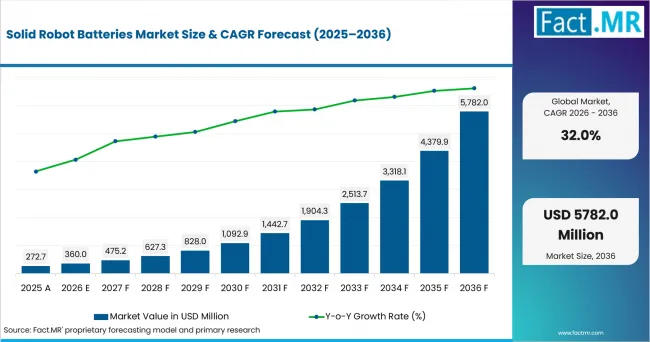
Solid Robot Batteries Market Value Analysis | Source: Fact.MR
What are the defining numbers behind Solid Robot Batteries Market growth?
An absolute opportunity of USD 5,422.0 million is expected between 2026 and 2036.
- Demand Drivers in the Market
- Robot OEMs need safer energy storage as higher utilization moves battery selection toward solid electrolytes and validated pack management.
- Mobile robot integrators need lighter modules that protect runtime while keeping chassis size and payload space stable.
- Battery engineers need sulfide formulas and pouch formats that combine ion transport with flexible module design.
- Procurement teams need documentation on separator stability, cycle life and abuse testing before approving robot pack changes.
- Key Segments Analyzed
- By Chemistry: Sulfide is expected to hold 37.0% share in 2026 due to its role in high-conductivity solid electrolyte designs.
- By Module Format: Pouch is projected to account for 36.0% share in 2026, supported by thin-pack layouts for compact robot bodies.
- By Power Class: Below 1 kWh is anticipated to capture 49.0% share in 2026 owing to use in compact mobile robots and auxiliary robotic systems.
- By Application: Industrial robots are estimated to represent 37.0% share in 2026, led by factory automation fleets that need documented battery safety and uptime.
- Analyst Opinion at Fact.MR
- Shambhu Nath Jha, Principal Consultant at Fact.MR states, “Solid robot batteries are drawing attention because robot platforms leave little room for pack failure. Qualification is expected to move first in compact packs where safer electrolytes solve a visible design problem. Suppliers should combine cell chemistry data with pack-level testing and robot-specific integration support.”
- Strategic Implications
- Cell makers should document electrolyte stability and abuse-test results for robot OEM platform approval.
- Pack integrators should design below 1 kWh modules around charging docks, payload limits and service access in factories.
- Robot OEMs should evaluate solid-state options at tool, gripper and mobile-base level before larger propulsion packs.
- Materials suppliers should align chemistry roadmaps with the qualification cycles used by automation customers.
South Korea is expected to post 37.8% CAGR through 2036, supported by robotics and battery policy. Germany is projected to record 37.3% CAGR due to industrial automation depth. The USA is anticipated to advance at 36.4% CAGR, supported by factory automation and battery manufacturing. The UK is estimated to hold 28.0% CAGR, while Japan is forecast to reach 25.8% CAGR.
How does the Solid Robot Batteries Market break down by segment?
Below 1 kWh leads Power Class at 49.0% share in 2026, while sulfide leads Chemistry at 37.0% share.
Which Chemistry dominates?
Sulfide is expected to hold 37.0% share in 2026.
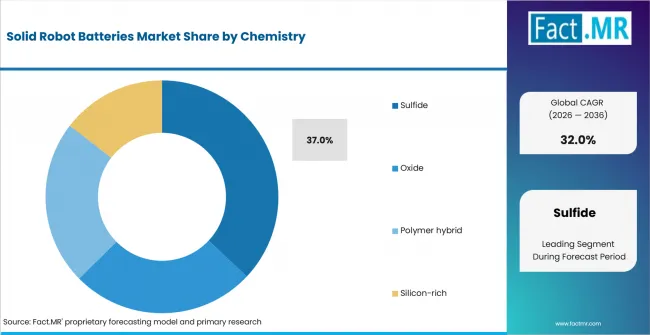
Solid Robot Batteries Market Analysis By Chemistry | Source: Fact.MR
Sulfide leads because many solid-state battery programs evaluate it for ion transport and compact pack potential. Robot applications require careful moisture handling and cell integration. The International Energy Agency reported in May 2025 that global battery demand in the energy sector reached the 1 TWh milestone in 2024, providing a broad scale indicator for the battery industry.
What leads the Module Format segment?
Pouch is projected to account for 36.0% share in 2026.
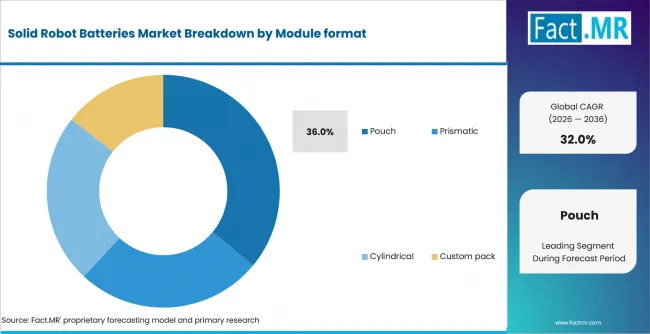
Solid Robot Batteries Market Analysis By Module Format | Source: Fact.MR
Pouch modules fit early robot needs because they support narrow housings and weight-sensitive layouts. ProLogium announced on 9 June 2026 that it signed an MoU with OPmobility to evaluate the joint development and integration of solid-state battery cells into battery modules and packs for electric-vehicle applications, with the objective of developing an OEM-adoptable battery-module solution for future EV platforms.
How does Power Class shape demand?
Below 1 kWh is anticipated to capture 49.0% share in 2026.
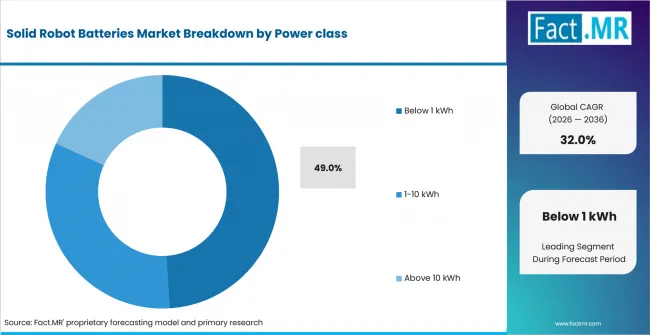
Solid Robot Batteries Market Analysis By Power Class | Source: Fact.MR
Below 1 kWh packs lead because compact robots need short charging cycles and controlled battery weight. The class fits service robots and robotic subsystems that operate near workers. TDK Electronics’ CeraCharge documentation lists a 4.4 x 3.0 x 1.1 mm solid-state SMD battery with 100 microampere-hour nominal capacity, demonstrating miniaturized solid-state battery packagin TDK Electronics’ CeraCharge documentation lists a solid-state SMD rechargeable battery measuring 4.4 × 3.0 × 1.1 mm with a nominal capacity of 100 µAh, illustrating the compact form factor achievable with solid-state battery technology.
What supports Industrial robots within Application?
Industrial robots are estimated to represent 37.0% share in 2026.
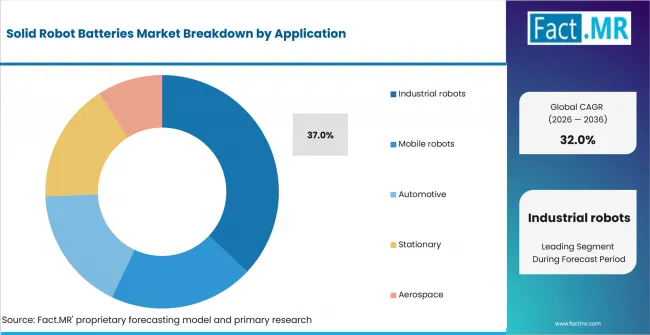
Solid Robot Batteries Market Analysis By Application | Source: Fact.MR
Industrial robots lead because factories require documented battery safety and maintenance control. IFR reported in September 2025 that 542,000 industrial robots were installed worldwide in 2024, highlighting the scale of global factory automation. Battery-powered mobile and compact robotic systems can provide potential application pathways for smaller battery modules, although battery capacity and solid-state technology adoption depend on individual system requirements.
What is accelerating Solid Robot Batteries Market adoption, and what is holding it back?
Demand is expected to rise due to safer robot energy storage and compact pack design. Qualification cost and long validation cycles are expected to shape adoption timing.
Driver Impact Analysis
| DRIVER | (~) % IMPACT ON CAGR | GEOGRAPHIC RELEVANCE | IMPACT TIMELINE |
|---|---|---|---|
| Solid-electrolyte safety and compact packaging | +3.4% | Global | Short term (<= 2 years) |
| Robot installations and mobile automation growth | +2.7% | East Asia, North America, Europe | Medium term (2-4 years) |
| Battery demand and cell-manufacturing learning | +2.1% | Global | Medium term (2-4 years) |
| Robot-specific battery collaborations | +1.4% | South Korea, Japan, USA | Short term (<= 2 years) |
Source: Fact.MR analysis. Updated Aug 27, 2026
- Solid-electrolyte safety and compact packaging: Robot OEMs want batteries that reduce thermal risk while fitting small housings and flexible chassis layouts.
- Robot installations and mobile automation growth: Expanding factory automation and mobile robotics are increasing the need for compact, reliable battery systems that can support repeated operating cycles.
- Battery demand and cell-manufacturing learning: Continued growth in battery production is improving manufacturing know-how, material handling and qualification processes for advanced cell technologies.
- Ceramic separator partnerships: Collaboration between battery developers and ceramic-material suppliers is supporting scale-up of solid-state battery components and improving readiness for higher-volume production.
| OPPORTUNITY | (~) % IMPACT ON CAGR | GEOGRAPHIC RELEVANCE | IMPACT TIMELINE |
|---|---|---|---|
| Below 1 kWh replacement modules | +1.8% | Global | Short term (<= 2 years) |
| Sulfide and oxide electrolyte qualification | +1.5% | East Asia, North America | Medium term (2-4 years) |
| Pouch and custom packs for mobile robots | +1.1% | Europe, East Asia | Medium term (2-4 years) |
Source: Fact.MR analysis. Updated Aug 27, 2026
- Below 1 kWh replacement modules: Early demand is concentrated in compact robot systems where safer batteries fit platform redesign cycles.
- Sulfide and oxide electrolyte qualification: Material suppliers gain orders when they shorten moisture-control, pressure and cycling validation.
- Pouch and custom packs for mobile robots: Integrators use flexible pack geometry to protect runtime and keep robot bodies narrow.
| RESTRAINT | (~) % IMPACT ON CAGR | GEOGRAPHIC RELEVANCE | IMPACT TIMELINE |
|---|---|---|---|
| Moisture handling and electrolyte qualification | -1.0% | Global | Short term (<= 2 years) |
| High material and equipment cost | -0.8% | Global | Medium term (2-4 years) |
| Long robot OEM validation cycles | -0.6% | North America, Europe, East Asia | Medium term (2-4 years) |
Source: Fact.MR analysis. Updated Aug 27, 2026
- Moisture handling and electrolyte qualification: Sulfide and ceramic separator routes require controlled processing and careful moisture management before buyers accept pack-level safety and reliability claims.
- High material and equipment cost: Advanced battery materials and specialized manufacturing equipment can raise production costs, making early adoption more difficult for robot OEMs and battery suppliers.
- Long robot OEM validation cycles: Automation customers require safety testing, charging validation and service procedures before a new battery system can enter production equipment.
Which countries are scaling the Solid Robot Batteries Market through 2036?
- The country comparison spans 12.0 percentage points and forms three growth bands across the forecast period.
- South Korea remains 0.5 percentage point above Germany through robotics policy and demand-specific battery technology funding.
- Germany remains 0.9 percentage point above the USA as industrial robot installations and machinery orders support pack qualification.
- The USA remains 8.4 percentage points above the UK through factory automation scale and electronics-linked durable-goods orders.
- The UK remains 2.2 percentage points above Japan as automotive electrification funding supports battery supply-chain capability.
- Japan closes the displayed range through robot installations, machinery orders and domestic all-solid-state battery strategy.
Comparable CAGRs create different entry conditions due to automation density, battery policy, pack-design capability and local manufacturing costs. Full report coverage includes North America, Latin America, Western Europe, Eastern Europe, East Asia, South Asia & Pacific, Middle East & Africa.
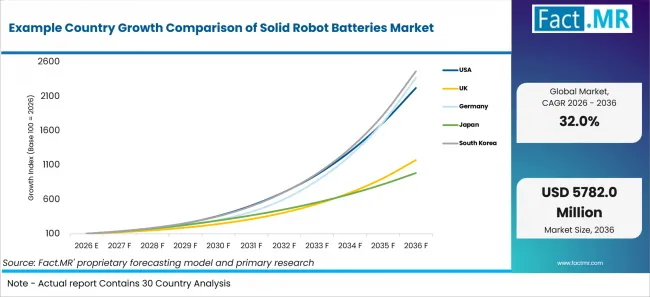
Example Country Growth Comparison Of Solid Robot Batteries Market | Source: Fact.MR
| Country | CAGR (2026-2036) |
|---|---|
| South Korea | 37.8% |
| Germany | 37.3% |
| USA | 36.4% |
| UK | 28.0% |
| Japan | 25.8% |
Source: Fact.MR analysis. Updated Aug 27, 2026
What supports South Korea adoption?
37.8% CAGR, supported by robot installations and battery technology funding.
South Korea enters the forecast with dense industrial automation and active battery-policy support. IFR reported in September 2025 that the Republic of Korea installed 30,600 industrial robots in 2024. In November 2025, MOTIR’s K-Battery Competitiveness Enhancement Plan included a KRW 40 billion demand-tailored battery technology development project running from 2026 to 2029 for new-demand industries including defense, robots, ships and UAM. The programme supports R&D and demonstration and directly identifies robots among the targeted battery-demand applications.
What supports Germany adoption?
37.3% CAGR, backed by industrial robotics and machinery demand.
Germany ties solid robot batteries to factory automation depth and engineering-led approval routines. IFR reported in September 2025 that Germany installed 26,982 industrial robots in 2024, representing 32% of Europe’s annual installations. Destatis reported in August 2026 that Germany’s real stock of orders in manufacturing increased 0.8% month over month in June 2026, after seasonal and calendar adjustment.
What supports USA adoption?
36.4% CAGR, driven by factory automation and battery manufacturing.
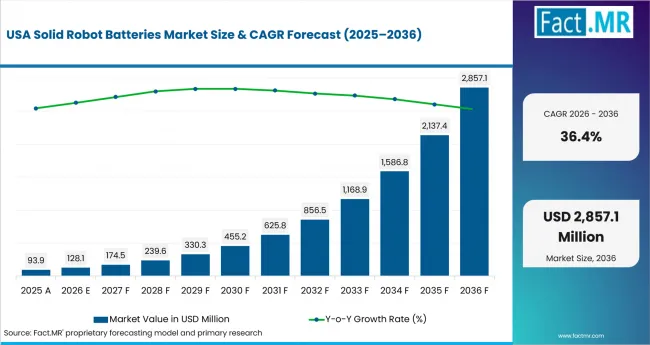
Solid Robot Batteries Market Country Value Analysis | Source: Fact.MR
The USA links robot-battery adoption to automation scale and electronics-heavy durable-goods activity. IFR reported in September 2025 that the USA installed 34,200 industrial robots in 2024. The U.S. Census Bureau reported in July 2026 that manufactured durable-goods orders reached USD 334.8 billion in June 2026, with computers and electronic products up 3.1%.
What supports UK growth?
28.0% CAGR, supported by electrification funding and compact automation use.
The UK profile is supported by manufacturing recovery and electrification funding. The Office for National Statistics reported in August 2026 that UK manufacturing output increased 1.0% in Quarter 2 2026 compared with Quarter 1 2026. The Department for Business and Trade’s DRIVE35 collection, updated in August 2026, states that GBP 4.0 billion of capital and R&D funding is available for the automotive industry to 2035. DRIVE35 supports zero-emission-vehicle manufacturing and associated supply chains, including batteries, upstream supply-chain activities and recycling.
How does Japan perform?
25.8% CAGR, led by robot installations and domestic battery strategy.
Japan remains a robot-manufacturing anchor and a battery-policy center. IFR reported in September 2025 that Japan installed approximately 44,500 industrial robots in 2024. The Cabinet Office reported in August 2026 that total machinery orders received by 280 manufacturers increased 11.3% in April–June 2026 compared with the previous quarter. METI’s June 2026 Battery and Power Industry Strategy targets full-scale commercialization of all-solid-state batteries around 2030, making commercialization of the technology a formal national policy target.
Who leads the Solid Robot Batteries Market?
Samsung SDI is active in robot-specific batteries through its collaboration with Hyundai Motor and Kia, targeting higher energy density, output and operating time within the limited battery space available in robots. Samsung SDI has also demonstrated cylindrical-cell integration in service robots, including Hyundai Motor Group’s DAL-e. Hyundai Motor and Kia are evaluating charge and discharge performance, operating time and qualification life as part of the robot-battery development programme.
TDK and Murata contribute compact solid-state battery and ceramic-material capabilities. TDK’s CeraCharge demonstrates a compact solid-state SMD format based on a ceramic electrolyte, while Murata combines oxide-based solid-state battery development with ceramics expertise being applied to high-volume production of QuantumScape ceramic separators. These capabilities provide relevant technology pathways for compact electronic and solid-state battery applications.
Ilika, ProLogium add specialist solid-state battery capabilities. Ilika announced on September 22, 2025 that its PRIMED Solid-State Battery Programme had commenced effective August 1, 2025, and completed commissioning of its Goliath automated pilot line in October 2025.
Competition centers on pack-level proof. The main checks include module pressure behavior, thermal response, charging rules and maintenance access. Robot OEMs are expected to prefer suppliers that translate cell claims into stable robot duty-cycle evidence.
Which companies are the key providers?
Key companies include TDK Corporation, Maxell, Samsung SDI Co., Ltd., Factorial Energy, ProLogium Technology Co., Ltd.
- TDK Corporation
- Maxell
- Samsung SDI Co., Ltd.
- Factorial Energy
- ProLogium Technology Co., Ltd.
Bibliography
- International Federation of Robotics. (2025, September 25). World Robotics 2025: Industrial robots.
- International Energy Agency. (2025, May 14). Electric vehicle batteries. In Global EV Outlook 2025.
- Samsung SDI. (2025, March 4). Samsung SDI to present collaborations on robotics, autonomous vehicles to realize 'InCelligent Life' at InterBattery 2025.
- ProLogium Technology Co., Ltd. (2026, June 9). ProLogium and OPmobility sign MoU to develop next generation solid-state battery modules for mobility.
- U.S. Census Bureau. (2026, July 27). Monthly advance report on durable goods manufacturers' shipments inventories and orders.
- U.S. Bureau of Labor Statistics. (2026, August 13). Producer Price Indexes—July 2026.
- Office for National Statistics. (2026, August 13). Index of Production, UK: June 2026.
- Department for Business, Innovation, Science and Trade, & Department for Business and Trade. (2026, August 10). Apply for automotive funding via the DRIVE35 programme. GOV.UK.
- Federal Statistical Office (Destatis). (2026, August 19). Stock of orders in manufacturing in June 2026: +0.8% on the previous month.
- Economic and Social Research Institute. (2026, August 19). Machinery orders in June, 2026 and forecast for Jul.-Sep. 2026. Cabinet Office, Government of Japan.
- Ministry of Economy, Trade and Industry. (2026, June 2). “Battery Industry Strategy” revised as the “Battery and Power Industry Strategy”.
- Ministry of Trade, Industry and Resources. (2025, December 1). K-Battery to power Korea’s future industries.
- Samsung SDI. (2025, February 25). Samsung SDI to develop high-performance robot batteries with Hyundai Motor, Kia.
This Report Answers
- The report explains where solid robot batteries are used across chemistry, module format, power class and application. It links pack requirements with robot uptime, charging access and safety validation.
- Segment analysis identifies the 2026 share leaders and explains why sulfide chemistry, pouch modules, below 1 kWh packs and industrial robots carry early commercial weight.
- Country analysis examines the listed markets and the policy or manufacturing mechanisms that support robot-battery qualification. It separates robotics scale from battery-specific commercialization readiness.
- Competitive analysis reviews current providers across compact solid-state cells, robot-specific collaboration, ceramic-separator work and vehicle-proven solid battery testing.
- Application analysis assesses how safety and charging behavior influence supplier selection. It also considers pack size and service access across industrial robots, mobile robots and adjacent automated equipment.
What does the Solid Robot Batteries Market cover?
The Solid Robot Batteries Market covers solid-electrolyte cells, modules and packs used in robotic systems. It includes sulfide, oxide, polymer-hybrid and silicon-rich chemistries designed for compact packaging, safer operation and robot-specific validation across factory robot systems.
The assessment covers below 1 kWh packs and larger module classes used around factory robot platforms, mobile bases and automated equipment. It connects robot batteries with industrial robot components where compact power modules affect design choices and maintenance planning.
What is included in the scope?
The scope includes commercial and pre-commercial batteries for robot energy storage or platform validation. It includes packs used in mobile industrial robot fleets and stationary automation systems where duty cycle, charging access and safety evidence guide procurement.
Included technologies cover solid-state cells, pack electronics and modules using solid-state battery materials. The scope also includes integration activity linked with industrial robotics systems.
What is excluded from the scope?
Coverage focuses on solid-electrolyte robot batteries and replacement routes tied to robotic platforms. Generic solid-state battery platforms are treated as adjacent only when a robot route is defined.
Raw battery materials remain outside the core scope until a robot pack or module context is defined. Adjacent areas such as silicon anode battery chemistries, lithium-ion battery electrolyte, battery passport systems and industrial battery packs support the analysis only when they connect to robot-battery qualification.
How Was the Analysis Built?
The analysis draws on 120+ sources. It reviews 35+ company portfolios, 25+ countries and 20+ interviews.
- Primary Research: Primary research includes discussions with battery manufacturers and robot OEMs. Pack integrators and material suppliers add production detail. Distributor and procurement-team interviews add buyer-side context. These conversations examine purchasing priorities and product adoption. They review operating requirements, approval needs and competitive positioning.
- Desk Research: Desk research covers government statistics and regulatory publications. Company filings and trade data support supplier mapping. Technical studies and industry associations support product-boundary checks. Standards and public policy are reviewed where they shape battery qualification.
- Market Sizing and Forecasting: Market estimates combine historical performance and demand indicators. Pricing and volume trends are reviewed with segment shares. Company participation and country-level growth are assessed against adoption patterns. Investment activity is used to test market-expansion timing.
- Data Validation and Update Cycle: Findings are validated by comparing primary interviews with public data and company activity. Reviews cover regulatory changes and trade patterns. Industry developments are checked against launches and capacity changes. Partnership activity and procurement trends are reviewed during each update cycle.
Segmentation
What is the report’s scope and coverage?
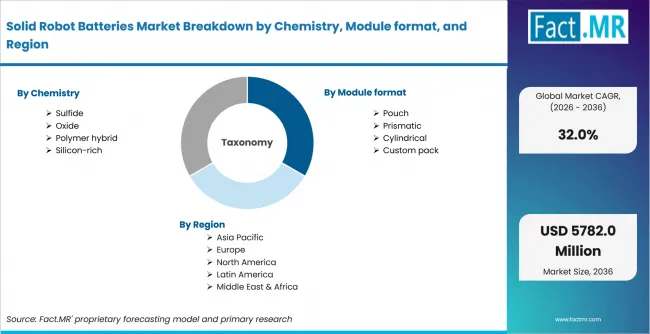
Solid Robot Batteries Market Breakdown By Chemistry, Module Format, And Region | Source: Fact.MR
| Attribute | Details |
|---|---|
| Quantitative Units | USD million |
| Market Definition | Solid-electrolyte cells, modules and packs designed for robotic platforms. |
| Chemistry | Sulfide; Oxide; Polymer hybrid; Silicon-rich |
| Module Format | Pouch; Prismatic; Cylindrical; Custom pack |
| Power Class | Below 1 kWh; 1-10 kWh; Above 10 kWh |
| Application | Industrial robots; Mobile robots; Automotive; Stationary; Aerospace |
| Regions Covered | North America; Latin America; Western Europe; Eastern Europe; East Asia; South Asia & Pacific; Middle East & Africa |
| Countries Covered | USA; UK; Germany; Japan; South Korea |
| Key Companies Profiled | TDK Corporation; Maxell; Samsung SDI Co., Ltd.; Factorial Energy; ProLogium Technology Co., Ltd. |
| Forecast Period | 2026 to 2036 |
| Approach | Hybrid top-down and bottom-up approach using robot demand, chemistry adoption, module selection, country growth and portfolio review. |
Source: Fact.MR analysis. Updated Aug 27, 2026
How is the market segmented?
-
By Chemistry:
- Sulfide
- Oxide
- Polymer hybrid
- Silicon-rich
-
By Module Format:
- Pouch
- Prismatic
- Cylindrical
- Custom pack
-
By Power Class:
- Below 1 kWh
- 1-10 kWh
- Above 10 kWh
-
By Application:
- Industrial robots
- Mobile robots
- Automotive
- Stationary
- Aerospace
-
By Region:
- North America
- Latin America
- Western Europe
- Eastern Europe
- East Asia
- South Asia & Pacific
- Middle East & Africa
Frequently Asked Questions
How big is the solid robot batteries market in 2026?
What is the CAGR of the solid robot batteries market from 2026 to 2036?
Which chemistry leads the solid robot batteries market?
Which module format leads the solid robot batteries market?
Who are the leading companies in the solid robot batteries market?
Who worked on this report


Preview the report firsthand - request a free sample
Free SampleGet the brochure for pricing and purchase details
Download PDF