- Base Value(2025): 6.8 Bn
- Estimated Value(2026): 7.5 Bn
- Forecast Value (2036): 23.7 Bn
- CAGR (2026 - 2036): 12.2%
Lithium and Lithium Ion Battery Electrolyte Market Forecast and Outlook 2026 to 2036
In 2025, the lithium and lithium ion battery electrolyte market surpassed a valuation of USD 6.8 billion. Based on Fact.MR analysis, demand for lithium and lithium ion battery electrolytes is estimated to grow to USD 7.5 billion in 2026 and USD 23.7 billion by 2036. Fact.MR projects a CAGR of 12.2% during the forecast period.
Between 2026 and 2036, the lithium and lithium ion battery electrolyte market is projected to create an absolute dollar opportunity of USD 16.2 billion. This expansion reflects the structural integration of lithium-ion batteries across automotive electrification, stationary energy storage, and consumer electronics, underpinned by coordinated government EV incentive programmes and gigafactory-scale manufacturing investment.
Simon Moores, CEO of Benchmark Mineral Intelligence said "We are in a new reality where countries are drawing up bridges. High-value manufacturing such as lithium-ion batteries is becoming more regional. Things are increasingly being made where they are sold."
Country growth reflects EV adoption, gigafactory investments, and battery policy support. India leads with 14.1% CAGR driven by PLI incentives and EV expansion. Germany grows 13.4% with Volkswagen and BMW boosting cell production and electrolyte localisation. China records 13.0% supported by its large EV manufacturing base. Japan reaches 12.3% with Toyota and Panasonic’s solid-state programs. The United States grows 11.8% due to Inflation Reduction Act incentives and new gigafactories. The UK (5.8%) and France (5.1%) grow through gigafactory investments and localized battery supply chains.
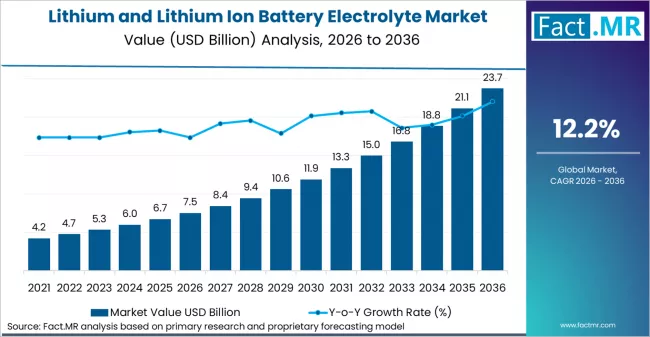
Lithium And Lithium Ion Battery Electrolyte Market Market Value Analysis | Source: Fact.MR
| Metric | Value |
|---|---|
| Estimated Value in 2026 | USD 7.5 billion |
| Forecast Value in 2036 | USD 23.7 billion |
| Forecast CAGR (2026 to 2036) | 12.2% |
Source: Fact.MR analysis. Updated Mar 5, 2026
Market Definition
The lithium and lithium-ion battery electrolyte market includes ionic-conducting materials used in lithium battery cells to enable charge transfer between cathode and anode. Electrolytes exist in liquid, solid, and gel forms and influence energy density, cycle life, safety, and fast-charging. Key applications include EV batteries, consumer electronics, stationary energy storage, and industrial power systems.
Market Inclusions
Includes global and regional revenue forecasts (2026-2036) by product type, end use, and form factor. Covers lithium, sulfide, polymer, oxide, and other electrolyte chemistries. Also includes pricing trends, supply chain costs, regulatory compliance timelines, and additive technology developments across industries.
Market Exclusions
Excludes cathode and anode materials, separators, and battery pack assemblies where electrolyte is not the main component. Also excludes aqueous electrolytes for lead-acid and nickel-metal hydride batteries, finished battery cells, modules, BMS systems, and post-sale electrolyte recycling activities.
Research Methodology
- Primary Research: Interviews with battery engineers, automotive OEM procurement managers, material suppliers, gigafactory specialists, and regulatory consultants across Asia Pacific, Europe, and North America.
- Desk Research: Sources include OEM investor reports, government energy and transport publications, EU battery regulations, IEA EV Outlook data, gigafactory investment announcements, electrochemical research papers, and manufacturer earnings transcripts.
- Market Sizing and Forecasting: Uses a hybrid model combining EV production forecasts with electrolyte usage per kWh by battery chemistry and form factor. Growth assumptions incorporate EV incentives, gigafactory ramp-up timelines, and electrolyte pricing tiers.
- Data Validation and Update Cycle: Forecasts validated using manufacturer revenues, chemistry adoption announcements, EV registration data, and regulatory updates. Market outlook is reviewed annually based on gigafactory progress, chemistry shifts, and lithium price changes.
Summary
- Market Definition
- The lithium and lithium-ion battery electrolyte market covers liquid, solid, and gel ionic materials enabling charge transfer in lithium battery cells used across EVs, electronics, energy storage, and industrial power systems.
- Demand Drivers
- Rapid EV adoption and government electrification policies in the EU, China, India, and the United States are driving large-scale electrolyte procurement for gigafactory battery production.
- Growth in grid-scale energy storage for renewable integration is expanding electrolyte demand through national battery storage programs in markets such as Germany, Australia, and the United States.
- Development of solid-state and high-voltage electrolyte formulations for next-generation batteries is increasing demand for premium, high-value electrolyte technologies.
- Key Segments Analyzed
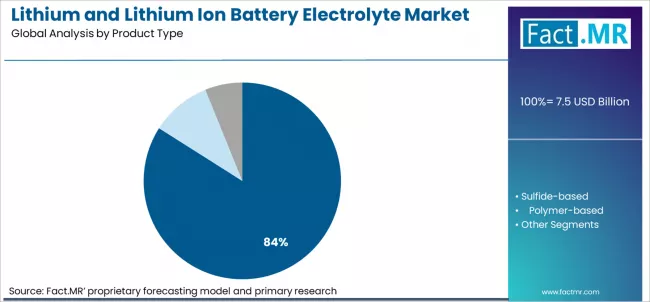
- By Product Type: Lithium-based electrolytes hold about 84% share in 2026 due to strong conductivity, cost efficiency, and compatibility with major cathode chemistries like NMC and LFP.
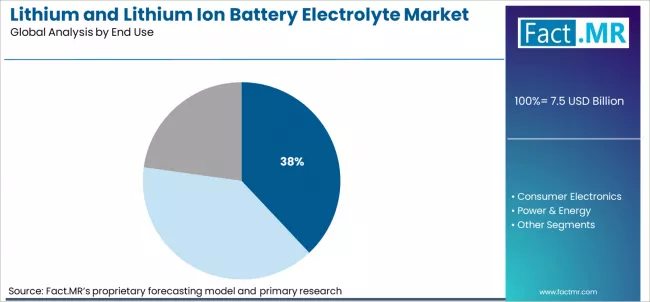
- By End Use: Automotive accounts for about 38% share in 2026, driven by high-volume electrolyte consumption in EV traction batteries produced in gigafactories.
- By Form: Liquid electrolytes dominate current battery production, while solid and gel electrolytes are gaining adoption in next-generation solid-state and semi-solid battery technologies.
- By Geography: Asia Pacific leads, contributing the highest expansion rates.
- Strategic Implications
- Electrolyte manufacturers should invest early in solid-state and polymer electrolytes to qualify for next-generation EV battery programmes as OEM timelines accelerate between 2025 and 2028.
- Suppliers should build localized production or partnerships in the EU, United States, and India to meet battery regulation domestic content rules and IRA incentive requirements.
- Companies should track lithium carbonate prices and secure long-term feedstock contracts to reduce cost volatility and protect margins in OEM supply agreements.
- Methodology
- Market sizing combined gigafactory battery production estimates with average electrolyte usage per kWh across liquid, solid, and gel forms.
- EV policy timelines, battery regulations, and OEM electrification investments were benchmarked using government records and OEM investor reports.
- Regional forecasts used EV registration data, energy storage targets, gigafactory investments, and primary interviews with battery engineers and procurement specialists.
Segmental Analysis
Lithium and Lithium Ion Battery Electrolyte Market Analysis by Product Type
Lithium And Lithium Ion Battery Electrolyte Market Analysis By Product Type | Source: Fact.MR
Based on FACT.MR’s report, lithium-based electrolytes hold about 84% share in 2026 due to the commercial maturity of LiPF6-based formulations used in NMC and LFP battery cell production.
- Mitsubishi Chemical Electrolyte Capacity Expansion: In January 2025, Mitsubishi Chemical expanded electrolyte capacity in Japan and announced a new North American plant to supply IRA-compliant battery cell manufacturers. [5]
- Capchem High-Voltage Additive Technology Development: In 2024, Shenzhen Capchem commercialized high-voltage electrolyte additives supporting 4.35V and 4.6V EV battery platforms, extending the performance of conventional liquid electrolytes. [6]
- Solid-State Electrolyte Pilot Production Ramp: In 2024, Panasonic Energy partnered with suppliers to develop sulfide-based solid-state electrolytes with pilot production planned for 2025-2026. [7]
Lithium and Lithium Ion Battery Electrolyte Market Analysis by End Use
Lithium And Lithium Ion Battery Electrolyte Market Analysis By End Use | Source: Fact.MR
Based on FACT.MR’s report, the automotive segment is expected to hold about 38% share in 2026 due to high electrolyte volumes required in EV traction battery packs.
- Guangzhou Tinci Automotive Electrolyte Supply Agreement: In 2025, Guangzhou Tinci signed long-term electrolyte supply agreements with CATL and BYD for LFP and NMC EV battery programs. [8]
- Shanshan Technology Consumer Electronics Electrolyte Expansion: In 2024, Shanshan Technology expanded electrolyte production to meet demand from laptop and portable electronics battery manufacturers.
- Power and Energy Storage Segment Growth: In 2024, the IEA reported global stationary battery storage additions exceeded 100 GWh, driving electrolyte demand in grid-scale LFP battery deployments.
Drivers, Restraints, and Opportunities
FACT.MR analysts observe that the lithium and lithium ion battery electrolyte market closely follows global lithium-ion battery production. Valued at USD 6.8 billion, the market reflects large-scale battery manufacturing and the critical role of electrolytes in cell performance, safety, and efficiency across EVs, electronics, and energy storage.
The market faces dual dynamics: volume growth in low-cost liquid electrolytes and higher-value opportunities in solid-state and polymer electrolytes. While Chinese competition pressures liquid electrolyte pricing, advanced electrolyte chemistries command premium pricing and are gaining traction in next-generation EV battery platforms.
- EV Fleet Mandate Acceleration: The European Union’s Regulation (EU) 2023/851 requires a 55% reduction in passenger car emissions by 2030, accelerating EV adoption and driving electrolyte procurement by gigafactories such as Northvolt, ACC, and CATL Europe. [2]
- Inflation Reduction Act Battery Manufacturing Incentive: The U.S. Inflation Reduction Act provides Section 45X tax credits for domestic battery production, encouraging localization of electrolyte supply chains and investments by Mitsubishi Chemical, Soulbrain, and Capchem. [3]
- India PLI Scheme for Advanced Chemistry Cells: India’s INR 18,100 crore PLI scheme is enabling gigafactory investments by Ola Electric, Reliance Industries, and Amara Raja, creating domestic electrolyte demand and localization opportunities for global suppliers. [4]
Regional Analysis
The lithium and lithium ion battery electrolyte market is analysed across Asia Pacific, Europe, North America, Latin America, and Middle East and Africa, covering 40+ countries. The full report also offers market attractiveness analysis based on regional investment, regulatory, and supply chain trends.
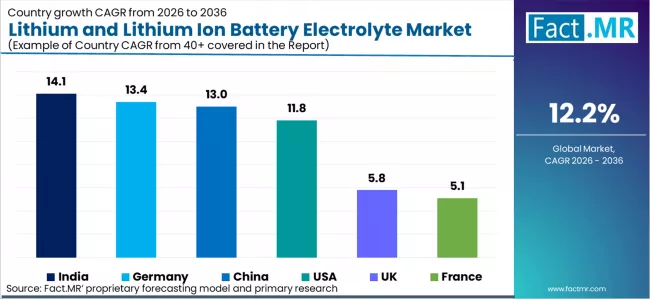
Lithium And Lithium Ion Battery Electrolyte Market Cagr Analysis By Country | Source: Fact.MR
| Country | CAGR (2026-2036) |
|---|---|
| India | 14.1% |
| Germany | 13.4% |
| China | 13.0% |
| USA | 11.8% |
| UK | 5.8% |
| France | 5.1% |
Source: Fact.MR analysis. Updated Mar 5, 2026
Source: Fact.MR (FACT.MR) analysis, based on proprietary forecasting model and primary research
Asia Pacific Lithium and Lithium Ion Battery Electrolyte Market Analysis
Asia Pacific is the largest production and consumption hub for lithium-ion battery electrolytes due to concentrated gigafactory capacity in China, Japan, and South Korea, along with India’s emerging battery manufacturing sector. Chinese companies such as Shenzhen Capchem, Guangzhou Tinci, and Zhangjiagang Guotai-Huarong dominate global supply, while Japanese firms like Mitsubishi Chemical and UBE focus on high-purity and advanced electrolyte technologies.
- India: Demand for lithium and lithium ion battery electrolytes in India is projected to grow at a 14.1% CAGR through 2036. The government’s Production Linked Incentive scheme for Advanced Chemistry Cells is driving gigafactory investments by Ola Electric and Reliance New Energy. Expansion of the FAME III EV incentive programme in 2025 further supports EV adoption and traction battery demand. Limited domestic electrolyte production creates strong import demand and long-term localisation opportunities for global suppliers.
- China: Demand for lithium and lithium ion battery electrolytes in China is projected to grow at a 13.0% CAGR through 2036. China produced over 12 million EVs in 2024, generating the world’s largest electrolyte demand pool. Expansion of CATL’s global and domestic gigafactories requires increased electrolyte supply across LFP, NMC, and emerging sodium-ion batteries. A strong domestic ecosystem led by Capchem, Tinci, and Guotai-Huarong ensures integrated production and competitive global pricing.
FACT.MR's Asia Pacific analysis of the lithium and lithium ion battery electrolyte market covers China, Japan, South Korea, India, Australia and New Zealand, ASEAN, and Rest of Asia Pacific. Readers can find country-level CAGR projections, gigafactory demand timelines, electrolyte chemistry adoption trends, and supply chain localisation investment benchmarks by end-use segment.
Europe Lithium and Lithium Ion Battery Electrolyte Market Analysis
Europe serves as a regulatory hub shaping electrolyte supply chains through the EU Battery Regulation (Regulation (EU) 2023/1542), which mandates sustainability and carbon footprint disclosures. Germany leads regional demand through major OEM gigafactory programmes, while France, Spain, and Sweden are expanding battery manufacturing capacity.
- Germany: Demand for lithium and lithium ion battery electrolytes in Germany is projected to grow at a 13.4% CAGR through 2036. BMW’s Neue Klasse battery platform launching from 2025 will use advanced electrolyte formulations for higher energy density and faster charging. Germany’s government continues supporting battery material localisation through the IPCEI Batteries II programme.
- United Kingdom: Demand for lithium and lithium ion battery electrolytes in the UK is projected to grow at a 5.8% CAGR through 2036. Nissan’s £2 billion EV hub expansion in Sunderland includes a new gigafactory requiring localized battery supply chains. The UK Battery Industrialization Centre is expanding electrolyte testing and qualification programmes to support domestic battery development.
- France: Demand for lithium and lithium ion battery electrolytes in France is projected to grow at a 5.1% CAGR through 2036. Automotive Cells Company is scaling its Douvrin gigafactory with commercial production starting in 2025 and reaching 40 GWh capacity by 2030. TotalEnergies is developing domestic electrolyte supply capabilities to reduce reliance on Asian imports and comply with EU battery regulations.
FACT.MR's European analysis of the lithium and lithium ion battery electrolyte market covers Germany, France, the United Kingdom, Italy, Spain, the Netherlands, the Nordics, and Rest of Europe. Readers can find EU Battery Regulation compliance timelines, gigafactory procurement trends, electrolyte chemistry adoption patterns, and country-level CAGR projections by end-use segment.
North America Lithium and Lithium Ion Battery Electrolyte Market Analysis
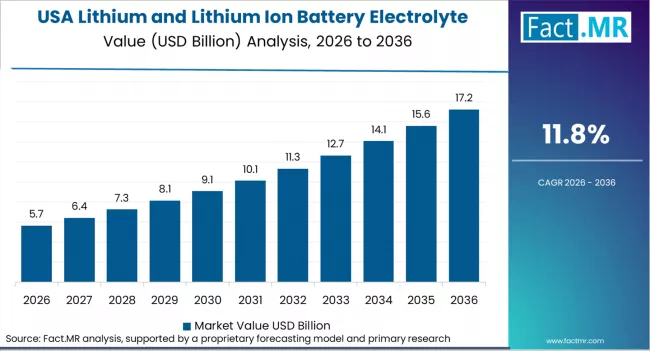
Lithium And Lithium Ion Battery Electrolyte Market Country Value Analysis | Source: Fact.MR
North America is a fast-growing electrolyte demand region driven by IRA-supported gigafactory investments. The United States is expected to become the second-largest EV battery production hub outside Asia by the mid-2030s, encouraging domestic electrolyte production capacity expansion.
- United States: Demand for lithium and lithium ion battery electrolytes in the United States is projected to grow at an 11.8% CAGR through 2036. The U.S. Department of Energy allocated USD 3.1 billion in 2024 to strengthen domestic battery supply chains, including electrolyte manufacturing. In 2025, Soulbrain MI expanded electrolyte production capacity in Michigan to support IRA-qualified battery manufacturing.
FACT.MR's North American analysis of the lithium and lithium ion battery electrolyte market covers the United States, Canada, and Mexico. Readers can find IRA policy impacts, gigafactory electrolyte demand projections, domestic content strategies, and country-level growth forecasts by product type and end-use segment.
Latin America Lithium and Lithium Ion Battery Electrolyte Market Analysis
Latin America is an emerging electrolyte demand region supported by EV adoption in Brazil and the lithium resource base of Chile, Bolivia, and Argentina. The region’s lithium supply supports upstream feedstock availability while downstream battery supply chains gradually develop.
- Brazil: Demand for lithium and lithium ion battery electrolytes in Brazil is projected to grow at a 6.5% CAGR through 2036. The government’s Mover programme launched in 2024 with BRL 19.3 billion to support EV production and green mobility investments. Automakers such as Stellantis and Volkswagen are planning electrified models assembled in Brazil, creating early-stage battery and electrolyte import demand.
FACT.MR's Latin American analysis of the lithium and lithium ion battery electrolyte market covers Brazil, Chile, Ecuador, and Rest of Latin America. Readers can find Mover programme investment timelines, EV adoption benchmarks, battery supply chain localisation potential, and country-level demand forecasts by end-use category.
Competitive Aligners for Market Players
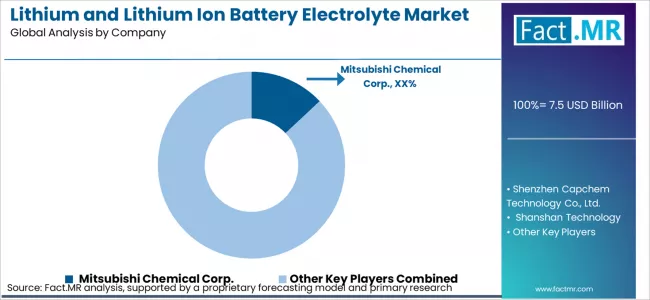
Lithium And Lithium Ion Battery Electrolyte Market Analysis By Company | Source: Fact.MR
The global lithium and lithium ion battery electrolyte market shows mixed competition dynamics. The advanced chemistry segment is moderately concentrated, while the commodity liquid electrolyte segment is highly fragmented. In China, Shenzhen Capchem Technology, Guangzhou Tinci Materials Technology, and Zhangjiagang Guotai Huarong supply a large share of global liquid electrolyte volume. Their scale advantages come from carbonate solvent production and LiPF6 salt sourcing.
In the premium segment, Mitsubishi Chemical Group, UBE Industries, and Soulbrain MI maintain strong positions. Their advantage comes from proprietary additives, polymer electrolyte technologies, and OEM qualification relationships with Japanese and Korean battery manufacturers. Supplier selection in this market depends heavily on technical qualification. Battery cell manufacturers conduct multi-year testing programs. Once approved, suppliers are rarely replaced.
Competitive strength also depends on vertical integration and supply chain control. Companies with access to lithium salts, solvents, and additives maintain cost advantages and formulation flexibility. Mitsubishi Chemical benefits from integrated material production. Capchem and Tinci have strong domestic positions due to proximity to CATL and BYD supply chains. Buyer leverage is higher in the commodity electrolyte segment where multiple suppliers compete. In advanced electrolyte technologies, buyer leverage is lower due to limited qualified suppliers and longer development cycles.
Recent Developments
- In January 2025, Mitsubishi Chemical Group announced formal expansion of electrolyte production capacity at its Kurosaki plant in Japan and confirmed initiation of site selection for a North American electrolyte manufacturing facility to serve IRA-eligible cell manufacturers.
- In November 2024, Shenzhen Capchem Technology disclosed a strategic supply agreement with a major South Korean battery cell manufacturer for provision of high-voltage electrolyte additives for next-generation NMC811 cell production, extending Capchem's customer base beyond its core Chinese domestic relationships.
Key Players
- Mitsubishi Chemical Corp.
- Shenzhen Capchem Technology Co., Ltd.
- Shanshan Technology
- Soulbrain MI
- Guangzhou Tinci Materials Technology Co.
- TOMIYAMA PURE CHEMICAL INDUSTRIES, LTD.
- GuangDong JinGuang High-Tech Co., Ltd.
- Panax Etec Co Ltd
- UBE Industries
- Zhangjiagang Guotai-Huarong New Chemical Materials Co., Ltd.
- NEI Corporation
Bibliography
- [1] Mitsubishi Chemical Group Corporation. (2025). Fiscal Year 2025 Investor Presentation: Functional Materials and Battery Materials Division. January 2025.
- [2] European Parliament and Council. (2023). Regulation (EU) 2023/851 on CO2 Emission Performance Standards for Passenger Cars and Light Commercial Vehicles. April 2023. EUR-Lex.
- [3] U.S. Internal Revenue Service. (2024). Section 45X Advanced Manufacturing Production Credit: Guidance and Updates. IRS.gov. March 2024.
- [4] Ministry of Heavy Industries, Government of India. (2021, updated 2024). Production Linked Incentive Scheme for Advanced Chemistry Cell Battery Storage. pli.gov.in.
- [5] Mitsubishi Chemical Group Corporation. (2025). Press Release: Lithium-Ion Battery Electrolyte Production Capacity Expansion and North America Facility Announcement. January 2025.
- [6] Shenzhen Capchem Technology Co., Ltd. (2024). Annual Report and Technology Development Disclosure: High-Voltage Electrolyte Additive Commercialisation. 2024.
- [7] Panasonic Energy Co., Ltd. (2024). Investor Relations Disclosure: Next-Generation Prismatic Cell Programme and Solid Electrolyte Material Partnership. September 2024.
- [8] Guangzhou Tinci Materials Technology Co. (2025). Corporate Announcement: Long-Term Electrolyte Supply Agreement with Major EV Cell Manufacturers. February 2025.
This Report Addresses
- Strategic intelligence on gigafactory electrolyte procurement, solid state chemistry transitions, supply chain localisation under IRA and EU Battery Regulation, and electrolyte pricing trends.
- Market size forecast from USD 7.5 billion in 2026 to USD 23.7 billion by 2036 at 12.2% CAGR, segmented by product type, end use, form, and region.
- Growth opportunities across high voltage and solid state electrolytes, EV battery OEM supply chains, and grid energy storage demand in the United States, Europe, and Asia Pacific.
- Regional outlook with country CAGR for India 14.1%, Germany 13.4%, China 13.0%, Japan 12.3%, United States 11.8%, United Kingdom 5.8%, and France 5.1%.
- Competitive analysis of Mitsubishi Chemical, Capchem, Tinci, Soulbrain, Shanshan Technology, and NEI Corporation covering OEM qualification, technology differentiation, and localisation strategies.
- Technology tracking of high voltage additives, solid state sulfide and oxide electrolytes, gel polymer electrolytes, and liquid electrolyte capacity expansion.
- Regulatory analysis covering EU Battery Regulation 2023/1542, U.S. IRA Section 45X credits, India PLI ACC scheme, and China MIIT battery standards.
- Report delivered in Excel datasets, PowerPoint summary, and detailed PDF supported by regulatory records, manufacturer disclosures, IEA data, and primary research.
Segmentation
Scope of Report
| Items | Values |
|---|---|
| Quantitative Units | USD 7.5 billion (2026) to USD 23.7 billion (2036), at a CAGR of 12.2% |
| Market Definition | Lithium and lithium ion battery electrolytes are ionic conducting materials in liquid, solid, or gel form that enable charge transfer between the cathode and anode. They play a critical role in battery energy density, safety, cycle life, and fast charging across EVs, consumer electronics, energy storage, and industrial applications. |
| Product Type Segmentation | Lithium-based, Sulfide-based, Polymer-based, Oxide-based, Others |
| End Use Segmentation | Automotive, Consumer Electronics, Power & Energy, General Industrial |
| Form Segmentation | Liquid, Solid, Gel |
| Application Coverage | EV traction battery cell production, stationary grid energy storage, consumer portable electronics, industrial power systems, solid-state battery pilot programmes, hybrid and plug-in hybrid vehicle battery packs |
| Regions Covered | Asia Pacific, Europe, North America, Latin America, Middle East and Africa |
| Countries Covered | China, Japan, South Korea, Australia and New Zealand, India, ASEAN, Rest of Asia Pacific, Germany, United Kingdom, France, Italy, Spain, Netherlands, Nordics, Rest of Europe, United States, Canada, Mexico, Brazil, Chile, Ecuador, Rest of Latin America, Kingdom of Saudi Arabia, United Arab Emirates, South Africa, Turkey, Rest of Middle East and Africa |
| Key Companies Profiled | Mitsubishi Chemical Corp., Shenzhen Capchem Technology Co. Ltd., Shanshan Technology, Soulbrain MI, Guangzhou Tinci Materials Technology Co., TOMIYAMA PURE CHEMICAL INDUSTRIES LTD., GuangDong JinGuang High-Tech Co. Ltd., Panax Etec Co Ltd, UBE Industries, Zhangjiagang Guotai-Huarong New Chemical Materials Co. Ltd., NEI Corporation |
| Forecast Period | 2026 to 2036 |
| Approach | A hybrid top down and bottom up modelling approach was used. Top down inputs included EV production volumes, gigafactory expansion plans, energy storage deployment targets, and battery chemistry adoption trends. Bottom up analysis used electrolyte loading per kWh, pricing by product type, and supply chain cost inputs from interviews with electrolyte manufacturers, battery producers, and OEM procurement teams. |
Source: Fact.MR analysis. Updated Mar 5, 2026
Lithium and Lithium Ion Battery Electrolyte Market by Segment
-
By Product Type
- Lithium-based
- Sulfide-based
- Polymer-based
- Oxide-based
- Others
-
By End Use
- Automotive
- Consumer Electronics
- Power & Energy
- General Industrial
-
By Form
- Liquid
- Solid
- Gel
-
By Region
- North America
- United States
- Canada
- Mexico
- Europe
- Germany
- United Kingdom
- France
- Italy
- Spain
- Netherlands
- Nordics
- Rest of Europe
- Asia Pacific
- China
- Japan
- South Korea
- India
- Australia and New Zealand
- ASEAN
- Rest of Asia Pacific
- Latin America
- Brazil
- Chile
- Ecuador
- Rest of Latin America
- Middle East and Africa
- Kingdom of Saudi Arabia
- United Arab Emirates
- South Africa
- Turkey
- Rest of Middle East and Africa
- North America
Frequently Asked Questions
How large is the lithium and lithium ion battery electrolyte market in 2025?
What will the market size be in 2026?
What is the projected market size by 2036?
What is the expected CAGR for the forecast period 2026 to 2036?
Which product type is poised to lead the lithium and lithium ion battery electrolyte market?
Which end-use segment holds the largest share?
Which country shows the fastest growth rate?
How fast is the lithium and lithium ion battery electrolyte market expected to expand in China?
What is the forecast CAGR for Germany's lithium and lithium ion battery electrolyte market?
Who worked on this report


Preview the report firsthand - request a free sample
Free SampleGet the brochure for pricing and purchase details
Download PDF