- Market Value (2025): USD 1.6 Bn
- Estimated Value (2026): USD 1.7 Bn
- Forecast Value (2036): USD 2.9 Bn
- CAGR (2026-2036): 5.6%
What is the Splined Sleeves Market forecast to be worth by 2036?
USD 1.7 billion in 2026 to USD 2.9 billion by 2036 at a 5.6% CAGR.
- The splined sleeves market reached approximately USD 1.6 billion in 2025.
- Demand is projected to increase from USD 1.7 billion in 2026 to USD 2.9 billion by 2036.
- The market is forecast to record a 5.6% CAGR from 2026 to 2036.
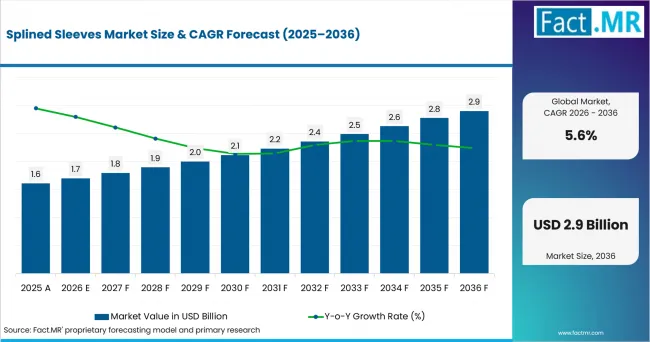
Splined Sleeves Market Value Analysis | Source: Fact.MR
What are the defining numbers behind Splined Sleeves Market growth?
An absolute opportunity of USD 1.2 billion is expected between 2026 and 2036.
- Demand Drivers in the Market:
- Vehicle production creates recurring demand for splined connections used within transmissions, differentials and related rotating assemblies. Global motor vehicle production increased from 92.7 million units in 2024 to 96.4 million units in 2025. Higher assembly volumes increase requirements for standardized sleeves supplied to powertrain manufacturers and component suppliers.
- Precision requirements are increasing the value of accurately machined spline interfaces. ISO 4156 covers the design, dimensions and inspection of straight cylindrical involute splines, while AGMA guidance addresses geometry, fit, materials, manufacturing processes and failure modes. These requirements support demand for sleeves manufactured with controlled tooth geometry and dimensional tolerances.
- Powertrain development creates demand for several sleeve configurations rather than a single standardized design. Splined connections may require clearance, sliding or interference fits depending on the assembly. Suppliers therefore serve both repeat-volume standard parts and application-specific sleeves designed around shaft dimensions and load conditions.
- Industrial machinery and renewable-energy equipment extend demand beyond automotive applications. The IEA expects cumulative onshore wind capacity additions to reach 732 GW during 2025–2030, increasing the installed base of rotating equipment and drivetrain systems requiring precision mechanical components.
- Aerospace activity supports demand for higher-specification splined components where load distribution and dimensional control are critical. The FAA forecasts the U.S. commercial aircraft fleet to increase from 6,949 aircraft in 2025 to 10,677 by 2046, while the cargo large-jet fleet is projected to rise from 894 to 1,598 aircraft. This creates a continuing requirement for precision drivetrain and actuation components across new aircraft and maintenance cycles.
- Key Segments Analyzed:
- Standard Splined Sleeves account for 52.6% of the Product segment in 2026 because standardized dimensions support repeat procurement across common shaft and hub connections.
- Automotive Powertrain Systems hold 44.3% of the Application segment in 2026 as transmissions and differential systems require reliable interfaces for transferring rotational force between components.
- Automotive Industry represents 61.8% of the End Use segment in 2026, supported by vehicle production volumes and established demand from passenger and commercial vehicle manufacturers.
- Precision Machining Technology accounts for 57.4% of the Technology segment in 2026 because spline geometry, fit and tooth dimensions require controlled machining and inspection.
- Analyst Opinion at Fact.MR:
- Shambhu Nath Jha, Principal Consultant at Fact.MR, states, “Splined sleeve purchasing is governed by fit, torque requirements and service conditions. Automotive and machinery customers need repeatable geometry across production volumes, while aerospace and specialized equipment applications place greater emphasis on material treatment and dimensional control. Suppliers that can combine standardized production with application-specific machining are positioned to address both volume and engineered demand.”
- Strategic Implications:
- Manufacturers should separate standard-volume products from custom engineered sleeves because purchasing criteria differ materially between repeat OEM programmes and low-volume precision applications.
- Investment in machining accuracy and inspection capability can improve access to automotive and aerospace applications where dimensional variation directly affects assembly fit and load distribution.
- Heat treatment and material selection should be matched to operating conditions. Hardened products are relevant where repeated torque loading raises wear requirements, while stainless steel configurations address corrosion-sensitive environments.
- Suppliers serving automotive customers should maintain production traceability and repeatable dimensional controls because sleeve specifications are typically integrated into wider drivetrain assemblies rather than evaluated as isolated parts.
How does the Splined Sleeves Market break down by segment?
The market is segmented by Product, Application, End Use and Technology.
Why do Standard Splined Sleeves lead Product?
Standard Splined Sleeves are projected to account for a 52.6% share in 2026.
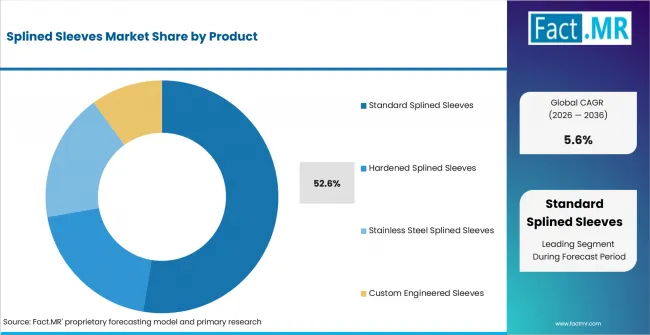
Splined Sleeves Market Analysis By Product | Source: Fact.MR
Standard sleeves lead because many shaft-to-hub connections can be served through established spline dimensions rather than a new design for every assembly. Standardization reduces engineering work for buyers and allows manufacturers to produce repeated dimensions at greater production volumes.
International spline standards define geometry and dimensional requirements for involute profiles. AGMA guidance also covers fit types and inspection practices, giving equipment designers a common engineering basis when specifying mating spline elements.
Commercial availability reinforces this model. WMH Herion lists splined shaft sleeves in standard round and flanged configurations while also offering custom production when application requirements differ. The coexistence of stock and engineered products supports the larger demand base for standard sleeves.
Why do Automotive Powertrain Systems lead Application?
Automotive Powertrain Systems are projected to account for a 44.3% share in 2026.
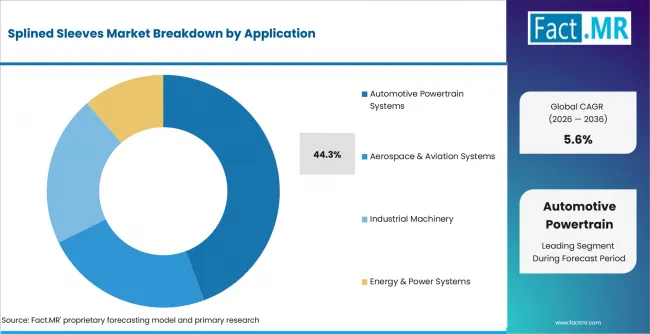
Splined Sleeves Market Analysis By Application | Source: Fact.MR
Automotive powertrains lead because rotational force must pass between multiple shafts and assemblies within transmissions and differential systems. Splined interfaces provide a mechanically positive connection while allowing manufacturers to control alignment and fit through specified tooth geometry.
Demand is reinforced by vehicle production. OICA reported global output of 96.4 million motor vehicles in 2025. Each production programme creates recurring demand for drivetrain components manufactured to repeatable OEM specifications.
Powertrain components also face repeated load cycles, making material condition and spline fit relevant to component life. AGMA guidance addresses spline stresses, lubrication and failure modes alongside manufacturing and inspection requirements.
Why does Automotive Industry lead End Use?
Automotive Industry is projected to account for a 61.8% share in 2026.
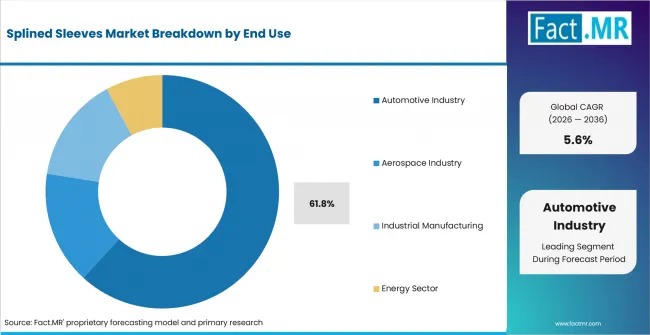
Splined Sleeves Market Analysis By End Use | Source: Fact.MR
Automotive demand is supported by the scale of passenger and commercial vehicle manufacturing and by the number of mechanical interfaces incorporated into drivetrains and related systems. Vehicle manufacturers require repeatable components that can be incorporated into production without additional machining at the assembly line.
Global motor vehicle output grew 3.9% in 2025, reaching 96.4 million units. The USA produced 10.24 million vehicles and Japan produced 8.41 million during the year, illustrating the continuing scale of manufacturing in two countries included in the market outlook.
Automotive buyers also impose tight requirements on dimensional repeatability because variation in tooth profile or fit can influence assembly and load distribution. This supports established suppliers with machining and inspection processes suited to repeat production.
Why does Precision Machining Technology lead Technology?
Precision Machining Technology is projected to account for a 57.4% share in 2026.
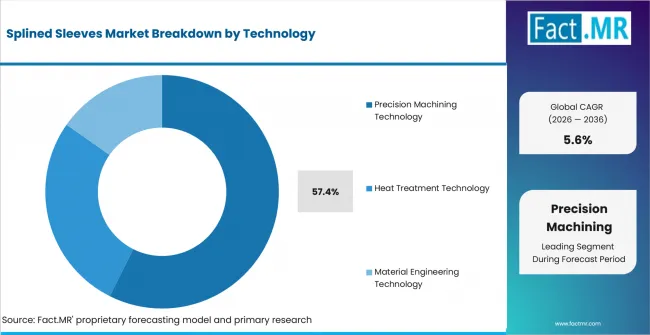
Splined Sleeves Market Analysis By Technology | Source: Fact.MR
Precision machining leads because splined sleeves depend on controlled tooth thickness, profile geometry and bore dimensions. These parameters determine how the sleeve mates with the corresponding shaft and whether the resulting connection provides the required fit.
ISO 4156 specifies geometry and inspection dimensions for cylindrical involute splines. AGMA guidance covers manufacturing processes that include hobbing, shaping, milling, broaching and grinding, showing why machining capability is central to spline production.
Manufacturers may combine CNC machining with grinding or broaching depending on whether the sleeve has an internal or external profile and on the required tolerance. WMH Herion, for example, identifies milling, grinding and internal-profile broaching among its manufacturing capabilities for splined shafts and sleeves.
What is accelerating Splined Sleeves Market adoption, and what is holding it back?
Drivers Impact Analysis
| Driver | (~) % Impact on CAGR | Geographic Relevance | Impact Timeline |
|---|---|---|---|
| Vehicle and drivetrain production | +1.6% | Global | Short term (≤ 2 years) |
| Replacement and powertrain refurbishment demand | +1.4% | USA, UK and Japan | Short term (≤ 2 years) |
| Precision machining and dimensional-control requirements | +1.1% | Global | Medium term (2–4 years) |
| Heat treatment and wear-resistance requirements | +0.9% | USA, France and South Korea | Medium term (2–4 years) |
| Wind and aerospace equipment demand | +0.6% | Global | Long term (≥ 4 years) |
Source: Fact.MR analysis. Updated Aug 13, 2026
Opportunity Impact Analysis
| Opportunity | (~) % Impact on CAGR | Geographic Relevance | Impact Timeline |
|---|---|---|---|
| Custom engineered sleeves for specialized drivetrain systems | +1.0% | Global | Medium term (2–4 years) |
| Aerospace and aviation precision components | +0.8% | USA, UK and France | Medium term (2–4 years) |
| Wind power and heavy machinery applications | +0.7% | Global | Long term (≥ 4 years) |
| Hardened and corrosion-resistant sleeve configurations | +0.5% | USA, Japan and South Korea | Long term (≥ 4 years) |
Source: Fact.MR analysis. Updated Aug 13, 2026
Restraints Impact Analysis
| Restraint | (~) % Impact on CAGR | Geographic Relevance | Impact Timeline |
|---|---|---|---|
| Material and precision machining costs | -1.1% | Global | Short term (≤ 2 years) |
| Tight tolerance inspection and qualification requirements | -0.9% | USA, UK and Japan | Short term (≤ 2 years) |
| Substitution through integrated shaft or hub designs | -0.7% | Global | Medium term (2–4 years) |
| Cyclical vehicle and machinery production | -0.5% | Global | Long term (≥ 4 years) |
Source: Fact.MR analysis. Updated Aug 13, 2026
Which countries are scaling the Splined Sleeves Market through 2036?
- USA: Vehicle production reached 10.24 million units in 2025. The country also has substantial aerospace and industrial-equipment activity, creating demand for standard powertrain sleeves alongside engineered components used in higher-specification rotating systems.
- UK: More than 717,000 cars were manufactured in the UK during 2025, with 77.5% of production exported. An export-oriented manufacturing base increases the importance of components produced to repeatable international specifications.
- France: Industrial component suppliers form a substantial part of the country's automotive value chain. INSEE reports that industrial components accounted for 77% of dedicated automotive value-chain employment in France in 2023, supporting an established customer base for precision drivetrain components.
- Italy: ANFIA recorded approximately 474,000 motor vehicles produced in Italy during 2025. Continued vehicle assembly and an established automotive-component network sustain requirements for mechanical drivetrain parts despite pressure on domestic production volumes.
- South Korea: Around 2.7 million vehicles, equal to 67% of domestic automobile production, were exported in 2025. Export exposure supports demand for components produced to controlled specifications across vehicle programmes serving multiple markets.
- Japan: Japan produced approximately 8.41 million vehicles in 2025. Its automotive manufacturing index increased 1.3% during the year, supporting continued demand for precision components used across vehicle powertrains and machinery.
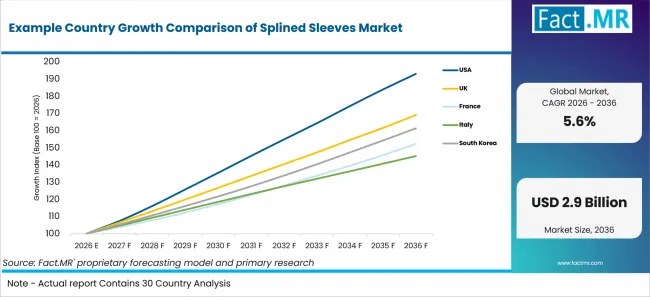
Example Country Growth Comparison Of Splined Sleeves Market | Source: Fact.MR
Country CAGR (2026–2036)
| Country | CAGR |
|---|---|
| USA | 6.8% |
| Japan | 5.9% |
| UK | 5.4% |
| South Korea | 4.9% |
| France | 4.3% |
| Italy | 3.8% |
Source: Fact.MR analysis. Updated Aug 13, 2026
What is driving USA’s growth through 2036?
The USA is forecast to expand at a 6.8% CAGR from 2026 to 2036.
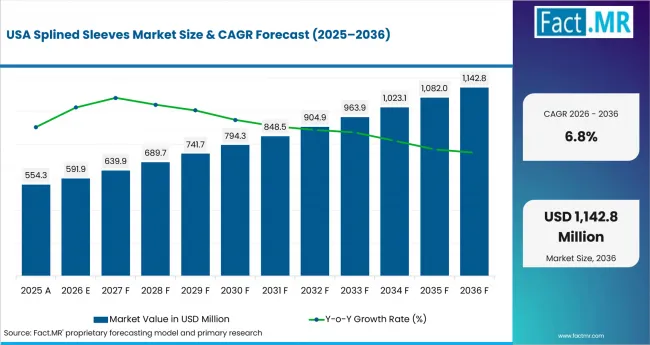
Splined Sleeves Market Country Value Analysis | Source: Fact.MR
The country combines automotive production with substantial aerospace and industrial-equipment demand. This creates requirements ranging from repeat-volume transmission sleeves to more tightly controlled components used in aviation and heavy machinery.
The FAA expects the U.S. commercial aircraft fleet to increase from 6,949 aircraft in 2025 to 10,677 by 2046. Cargo large jets are forecast to rise from 894 to 1,598 aircraft over the same period. Fleet expansion and replacement support demand for precision mechanical components across aircraft manufacturing and maintenance.
What is driving Japan’s growth through 2036?
Japan is forecast to expand at a 5.9% CAGR from 2026 to 2036.
Japan retains a substantial vehicle and precision-manufacturing base. METI's industrial production data show that the automotive production index increased 1.3% in 2025, providing a stable industrial foundation for drivetrain and machined-component suppliers.
Demand also reflects Japanese manufacturers' emphasis on manufacturing consistency and long equipment service life. Splined sleeves used in vehicle and machinery assemblies must maintain controlled fit across repeated production, supporting precision machining and hardened configurations where operating loads require them.
What is driving the UK’s growth through 2036?
The UK is forecast to expand at a 5.4% CAGR from 2026 to 2036.
The country's automotive sector remains strongly export oriented. SMMT reports that 555,826 UK-built cars were exported in 2025, equal to 77.5% of domestic car production. Suppliers serving these programmes must meet specifications used by assembly operations and destination markets outside the UK.
Vehicle components also have an important role in British manufactured trade. Motor vehicles and parts represented 12.6% of British manufactured-goods exports during the first half of 2025, reinforcing the commercial importance of internationally qualified component supply.
What is driving South Korea’s growth through 2036?
South Korea is forecast to expand at a 4.9% CAGR from 2026 to 2036.
Automobile exports create a continuing requirement for components that can be supplied consistently across international vehicle programmes. The Korean government reported that 2.7 million vehicles were exported in 2025, representing 67% of production.
Changes in drivetrain design also create engineering work for component suppliers. Eco-friendly vehicle sales in South Korea reached 813,000 units in 2025, up 25% from the previous year. As propulsion architectures change, spline suppliers may need to support revised shaft geometry and torque requirements rather than relying entirely on legacy drivetrain dimensions.
What is driving France’s growth through 2036?
France is forecast to expand at a 4.3% CAGR from 2026 to 2036.
France has an established automotive component base serving vehicle assembly and replacement demand. Government industrial policy continues to emphasize maintaining vehicle-component production in Europe as the sector transitions toward electrified drivetrains.
This transition can alter individual powertrain components, but it preserves demand for precision torque-transfer interfaces across motors, reduction systems and related rotating assemblies. Suppliers able to adjust spline geometry and material treatment for revised drivetrains can address these changing specifications.
What is driving Italy’s growth through 2036?
Italy is forecast to expand at a 3.8% CAGR from 2026 to 2036.
Italian vehicle production remained under pressure during 2025, but the country retains an extensive automotive supply chain. ANFIA identifies vehicle manufacturers, component producers and engineering companies as established parts of the domestic sector.
For splined sleeve suppliers, slower vehicle output increases the importance of higher-value applications and replacement demand. Precision-machined and custom products can address specialized vehicles, industrial machinery and other equipment where procurement depends more on specification than on passenger-car production volume.
Who leads the Splined Sleeves Market?
Bosch Rexroth AG is positioned as a leading supplier through its established drive and control technology portfolio for mobile and industrial machinery. Its presence across drive systems gives it exposure to applications where splined interfaces form part of larger mechanical assemblies.
Schaeffler Technologies AG & Co. KG competes through motion and drivetrain components used across vehicle and industrial applications. Its product base gives the company exposure to several end-use areas included in the splined sleeves market.
WMH Herion GmbH supplies standard and custom splined shafts and sleeves, including round and flanged configurations. Its manufacturing capabilities include milling, grinding and internal-profile broaching, illustrating the role of machining flexibility in serving application-specific demand.
Shanghai Trisun Parts Manufacture Co., Ltd. participates through precision-machined shaft and sleeve components for rotating equipment. Competition across the market is shaped by dimensional accuracy, material capability, heat treatment and the ability to manufacture internal or external spline profiles according to customer drawings.
Supplier selection also depends on delivery consistency and application engineering. Standard products compete through availability and repeatability, while custom sleeves depend more heavily on drawing interpretation, machining capability and low-volume production economics.
Which companies are the key providers?
Key companies include Bosch Rexroth AG; Schaeffler Technologies AG & Co. KG; Shanghai Trisun Parts Manufacture Co., Ltd.; and WMH Herion GmbH.
- Bosch Rexroth AG
- Schaeffler Technologies AG & Co. KG
- Shanghai Trisun Parts Manufacture Co., Ltd.
- WMH Herion GmbH
How is the market segmented?
-
By Product
- Standard Splined Sleeves
- Internal Splined Sleeves
- External Splined Sleeves
- Hardened Splined Sleeves
- Surface Hardened Sleeves
- Through Hardened Sleeves
- Stainless Steel Splined Sleeves
- Corrosion Resistant Sleeves
- Food Grade Stainless Sleeves
- Custom Engineered Sleeves
- Application Specific Sleeves
- Precision Machined Sleeves
- Standard Splined Sleeves
-
By Application
- Automotive Powertrain Systems
- Transmission Systems
- Differential Systems
- Aerospace & Aviation Systems
- Aircraft Landing Systems
- Aircraft Engine Systems
- Industrial Machinery
- Heavy Equipment Machinery
- Production Machinery
- Energy & Power Systems
- Wind Energy Systems
- Hydropower Systems
- Automotive Powertrain Systems
-
By End Use
- Automotive Industry
- Passenger Vehicle Manufacturers
- Commercial Vehicle Manufacturers
- Aerospace Industry
- Aircraft OEMs
- Aerospace Component Suppliers
- Industrial Manufacturing
- Heavy Machinery Producers
- Factory Equipment Manufacturers
- Energy Sector
- Renewable Energy Companies
- Conventional Energy Companies
- Automotive Industry
-
By Technology
- Precision Machining Technology
- CNC Machining Systems
- Grinding Technology Systems
- Heat Treatment Technology
- Induction Hardening Systems
- Carburizing Systems
- Material Engineering Technology
- Alloy Optimization Systems
- Surface Engineering Systems
- Precision Machining Technology
-
By Region
- North America
- Latin America
- Western Europe
- Eastern Europe
- East Asia
- South Asia and Pacific
- Middle East & Africa
Bibliography
- American Gear Manufacturers Association. (2020, reaffirmed 2025). AGMA 945-1-B20: Splines – Design and Application. American Gear Manufacturers Association.
- Association Nationale de la Filière Automobile. (2026). Focus Italia Produzione Automotive Dicembre 2025. ANFIA.
- Federal Aviation Administration. (2026). FAA Aerospace Forecast Fiscal Years 2026–2046. U.S. Department of Transportation.
- Institut national de la statistique et des études économiques. (2025). The Weight of the French Automotive Value Chain. INSEE.
- International Energy Agency. (2025). Renewables 2025: Renewable Electricity. IEA.
- International Organization of Motor Vehicle Manufacturers. (2026). Auto Industry Growth Shifted East in 2025 amid Global Repositioning. OICA.
- International Organization for Standardization. (2021). ISO 4156: Straight Cylindrical Involute Splines. ISO.
- Japan Ministry of Economy, Trade and Industry. (2026). Indices of Industrial Production, December 2025. METI.
- Ministry of Economy, Finance and Industrial and Digital Sovereignty, France. (2025). Government Meeting with the Automotive Industry on European Industrial Production. Government of France.
- Ministry of Trade, Industry and Resources, Republic of Korea. (2026). Automobile Exports Hit Record High in 2025. Government of the Republic of Korea.
- Society of Motor Manufacturers and Traders. (2026). UK Car Manufacturing and Production Data. SMMT.
- Society of Motor Manufacturers and Traders. (2025). SMMT Trade Report 2025. SMMT.
- Shanghai Trisun Parts Manufacture Co., Ltd. (2026). Machining Sleeve and Shaft for Chemical Pump. TRISUN.
- Schaeffler Technologies AG & Co. KG. (2026). Drive Shaft: Components for Cars & LCVs. Schaeffler.
- Bosch Rexroth AG. (2026). About Bosch Rexroth. Bosch Rexroth.
- WMH Herion GmbH. (2026). Splined Shafts and Sleeves. WMH Herion.
This Report Answers
- The report examines demand for splined sleeves across product types, applications, end-use sectors and manufacturing technologies.
- Segment analysis evaluates the categories shaping procurement across automotive and industrial applications.
- Country analysis covers the USA, UK, France, Italy, South Korea and Japan.
- Competitive analysis reviews the companies participating in splined sleeve and related drive-component supply.
- Application analysis assesses requirements across automotive powertrains, aerospace systems, industrial machinery and energy equipment.
What does the Splined Sleeves Market cover?
The Splined Sleeves Market covers sleeve-type mechanical components with spline profiles used to connect mating shafts or hubs for rotational power transfer. The assessment includes standard products and application-specific configurations supplied within the stated Product, Application, End Use and Technology segments.
The market includes demand from automotive powertrain systems, aerospace and aviation equipment, industrial machinery, and energy systems. Both internal and external spline configurations are considered where they are supplied as splined sleeve products.
What is included in the scope?
The scope includes Standard Splined Sleeves, Hardened Splined Sleeves, Stainless Steel Splined Sleeves and Custom Engineered Sleeves.
Applications include transmission and differential systems, aircraft landing and engine systems, heavy and production machinery, wind energy systems and hydropower systems.
The assessment covers demand from vehicle manufacturers, aerospace companies, industrial manufacturers and energy-sector customers. Technology coverage includes precision machining, heat treatment and material engineering used in the production of splined sleeves.
What is excluded from the scope?
Standalone splined shafts are excluded when they are sold without a corresponding sleeve product.
Complete transmissions, differential assemblies, gearboxes and other drivetrain systems are outside the market except for the value attributable directly to the splined sleeve.
Bearings, gears, couplings without a splined sleeve interface and unrelated bushings are excluded. General machining services are also outside the scope unless they are directly associated with production of a splined sleeve included within the stated segmentation.
How Was the Analysis Built?
The analysis draws on more than 120 sources, over 35 company portfolios and more than 20 industry interviews across at least 25 countries.
- Primary Research: Interviews with precision-component manufacturers, drivetrain suppliers, vehicle manufacturers, industrial machinery companies and engineering specialists examine spline specifications, sourcing requirements and purchasing criteria.
- Desk Research: The review covers vehicle production, aerospace activity, industrial machinery demand, renewable-energy deployment, spline standards, machining requirements and company product information. Sources used in the analysis are recorded in the bibliography.
- Market Sizing and Forecasting: Estimates combine vehicle and equipment production, sleeve content across relevant assemblies, replacement demand, material mix, machining intensity and country-level industrial activity.
- Data Validation and Update Cycle: Findings are cross-checked against company activity, industry production data and technical standards. Updates account for changes in vehicle output, manufacturing investment, material costs and drivetrain design.
Segmentation
What is the report's scope and coverage?
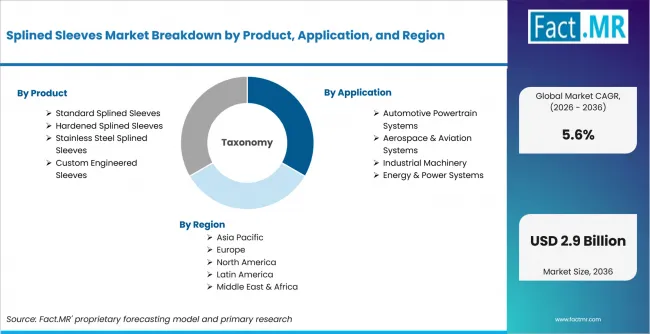
Splined Sleeves Market Breakdown By Product Application And Region | Source: Fact.MR
| Attribute | Details |
|---|---|
| Quantitative Units | USD Billion |
| Market Definition | Splined sleeves used in shaft and hub connections across the stated product, application and end-use categories |
| Segments Covered | Product; Application; End Use; Technology |
| Regions Covered | North America; Latin America; Europe; East Asia; South Asia and Pacific; Middle East and Africa |
| Countries Covered | USA; UK; France; Italy; South Korea; Japan |
| Key Companies Profiled | Bosch Rexroth AG; Schaeffler Technologies AG & Co. KG; Shanghai Trisun Parts Manufacture Co., Ltd.; WMH Herion GmbH |
| Forecast Period | 2026 to 2036 |
| Approach | Hybrid top-down and bottom-up approach using end-use production, drivetrain demand, spline specifications, machining requirements, pricing and supplier activity |
Source: Fact.MR analysis. Updated Aug 13, 2026
Frequently Asked Questions
Which Product leads the market?
Which Application leads the market?
Which End Use leads the market?
Which Technology leads the market?
Which country records the leading listed CAGR?
What is the primary driver in this market?
What is the main restraint?
Which companies are included in the market assessment?
Who worked on this report


Preview the report firsthand - request a free sample
Free SampleGet the brochure for pricing and purchase details
Download PDF