- Base Value(2025): 0.6 Bn
- Forecast Value (2036): 6.3 Bn
- CAGR (2036): 24.5%
What is the stadium cooling systems market forecast to be worth by 2036?
USD 0.7 billion in 2026 to USD 6.3 billion by 2036, at 24.5% CAGR.
- The Stadium Cooling Systems Market was valued at USD 0.6 billion in 2025.
- The market is estimated at USD 0.7 billion in 2026 and is projected to reach USD 6.3 billion by 2036.
- The market is forecast to expand at 24.5% CAGR during the forecast period as climate adaptation investments increase and stadium operators seek to improve comfort levels across large sports venues.
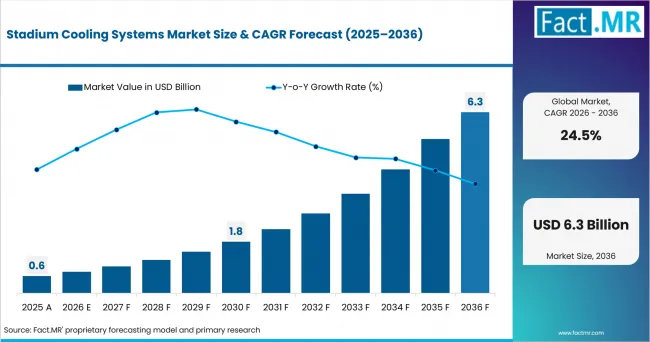
Stadium Cooling Systems Market Market Value Analysis | Source: Fact.MR
What are the defining numbers behind stadium cooling system growth?
USD 5.6 billion absolute opportunity by 2036 led by Saudi Arabia, the United States and Japan.
- Demand Drivers in the Market
- Rising temperatures are increasing demand for climate-resilient sports infrastructure.
- Stadium operators are investing in fan comfort and venue modernization.
- Mega sporting events continue supporting cooling technology deployment.
- Smart stadium initiatives are accelerating climate control investments.
- Key Segments Analyzed
- By Cooling Technology: Targeted Air Cooling Systems are expected to hold 38.0% share in 2026 due to energy-efficient cooling of occupied seating areas.
- By System Type: Integrated HVAC Cooling Systems are projected to account for 44.0% share in 2026 as operators prefer centralized climate management.
- By Stadium Type: Outdoor Stadiums are expected to hold 57.0% share in 2026 because exposure to weather conditions increases cooling requirements.
- By End User: Stadium Operators are projected to account for 52.0% share in 2026 as they directly invest in venue comfort and operational performance.
- By Application: Spectator Comfort Management is expected to hold 41.0% share in 2026 due to increasing focus on fan experience and attendance growth.
- By Geography: Saudi Arabia is projected to record 27.6% CAGR through 2036.
- Analyst Opinion at Fact.MR
- Shambhu Nath Jha, Senior Analyst at Fact.MR, states, “The stadium cooling systems market is transitioning from a niche infrastructure segment into a strategic component of modern venue design. Climate adaptation requirements are becoming increasingly important as venue operators seek to improve fan comfort and maintain year-round event schedules.”
- Strategic Implications
- Prioritize cooling technologies that improve spectator comfort while reducing energy consumption.
- Integrate climate management systems with smart stadium platforms.
- Evaluate cooling upgrades during venue modernization projects.
Stadium cooling systems include advanced air cooling and climate management technologies designed to regulate temperatures in sports venues. These systems support spectator comfort, athlete performance and operational efficiency. Growing investments in smart stadium infrastructure continue supporting long-term market growth.
The Saudi Arabia market is projected to record 27.6% CAGR through 2036, supported by the 2034 FIFA World Cup stadium development program. The United States is expected to expand at 24.8% CAGR as venue operators invest in heat adaptation strategies. Japan is forecast to grow at 23.5% CAGR due to increasing summer heat events and stadium modernization projects. The United Kingdom is projected to advance at 18.1% CAGR through gradual adoption of cooling technologies across major venues. South Korea is expected to register 16.9% CAGR through 2036 as smart stadium investments continue expanding.
How does the stadium cooling systems market break down by segment?
Targeted Air Cooling Systems lead at 38.0%; Stadium Operators lead at 52.0%.
Which cooling technology dominates?
Targeted Air Cooling Systems hold 38.0% share in 2026.
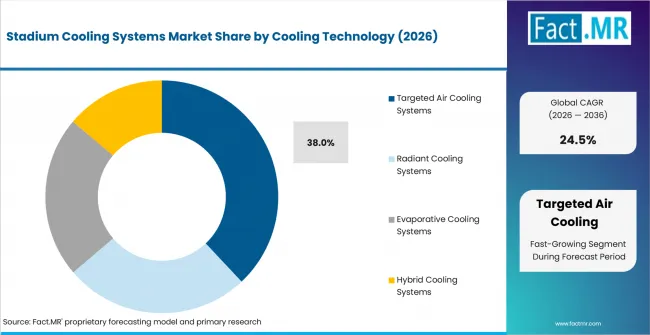
Stadium Cooling Systems Market Analysis By Cooling Technology | Source: Fact.MR
Targeted air cooling systems lead because they cool occupied areas rather than entire venues. The technology improves energy efficiency while maintaining spectator comfort. Growing adoption in large outdoor stadiums continues supporting segment growth. Johnson Controls announced that its HVAC, building automation, and cooling technologies were deployed across eight Paris 2024 Olympic venues. The company supplied YORK chillers for the La Chapelle cooling plant serving the Adidas Arena, improving energy-efficient stadium cooling and sustainability.
Which system type dominates?
Integrated HVAC Cooling Systems lead with 44.0% share in 2026.
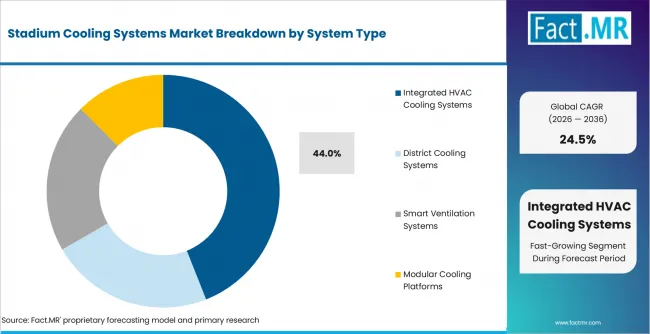
Stadium Cooling Systems Market Analysis By System Type | Source: Fact.MR
Integrated HVAC cooling systems dominate because they provide comprehensive climate control across multiple venue zones. Operators favor centralized systems that improve operational management and performance. Advanced automation capabilities further strengthen adoption. Paris 2024 implemented a cooling system using naturally cool underground water instead of conventional air conditioning. The project highlighted growing adoption of sustainable cooling technologies for major sports infrastructure.
Which stadium type dominates?
Outdoor Stadiums account for 57.0% share in 2026.
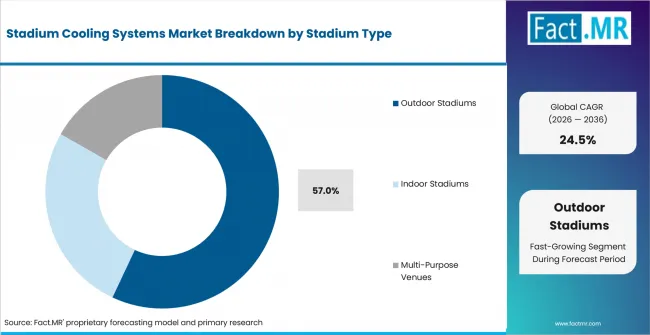
Stadium Cooling Systems Market Analysis By Stadium Type | Source: Fact.MR
Outdoor stadiums dominate because they face greater exposure to heat and weather conditions. Cooling technologies help improve visitor experiences and expand venue usability. Mega-event infrastructure investments continue supporting demand.
Which end user dominates?
Stadium Operators hold 52.0% share in 2026.
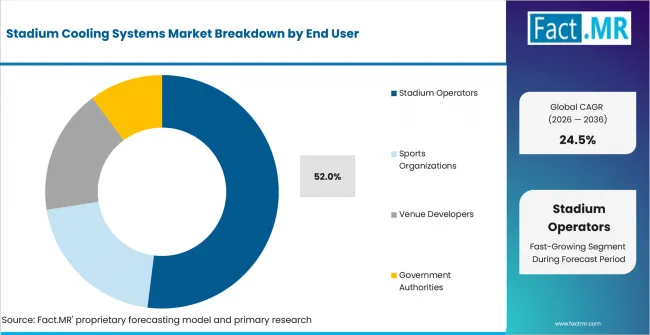
Stadium Cooling Systems Market Analysis By End User | Source: Fact.MR
Stadium operators account for the largest share because they directly invest in climate control infrastructure. Improved comfort levels support attendance growth and fan engagement. Cooling systems also enhance venue competitiveness.
Which application dominates?
Spectator Comfort Management leads with 41.0% share in 2026.
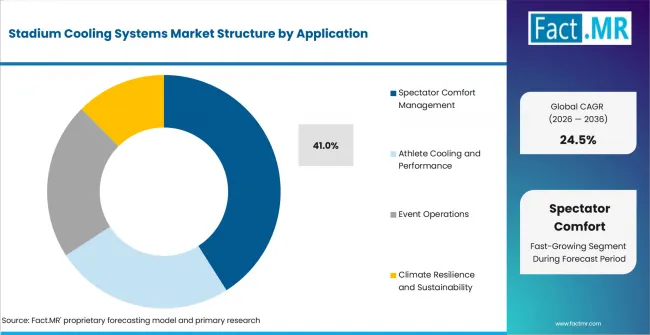
Stadium Cooling Systems Market Analysis By Application | Source: Fact.MR
Spectator comfort management leads because maintaining acceptable temperatures is a primary objective for venue operators. Enhanced comfort improves event experiences and supports longer venue utilization periods. Growing attendance expectations continue driving adoption.
What is accelerating stadium cooling demand and what is holding it back?
Climate adaptation drives demand while infrastructure costs restrain adoption.
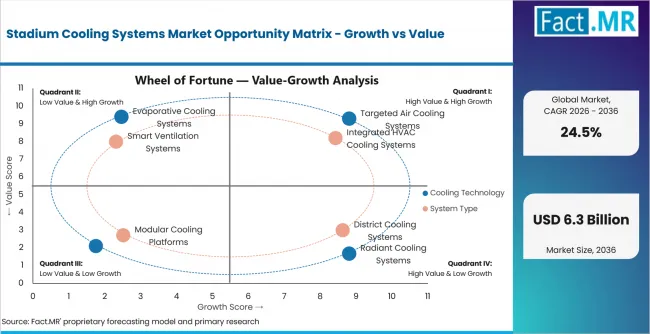
Stadium Cooling Systems Market Opportunity Matrix Growth Vs Value | Source: Fact.MR
The primary growth driver is rising investment in climate-resilient sports infrastructure. Venue operators increasingly require cooling systems to maintain comfortable environments during high-temperature events. Growing demand for year-round venue utilization is also supporting adoption. Johnson Controls deployed YORK industrial chillers at the La Chapelle cooling plant serving Adidas Arena and nearby infrastructure. The installation demonstrates large-scale cooling solutions designed for sports and entertainment venues.
The main restraint is the substantial capital expenditure required for installation and operation. Large-scale cooling systems require significant infrastructure investment and ongoing energy management. Project economics can be challenging for smaller venues.
Where do the biggest stadium cooling opportunities sit?
World Cup venues, smart stadiums and district cooling networks.
- World Cup Infrastructure Projects: Major international sporting events continue driving investments in advanced stadium cooling technologies. New venue developments increasingly incorporate climate control from the design phase. Large tournament infrastructure programs create long-term opportunities.
- Smart Stadium Platforms: Integrated cooling systems connected with digital monitoring platforms improve operational efficiency. Smart controls optimize energy consumption and environmental performance. Technology convergence is creating new growth opportunities.
- District Cooling Networks: District cooling solutions allow multiple venues and surrounding facilities to share centralized cooling resources. The model improves efficiency and supports large entertainment districts. Adoption is increasing across major sports infrastructure projects.
Which countries are scaling stadium cooling adoption fastest?
Saudi Arabia 27.6%, United States 24.8%, Japan 23.5%, United Kingdom 18.1%, South Korea 16.9%.
.webp "Top Country Growth Comparison Stadium Cooling Systems Market Cagr (2026 2036)")
Top Country Growth Comparison Stadium Cooling Systems Market Cagr (2026 2036) | Source: Fact.MR
| Country | CAGR |
|---|---|
| Saudi Arabia | 27.6% |
| United States | 24.8% |
| Japan | 23.5% |
| United Kingdom | 18.1% |
| South Korea | 16.9% |
Source: Fact.MR analysis. Updated Jun 25, 2026
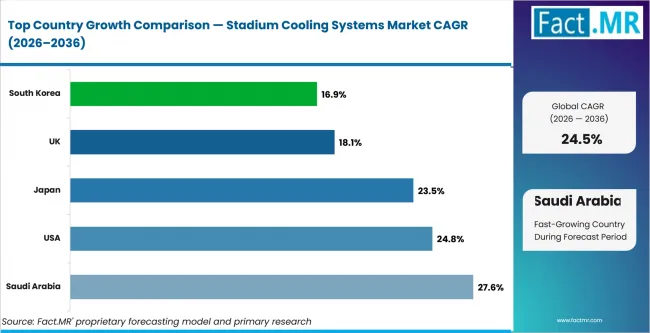
Stadium Cooling Systems Market Cagr Analysis By Country | Source: Fact.MR
What is driving Saudi Arabia's leadership?
27.6% CAGR, due to climate-controlled stadium infrastructure
Saudi Arabia is projected to record 27.6% CAGR through 2036 as preparations for the 2034 FIFA World Cup accelerate investments in climate-controlled stadium infrastructure. Several planned venues incorporate advanced climate control technologies designed to support year-round event operations in extreme weather conditions. Large-scale stadium construction programs continue creating strong demand for cooling systems and energy-efficient climate management solutions.
How is the United States expanding stadium cooling demand?
24.8% CAGR, driven by rising heat adaptation investments
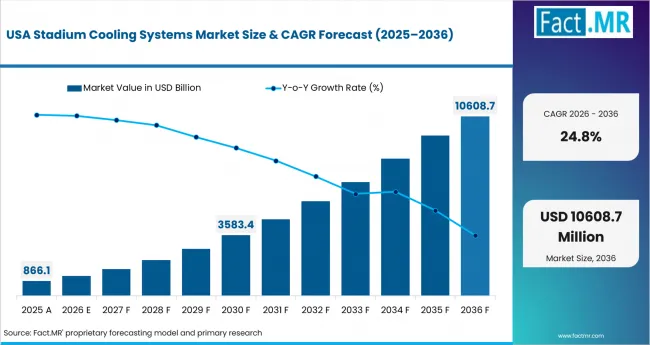
Stadium Cooling Systems Market Country Value Analysis | Source: Fact.MR
The United States is expected to post 24.8% CAGR by 2036 as venue operators invest in heat adaptation strategies across professional sports facilities. Rising temperatures and growing focus on fan comfort are encouraging deployment of advanced cooling and ventilation technologies. Modernization projects across major stadiums continue supporting market expansion.
Why is Japan becoming an important market?
23.5% CAGR, fueled by growing need for spectator cooling during summer sporting events
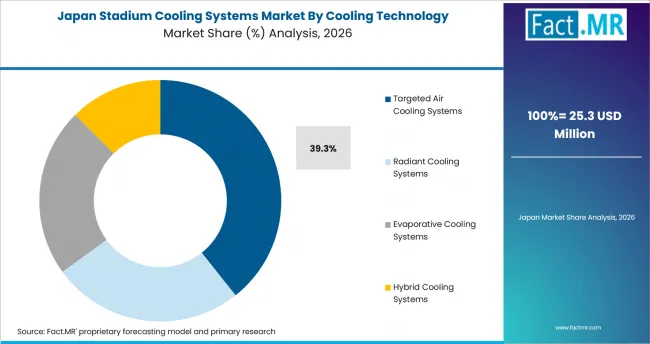
Stadium Cooling Systems Market Japan Market Share Analysis By Cooling Technology | Source: Fact.MR
Japan is forecast to advance at 23.5% CAGR through 2036 as summer sporting events increasingly require enhanced cooling capabilities. Stadium operators are investing in advanced climate management systems to improve visitor comfort and operational efficiency. Technology adoption remains supported by the country's strong engineering capabilities.
What supports demand in the United Kingdom?
18.1% CAGR, supported by stadium modernization projects
The United Kingdom is projected to register 18.1% CAGR by 2036 as stadium modernization programs gradually incorporate cooling and ventilation upgrades. Demand is primarily linked to premium spectator experiences and multi-purpose venue utilization. Adoption remains lower than warmer climate regions.
How does South Korea perform?
16.9% CAGR, driven by smart stadium initiatives
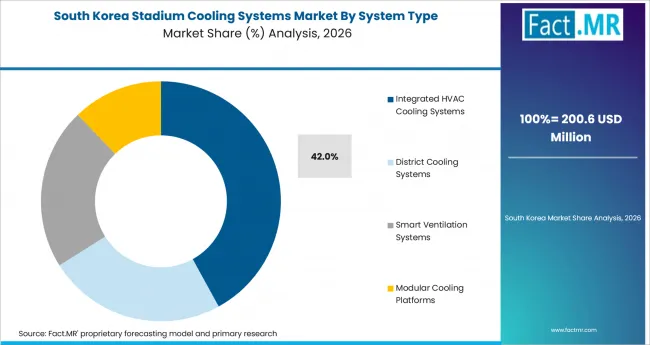
Stadium Cooling Systems Market South Korea Market Share Analysis By System Type | Source: Fact.MR
South Korea is expected to expand at 16.9% CAGR as smart venue investments support gradual deployment of climate control technologies. The market benefits from advanced infrastructure and growing focus on digital stadium experiences. Cooling demand remains moderate compared with hotter regions.
Who leads the stadium cooling systems landscape?
Johnson Controls, Carrier Global, Trane Technologies, Daikin Industries and Siemens lead through large-scale HVAC expertise and stadium climate control capabilities.
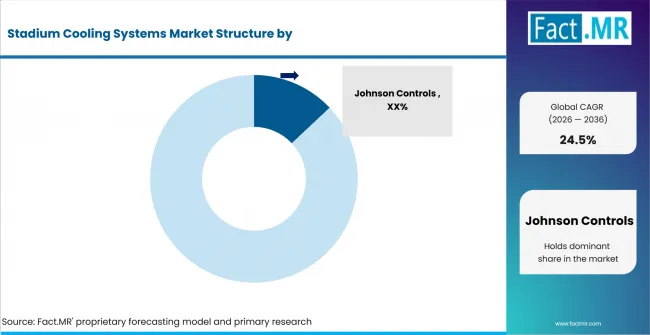
Stadium Cooling Systems Market Analysis By Company | Source: Fact.MR
The market is characterized by competition focused on cooling efficiency, energy management and large-venue deployment expertise. Companies continue investing in smart climate control systems, advanced monitoring platforms and automated cooling technologies to improve operational performance. Integration with smart stadium infrastructure is becoming an increasingly important differentiator.
Johnson Controls and Carrier Global maintain strong positions through extensive HVAC portfolios and large-scale project execution capabilities. Trane Technologies benefits from expertise in energy-efficient cooling systems and intelligent building management solutions. Daikin Industries continues expanding its presence through advanced air conditioning technologies and customized cooling platforms. Siemens supports the market through automation, controls and smart infrastructure integration.
Competition through 2036 will depend on energy efficiency improvements, cooling performance and digital control capabilities. Companies that combine advanced cooling technologies with intelligent monitoring and lower operating costs will be better positioned to strengthen market share. Partnerships with stadium developers, engineering firms and sports infrastructure operators are expected to remain important growth strategies.
Which companies are the key players?
Johnson Controls, Carrier Global, Trane Technologies, Daikin Industries, Siemens
- Johnson Controls
- Carrier Global
- Trane Technologies
- Daikin Industries
- Siemens
- Honeywell International
- Schneider Electric
- LG Electronics
Bibliography
- [1] Johnson Controls. (2024, July 22). Johnson Controls enhances efficiency and sustainability of eight Paris Olympic venues. Johnson Controls.
- [2] Reuters. (2024, February 28). No air conditioning? No problem for Paris 2024 athletes village. Reuters.
- [3] Daikin Industries, Ltd. (2024, November 19). Daikin develops advanced air conditioning and energy management solutions for sustainable facilities. Daikin Industries.
This Report Addresses
- Market size assessment and long-term forecast for stadium cooling systems.
- Analysis of cooling technology adoption across sports venues.
- Evaluation of climate adaptation investments and stadium modernization activity.
- Assessment of spectator comfort and athlete safety requirements.
- Competitive benchmarking of leading cooling technology providers.
- Analysis of growth drivers, restraints and emerging opportunities.
- Country-level outlook across the United States, United Kingdom, Saudi Arabia, South Korea and Japan.
- Strategic assessment of smart stadium and climate management trends.
- Evaluation of district cooling and intelligent HVAC deployment opportunities.
- Market forecasting supported by primary interviews, infrastructure benchmarking and project analysis.
What does the stadium cooling systems market cover?
Advanced cooling technologies supporting temperature management, climate control and spectator comfort in sports venues.
The market covers targeted cooling systems, HVAC platforms, ventilation technologies, district cooling solutions and integrated stadium climate management infrastructure. Revenue is generated through equipment sales, installation services, maintenance contracts and system upgrades.
What is included in the scope?
Stadium cooling systems, climate control platforms, ventilation systems and associated infrastructure.
The scope includes cooling equipment, monitoring platforms, air distribution systems, control software and maintenance services.
What is excluded from the scope?
General commercial building cooling systems and residential HVAC applications.
The scope excludes non-stadium cooling installations, residential cooling equipment and conventional building climate control projects.
How was the analysis built?
100+ sources, 30+ stadium infrastructure assessments, 25+ countries and industry interviews.
- Primary Research: Interviews with stadium operators, cooling technology providers, engineering firms and infrastructure specialists.
- Desk Research: Analysis of stadium construction activity, climate adaptation investments and venue modernization programs.
- Market Sizing and Forecasting: Estimates based on cooling system deployments, infrastructure spending and stadium project activity.
- Data Validation and Update Cycle: Forecasts validated through project benchmarking, supplier disclosures and infrastructure analysis.
Segmentation
What is the report's scope and coverage?
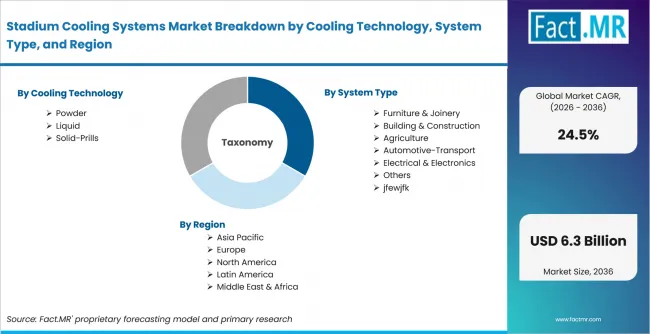
Stadium Cooling Systems Market Breakdown By Cooling Technology, System Type, And Region | Source: Fact.MR
| Attribute | Details |
|---|---|
| Quantitative Units | USD Billion in 2026 to USD Billion by 2036 |
| Market Definition | Cooling and climate management systems designed for sports stadiums and large spectator venues |
| Cooling Technologies Covered | Targeted Air Cooling Systems, Radiant Cooling Systems, Evaporative Cooling Systems, Hybrid Cooling Systems |
| System Types Covered | Integrated HVAC Cooling Systems, District Cooling Systems, Smart Ventilation Systems, Modular Cooling Platforms |
| Stadium Types Covered | Outdoor Stadiums, Indoor Stadiums, Multi-Purpose Venues |
| End Users Covered | Stadium Operators, Sports Organizations, Venue Developers, Government Authorities |
| Applications Covered | Spectator Comfort Management, Athlete Cooling, Event Operations, Climate Resilience |
| Regions Covered | North America, Western Europe, Asia Pacific, Latin America, Middle East & Africa |
| Key Countries Covered | United States, United Kingdom, Saudi Arabia, South Korea, Japan |
| Companies Covered | Johnson Controls, Carrier Global, Trane Technologies, Daikin Industries, Siemens, Honeywell International, Schneider Electric and LG Electronics |
| Forecast Period | 2026 to 2036 |
| Research Approach | Hybrid top-down and bottom-up methodology using stadium infrastructure spending, cooling system deployments and venue modernization activity. |
Source: Fact.MR analysis. Updated Jun 25, 2026
How is the market segmented?
-
By Cooling Technology
- Targeted Air Cooling Systems
- Radiant Cooling Systems
- Evaporative Cooling Systems
- Hybrid Cooling Systems
-
By System Type
- Integrated HVAC Cooling Systems
- District Cooling Systems
- Smart Ventilation Systems
- Modular Cooling Platforms
-
By Stadium Type
- Outdoor Stadiums
- Indoor Stadiums
- Multi-Purpose Venues
-
By End User
- Stadium Operators
- Sports Organizations
- Venue Developers
- Government Authorities
-
By Application
- Spectator Comfort Management
- Athlete Cooling and Performance
- Event Operations
- Climate Resilience and Sustainability
-
Region:
- North America
- United States
- Canada
- Europe
- United Kingdom
- Germany
- France
- Netherlands
- Spain
- Asia Pacific
- Australia
- Japan
- South Korea
- Singapore
- India
- Latin America
- Brazil
- Mexico
- Chile
- Middle East & Africa
- GCC Countries
- South Africa
- Israel
- North America
Frequently Asked Questions
Which cooling technology leads the market?
Which system type dominates the market?
Which stadium type accounts for the largest share?
What is driving demand for stadium cooling systems?
Which country is growing the fastest?
What is the primary challenge facing the market?
How are smart stadium initiatives influencing demand?
What opportunities exist for cooling system providers?
Why are stadium operators investing in cooling technologies?
How does district cooling support stadium operations?
What role does energy efficiency play in purchasing decisions?
Who worked on this report


Preview the report firsthand - request a free sample
Free SampleGet the brochure for pricing and purchase details
Download PDF