- Market Value (2025): USD 269.3 Mn
- Estimated Value (2026): USD 282.0 Mn
- Forecast Value (2036): USD 447.3 Mn
- CAGR (2026-2036): 4.7%
What is the Sulfadimethoxine (SDM) Market forecast to be worth by 2036?
USD 282.0 million in 2026 to USD 447.3 million by 2036 at a 4.7% CAGR.
- Worth USD 269.3 million in 2025, the sulfadimethoxine market draws most of its revenue from poultry and cattle treatments given through drinking water.
- Revenue will move from USD 282.0 million in 2026 to USD 447.3 million by 2036, as livestock and fish output keeps growing in Latin America and Asia.
- A 4.7% CAGR reflects steady prescription demand held in check by tighter stewardship rules in Europe and North America.
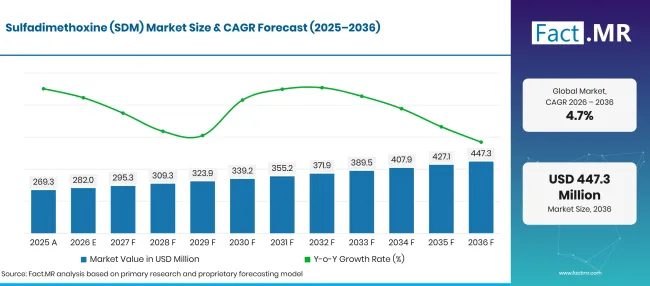
Sulfadimethoxine Sdm Market Forecast Global | Source: Fact.MR
| Year | Basis | Market Value (USD million) |
|---|---|---|
| 2025 | Actual | 269.3 |
| 2026 | Estimate | 282.0 |
| 2036 | Forecast | 447.3 |
| CAGR 2026 to 2036 | Forecast period | 4.7% |
Source: Fact.MR analysis. Updated Nov 3, 2026
What are the defining numbers behind Sulfadimethoxine (SDM) Market growth?
The 2026 to 2036 period adds USD 165.3 million in new value, led by soluble powders for flock and herd treatment.
- Demand Drivers in the Market
- Livestock antimicrobial use is rising again in the United States, where FDA reported a 16% increase in sales of medically important antimicrobials for food-producing animals between 2023 and 2024 [1].
- Current U.S. labels keep sulfadimethoxine relevant for poultry and cattle, since a concentrated solution updated in July 2026 covers coccidiosis, fowl cholera and infectious coryza in chickens alongside shipping fever and foot rot in cattle [2].
- Format choice supports wider use, with a soluble powder label revised in April 2026 allowing flock dosing through drinking water and drenching of individual cattle [3].
- Injectable versions give veterinarians a faster option for sick cattle, and a 40% intravenous injection label was updated in November 2025 for respiratory disease and foot rot [4].
- Key Segments Analyzed
- By Product Form: Powder will hold 48.3% in 2026 since it dissolves into drinking water for whole-flock dosing.
- By Application: Aquaculture will account for 38.2% of 2026 value, as fish farms rely on medicated feed during bacterial disease outbreaks.
- By Distribution Channel: Veterinary Clinics will capture 38.6% in 2026, given that most labels restrict sulfadimethoxine to use on a veterinarian’s order.
- By End User: Farmers will take 41.3% of 2026 sales, reflecting purchases by poultry, cattle and fish operations treating groups of animals.
- Analyst Opinion at Fact.MR
- Shambhu Nath Jha, Principal Consultant at Fact.MR, states, “Sulfadimethoxine will keep its place in veterinary practice because it is cheap, well understood and easy to give through water. The growth story will come from Latin American poultry and cattle herds and from fish farms in Europe and Asia. Suppliers that keep labels current and publish clear withdrawal times will win the prescriptions that stewardship rules still allow.”
- Strategic Implications
- Manufacturers should keep label revisions current and print withdrawal periods for each species in plain terms on every pack.
- Distributors can add value by training clinic staff on the differences between soluble powder, oral solution and injectable formats.
- Veterinarians will need culture and susceptibility results on file before prescribing, as sulfonamide use draws closer review in national surveillance.
- Fish farm suppliers must confirm country-by-country authorization and residue limits before entering new aquaculture markets.
The United Kingdom will lead country growth at 6.1%, with salmon and broiler producers depending on a narrow list of authorized antimicrobials. The United States follows at 5.0%, 1.1 points behind, supported by a large poultry and cattle base and several current label holders. Japan will advance at 4.4%, keeping a 0.3-point edge over Brazil at 4.1% thanks to steady layer flock expansion. Brazil’s record meat output gives volume, but price competition from local generics trims value growth. Germany will close the range at 3.6%, as federal monitoring keeps antibiotic use under pressure.
How does the Sulfadimethoxine (SDM) Market break down by segment?
Powder will lead Product Form at 48.3%; Aquaculture will head Application at 38.2%; Veterinary Clinics will hold Distribution Channel at 38.6%; Farmers will lead End User at 41.3% in 2026.
Which Product Form leads?
Powder holds 48.3% of 2026 sales.
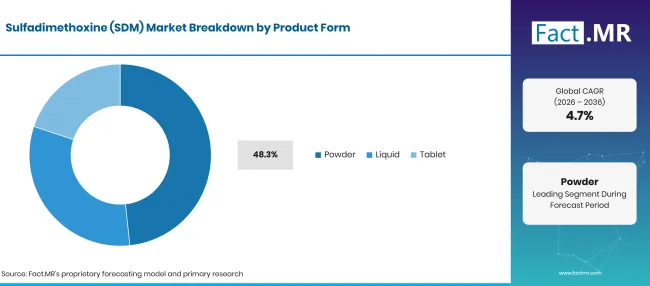
Sulfadimethoxine Sdm Market Breakdown Product Form | Source: Fact.MR
| Product Form | Share (2026) |
|---|---|
| Powder (Leading segment) | 48.3% |
| Other segments combined | 51.7%* |
| Total | 100.0% |
Source: Fact.MR analysis. Updated Nov 3, 2026
Poultry integrators prefer a soluble powder they can weigh, dissolve and run through the barn water line. A powder label revised in April 2026 sets six-day drinking-water courses for chickens and turkeys and allows individual cattle to be drenched with the same stock solution [3]. Bulk powders are also easier to ship and store than liquid concentrates, which helps rural distributors serving large farms. The format links closely with the feed premix industry, since many farms already handle water and feed additives at scale. Liquid concentrates serve buyers who want a ready-to-measure product and no mixing step. Tablets and boluses cover individual dogs, cats and cattle, where a veterinarian sets the exact dose by body weight. Injectable solutions round out the range for animals too sick to drink. Each format carries its own withdrawal rules, so product choice depends on the species and the intended slaughter or milk date.
What supports Aquaculture within Application?
Aquaculture takes 38.2% of 2026 revenue.
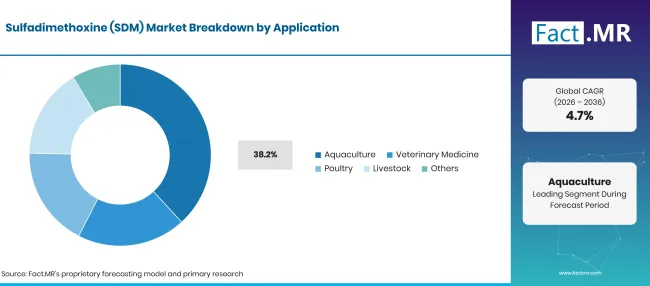
Sulfadimethoxine Sdm Market Breakdown Application | Source: Fact.MR
| Application | Share (2026) |
|---|---|
| Aquaculture (Leading segment) | 38.2% |
| Other segments combined | 61.8%* |
| Total | 100.0% |
Source: Fact.MR analysis. Updated Nov 3, 2026
Fish farms treat bacterial disease through medicated feed, and sulfonamide combinations remain one of the few authorized options in several producing countries. In the United Kingdom, salmon producers used 1.6 tonnes of antibiotics in 2024, equal to 8.1 mg/kg and 69% below the 2017 level [5]. That falling intensity shows how closely regulators watch fish treatments, which favors suppliers with clean residue data. Growth in the wider aquaculture industry keeps the treated biomass rising even as dose rates fall. Poultry applications remain a strong second pillar, covering coccidiosis and fowl cholera outbreaks in broilers and turkeys. Livestock use centers on cattle respiratory disease and foot rot. Companion animal treatment through veterinary medicine is smaller in value but steady, built on oral suspension and tablet formats for dogs and cats.
Why do Veterinary Clinics lead Distribution Channel?
Veterinary Clinics secure 38.6% of 2026 value.
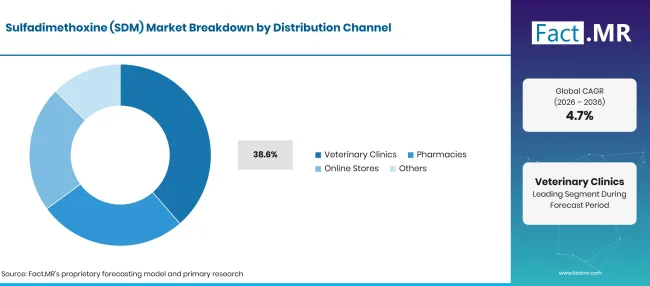
Sulfadimethoxine Sdm Market Breakdown Distribution Channel | Source: Fact.MR
| Distribution Channel | Share (2026) |
|---|---|
| Veterinary Clinics (Leading segment) | 38.6% |
| Other segments combined | 61.4%* |
| Total | 100.0% |
Source: Fact.MR analysis. Updated Nov 3, 2026
Most sulfadimethoxine labels in the United States carry the federal prescription statement, so purchases start with a veterinary visit or a farm call. A cattle injection label updated in August 2025 limits use to licensed veterinarians and covers shipping fever and calf diphtheria [6]. Clinics therefore control both diagnosis and the choice of format, which keeps them at the center of the buying chain. Pharmacies fill prescriptions for companion animals and some farm accounts. Online stores serve repeat orders where local law allows remote dispensing against a valid prescription. Other channels include farm supply dealers and integrator purchasing teams that buy under a herd veterinarian’s oversight.
How does End User shape demand?
Farmers account for 41.3% of 2026 spending.
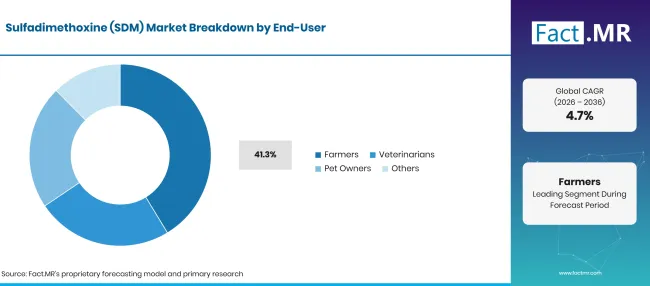
Sulfadimethoxine Sdm Market Breakdown End User | Source: Fact.MR
| End User | Share (2026) |
|---|---|
| Farmers (Leading segment) | 41.3% |
| Other segments combined | 58.7%* |
| Total | 100.0% |
Source: Fact.MR analysis. Updated Nov 3, 2026
Commercial producers buy in bulk because a single outbreak can affect thousands of birds or a full pen of calves. Spain published updated product information in March 2026 for an oral drinking-water solution used in broilers, turkeys, rabbits and calves [7]. Producers weigh treatment cost against lost growth and the withdrawal days before sale. Many also follow trends in the animal antibiotics sector to plan around new class restrictions. Pet owners buy tablets and suspensions for dogs and cats, mostly through clinics and pharmacies. Other end users include research facilities and public animal health programs. Their share is smaller, but purchase frequency is more stable than in farm channels.
What is accelerating Sulfadimethoxine (SDM) Market adoption, and what is holding it back?
Rising livestock output in Brazil and the United States, current water-soluble labels and the low cost of sulfonamides support sales. On the other side, national monitoring in Europe, prescription requirements and withdrawal periods limit how often producers can reach for the drug. Resistance to sulfonamide combinations in pig bacteria also pushes veterinarians toward culture testing before treatment. The balance favors steady, moderate growth through 2036.
Drivers Impact Analysis
| DRIVER | (~) % IMPACT ON CAGR | GEOGRAPHIC RELEVANCE | IMPACT TIMELINE |
|---|---|---|---|
| Poultry and cattle disease outbreaks requiring treatment | +1.0% | Global | Medium term (2-4 years) |
| Growth in livestock slaughter volumes | +0.9% | Latin America, North America | Short term (<=2 years) |
| Water-soluble formats for flock dosing | +0.7% | Global | Medium term (2-4 years) |
| Veterinary clinic guided prescribing | +0.5% | North America, Western Europe | Short term (<=2 years) |
Source: Fact.MR analysis. Updated Nov 3, 2026
Opportunity Impact Analysis
| OPPORTUNITY | (~) % IMPACT ON CAGR | GEOGRAPHIC RELEVANCE | IMPACT TIMELINE |
|---|---|---|---|
| Authorized aquaculture treatments | +0.8% | Western Europe, East Asia | Long term (>=4 years) |
| Improved soluble powder formulations | +0.6% | Latin America, North America | Medium term (2-4 years) |
| Species-specific labels for minor species | +0.4% | Global | Medium term (2-4 years) |
| Distribution partnerships in emerging markets | +0.3% | South Asia & Pacific | Long term (>=4 years) |
Source: Fact.MR analysis. Updated Nov 3, 2026
Restraints Impact Analysis
| RESTRAINT | (~) % IMPACT ON CAGR | GEOGRAPHIC RELEVANCE | IMPACT TIMELINE |
|---|---|---|---|
| Antimicrobial resistance and stewardship policy | -0.8% | Global | Long term (>=4 years) |
| Veterinary prescription requirements | -0.6% | North America, Western Europe | Short term (<=2 years) |
| Food-animal withdrawal periods | -0.5% | Global | Medium term (2-4 years) |
| Price pressure from generic suppliers | -0.3% | Latin America, East Asia | Medium term (2-4 years) |
Source: Fact.MR analysis. Updated Nov 3, 2026
Which countries are scaling the Sulfadimethoxine (SDM) Market through 2036?
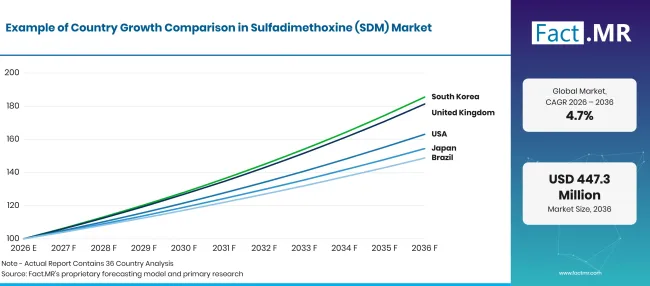
Sulfadimethoxine Sdm Market Growth Index | Source: Fact.MR
| Country | CAGR (2026 to 2036) |
|---|---|
| United Kingdom | 6.1% |
| United States | 5.0% |
| Japan | 4.4% |
| Brazil | 4.1% |
| Germany | 3.6% |
Source: Fact.MR analysis. Updated Nov 3, 2026
How is the United Kingdom developing demand?
6.1% CAGR, helped by salmon and broiler producers that rely on a short list of authorized treatments.
British farms have cut antibiotic use sharply, which leaves sulfonamide combinations as one of the remaining tools for targeted treatment. Sales of antibiotics for food-producing animals fell to 15.6 mg/kg in 2024, which is 57% below 2014 [5]. Broilers used 4.7 mg/kg in the same year, so each prescribed course carries more weight in the clinic. Value growth will come from higher-specification products with clean residue data for fish and poultry.
What is supporting United States adoption?
5.0% CAGR, backed by a wide base of current labels for poultry, cattle and pets.
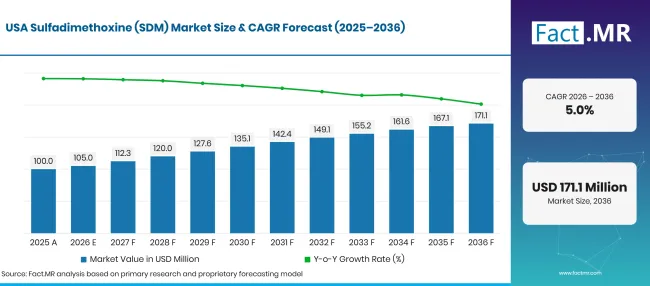
Sulfadimethoxine Sdm Market Forecast Usa | Source: Fact.MR
U.S. buyers can choose from soluble powders, concentrated solutions, injections and pet tablets. FDA posted its 2024 summary of antimicrobial sales for food-producing animals in November 2025, with a full 2015 to 2024 dataset for each drug class [8]. The same agency reported that 2024 sales still sat 27% below the 2015 peak [1]. Several generic labelers keep pricing competitive in feed stores and veterinary distribution.
What supports Japan’s adoption?
4.4% CAGR, reflecting a growing layer flock and careful veterinary oversight.
Japan counted 138.6 million adult laying hens on February 1, 2026, up 6.8% from 2024 [9]. Broilers numbered 139.6 million on the same date [9]. Larger layer houses raise the stakes of a coccidiosis or coryza outbreak, which keeps demand for water-soluble treatments steady. Japanese buyers also expect detailed residue documentation, so suppliers with local approvals hold an advantage over importers.
How is Brazil developing demand?
4.1% CAGR, driven by record poultry and cattle slaughter.
Brazil slaughtered 6.69 billion chickens in 2025, up 3.1% on the year, and cattle slaughter rose 8.2% to 42.94 million head [10]. Egg production reached 4.95 billion dozen, up 5.7% [10]. These volumes create a large treated population, although local generic producers keep unit prices low. Export meat plants also enforce strict residue checks, which favors products with clear withdrawal guidance.
What supports Germany’sadoption?
3.6% CAGR, as federal monitoring keeps antibiotic use under close watch.
Germany dispensed 562 tonnes of veterinary antibiotics in 2024, about 6.4% more than in 2023 [11]. Sulfonamides accounted for 62 tonnes, up 8.5% on the year but about 66% below 2011 [11]. The rebound shows that sulfonamides still serve a clinical need, yet strict reporting rules will keep growth below the other four countries. Suppliers here compete on documentation and on combination products with trimethoprim.
Who leads the Sulfadimethoxine (SDM) Market?
Competition splits into three groups. Zoetis anchors the branded tier with long-established companion animal and poultry products, and its strength rests on veterinarian trust and brand recognition.
Huvepharma leads the food-animal specialists, holding current U.S. labels for concentrated solutions and a French authorization whose package leaflet was published in October 2025 [12]. Bimeda competes in the same tier with a cattle injection label updated in August 2025 [6], and it widened its U.S. cattle range in October 2026 with the launch of a tulathromycin injection for calves [13]. The third group covers generic and regional suppliers such as Aspen Veterinary Resources, First Priority, Cronus Pharma and S.P. Veterinaria, which compete mainly on price and pack size. Wider portfolios across the animal antibiotics and antimicrobials space help these firms bundle sulfonamides with other classes. Success through 2036 will turn on keeping labels current and proving residue safety for food animals.
Which companies are the key providers?
Key companies include Zoetis, Huvepharma, Bimeda, Aspen Veterinary Resources, First Priority, Cronus Pharma and S.P. Veterinaria.
- Zoetis
- Huvepharma
- Bimeda
- Aspen Veterinary Resources
- First Priority
- Cronus Pharma
- S.P. Veterinaria
Bibliography
- [1] U.S. Food and Drug Administration. (2025, December 5). FDA Releases Annual Summary of Sales and Distribution of Antimicrobials in 2024 for Use in Food-Producing Animals.
- [2] U.S. National Library of Medicine, DailyMed. (2026, July 23). DI-METHOX CONCENTRATED SOLUTION 12.5%: sulfadimethoxine concentrated solution 12.5% solution, concentrate (Huvepharma, Inc).
- [3] U.S. National Library of Medicine, DailyMed. (2026, April 6). SULFADIMETHOXINE SOLUBLE POWDER: sulfadimethoxine sodium powder, for solution (First Priority Incorporated).
- [4] U.S. National Library of Medicine, DailyMed. (2025, November 14). SULFADIMETHOXINE 40%: sulfadimethoxine injection (Aspen Veterinary Resources, Ltd.).
- [5] Veterinary Medicines Directorate. (2025, November 18). UK-VARSS 2024 Highlights.
- [6] U.S. National Library of Medicine, DailyMed. (2025, August 14). SULFAMED: sulfadimethoxine injection (Bimeda, Inc.).
- [7] European Commission, Union Product Database. (2026, March 14). SULFADIM 250 mg/ml oral solution for drinking water.
- [8] U.S. Food and Drug Administration. (2025, November 21). 2024 Summary Report On Antimicrobials Sold or Distributed for Use in Food-Producing Animals.
- [9] Agriculture & Livestock Industries Corporation. (2026, October). 令和8年「畜産統計」について (On the 2026 Livestock Statistics).
- [10] Instituto Brasileiro de Geografia e Estatística. (2026, March 18). In 2025, Brazil registers the highest production of milk, leather and eggs in history; slaughter of cattle, chickens and pigs also hits record.
- [11] Bundestierärztekammer, Deutsches Tierärzteblatt. (2025, November). Abgabemengenerfassung von Antibiotika in Deutschland 2024.
- [12] European Commission, Union Product Database. (2025, October 15). SULFADIMETHOXINE 100-CR LAPIN-VOLAILLE-PORC ET AGNEAU-CHEVREAU SEVRES.
- [13] Bimeda. (2026, October 7). Bimeda USA Announces the Launch of Macrosyn 25 (Tulathromycin Injection), FDA-approved Bioequivalent to Draxxin 25.
This Report Answers
- How much will sulfadimethoxine sales be worth each year from 2026 to 2036?
- Which product form gives poultry and cattle producers the best fit for group treatment?
- Why does aquaculture hold the leading application position, and how do fish residue rules shape it?
- Where do veterinary clinics, pharmacies and online stores fit in the buying chain?
- How do growth rates differ across the United Kingdom, United States, Japan, Brazil and Germany?
- What separates branded suppliers from generic labelers in this category?
What does the Sulfadimethoxine (SDM) Market cover?
This study tracks veterinary products in which sulfadimethoxine is a declared active ingredient, sold for the treatment or control of susceptible bacterial and protozoal infections in animals. It includes single-ingredient products and combinations with potentiators such as ormetoprim.
Values are measured at manufacturer selling prices in USD million and reflect sales through clinics, pharmacies, online stores and farm supply channels. Bulk active ingredient sold to formulators is counted once, at the finished product stage.
What is included in the scope?
Soluble powders and concentrated oral solutions given through drinking water to poultry and cattle.
Tablets, boluses and oral suspensions for dogs, cats, cattle and horses.
Injectable sulfadimethoxine solutions for cattle and medicated feed premixes for fish.
Sales to farmers, pet owners, veterinary practices and other animal health buyers where the product is legally authorized.
What is excluded from the scope?
Human medicines and veterinary products based on other sulfonamides without sulfadimethoxine.
Antimicrobials from other classes, such as tetracyclines or macrolides, covered in the macrolide antibiotics study and related reports.
Diagnostic tests, veterinary equipment and non-medicated feed.
Wider human and animal anti-infective totals, which are tracked in the global antibiotics outlook.
How Was the Analysis Built?
The analysis draws on 120+ sources, 35+ company portfolios, 25+ countries, and more than 20 industry interviews.
- Primary Research: Primary research includes discussions with manufacturers, service providers, technology developers, distributors, end users, and subject-matter experts. These conversations examine purchasing priorities, product adoption, operational challenges, approval requirements, competitive positioning, and the factors that influence wider market acceptance.
- Desk Research: Desk research covers government statistics, regulatory publications, company filings, trade data, technical studies, industry associations, standards, public policy, and other authoritative sources. Every source used in the analysis is documented in the bibliography.
- Market Sizing and Forecasting: Market estimates combine historical performance, demand indicators, pricing and volume trends, segment shares, company participation, country-level growth, adoption patterns, investment activity, and barriers to market expansion.
- Data Validation and Update Cycle: Findings are validated by comparing primary interviews with public data, company activity, regulatory changes, trade patterns, and industry developments. Regular updates review new product launches, capacity changes, partnerships, approvals, and shifts in commercial adoption.
Segmentation
What is the report’s scope and coverage?
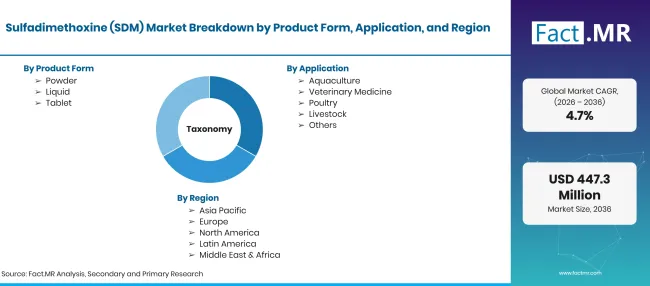
Sulfadimethoxine Sdm Market Taxonomy | Source: Fact.MR
| Attribute | Details |
|---|---|
| Quantitative Units | USD million in 2026 to USD million by 2036 at CAGR |
| Market Definition | The sulfadimethoxine market covers veterinary medicines containing sulfadimethoxine as an active ingredient, alone or with a potentiator, in powder, liquid and tablet forms for poultry, livestock, fish and companion animals. |
| Product Form | Powder; Liquid; Tablet |
| Application | Aquaculture; Veterinary Medicine; Poultry; Livestock; Others |
| Distribution Channel | Veterinary Clinics; Pharmacies; Online Stores; Others |
| End User | Farmers; Pet Owners; Others |
| Regions Covered | North America; Latin America; Western Europe; Eastern Europe; East Asia; South Asia & Pacific; Middle East & Africa |
| Countries Covered | United Kingdom; United States; Japan; Brazil; Germany |
| Companies Profiled | Zoetis; Huvepharma; Bimeda; Aspen Veterinary Resources; First Priority; Cronus Pharma; S.P. Veterinaria |
| Forecast Period | 2026 to 2036 |
| Approach | Bottom-up sizing by product form and species, checked against regulatory label data and national antimicrobial sales surveillance. |
Source: Fact.MR analysis. Updated Nov 3, 2026
How is the market segmented?
-
By Product Form
- Powder
- Liquid
- Tablet
-
By Application
- Aquaculture
- Veterinary Medicine
- Poultry
- Livestock
- Others
-
By Distribution Channel
- Veterinary Clinics
- Pharmacies
- Online Stores
- Others
-
By End User
- Farmers
- Pet Owners
- Others
-
By Region
- North America
- Latin America
- Western Europe
- Eastern Europe
- East Asia
- South Asia & Pacific
- Middle East & Africa
Frequently Asked Questions
How large is the sulfadimethoxine market in 2026?
What growth rate will the sulfadimethoxine market record?
Which product form leads?
Which application leads?
Which distribution channel leads?
Which end user leads?
Which country will grow quickest?
Who are the main companies?
What holds the market back?
Who worked on this report


Preview the report firsthand - request a free sample
Free SampleGet the brochure for pricing and purchase details
Download PDF