- Base Value(2025): 713.8 Mn
- Estimated Value(2026): 735.2 Mn
- Forecast Value (2036): 988.1 Mn
- CAGR (2026 - 2036): 3.0%
Synchronous Condenser Market Analysis and Forecast by Fact.MR
- The global market for synchronous condensers is estimated to be around US$ 735.2 million in 2026 and has been forecast to expand at a CAGR of 3% to end up at US$ 988.1 million by 2036.
- Synchronous condensers are rotating machines that provide reactive power compensation, voltage regulation, short-circuit strength, and system inertia to electrical grids without generating active power.
- Configurations include new-build units and converted retired generators. Cooling methods cover air-cooled and hydrogen-cooled designs.
- Demand is shaped by rising renewable energy penetration displacing conventional generation, growing grid stability concerns from inverter-based resources, and utility investment in transmission-level reactive power assets to maintain power quality and frequency response.
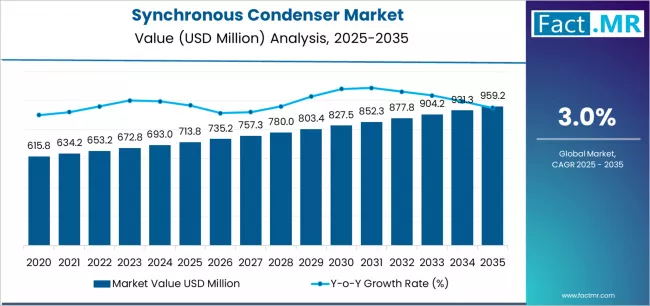
Synchronous Condenser Market Market Value Analysis | Source: Fact.MR
Summary of Synchronous Condenser Market
- Market Snapshot
- In 2025, the global Synchronous Condenser Market was valued at approximately USD 713.8 million.
- The market is estimated to reach USD 735.2 million in 2026 and is projected to attain USD 988.1 million by 2036.
- The synchronous condenser market is likely to expand at a CAGR of 3% during the forecast period.
- The market is anticipated to create an absolute dollar opportunity of USD 252.9 million between 2026 and 2036.
- New Synchronous Condenser accounts for 68% of product type share in 2026.
- USA (3.5%) and Germany (3.3%) are the key growth markets during the forecast period.
- Demand and Growth Drivers
- Rising renewable energy penetration across global grids is reducing system inertia and reactive power availability, increasing the need for synchronous condensers to maintain grid stability.
- Retirement of conventional coal and gas-fired generation units is removing natural sources of short-circuit strength and voltage regulation from transmission networks.
- Utility-scale battery storage and inverter-based resources do not inherently provide rotational inertia, creating a structural gap that synchronous condensers are uniquely positioned to fill.
- Transmission operators in Europe, North America, and parts of Asia are including synchronous condenser procurement in grid reliability investment programs.
- Conversion of retired generators into synchronous condensers offers utilities a lower-cost alternative to new-build installations while preserving existing grid support infrastructure.
- Product and Segment View
- New Synchronous Condenser accounts for 68% of product type share in 2026, supported by consistent demand across primary end-use applications.
- Electrical Utilities account for 74% of end use share in 2026, supported by consistent demand across primary end-use applications.
- Voltage Regulation accounts for 42% of grid application share in 2026, supported by consistent demand across primary end-use applications.
- Key segmentation includes:
- Product Type: New Synchronous Condenser, Refurbished Synchronous Condenser
- End Use: Electrical Utilities, Transmission Utilities, Power Generation Utilities, Industrial, Heavy Industries
- Grid Application: Voltage Regulation, Frequency Control, Short Circuit Ratio Improvement
- Installation Type: Transmission Grid Installations, Generation Plant Installations, Industrial Captive Installations
- These systems enable:
- Reactive power compensation and voltage regulation across transmission and distribution networks
- System inertia provision to improve frequency response during generation-load imbalances
- Short-circuit strength support to maintain protection system reliability in weak grid areas
- Geography and Competitive Outlook
- Asia Pacific leads growth with India at 3.2%, Japan at 3.1%, China at 2.9%, supported by expanding industrial capacity and infrastructure investment.
- North America shows steady demand with USA at 3.5%, Brazil at 2.7%, reflecting established end-use markets and replacement-led procurement.
- Europe maintains stable growth with Germany at 3.3%, UK at 2.5%, supported by regulatory compliance requirements and technology upgrades.
- USA (3.5%) and Germany (3.3%) are the key growth markets, reflecting strong investment activity and expanding addressable demand.
- Leading participants include ABB Ltd., Siemens Energy AG, Ideal Electric Company, Ansaldo Energia S.p.A., GE Vernova Inc., Andritz AG.
- Analyst Opinion
- Shambhu Nath Jha, Principal Consultant at Fact.MR, says 'The synchronous condenser market is being pulled forward by a structural shift in grid composition. As thermal generation retires and inverter-based resources grow, grids lose the inertia and reactive power that rotating machines naturally provide. Synchronous condensers fill that gap. The procurement pipeline is strongest in markets with aggressive renewable targets, particularly the United States, Germany, India, and parts of Northern Europe. Converted retired generators offer a lower-cost entry point, but new-build units with flywheel energy storage are gaining traction where grid operators need both inertia and faster response capability.'
Key Growth Drivers, Constraints, and Opportunities
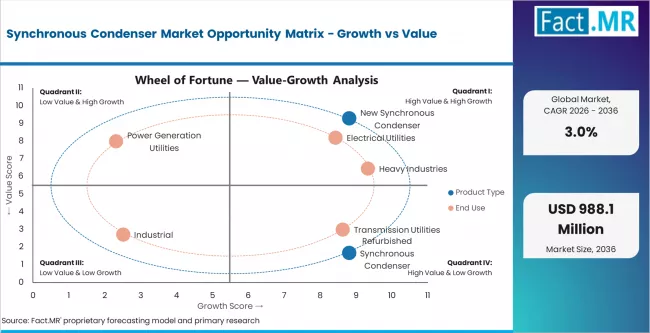
Synchronous Condenser Market Opportunity Matrix Growth Vs Value | Source: Fact.MR
Key Factors Driving Growth
- Rising renewable energy share is reducing grid inertia and reactive power availability, creating a structural need for synchronous condensers.
- Retirement of thermal generation assets is removing rotating machine support from grids, requiring dedicated compensation equipment.
- Utility investment programs focused on grid reliability are including synchronous condenser procurement as part of transmission infrastructure upgrades.
Key Market Constraints
- High installation and civil works costs for new-build synchronous condensers can slow procurement decisions in cost-sensitive utility environments.
- Competition from static power electronics-based compensation devices such as STATCOMs in certain grid applications.
- Long project lead times for new installations and generator conversions can delay grid support deployment timelines.
Key Opportunity Areas
- Conversion of retired thermal generators into synchronous condensers provides a lower-cost grid support option for utilities managing coal-to-renewable transitions.
- Integration of flywheel energy storage with synchronous condensers creates a differentiated product offering for grid operators requiring fast inertia response.
- Expansion of offshore wind and large-scale solar installations in new geographies is broadening the pipeline for grid-connected compensation equipment.
Segment-wise Analysis of the Synchronous Condenser Market
- New Synchronous Condenser holds 68% of the product type segment in 2026, supported by established demand across primary end-use applications.
- Electrical Utilities represent 74% of the end use segment in 2026, with consistent adoption across core applications.
- Voltage Regulation accounts for 42% of the grid application segment in 2026, reflecting concentrated demand in the leading vertical.
The synchronous condenser market is segmented by product type, end use, grid application, installation type, and region. New Synchronous Condenser leads by value in the near term, while emerging categories are expected to drive the next phase of growth as end-use requirements evolve.
Which Product Type Segment Dominates the Synchronous Condenser Market?
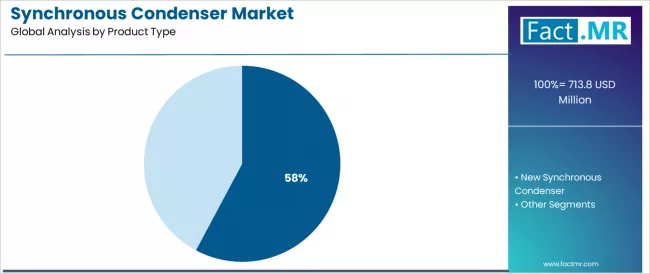
Synchronous Condenser Market Analysis By Product Type | Source: Fact.MR
New Synchronous Condenser is expected to account for 68% of the product type segment in the global Synchronous Condenser Market by 2026. Demand is supported by consistent procurement across primary end-use applications, where established performance requirements and pricing accessibility sustain the installed base.
The segment is expected to maintain its position through the forecast period as replacement demand and capacity expansion in core verticals continue to generate steady procurement. Emerging alternatives are gaining share, but new synchronous condenser remains the primary volume category because of buyer familiarity and application suitability across mature and developing markets.
Which End Use Segment Dominates the Synchronous Condenser Market?

Synchronous Condenser Market Analysis By End Use | Source: Fact.MR
Electrical Utilities is expected to account for 74% of the end use segment in the global Synchronous Condenser Market by 2026. Demand is supported by consistent procurement across primary end-use applications, where established performance requirements and pricing accessibility sustain the installed base.
The segment is expected to maintain its position through the forecast period as replacement demand and capacity expansion in core verticals continue to generate steady procurement. Emerging alternatives are gaining share, but electrical utilities remain the primary volume category because of buyer familiarity and application suitability across mature and developing markets.
Which Grid Application Segment Dominates the Synchronous Condenser Market?
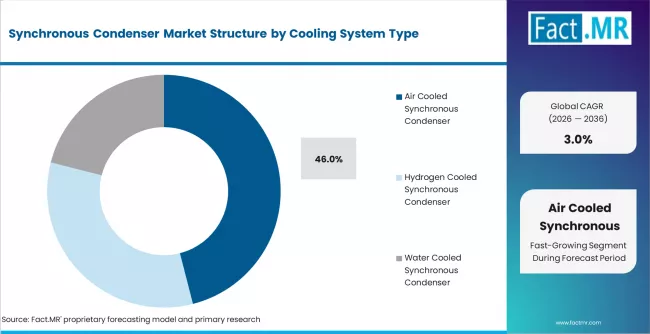
Synchronous Condenser Market Analysis By Cooling System Type | Source: Fact.MR
Voltage Regulation is expected to account for 42% of the grid application segment in the global Synchronous Condenser Market by 2026. Demand is supported by consistent procurement across primary end-use applications, where established performance requirements and pricing accessibility sustain the installed base.
The segment is expected to maintain its position through the forecast period as replacement demand and capacity expansion in core verticals continue to generate steady procurement. Emerging alternatives are gaining share, but voltage regulation remains the primary volume category because of buyer familiarity and application suitability across mature and developing markets.
Which Product Trend is Shaping the Next Phase of Growth in the Synchronous Condenser Market?
Generator conversion projects are gaining traction as a cost-effective way to maintain grid inertia and reactive power capability following the retirement of thermal generation assets. Utilities and grid operators are increasingly evaluating retired coal and gas-fired generators for conversion into synchronous condensers rather than decommissioning them entirely, preserving grid support infrastructure at a fraction of new-build cost.
The conversion trend reflects a structural shift in grid planning. As renewable energy penetration increases, grid operators face a growing gap in rotational inertia and fault current contribution that inverter-based resources cannot fill. Converted generators offer a practical solution in markets where existing generation infrastructure is available and where the civil and electrical balance of plant can be retained, reducing both project lead time and capital expenditure.
Regional Outlook Across Key Markets
.webp "Top Country Growth Comparison Synchronous Condenser Market Cagr (2026 2036)")
Top Country Growth Comparison Synchronous Condenser Market Cagr (2026 2036) | Source: Fact.MR
- USA leads growth at 3.5%, supported by expanding domestic demand, industrial capacity investment, and broadening end-use adoption across commercial and institutional applications.
- The U.S. at 3.5% reflects a mature market where replacement demand and technology upgrades are the primary growth drivers.
- European demand remains steady, with the UK at 2.5% and Germany at 3.3%, supported by regulatory compliance requirements and technology-led procurement upgrades.
CAGR Table
| Country | CAGR (%) |
|---|---|
| USA | 3.5% |
| Germany | 3.3% |
| India | 3.2% |
| Japan | 3.1% |
| China | 2.9% |
| Brazil | 2.7% |
| UK | 2.5% |
Source: Fact.MR analysis. Updated May 19, 2026
Source: Fact MR (FMR) analysis, based on proprietary forecasting model and primary research.
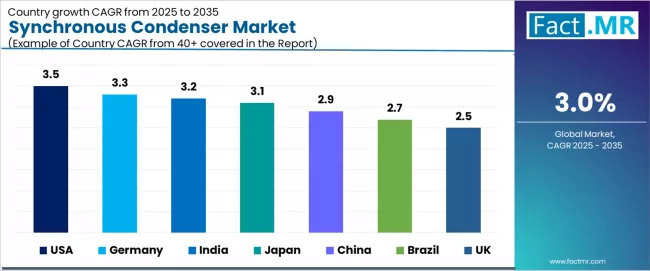
Synchronous Condenser Market Cagr Analysis By Country | Source: Fact.MR
Market Outlook for Synchronous Condensers in USA
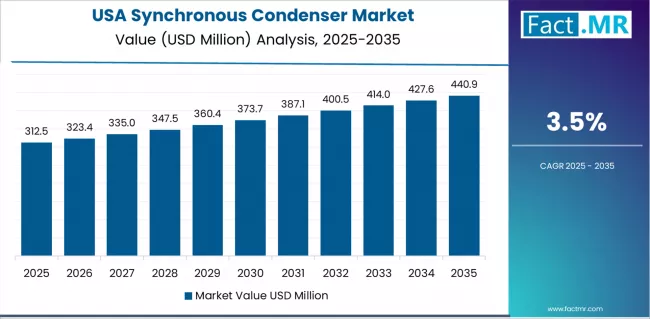
Synchronous Condenser Market Country Value Analysis | Source: Fact.MR
The USA synchronous condenser market is projected to grow at a CAGR of 3.5% through 2036. Demand is supported by expanding end-use activity and growing adoption of higher-specification products across key application segments.
- Expanding end-use demand supports procurement across primary applications.
- Infrastructure investment is broadening the installed equipment base.
- Growing performance requirements support mid-range and premium demand.
Demand Trends for Synchronous Condensers in Germany
The Germany synchronous condenser market is projected to grow at a CAGR of 3.3% through 2036. Demand is supported by expanding end-use activity and growing adoption of higher-specification products across key application segments.
- Expanding end-use demand supports procurement across primary applications.
- Infrastructure investment is broadening the installed equipment base.
- Growing performance requirements support mid-range and premium demand.
Growth Assessment for Synchronous Condensers in India
The India synchronous condenser market is projected to grow at a CAGR of 3.2% through 2036. Demand is supported by expanding end-use activity and growing adoption of higher-specification products across key application segments.
- Expanding end-use demand supports procurement across primary applications.
- Infrastructure investment is broadening the installed equipment base.
- Growing performance requirements support mid-range and premium demand.
Market Growth Outlook for Synchronous Condensers in Japan

Synchronous Condenser Market Japan Market Share Analysis By Product Type | Source: Fact.MR
The Japan synchronous condenser market is projected to grow at a CAGR of 3.1% through 2036. Demand is supported by expanding end-use activity and growing adoption of higher-specification products across key application segments.
- Expanding end-use demand supports procurement across primary applications.
- Infrastructure investment is broadening the installed equipment base.
- Growing performance requirements support mid-range and premium demand.
Market Opportunity Outlook for Synchronous Condensers in China
The China synchronous condenser market is projected to grow at a CAGR of 2.9% through 2036. Demand is supported by expanding end-use activity and growing adoption of higher-specification products across key application segments.
- Expanding end-use demand supports procurement across primary applications.
- Infrastructure investment is broadening the installed equipment base.
- Growing performance requirements support mid-range and premium demand.
Demand Analysis for Synchronous Condensers in Brazil
The Brazil synchronous condenser market is projected to grow at a CAGR of 2.7% through 2036. Demand is supported by expanding end-use activity and growing adoption of higher-specification products across key application segments.
- Expanding end-use demand supports procurement across primary applications.
- Infrastructure investment is broadening the installed equipment base.
- Growing performance requirements support mid-range and premium demand.
Growth Forecast for Synchronous Condensers in UK
The UK synchronous condenser market is projected to grow at a CAGR of 2.5% through 2036. Demand is supported by expanding end-use activity and growing adoption of higher-specification products across key application segments.
- Expanding end-use demand supports procurement across primary applications.
- Infrastructure investment is broadening the installed equipment base.
- Growing performance requirements support mid-range and premium demand.
Competitive Benchmarking and Company Positioning
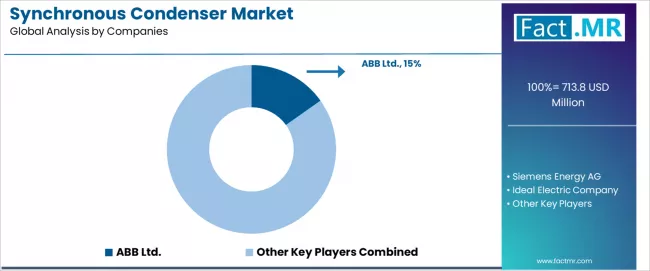
Synchronous Condenser Market Analysis By Company | Source: Fact.MR
Synchronous Condenser Market Analysis By Company
- ABB Ltd., Siemens Energy AG, Ideal Electric Company, Ansaldo Energia S.p.A. hold strong positions in the global synchronous condenser market through broad product portfolios, established brand recognition, and growing capabilities across core end-use applications.
- GE Vernova Inc., Andritz AG, Voith GmbH & Co. KGaA, Fuji Electric Co., Ltd. participate meaningfully across specific price tiers, user segments, and regional channels, with competition shaped by product quality, application fit, and distribution access.
- Technology integration and aftermarket service capability create differentiation, particularly in higher-specification product categories where buyer retention depends on performance reliability and ongoing support.
The competitive landscape is moderately fragmented, with established industrial players, specialized manufacturers, and value-oriented producers. ABB Ltd., Siemens Energy AG, Ideal Electric Company, Ansaldo Energia S.p.A. compete through product breadth, technical capability, and visibility across primary end-use applications.
Competition is shaped by differences between standard and premium product categories. Standard products attract price-sensitive buyers, while higher-specification systems create a premium layer of competition built around performance, durability, and service support.
Strategic priorities include expanding product portfolios, strengthening service networks, and widening reach across direct and e-commerce distribution channels. Companies combining reliable product performance with stronger technical support are positioned to improve retention and margin stability.
Key Companies in the Synchronous Condenser Market
ABB Ltd., Siemens Energy AG, Ideal Electric Company, Ansaldo Energia S.p.A. are among the leading players in the synchronous condenser market globally, supported by strong product portfolios, established market presence, and growing positions across primary end-use applications.
GE Vernova Inc., Andritz AG, Voith GmbH & Co. KGaA, Fuji Electric Co., Ltd. hold established positions across specific application segments and regional markets, supported by durable products, distribution penetration, and category familiarity among end users.
WEG S.A., BRUSH Group Ltd. and other specialist participants continue to compete through focused product offerings, price-point coverage, and niche application strength, reinforcing their relevance in a fragmented market.
Recent Industry Developments
- ABB Ltd. – Product Portfolio Expansion (2025)
- ABB Ltd. expanded its product portfolio with new models targeting higher-specification applications. The expansion strengthens the company's position in the growing premium segment.
- Siemens Energy AG – Technology Upgrade Launch (2026)
- Siemens Energy AG introduced upgraded technology capabilities across core product lines, improving operational efficiency and application versatility for end users.
- Ideal Electric Company – Geographic Expansion (2025)
- Ideal Electric Company expanded its distribution and service network into high-growth markets in Asia Pacific and Latin America, strengthening access to institutional procurement channels.
Leading Companies Shaping the Synchronous Condenser Market
- ABB Ltd.
- Siemens Energy AG
- Ideal Electric Company
- Ansaldo Energia S.p.A.
- GE Vernova Inc.
- Andritz AG
- Voith GmbH & Co. KGaA
- Fuji Electric Co., Ltd.
- WEG S.A.
- BRUSH Group Ltd.
Sources and Research References
- ABB Ltd.. Product portfolio updates and corporate announcements.
- Siemens Energy AG. Product portfolio updates and corporate announcements.
- Ideal Electric Company. Product portfolio updates and corporate announcements.
- Industry association publications, government regulatory databases, trade statistics, customs databases, and company product catalogs.
- Primary interviews with manufacturers, distributors, system integrators, end users, and industry consultants.
This bibliography is provided for reader reference and is not exhaustive. The full report contains the complete reference list and detailed citations.
Key Questions This Report Addresses
- What is the current and future size of the Synchronous Condenser Market?
- How fast is the Synchronous Condenser Market expected to grow between 2026 and 2036?
- Which product type is likely to lead the market by 2026?
- Which end use segment is expected to account for the highest demand by 2026?
- What factors are driving demand globally?
- How is technology evolution influencing market growth?
- Which countries are projected to show the fastest growth through 2036?
- What is driving market expansion in USA and Germany?
- Who are the key companies active in the Synchronous Condenser Market?
- How does Fact.MR estimate and validate the market forecast?
Synchronous Condenser Market Definition
The synchronous condenser market covers rotating machines used to provide reactive power compensation, voltage regulation, system inertia, and short-circuit strength to electrical grids. It includes new-build synchronous condensers and converted retired generators, deployed across electrical utility, industrial, and transmission grid applications with air-cooled and hydrogen-cooled configurations.
Synchronous Condenser Market Inclusions
- The scope covers global and regional market size and forecasts for 2026 to 2036 across product type, end use, grid application, installation type, and region.
- It includes regional demand analysis across major geographies, based on factors such as end-use activity levels, regulatory requirements, infrastructure investment, and technology adoption.
- The report includes pricing and cost analysis across entry-level, mid-range, and premium product categories, including hardware, consumables, and service components.
- It covers technology trends, market drivers and constraints, and the competitive landscape, including product portfolios, pricing strategy, geographic reach, and distribution positioning of leading players.
Synchronous Condenser Market Exclusions
- The scope excludes active power generation equipment, battery energy storage systems, and static VAR compensators that do not use rotating machine technology.
- It excludes power electronics-based reactive power devices such as STATCOMs and SVCs that operate without rotating components.
- The report excludes generator maintenance, overhaul, and repair services not associated with synchronous condenser conversion or new installation.
- It also excludes small-scale distributed compensation devices and capacitor banks used for power factor correction at end-user facilities.
Synchronous Condenser Market Research Methodology
- The methodology combines secondary research, primary interviews, and forecast modelling.
- It draws on 120+ secondary sources and benchmarks 65+ company product portfolios.
- Market sizing covers 30+ countries through a demand-side model, supported by top-down validation.
- Key inputs include end-use activity levels, regulatory requirements, procurement patterns, and technology adoption rates.
- The model cross-checks demand with shipments, pricing trends, channel mix, and product launches.
- Primary validation includes 25+ interviews across manufacturers, distributors, system integrators, and end users.
- Final estimates go through trade-flow checks, sales-pattern review, and sensitivity testing.
Segmentation
Scope of Analysis
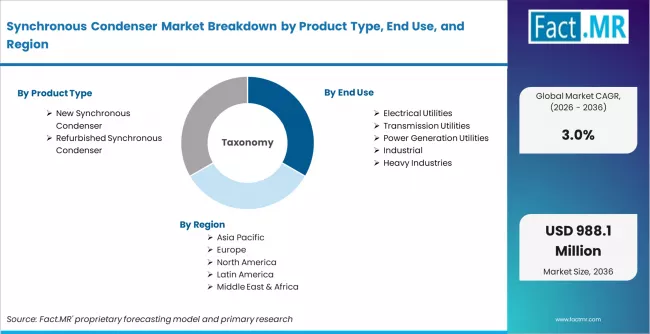
Synchronous Condenser Market Breakdown By Product Type, End Use, And Region | Source: Fact.MR
| Parameter | Details |
|---|---|
| Quantitative Units | USD 735.2 million to USD 988.1 million, at a CAGR of 3% |
| Market Definition | Rotating machines providing reactive power, voltage regulation, inertia, and short-circuit strength to electrical grids across utility and industrial applications. |
| Regions Covered | North America, Latin America, Europe, East Asia, South Asia and Pacific, Middle East and Africa |
| Countries Covered | USA, Germany, India, Japan, China, Brazil, UK, 30 plus countries |
| Key Companies | ABB Ltd., Siemens Energy AG, Ideal Electric Company, Ansaldo Energia S.p.A., GE Vernova Inc., Andritz AG, Voith GmbH & Co. KGaA, Fuji Electric Co., Ltd., WEG S.A., BRUSH Group Ltd. |
| Forecast Period | 2026 to 2036 |
| Approach | Hybrid demand-side and top-down methodology built on country-level application demand, product benchmarking, pricing analysis, shipment validation, and primary interviews across manufacturers, distributors, and end users |
Source: Fact.MR analysis. Updated May 19, 2026
Synchronous Condenser Market Segmentation
-
Synchronous Condenser marketSegmented by Product Type:
- New Synchronous Condenser
- Fully New Installations
- Greenfield Grid Projects
- Advanced Grid Stabilization Systems
- Modern High Efficiency Units
- Renewable Integration Support
- HVDC And Transmission Support
- Fully New Installations
- Refurbished Synchronous Condenser
- Reconditioned Grid Stability Units
- Cost Efficient Power Grid Support
- Retrofit Of Existing Infrastructure
- Upgraded Legacy Systems
- Extended Equipment Lifespan
- Maintenance Driven Installations
- Reconditioned Grid Stability Units
- New Synchronous Condenser
-
Synchronous Condenser marketSegmented by End Use:
- Electrical Utilities
- Transmission Utilities
- Grid Stability Operations
- Voltage Regulation Systems
- Frequency Control Support
- Grid Stability Operations
- Power Generation Utilities
- Renewable Energy Integration
- Wind And Solar Stabilization
- Grid Balancing Operations
- Renewable Energy Integration
- Industrial
- Heavy Industries
- Steel And Metal Plants
- Power Quality Improvement
- Reactive Power Compensation
- Chemical And Manufacturing Plants
- Industrial Grid Support Systems
- Voltage Stabilization
- Steel And Metal Plants
-
Synchronous Condenser marketSegmented by Grid Application:
- Voltage Regulation
- Reactive Power Compensation
- Power Factor Correction Systems
- Transmission Stability Support
- Grid Voltage Support
- Load Fluctuation Management
- Substation Stability Enhancement
- Reactive Power Compensation
- Frequency Control
- System Frequency Stabilization
- Grid Balancing Services
- Renewable Intermittency Control
- Rapid Response Support
- Disturbance Recovery Systems
- Grid Reliability Improvement
- System Frequency Stabilization
- Voltage Regulation
-
Synchronous Condenser marketSegmented by Installation Type:
- Transmission Grid Installations
- Extra High Voltage Networks
- National Grid Stabilization
- Long Distance Power Transmission
- Substation Based Installations
- Reactive Power Compensation Sites
- Grid Reliability Enhancement
- Extra High Voltage Networks
- Generation Plant Installations
- Thermal Power Plants
- Generator Excitation Support
- Plant Level Voltage Control
- Renewable Power Plants
- Wind Farm Stabilization
- Solar Plant Grid Integration
- Thermal Power Plants
- Industrial Captive Installations
- On Site Power Systems
- Power Quality Improvement Units
- Factory Level Grid Support
- Process Industry Installations
- Voltage Stability Enhancement
- Heavy Load Management Systems
- On Site Power Systems
- Transmission Grid Installations
-
Synchronous Condenser marketSegmented by Cooling System Type:
- Air Cooled Synchronous Condenser
- Natural Air Cooling Systems
- Low Maintenance Operation
- Rural And Remote Grid Use
- Forced Air Cooling Systems
- Compact Grid Installations
- Medium Capacity Applications
- Natural Air Cooling Systems
- Hydrogen Cooled Synchronous Condenser
- High Efficiency Cooling Systems
- Large Scale Grid Stability
- High Performance Power Plants
- Advanced Heat Dissipation Units
- Reduced Electrical Losses
- Industrial Grade Applications
- High Efficiency Cooling Systems
- Water Cooled Synchronous Condenser
- Direct Water Cooling Systems
- High Capacity Power Grids
- Urban Substation Installations
- Closed Loop Cooling Systems
- Enhanced Thermal Efficiency
- Critical Grid Infrastructure
- Direct Water Cooling Systems
- Air Cooled Synchronous Condenser
-
Synchronous Condenser marketby Region:
- North America
- USA
- Canada
- Mexico
- Latin America
- Brazil
- Chile
- Rest of Latin America
- Western Europe
- Germany
- UK
- Italy
- Spain
- France
- Nordic
- BENELUX
- Rest of Western Europe
- Eastern Europe
- Russia
- Poland
- Hungary
- Balkan & Baltic
- Rest of Eastern Europe
- East Asia
- China
- Japan
- South Korea
- South Asia and Pacific
- India
- ASEAN
- Australia & New Zealand
- Rest of South Asia and Pacific
- Middle East & Africa
- Kingdom of Saudi Arabia
- Other GCC Countries
- Turkiye
- South Africa
- Other African Union
- Rest of Middle East & Africa
- North America
Frequently Asked Questions
How big is the synchronous condenser market in 2025?
What will be the size of the synchronous condenser market in 2036?
How much will the synchronous condenser market grow between 2026 and 2036?
What are the key product types in the synchronous condenser market?
Which segment will contribute the most share in the synchronous condenser market in 2026?
Which countries are growing fastest in the Synchronous Condenser Market?
Who are the key companies in the synchronous condenser market?
Who worked on this report


Preview the report firsthand - request a free sample
Free SampleGet the brochure for pricing and purchase details
Download PDF