- Market Value (2025): USD 0.3 Bn
- Estimated Value (2026): USD 0.4 Bn
- Forecast Value (2036):USD 4.1 Bn
- CAGR (2026-2036): 26.2%
What is the synthetic vision datasets market forecast to be worth by 2036?
USD 0.4 billion in 2026. USD 4.1 billion by 2036. CAGR of 26.2%.
- The synthetic vision datasets market crossed a valuation of USD 0.3 billion in 2025.
- The market is estimated at USD 0.4 billion in 2026. It is projected to reach USD 4.1 billion by 2036.
- The market is forecast to record 26.2% CAGR from 2026 to 2036.
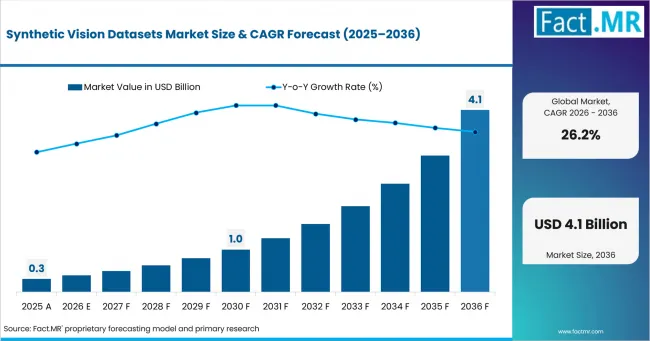
Synthetic Vision Datasets Market Market Value Analysis | Source: Fact.MR
What are the defining numbers behind synthetic vision datasets growth?
USD 3.7 billion absolute opportunity by 2036, led by South Korea and China.
- Demand Drivers in the Market
- Factory vision projects need rare defect images without stopping production lines.
- Robotics testing teams use synthetic scenes to train perception models before real-site trials.
- Inspection vendors use generated images to reduce manual annotation workloads.
- Edge AI rollouts require task-specific datasets for cameras and robot sensors.
- Key Segments Analyzed
- By Dataset Type: Object Detection is projected to account for 34.0% share in 2026 since most buyers start with box-level recognition tasks.
- By Generation Method: Simulation-Rendered datasets are expected to hold 36.0% share in 2026 where geometry and lighting control matter.
- By Application: Manufacturing Inspection is forecast to capture 31.0% share in 2026 as defect classes are hard to collect in live plants.
- By Delivery Model: Custom Synthetic Data Services are anticipated to hold 38.0% share in 2026 with buyers asking for site-specific scenes.
- By Buyer Type: AI Teams are projected to account for 35.0% share in 2026 since they own model quality and release timing.
- By Geography: South Korea is expected to record 29.6% CAGR through 2036 with robotics policy and automation depth supporting demand.
- Analyst Opinion at Fact.MR
- Shambhu Nath Jha, Senior Analyst at Fact.MR, states, “Synthetic vision datasets now sit between simulation and field learning. I see buyers asking less about image volume and more about scene control. Providers that can show synthetic-to-real lift with buyer camera data gain trust faster than vendors selling generic image volume.”
- Strategic Implications
- Robotics companies need synthetic datasets that cover pose changes and object clutter.
- Inspection vendors should link generated images to defect classes used in production.
- Dataset providers need validation loops that compare synthetic images with real camera captures.
The International Federation of Robotics stated in September 2025 that 542,000 industrial robots were installed in 2024. That installed base gives inspection and robotics teams more physical sites where synthetic vision datasets can reduce early-stage data collection work.
South Korea is projected to record 29.6% CAGR through 2036 as robotics funding and factory automation support vision data use. China is expected to expand at 29.1% CAGR as robot builders and inspection vendors scale model-training programs. India is forecast to grow at 28.4% CAGR as AI infrastructure funding improves local data generation capacity. The United States is expected to advance at 27.5% CAGR with physical AI buyers asking for validation datasets. Germany is projected to rise at 25.9% CAGR as industrial quality systems favor careful dataset testing. Japan is forecast at 25.4% CAGR where robot and camera suppliers need controlled visual edge cases. The United Kingdom is expected to post 24.9% CAGR with AI compute zones helping dataset providers scale.
How does the synthetic vision datasets market break down by segment?
Object Detection leads at 34.0%. Simulation-Rendered generation leads at 36.0%.
Which dataset type dominates?
Object Detection holds 34.0% share in 2026.
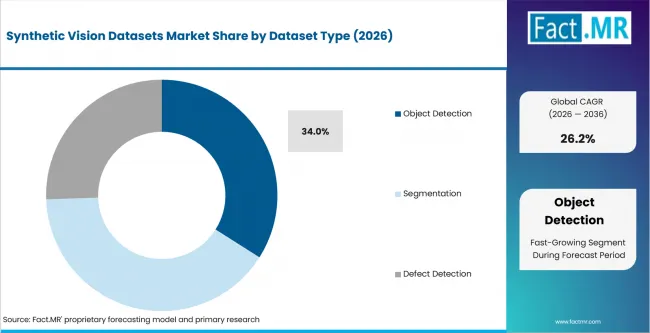
Synthetic Vision Datasets Market Analysis By Dataset Type | Source: Fact.MR
Object Detection leads early projects since most AI teams need to locate products and defects before adding pixel-level detail. The segment is projected to hold 34.0% share in 2026. This use case connects with autonomous quality gates where pass or fail decisions start with reliable part detection.
Which generation method dominates?
Simulation-Rendered datasets account for 36.0% share in 2026.
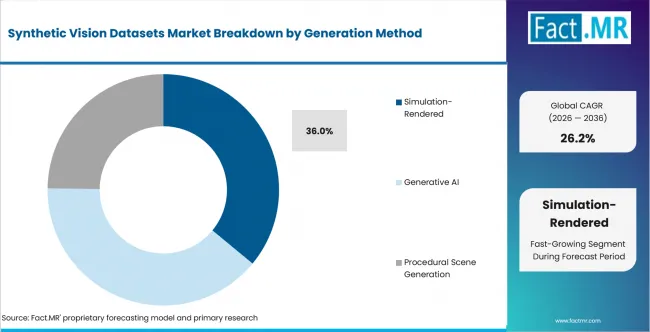
Synthetic Vision Datasets Market Analysis By Generation Method | Source: Fact.MR
Simulation-Rendered generation leads because it can control camera angle and object placement. NVIDIA Cosmos world foundation models support synthetic data generation and physical AI reasoning workflows. This matters when buyers need repeatable scenes for robot vision systems.
Which application dominates?
Manufacturing Inspection holds 31.0% share in 2026.
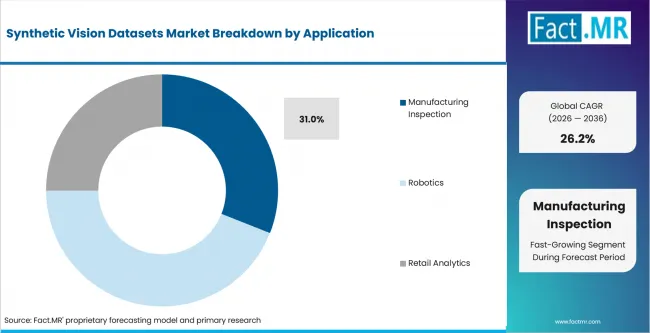
Synthetic Vision Datasets Market Analysis By Application | Source: Fact.MR
Manufacturing Inspection leads because defects are rare and costly to capture in real plants. Buyers need examples of scratches and missing labels. Synthetic datasets also support semiconductor defect inspection equipment where visual fault classes need clean training examples.
Which delivery model dominates?
Custom Synthetic Data Services lead with 38.0% share in 2026.
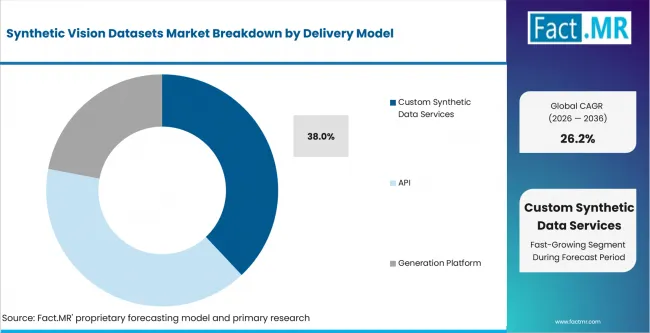
Synthetic Vision Datasets Market Analysis By Delivery Model | Source: Fact.MR
Custom services lead because most buyer requests are tied to a camera view or product surface. A reusable platform helps with speed. The paid service layer still matters when dataset realism must match one factory or one robot task.
Which buyer type dominates?
AI Teams hold 35.0% share in 2026.
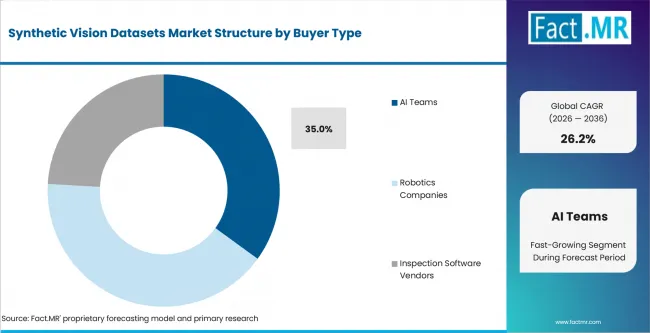
Synthetic Vision Datasets Market Analysis By Buyer Type | Source: Fact.MR
AI Teams lead buyer demand because model release cycles depend on training data quality. Procurement may sign the contract. Model owners still define the classes and validation thresholds. Some teams compare edge AI tuning kits when dataset work connects to model compression.
What is accelerating synthetic vision dataset adoption, and what is holding it back?
Rare defect coverage and robotics pre-trial training drive it, while synthetic-to-real gaps and unclear dataset ownership restrain it.
Drivers Impact Analysis
| DRIVER | (~) % IMPACT ON CAGR |
GEOGRAPHIC RELEVANCE | IMPACT TIMELINE |
|---|---|---|---|
| Rare defect coverage for inspection models | +5.8% | Global, strongest in manufacturing hubs | Short term (<= 2 years) |
| Robotics training before customer trials | +4.9% | South Korea, China, Japan, United States | Medium term (2-4 years) |
| Manual labeling workload reduction | +4.3% | Global, strongest in AI service markets | Short term (<= 2 years) |
| Edge camera model refresh cycles | +3.8% | United States, Germany, China, Japan | Medium term (2-4 years) |
| Private asset protection in dataset work | +3.2% | North America, Europe, East Asia | Long term (>= 4 years) |
Source: Fact.MR analysis. Updated Jul 2, 2026
- Rare defect coverage
- Inspection teams struggle to collect enough real images of uncommon faults. Synthetic datasets help them create controlled examples for each defect class. The National Institute of Standards and Technology invested USD 20 million in December 2025 to establish centers for AI in manufacturing and critical infrastructure. Public support for manufacturing AI reinforces the need for better training data.
- Robotics training before trials
- Robotics companies need image data before a robot enters a customer site. Synthetic scenes let teams test object views and occlusion cases in a safer setting. The same logic supports edge-AI inspection cells where retraining happens near the production line.
- Lower labeling load
- Manual labeling is slow when every image needs a box or mask. Synthetic generation creates labels at the same time as the image. This gives AI teams a cleaner starting point and lets human reviewers focus on validation.
Opportunity Impact Analysis
| OPPORTUNITY | (~) % IMPACT ON CAGR |
GEOGRAPHIC RELEVANCE | IMPACT TIMELINE |
|---|---|---|---|
| Factory-specific dataset packages | +5.4% | United States, Germany, Japan, South Korea | Medium term (2-4 years) |
| Robot pose and grasp datasets | +4.8% | China, South Korea, Japan, United States | Short term (<= 2 years) |
| Retail shelf and label datasets | +3.7% | United States, United Kingdom, China, India | Medium term (2-4 years) |
| Dataset refresh subscriptions | +3.5% | Global | Long term (>= 4 years) |
| Local compute-linked generation | +3.0% | India, United Kingdom, Europe, South Korea | Medium term (2-4 years) |
Source: Fact.MR analysis. Updated Jul 2, 2026
- Factory-specific packages
- Factory buyers do not need generic image libraries. They need scene logic that matches lighting and conveyor layouts. This opens a service opportunity for providers that can build datasets around one inspection cell. Fact.MR coverage of industrial vision gateways reflects the same push toward camera-side model use.
- Robot pose datasets
- Robot vision models need image sets that cover object tilt and hand position. Pose-rich synthetic data reduces trial time before real grasp testing. Providers can package these datasets around bin picking systems where object overlap creates hard perception cases.
- Edge camera refresh
- Edge cameras create a repeat buyer need because models change after deployment. A site may add a new package or fixture. Dataset providers can sell refresh services when camera views and object classes change.
Restraints Impact Analysis
| RESTRAINT | (~) % IMPACT ON CAGR |
GEOGRAPHIC RELEVANCE | IMPACT TIMELINE |
|---|---|---|---|
| Synthetic-to-real performance gap | -3.9% | Global, strongest in safety-critical uses | Medium term (2-4 years) |
| Unclear dataset ownership terms | -3.2% | North America, Europe, Japan | Short term (<= 2 years) |
| Shortage of validation skills | -2.8% | India, Latin America, parts of Europe | Medium term (2-4 years) |
| High scene-building effort | -2.4% | Global | Medium term (2-4 years) |
| Buyer hesitation on generated data | -2.1% | Global, strongest in conservative plants | Long term (>= 4 years) |
Source: Fact.MR analysis. Updated Jul 2, 2026
- Synthetic-to-real gap
- Synthetic images can fail when lighting or texture does not match real sites. Buyers therefore ask for validation against camera captures. Fact.MR coverage of 3D machine vision shows why depth and calibration remain important for industrial vision accuracy.
- Ownership terms
- Dataset ownership can slow deals when buyers train commercial models. They ask who owns the generated images and scene assets. Providers need clear terms for reuse and customer exclusivity.
- Validation skills
- Some buyers can train models but cannot judge synthetic image quality. This creates a gap between dataset volume and useful training value. Providers that include test results can reduce buyer hesitation.
Which countries are scaling synthetic vision datasets fastest?
South Korea 29.6%, China 29.1%, India 28.4%, United States 27.5%, Germany 25.9%, Japan 25.4%, United Kingdom 24.9%.
Based on regional analysis, the synthetic vision datasets market is segmented into East Asia, North America, South Asia and Pacific, Western Europe, Latin America, and Middle East and Africa.
| Country | CAGR |
|---|---|
| South Korea | 29.6% |
| China | 29.1% |
| India | 28.4% |
| United States | 27.5% |
| Germany | 25.9% |
| Japan | 25.4% |
| United Kingdom | 24.9% |
Source: Fact.MR analysis. Updated Jul 2, 2026
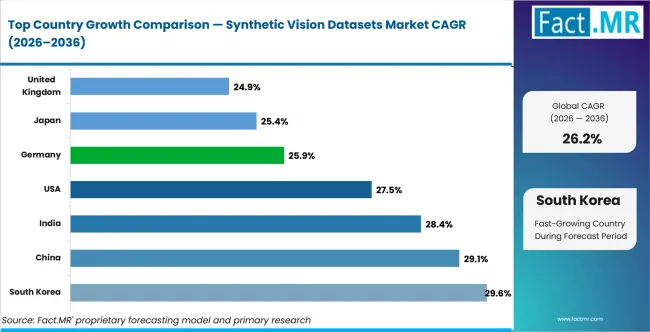
Synthetic Vision Datasets Market Cagr Analysis By Country | Source: Fact.MR
What is powering South Korea’s lead?
29.6% CAGR, supported by robotics policy and automation depth.
South Korea is using robotics policy to pull vision datasets into physical AI programs. The U.S. International Trade Administration said in August 2024 that the Fourth Intelligent Robot Basic Plan targets more than USD 2.24 billion in public and private investment by 2030. That policy gives local robot builders a reason to test synthetic scenes for grasping and navigation. Buyers in Seoul and Gyeonggi Province are expected to favor providers that combine synthetic images with robot-cell validation.
How is China scaling synthetic vision dataset demand?
29.1% CAGR, backed by robot installations and local inspection software demand.
China has the largest robot installed base and a fast AI software supplier pool. The International Federation of Robotics reported in September 2025 that China had 2.027 million industrial robots working in factories. This installed base creates many camera views and part-handling tasks that need labeled examples. Chinese buyers are expected to compare speed and localization before selecting providers.
Why is India an important growth market?
28.4% CAGR, supported by AI infrastructure funding and software delivery strength.
India is building AI infrastructure while many software teams serve global vision buyers. The Press Information Bureau reported in February 2026 that the IndiaAI Mission carries an outlay of Rs 10,372 crore. That public program supports compute access and AI ecosystem development. Dataset demand is expected to grow fastest in Bengaluru, Hyderabad and Pune.
What supports the United States outlook?
27.5% CAGR, driven by physical AI testing and industrial model validation.
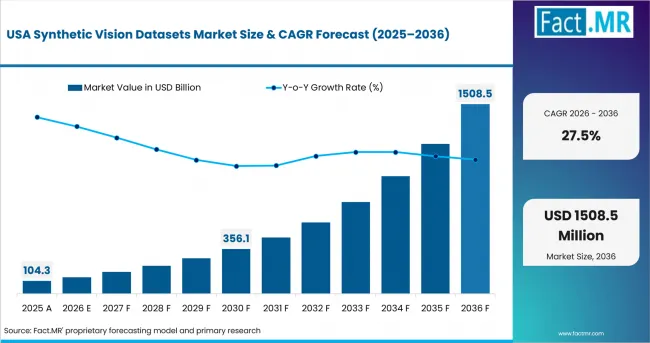
Synthetic Vision Datasets Market Country Value Analysis | Source: Fact.MR
United States buyers focus on measurable model improvement before adding new data suppliers. Industrial AI programs and robotics developers need datasets that shorten trial cycles. Suppliers that show synthetic-to-real lift in customer trials are better placed than image-volume vendors. The buyer priority is proof that generated scenes improve a real model.
What underpins Germany’s growth?
25.9% CAGR, supported by industrial quality systems and AI infrastructure plans.
Germany has a quality-led industrial buyer base and a strong automation supplier network. The European Commission committed EUR 20 billion for AI gigafactories in April 2025. That funding improves the broader compute setting for model training and synthetic data workflows. German buyers are expected to move carefully because inspection datasets must align with production tolerance and audit needs.
Why does Japan remain relevant?
25.4% CAGR, backed by camera expertise and factory robotics activity.
Japan combines camera expertise with a long history of factory robotics. The International Federation of Robotics stated in July 2025 that the Japanese automotive industry installed about 13,000 industrial robots in 2024. This supports demand for synthetic vision datasets in inspection and robot guidance. Buyers are expected to favor providers that document scene generation logic and validation results.
How is the United Kingdom building dataset demand?
24.9% CAGR, supported by AI compute zones and software-led buyers.
The United Kingdom is using AI infrastructure policy to support model development. The government stated in January 2026 that it had designated 5 AI Growth Zones. These zones can improve compute access for AI teams that need to generate and test visual datasets. The country is expected to post steadier growth than Asian robot hubs because buyer demand is more concentrated in software and service programs.
Who leads the synthetic vision datasets landscape?
NVIDIA leads through generation tools. Synthesis AI and Parallel Domain compete through scene realism and validation capability.
Synthetic vision datasets are supplied by platform firms, vision data specialists and simulation providers. NVIDIA supports physical AI workflows through Cosmos and Omniverse. Synthesis AI and Parallel Domain focus on controlled visual worlds for perception tasks. Rendered.ai and Anyverse strengthen coverage where buyers need sensor-specific synthetic imagery.
Gretel is not treated as a standalone competitor because NVIDIA acquired Gretel in 2025. MOSTLY AI is referenced through Syntho where privacy-safe synthetic data is relevant. Datagen is not listed as a current core competitor because its active status is unclear. Competition through 2036 is expected to depend on scene control, private asset handling and buyer validation access.
Providers that understand optics and field validation are better placed. Simulation specialists can win early robotics work if they show real-world transfer. Platform firms can win broader accounts when dataset generation connects with industrial robot components and physical AI development workflows.
Which companies are the key players?
NVIDIA leads the company list. Synthesis AI and Parallel Domain are included. Rendered.ai and Anyverse are included. Unity Software Inc. and AI Verse are included.
- NVIDIA
- Synthesis AI
- Parallel Domain
- Rendered.ai
- Anyverse
- Unity Software Inc.
- AI Verse
Bibliography
- International Federation of Robotics. (2025, September 25). World Robotics 2025 report: Industrial robots. International Federation of Robotics.
- NVIDIA Corporation. (2026, March 13). Scale synthetic data and physical AI reasoning with NVIDIA Cosmos world foundation models. NVIDIA Developer Blog.
- National Institute of Standards and Technology. (2025, December 22). NIST launches centers for AI in manufacturing and critical infrastructure. U.S. Department of Commerce.
- U.S. International Trade Administration. (2024, August 28). South Korea robotics industry. U.S. Department of Commerce.
- International Federation of Robotics. (2025, September 25). China tops world record of 2 million factory robots. International Federation of Robotics.
- Press Information Bureau. (2026, February 13). In less than 24 months, IndiaAI Mission has set up a foundation for development of AI ecosystem. Government of India.
- European Commission. (2025, April 9). AI continent action plan. European Commission.
- International Federation of Robotics. (2025, July 15). Japan’s car industry has highest robot installations in five years. International Federation of Robotics.
- Department for Science, Innovation and Technology. (2026, January 29). AI Opportunities Action Plan: One year on. Government of the United Kingdom.
This Report Addresses
- Strategic intelligence on synthetic vision datasets across dataset type, generation method and buyer type.
- Segment analysis covers Object Detection and Simulation-Rendered generation. It also covers Manufacturing Inspection and Custom Synthetic Data Services.
- Regional outlook covers South Korea and China. It also covers India and the United States. Germany, Japan and the United Kingdom are included.
- Competitive analysis covers NVIDIA and Synthesis AI. It also covers Parallel Domain and Rendered.ai. Anyverse, Unity Software Inc. and AI Verse are included.
- Service assessment covers dataset licenses and generation platforms. It also covers APIs and custom synthetic data services.
- Buyer assessment covers AI teams and robotics companies. It also covers inspection vendors and automotive suppliers.
- Primary interviews and provider checks support the forecast. Official source review and dataset workflow validation also support the forecast.
What does the synthetic vision datasets market cover?
Labeled synthetic image and video datasets for computer vision model training.
The synthetic vision datasets market covers artificial images and videos generated for model training. These datasets support object detection and segmentation. They also support defect detection, pose estimation and label recognition.
What is included in the scope?
Dataset generation and licensing are included. API access and custom synthetic data services are included.
The scope includes simulation-rendered images and generated scenes. It covers domain randomization and procedural scene creation. It includes dataset licenses and custom dataset services. It also includes APIs that let AI teams request new scenes or labels.
What is excluded from the scope?
General image labeling services without synthetic generation are excluded.
The scope excludes raw camera hardware and standard real-image annotation. It excludes general data lake services without vision dataset generation. It also excludes synthetic tabular data unless it is sold with a vision image dataset.
How was the analysis built?
100+ sources, 40+ company portfolios, 25+ countries, 20+ interviews.
- Primary Research: Primary research includes interviews with AI model owners and computer vision product teams. It also includes input from robotics integrators and industrial inspection software vendors.
- Desk Research: Desk research reviews robotics statistics and AI infrastructure programs. It covers company data products, simulation workflows and vision model training practices.
- Market-Sizing and Forecasting: Forecasting uses buyer counts and dataset generation spend. Dataset refresh frequency and use-case complexity support the market assessment.
- Data Validation and Update Cycle: Forecasts are validated through provider checks and buyer interviews. Company launches and public AI programs help confirm market direction.
Segmentation
What is the report’s scope and coverage?
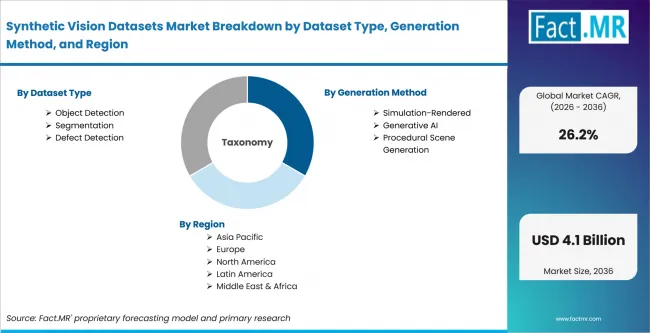
Synthetic Vision Datasets Market Breakdown By Dataset Type, Generation Method, And Region | Source: Fact.MR
| Attribute | Details |
|---|---|
| Quantitative Units | USD Billion in 2026 to USD Billion by 2036 at CAGR |
| Market Definition | Labeled synthetic image and video datasets for computer vision model training |
| Dataset Type | Object Detection, Segmentation, Defect Detection, Pose Estimation, OCR Label Recognition |
| Generation Method | Simulation-Rendered, Generative AI, Procedural Scene Generation, Domain Randomization |
| Application | Manufacturing Inspection, Robotics, Retail Analytics, Logistics, Urban Vision |
| Delivery Model | Dataset License, Generation Platform, API, Custom Synthetic Data Service |
| Buyer Type | AI Teams, Robotics Companies, Inspection Software Vendors, Automotive Suppliers |
| Regions Covered | East Asia, North America, South Asia and Pacific, Western Europe, Latin America, Middle East and Africa |
| Countries Covered | South Korea, China, India, United States, Germany, Japan, United Kingdom |
| Key Companies Profiled | NVIDIA, Synthesis AI, Parallel Domain, Rendered.ai, Anyverse, Unity Software Inc. and AI Verse |
| Forecast Period | 2026 to 2036 |
| Approach | Hybrid top-down and bottom-up approach using buyer counts, dataset spend, company portfolios and provider validation |
Source: Fact.MR analysis. Updated Jul 2, 2026
How is the market segmented?
-
By Dataset Type:
- Object Detection
- Segmentation
- Defect Detection
- Pose Estimation
- OCR Label Recognition
-
By Generation Method:
- Simulation-Rendered
- Generative AI
- Procedural Scene Generation
- Domain Randomization
-
By Application:
- Manufacturing Inspection
- Robotics
- Retail Analytics
- Logistics
- Urban Vision
-
By Delivery Model:
- Dataset License
- Generation Platform
- API
- Custom Synthetic Data Service
-
By Buyer Type:
- AI Teams
- Robotics Companies
- Inspection Software Vendors
- Automotive Suppliers
-
By Region:
- North America
- United States
- Canada
- Mexico
- Latin America
- Brazil
- Argentina
- Rest of Latin America
- Europe
- Germany
- United Kingdom
- France
- Italy
- Spain
- Rest of Europe
- Asia Pacific
- China
- India
- Japan
- South Korea
- ASEAN
- Middle East & Africa
- GCC Countries
- South Africa
- UAE
- Rest of Middle East & Africa
- North America
Frequently Asked Questions
Which dataset type leads the Synthetic Vision Datasets Market?
Which generation method leads the Synthetic Vision Datasets Market?
How does South Korea perform in the Synthetic Vision Datasets Market?
How does China perform in the Synthetic Vision Datasets Market?
How does India perform in the Synthetic Vision Datasets Market?
What is the primary driver in the Synthetic Vision Datasets Market?
What is the main restraint in the Synthetic Vision Datasets Market?
Why are custom services important in this market?
Who worked on this report


Preview the report firsthand - request a free sample
Free SampleGet the brochure for pricing and purchase details
Download PDF