Edge-AI Inspection Cells Market Size, Share, Growth and Forecast (2026 - 2036)
The Edge-AI Inspection Cells Market is segmented by Cell Type, by Processing Architecture, by Inspection Application, by End Use, by Deployment Model and Region. Forecast for 2026 to 2036.
What is the edge-AI inspection cells market forecast to be worth by 2036?
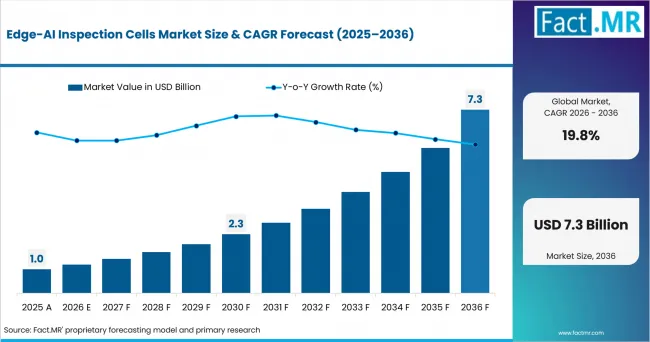
USD 1.2 billion in 2026 to USD 7.3 billion by 2036, at 19.8% CAGR.
- The edge-AI inspection cells market crossed a valuation of USD 0.95 billion in 2025. Demand is expected to increase from USD 1.2 billion in 2026 to USD 7.3 billion by 2036.
- The market is forecast to record 19.8% CAGR from 2026 to 2036 as manufacturers use local AI models to inspect parts in real time and reduce manual quality checks.
- Edge-AI inspection cells combine cameras, lighting, industrial PCs and AI models in a production-ready station. The category connects with edge computing because defect decisions are processed near the line instead of being routed through distant servers.
- The strongest adoption case comes from factories where inspection latency affects throughput.
What are the defining numbers behind edge-AI inspection cells market growth?
USD 6.1 billion absolute opportunity by 2036, led by the United States and Germany.
- Demand Drivers in the Market
- Quality engineers need defect decisions close to the production line.
- Plant automation heads need inspection stations that reduce manual review.
- Electronics manufacturers need local AI models for fine visual defects.
- Machine vision integrators need repeatable cells that shorten commissioning cycles.
- Key Segments Analyzed
- By Cell Type: Modular Camera-Based AI Inspection Cells are expected to hold 41.0% share in 2026 because they fit retrofit quality stations.
- By Processing Architecture: On-Cell Edge Inference leads because inspection decisions must stay close to the line. The share is projected at 44.0% in 2026.
- By Inspection Application: Surface Defect Inspection is likely to account for 36.0% share in 2026 because visual flaws are the first AI inspection use case.
- By End Use: Electronics and Semiconductor Assembly leads with 32.0% share in 2026 because small defects need high-resolution inspection.
- By Deployment Model: Hardware-Software Bundles are expected to hold 38.0% share in 2026 because factories prefer one validated cell package.
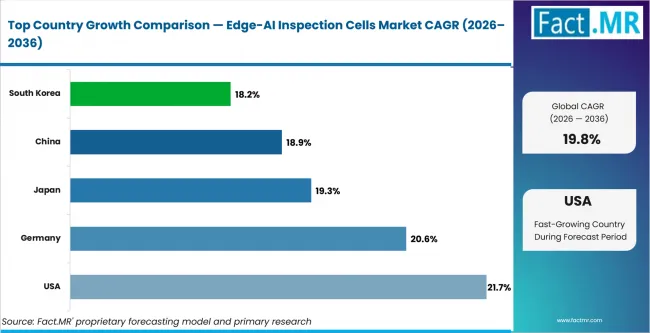
- By Geography: The United States is projected to record 21.7% CAGR through 2036 as AI hardware production raises quality-control intensity.
- Analyst Opinion at Fact.MR
- Shambhu Nath Jha, Senior Analyst at Fact.MR, states, “Edge-AI inspection cells are changing quality control from delayed review into line-side decision-making. We see manufacturers asking for AI that can be retrained near production. Providers that combine reliable cameras with deployable edge models will gain stronger access to factory modernization budgets.”
- Strategic Implications
- Vision suppliers should package cameras and edge inference as one cell.
- Manufacturers should choose inspection cells that support retraining after product changes.
- Integrators can build repeatable templates for surface inspection and assembly verification.
- Edge hardware providers should prioritize thermal reliability for factory floors.
Siemens and NVIDIA expanded their manufacturing AI partnership in 2025. Siemens stated that GPU-certified industrial PCs can support AI-based robotics and quality inspection with 25x acceleration in AI execution. [2] This shows why edge infrastructure is becoming part of inspection cell design. ABB announced a 2025 collaboration with LandingAI to bring vision AI into robotic applications. ABB stated that no-code tools can reduce training and deployment time by up to 80%. [3] This supports the shift toward inspection cells that operators can retrain after product changes.
The United States is projected to record 21.7% CAGR through 2036 as electronics and data center hardware manufacturers use AI inspection at the line. Germany is expected to post 20.6% CAGR through 2036 as automotive plants use edge computing for visual quality. Japan is likely to record 19.3% CAGR as precision manufacturing favors local inspection logic. China is forecast to advance at 18.9% CAGR as electronics lines automate defect review. South Korea is set to record 18.2% CAGR as display and semiconductor assembly sites adopt fast visual inspection.
How does the edge-AI inspection cells market break down by segment?
Modular Camera-Based AI Inspection Cells lead at 41.0%; On-Cell Edge Inference leads at 44.0%.
Which cell type dominates?
Modular Camera-Based AI Inspection Cells hold 41.0% share in 2026.
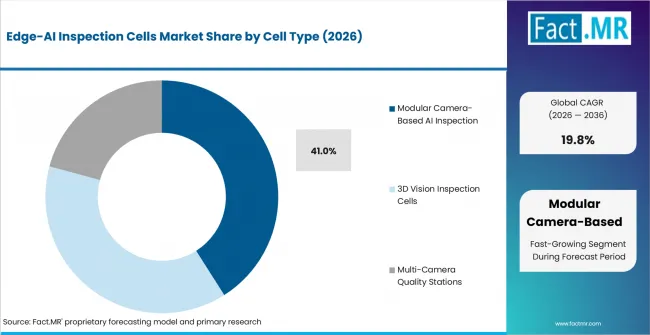
Modular Camera-Based AI Inspection Cells are expected to hold 41.0% share in 2026 because factories can add them to existing lines with limited redesign. The format works well for surface checks and assembly verification. Operators can place these cells near high-risk quality gates. The segment connects with smart camera adoption because cameras increasingly include AI-ready processing and industrial connectivity.
Which processing architecture dominates?
On-Cell Edge Inference holds 44.0% share in 2026.
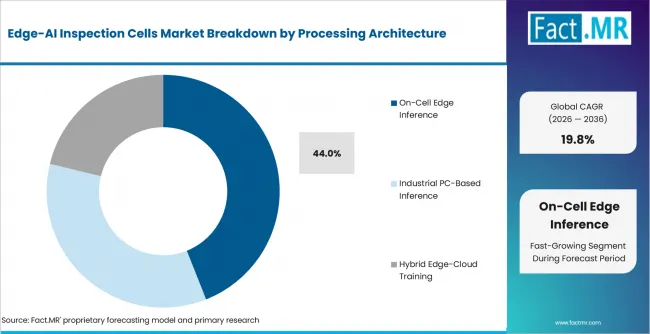
On-Cell Edge Inference leads because inspection decisions need to occur during line movement. The architecture is projected to capture 44.0% share in 2026. Local inference reduces delay and lowers dependence on plant network stability. Siemens stated in 2026 that industrial edge infrastructure can host production-critical AI applications directly at the edge. [4] This supports factory use cases such as image-based quality control.
Which inspection application dominates?
Surface Defect Inspection holds 36.0% share in 2026.
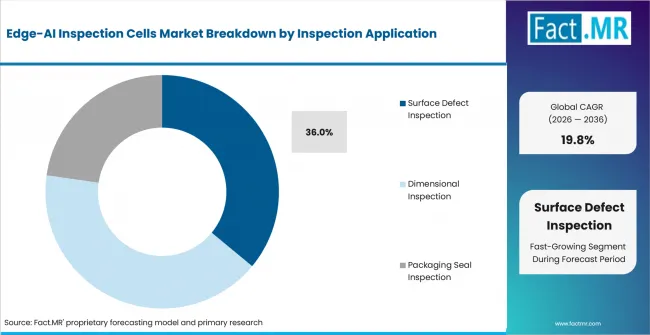
Surface Defect Inspection leads because scratches and coating flaws are hard to manage with rule-only vision. The application is likely to account for 36.0% share in 2026. AI models can learn variation from accepted and rejected samples. LMI Technologies’ 2026 AI-powered vision inspection session highlighted AI and 3D scanning for difficult inspection challenges. [5] The application connects with video as a sensor where camera streams become production intelligence.
Which end use dominates?
Electronics and Semiconductor Assembly holds 32.0% share in 2026.
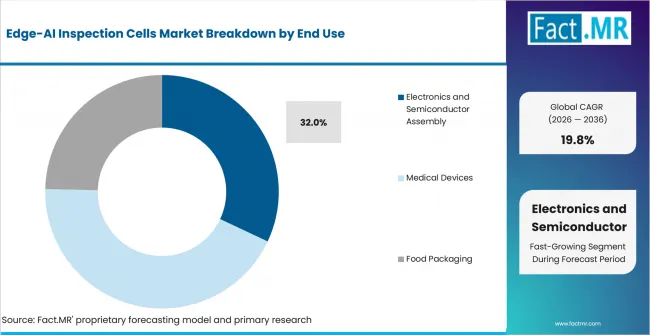
Electronics and Semiconductor Assembly leads because small defects can create expensive downstream failures. The end use is expected to hold 32.0% share in 2026. Edge-AI cells inspect connectors, boards and precision assemblies without waiting for remote processing. The end use connects with consumer electronics manufacturing because product complexity increases visual quality risk.
Which deployment model dominates?
Hardware-Software Bundles hold 38.0% share in 2026.
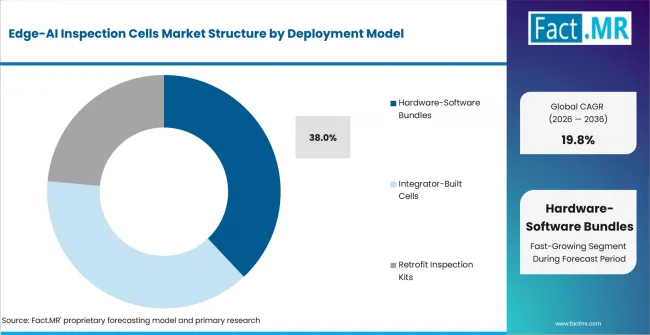
Hardware-Software Bundles lead because factories want a validated cell rather than separate cameras and AI tools. The model is expected to hold 38.0% share in 2026. Bundles reduce vendor coordination and simplify support. Zebra Technologies stated in 2025 that its machine vision system supported full-coverage injection molding inspection for Sentinel Vision. [6] This supports the case for integrated inspection packages.
What is accelerating edge-AI inspection cells demand, and what is holding it back?
Line-side quality decisions drive demand; model maintenance restrains rollout.
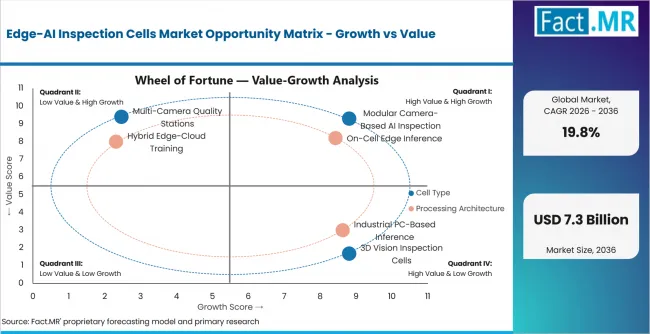
Line-side quality decisions are the main driver. Manufacturers want defect detection before parts move into later process steps. Edge inference helps quality teams act during production instead of reviewing issues after a batch is complete. AI model setup is becoming easier. Cognex stated in 2025 that OneVision uses guided workflows to help teams build and scale AI-powered vision applications. [1] This reduces the barrier for factories that lack large AI teams. Industrial edge infrastructure adds another driver.
Robot-linked inspection is another opportunity. The industrial robotics link matters because robot-mounted cameras can inspect complex parts from multiple angles. AI inspection cells can also connect with factory robot systems when robots present parts to the vision station.
The main restraint is model maintenance. AI inspection cells need updated training data when materials or lighting change. Factories also need clear ownership for false rejects and missed defects.
Where do the biggest edge-AI inspection cell opportunities sit?
Surface inspection, assembly verification and high-speed packaging checks.
- Surface Inspection: Manufacturers can detect scratches and coating flaws close to the line.
- Assembly Verification: Electronics plants can check connectors and board placement before test failure.
- Packaging Checks: Food and medical device plants can verify labels and seal appearance at speed.
Which countries are scaling edge-AI inspection cells fastest?
United States 21.7%, Germany 20.6%, Japan 19.3%, China 18.9%, South Korea 18.2%.
Based on regional analysis, the edge-AI inspection cells market is segmented into North America, Western Europe, Asia Pacific, Latin America, and Middle East and Africa.
.webp)
| Country | CAGR |
|---|---|
| United States | 21.7% |
| Germany | 20.6% |
| Japan | 19.3% |
| China | 18.9% |
| South Korea | 18.2% |

What is powering the United States lead?
21.7% CAGR, driven by Cognex and AI hardware manufacturing.
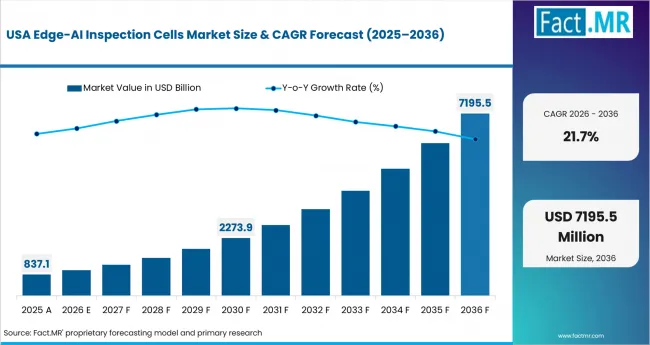
The United States is projected to record 21.7% CAGR by 2036 as electronics and data center hardware production increases visual quality pressure. Cognex supports AI-powered machine vision development through OneVision. Manufacturers need edge inspection cells for connector checks and assembly verification. Growth will favor providers with strong factory support.
How is Germany scaling edge-AI inspection cell demand?
20.6% CAGR, supported by Siemens and automotive quality programs.
Germany is expected to post 20.6% CAGR through 2036 as automotive and machinery plants use edge AI for quality control. Siemens’ industrial edge infrastructure supports local AI deployment in factories. German manufacturers need inspection cells that work with established automation systems. Growth will favor validated IT/OT platforms.
What supports Japan’s outlook?
19.3% CAGR, driven by precision manufacturing and camera-led inspection.
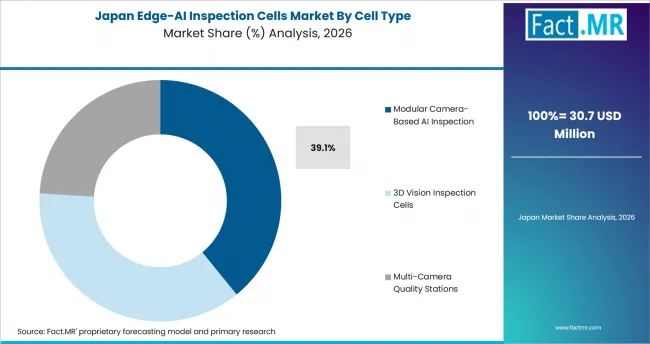
Japan is likely to record 19.3% CAGR from 2026 to 2036 as precision manufacturers adopt camera-led inspection cells. Electronics and automotive suppliers need stable line-side quality. AI inspection supports defect detection where manual review is slow. Growth will favor compact systems that fit dense production floors.
What underpins China’s growth?
18.9% CAGR, led by electronics production and AI-enabled factory upgrades.
China is forecast to advance at 18.9% CAGR through 2036 as electronics manufacturers automate visual checks on fast lines. Factory teams need inspection systems that can adapt to frequent product refreshes. Edge-AI cells reduce dependence on remote processing. Growth will favor cost-effective systems with local service coverage.
How is South Korea scaling edge-AI inspection cell adoption?
18.2% CAGR, backed by display production and semiconductor assembly.
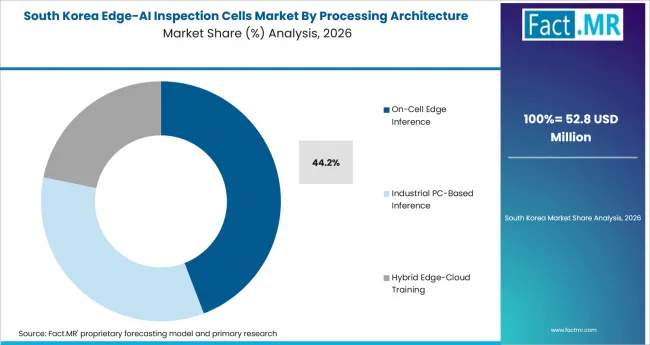
South Korea is set to record 18.2% CAGR by 2036 as display and semiconductor plants increase visual inspection automation. Defect detection needs to happen before high-value parts move downstream. Edge inference supports fast quality decisions. Growth will favor high-resolution vision systems with robust plant connectivity.
Who leads the edge-AI inspection cells market?
Cognex and Siemens lead through AI vision software and industrial edge infrastructure.
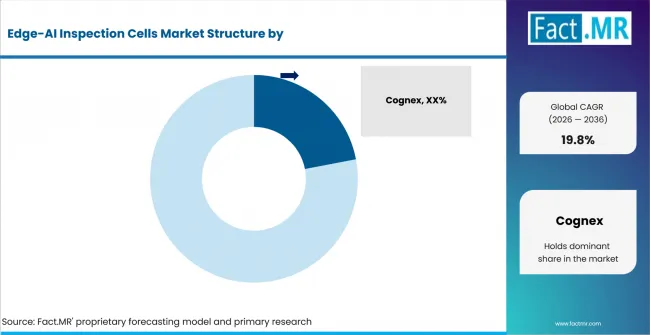
Edge-AI inspection cells are supplied by machine vision providers, industrial automation firms and AI inspection specialists. Cognex leads through AI-powered machine vision tools and factory-grade vision systems. Siemens supports edge infrastructure for production-critical AI and quality inspection.
ABB and LandingAI support vision AI for robotic applications and no-code training. Zebra Technologies competes through machine vision systems for industrial inspection. LMI Technologies supports 3D and AI-powered vision inspection. Instrumental is relevant for AI-based electronics inspection and factory quality data.
Competition through 2036 will depend on inspection accuracy and deployment speed. Providers need reliable cameras, stable edge compute and clear model update workflows. The factory floor edge layer will shape cell performance where AI inference runs near the line. The industrial automation layer matters because inspection cells must connect with PLCs and reject mechanisms.
Which companies are the key providers?
Cognex and Siemens are key providers. ABB and Zebra Technologies are also profiled. LMI Technologies and Instrumental complete the company set.
- Cognex
- Siemens
- ABB
- Zebra Technologies
- LMI Technologies
- Instrumental
Bibliography
- [1] Cognex Corporation. (2025, June 10). Cognex introduces OneVision: A breakthrough cloud platform for AI-powered machine vision. Cognex Corporation.
- [2] Siemens. (2025, June 11). Siemens and NVIDIA expand partnership to accelerate AI capabilities in manufacturing. Siemens.
- [3] ABB. (2025, September 17). ABB and LandingAI unleash the power of generative AI for robotic vision. ABB.
- [4] Siemens. (2026, April 13). AI-ready at the edge: Siemens Industrial Automation DataCenter with accelerated AI computing power and advanced cybersecurity. Siemens.
- [5] LMI Technologies. (2026, February 19). AI-powered vision inspection: The future of quality in manufacturing. LMI Technologies.
- [6] Zebra Technologies. (2025). Sentinel Vision improves injection molding inspection with Zebra Technologies machine vision. Zebra Technologies.
This Report Addresses
- Strategic intelligence on edge-AI inspection cells across cell type and processing architecture.
- Segment analysis covering Modular Camera-Based AI Inspection Cells and On-Cell Edge Inference.
- Regional outlook covering the United States, Germany, Japan, China and South Korea.
- Competitive analysis of Cognex, Siemens, ABB, Zebra Technologies, LMI Technologies and Instrumental.
- Technology assessment covering edge inference, smart cameras, 3D vision and AI model retraining.
- Use case assessment covering surface inspection, assembly verification and packaging checks.
- Primary interviews, provider checks and official source review support the forecast.
What does the edge-AI inspection cells market cover?
Inspection stations that run AI inference close to the production line.
The edge-AI inspection cells market covers integrated stations used to detect surface flaws, assembly errors and dimensional issues. It includes cameras and pass/fail interfaces. The scope connects with edge analytics because manufacturers need local decisions from visual data.
The market differs from ordinary machine vision because inspection logic can learn from examples rather than fixed rules alone. Edge processing matters because high-speed production lines cannot wait for remote model calls. The cell must support stable factory operation and fast operator response.
What is included in the scope?
Camera-based AI cells and edge inference stations.
The scope includes 2D AI inspection cells and multi-camera quality stations. It includes 3D machine vision when depth data is processed locally for defect detection. It covers training software and deployment tools when they are sold with the inspection cell.
The scope includes cells used for electronics, automotive parts, packaging lines and medical device assembly. It covers fixed inspection stations and robot-mounted vision cells. It also includes edge servers when they support production-critical quality inspection.
What is excluded from the scope?
Cloud-only inspection software without factory cell integration.
The scope excludes pure cloud annotation tools that do not connect with line equipment. It excludes ordinary cameras used only for monitoring. It excludes manual inspection benches with no AI inference. It also excludes general plant analytics software unless it controls a visual inspection decision.
How was the analysis built?
100+ sources, 40+ company portfolios, 25+ countries, 20+ interviews.
- Primary Research:
- Primary research includes interviews with quality engineers and plant automation heads. It includes input from machine vision integrators and industrial AI software teams.
- Desk Research:
- Desk research reviews official AI vision launches and factory edge computing references. It covers smart cameras and robot vision systems used in inspection.
- Market-Sizing and Forecasting:
- Forecasting uses inspection cell deployment activity and factory vision upgrade cycles. Model training workflow adoption and edge hardware attachment support the market assessment.
- Data Validation and Update Cycle:
- Forecasts are validated through provider checks and integrator feedback. Product launches and industrial AI platform updates help confirm market direction.
What is the report’s scope and coverage?
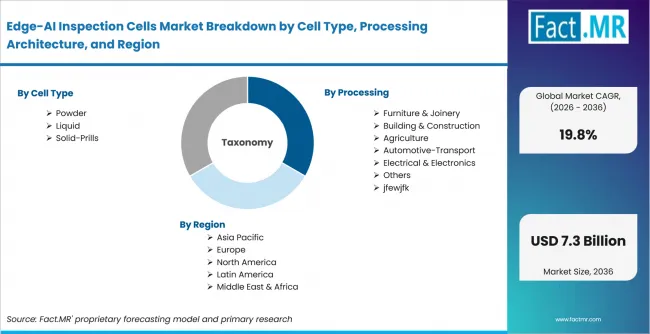
| Attribute | Details |
|---|---|
| Quantitative Units | USD Billion in 2026 to USD Billion by 2036 at CAGR |
| Market Definition | Integrated inspection cells that run AI inference close to the production line |
| Cell Type | Modular Camera-Based AI Inspection Cells; Robot-Guided Inspection Cells; 3D Vision Inspection Cells; Multi-Camera Quality Stations; Inline Edge-AI Inspection Tunnels |
| Processing Architecture | On-Cell Edge Inference; Industrial PC-Based Inference; Smart Camera Inference; Hybrid Edge-Cloud Training; Edge Server Deployment |
| Inspection Application | Surface Defect Inspection; Assembly Verification; Dimensional Inspection; Label and Code Inspection; Packaging Seal Inspection |
| End Use | Electronics and Semiconductor Assembly; Automotive Components; Medical Devices; Food Packaging; Industrial Equipment |
| Deployment Model | Hardware-Software Bundles; Integrator-Built Cells; Vendor-Managed Deployment; Retrofit Inspection Kits; Subscription-Based AI Models |
| Regions Covered | North America; Western Europe; Asia Pacific; Latin America; Middle East and Africa |
| Countries Covered | United States; Germany; Japan; China; South Korea |
| Key Companies Profiled | Cognex; Siemens; ABB; Zebra Technologies; LMI Technologies; Instrumental |
| Forecast Period | 2026 to 2036 |
| Approach | Hybrid top-down and bottom-up approach using inspection cell deployments, edge compute adoption, AI vision launches and provider validation |
How is the market segmented?
-
By Cell Type:
- Modular Camera-Based AI Inspection Cells
- Robot-Guided Inspection Cells
- 3D Vision Inspection Cells
- Multi-Camera Quality Stations
- Inline Edge-AI Inspection Tunnels
-
By Processing Architecture:
- On-Cell Edge Inference
- Industrial PC-Based Inference
- Smart Camera Inference
- Hybrid Edge-Cloud Training
- Edge Server Deployment
-
By Inspection Application:
- Surface Defect Inspection
- Assembly Verification
- Dimensional Inspection
- Label and Code Inspection
- Packaging Seal Inspection
-
By End Use:
- Electronics and Semiconductor Assembly
- Automotive Components
- Medical Devices
- Food Packaging
- Industrial Equipment
-
By Deployment Model:
- Hardware-Software Bundles
- Integrator-Built Cells
- Vendor-Managed Deployment
- Retrofit Inspection Kits
- Subscription-Based AI Models
-
Region:
- North America
- United States
- Canada
- Europe
- Germany
- United Kingdom
- France
- Italy
- Netherlands
- Asia Pacific
- Japan
- China
- South Korea
- Singapore
- India
- Latin America
- Brazil
- Mexico
- Chile
- Middle East & Africa
- UAE
- Saudi Arabia
- South Africa
- Israel
- North America
- Frequently Asked Questions -
Which cell type leads the Edge-AI Inspection Cells Market?
Modular Camera-Based AI Inspection Cells lead with 41.0% share in 2026 because they fit retrofit quality stations.
Which processing architecture leads the Edge-AI Inspection Cells Market?
On-Cell Edge Inference holds 44.0% share in 2026 because inspection decisions must stay close to the line.
Which inspection application leads the Edge-AI Inspection Cells Market?
Surface Defect Inspection holds 36.0% share in 2026 because visual flaws are the first AI inspection use case.
Which end use leads the Edge-AI Inspection Cells Market?
Electronics and Semiconductor Assembly holds 32.0% share in 2026 because small defects need high-resolution inspection.
Which deployment model leads the Edge-AI Inspection Cells Market?
Hardware-Software Bundles hold 38.0% share in 2026 because factories prefer one validated cell package.
Which country expands fastest in the Edge-AI Inspection Cells Market?
The United States is projected to record 21.7% CAGR through 2036 as AI hardware production raises quality-control intensity.
How does Germany perform in the Edge-AI Inspection Cells Market?
Germany is expected to post 20.6% CAGR through 2036 as automotive plants use edge AI for visual quality.
How does Japan perform in the Edge-AI Inspection Cells Market?
Japan is likely to record 19.3% CAGR through 2036 as precision manufacturing favors local inspection logic.
How does China perform in the Edge-AI Inspection Cells Market?
China is forecast to advance at 18.9% CAGR through 2036 as electronics lines automate defect review.
How does South Korea perform in the Edge-AI Inspection Cells Market?
South Korea is set to record 18.2% CAGR through 2036 as display and semiconductor assembly sites adopt fast visual inspection.
What is the primary driver in the Edge-AI Inspection Cells Market?
The primary driver is line-side quality decision-making because manufacturers need defect detection before downstream process steps.
What is the main restraint in the Edge-AI Inspection Cells Market?
The main restraint is model maintenance because AI inspection cells need updated training data after process changes.
Why is on-cell edge inference important?
On-cell edge inference is important because high-speed lines need inspection decisions without cloud delay.
Why are modular camera-based cells important?
Modular camera-based cells are important because factories can add them to existing lines with limited redesign.
Table of Content
- Key Takeaways
- Market Size and CAGR
- Top Growth Driver
- Fastest Growing Segment
- Leading Region
- Key Companies
- Emerging Opportunities
- Executive Summary
- Global Market Outlook
- Demand-side Trends
- Supply-side Trends
- Technology Roadmap Analysis
- Analysis and Recommendations
- Analyst Perspective (What is happening? Why now? What should investors know?)
- Key Questions Answered
- How large is the market?
- What is the CAGR?
- What are key trends?
- Which region dominates?
- Who are the leaders?
- Market Overview
- Market Coverage / Taxonomy
- Market Definition / Scope / Limitations
- Research Methodology
- Chapter Orientation
- Analytical Lens and Working Hypotheses
- Market Structure, Signals, and Trend Drivers
- Benchmarking and Cross-market Comparability
- Market Sizing, Forecasting, and Opportunity Mapping
- Research Design and Evidence Framework
- Desk Research Programme (Secondary Evidence)
- Expert Input and Fieldwork (Primary Evidence)
- Tooling, Models, and Reference Databases
- Data Engineering and Model Build
- Quality Assurance and Audit Trail
- Market Background
- Market Dynamics (Drivers, Restraints, Opportunity, Trends)
- Scenario Forecast (Optimistic, Likely, Conservative)
- Impact Analysis
- AI Impact
- Sustainability Impact
- Regulatory Impact
- Technology Impact
- Consumer / Buyer Analysis
- Purchase Drivers
- Adoption Barriers
- Buyer Journey
- Opportunity Map Analysis
- Product Life Cycle Analysis
- Supply Chain Analysis
- Investment Feasibility Matrix
- Value Chain Analysis
- PESTLE and Porter's Analysis
- Regulatory Landscape
- Regional Parent Market Outlook
- Production and Consumption Statistics
- Import and Export Statistics
- Global Market Analysis and Forecast, 2021 to 2036
- Historical Market Size Value (USD Billion) Analysis, 2021 to 2025
- Current and Future Market Size Value (USD Billion) Projections, 2026 to 2036
- Y-o-Y Growth Trend Analysis
- Absolute $ Opportunity Analysis
- Global Market Pricing Analysis, 2021 to 2036
- Global Market Analysis and Forecast, By Cell Type, 2021 to 2036
- Introduction / Key Findings
- Historical Market Size Value (USD Billion) Analysis By Cell Type, 2021 to 2025
- Current and Future Market Size Value (USD Billion) Analysis and Forecast By Cell Type, 2026 to 2036
- Modular Camera-Based AI Inspection
- 3D Vision Inspection Cells
- Multi-Camera Quality Stations
- Y-o-Y Growth Trend Analysis By Cell Type, 2021 to 2025
- Absolute $ Opportunity Analysis By Cell Type, 2026 to 2036
- Global Market Analysis and Forecast, By Processing Architecture, 2021 to 2036
- Introduction / Key Findings
- Historical Market Size Value (USD Billion) Analysis By Processing Architecture, 2021 to 2025
- Current and Future Market Size Value (USD Billion) Analysis and Forecast By Processing Architecture, 2026 to 2036
- On-Cell Edge Inference
- Industrial PC-Based Inference
- Hybrid Edge-Cloud Training
- Y-o-Y Growth Trend Analysis By Processing Architecture, 2021 to 2025
- Absolute $ Opportunity Analysis By Processing Architecture, 2026 to 2036
- Global Market Analysis and Forecast, By Inspection Application, 2021 to 2036
- Introduction / Key Findings
- Historical Market Size Value (USD Billion) Analysis By Inspection Application, 2021 to 2025
- Current and Future Market Size Value (USD Billion) Analysis and Forecast By Inspection Application, 2026 to 2036
- Surface Defect Inspection
- Dimensional Inspection
- Packaging Seal Inspection
- Y-o-Y Growth Trend Analysis By Inspection Application, 2021 to 2025
- Absolute $ Opportunity Analysis By Inspection Application, 2026 to 2036
- Global Market Analysis and Forecast, By End Use, 2021 to 2036
- Introduction / Key Findings
- Historical Market Size Value (USD Billion) Analysis By End Use, 2021 to 2025
- Current and Future Market Size Value (USD Billion) Analysis and Forecast By End Use, 2026 to 2036
- Electronics and Semiconductor Assembly
- Medical Devices
- Food Packaging
- Y-o-Y Growth Trend Analysis By End Use, 2021 to 2025
- Absolute $ Opportunity Analysis By End Use, 2026 to 2036
- Global Market Analysis and Forecast, By Deployment Model, 2021 to 2036
- Introduction / Key Findings
- Historical Market Size Value (USD Billion) Analysis By Deployment Model, 2021 to 2025
- Current and Future Market Size Value (USD Billion) Analysis and Forecast By Deployment Model, 2026 to 2036
- Hardware-Software Bundles
- Integrator-Built Cells
- Retrofit Inspection Kits
- Y-o-Y Growth Trend Analysis By Deployment Model, 2021 to 2025
- Absolute $ Opportunity Analysis By Deployment Model, 2026 to 2036
- Global Market Analysis and Forecast, By Region, 2021 to 2036
- Introduction
- Historical Market Size Value (USD Billion) Analysis By Region, 2021 to 2025
- Current Market Size Value (USD Billion) Analysis and Forecast By Region, 2026 to 2036
- North America
- Latin America
- Western Europe
- Eastern Europe
- East Asia
- South Asia and Pacific
- Middle East & Africa
- Market Attractiveness Analysis By Region
- North America Market Analysis and Forecast, By Country, 2021 to 2036
- Historical Market Size Value (USD Billion) Trend Analysis By Market Taxonomy, 2021 to 2025
- Market Size Value (USD Billion) Forecast By Market Taxonomy, 2026 to 2036
- By Country
- USA
- Canada
- Mexico
- By Cell Type
- By Processing Architecture
- By Inspection Application
- By End Use
- By Deployment Model
- By Country
- Market Attractiveness Analysis
- By Country
- By Cell Type
- By Processing Architecture
- By Inspection Application
- By End Use
- By Deployment Model
- Key Takeaways
- Latin America Market Analysis and Forecast, By Country
- Historical Market Size Value (USD Billion) Trend Analysis By Market Taxonomy, 2021 to 2025
- Market Size Value (USD Billion) Forecast By Market Taxonomy, 2026 to 2036
- By Country
- Brazil
- Chile
- Rest of Latin America
- By Cell Type
- By Processing Architecture
- By Inspection Application
- By End Use
- By Deployment Model
- By Country
- Market Attractiveness Analysis
- By Country
- By Cell Type
- By Processing Architecture
- By Inspection Application
- By End Use
- By Deployment Model
- Key Takeaways
- Western Europe Market Analysis and Forecast, By Country
- Historical Market Size Value (USD Billion) Trend Analysis By Market Taxonomy, 2021 to 2025
- Market Size Value (USD Billion) Forecast By Market Taxonomy, 2026 to 2036
- By Country
- Germany
- UK
- Italy
- Spain
- France
- Nordic
- BENELUX
- Rest of Western Europe
- By Cell Type
- By Processing Architecture
- By Inspection Application
- By End Use
- By Deployment Model
- By Country
- Market Attractiveness Analysis
- By Country
- By Cell Type
- By Processing Architecture
- By Inspection Application
- By End Use
- By Deployment Model
- Key Takeaways
- Eastern Europe Market Analysis and Forecast, By Country
- Historical Market Size Value (USD Billion) Trend Analysis By Market Taxonomy, 2021 to 2025
- Market Size Value (USD Billion) Forecast By Market Taxonomy, 2026 to 2036
- By Country
- Russia
- Poland
- Hungary
- Balkan & Baltic
- Rest of Eastern Europe
- By Cell Type
- By Processing Architecture
- By Inspection Application
- By End Use
- By Deployment Model
- By Country
- Market Attractiveness Analysis
- By Country
- By Cell Type
- By Processing Architecture
- By Inspection Application
- By End Use
- By Deployment Model
- Key Takeaways
- East Asia Market Analysis and Forecast, By Country
- Historical Market Size Value (USD Billion) Trend Analysis By Market Taxonomy, 2021 to 2025
- Market Size Value (USD Billion) Forecast By Market Taxonomy, 2026 to 2036
- By Country
- China
- Japan
- South Korea
- By Cell Type
- By Processing Architecture
- By Inspection Application
- By End Use
- By Deployment Model
- By Country
- Market Attractiveness Analysis
- By Country
- By Cell Type
- By Processing Architecture
- By Inspection Application
- By End Use
- By Deployment Model
- Key Takeaways
- South Asia and Pacific Market Analysis and Forecast, By Country
- Historical Market Size Value (USD Billion) Trend Analysis By Market Taxonomy, 2021 to 2025
- Market Size Value (USD Billion) Forecast By Market Taxonomy, 2026 to 2036
- By Country
- India
- ASEAN
- Australia & New Zealand
- Rest of South Asia and Pacific
- By Cell Type
- By Processing Architecture
- By Inspection Application
- By End Use
- By Deployment Model
- By Country
- Market Attractiveness Analysis
- By Country
- By Cell Type
- By Processing Architecture
- By Inspection Application
- By End Use
- By Deployment Model
- Key Takeaways
- Middle East & Africa Market Analysis and Forecast, By Country
- Historical Market Size Value (USD Billion) Trend Analysis By Market Taxonomy, 2021 to 2025
- Market Size Value (USD Billion) Forecast By Market Taxonomy, 2026 to 2036
- By Country
- Kingdom of Saudi Arabia
- Other GCC Countries
- Turkiye
- South Africa
- Other African Union
- Rest of Middle East & Africa
- By Cell Type
- By Processing Architecture
- By Inspection Application
- By End Use
- By Deployment Model
- By Country
- Market Attractiveness Analysis
- By Country
- By Cell Type
- By Processing Architecture
- By Inspection Application
- By End Use
- By Deployment Model
- Key Takeaways
- Key Countries Market Analysis
- USA
- Pricing Analysis
- Market Share Analysis, 2025
- By Cell Type
- By Processing Architecture
- By Inspection Application
- By End Use
- By Deployment Model
- Canada
- Pricing Analysis
- Market Share Analysis, 2025
- By Cell Type
- By Processing Architecture
- By Inspection Application
- By End Use
- By Deployment Model
- Mexico
- Pricing Analysis
- Market Share Analysis, 2025
- By Cell Type
- By Processing Architecture
- By Inspection Application
- By End Use
- By Deployment Model
- Brazil
- Pricing Analysis
- Market Share Analysis, 2025
- By Cell Type
- By Processing Architecture
- By Inspection Application
- By End Use
- By Deployment Model
- Chile
- Pricing Analysis
- Market Share Analysis, 2025
- By Cell Type
- By Processing Architecture
- By Inspection Application
- By End Use
- By Deployment Model
- Germany
- Pricing Analysis
- Market Share Analysis, 2025
- By Cell Type
- By Processing Architecture
- By Inspection Application
- By End Use
- By Deployment Model
- UK
- Pricing Analysis
- Market Share Analysis, 2025
- By Cell Type
- By Processing Architecture
- By Inspection Application
- By End Use
- By Deployment Model
- Italy
- Pricing Analysis
- Market Share Analysis, 2025
- By Cell Type
- By Processing Architecture
- By Inspection Application
- By End Use
- By Deployment Model
- Spain
- Pricing Analysis
- Market Share Analysis, 2025
- By Cell Type
- By Processing Architecture
- By Inspection Application
- By End Use
- By Deployment Model
- France
- Pricing Analysis
- Market Share Analysis, 2025
- By Cell Type
- By Processing Architecture
- By Inspection Application
- By End Use
- By Deployment Model
- India
- Pricing Analysis
- Market Share Analysis, 2025
- By Cell Type
- By Processing Architecture
- By Inspection Application
- By End Use
- By Deployment Model
- ASEAN
- Pricing Analysis
- Market Share Analysis, 2025
- By Cell Type
- By Processing Architecture
- By Inspection Application
- By End Use
- By Deployment Model
- Australia & New Zealand
- Pricing Analysis
- Market Share Analysis, 2025
- By Cell Type
- By Processing Architecture
- By Inspection Application
- By End Use
- By Deployment Model
- China
- Pricing Analysis
- Market Share Analysis, 2025
- By Cell Type
- By Processing Architecture
- By Inspection Application
- By End Use
- By Deployment Model
- Japan
- Pricing Analysis
- Market Share Analysis, 2025
- By Cell Type
- By Processing Architecture
- By Inspection Application
- By End Use
- By Deployment Model
- South Korea
- Pricing Analysis
- Market Share Analysis, 2025
- By Cell Type
- By Processing Architecture
- By Inspection Application
- By End Use
- By Deployment Model
- Russia
- Pricing Analysis
- Market Share Analysis, 2025
- By Cell Type
- By Processing Architecture
- By Inspection Application
- By End Use
- By Deployment Model
- Poland
- Pricing Analysis
- Market Share Analysis, 2025
- By Cell Type
- By Processing Architecture
- By Inspection Application
- By End Use
- By Deployment Model
- Hungary
- Pricing Analysis
- Market Share Analysis, 2025
- By Cell Type
- By Processing Architecture
- By Inspection Application
- By End Use
- By Deployment Model
- Kingdom of Saudi Arabia
- Pricing Analysis
- Market Share Analysis, 2025
- By Cell Type
- By Processing Architecture
- By Inspection Application
- By End Use
- By Deployment Model
- Turkiye
- Pricing Analysis
- Market Share Analysis, 2025
- By Cell Type
- By Processing Architecture
- By Inspection Application
- By End Use
- By Deployment Model
- South Africa
- Pricing Analysis
- Market Share Analysis, 2025
- By Cell Type
- By Processing Architecture
- By Inspection Application
- By End Use
- By Deployment Model
- USA
- Market Structure Analysis
- Competition Dashboard
- Competition Benchmarking
- Market Share Analysis of Top Players
- By Regional
- By Cell Type
- By Processing Architecture
- By Inspection Application
- By End Use
- By Deployment Model
- Emerging Startups
- Innovation Benchmarking
- Competition Analysis
- Competition Deep Dive
- Cognex
- Overview
- Product Portfolio
- Profitability by Market Segments (Product/Age /Sales Channel/Region)
- Sales Footprint
- Strategy Overview
- Marketing Strategy
- Product Strategy
- Channel Strategy
- Siemens
- ABB
- Zebra Technologies
- LMI Technologies
- Instrumental
- Cognex
- Competition Deep Dive
- Case Studies
- Success Stories
- Recent Developments
- Assumptions & Acronyms Used
List Of Table
- Table 1: Global Market Value (USD Billion) Forecast by Region, 2021-2036
- Table 2: Global Market Value (USD Billion) Forecast by Cell Type, 2021-2036
- Table 3: Global Market Value (USD Billion) Forecast by Processing Architecture, 2021-2036
- Table 4: Global Market Value (USD Billion) Forecast by Inspection Application, 2021-2036
- Table 5: Global Market Value (USD Billion) Forecast by End Use, 2021-2036
- Table 6: Global Market Value (USD Billion) Forecast by Deployment Model, 2021-2036
- Table 7: North America Market Value (USD Billion) Forecast by Country, 2021-2036
- Table 8: North America Market Value (USD Billion) Forecast by Cell Type, 2021-2036
- Table 9: North America Market Value (USD Billion) Forecast by Processing Architecture, 2021-2036
- Table 10: North America Market Value (USD Billion) Forecast by Inspection Application, 2021-2036
- Table 11: North America Market Value (USD Billion) Forecast by End Use, 2021-2036
- Table 12: North America Market Value (USD Billion) Forecast by Deployment Model, 2021-2036
- Table 13: Latin America Market Value (USD Billion) Forecast by Country, 2021-2036
- Table 14: Latin America Market Value (USD Billion) Forecast by Cell Type, 2021-2036
- Table 15: Latin America Market Value (USD Billion) Forecast by Processing Architecture, 2021-2036
- Table 16: Latin America Market Value (USD Billion) Forecast by Inspection Application, 2021-2036
- Table 17: Latin America Market Value (USD Billion) Forecast by End Use, 2021-2036
- Table 18: Latin America Market Value (USD Billion) Forecast by Deployment Model, 2021-2036
- Table 19: Western Europe Market Value (USD Billion) Forecast by Country, 2021-2036
- Table 20: Western Europe Market Value (USD Billion) Forecast by Cell Type, 2021-2036
- Table 21: Western Europe Market Value (USD Billion) Forecast by Processing Architecture, 2021-2036
- Table 22: Western Europe Market Value (USD Billion) Forecast by Inspection Application, 2021-2036
- Table 23: Western Europe Market Value (USD Billion) Forecast by End Use, 2021-2036
- Table 24: Western Europe Market Value (USD Billion) Forecast by Deployment Model, 2021-2036
- Table 25: Eastern Europe Market Value (USD Billion) Forecast by Country, 2021-2036
- Table 26: Eastern Europe Market Value (USD Billion) Forecast by Cell Type, 2021-2036
- Table 27: Eastern Europe Market Value (USD Billion) Forecast by Processing Architecture, 2021-2036
- Table 28: Eastern Europe Market Value (USD Billion) Forecast by Inspection Application, 2021-2036
- Table 29: Eastern Europe Market Value (USD Billion) Forecast by End Use, 2021-2036
- Table 30: Eastern Europe Market Value (USD Billion) Forecast by Deployment Model, 2021-2036
- Table 31: East Asia Market Value (USD Billion) Forecast by Country, 2021-2036
- Table 32: East Asia Market Value (USD Billion) Forecast by Cell Type, 2021-2036
- Table 33: East Asia Market Value (USD Billion) Forecast by Processing Architecture, 2021-2036
- Table 34: East Asia Market Value (USD Billion) Forecast by Inspection Application, 2021-2036
- Table 35: East Asia Market Value (USD Billion) Forecast by End Use, 2021-2036
- Table 36: East Asia Market Value (USD Billion) Forecast by Deployment Model, 2021-2036
- Table 37: South Asia and Pacific Market Value (USD Billion) Forecast by Country, 2021-2036
- Table 38: South Asia and Pacific Market Value (USD Billion) Forecast by Cell Type, 2021-2036
- Table 39: South Asia and Pacific Market Value (USD Billion) Forecast by Processing Architecture, 2021-2036
- Table 40: South Asia and Pacific Market Value (USD Billion) Forecast by Inspection Application, 2021-2036
- Table 41: South Asia and Pacific Market Value (USD Billion) Forecast by End Use, 2021-2036
- Table 42: South Asia and Pacific Market Value (USD Billion) Forecast by Deployment Model, 2021-2036
- Table 43: Middle East & Africa Market Value (USD Billion) Forecast by Country, 2021-2036
- Table 44: Middle East & Africa Market Value (USD Billion) Forecast by Cell Type, 2021-2036
- Table 45: Middle East & Africa Market Value (USD Billion) Forecast by Processing Architecture, 2021-2036
- Table 46: Middle East & Africa Market Value (USD Billion) Forecast by Inspection Application, 2021-2036
- Table 47: Middle East & Africa Market Value (USD Billion) Forecast by End Use, 2021-2036
- Table 48: Middle East & Africa Market Value (USD Billion) Forecast by Deployment Model, 2021-2036
List Of Figures
- Figure 1: Global Market Pricing Analysis
- Figure 2: Global Market Value (USD Billion) Forecast 2021-2036
- Figure 3: Global Market Value Share and BPS Analysis by Cell Type, 2026 and 2036
- Figure 4: Global Market Y-o-Y Growth Comparison by Cell Type, 2026-2036
- Figure 5: Global Market Attractiveness Analysis by Cell Type
- Figure 6: Global Market Value Share and BPS Analysis by Processing Architecture, 2026 and 2036
- Figure 7: Global Market Y-o-Y Growth Comparison by Processing Architecture, 2026-2036
- Figure 8: Global Market Attractiveness Analysis by Processing Architecture
- Figure 9: Global Market Value Share and BPS Analysis by Inspection Application, 2026 and 2036
- Figure 10: Global Market Y-o-Y Growth Comparison by Inspection Application, 2026-2036
- Figure 11: Global Market Attractiveness Analysis by Inspection Application
- Figure 12: Global Market Value Share and BPS Analysis by End Use, 2026 and 2036
- Figure 13: Global Market Y-o-Y Growth Comparison by End Use, 2026-2036
- Figure 14: Global Market Attractiveness Analysis by End Use
- Figure 15: Global Market Value Share and BPS Analysis by Deployment Model, 2026 and 2036
- Figure 16: Global Market Y-o-Y Growth Comparison by Deployment Model, 2026-2036
- Figure 17: Global Market Attractiveness Analysis by Deployment Model
- Figure 18: Global Market Value (USD Billion) Share and BPS Analysis by Region, 2026 and 2036
- Figure 19: Global Market Y-o-Y Growth Comparison by Region, 2026-2036
- Figure 20: Global Market Attractiveness Analysis by Region
- Figure 21: North America Market Incremental Dollar Opportunity, 2026-2036
- Figure 22: Latin America Market Incremental Dollar Opportunity, 2026-2036
- Figure 23: Western Europe Market Incremental Dollar Opportunity, 2026-2036
- Figure 24: Eastern Europe Market Incremental Dollar Opportunity, 2026-2036
- Figure 25: East Asia Market Incremental Dollar Opportunity, 2026-2036
- Figure 26: South Asia and Pacific Market Incremental Dollar Opportunity, 2026-2036
- Figure 27: Middle East & Africa Market Incremental Dollar Opportunity, 2026-2036
- Figure 28: North America Market Value Share and BPS Analysis by Country, 2026 and 2036
- Figure 29: North America Market Value Share and BPS Analysis by Cell Type, 2026 and 2036
- Figure 30: North America Market Y-o-Y Growth Comparison by Cell Type, 2026-2036
- Figure 31: North America Market Attractiveness Analysis by Cell Type
- Figure 32: North America Market Value Share and BPS Analysis by Processing Architecture, 2026 and 2036
- Figure 33: North America Market Y-o-Y Growth Comparison by Processing Architecture, 2026-2036
- Figure 34: North America Market Attractiveness Analysis by Processing Architecture
- Figure 35: North America Market Value Share and BPS Analysis by Inspection Application, 2026 and 2036
- Figure 36: North America Market Y-o-Y Growth Comparison by Inspection Application, 2026-2036
- Figure 37: North America Market Attractiveness Analysis by Inspection Application
- Figure 38: North America Market Value Share and BPS Analysis by End Use, 2026 and 2036
- Figure 39: North America Market Y-o-Y Growth Comparison by End Use, 2026-2036
- Figure 40: North America Market Attractiveness Analysis by End Use
- Figure 41: North America Market Value Share and BPS Analysis by Deployment Model, 2026 and 2036
- Figure 42: North America Market Y-o-Y Growth Comparison by Deployment Model, 2026-2036
- Figure 43: North America Market Attractiveness Analysis by Deployment Model
- Figure 44: Latin America Market Value Share and BPS Analysis by Country, 2026 and 2036
- Figure 45: Latin America Market Value Share and BPS Analysis by Cell Type, 2026 and 2036
- Figure 46: Latin America Market Y-o-Y Growth Comparison by Cell Type, 2026-2036
- Figure 47: Latin America Market Attractiveness Analysis by Cell Type
- Figure 48: Latin America Market Value Share and BPS Analysis by Processing Architecture, 2026 and 2036
- Figure 49: Latin America Market Y-o-Y Growth Comparison by Processing Architecture, 2026-2036
- Figure 50: Latin America Market Attractiveness Analysis by Processing Architecture
- Figure 51: Latin America Market Value Share and BPS Analysis by Inspection Application, 2026 and 2036
- Figure 52: Latin America Market Y-o-Y Growth Comparison by Inspection Application, 2026-2036
- Figure 53: Latin America Market Attractiveness Analysis by Inspection Application
- Figure 54: Latin America Market Value Share and BPS Analysis by End Use, 2026 and 2036
- Figure 55: Latin America Market Y-o-Y Growth Comparison by End Use, 2026-2036
- Figure 56: Latin America Market Attractiveness Analysis by End Use
- Figure 57: Latin America Market Value Share and BPS Analysis by Deployment Model, 2026 and 2036
- Figure 58: Latin America Market Y-o-Y Growth Comparison by Deployment Model, 2026-2036
- Figure 59: Latin America Market Attractiveness Analysis by Deployment Model
- Figure 60: Western Europe Market Value Share and BPS Analysis by Country, 2026 and 2036
- Figure 61: Western Europe Market Value Share and BPS Analysis by Cell Type, 2026 and 2036
- Figure 62: Western Europe Market Y-o-Y Growth Comparison by Cell Type, 2026-2036
- Figure 63: Western Europe Market Attractiveness Analysis by Cell Type
- Figure 64: Western Europe Market Value Share and BPS Analysis by Processing Architecture, 2026 and 2036
- Figure 65: Western Europe Market Y-o-Y Growth Comparison by Processing Architecture, 2026-2036
- Figure 66: Western Europe Market Attractiveness Analysis by Processing Architecture
- Figure 67: Western Europe Market Value Share and BPS Analysis by Inspection Application, 2026 and 2036
- Figure 68: Western Europe Market Y-o-Y Growth Comparison by Inspection Application, 2026-2036
- Figure 69: Western Europe Market Attractiveness Analysis by Inspection Application
- Figure 70: Western Europe Market Value Share and BPS Analysis by End Use, 2026 and 2036
- Figure 71: Western Europe Market Y-o-Y Growth Comparison by End Use, 2026-2036
- Figure 72: Western Europe Market Attractiveness Analysis by End Use
- Figure 73: Western Europe Market Value Share and BPS Analysis by Deployment Model, 2026 and 2036
- Figure 74: Western Europe Market Y-o-Y Growth Comparison by Deployment Model, 2026-2036
- Figure 75: Western Europe Market Attractiveness Analysis by Deployment Model
- Figure 76: Eastern Europe Market Value Share and BPS Analysis by Country, 2026 and 2036
- Figure 77: Eastern Europe Market Value Share and BPS Analysis by Cell Type, 2026 and 2036
- Figure 78: Eastern Europe Market Y-o-Y Growth Comparison by Cell Type, 2026-2036
- Figure 79: Eastern Europe Market Attractiveness Analysis by Cell Type
- Figure 80: Eastern Europe Market Value Share and BPS Analysis by Processing Architecture, 2026 and 2036
- Figure 81: Eastern Europe Market Y-o-Y Growth Comparison by Processing Architecture, 2026-2036
- Figure 82: Eastern Europe Market Attractiveness Analysis by Processing Architecture
- Figure 83: Eastern Europe Market Value Share and BPS Analysis by Inspection Application, 2026 and 2036
- Figure 84: Eastern Europe Market Y-o-Y Growth Comparison by Inspection Application, 2026-2036
- Figure 85: Eastern Europe Market Attractiveness Analysis by Inspection Application
- Figure 86: Eastern Europe Market Value Share and BPS Analysis by End Use, 2026 and 2036
- Figure 87: Eastern Europe Market Y-o-Y Growth Comparison by End Use, 2026-2036
- Figure 88: Eastern Europe Market Attractiveness Analysis by End Use
- Figure 89: Eastern Europe Market Value Share and BPS Analysis by Deployment Model, 2026 and 2036
- Figure 90: Eastern Europe Market Y-o-Y Growth Comparison by Deployment Model, 2026-2036
- Figure 91: Eastern Europe Market Attractiveness Analysis by Deployment Model
- Figure 92: East Asia Market Value Share and BPS Analysis by Country, 2026 and 2036
- Figure 93: East Asia Market Value Share and BPS Analysis by Cell Type, 2026 and 2036
- Figure 94: East Asia Market Y-o-Y Growth Comparison by Cell Type, 2026-2036
- Figure 95: East Asia Market Attractiveness Analysis by Cell Type
- Figure 96: East Asia Market Value Share and BPS Analysis by Processing Architecture, 2026 and 2036
- Figure 97: East Asia Market Y-o-Y Growth Comparison by Processing Architecture, 2026-2036
- Figure 98: East Asia Market Attractiveness Analysis by Processing Architecture
- Figure 99: East Asia Market Value Share and BPS Analysis by Inspection Application, 2026 and 2036
- Figure 100: East Asia Market Y-o-Y Growth Comparison by Inspection Application, 2026-2036
- Figure 101: East Asia Market Attractiveness Analysis by Inspection Application
- Figure 102: East Asia Market Value Share and BPS Analysis by End Use, 2026 and 2036
- Figure 103: East Asia Market Y-o-Y Growth Comparison by End Use, 2026-2036
- Figure 104: East Asia Market Attractiveness Analysis by End Use
- Figure 105: East Asia Market Value Share and BPS Analysis by Deployment Model, 2026 and 2036
- Figure 106: East Asia Market Y-o-Y Growth Comparison by Deployment Model, 2026-2036
- Figure 107: East Asia Market Attractiveness Analysis by Deployment Model
- Figure 108: South Asia and Pacific Market Value Share and BPS Analysis by Country, 2026 and 2036
- Figure 109: South Asia and Pacific Market Value Share and BPS Analysis by Cell Type, 2026 and 2036
- Figure 110: South Asia and Pacific Market Y-o-Y Growth Comparison by Cell Type, 2026-2036
- Figure 111: South Asia and Pacific Market Attractiveness Analysis by Cell Type
- Figure 112: South Asia and Pacific Market Value Share and BPS Analysis by Processing Architecture, 2026 and 2036
- Figure 113: South Asia and Pacific Market Y-o-Y Growth Comparison by Processing Architecture, 2026-2036
- Figure 114: South Asia and Pacific Market Attractiveness Analysis by Processing Architecture
- Figure 115: South Asia and Pacific Market Value Share and BPS Analysis by Inspection Application, 2026 and 2036
- Figure 116: South Asia and Pacific Market Y-o-Y Growth Comparison by Inspection Application, 2026-2036
- Figure 117: South Asia and Pacific Market Attractiveness Analysis by Inspection Application
- Figure 118: South Asia and Pacific Market Value Share and BPS Analysis by End Use, 2026 and 2036
- Figure 119: South Asia and Pacific Market Y-o-Y Growth Comparison by End Use, 2026-2036
- Figure 120: South Asia and Pacific Market Attractiveness Analysis by End Use
- Figure 121: South Asia and Pacific Market Value Share and BPS Analysis by Deployment Model, 2026 and 2036
- Figure 122: South Asia and Pacific Market Y-o-Y Growth Comparison by Deployment Model, 2026-2036
- Figure 123: South Asia and Pacific Market Attractiveness Analysis by Deployment Model
- Figure 124: Middle East & Africa Market Value Share and BPS Analysis by Country, 2026 and 2036
- Figure 125: Middle East & Africa Market Value Share and BPS Analysis by Cell Type, 2026 and 2036
- Figure 126: Middle East & Africa Market Y-o-Y Growth Comparison by Cell Type, 2026-2036
- Figure 127: Middle East & Africa Market Attractiveness Analysis by Cell Type
- Figure 128: Middle East & Africa Market Value Share and BPS Analysis by Processing Architecture, 2026 and 2036
- Figure 129: Middle East & Africa Market Y-o-Y Growth Comparison by Processing Architecture, 2026-2036
- Figure 130: Middle East & Africa Market Attractiveness Analysis by Processing Architecture
- Figure 131: Middle East & Africa Market Value Share and BPS Analysis by Inspection Application, 2026 and 2036
- Figure 132: Middle East & Africa Market Y-o-Y Growth Comparison by Inspection Application, 2026-2036
- Figure 133: Middle East & Africa Market Attractiveness Analysis by Inspection Application
- Figure 134: Middle East & Africa Market Value Share and BPS Analysis by End Use, 2026 and 2036
- Figure 135: Middle East & Africa Market Y-o-Y Growth Comparison by End Use, 2026-2036
- Figure 136: Middle East & Africa Market Attractiveness Analysis by End Use
- Figure 137: Middle East & Africa Market Value Share and BPS Analysis by Deployment Model, 2026 and 2036
- Figure 138: Middle East & Africa Market Y-o-Y Growth Comparison by Deployment Model, 2026-2036
- Figure 139: Middle East & Africa Market Attractiveness Analysis by Deployment Model
- Figure 140: Global Market - Tier Structure Analysis
- Figure 141: Global Market - Company Share Analysis