- Base Value(2025): 533.2 Mn
- Forecast Value (2035): 4261 Mn
- CAGR (2035): 23.0%
Terahertz Chips Market Outlook (2025 to 2035)
The global terahertz chips market is expected to reach USD 4,261 million by 2035, up from USD 533.2 million in 2025. During the forecast period (2025 – 2035), the industry is projected to expand at a CAGR of 23.1%.
The terahertz chips market is gaining strategic importance due to its role in ultra-fast wireless communication, advanced imaging systems, and security applications. Adoption is motivated by increasing demand of high-speed data transmission, non-invasive testing in healthcare and precision sensing in industrial automation. The market is further relevant because rapid investments in 6G technology and strong security to match defense interests are being made worldwide.
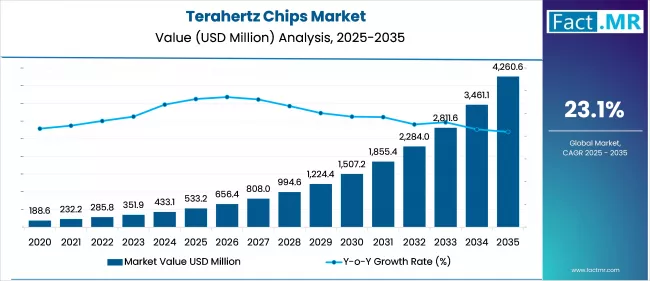
Terahertz Chips Market Analysis By Value 2025 To 2035 | Source: Fact.MR
Quick Stats for Terahertz Chips Market
- Industry Value (2025): USD 533.2 Million
- Projected Value (2035): USD 4,261 Million
- Forecast CAGR (2025 to 2035): 23.1%
- Leading Segment (2025): 0.3–1 THz (40.3% Market Share)
- Fastest Growing Country (2025-2035): China (24.9% CAGR)
- Top Key Players: Virginia Diodes, Inc. (VDI), TeraSense, Sivers Semiconductors, and Zomega Terahertz Corporation
What are the drivers of the terahertz chips market?
The transition toward 6G networks is fueling demand for terahertz chips, as their frequency range enables ultra-fast data transmission and low-latency performance. These have been addressing the growing demands of bandwidth in smart cities, autonomous vehicles, and industrial automation.
Imaging that uses terahertz waves is becoming popular in the healthcare and industrial sectors to detect diseases at early stages and for quality control. Terahertz radiation at non-ionizing levels delivers safe and accurate imaging in the identification of tumors and the inspection of pharmaceuticals. It works well in advanced diagnostic devices, making it suitable for extensive deployment.
Tera hertz chip integration is of utmost concern to governments around the world in their security screening and detection of threats. They can also penetrate clothing and packaging without any harmful radiation, making them necessary in airports, at border control, and on military grounds. Increasing defense expenditures and intelligent surveillance programs also pose additional demand, especially in high-threat regions.
What are the regional trends of the terahertz chips market?
In the case of North America, huge investments in 6G infrastructure and terahertz communication systems contribute to dominance. Major universities and semiconductor developers work together on chip miniaturization and scalable production in order to remain in leadership positions.
The lead by Japan, South Korea, and China puts the Asia Pacific in the direction of integrating terahertz chips in smartphones and automotive sensors. The 6G projects sponsored by governments and large-scale capacity semiconductor fabrication guarantee funds to be commercialized in the shortest period and optimally.
In the use of terahertz, Europe wants to be a hub of regulation as well as innovation, especially in the field of screening and monitoring in industries. Funding provided by the EU helps in speeding up prototype to market application,s and aerospace and car industries help in leveraging chip performance in terms of precision.
What are the challenges and restraining factors of the terahertz chips market?
Fabrication complexity imposes substantial capital and process risk for terahertz chips. Newer lithography and custom materials make units expensive and ramp timeline longer. The supplier choice is restricted by the limited high volume foundry capacity and puts extra pressure on pricing in favor of integrators on scale. The break in supply chain of specialty substrates incurs a menace.
Thermal issues of dissipation and power efficiency continue to be the underlying engineering limitations to high frequency operation. Design trade-offs involving performance of high output power against long life impair the qualified usage of the device concerning mission critical applications.
Combined with uncertainty and fragmented regulatory systems about spectrum allocation, this impedes the process of integration and commercial rollouts of telecom. Complex certification processes regarding the medical and security applications contribute to increasing the time of market and procurement activities.
Shortages in niche photonics packaging and terahertz test engineering increase the cost of development and raise the risk in the project. An exercise in regulatory harmonization will be needed to de risk deployment.
Country-Wise Insights
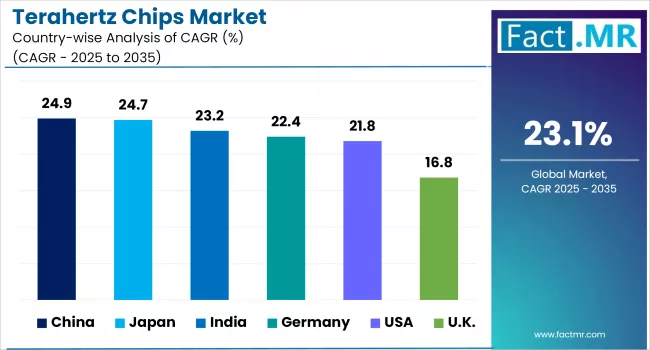
Terahertz Chips Marketanalysis By Country | Source: Fact.MR
United States is the Innovation and Scale Leader in Terahertz Chips
The United States anchors terahertz innovation through concentrated R&D hubs, national labs, and advanced fabrication. Telecom trial programs and modernization of the defense establish procurement high-value pathways, which hasten the commercialization of the dual-use systems.
The industry focus is on proprietary semiconductor photonic integration and energy-efficient architectures to increase enterprise application reliability. Chip foundries, among start-ups and incumbents, work together to decrease the duration between design and manufacture. Public funds sponsor pilot deployments and commercialization grants.
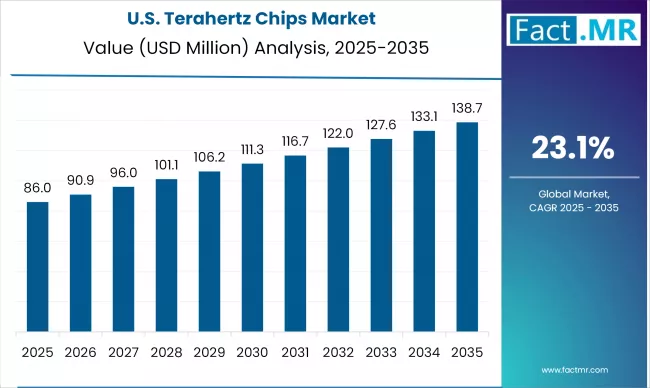
US Terahertz Chips Market Analysis By Value 2025 To 2035 | Source: Fact.MR
Commercial strategies prioritize public-private partnerships, supplier diversification, and strategic investments in workforce skills and test infrastructure. Export orientation dwells on security-grade modules and telecommunication backbone components that enhance allied procurement priority. Resilience is achieved through merger activity to provide access to substrate guests and the foundry. Export relationships with like-minded suppliers increase markets and aid resilient overseas operations.
Japan is the Precision Engineering and Component Specialist in Terahertz Chips
Japan is strong in high-technology materials science and reliability manufacturing and makes high performance terahertz components. Major electronics conglomerates and specialty foundries concentrate on reliability and miniaturization that is integrated into medical and auto systems. Suppliers specialize in custom substrates and calibrated module testing.
The focus of the corporate strategy is on the relationship with a term supplier and gradual innovation, increasing the lifetime of the product and compliance with high-quality standards. The research organizations work with industry to develop photonic packages and sensor-level integration. Pilot-scale productions boost the system of reliability validation.
The focus of export orientation is on high-value markets, which require certified modules used in industries and healthcare. Incentives on policies and selective R&D grants aid the way of commercialization when companies seek to license and enter joint development contracts to venture into international channels. The manufacturer's focus on energy efficiency certification and sales support network.
China is the Volume Manufacturing and Integration Hub for Terahertz Chips
China has both vast scale capabilities in fabrication and integrated component supply chains to create cost savings and scale rapidly. The priorities of state-sponsored programs and major foundries are to expand the capacities to achieve domestic and regional demand. Export promotion plans and regional cluster incentives are quick in bringing an enterprise to the global market.
Domestic OEMs are demanding to incorporate terahertz modules in consumer electronics and automotive, automation in industrial processes, and sensing. Close cooperation between system integrators serving a local market and chipmakers, as well as packaging specialists, helps to reduce time to deployment. With supplier ecosystems, form factor testing and accelerated validation cycles are possible.
Export strategies balance competitive pricing with targeted quality upgrades for regulated markets. Manufacturers are investing in automation testing and training local skills in order to increase yields and cut lead times as they seek strategic alliances in foreign countries. Export access is facilitated by quality certification and joint venture agreements abroad.
Category-Wise Analysis
0.3 to 1 THz Band Powers Imaging and Security
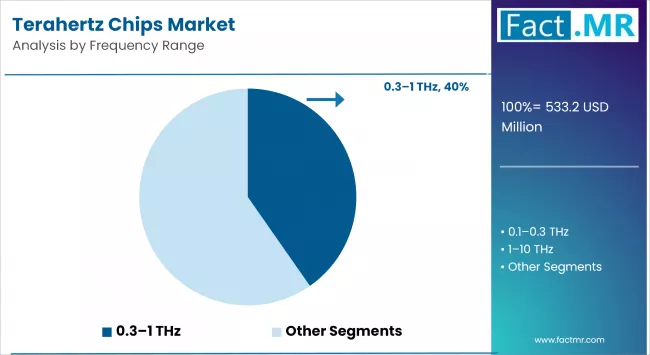
Terahertz Chips Marketanalysis By Frequency Range | Source: Fact.MR
The 0.3 to 1 terahertz frequency band provides the best resolution and penetration combination for security screening and informs on the material characterisation. Its propagation properties facilitate high-resolution imaging and small system complexity of portable and large scanners applied in the pharmaceutical and industrial inspection of aviation. The procurement cycles of the institutional buyers are reduced by the regulatory acceptance or emerging standards.
The commercial usage is picking up pace because signal processing is taking place in chip technologies using smaller chip modules and decreasing cost. Improvements in detector sensitivity and packaging lead to greater usage in access control systems and inline quality inspection, where non-invasive analysis can bring an operating value that can be measured. Cloud analytics enables integration to improve the ability to detect threats.
Imaging and Spectroscopy Drive Non-Invasive Material Analysis
Imaging and spectroscopy applications capitalize on terahertz radiation to reveal compositional and structural signatures without ionizing exposure. Terahertz modules that can be used in pharmaceutical inspection, material sorting, and biomedical research are ideal in terms of specificity and streamlining continuous manufacturing processes. Resellers package hardware to include domain-specific analytics to reduce the friction of adoption.
Software-defined analytics accelerate the commercialization process by generating predictive quality analogues of spectral fingerprints. The combination of automation and AI enables real-time decision-making to cut waste and enhance the integrity of products throughout regulated supply chains. In partnership with instrument OEMs and contract manufacturers, penetration is extended into continuous processing lines and clinical laboratories in markets.
Competitive Analysis
Key players in the terahertz chips industry including Virginia Diodes, Inc. (VDI), TeraSense, Sivers Semiconductors, Zomega Terahertz Corporation, BATOP GmbH, Microtech Instruments, ACST GmbH, Echodyne, Northrop Grumman Corporation, Teraphysics Corp., M Squared Lasers, NanoSemi, OMMIC, Radiabeam Technologies, Traycer (Luna Innovations), and Ricoh THz Devices.
The Competition in the terahertz chips focuses on technical distinction and the size of production. The players compete against each other on the basis of photonic integration detector sensitivity and thermal efficiency, and they ensure that they bridge the gap between prototype validation and reliable volume production capabilities. Strategic alliances and venture investment can put roadmaps on a fast track and IP stacking fights commercial moats in regional centers of innovation.
The procurement is more amenable to suppliers who provide integrated subsystems that are certified in market vertical targets and that have predictable supply chains. Modules of communication, backhaul imaging scanners, and automotive sensors are among the products that face increased competition since their selection is determined by reliability as well as the overall cost of ownership. Channels shift toward systems integrators and cloud service partnerships that embed terahertz sensing into enterprise workflows.
Recent Development
- In 2025, Microtech Instruments announced its new Thin Film Polarizers designed for applications in the 0.2-5 THz range. These polarizers are part of their expanding product line, which also includes band-pass filters for the THz frequency spectrum.
- In April 2024, Fermilab partnered with RadiaBeam Technologies to commercialize advanced compact superconducting accelerator modules. This collaboration aims to leverage emerging technologies in accelerator science, enhancing the potential for innovative applications in various fields.
Fact.MR has provided detailed information about the price points of key manufacturers of the Terahertz Chips Market positioned across regions, sales growth, production capacity, and speculative technological expansion, in the recently published report.
Methodology and Industry Tracking Approach
The 2025 terahertz chips market report by Fact.MR is founded on insights collected from 1,300 stakeholders across 12 countries with a minimum of seventy five respondents per country. Sixty five percent of participants were end users including telecom service providers semiconductor manufacturers defense integrators and healthcare imaging solution providers while the remaining thirty five percent comprised procurement leads R and D heads regulatory consultants and system integrators.
Data collection took place between June 2024 and May 2025 focusing on parameters such as chip performance frequency stability integration with next generation networks compliance with spectrum regulations and thermal efficiency. The study draws from over 95 validated sources including peer reviewed research semiconductor technology reports product specification sheets and corporate filings. All sources were rigorously triangulated through a regionally balanced calibration model to produce representative estimates and actionable insights for stakeholders across the value chain.
Fact.MR applied rigorous analytical tools such as multi-variable regression and scenario modeling to ensure data robustness. With continuous monitoring of the glass adhesives space since 2018, this report offers a comprehensive roadmap for firms seeking competitive advantage, innovation, and sustainable growth within the sector.
Segmentation
Segmentation of Terahertz Chips Market
-
By Frequency Range :
- 0.1 – 0.3 THz
- 0.3 – 1 THz
- 1 – 10 THz
-
By Application :
- Imaging & Spectroscopy
- Communication & Networking
- Sensing & Detection
- Computing & Data Processing
-
By Technology :
- Electronic THz Sources
- Photonic THz Sources
- Plasmonic & Metamaterial-Based THz Chips
- Hybrid THz Systems
-
By End Use Industry :
- Telecommunications
- Healthcare & Life Sciences
- Defense & Aerospace
- Automotive & Transportation
- Industrial & Manufacturing
-
By Region :
- North America
- Latin America
- Western Europe
- Eastern Europe
- East Asia
- South Asia & Pacific
- Middle East & Africa
Frequently Asked Questions
What was the Global Terahertz Chips Market Size Reported by Fact.MR for 2025?
Who are the Major Players Operating in the Terahertz Chips Market?
What is the Estimated Valuation of the Terahertz Chips Market in 2035?
What Value CAGR did the Terahertz Chips Market Exhibit Over the Last Five Years?
Who worked on this report


Preview the report firsthand - request a free sample
Free SampleGet the brochure for pricing and purchase details
Download PDF