Thermal Imaging Components Market (2026 - 2036)

Thermal Imaging Components Market is segmented by Component Type (Sensor Arrays, Optics/Lenses, Thermal Cores, and Electronics/Calibration), Wavelength Range (SWIR, MWIR, LWIR, and Multispectral), End Use (Defense & Security, Industrial, Automotive ADAS, and Medical/Other), and Region. Forecast for 2026 to 2036.

Core Findings

    Thermal Imaging Components Market Forecast and Outlook 2026 to 2036

    In 2025, the thermal imaging components market was valued at USD 4.3 billion. Based on FACT.MR analysis, demand for thermal imaging components is estimated to grow to USD 4.5 billion in 2026 and USD 8.1 billion by 2036. FACT.MR projects a CAGR of 6.0% during the forecast period.

    The absolute dollar growth from 2026 to 2036 represents an incremental gain of USD 3.6 billion a near-doubling of the market that reflects both volume expansion across automotive ADAS and industrial automation applications and per-unit value escalation in defence and security segments demanding higher-resolution, cooled MWIR arrays with onboard image processing. Growth is partially constrained by US International Traffic in Arms Regulations (ITAR) and Export Administration Regulations (EAR) that restrict cross-border transfer of high-performance infrared detectors, limiting the speed at which qualified supply capacity can be scaled to match demand growth from allied defence programmes.

    Fritz Krainer, SVP of Engineering, Seek Thermal, says this is more than an upgrade, it's a transformative leap. Our new architecture is designed with automotive integration in mind, offering advanced imaging capability, seamless connectivity, and performance that scales."

    Country-level growth reflects differences in defence spending, EV and ADAS adoption, and industrial automation intensity. China leads at 7.2% CAGR on drone, autonomous vehicle, and LWIR detector scaling, followed by Brazil at 6.8% supported by agricultural drones and public security procurement. Europe posts 5.8%, while the United States and United Kingdom each record 5.7%. Germany reaches 5.6%, South Korea 5.2%, and Japan 4.5% amid slower defence expansion.
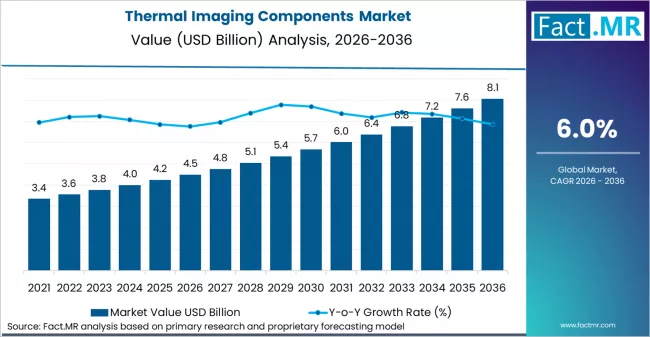
    Thermal Imaging Components Market Market Value Analysis

    Market Definition

    Thermal imaging components are optoelectronic parts that detect infrared radiation and convert it into electronic signals or images, including focal plane array sensors, infrared lenses, thermal cores, and calibration electronics used in defence, industrial monitoring, automotive ADAS, and medical applications worldwide.

    Market Inclusions

    The report covers global market sizing from 2026 to 2036, segmented by component type, wavelength range including SWIR, MWIR, LWIR and multispectral, and end use, with pricing, export control, and foundry capacity analysis.

    Market Exclusions

    Complete thermal cameras, finished devices, visible light sensors unless multispectral, passive infrared motion detectors, and service or maintenance activities are excluded.

    Research Methodology

    • Primary Research: The study is based on structured interviews with infrared detector foundry managers, defence system integrators, automotive Tier 1 ADAS engineers, industrial thermography OEM product leaders, and export control specialists operating under ITAR and EAR regulations across North America, Europe, and Asia Pacific.
    • Desk Research: Secondary research draws on US Department of Defense budget disclosures, NATO defence spending data, ACEA and JAMA automotive production statistics, company filings from Teledyne Technologies, Leonardo DRS, and Lynred, and export control publications from the US Bureau of Industry and Security.
    • Market Sizing and Forecasting; Market estimates combine bottom up shipment modelling by wavelength and end use with top down validation against defence procurement budgets, automotive ADAS penetration forecasts, and publicly disclosed revenues from leading infrared component suppliers.
    • Data Validation and Update Cycle: Findings are cross checked against quarterly earnings from Teledyne, L3Harris, and RTX, automotive OEM procurement guidance, and US export licence data, with semiannual updates aligned to revised defence and vehicle production outlooks.

    Key Takeaways

    • Market Definition
      • Thermal imaging components include infrared focal plane arrays, IR optics, integrated thermal cores, and calibration electronics used in defence targeting, industrial monitoring, automotive night vision, and medical diagnostics.
    • Demand Drivers
      • Rising NATO defence budgets and 2 percent GDP commitments are sustaining long term demand for cooled MWIR and uncooled LWIR sensors in surveillance and UAV systems.
      • Automotive ADAS adoption is accelerating as LWIR module costs fall below USD 200, potentially enabling thermal cameras in more than 8 million vehicles annually by 2030.
      • Industrial automation in semiconductors, pharma, and energy requires non-contact thermal inspection, supporting steady demand for qualified MWIR and LWIR arrays.
    • Key Segments Analyzed
      • By Component Type, Sensor Arrays and Thermal Cores each command 35% share in 2025, collectively representing 70% of global thermal imaging component value and reflecting the foundational role of detector and integrated core modules in determining system performance, price, and qualification status across all end-use segments.
      • By Wavelength Range, LWIR holds 45% share in 2025, driven by uncooled vanadium oxide and amorphous silicon microbolometer detector technology that requires no cryogenic cooling, enabling cost-effective mass production for automotive ADAS, commercial security, and industrial thermography applications that cannot accommodate the size and power requirements of cooled detector systems.
      • By End Use, Defense and Security holds 45% share in 2025, reflecting sustained global defence modernization programs and procurement of cooled MWIR and uncooled LWIR sensor arrays for weapon sights, surveillance systems, and unmanned platforms,
      • By Region, North America leads in per-unit component value through US defence procurement of export-controlled cooled MWIR arrays, while Asia-Pacific leads in volume growth rate through China’s domestic LWIR manufacturing scale-up and South Korean and Japanese automotive ADAS programme ramps serving global OEM platforms.
    • Analyst Opinion at FACT.MR
      • Shambhu Nath Jha, Principal Consultant at FACT.MR, opines, ‘CXOs will find this report essential for understanding how ITAR export control constraints are reshaping global component supply chains, which wavelength ranges are capturing the fastest volume growth from automotive ADAS and commercial security procurement, and how Hikmicro’s volume LWIR manufacturing is forcing Western OEMs to restructure their commercial versus defence component portfolio strategies through 2036.’
    • Strategic Implications / Executive Takeaways
      • Prioritize ITAR compliant onshore foundry expansion to secure long term defence contracts and Foreign Military Sales eligibility.
      • Implement dual sourcing strategies across ITAR and commercial LWIR suppliers to reduce regulatory and supply concentration risk in automotive ADAS platforms.
      • Shift differentiation toward calibration electronics and software IP as detector hardware commoditizes and pricing pressure intensifies.
    • Methodology
      • Validated through first-hand production and capacity data.
      • Zero reliance on speculative third-party market research reports.
      • Based on verifiable industrial benchmarks and verified sources.

    Segmental Analysis

    Thermal Imaging Components Market Analysis by Component Type
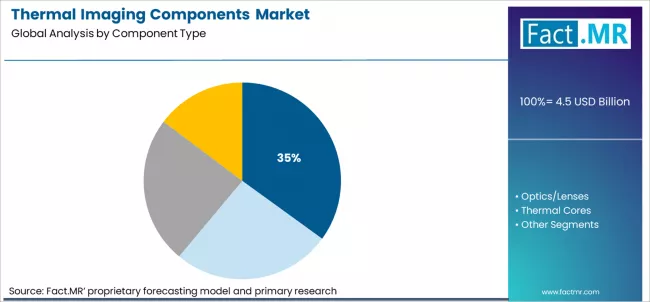
    Thermal Imaging Components Market Analysis By Component Type

    Based on FACT.MR’s thermal imaging components market report, consumption of Sensor Arrays is estimated to hold 35% share in 2025, as focal plane arrays remain the primary performance defining and revenue generating component across all wavelength categories.

    • Foundry Expansion: Lynred announced a EUR 50 million expansion of its French detector foundry to increase output of cooled MWIR and uncooled LWIR arrays for European defence and automotive programmes.
    • Performance Upgrade: Excelitas introduced a 15 micrometre pitch cooled MWIR InSb array achieving NETD below 15 mK, extending detection range for airborne surveillance platforms.
    • Automotive Volume Ramp: Teledyne FLIR reported uncooled LWIR automotive shipments exceeding 500,000 units, reflecting accelerating ADAS integration.

    Thermal Imaging Components Market Analysis by Wavelength Range
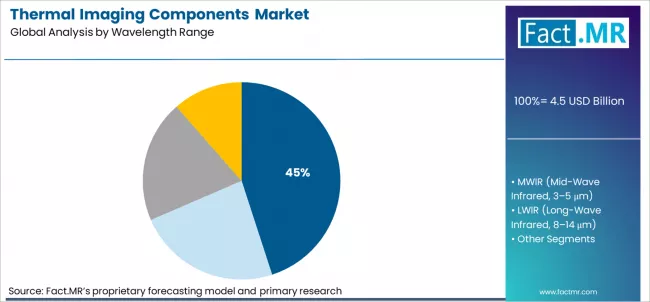
    Thermal Imaging Components Market Analysis By Wavelength Range

    Based on FACT.MR’s thermal imaging components market report, LWIR holds 45% share in 2025 due to uncooled microbolometer technology enabling compact, low power, sub USD 300 modules suitable for automotive, security, and industrial applications.

    • Volume Leadership: Hikmicro expanded annual capacity to 2 million LWIR modules, targeting sub USD 150 automotive grade pricing.
    • Defence Modernisation: Leonardo DRS advanced dual band MWIR and LWIR systems under US Army contracts exceeding USD 200 million.
    • Multispectral Upside: ESA Copernicus procurement of combined SWIR, MWIR, and LWIR assemblies signals multispectral adoption rising toward 9 to 12% share by 2036.

    Thermal Imaging Components Market Drivers, Restraints, And Opportunities

    Based on FACT.MR’s thermal imaging components market report, the market is valued at USD 4.3 billion in 2025, reflecting its transition from a defence exclusive supply chain to a multi vertical technology platform serving automotive, industrial, and security applications as declining LWIR microbolometer costs have reduced module pricing by nearly 60% over the past decade, enabling large scale commercial adoption while MWIR cooled detectors retain premium pricing power in defence programmes.

    Standard 320×240 uncooled LWIR modules that sold for USD 800 to 1,200 in 2018 now transact at USD 150 to 300 in volume procurement, driven by Chinese manufacturers such as Hikmicro, GUIDE Infrared, and Dali Technology operating at wafer scale, while cooled MWIR InSb and MCT detector arrays for defence applications sustain prices between USD 5,000 and 50,000 under ITAR restricted procurement frameworks.

    • ITAR Category XII Controls: USML Category XII restrictions on high performance focal plane arrays create a bifurcated supply chain in which US and allied foundries dominate export controlled cooled MWIR segments, preserving pricing power in defence contracts while commercial grade LWIR remains globally competitive.
    • Euro NCAP 2026 Catalyst: Updated Euro NCAP safety protocols incorporating thermal pedestrian detection scoring are accelerating OEM adoption, with Volvo’s EX90 integrating Teledyne FLIR thermal cameras as standard equipment beginning model year 2025.
    • Indo Pacific Defence Upswing: Japan’s defence budget expansion toward 2% of GDP by 2027 is driving sustained import demand for ITAR qualified MWIR detector arrays benefiting suppliers such as Teledyne FLIR, Lynred, and Excelitas.

    Regional Analysis

    The thermal imaging components market is analysed across North America, Latin America, Europe, Asia-Pacific spanning 40+ countries aligned with global defence procurement centres, automotive manufacturing hubs, and industrial automation investment regions. The report offers detailed market attractiveness analysis comparing defence budget trajectories, automotive ADAS penetration rates, and export control regulatory environments across regional thermal imaging component supply and demand markets.
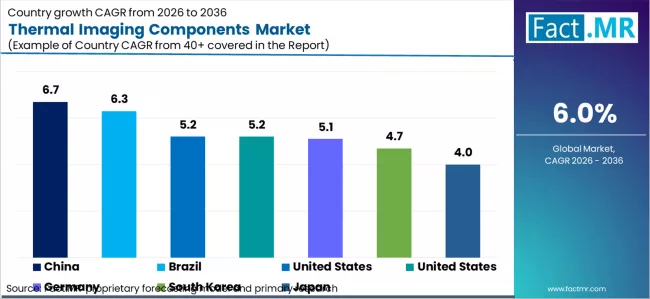
    Thermal Imaging Components Market Cagr Analysis By Country

    Country CAGR%
    China 6.7%
    Brazil 6.3%
    United States 5.2%
    United Kingdom 5.2%
    Germany 5.1%
    South Korea 4.7%
    Japan 4.0%

    Source: Fact.MR (FACT.MR) analysis, based on proprietary forecasting model and primary research

    North America Thermal Imaging Components Market Analysis

    North America operates as the technology sovereignty hub of the thermal imaging components market, where ITAR controls preserve US dominance in high performance cooled MWIR and multispectral detector supply. Teledyne FLIR, Leonardo DRS, and RTX anchor the competitive landscape through vertically integrated foundry to system capabilities and long term DoD contracts, making programme qualification and licensing status more critical than unit pricing.

    • United States: Demand for thermal imaging components in the United States is projected to rise at 5.7% CAGR through 2036. Growth is driven by DoD investments across squad weapon sights, ENVG B night vision systems, Air Force infrared countermeasures, and a USD 500 million Industrial Base Investment Fund supporting domestic detector foundry expansion, alongside emerging automotive demand linked to NHTSA pedestrian safety rulemaking referencing thermal imaging for night detection.

    FACT.MR’s analysis of the thermal imaging components market in North America includes the United States and Canada, covering DoD award pipelines, ITAR export constraints, automotive ADAS integration, and industrial thermography demand.

    Europe Thermal Imaging Components Market Analysis

    Europe functions as a dual defence and automotive innovation center, where NATO procurement drives MWIR demand and premium automotive OEMs accelerate LWIR adoption. Lynred anchors ITAR free detector manufacturing in France, while BAE Systems and Thales support regional defence integration, with ITAR independent supply serving export markets.

    • Germany: Demand in Germany is projected to rise at 5.6% CAGR through 2036. Defence procurement under the EUR 100 billion Sondervermögen fund supports MWIR sensor orders, while BMW’s integration of thermal cameras on 7 Series and i7 platforms and updated BSI cybersecurity rules drive automotive and industrial component demand.
    • United Kingdom: Demand in the United Kingdom is projected to rise at 5.7% CAGR through 2036. The GBP 305.5 billion Defence Equipment Plan supports infrared upgrades for Ajax vehicles and RAF platforms, while fleet level adoption under updated vehicle inspection standards stimulates commercial thermal camera integration.

    FACT.MR’s analysis of the thermal imaging components market in Europe includes Germany, United Kingdom, France, Netherlands, and Nordic markets, detailing NATO procurement, ITAR free supply positioning, Euro NCAP incentives, and industrial demand clusters.

    Asia-Pacific Thermal Imaging Components Market Analysis

    Asia Pacific represents the volume manufacturing and growth frontier, led by China’s cost competitive LWIR ecosystem and supported by Japan and South Korea’s defence and automotive programmes. The region’s competitive dynamic centers on commercial LWIR scale versus ITAR controlled Western defence supply.

    • China: Demand in China is projected to rise at 7.2% CAGR through 2036. Growth is driven by PLA modernization, autonomous vehicle ADAS expansion at BYD and NIO, national policy support for infrared manufacturing, and a rapidly expanding commercial drone fleet generating sustained LWIR payload demand.
    • Japan: Demand in Japan is projected to rise at 4.5% CAGR through 2036. Defence modernization under rising budgets supports MWIR seeker procurement, while Hamamatsu and Mitsubishi Electric expand domestic detector capabilities to reduce reliance on US controlled imports.
    • South Korea: Demand in South Korea is projected to rise at 5.2% CAGR through 2036. Defence upgrades for K2 and K21 platforms, Hyundai Kia thermal ADAS integration, and Hanwha Vision’s capacity expansion anchor market growth.

    FACT.MR’s analysis of the thermal imaging components market in Asia Pacific includes China, Japan, South Korea, India, and Southeast Asia, covering domestic foundry expansion, defence procurement timelines, and automotive localization trends.

    Latin America Thermal Imaging Components Market Analysis

    Latin America represents an emerging application driven market, with demand concentrated in border surveillance, agricultural drone monitoring, and public safety infrastructure, and limited domestic manufacturing capacity.

    • Brazil: Demand in Brazil is projected to rise at 6.8% CAGR through 2036. Growth is supported by SISFRON border monitoring expansion, agricultural thermal drone adoption under Plano ABC+, and health screening infrastructure requirements, with most components imported from US, European, and Chinese suppliers.

    FACT.MR’s analysis of the thermal imaging components market in Latin America centers on Brazil, detailing border surveillance procurement, agricultural drone adoption, health infrastructure demand, and regional import dependency.

    Competitive Aligners for Market Players
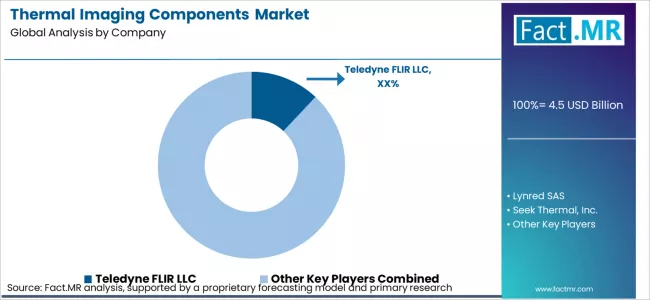
    Thermal Imaging Components Market Analysis By Company

    Market structure is bifurcated between a concentrated defence grade tier and a more competitive commercial LWIR tier. In defence, a limited group including Teledyne FLIR, Leonardo DRS, RTX, and BAE Systems controls the majority of cooled MWIR and high performance detector value under ITAR protected programme structures, while commercial LWIR remains fragmented with no single supplier holding dominant share. Primary competitive variable in defence is qualification status and licensing posture, whereas in commercial segments it is production scale and firmware differentiation.

    Suppliers with captive detector foundries maintain structural advantage through yield control, custom specification capability, and accelerated qualification cycles. Vertical integration enables programme specific variants and shorter lead times, supporting pricing premiums in defence procurement relative to fabless competitors. Merchant dependent suppliers face tighter margins and longer qualification timelines.

    Customer concentration shapes pricing discipline. Defence programme incumbency often results in sole source follow on contracts spanning decade long lifecycles. Commercial automotive Tier 1 integrators dual qualify suppliers to avoid dependency, limiting annual price escalation and sustaining competitive pressure despite rising resolution and performance standards.

    Recent Development

    • In 2025, LightPath Technologies completed the acquisition of G5 Infrared, a specialist in high-end infrared camera systems, enhancing its product lineup and expanding its defense and industrial thermal imaging capabilities at a transaction value of USD 27 million.
    • In 2025, Meridian Innovation unveiled its “Cheetah” 50×50 LWIR thermal imaging sensor, introducing a cost-optimized, compact LWIR detector designed for broad adoption in smart devices, industrial systems, automotive interior sensing, and IoT applications.

    Key Players

    • Teledyne FLIR LLC
    • Lynred SAS
    • Seek Thermal, Inc.
    • Leonardo DRS, Inc.
    • Excelitas Technologies Corp.
    • Hamamatsu Photonics K.K.
    • Hikmicro Sensing Technology Co., Ltd.
    • Raytheon Technologies Corporation (RTX)
    • Ulis SAS (Lynred Group)
    • BAE Systems plc

    Scope of the Report

    Items Values
    Quantitative Units USD 4.5 billion (2026) to USD 8.1 billion (2036), at a CAGR of 6.0%
    Market Definition Thermal imaging components are discrete optoelectronic assemblies-including infrared sensor arrays, specialised optics and lenses, integrated thermal cores, and electronics/calibration modules-that detect and convert infrared radiation emitted by objects into electronic signals or visual images, enabling non-contact temperature measurement, target detection, and scene analysis across defence, industrial, automotive, and medical end uses.
    Component Type Sensor Arrays, Optics/Lenses, Thermal Cores, Electronics/Calibration
    Wavelength Range SWIR, MWIR, LWIR, Multispectral
    End Use Defense & Security, Industrial, Automotive ADAS, Medical/Other
    Regions Covered Asia Pacific, Europe, North America, Latin America, Middle East & Africa
    Countries Covered India, China, Japan, South Korea, Indonesia, Australia & New Zealand, ASEAN, Rest of Asia Pacific, Germany, Italy, France, United Kingdom, Spain, Benelux, Nordics, Central & Eastern Europe, Rest of Europe, United States, Canada, Mexico, Brazil, Argentina, Chile, Rest of Latin America, Kingdom of Saudi Arabia, United Arab Emirates, South Africa, Turkey, Rest of Middle East & Africa
    Key Companies Profiled Teledyne FLIR, Lynred, Seek Thermal, Leonardo DRS, Excelitas, Hamamatsu, Hikmicro, Raytheon Technologies, Ulis, BAE Systems
    Forecast Period 2026 to 2036
    Approach Top-down and bottom-up market modeling validated through primary interviews with defence procurement officers, industrial automation engineers, automotive Tier-1 ADAS suppliers, medical imaging OEM developers, and infrared detector foundry managers, supported by government defence budget disclosures, automotive production forecasts, regulatory approvals, and component shipment data from publicly reported OEM financials.
    Quantitative Units USD 4.5 billion (2026) to USD 8.1 billion (2036), at a CAGR of 6.0%

    Thermal Imaging Components Market by Segments

    • By Component Type

      • Sensor Arrays
      • Optics/Lenses
      • Thermal Cores
      • Electronics/Calibration
    • By Wavelength Range

      • SWIR (Short-Wave Infrared, 0.9-1.7 μm)
      • MWIR (Mid-Wave Infrared, 3-5 μm)
      • LWIR (Long-Wave Infrared, 8-14 μm)
      • Multispectral
    • By End Use

      • Defense & Security
      • Industrial
      • Automotive ADAS
      • Medical/Other
    • Region

      • Asia Pacific
        • India
        • China
        • Japan
        • South Korea
        • Indonesia
        • Australia & New Zealand
        • ASEAN
        • Rest of Asia Pacific
      • Europe
        • Germany
        • Italy
        • France
        • United Kingdom
        • Spain
        • Benelux
        • Nordics
        • Central & Eastern Europe
        • Rest of Europe
      • North America
        • United States
        • Canada
        • Mexico
        • Latin America
      • Brazil
        • Argentina
        • Chile

    This Report Addresses

    • Market intelligence to enable structured strategic decision making across defence, automotive ADAS, industrial, and medical thermal imaging value chains
    • Market size estimation and 10-year revenue forecasts from 2026 to 2036, supported by component and wavelength level benchmarks
    • Growth opportunity mapping across cooled MWIR defence arrays, sub USD 200 automotive grade LWIR cores, and multispectral assemblies for airborne and space platforms
    • Segment and regional revenue forecasts covering component type, wavelength range, and country level CAGR across China, Brazil, United States, Germany, United Kingdom, South Korea, and Japan
    • Competition strategy assessment including detector foundry integration advantages, ITAR qualification positioning, and automotive dual sourcing dynamics
    • Export control and regulatory impact analysis covering ITAR Category XII, EAR licensing, Euro NCAP 2026 scoring protocols, and national infrared policy frameworks
    • Detector foundry capacity and technology roadmap analysis including pixel pitch reduction, format scaling, and wafer fabrication expansion timelines
    • Market report delivery in PDF, Excel, and PowerPoint formats for executive and operational planning

    Table of Content

    1. Executive Summary
      • Global Market Outlook
      • Demand to side Trends
      • Supply to side Trends
      • Technology Roadmap Analysis
      • Analysis and Recommendations
    2. Market Overview
      • Market Coverage / Taxonomy
      • Market Definition / Scope / Limitations
    3. Research Methodology
      • Chapter Orientation
      • Analytical Lens and Working Hypotheses
        • Market Structure, Signals, and Trend Drivers
        • Benchmarking and Cross-market Comparability
        • Market Sizing, Forecasting, and Opportunity Mapping
      • Research Design and Evidence Framework
        • Desk Research Programme (Secondary Evidence)
          • Company Annual and Sustainability Reports
          • Peer-reviewed Journals and Academic Literature
          • Corporate Websites, Product Literature, and Technical Notes
          • Earnings Decks and Investor Briefings
          • Statutory Filings and Regulatory Disclosures
          • Technical White Papers and Standards Notes
          • Trade Journals, Industry Magazines, and Analyst Briefs
          • Conference Proceedings, Webinars, and Seminar Materials
          • Government Statistics Portals and Public Data Releases
          • Press Releases and Reputable Media Coverage
          • Specialist Newsletters and Curated Briefings
          • Sector Databases and Reference Repositories
          • FMR Internal Proprietary Databases and Historical Market Datasets
          • Subscription Datasets and Paid Sources
          • Social Channels, Communities, and Digital Listening Inputs
          • Additional Desk Sources
        • Expert Input and Fieldwork (Primary Evidence)
          • Primary Modes
            • Qualitative Interviews and Expert Elicitation
            • Quantitative Surveys and Structured Data Capture
            • Blended Approach
          • Why Primary Evidence is Used
          • Field Techniques
            • Interviews
            • Surveys
            • Focus Groups
            • Observational and In-context Research
            • Social and Community Interactions
          • Stakeholder Universe Engaged
            • C-suite Leaders
            • Board Members
            • Presidents and Vice Presidents
            • R&D and Innovation Heads
            • Technical Specialists
            • Domain Subject-matter Experts
            • Scientists
            • Physicians and Other Healthcare Professionals
          • Governance, Ethics, and Data Stewardship
            • Research Ethics
            • Data Integrity and Handling
        • Tooling, Models, and Reference Databases
      • Data Engineering and Model Build
        • Data Acquisition and Ingestion
        • Cleaning, Normalisation, and Verification
        • Synthesis, Triangulation, and Analysis
      • Quality Assurance and Audit Trail
    4. Market Background
      • Market Dynamics
        • Drivers
        • Restraints
        • Opportunity
        • Trends
      • Scenario Forecast
        • Demand in Optimistic Scenario
        • Demand in Likely Scenario
        • Demand in Conservative Scenario
      • Opportunity Map Analysis
      • Product Life Cycle Analysis
      • Supply Chain Analysis
      • Investment Feasibility Matrix
      • Value Chain Analysis
      • PESTLE and Porter’s Analysis
      • Regulatory Landscape
      • Regional Parent Market Outlook
      • Production and Consumption Statistics
      • Import and Export Statistics
    5. Global Market Analysis 2021 to 2025 and Forecast, 2026 to 2036
      • Historical Market Size Value (USD Million) Analysis, 2021 to 2025
      • Current and Future Market Size Value (USD Million) Projections, 2026 to 2036
        • Y to o to Y Growth Trend Analysis
        • Absolute $ Opportunity Analysis
    6. Global Market Pricing Analysis 2021 to 2025 and Forecast 2026 to 2036
    7. Global Market Analysis 2021 to 2025 and Forecast 2026 to 2036, By Component Type
      • Introduction / Key Findings
      • Historical Market Size Value (USD Million) Analysis By Component Type , 2021 to 2025
      • Current and Future Market Size Value (USD Million) Analysis and Forecast By Component Type , 2026 to 2036
        • Sensor Arrays
        • Optics/Lenses
        • Thermal Cores
        • Electronics/Calibration
      • Y to o to Y Growth Trend Analysis By Component Type , 2021 to 2025
      • Absolute $ Opportunity Analysis By Component Type , 2026 to 2036
    8. Global Market Analysis 2021 to 2025 and Forecast 2026 to 2036, By Wavelength Range
      • Introduction / Key Findings
      • Historical Market Size Value (USD Million) Analysis By Wavelength Range, 2021 to 2025
      • Current and Future Market Size Value (USD Million) Analysis and Forecast By Wavelength Range, 2026 to 2036
        • SWIR (Short-Wave Infrared, 0.9-1.7 μm)
        • MWIR (Mid-Wave Infrared, 3-5 μm)
        • LWIR (Long-Wave Infrared, 8-14 μm)
        • Multispectral
      • Y to o to Y Growth Trend Analysis By Wavelength Range, 2021 to 2025
      • Absolute $ Opportunity Analysis By Wavelength Range, 2026 to 2036
    9. Global Market Analysis 2021 to 2025 and Forecast 2026 to 2036, By Region
      • Introduction
      • Historical Market Size Value (USD Million) Analysis By Region, 2021 to 2025
      • Current Market Size Value (USD Million) Analysis and Forecast By Region, 2026 to 2036
        • North America
        • Latin America
        • Western Europe
        • Eastern Europe
        • East Asia
        • South Asia and Pacific
        • Middle East & Africa
      • Market Attractiveness Analysis By Region
    10. North America Market Analysis 2021 to 2025 and Forecast 2026 to 2036, By Country
      • Historical Market Size Value (USD Million) Trend Analysis By Market Taxonomy, 2021 to 2025
      • Market Size Value (USD Million) Forecast By Market Taxonomy, 2026 to 2036
        • By Country
          • USA
          • Canada
          • Mexico
        • By Component Type
        • By Wavelength Range
      • Market Attractiveness Analysis
        • By Country
        • By Component Type
        • By Wavelength Range
      • Key Takeaways
    11. Latin America Market Analysis 2021 to 2025 and Forecast 2026 to 2036, By Country
      • Historical Market Size Value (USD Million) Trend Analysis By Market Taxonomy, 2021 to 2025
      • Market Size Value (USD Million) Forecast By Market Taxonomy, 2026 to 2036
        • By Country
          • Brazil
          • Chile
          • Rest of Latin America
        • By Component Type
        • By Wavelength Range
      • Market Attractiveness Analysis
        • By Country
        • By Component Type
        • By Wavelength Range
      • Key Takeaways
    12. Western Europe Market Analysis 2021 to 2025 and Forecast 2026 to 2036, By Country
      • Historical Market Size Value (USD Million) Trend Analysis By Market Taxonomy, 2021 to 2025
      • Market Size Value (USD Million) Forecast By Market Taxonomy, 2026 to 2036
        • By Country
          • Germany
          • UK
          • Italy
          • Spain
          • France
          • Nordic
          • BENELUX
          • Rest of Western Europe
        • By Component Type
        • By Wavelength Range
      • Market Attractiveness Analysis
        • By Country
        • By Component Type
        • By Wavelength Range
      • Key Takeaways
    13. Eastern Europe Market Analysis 2021 to 2025 and Forecast 2026 to 2036, By Country
      • Historical Market Size Value (USD Million) Trend Analysis By Market Taxonomy, 2021 to 2025
      • Market Size Value (USD Million) Forecast By Market Taxonomy, 2026 to 2036
        • By Country
          • Russia
          • Poland
          • Hungary
          • Balkan & Baltic
          • Rest of Eastern Europe
        • By Component Type
        • By Wavelength Range
      • Market Attractiveness Analysis
        • By Country
        • By Component Type
        • By Wavelength Range
      • Key Takeaways
    14. East Asia Market Analysis 2021 to 2025 and Forecast 2026 to 2036, By Country
      • Historical Market Size Value (USD Million) Trend Analysis By Market Taxonomy, 2021 to 2025
      • Market Size Value (USD Million) Forecast By Market Taxonomy, 2026 to 2036
        • By Country
          • China
          • Japan
          • South Korea
        • By Component Type
        • By Wavelength Range
      • Market Attractiveness Analysis
        • By Country
        • By Component Type
        • By Wavelength Range
      • Key Takeaways
    15. South Asia and Pacific Market Analysis 2021 to 2025 and Forecast 2026 to 2036, By Country
      • Historical Market Size Value (USD Million) Trend Analysis By Market Taxonomy, 2021 to 2025
      • Market Size Value (USD Million) Forecast By Market Taxonomy, 2026 to 2036
        • By Country
          • India
          • ASEAN
          • Australia & New Zealand
          • Rest of South Asia and Pacific
        • By Component Type
        • By Wavelength Range
      • Market Attractiveness Analysis
        • By Country
        • By Component Type
        • By Wavelength Range
      • Key Takeaways
    16. Middle East & Africa Market Analysis 2021 to 2025 and Forecast 2026 to 2036, By Country
      • Historical Market Size Value (USD Million) Trend Analysis By Market Taxonomy, 2021 to 2025
      • Market Size Value (USD Million) Forecast By Market Taxonomy, 2026 to 2036
        • By Country
          • Kingdom of Saudi Arabia
          • Other GCC Countries
          • Turkiye
          • South Africa
          • Other African Union
          • Rest of Middle East & Africa
        • By Component Type
        • By Wavelength Range
      • Market Attractiveness Analysis
        • By Country
        • By Component Type
        • By Wavelength Range
      • Key Takeaways
    17. Key Countries Market Analysis
      • USA
        • Pricing Analysis
        • Market Share Analysis, 2025
          • By Component Type
          • By Wavelength Range
      • Canada
        • Pricing Analysis
        • Market Share Analysis, 2025
          • By Component Type
          • By Wavelength Range
      • Mexico
        • Pricing Analysis
        • Market Share Analysis, 2025
          • By Component Type
          • By Wavelength Range
      • Brazil
        • Pricing Analysis
        • Market Share Analysis, 2025
          • By Component Type
          • By Wavelength Range
      • Chile
        • Pricing Analysis
        • Market Share Analysis, 2025
          • By Component Type
          • By Wavelength Range
      • Germany
        • Pricing Analysis
        • Market Share Analysis, 2025
          • By Component Type
          • By Wavelength Range
      • UK
        • Pricing Analysis
        • Market Share Analysis, 2025
          • By Component Type
          • By Wavelength Range
      • Italy
        • Pricing Analysis
        • Market Share Analysis, 2025
          • By Component Type
          • By Wavelength Range
      • Spain
        • Pricing Analysis
        • Market Share Analysis, 2025
          • By Component Type
          • By Wavelength Range
      • France
        • Pricing Analysis
        • Market Share Analysis, 2025
          • By Component Type
          • By Wavelength Range
      • India
        • Pricing Analysis
        • Market Share Analysis, 2025
          • By Component Type
          • By Wavelength Range
      • ASEAN
        • Pricing Analysis
        • Market Share Analysis, 2025
          • By Component Type
          • By Wavelength Range
      • Australia & New Zealand
        • Pricing Analysis
        • Market Share Analysis, 2025
          • By Component Type
          • By Wavelength Range
      • China
        • Pricing Analysis
        • Market Share Analysis, 2025
          • By Component Type
          • By Wavelength Range
      • Japan
        • Pricing Analysis
        • Market Share Analysis, 2025
          • By Component Type
          • By Wavelength Range
      • South Korea
        • Pricing Analysis
        • Market Share Analysis, 2025
          • By Component Type
          • By Wavelength Range
      • Russia
        • Pricing Analysis
        • Market Share Analysis, 2025
          • By Component Type
          • By Wavelength Range
      • Poland
        • Pricing Analysis
        • Market Share Analysis, 2025
          • By Component Type
          • By Wavelength Range
      • Hungary
        • Pricing Analysis
        • Market Share Analysis, 2025
          • By Component Type
          • By Wavelength Range
      • Kingdom of Saudi Arabia
        • Pricing Analysis
        • Market Share Analysis, 2025
          • By Component Type
          • By Wavelength Range
      • Turkiye
        • Pricing Analysis
        • Market Share Analysis, 2025
          • By Component Type
          • By Wavelength Range
      • South Africa
        • Pricing Analysis
        • Market Share Analysis, 2025
          • By Component Type
          • By Wavelength Range
    18. Market Structure Analysis
      • Competition Dashboard
      • Competition Benchmarking
      • Market Share Analysis of Top Players
        • By Regional
        • By Component Type
        • By Wavelength Range
    19. Competition Analysis
      • Competition Deep Dive
        • Teledyne FLIR LLC
          • Overview
          • Product Portfolio
          • Profitability by Market Segments (Product/Age /Sales Channel/Region)
          • Sales Footprint
          • Strategy Overview
            • Marketing Strategy
            • Product Strategy
            • Channel Strategy
        • Lynred SAS
        • Seek Thermal, Inc.
        • Leonardo DRS, Inc.
        • Excelitas Technologies Corp.
        • Hamamatsu Photonics K.K.
        • Hikmicro Sensing Technology Co., Ltd.
        • Raytheon Technologies Corporation (RTX)
        • Ulis SAS (Lynred Group)
        • BAE Systems plc
    20. Assumptions & Acronyms Used

    List Of Table

    • Table 1: Global Market Value (USD Million) Forecast by Region, 2021 to 2036
    • Table 2: Global Market Value (USD Million) Forecast by Component Type, 2021 to 2036
    • Table 3: Global Market Value (USD Million) Forecast by Wavelength Range, 2021 to 2036
    • Table 4: North America Market Value (USD Million) Forecast by Country, 2021 to 2036
    • Table 5: North America Market Value (USD Million) Forecast by Component Type, 2021 to 2036
    • Table 6: North America Market Value (USD Million) Forecast by Wavelength Range, 2021 to 2036
    • Table 7: Latin America Market Value (USD Million) Forecast by Country, 2021 to 2036
    • Table 8: Latin America Market Value (USD Million) Forecast by Component Type, 2021 to 2036
    • Table 9: Latin America Market Value (USD Million) Forecast by Wavelength Range, 2021 to 2036
    • Table 10: Western Europe Market Value (USD Million) Forecast by Country, 2021 to 2036
    • Table 11: Western Europe Market Value (USD Million) Forecast by Component Type, 2021 to 2036
    • Table 12: Western Europe Market Value (USD Million) Forecast by Wavelength Range, 2021 to 2036
    • Table 13: Eastern Europe Market Value (USD Million) Forecast by Country, 2021 to 2036
    • Table 14: Eastern Europe Market Value (USD Million) Forecast by Component Type, 2021 to 2036
    • Table 15: Eastern Europe Market Value (USD Million) Forecast by Wavelength Range, 2021 to 2036
    • Table 16: East Asia Market Value (USD Million) Forecast by Country, 2021 to 2036
    • Table 17: East Asia Market Value (USD Million) Forecast by Component Type, 2021 to 2036
    • Table 18: East Asia Market Value (USD Million) Forecast by Wavelength Range, 2021 to 2036
    • Table 19: South Asia and Pacific Market Value (USD Million) Forecast by Country, 2021 to 2036
    • Table 20: South Asia and Pacific Market Value (USD Million) Forecast by Component Type, 2021 to 2036
    • Table 21: South Asia and Pacific Market Value (USD Million) Forecast by Wavelength Range, 2021 to 2036
    • Table 22: Middle East & Africa Market Value (USD Million) Forecast by Country, 2021 to 2036
    • Table 23: Middle East & Africa Market Value (USD Million) Forecast by Component Type, 2021 to 2036
    • Table 24: Middle East & Africa Market Value (USD Million) Forecast by Wavelength Range, 2021 to 2036

    List Of Figures

    • Figure 1: Global Market Pricing Analysis
    • Figure 2: Global Market Value (USD Million) Forecast 2021 to 2036
    • Figure 3: Global Market Value Share and BPS Analysis by Component Type, 2026 and 2036
    • Figure 4: Global Market Y to o to Y Growth Comparison by Component Type, 2026 to 2036
    • Figure 5: Global Market Attractiveness Analysis by Component Type
    • Figure 6: Global Market Value Share and BPS Analysis by Wavelength Range, 2026 and 2036
    • Figure 7: Global Market Y to o to Y Growth Comparison by Wavelength Range, 2026 to 2036
    • Figure 8: Global Market Attractiveness Analysis by Wavelength Range
    • Figure 9: Global Market Value (USD Million) Share and BPS Analysis by Region, 2026 and 2036
    • Figure 10: Global Market Y to o to Y Growth Comparison by Region, 2026 to 2036
    • Figure 11: Global Market Attractiveness Analysis by Region
    • Figure 12: North America Market Incremental Dollar Opportunity, 2026 to 2036
    • Figure 13: Latin America Market Incremental Dollar Opportunity, 2026 to 2036
    • Figure 14: Western Europe Market Incremental Dollar Opportunity, 2026 to 2036
    • Figure 15: Eastern Europe Market Incremental Dollar Opportunity, 2026 to 2036
    • Figure 16: East Asia Market Incremental Dollar Opportunity, 2026 to 2036
    • Figure 17: South Asia and Pacific Market Incremental Dollar Opportunity, 2026 to 2036
    • Figure 18: Middle East & Africa Market Incremental Dollar Opportunity, 2026 to 2036
    • Figure 19: North America Market Value Share and BPS Analysis by Country, 2026 and 2036
    • Figure 20: North America Market Value Share and BPS Analysis by Component Type, 2026 and 2036
    • Figure 21: North America Market Y to o to Y Growth Comparison by Component Type, 2026 to 2036
    • Figure 22: North America Market Attractiveness Analysis by Component Type
    • Figure 23: North America Market Value Share and BPS Analysis by Wavelength Range, 2026 and 2036
    • Figure 24: North America Market Y to o to Y Growth Comparison by Wavelength Range, 2026 to 2036
    • Figure 25: North America Market Attractiveness Analysis by Wavelength Range
    • Figure 26: Latin America Market Value Share and BPS Analysis by Country, 2026 and 2036
    • Figure 27: Latin America Market Value Share and BPS Analysis by Component Type, 2026 and 2036
    • Figure 28: Latin America Market Y to o to Y Growth Comparison by Component Type, 2026 to 2036
    • Figure 29: Latin America Market Attractiveness Analysis by Component Type
    • Figure 30: Latin America Market Value Share and BPS Analysis by Wavelength Range, 2026 and 2036
    • Figure 31: Latin America Market Y to o to Y Growth Comparison by Wavelength Range, 2026 to 2036
    • Figure 32: Latin America Market Attractiveness Analysis by Wavelength Range
    • Figure 33: Western Europe Market Value Share and BPS Analysis by Country, 2026 and 2036
    • Figure 34: Western Europe Market Value Share and BPS Analysis by Component Type, 2026 and 2036
    • Figure 35: Western Europe Market Y to o to Y Growth Comparison by Component Type, 2026 to 2036
    • Figure 36: Western Europe Market Attractiveness Analysis by Component Type
    • Figure 37: Western Europe Market Value Share and BPS Analysis by Wavelength Range, 2026 and 2036
    • Figure 38: Western Europe Market Y to o to Y Growth Comparison by Wavelength Range, 2026 to 2036
    • Figure 39: Western Europe Market Attractiveness Analysis by Wavelength Range
    • Figure 40: Eastern Europe Market Value Share and BPS Analysis by Country, 2026 and 2036
    • Figure 41: Eastern Europe Market Value Share and BPS Analysis by Component Type, 2026 and 2036
    • Figure 42: Eastern Europe Market Y to o to Y Growth Comparison by Component Type, 2026 to 2036
    • Figure 43: Eastern Europe Market Attractiveness Analysis by Component Type
    • Figure 44: Eastern Europe Market Value Share and BPS Analysis by Wavelength Range, 2026 and 2036
    • Figure 45: Eastern Europe Market Y to o to Y Growth Comparison by Wavelength Range, 2026 to 2036
    • Figure 46: Eastern Europe Market Attractiveness Analysis by Wavelength Range
    • Figure 47: East Asia Market Value Share and BPS Analysis by Country, 2026 and 2036
    • Figure 48: East Asia Market Value Share and BPS Analysis by Component Type, 2026 and 2036
    • Figure 49: East Asia Market Y to o to Y Growth Comparison by Component Type, 2026 to 2036
    • Figure 50: East Asia Market Attractiveness Analysis by Component Type
    • Figure 51: East Asia Market Value Share and BPS Analysis by Wavelength Range, 2026 and 2036
    • Figure 52: East Asia Market Y to o to Y Growth Comparison by Wavelength Range, 2026 to 2036
    • Figure 53: East Asia Market Attractiveness Analysis by Wavelength Range
    • Figure 54: South Asia and Pacific Market Value Share and BPS Analysis by Country, 2026 and 2036
    • Figure 55: South Asia and Pacific Market Value Share and BPS Analysis by Component Type, 2026 and 2036
    • Figure 56: South Asia and Pacific Market Y to o to Y Growth Comparison by Component Type, 2026 to 2036
    • Figure 57: South Asia and Pacific Market Attractiveness Analysis by Component Type
    • Figure 58: South Asia and Pacific Market Value Share and BPS Analysis by Wavelength Range, 2026 and 2036
    • Figure 59: South Asia and Pacific Market Y to o to Y Growth Comparison by Wavelength Range, 2026 to 2036
    • Figure 60: South Asia and Pacific Market Attractiveness Analysis by Wavelength Range
    • Figure 61: Middle East & Africa Market Value Share and BPS Analysis by Country, 2026 and 2036
    • Figure 62: Middle East & Africa Market Value Share and BPS Analysis by Component Type, 2026 and 2036
    • Figure 63: Middle East & Africa Market Y to o to Y Growth Comparison by Component Type, 2026 to 2036
    • Figure 64: Middle East & Africa Market Attractiveness Analysis by Component Type
    • Figure 65: Middle East & Africa Market Value Share and BPS Analysis by Wavelength Range, 2026 and 2036
    • Figure 66: Middle East & Africa Market Y to o to Y Growth Comparison by Wavelength Range, 2026 to 2036
    • Figure 67: Middle East & Africa Market Attractiveness Analysis by Wavelength Range
    • Figure 68: Global Market - Tier Structure Analysis
    • Figure 69: Global Market - Company Share Analysis

    - FAQs -

    How large is the thermal imaging components market in 2025?

    The thermal imaging components market was valued at USD 4.3 billion in 2025.

    What will the market size be in 2026?

    The market is estimated to grow to USD 4.5 billion in 2026.

    What will the market size be by 2036?

    The thermal imaging components market is projected to reach USD 8.1 billion by 2036.

    What is the expected CAGR for the 2026 to 2036 forecast period?

    FACT.MR projects a CAGR of 6.0% from 2026 to 2036.

    Which component type segment is poised to lead the market?

    Sensor Arrays and Thermal Cores jointly lead with 35% share each in 2025, reflecting their central role in defining system performance and pricing across all applications.

    How significant is the LWIR wavelength segment?

    LWIR holds 45% share in 2025, dominating due to scalable uncooled microbolometer technology enabling cost-effective mass adoption.

    Which end-use segment dominates demand for thermal imaging components?

    Defense and Security leads with 45% share in 2025, sustained by long-cycle DoD procurement and ITAR-protected detector programs.

    How significant is the Automotive ADAS end-use segment?

    Automotive ADAS accounts for 20% share in 2025 and represents the fastest-growing segment driven by safety regulation and falling LWIR costs.

    What is the market share of the Industrial end-use segment?

    Industrial applications hold 25% share in 2025, supported by non-contact thermal inspection requirements in precision manufacturing.

    Which country is growing fastest in the thermal imaging components market?

    China leads growth at 7.2% - CAGR through 2036 due to defence modernization and large-scale LWIR production expansion.

    What is the projected CAGR for Brazil in the thermal imaging components market?

    Brazil is projected to grow at 6.8% - CAGR through 2036, driven by border surveillance and agricultural drone adoption.

    What is the projected CAGR for Europe in the thermal imaging components market?

    Europe is expected to grow at 5.8% - CAGR through 2036, supported by NATO defence spending and automotive thermal integration.

    What is the absolute dollar growth of the market from 2026 to 2036?

    The market will expand by USD 3.6 billion between 2026 and 2036, increasing from USD 4.5 billion to USD 8.1 billion.

    How significant is the MWIR wavelength segment?

    MWIR holds 35% share in 2025, generating high per-unit value in defence and missile seeker applications.

    Which component type has the fastest adoption rate?

    Multispectral components show the fastest adoption growth, projected to rise from 5% share in 2025 toward 9–12% by 2036.

    Thermal Imaging Components Market