- Market Value (2025): USD 351.0 Mn
- Estimated Value (2026): USD 410.0 Mn
- Forecast Value (2036): USD 1937.4 Mn
- CAGR (2026-2036): 16.8%
What is the Tire-Derived Clearcoats Market forecast to be worth by 2036?
USD 410.0 million in 2026 to USD 1,937.4 million by 2036 at a 16.8% CAGR.
- The Tire-Derived Clearcoats Market reached USD 351.0 million in 2025.
- Demand is projected to increase from USD 410.0 million in 2026 to USD 1,937.4 million by 2036.
- The market is forecast to record 16.8% CAGR from 2026 to 2036 as coatings formulators qualify recycled aromatic inputs and mass-balance resin routes.
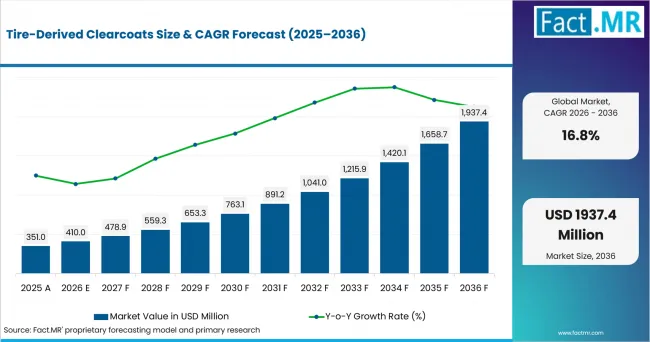
Tire Derived Clearcoats Value Analysis | Source: Fact.MR
What are the defining numbers behind Tire-Derived Clearcoats Market growth?
An absolute opportunity of USD 1,527.4 million is expected between 2026 and 2036.
- Demand Drivers in the Market
- Automotive OEM paint teams need clearcoat systems that preserve gloss and chemical resistance while supporting circular-content documentation for future vehicle programs.
- Refinish body shops value low-bake and fast-dry clearcoats because cycle time affects booth use, energy bills and same-day repair throughput.
- Chemical producers are establishing mass-balance routes for tire pyrolysis oil.
- Industrial coating formulators need traceable recycled inputs that fit 2K polyurethane and acrylic systems used on equipment, mobility parts and engineered plastics.
- Key Segments Analyzed
- By Circular Feedstock: Recovered carbon and aromatic intermediates are expected to hold 27.0% share in 2026 because they connect tire pyrolysis output with resin and additive pathways.
- By Clearcoat Chemistry: 2K polyurethane is projected to account for 32.0% share in 2026 owing to its fit with high-gloss automotive and industrial finishing.
- By End-use: Automotive OEM is anticipated to capture 37.0% share in 2026, supported by factory qualification systems and a clear link to vehicle circularity claims.
- By Circular Content Claim: 10-25% is estimated to represent 31.0% share in 2026 since coating users tend to start with moderate recycled-content claims.
- Analyst Opinion at Fact.MR
- Shambhu Nath Jha, Principal Consultant at Fact.MR, states, “The commercial test for tire-derived clearcoats is repeatability. A recycled feedstock story helps open the door, but the coating still has to cure, polish and weather like a familiar clearcoat. Suppliers are expected to gain ground when they combine mass-balance records, resin know-how and repair-shop proof in one qualification package.”
- Strategic Implications
- Resin producers should build mass-balance documentation around recovered carbon and aromatic intermediates before asking coating formulators to approve new recipes.
- Automotive OEM coating teams should run circular-content screening and appearance validation in parallel so material claims remain aligned with color-matching work.
- Refinish brands should position tire-derived clearcoats around booth productivity only where drying, sanding and polishing behavior matches current repair routines.
- Industrial coating formulators should use low-to-mid circular-content claims first, then expand content ranges after viscosity and weathering data stabilize.
The UK is projected to record 21.0% CAGR through 2036, driven by zero-emission vehicle registrations and traceable tire recovery. France is anticipated to advance at 20.2% CAGR, supported by electric car registrations and EU circular-vehicle rules. The USA is estimated to post 18.0% CAGR as scrap-tire recovery channels mature. Germany is forecast to reach 16.7% CAGR owing to vehicle-manufacturing depth and coatings qualification capacity. Japan is expected to record 14.7% CAGR because end-of-life tire utilization gives formulators a disciplined recovery base.
How does the Tire-Derived Clearcoats Market break down by segment?
Automotive OEM leads End-use at 37.0%; 2K polyurethane leads Clearcoat Chemistry at 32.0%.
Which Circular Feedstock dominates?
Recovered carbon and aromatic intermediates hold 27.0% share in 2026.
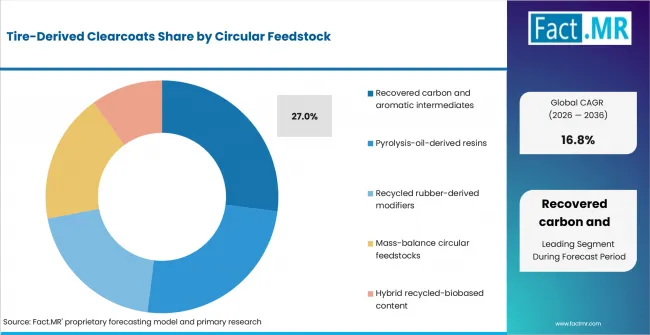
Tire Derived Clearcoats Analysis By Circular Feedstock | Source: Fact.MR
Recovered carbon and aromatic intermediates lead the feedstock segment because they are closest to the tire-pyrolysis output stream. Their value comes from linking tire-derived carbonaceous material with resin-building and modifier applications where identity and allocation records can be checked by customers.
The recovered carbon black base is relevant because tire pyrolysis already produces carbon-rich material alongside tire pyrolysis oil. Clearcoat formulators then evaluate whether the linked resin or modifier route maintains film clarity, gloss and color stability under automotive specifications.
What leads the Clearcoat Chemistry segment?
2K polyurethane accounts for 32.0% share in 2026.
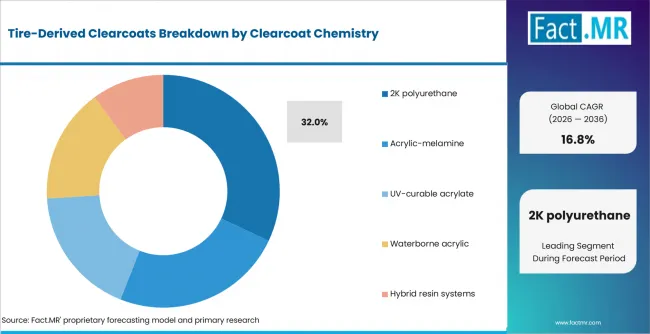
Tire Derived Clearcoats Analysis By Clearcoat Chemistry | Source: Fact.MR
2K polyurethane leads because automotive clearcoats need a hard, glossy film after curing. The chemistry is familiar to OEM and refinish users, so new recycled or tire-derived content can be evaluated inside known durability and mixing systems.
How does End-use shape demand?
Automotive OEM represents 37.0% share in 2026.
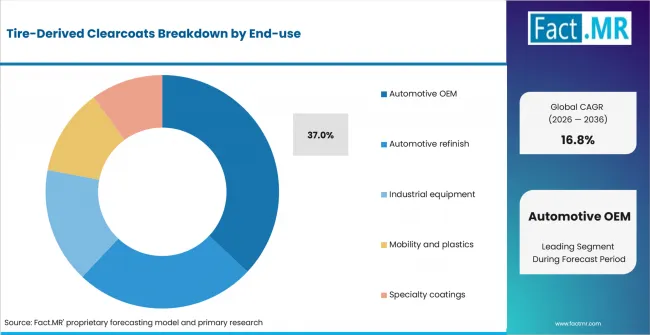
Tire Derived Clearcoats Analysis By End Use | Source: Fact.MR
Automotive OEM leads the end-use segment because factory coating programs create repeatable volumes and strict qualification routines. Tire-derived clearcoats must pass appearance, durability and line-performance checks before they enter platform-level approvals.
In December 2025, the European Parliament said around 6.5 million motor vehicles reach end of life in the EU every year.
What supports Circular Content Claim demand?
10-25% attributed content holds 26.0% share in 2026.
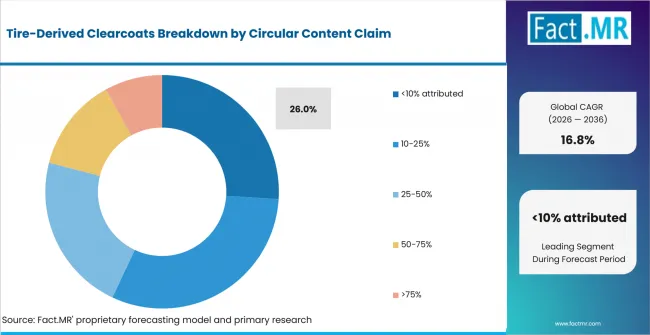
Tire Derived Clearcoats Analysis By Circular Content Claim | Source: Fact.MR
The 10-25% claim range leads because coating formulators need a cautious entry point for tire-derived content. A moderate range helps teams protect clarity, cure response and outdoor durability while still giving brand owners a measurable circular-content story.
Higher claim bands are expected to expand after repeated weathering and appearance data become available across OEM, refinish and industrial uses. Until then, moderate claims give suppliers a practical path for qualification inside existing coating binders and resin systems.
What is accelerating Tire-Derived Clearcoats Market adoption, and what is holding it back?
Demand is expected to rise through circular feedstock qualification and low-bake clearcoat productivity. Adoption is constrained by testing burden, input variation and documentation work.
Drivers Impact Analysis
| DRIVER | (~) % IMPACT ON CAGR | GEOGRAPHIC RELEVANCE | IMPACT TIMELINE |
|---|---|---|---|
| Circular feedstock allocation from tire pyrolysis oil | +2.1% | Europe, North America | Medium term (2-4 years) |
| Automotive OEM recycled-content qualification | +1.8% | Europe, Japan | Long term (>= 4 years) |
| Fast-dry refinish clearcoat productivity | +1.5% | USA, UK | Short term (<= 2 years) |
| Moderate circular-content claims in 10-25% range | +1.0% | Global | Medium term (2-4 years) |
- Circular feedstock allocation from tire pyrolysis oil: Tire pyrolysis oil can support recycled feedstock routes for coating-resin production through mass-balance accounting. Traceable allocation systems help connect end-of-life tire materials with downstream chemical products and provide documentation relevant to coating-resin qualification.
- Automotive OEM recycled-content qualification: Automotive circularity requirements are increasing attention on recycled materials, traceability, and supporting product documentation. Tire-derived clearcoat inputs can benefit where they meet OEM expectations for appearance, durability, processing consistency, and line performance.
- Fast-dry refinish clearcoat productivity: Fast-curing clearcoat systems can improve refinish-shop productivity by shortening drying cycles and reducing energy requirements. Suppliers that combine rapid curing with consistent gloss, surface quality, and application reliability can strengthen adoption across automotive repair and refinishing operations.
Opportunity Impact Analysis
| OPPORTUNITY | (~) % IMPACT ON CAGR | GEOGRAPHIC RELEVANCE | IMPACT TIMELINE |
|---|---|---|---|
| Mass-balance resin systems for clearcoat supply | +1.4% | Europe, USA | Medium term (2-4 years) |
| Waterborne and low-bake refinish systems | +1.0% | USA, UK, Japan | Short term (<= 2 years) |
| Industrial equipment and mobility plastics coatings | +0.8% | Germany, France | Long term (>= 4 years) |
- Mass-balance chemical-feedstock systems: Tire pyrolysis oil can enter chemical production through mass-balance routes that make downstream chemicals such as butadiene and styrene. Clearcoat use sits downstream of this chemical-feedstock stage and requires resin and formulation qualification.
- Waterborne and low-bake refinish systems: Refinish brands can position tire-derived clearcoats where repair shops already seek fast drying and lower energy use. The clearest case is in systems that protect gloss after short bake cycles.
- Industrial equipment and mobility plastics coatings: Specialty coating users are expected to test tire-derived inputs in lower-visibility applications first. Success in those applications can create data for more demanding exterior clearcoat approvals.
Restraints Impact Analysis
| RESTRAINT | (~) % IMPACT ON CAGR | GEOGRAPHIC RELEVANCE | IMPACT TIMELINE |
|---|---|---|---|
| Variation in tire-pyrolysis input quality | -0.8% | Global | Short term (<= 2 years) |
| Long automotive qualification cycles | -0.6% | Europe, Japan, USA | Medium term (2-4 years) |
| Color and gloss consistency burden | -0.4% | Global | Long term (>= 4 years) |
- Variation in tire-pyrolysis input quality: Different tire streams and reactor conditions can change oil composition. Resin producers therefore need repeatable specifications before formulators can scale clearcoat trials.
- Long automotive qualification cycles: OEM coating approval requires weathering, chemical resistance and line-performance testing across platforms. This slows the pace at which new circular feedstocks reach high-volume paint shops.
- Color and gloss consistency burden: Clearcoats are visible final layers, so small changes in haze or cure response can affect finish acceptance. Tire-derived routes must keep appearance stable across batches.
Which countries are scaling the Tire-Derived Clearcoats Market through 2036?
- The country comparison spans 6.29 percentage points and forms three practical growth bands across the forecast period.
- The UK remains 0.82 percentage point above France through zero-emission vehicle registrations and tire-recovery documentation.
- France remains 2.26 percentage points above the USA as electric-car registrations align with EU circular-vehicle design rules.
- The USA remains 1.21 percentage points above Germany as abandoned scrap-tire cleanup improves the circular feedstock discussion.
- Germany remains 2.00 percentage points above Japan through vehicle-manufacturing depth and coatings qualification capacity.
Comparable CAGRs can create different entry conditions due to vehicle production mix, resin qualification depth, end-of-life tire recovery and clearcoat testing routines. Full report coverage includes North America, Latin America, Western Europe, Eastern Europe, East Asia, South Asia & Pacific, Middle East & Africa.
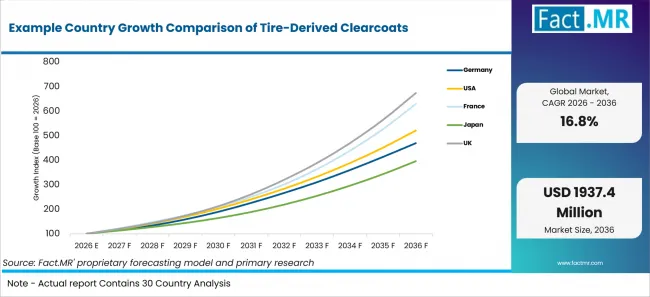
Example Country Growth Comparison Of Tire Derived Clearcoats | Source: Fact.MR
| Country | CAGR |
|---|---|
| United Kingdom | 21.0% |
| France | 20.2% |
| United States | 18.0% |
| Germany | 16.7% |
| Japan | 14.7% |
What supports UK adoption?
21.0% CAGR, supported by zero-emission vehicle registrations and tire-recovery documentation.
UK clearcoat demand is expected to gain from vehicle programs that need durable exterior finishes and traceable circular-content inputs. In April 2026, the Department for Transport reported 473,226 zero-emission cars first registered in 2025. The registration base provides context for automotive OEM and refinish activity relevant to clearcoat qualification.
How is France scaling demand?
20.2% CAGR, driven by electric-car registrations and circular vehicle rules.
France combines a sizable electric-car market with EU policy pressure on vehicle circularity. In February 2026, SDES reported 331,200 new electric-car registrations in France for 2025. The registration base provides automotive-market context for coating qualification and circular-content planning.
What supports USA growth?
18.0% CAGR, backed by scrap-tire recovery and refinish productivity.
The USA has a large repair base and a visible abandoned-tire cleanup issue, which gives tire-derived inputs a clear materials story. In March 2026, the U.S. Environmental Protection Agency reported that approximately 48 million abandoned scrap tires remained in at least 23 states and Tribal lands. The cleanup context highlights the scale of scrap-tire recovery activity relevant to circular feedstock discussions.
What is supporting Germany’s adoption?
16.7% CAGR, supported by vehicle registration depth and 2K polyurethane know-how.
Germany remains a demanding qualification market because OEM paint approval relies on consistent film performance. In March 2026, Destatis recorded 3,410.6 thousand new motor-vehicle registrations in Germany for 2025. The registration base provides context for Germany's automotive market and clearcoat qualification environment.
How does Japan perform?
14.7% CAGR, led by end-of-life tire utilization and high-specification coating demand.
Japan offers a disciplined tire-recovery environment and a high-expectation coating base. JATMA reported 708,000 tons of effectively utilized end-of-life tires in 2025. JATMA's data establish a high effective-utilization rate across multiple end-of-life tire routes, providing context for Japan's tire-recovery system.
Who leads the Tire-Derived Clearcoats Market?
BASF SE is an active participant through circular chemical-feedstock and mass-balance pathways that connect tire-pyrolysis inputs with downstream coating materials. Its role is strengthened by work linking end-of-life tires with recycled chemical products that can support resin and clearcoat qualification.
Pyrum Innovations AG is positioned within the tire-derived feedstock side of the value chain and is profiled alongside BASF in initiatives that convert end-of-life tires into recycled materials for new chemical and coating applications. This gives it relevance where pyrolysis-derived inputs need traceable routes into downstream formulations.
New Energy Recycling (NE-TECH Group), Cromology, and Gunvor Group are also included among the key providers reviewed in the market. Together, these companies represent different parts of the value chain spanning circular feedstock generation, chemical intermediates, coating formulation, and supply-chain participation.
Which companies are the key providers?
Key companies include BASF SE, Pyrum Innovations AG, New Energy Recycling (NE-TECH Group), Cromology, and Gunvor Group.
- BASF SE
- Pyrum Innovations AG
- New Energy Recycling (NE-TECH Group)
- Cromology
- Gunvor Group
Bibliography
- BASF SE. (2026, July 22). Pirelli, Pyrum, Synthos and BASF SE partner to transform end-of-life and scrap tyres into recycled materials for new products.
- Department for Transport. (2026, April 29). Vehicle licensing statistics, United Kingdom: 2025. GOV.UK.
- European Parliament. (2025, December 12). Circular economy: Deal on new EU rules for the automotive sector.
- Service des données et études statistiques. (2026, February 11). Immatriculations de voitures en 2025 : le marché du neuf baisse, celui de l’occasion résiste.
- Statistisches Bundesamt (Destatis). (2026, March 23). Neuzulassungen von Kraftfahrzeugen in Deutschland.
- U.S. Environmental Protection Agency. (2026, March 20). EPA releases proposal to help cleanup of millions of abandoned tires, promote energy dominance.
This Report Answers
- The report explains where tire-derived clearcoats are used across circular feedstock and clearcoat chemistry. It also connects tire-derived inputs with coating additives used in performance coating formulations.
- Segment analysis identifies why 2K polyurethane and automotive OEM uses lead early qualification. Related automotive coatings demand shapes the performance standards applied to recycled-content clearcoats.
- Country analysis examines the UK, France, the USA, Germany and Japan. The discussion links tire recovery with vehicle and repair activity across relevant refinish paints channels.
- Competitive analysis reviews providers with circular feedstock routes, refinish clearcoat portfolios and resin chemistry. Adjacent biomass-balanced coating additives show how chain-of-custody claims affect supplier selection.
- Application analysis assesses gloss, cure response and documentation needs across OEM and refinish users. The scope also relates to paints and coatings where binders, solvents and additives determine finished film behavior.
What does the Tire-Derived Clearcoats Market cover?
The Tire-Derived Clearcoats Market covers clearcoat systems that attribute part of their resin, modifier or carbon-derived content to end-of-life tire recovery. It includes direct recovered-carbon pathways and mass-balance routes that convert tire pyrolysis oil into chemical intermediates for coating production.
The assessment covers automotive OEM, automotive refinish, industrial equipment, mobility plastics and specialty coatings. Adjacent automotive tire activity is relevant because end-of-life tire streams provide the circular input base for tire-derived coating concepts.
What is included in the scope?
The scope includes tire-derived clearcoats based on 2K polyurethane, acrylic-melamine, UV-curable acrylate, waterborne acrylic and hybrid resin systems. It includes formulations that use recovered carbon, pyrolysis-oil-derived resins, recycled rubber modifiers and mass-balance circular feedstocks.
It includes OEM clearcoats, refinish clearcoats, specialty coating clear layers and industrial finishing systems where circular-content claims are documented. Related self-healing auto coatings are considered adjacent when the clearcoat layer is evaluated for gloss and surface durability.
What is excluded from the scope?
The scope excludes tire recycling equipment, tire manufacturing compounds, carbon black sold for rubber reinforcement and basecoat-only systems. It also excludes ordinary clearcoats that make recycled claims outside a documented tire-derived feedstock pathway.
The market assessment excludes tire-derived fuels and cement-kiln uses because they are energy-recovery routes. It includes chemical and coating routes where tire-derived inputs enter clearcoat resin, modifier or attributed-content systems.
How Was the Analysis Built?
The analysis draws on 120+ sources, 35+ company portfolios, 25+ countries, and more than 20 industry interviews.
- Primary Research: Primary research includes discussions with manufacturers, service providers, technology developers, distributors, end users, and subject-matter experts. These conversations examine purchasing priorities, product adoption, operational challenges, approval requirements, competitive positioning, and the factors that influence wider market acceptance.
- Desk Research: Desk research covers government statistics, regulatory publications, company filings, trade data, technical studies, industry associations, standards, public policy, and other authoritative sources. Every source used in the analysis is documented in the bibliography.
- Market Sizing and Forecasting: Market estimates combine historical performance, demand indicators, pricing and volume trends, segment shares, company participation, country-level growth, adoption patterns, investment activity, and barriers to market expansion.
- Data Validation and Update Cycle: Findings are validated by comparing primary interviews with public data, company activity, regulatory changes, trade patterns, and industry developments. Regular updates review new product launches, capacity changes, partnerships, approvals, and shifts in commercial adoption.
What is the report’s scope and coverage?
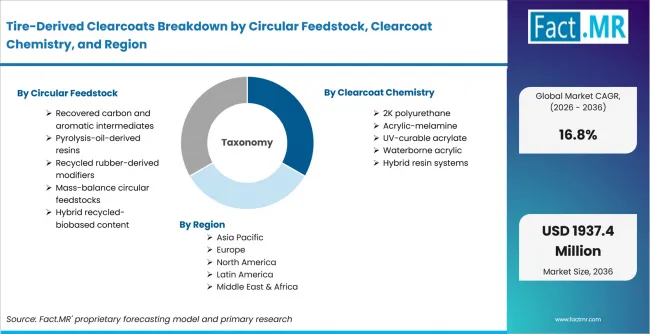
Tire Derived Clearcoats Breakdown By Circular Feedstock, Clearcoat Chemistry, And Region | Source: Fact.MR
| Attribute | Details |
|---|---|
| Quantitative Units | USD million |
| Market Definition | Clearcoat systems that use tire-derived circular inputs through recovered carbon, aromatic intermediates, pyrolysis-oil-derived resins, recycled rubber-derived modifiers or mass-balance feedstock allocation. |
| Circular Feedstock | Recovered carbon and aromatic intermediates; Pyrolysis-oil-derived resins; Recycled rubber-derived modifiers; Mass-balance circular feedstocks; Hybrid recycled-biobased content |
| Clearcoat Chemistry | 2K polyurethane; Acrylic-melamine; UV-curable acrylate; Waterborne acrylic; Hybrid resin systems |
| End-use | Automotive OEM; Automotive refinish; Industrial equipment; Mobility and plastics; Specialty coatings |
| Circular Content Claim | <10% attributed; 10-25%; 25-50%; 50-75%; >75% |
| Regions Covered | North America; Latin America; Western Europe; Eastern Europe; East Asia; South Asia & Pacific; Middle East & Africa |
| Countries Covered | United Kingdom; France; United States; Germany; Japan |
| Key Companies Profiled | BASF SE; Pyrum Innovations AG; New Energy Recycling (NE-TECH Group); Cromology; Gunvor Group |
| Forecast Period | 2026 to 2036 |
| Approach | Hybrid top-down and bottom-up approach using vehicle production indicators; coating chemistry demand; tire recovery streams; resin qualification pathways; country CAGR inputs; and provider portfolio review. |
How is the market segmented?
-
By Circular Feedstock
- Recovered carbon and aromatic intermediates
- Pyrolysis-oil-derived resins
- Recycled rubber-derived modifiers
- Mass-balance circular feedstocks
- Hybrid recycled-biobased content
-
By Clearcoat Chemistry
- 2K polyurethane
- Acrylic-melamine
- UV-curable acrylate
- Waterborne acrylic
- Hybrid resin systems
-
By End-use
- Automotive OEM
- Automotive refinish
- Industrial equipment
- Mobility and plastics
- Specialty coatings
-
By Circular Content Claim
- <10% attributed
- 10-25%
- 25-50%
- 50-75%
- >75%
-
By Region
- North America
- Latin America
- Western Europe
- Eastern Europe
- East Asia
- South Asia & Pacific
- Middle East & Africa