- Market Value (2025): USD 1.3 Bn
- Estimated Value (2026): USD 1.4 Bn
- Forecast Value (2036): USD 2.8 Bn
- CAGR (2026-2036): 7.4%
What is the In-Mold PU Coatings Market forecast to be worth by 2036?
USD 1.4 billion in 2026 to USD 2.8 billion by 2036 at a 7.4% CAGR.
- The In-Mold PU Coatings Market reached USD 1.3 billion in 2025.
- Demand is projected to increase from USD 1.4 billion in 2026 to USD 2.8 billion by 2036.
- The market is forecast to record 7.4% CAGR from 2026 to 2036 as automotive interiors and exterior trim move selected surface finishing into the mold.
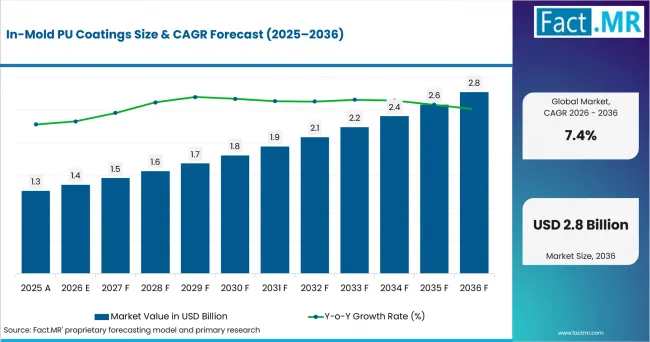
In Mold Pu Coatings Value Analysis | Source: Fact.MR
What are the defining numbers behind In-Mold PU Coatings Market growth?
USD 1.4 billion absolute opportunity by 2036, led by Aliphatic 2K PU, RIM and polyurethane molding and automotive interior parts.
- Demand Drivers in the Market
- Automotive interior teams need molded surfaces that retain gloss, soft touch and scratch control after assembly and cleaning.
- Tier molders need lower process complexity when paint-line space, curing energy and overspray control add cost to molded plastic parts.
- Coatings formulators need aliphatic 2K PU systems that cure reliably in the tool and protect visible surfaces.
- Industrial part producers need coatings that bond to plastics and composites while meeting chemical resistance and weathering targets.
- Key Segments Analyzed
- By PU Chemistry: Aliphatic 2K PU is expected to hold 34.0% share in 2026 due to its clarity, UV resistance and premium surface performance.
- By Molding Process: RIM and polyurethane molding is projected to account for 32.0% share in 2026 because reactive PU flow fits in-tool curing.
- By Substrate and Part: Automotive interior parts are anticipated to capture 31.0% share in 2026 as instrument panels and trim need repeatable surface quality.
- By Performance Target: Class-A surface is estimated to represent 29.0% share in 2026 owing to OEM focus on visible panels and defect-free molded finishes.
- Analyst Opinion at Fact.MR
- Shambhu Nath Jha, Principal Consultant at Fact.MR, states, “In-mold PU coatings draw attention because they move finish quality into the molding cell. The market is expected to favor systems that prove adhesion, gloss retention and cycle behavior on the actual part geometry. Suppliers should combine resin chemistry, mold-trial support and test documentation so OEM and tier teams can approve coated parts with fewer rework loops.”
- Strategic Implications
- Coating suppliers should document adhesion and mar resistance on the exact plastic or composite substrate targeted by each program.
- Molders should evaluate tool temperature, flow path and cure time together before quoting parts that require a Class-A surface.
- OEM surface teams should compare in-mold PU against spray coating on energy use, scrap reduction and repeatability.
- Application labs should give customers trial panels that mirror final texture, gloss and cleaning exposure.
Japan is projected to record 9.0% CAGR through 2036 due to automotive surface requirements and tightly controlled molding operations. The USA is expected to post 8.0% CAGR as domestic part programs use coated plastics to reduce finish-line complexity. Germany is anticipated to advance at 7.4% CAGR, supported by its automotive and plastics base. The UK is forecast to hold 6.3% CAGR where vehicle electrification and specialty manufacturing sustain trials. Italy is estimated to reach 6.0% CAGR as molded-part finishing stays tied to vehicle registrations and industrial cost discipline.
How does the In-Mold PU Coatings Market break down by segment?
Aliphatic 2K PU leads at 34.0%; RIM and polyurethane molding leads at 32.0%.
Which PU Chemistry dominates?
Aliphatic 2K PU holds 34.0% share in 2026.
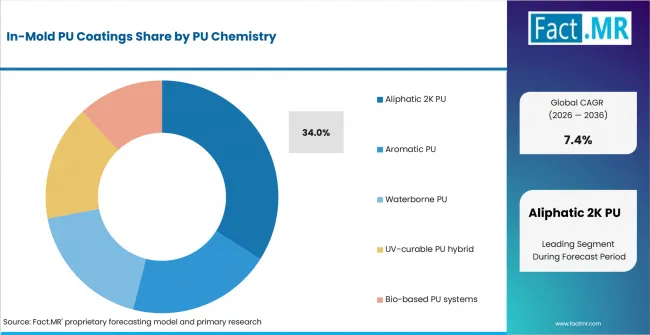
In Mold Pu Coatings Analysis By Pu Chemistry | Source: Fact.MR
Aliphatic 2K PU leads because it gives molded parts a clear and durable coating with better color stability than aromatic systems. That makes it suitable for illuminated trim, gloss-black panels and other surfaces that remain visible to the customer.
Low-viscosity 2K PU can be applied in a second cavity and cured inside the mold. Formulators therefore gain a route to combine premium haptics with automotive part productivity.
What leads the Molding Process segment?
RIM and polyurethane molding accounts for 32.0% share in 2026.
RIM and polyurethane molding lead because reactive PU systems flow into the cavity and cure around complex surfaces. The process suits parts that need coating thickness, soft touch or optical depth within the molding cycle.
Molders favor this route when one tool can create the part geometry and the finished surface. That process fit supports aliphatic 2K PU where visible trim requires repeatable gloss and surface feel.
How does Substrate and Part shape demand?
Automotive interior parts capture 31.0% share in 2026.
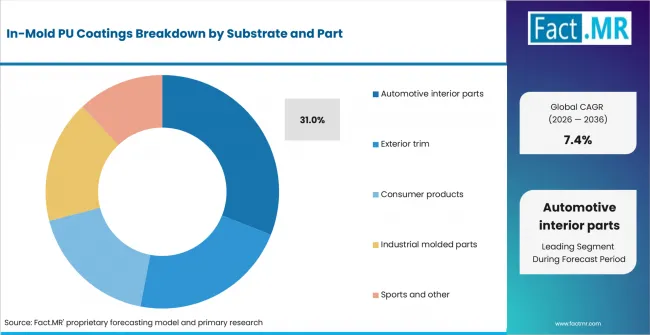
In Mold Pu Coatings Analysis By Substrate And Part | Source: Fact.MR
Automotive interior parts lead because users see and touch these components throughout vehicle life. In-mold PU coating helps molders add gloss, texture and scratch resistance while reducing separate handling after molding.
Interior trim also gives coating suppliers a route to prove surface stability under cleaning, heat and repeated contact. Once validated, the same coating platform can move across related molded cabin parts.
What supports the Performance Target segment?
Class-A surface represents 29.0% share in 2026.
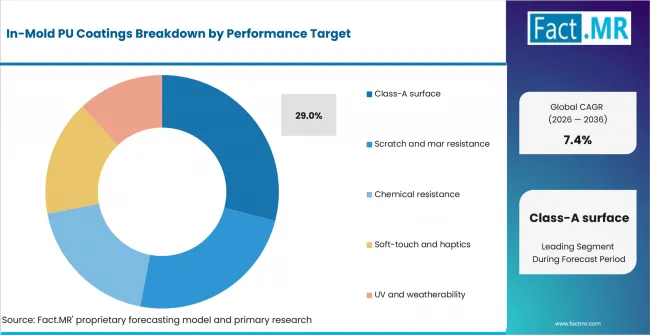
In Mold Pu Coatings Analysis By Performance Target | Source: Fact.MR
Class-A surface leads because visible parts expose flow marks, orange peel defects and gloss mismatch. In-mold PU coating helps control the finish inside the tool so appearance and protection are created during molding.
PPG introduced DELTRON® D8178 Rapid Low Energy clearcoat across EMEA in March 2026. PPG stated that its 20°C air-dry mode can deliver up to 60% energy savings compared with a standard clearcoat baked for 20 minutes at 60°C.
What is accelerating In-Mold PU Coatings Market adoption, and what is holding it back?
Demand is rising through integrated molding cells, automotive interior upgrades and surface-performance requirements.
Drivers Impact Analysis
| DRIVER | (~) % IMPACT ON CAGR | GEOGRAPHIC RELEVANCE | IMPACT TIMELINE |
|---|---|---|---|
| Automotive visible-part finishing | +1.8% | Japan, Germany, USA | Short term (<= 2 years) |
| Paint-line energy and handling reduction | +1.4% | Europe, North America | Medium term (2-4 years) |
| Premium haptics and smart interior surfaces | +1.1% | Japan, Germany, UK | Medium term (2-4 years) |
| Adhesion to plastics and composites | +0.8% | Global | Long term (>= 4 years) |
Source: Fact.MR analysis. Updated Sep 4, 2026
- Automotive visible-part finishing: Interior and exterior trim programs use in-mold PU when the part must leave the mold with a controlled finish.
- Paint-line energy and handling reduction: Integrated coating reduces extra movement, drying and overspray control for selected molded plastic parts.
- Premium haptics and smart surfaces: Touch panels, light bars and gloss trim require coatings that protect the surface while preserving the design.
Opportunity Impact Analysis
| OPPORTUNITY | (~) % IMPACT ON CAGR | GEOGRAPHIC RELEVANCE | IMPACT TIMELINE |
|---|---|---|---|
| Bio-based PU systems for molded parts | +1.0% | Europe, Japan | Medium term (2-4 years) |
| Composite molded-part coating | +0.7% | USA, Italy | Long term (>= 4 years) |
| Waterborne PU in lower-emission programs | +0.6% | Europe, North America | Short term (<= 2 years) |
Source: Fact.MR analysis. Updated Sep 4, 2026
- Bio-based PU systems: Mass-balance and lower-carbon resin options create a route for OEM programs that track material footprints.
- Composite molded-part coating: Lightweight exterior and sports parts create room for PU coatings that follow complex shapes and protect exposed surfaces.
- Waterborne PU programs: Lower-emission coating goals support trials where in-mold finishing needs safer handling and reduced solvent exposure.
Restraints Impact Analysis
| RESTRAINT | (~) % IMPACT ON CAGR | GEOGRAPHIC RELEVANCE | IMPACT TIMELINE |
|---|---|---|---|
| Tooling and process validation burden | -0.8% | Global | Short term (<= 2 years) |
| Raw material and chemical price volatility | -0.6% | Europe, USA | Medium term (2-4 years) |
| Limited fit for hidden parts | -0.4% | Global | Long term (>= 4 years) |
Source: Fact.MR analysis. Updated Sep 4, 2026
- Tooling and process validation burden: In-mold coating requires tool design, cavity control and cure behavior to match the production part.
- Raw material and chemical price volatility: Isocyanates, polyols and additives affect part economics when OEMs compare coating routes.
- Limited fit for hidden parts: Hidden molded components usually retain simpler finishes, so in-mold PU is concentrated in visible or touched parts.
Which countries are scaling the In-Mold PU Coatings Market through 2036?
- The country comparison spans 3.01 percentage points and forms three practical growth bands across the forecast period.
- Japan remains 1.02 percentage points above the USA through premium molded-surface requirements and controlled automotive production routines.
- The USA remains 0.59 percentage point above Germany as domestic part programs support coated plastic qualification work.
- Germany remains 1.06 percentage points above the UK through automotive production depth and plastics-processing capability.
- The UK remains 0.34 percentage point above Italy as zero-emission vehicle registrations create model-refresh opportunities.
- Italy closes the displayed range through vehicle registration activity and design-led molded component demand.
Comparable CAGRs can create different entry conditions due to automotive production mix, mold-trial capacity, coating validation routines and energy-cost pressure. Full report coverage includes North America, Latin America, Western Europe, Eastern Europe, East Asia, South Asia & Pacific, Middle East & Africa.
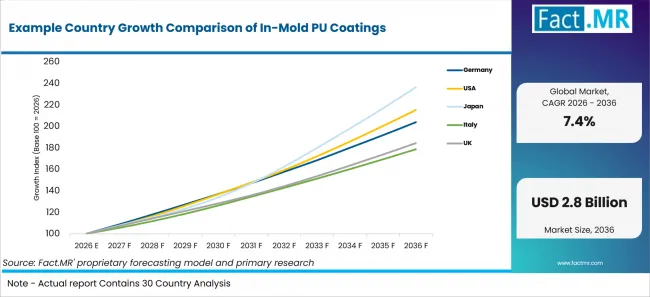
Example Country Growth Comparison Of In Mold Pu Coatings | Source: Fact.MR
| Country | CAGR (2026-2036) |
|---|---|
| Japan | 9.0% |
| USA | 8.0% |
| Germany | 7.4% |
| UK | 6.3% |
| Italy | 6.0% |
Source: Fact.MR analysis. Updated Sep 4, 2026
How does Japan perform?
9.0% CAGR, supported by automotive surface discipline and premium molded-part requirements.
Japan benefits from automotive programs that treat trim quality as part of the full part-design decision. The Statistics Bureau of Japan e-Stat Dashboard listed 417,153 new vehicle sales for July 2026 in an update dated August 6, 2026.
What supports USA adoption?
8.0% CAGR, led by molded automotive parts and process-efficiency pressure.
U.S. adoption is shaped by large molded-part programs and tier suppliers that compare in-mold PU against spray coating for cycle time and finish consistency. The Federal Reserve Board reported on August 18, 2026 that manufacturing output excluding motor vehicles and parts increased 0.4% in July 2026.
What is supporting Germany’s adoption?
7.4% CAGR, backed by automotive output and surface-quality expectations.
Germany’s surface-coating demand is tied to OEM approval routines where adhesion, UV exposure and scratch resistance are tested before series production. Destatis's GENESIS table 42131-0003 lists the 2025 value of motor vehicles and motor-vehicle parts production intended for sale at EUR 274.821 billion.
What supports the United Kingdom’s growth?
6.3% CAGR, driven by vehicle electrification and specialty manufacturing demand.
The UK outlook is linked to model refresh, specialty vehicle programs and EV interior design. The Department for Transport reported 528,000 zero-emission vehicles registered for the first time in 2025, up 24% from 2024.
How is Italy developing demand?
6.0% CAGR, supported by vehicle registration activity and design-led molded components.
Italy’s demand is shaped by design-focused interiors and exterior accents where gloss, texture and soft-touch effects need stable production quality. The Ministry of Infrastructure and Transport reported 146,423 car registrations in June 2026, up 10.59% from June 2025.
Who leads the In-Mold PU Coatings Market?
Covestro has direct, source-confirmed in-mold PU coating technology through its Direct Coating platform, which combines injection molding with a polyurethane coating in a two-shot process for automotive plastic components.
BASF contributes automotive coating-resin capability. In March 2025, BASF Coatings expanded annual polyester and polyurethane resin capacity at its Caojing plant in Shanghai from 8,000 metric tons to 18,800 metric tons, with the resins used in automotive spraycoats. Huntsman contributes polyurethane composite technologies for automotive parts, including resin-transfer and compression-moulding systems.
PPG, AkzoNobel and Mankiewicz extend the adjacent capability set through automotive clearcoat, composite in-mould coating and automotive plastic-part coating portfolios. The competitive review therefore distinguishes direct in-mold PU technology from adjacent coating and molding capabilities.
Which companies are the key providers?
Key companies include Covestro, BASF, Huntsman, PPG, AkzoNobel, and Mankiewicz.
- Covestro
- BASF
- Huntsman
- PPG
- AkzoNobel
- Mankiewicz
Bibliography
- Covestro. (2025, December 17). Covestro accelerates automotive coatings innovation with Direct Coating – The In-Mold Coating technology.
- BASF. (2025, March 24). BASF Coatings increases production capacities in Caojing, China to meet growing automotive demand in Asia Pacific.
- PPG. (2026, March 9). PPG introduces fast-drying clearcoat to PPG DELTRON automotive refinish line.
- U.S. Census Bureau. (2026, August 4). Table 2. Value of manufacturers’ new orders for industry groups [June 2026 M3 full report].
- Board of Governors of the Federal Reserve System. (2026, August 18). Industrial Production and Capacity Utilization - G.17.
- Statistisches Bundesamt (Destatis). (2026, July 22). Produktion im Verarbeitenden Gewerbe: Deutschland, Jahre, Güterverzeichnis (2-/4-Steller) [Production in manufacturing: Germany, years, product classification (2-/4-digit)] (GENESIS-Online Table 42131-0003).
- Department for Transport. (2026, April 29). Vehicle licensing statistics, United Kingdom: 2025. GOV.UK.
- Ministero delle Infrastrutture e dei Trasporti. (2026, July 1). Auto: 146.423 immatricolazioni a giugno (+10,59% rispetto allo stesso mese dell’anno precedente).
This Report Answers
- The report explains where in-mold PU coatings are used across chemistry, molding process and molded-part application.
- Segment analysis identifies the leading subsegments and the operating reasons buyers prioritize them.
- Country analysis examines the listed markets and the manufacturing indicators that support coated molded-part demand.
- Competitive analysis reviews current providers across PU chemistry, automotive coatings, clearcoats and specialty plastic-part coatings.
- Application analysis assesses how Class-A surface quality, haptics and chemical resistance influence supplier selection.
What does the In-Mold PU Coatings Market cover?
The In-Mold PU Coatings Market covers polyurethane coating systems used inside molding operations to finish visible plastic, composite and PU parts. It is adjacent to in-mold coatings and urethane surface coatings, while the analysis stays centered on PU chemistry applied during molding.
The assessment includes automotive interiors, exterior trim and molded industrial parts. It connects with automotive coating systems, automotive OEM coatings and automotive plastic components where finished surface quality shapes material choice.
What is included in the scope?
The scope includes aliphatic 2K PU, aromatic PU, waterborne PU, UV-curable PU hybrids and bio-based PU systems. It covers RIM, injection molding, compression molding and composite molding.
It includes coating systems, raw-material packages and formulation support linked to polyurethane dispersions, waterborne polyurethane dispersion and coating binders when these materials are used for in-mold PU coating applications.
What is excluded from the scope?
The scope excludes standard post-mold spray coating, decorative films, paint equipment sold without PU chemistry and general injection molding machines when the machine sale is separate from any in-mold coating function.
Powder coatings and conventional refinish materials are outside the market boundary when they are used away from the molding cycle. These categories are considered only where they influence substitution against in-mold PU coating.
How Was the Analysis Built?
The analysis draws on 120+ sources, 35+ company portfolios, 25+ countries, and more than 20 industry interviews.
- Primary Research: Primary research includes discussions with manufacturers, service providers, technology developers, distributors, end users, and subject-matter experts. These conversations examine purchasing priorities, product adoption, operational challenges, approval requirements, competitive positioning, and the factors that influence wider market acceptance.
- Desk Research: Desk research covers government statistics, regulatory publications, company filings, trade data, technical studies, industry associations, standards, public policy, and other authoritative sources. Every source used in the analysis is documented in the bibliography.
- Market Sizing and Forecasting: Market estimates combine historical performance, demand indicators, pricing and volume trends, segment shares, company participation, country-level growth, adoption patterns, investment activity, and barriers to market expansion.
- Data Validation and Update Cycle: Findings are validated by comparing primary interviews with public data, company activity, regulatory changes, trade patterns, and industry developments. Regular updates review new product launches, capacity changes, partnerships, approvals, and shifts in commercial adoption.
Segmentation
What is the report’s scope and coverage?
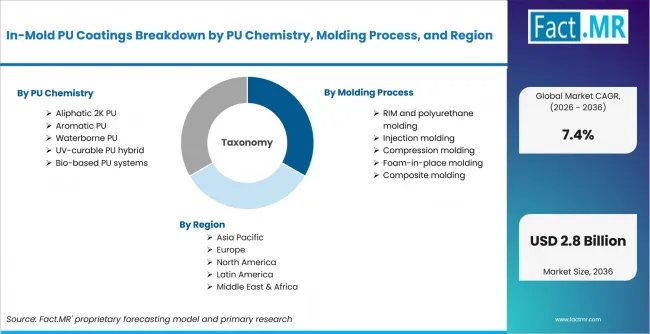
In Mold Pu Coatings Breakdown By Pu Chemistry, Molding Process, And Region | Source: Fact.MR
| Attribute | Details |
|---|---|
| Quantitative Units | USD billion |
| Market Definition | Polyurethane coating systems applied during molding to create a finished or protected surface on molded plastic, composite or PU parts. |
| PU Chemistry | Aliphatic 2K PU; Aromatic PU; Waterborne PU; UV-curable PU hybrid; Bio-based PU systems |
| Molding Process | RIM and polyurethane molding; Injection molding; Compression molding; Foam-in-place molding; Composite molding |
| Substrate and Part | Automotive interior parts; Exterior trim; Consumer products; Industrial molded parts; Sports and other |
| Performance Target | Class-A surface; Scratch and mar resistance; Chemical resistance; Soft-touch and haptics; UV and weatherability |
| Regions Covered | North America; Latin America; Western Europe; Eastern Europe; East Asia; South Asia & Pacific; Middle East & Africa |
| Countries Covered | Germany; USA; Japan; Italy; UK |
| Key Companies Profiled | Covestro; BASF; Huntsman; PPG; AkzoNobel; Mankiewicz |
| Forecast Period | 2026 to 2036 |
| Approach | Hybrid top-down and bottom-up approach using molded-part demand, PU coating intensity, process adoption, country-level manufacturing indicators and provider portfolio review. |
Source: Fact.MR analysis. Updated Sep 4, 2026
How is the market segmented?
-
By PU Chemistry
- Aliphatic 2K PU
- Aromatic PU
- Waterborne PU
- UV-curable PU hybrid
- Bio-based PU systems
-
By Molding Process
- RIM and polyurethane molding
- Injection molding
- Compression molding
- Foam-in-place molding
- Composite molding
-
By Substrate and Part
- Automotive interior parts
- Exterior trim
- Consumer products
- Industrial molded parts
- Sports and other
-
By Performance Target
- Class-A surface
- Scratch and mar resistance
- Chemical resistance
- Soft-touch and haptics
- UV and weatherability
-
By Region
- North America
- Latin America
- Western Europe
- Eastern Europe
- East Asia
- South Asia & Pacific
- Middle East & Africa
Frequently Asked Questions
How big is the in-mold PU coatings market in 2026?
What is the CAGR of the in-mold PU coatings market from 2026 to 2036?
Which PU chemistry leads the in-mold PU coatings market?
Which molding process leads the in-mold PU coatings market?
Which companies are reviewed for in-mold PU coating capabilities?
Who worked on this report


Preview the report firsthand - request a free sample
Free SampleGet the brochure for pricing and purchase details
Download PDF