- Market Value (2025): USD 1.07 Bn
- Estimated Value (2026): USD 1.13 Bn
- Forecast Value (2036): USD 1.99 Bn
- CAGR (2026-2036): 5.8%
What is the Tube Filler Market forecast to be worth by 2036?
USD 1.1 billion in 2026 to USD 2.0 billion by 2036 at a 5.8% CAGR.
- As per Fact.MR analysis, the tube filler market reached USD 1.07 billion in 2025.
- Sales are projected to rise from USD 1.13 billion in 2026 to USD 1.99 billion by 2036.
- The tube filler market is forecast to record a 5.8% CAGR between 2026 and 2036.
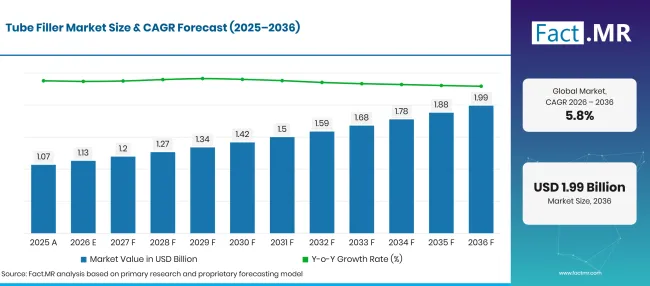
Factmr Tube Filler Market Forecast Global | Source: Fact.MR
| Year | Basis | Market Value (USD billion) |
|---|---|---|
| 2025 | Actual | 1.07 |
| 2026 | Estimate | 1.13 |
| 2036 | Forecast | 1.99 |
| CAGR 2026 to 2036 | Forecast period | 5.8% |
Source: Fact.MR analysis. Updated Oct 16, 2026
What are the defining numbers behind Tube Filler Market growth?
An absolute opportunity of USD 0.9 billion is expected between 2026 and 2036.
- Demand Drivers in the Market
- Pharmaceutical makers need controlled dosing and sound seals when packing topical creams and medicinal gels. Product contact parts and cleaning access influence which filling machine a plant selects.
- Cosmetics makers change tube size and formulation more often than makers handling a single product. Adjustable filling heads help teams move between personal care batches while keeping the sealed tube steady.
- Contract packers often fill several formulations on the same line and need accurate settings for different tube sizes.
- Key Segments Analyzed
- By Product Type: Automatic Tube Fillers account for 48.2% share in 2026, reflecting their fit with continuous production lines and repeatable filling needs.
- By Application: Pharmaceuticals represent 38.2% share in 2026, supported by traceability and precise dispensing needs for products packed in tubes.
- By Material Type: Plastic tubes hold 42.3% share in 2026, as makers use them for squeezable creams and other personal care products.
- By End-User: Manufacturing accounts for 62.7% share in 2026 because factory teams purchase complete filling systems for repeat production.
- Analyst Opinion at Fact.MR
- Shambhu Nath Jha, Principal Consultant at Fact.MR, states, “Tube-filler purchases depend on the performance of the wider packaging line rather than the filling machine alone. The equipment must suit the tube dimensions and sealing method, and operators need convenient cleaning access between product batches.”
- Strategic Implications
- Equipment makers can demonstrate filling performance across thick creams and lighter gels by using products that closely match the customer's formulations.
- Pharmaceutical companies need to review cleaning access and batch documentation early, as approval processes often take longer than machine installation.
- Packaging-line integrators need to keep filling, tube loading, and cartoning properly coordinated so delays in one stage do not slow the entire line.
Germany is forecast to advance at 6.7% CAGR through 2036 as pharmaceutical packaging and specialist machinery expertise shape investment. Brazil follows at 6.1% amid product variety in personal care and medicine.
How does the Tube Filler Market break down by segment?
Fact.MR analysis indicates that automatic Tube Fillers lead at 48.2%; Pharmaceuticals at 38.2%; Plastic at 42.3%; Manufacturing at 62.7%.
Which Product Type dominates?
Automatic Tube Fillers are projected to hold 48.2% share in 2026.
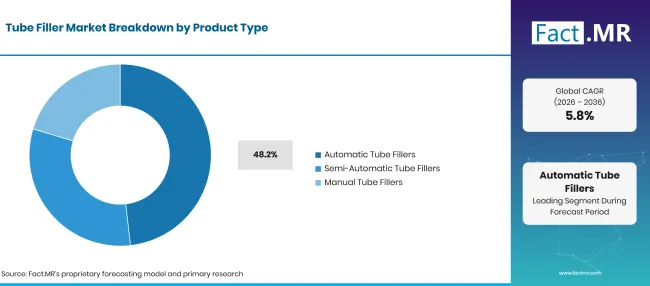
Factmr Tube Filler Market Breakdown Product Type | Source: Fact.MR
| Product Type | Share (2026) |
|---|---|
| Automatic Tube Fillers (Leading segment) | 48.2% |
| Other segments combined | 51.8%* |
| Total | 100.0% |
Source: Fact.MR analysis. Updated Oct 16, 2026
Fact.MR analysis suggests that automatic machines are suitable for factories needing repeat fills over longer production runs. Operators can combine tube loading and filling with sealing and discharge controls that help production teams limit handling between jobs. Semi-automatic machines still have a place for shorter runs with tighter capital budgets or for frequent product changes.
Manual units serve testing work and very small orders, where the investment in a complete line may be difficult to justify. Norden displayed its NM 702 filler at the September 2025 PPMA event, illustrating the continued focus on flexible automatic machines [7].
What leads the Application segment?
Pharmaceuticals are estimated to capture 38.2% share in 2026.
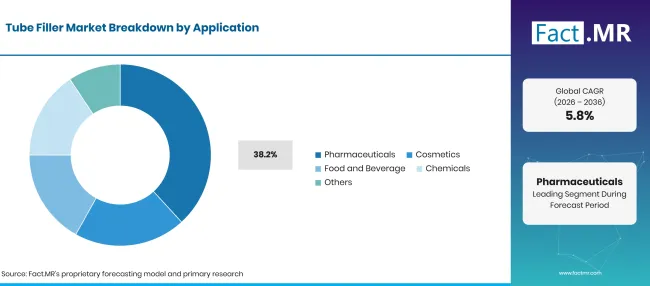
Factmr Tube Filler Market Breakdown Application | Source: Fact.MR
| Application | Share (2026) |
|---|---|
| Pharmaceuticals (Leading segment) | 38.2% |
| Other segments combined | 61.8%* |
| Total | 100.0% |
Source: Fact.MR analysis. Updated Oct 16, 2026
Pharmaceutical uses place weight on fill repeatability and the condition of finished seals. Creams and topical gels need machines that handles product thickness without leaving unwanted residue near the closure. Cosmetics makers also purchase tube fillers, mainly for lotions and skin-care products sold in multiple sizes.
How does Material Type influence selection?
Plastic is forecast to account for 42.3% share in 2026.
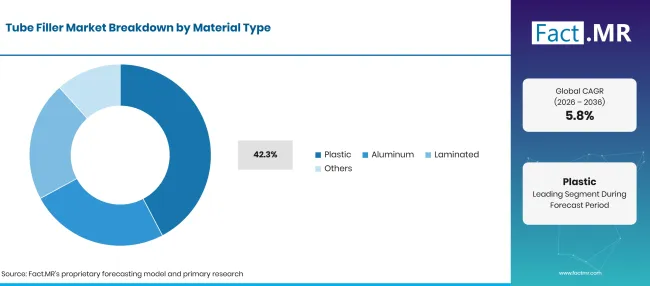
Factmr Tube Filler Market Breakdown Material Type | Source: Fact.MR
| Material Type | Share (2026) |
|---|---|
| Plastic (Leading segment) | 42.3% |
| Other segments combined | 57.7%* |
| Total | 100.0% |
Source: Fact.MR analysis. Updated Oct 16, 2026
Plastic tubes are suitable for a wide range of personal care and topical products due to their flexible shapes. The equipment must ensure that the plastic tubes are filled securely while also safeguarding the package body. In order to achieve consistent seams, laminated tubes necessitate meticulously controlled heat settings, and we require an alternative method of closing aluminum tubes. In July 2025, Norden presented the NM 702 as suitable for plastic, metal and laminated tube formats at INTERPHEX Week Tokyo [6].
Which End-User accounts for more sales?
Manufacturing is projected to represent 62.7% share in 2026.
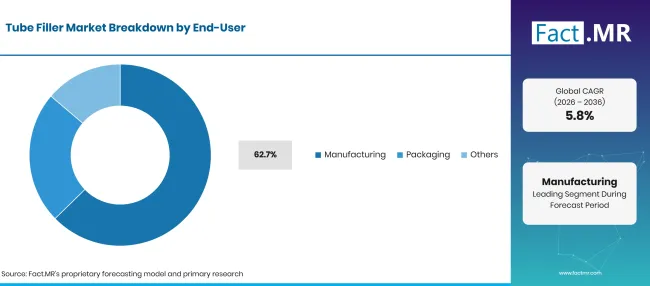
Factmr Tube Filler Market Breakdown End User | Source: Fact.MR
| End-User | Share (2026) |
|---|---|
| Manufacturing (Leading segment) | 62.7% |
| Other segments combined | 37.3%* |
| Total | 100.0% |
Source: Fact.MR analysis. Updated Oct 16, 2026
Tube fillers are purchased by manufacturing plants as part of a repeatable filling and packing operation. Before choosing a model, their engineering teams consider uptime and access to service. Where individual orders vary in size from month to month, packaging service companies and other end users will prefer units that can change formats quickly.
What is accelerating Tube Filler Market adoption, and what is holding it back?
Purchases are supported by repeatable dosing and flexible tube handling; installations are constrained by testing and approval costs and changeover challenges.
Drivers Impact Analysis
| DRIVER | (~) % IMPACT ON CAGR | GEOGRAPHIC RELEVANCE | IMPACT TIMELINE |
|---|---|---|---|
| Automatic filling for longer production runs | +1.0% | Europe, North America | Medium term (2–4 years) |
| Pharmaceutical fill control | +0.9% | Global | Medium term (2–4 years) |
| Flexible tube handling in personal care | +0.8% | Latin America, Asia | Short term (<= 2 years) |
| Multiple packaging formats | +0.6% | Global | Medium term (2–4 years) |
| Line integration and service support | +0.4% | Global | Long term (>= 4 years) |
Source: Fact.MR analysis. Updated Oct 16, 2026
Opportunity Impact Analysis
| OPPORTUNITY | (~) % IMPACT ON CAGR | GEOGRAPHIC RELEVANCE | IMPACT TIMELINE |
|---|---|---|---|
| Changeover-focused machines | +0.8% | Global | Medium term (2–4 years) |
| Contract packaging investment | +0.6% | North America, Europe | Medium term (2–4 years) |
| Tube and cartoning integration | +0.5% | Global | Long term (>= 4 years) |
| Mixed-material filling lines | +0.4% | Asia, Europe | Medium term (2–4 years) |
Source: Fact.MR analysis. Updated Oct 16, 2026
Restraints Impact Analysis
| RESTRAINT | (~) % IMPACT ON CAGR | GEOGRAPHIC RELEVANCE | IMPACT TIMELINE |
|---|---|---|---|
| High initial investment | -0.8% | Global | Short term (<= 2 years) |
| Validation and cleaning workload | -0.6% | North America, Europe | Medium term (2–4 years) |
| Tube material changes | -0.5% | Global | Medium term (2–4 years) |
| Uneven factory investment | -0.4% | Europe, Asia | Short term (<= 2 years) |
Source: Fact.MR analysis. Updated Oct 16, 2026
Which countries are scaling the Tube Filler Market through 2036?
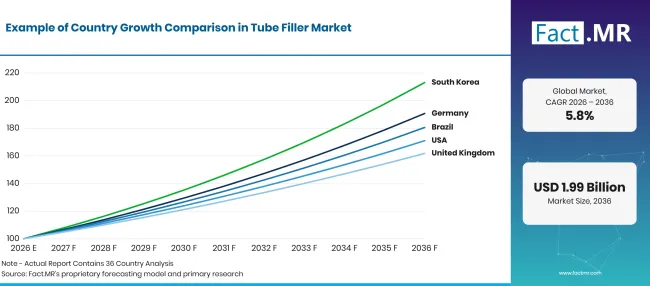
Factmr Tube Filler Market Growth Index | Source: Fact.MR
| Country | CAGR (2026–2036) |
|---|---|
| Germany | 6.7% |
| Brazil | 6.1% |
| USA | 5.5% |
| UK | 4.9% |
| Japan | 4.4% |
Source: Fact.MR analysis. Updated Oct 16, 2026
Why is Germany strengthening tube filler adoption?
6.7% CAGR, supported by packaging machinery expertise and pharmaceutical production.
Germany combines a strong machinery industry with a large pharmaceutical manufacturing base. Destatis reported pharmaceutical exports worth EUR 28.0 billion to the United States in 2025 [2]. Local suppliers help factories introduce new tube formats and adjust production lines when needed. Pharmaceutical and cosmetics manufacturers look for consistent filling quality, reliable operation, and dependable service support.
How is Brazil expanding tube filler use?
6.1% CAGR, shaped by varied cosmetics and pharmaceutical production.
Brazilian manufacturers produce a wide range of creams, personal care items, medicines, and other products packed in tubes. Anvisa reported medicine sales exceeding R$ 180 billion in 2025 [1]. Cosmetics companies also launch products in different pack sizes, which increases the need for flexible filling equipment. Semi-automatic and automatic machines can support both smaller batches and higher-volume production.
What is driving tube filler sales in the United States?
5.5% CAGR, linked to controlled filling processes and factory modernization.
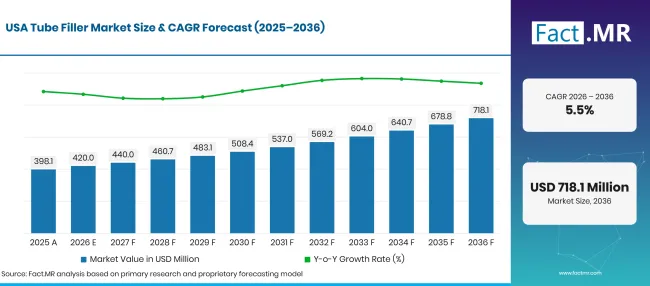
Factmr Tube Filler Market Forecast Usa | Source: Fact.MR
U.S. pharmaceutical and personal care manufacturers place close attention on filling accuracy, product quality and production records. The U.S. FDA completed 2,740 inspections at domestic drug and device establishments during fiscal 2025 [3]. Tube filler buyers look for easy machine access, available spare parts and reliable service support because production delays can affect packaging schedules.
How is the United Kingdom developing tube filler demand?
4.9% CAGR, influenced by contract packing and flexible production needs.
UK contract packers and manufacturers handle private-label cosmetics, topical products and a range of tube sizes. The Office for National Statistics reported GBP 452.0 billion in manufacturers’ product sales in 2025 [4]. Flexible filling machines help plants manage different customer orders and product formats. Compact equipment and quick format changes are also valuable where production space is limited and schedules are busy.
Why is Japan maintaining steady tube filler growth?
4.4% CAGR, influenced by precision filling and established pharmaceutical production.
Japanese medicine and personal care manufacturers place close attention on consistent filling results and smooth operation with existing production lines. The Ministry of Health, Labour and Welfare reported JPY 10.2485 trillion in domestic pharmaceutical production for 2024 [5]. Before investing in new equipment, companies check whether it can fit into current production and packaging lines without major changes. Sealing performance and compatibility with existing systems are also important factors in the buying decision.
Who leads the Tube Filler Market?
Competition focuses on filling accuracy, production speed and how well machines work with different tube materials. IWK Verpackungstechnik GmbH and Norden Machinery AB supply automated tube filling equipment, while ProSys Servo Filling Systems offers machines for both smaller and larger production requirements.
According to Fact.MR analysis, the market includes equipment manufacturers, component suppliers, tube producers and installation partners. Companies that can test a customer's actual product before purchase often have an advantage during the evaluation process.
Which companies are the key providers?
Key companies include IWK Verpackungstechnik GmbH; ProSys Servo Filling Systems; Norden Machinery AB; Accutek Packaging Equipment Companies Inc.; GGM Group; JDA Progress Industries Ltd.; and TGM-Tecnomachines Srl.
- IWK Verpackungstechnik GmbH
- ProSys Servo Filling Systems
- Norden Machinery AB
- Accutek Packaging Equipment Companies Inc.
- GGM Group
- JDA Progress Industries Ltd.
- TGM-Tecnomachines Srl
Bibliography
- [1] Agência Nacional de Vigilância Sanitária. (2026, September 25). CMED publica o Anuário Estatístico do Mercado Farmacêutico – Edição 2025.
- [2] Statistisches Bundesamt (Destatis). (2026, February 6). Exports in December 2025: +4.0% on November 2025.
- [3] U.S. Food and Drug Administration. (2026). Annual Report on Inspections of Establishments: FY 2025.
- [4] Office for National Statistics. (2026, July 24). UK manufacturers’ sales by product: 2025.
- [5] Ministry of Health, Labour and Welfare. (2025, December 24). 令和6年 薬事工業生産動態統計年報 [Annual Report on Statistics of Pharmaceutical Industry Production, 2024].
- [6] Norden Machinery. (n.d.). Norden to showcase tube packaging solutions at INTERPHEX Week Tokyo 2025.
- [7] Norden Machinery. (n.d.). Norden at PPMA 2025.
This Report Answers
- The report examines why factories purchase automatic, semi-automatic and manual tube filling machines.
- Segment analysis explains which uses and tube materials shape machine choice.
- Country analysis compares commercial conditions across Germany, Brazil, the USA, the UK and Japan.
- Competitive coverage identifies machine suppliers serving tube filling uses.
- Operational analysis reviews sealing needs, integration issues and the effect of shorter production runs.
What does the Tube Filler Market cover?
The Tube Filler Market covers machines that fill and close tubes used for pharmaceutical, cosmetic, food and suitable chemical products.
What is included in the scope?
The assessment includes new tube filling machines sold for factory use. Filling heads, tube handling mechanisms and sealing functions are counted within a complete machine, along with the control systems normally supplied as part of that machines.
What is excluded from the scope?
The scope excludes the value of the products packed into tubes and the value of empty packaging tubes sold separately.
How Was the Analysis Built?
The analysis draws on 120+ sources, 35+ company portfolios, 25+ countries, and more than 20 industry interviews.
- Primary Research: Primary research includes discussions with manufacturers, service providers, technology developers, distributors, end users, and subject-matter experts. These conversations examine purchasing priorities, product adoption, operational challenges, approval requirements, competitive positioning, and the factors that influence wider market acceptance.
- Desk Research: Desk research covers government statistics, regulatory publications, company filings, trade data, technical studies, industry associations, standards, public policy, and other authoritative sources. Every source used in the analysis is documented in the bibliography.
- Market Sizing and Forecasting: Market estimates combine historical performance, demand indicators, pricing and volume trends, segment shares, company participation, country-level growth, adoption patterns, investment activity, and barriers to market expansion.
- Data Validation and Update Cycle: Findings are validated by comparing primary interviews with public data, company activity, regulatory changes, trade patterns, and industry developments. Regular updates review new product launches, capacity changes, partnerships, approvals, and shifts in commercial adoption.
Segmentation
What is the report’s scope and coverage?
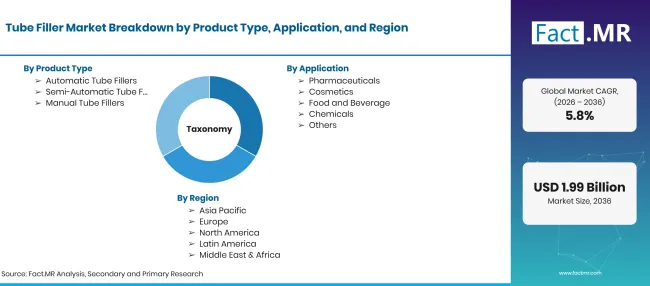
Factmr Tube Filler Market Taxonomy | Source: Fact.MR
| Attribute | Details |
|---|---|
| Quantitative Units | USD billion in 2026 to USD billion by 2036 at CAGR |
| Market Definition | Machines designed to meter product into tubes and close the filled package for industrial production. |
| Product Type | Automatic Tube Fillers; Semi-Automatic Tube Fillers; Manual Tube Fillers |
| Application | Pharmaceuticals; Cosmetics; Food and Beverage; Chemicals; Others |
| Material Type | Plastic; Aluminum; Laminated; Others |
| End-User | Manufacturing; Packaging |
| Regions Covered | North America; Latin America; Western Europe; Eastern Europe; East Asia; South Asia & Pacific; Middle East & Africa |
| Countries Covered | Germany; Brazil; USA; UK; Japan |
| Companies Profiled | IWK Verpackungstechnik GmbH; ProSys Servo Filling Systems; Norden Machinery AB; Accutek Packaging Equipment Companies Inc.; GGM Group; JDA Progress Industries Ltd.; and TGM-Tecnomachines Srl |
| Forecast Period | 2026 to 2036 |
| Approach | Bottom-up and top-down review of equipment applications, tube formats, installed line conditions, supplier portfolios and country manufacturing activity. |
Source: Fact.MR analysis. Updated Oct 16, 2026
How is the market segmented?
-
By Product Type:
- Automatic Tube Fillers
- Semi-Automatic Tube Fillers
- Manual Tube Fillers
-
By Application:
- Pharmaceuticals
- Cosmetics
- Food and Beverage
- Chemicals
- Others
-
By Material Type:
- Plastic
- Aluminum
- Laminated
- Others
-
By End-User:
- Manufacturing
- Packaging
-
By Region:
- North America
- Latin America
- Western Europe
- Eastern Europe
- East Asia
- South Asia & Pacific
- Middle East & Africa
Frequently Asked Questions
How big is the tube filler market in 2026?
What is the CAGR of the tube filler market?
Which product type leads the tube filler market?
Which material type leads the tube filler market?
Who are the main companies in the tube filler market?
Who worked on this report


Preview the report firsthand - request a free sample
Free SampleGet the brochure for pricing and purchase details
Download PDF