- Market Value (2025): USD 6.7 Bn
- Estimated Value (2026): USD 7.4 Bn
- Forecast Value (2036): USD 18.3 Bn
- CAGR (2026-2036): 9.5%
What is the Ultra-High Barrier Mono Films Market forecast to be worth by 2036?
USD 7.4 billion in 2026 to USD 18.3 billion by 2036 at a 9.5% CAGR.
- The Ultra-High Barrier Mono Films Market reached USD 6.7 billion in 2025.
- Demand is expected to increase from USD 7.4 billion in 2026 to USD 18.3 billion by 2036.
- The market is expected to grow at a 9.5% CAGR from 2026 to 2036 as food brands and film makers shift barrier structures toward recyclable mono-material formats.
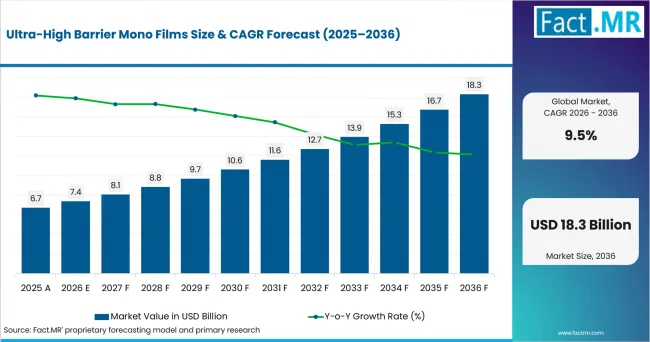
Ultra High Barrier Mono Films Value Analysis | Source: Fact.MR
What are the defining numbers behind Ultra-High Barrier Mono Films Market growth?
An absolute opportunity of USD 10.9 billion is expected between 2026 and 2036.
- Demand Drivers in the Market
- Food makers need oxygen and moisture control so products keep their shelf life. Mono PE or PP films are expected to replace more mixed laminates when the new pack gives the same seal and shelf-life results.
- Flexible pack film makers need mono-PE and mono-PP structures that run on installed form-fill-seal equipment. Mondi markets mono-material barrier structures for food, snacks, pet food, and home or personal care uses with high oxygen and water-vapour shelf-life care. Related film supply is covered in polyfilm analysis.
- Brand owners need pack formats that support product visibility and graphics without losing barrier strength. Printed rollstock fits this line model because film makers can combine print, sealing, and barrier layers inside a single-polymer design strategy.
- Food retail creates a large base for protective film. USDA Economic Research Service said on June 11, 2026 that U.S. Food spending reached USD 2.51 trillion in 2025. That scale supports frequent use of flexible packs for snacks and other food products where moisture and oxygen control affect shelf life.
- EU pack rules are expected to raise interest in mono films built for recycling. The European Commission said on August 11, 2026 that the Packaging and Packaging Waste rule applies across the EU from August 12, 2026. Film firms are expected to pair strong barrier results with a clear recycling route.
- Key Segments Analyzed
- By Polymer Platform: PE mono-material is expected to hold 37.0% share in 2026 due to its fit with recyclable flexible-film structures and broad converting familiarity. Food pack demand is compared with the fresh food packaging market.
- By Barrier Method: EVOH-compatible barrier is expected to account for 33.0% share in 2026 because thin barrier layers can protect oxygen-sensitive products while preserving a mono-material design approach.
- By Format: Printed rollstock is anticipated to capture 34.0% share in 2026 as high-speed pack lines rely on continuous web formats for branding and sealing. Printing and web handling also connect with digital printing for flexible packs. Print needs link with digital printing for flexible packaging.
- By End-use: Snacks are estimated to represent 31.0% share in 2026 owing to frequent use of flexible packs that require moisture, oxygen, aroma, and seal results. Polypropylene film demand is detailed in the BOPP pack film market. PP film use also connects with the BOPP packaging film market.
- Analyst Opinion at Fact.MR
- Shambhu Nath Jha, Principal Consultant at Fact.MR, states, “The commercial test is whether a recyclable mono film can match the shelf-life and line-speed behavior of the laminate it replaces. Firms are expected to gain testing opportunities when they document barrier strength under real filling settings. Pack maker support should connect film design with sealing, printability, and recycling guidance.”
- Strategic Implications
- Film makers should document barrier strength after printing and converting because downstream processing can change the behavior of thin functional layers. The pack must work on the line as well as on the shelf. A broad seal range helps plant teams test a new mono film with less line change.
- Film makers should test mono webs on pouch and flow-wrap lines. Lidding and form-fill-seal lines need the same checks before a broad switch.
- Food brands should compare shelf-life results and recycling fit together so material simplification avoids shift waste into product loss.
China is expected to record 10.5% CAGR through 2036 as packaged-food retail expands. The USA and Japan are expected to post 10.0% each. Germany is expected to grow at 9.8% as recycling rules shape testing. France is expected to record 9.3% amid food industry and packaging-recycling activity.
How does the Ultra-High Barrier Mono Films Market break down by segment?
PE mono-material leads Polymer Platform at 37.0%. Printed rollstock leads Format at 34.0%.
Which Polymer Platform dominates?
PE mono-material is expected to hold 37.0% share in 2026.
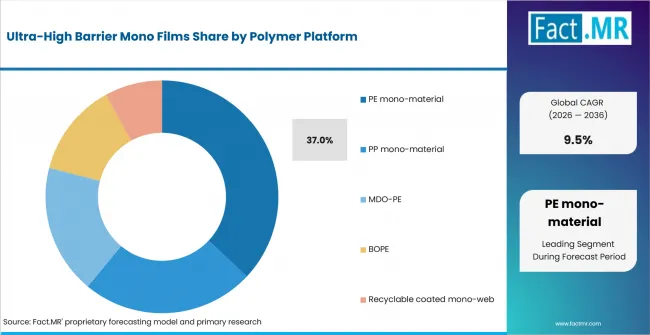
Ultra High Barrier Mono Films Analysis By Polymer Platform | Source: Fact.MR
PE mono-material offers a familiar flexible-film base and a route toward single-polymer packaging. MDO-PE adds stiffness, while BOPE broadens orientation options. PP remains relevant for heat resistance, and coated mono-webs address uses needing a thin functional barrier. Cast polypropylene uses are covered in the CPP pack film market. Cast PP film use is covered in the CPP packaging film market. PE film is common on many pack lines. That base can make line trials easier when a brand moves from a mixed laminate to a mono web.
Amcor introduced a recycle-ready mono-PE film for DCM fertilizer packs in March 2026. The structure replaced a previous multi-material pack and contains 35% post-consumer recycled content. Amcor states that the film provides protection against gas and moisture ingress while supporting recyclability and product protection.
What leads the Barrier Method segment?
EVOH-compatible barrier is expected to account for 33.0% share in 2026.
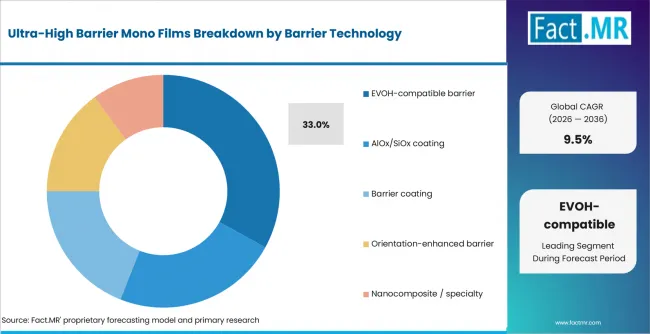
Ultra High Barrier Mono Films Analysis By Barrier Technology | Source: Fact.MR
EVOH-compatible structures provide strong oxygen shelf-life care at low thickness within PE or PP designs. AlOx and SiOx provide transparent barrier options, while other coatings target moisture or aroma. Orientation-enhanced and specialty systems serve uses that need added stiffness or tailored shelf-life care. Barrier choices can be compared with permeable polyamide films.
Mondi describes mono-PE and mono-PP packaging with ultra-high barriers against oxygen and water vapour. Its portfolio includes form-fill-seal and pre-made pouch formats, linking barrier performance with commercial converting requirements.
How does Format shape demand?
Printed rollstock is expected to capture 34.0% share in 2026.
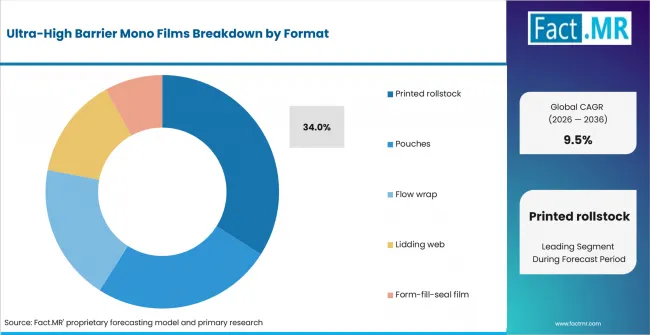
Ultra High Barrier Mono Films Analysis By Format | Source: Fact.MR
Printed rollstock suits high-volume lines because the web enters the line before pack formation. Pouches add convenience, flow wrap supports unit packs, and lidding serves trays. Form-fill-seal film increases the value of stable sealing and barrier strength across line speeds. Coating choices also link with the paper barrier coatings market. Rollstock also gives brands one web for print and pack forming. That can help keep changeovers simple when the same film is used across several pack sizes.
ProAmpac launched ProActive Recycle-Ready polyolefin films for high-speed chunk cheese on August 14, 2025. The films target clarity, puncture resistance and high-temperature filling while remaining compatible with polyethylene recycling streams.
What supports Snacks within End-use?
Snacks are expected to hold 31.0% share in 2026.
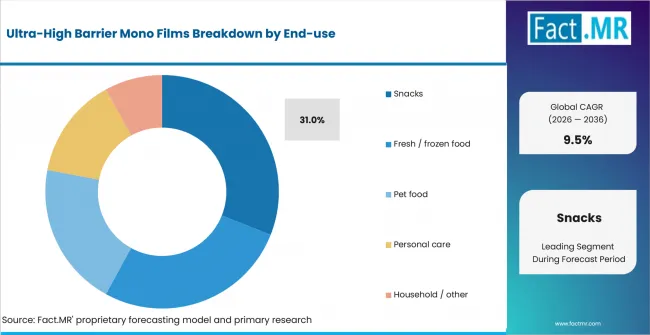
Ultra High Barrier Mono Films Analysis By End Use | Source: Fact.MR
Snack packs require moisture and aroma control in lightweight printed formats. Fresh and frozen foods add puncture and temperature demands. Pet food needs shelf-life care from moisture, fat, and odour, while personal care and household packs emphasize sealing and chemical resistance. Snack-format innovation is also tracked in dispersible snack films. Snack film ideas are tracked in dispersible snack films.
Food sales in China support high use of rollstock and pouches. Brands need light packs that hold aroma and moisture during store sales and home delivery.
What is accelerating Ultra-High Barrier Mono Films Market use, and what is holding it back?
recycling rules and shelf-life needs support use. Testing complexity and barrier trade-offs restrain it.
Drivers Impact Review
| DRIVER | (~) % IMPACT ON CAGR | GEOGRAPHIC RELEVANCE | IMPACT TIMELINE |
|---|---|---|---|
| Recyclability rules for flexible packaging | +1.2% | Europe, North America | Medium term (2-4 years) |
| Shelf-life protection in food and pet food | +1.0% | Global | Short term (<= 2 years) |
| Mono-material conversion on existing lines | +0.8% | Europe, East Asia | Medium term (2-4 years) |
| Printed rollstock and pouch replacement cycles | +0.6% | Global | Long term (>= 4 years) |
Source: Fact.MR analysis. Updated Sep 23, 2026
Opportunity Impact Review
| OPPORTUNITY | (~) % IMPACT ON CAGR | GEOGRAPHIC RELEVANCE | IMPACT TIMELINE |
|---|---|---|---|
| EVOH-compatible recyclable film structures | +0.9% | Europe, North America | Short term (<= 2 years) |
| Transparent AlOx and SiOx barrier films | +0.7% | Europe, Japan | Medium term (2-4 years) |
| High-barrier mono films for frozen and pet food | +0.5% | Global | Medium term (2-4 years) |
Source: Fact.MR analysis. Updated Sep 23, 2026
Restraints Impact Review
| RESTRAINT | (~) % IMPACT ON CAGR | GEOGRAPHIC RELEVANCE | IMPACT TIMELINE |
|---|---|---|---|
| Shelf-life requalification after material change | -0.6% | Global | Short term (<= 2 years) |
| Barrier loss from coating or converting variation | -0.5% | Global | Medium term (2-4 years) |
| Recycling-design limits on incompatible layers | -0.4% | Europe, North America | Long term (>= 4 years) |
Source: Fact.MR analysis. Updated Sep 23, 2026
Which countries are scaling the Ultra-High Barrier Mono Films Market through 2036?
- The five-country comparison spans 1.2 percentage points across the forecast period. China records 10.5% while France records 9.3%.
- China is forecast to remain 0.5 percentage point above the USA as packaged-food retail and online food sales support film use.
- The USA and Japan are each forecast at 10.0%. Food spending shapes U.S. Demand while food exports support Japan.
- Germany is expected to grow at 9.8% as recyclable pack rules shape film maker testing and film design.
- France is projected at 9.3% as food industry and packaging recycling guide material choice.
Similar CAGRs can still create different entry settings because food output and recycling rules vary by country. Full coverage includes North America, Latin America, Western Europe, Eastern Europe, East Asia, South Asia & Pacific, Middle East & Africa.
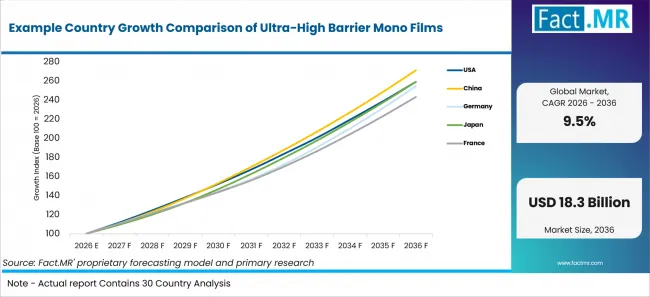
Example Country Growth Comparison Of Ultra High Barrier Mono Films | Source: Fact.MR
| Country | CAGR (2026-2036) |
|---|---|
| United States | 10.0% |
| China | 10.5% |
| Germany | 9.8% |
| Japan | 10.0% |
| France | 9.3% |
Source: Fact.MR analysis. Updated Sep 23, 2026
What supports USA use?
10.0% CAGR, backed by film maker use and high-volume food packaging.
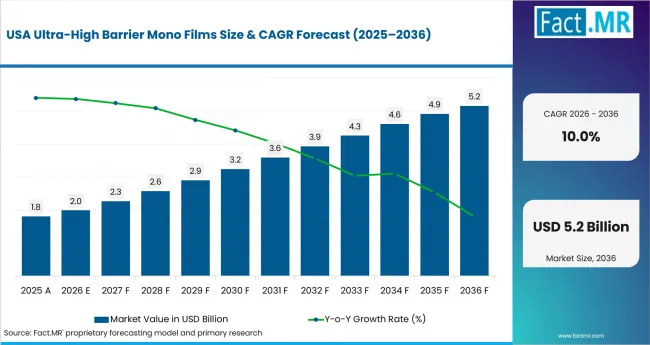
Ultra High Barrier Mono Films Country Value Analysis | Source: Fact.MR
U.S. Film makers operate within a large plastics processing base and serve food brands that need stable barrier strength on fast lines. The Federal Reserve said on January 16, 2026 that plastics and rubber products capacity use was 73.2% in December 2025. That line base is expected to support trials of PE and PP mono films that keep oxygen and moisture shelf-life care within a recyclable structure. Printed rollstock is suited to this setting because it combines graphics and sealing in a continuous web. Film firms are expected to compete on line speed, seal range and verified shelf-life results.
How is China scaling demand?
10.5% CAGR, led by online food sales and high-volume flexible packs use.
China's packaged-food channels are expected to favor light films that protect aroma and moisture across pouches and rollstock. The National Bureau of Statistics said on January 20, 2026 that online retail sales of food increased 14.5% in 2025. Higher online food activity raises the value of packs that travel well and use less material per unit. Mono-PE and mono-PP structures are expected to gain attention when they retain print quality and barrier strength after switch. Local firms are likely to focus on repeatable sealing and coating quality for large production runs.
What supports Germany use?
9.8% CAGR, supported by prepared-food output and recyclable pack rules.
Germany's food processors are expected to require barrier films that protect ready meals while fitting the move toward recyclable PE and PP structures. Destatis said on January 14, 2026 that ready meals worth EUR 4.5 billion were produced during the first three quarters of 2025. The market is therefore expected to reward films that combine oxygen control with steady sealing on installed lines. Germany's pack rules and recycling systems add pressure for designs with simpler material combinations.
How does Japan perform?
10.0% CAGR, driven by food exports and demanding shelf-life needs.
Japan's food exporters are expected to value compact flexible packs that keep quality during longer distribution routes. The Ministry of Agriculture, Forestry and Fisheries reported on February 3, 2026, that exports of agricultural, forestry and fishery products and food reached JPY 1.7005 trillion in 2025. High-barrier mono films fit this use when oxygen and moisture control remain stable after printing and sealing. AlOx and SiOx coatings are expected to support transparent formats where product visibility is useful. Firms are likely to compete on coating stability and evidence that the finished pack performs through storage and transport.
What supports France use?
9.3% CAGR, shaped by food industry scale and recyclable film switch.
France's food makers are expected to keep flexible barrier packs central to snacks and other shelf-life-sensitive products. INSEE said on July 21, 2026 that food, beverage and tobacco industry production was valued at EUR 207 billion in 2025. That production base gives film makers a broad set of uses for printed mono films and pouches. Recycling rules are expected to favor structures that keep barrier strength with fewer material families. Firms are likely to focus on print quality, seal strength and coating durability so brand owners can change structures without disrupting filling lines.
Who leads the Ultra-High Barrier Mono Films Market?
Amcor includes the former Berry Global business following completion of the combination on April 30, 2025. The combined portfolio brings together broader flexible-film and material-science capabilities for consumer and food packaging.
Mondi supplies mono-PE and mono-PP barrier packaging for food and pet-food applications. Coveris competes through its MonoFlex family of recyclable monomaterial structures. ProAmpac launched a recycle-ready polyolefin-based platform for chunk-cheese packaging in August 2025, while Constantia Flexibles supplies mono-PP high-barrier packaging structures. Across these portfolios, barrier performance, sealing, printability, runability, and recycling compatibility are important product-performance considerations.
Which companies are the key providers?
Key companies include Amcor, Mondi, Coveris, Constantia Flexibles, and ProAmpac.
- Amcor
- Mondi
- Coveris
- Constantia Flexibles
- ProAmpac
Bibliography
- Coveris. (2025, August 18). Coveris introduces monomaterial tortilla wraps.
- Directorate-General for Environment. (2026, August 11). New EU packaging rules start to apply, including restrictions on PFAS in food-contact packaging. European Commission.
- Board of Governors of the Federal Reserve System. (2026, January 16). Industrial production and capacity utilization—G.17: Table 7. Capacity utilization.
- Institut national de la statistique et des études économiques. (2026, July 21). Indicateurs macroéconomiques de l’industrie manufacturière: Données annuelles de 2010 à 2025.
- National Bureau of Statistics of China. (2026, January 20). Total retail sales of consumer goods in December 2025.
- ProAmpac. (2025, August 14). ProAmpac commercializes high-performance, recyclable ready packaging for chunk cheese.
- Statistisches Bundesamt (Destatis). (2026, January 14). Produktion von Fertiggerichten binnen fünf Jahren mengenmäßig um 25,6 % gestiegen.
- Zeballos, E., & Sinclair, W. (2026, June 11). Total U.S. food spending reached $2.51 trillion in 2025. U.S. Department of Agriculture, Economic Research Service.
This Report Answers
- The report explains how ultra-high barrier mono films are used by polymer type, barrier method, format and end use.
- Segment review gives the 2026 share leaders and explains why each one holds its place.
- Country review compares the five CAGRs and looks at food sales, pack rules and local film use.
- Use-case review looks at shelf life and seals. It also covers print results, line fit and film tests.
What does the Ultra-High Barrier Mono Films Market cover?
The Ultra-High Barrier Mono Films Market covers PE- or PP-based films that give a strong barrier and a mono-film recycling route. It includes oriented film, coated mono-webs, EVOH layers and clear oxide barriers. These films are used in rollstock, pouches, flow wrap, lidding and form-fill-seal packs. Alternative barrier formats are assessed in alu-free barrier cartons. A paper-based comparison is available in alu-free barrier cartons.
The review also looks at nearby film and pack types so the market boundary stays clear. It separates mono films from recycled-content films and other flexible structures.
What is included in the scope?
The scope includes mono-PE, mono-PP, MDO-PE, BOPE and coated mono-web films. Barrier methods include EVOH layers, AlOx or SiOx coatings, other coatings and oriented film systems that fit the mono-film definition.
End-use coverage includes snacks, fresh and frozen food, pet food, personal care and household products. The rules section also links pack recycling and film redesign with wider flexible-pack trends.
What is excluded from the scope?
The scope excludes mixed laminates that use PET, PA, aluminium foil or other layers outside a mono-film recycling route. Rigid packs, stretch film, shrink film, farm film and low-barrier film stay outside the market boundary.
Paper-based flexible packs are outside the scope even when coated. Stand-alone coatings, resins, glues, inks and pack machines are outside film revenue when sold on their own.
How Was the Analysis Built?
The analysis draws on 120+ sources, 35+ company portfolios, 25+ countries, and more than 20 industry interviews.
- Primary Research: Primary research includes discussions with manufacturers, service providers, technology developers, distributors, end users, and subject-matter experts. These conversations examine purchasing priorities, product adoption, operational challenges, approval requirements, competitive positioning, and the factors that influence wider market acceptance.
- Desk Research: Desk research covers government statistics, regulatory publications, company filings, trade data, technical studies, industry associations, standards, public policy, and other authoritative sources. Every source used in the analysis is documented in the bibliography.
- Market Sizing and Forecasting: Market estimates combine historical performance, demand indicators, pricing and volume trends, segment shares, company participation, country-level growth, adoption patterns, investment activity, and barriers to market expansion.
- Data Validation and Update Cycle: Findings are validated by comparing primary interviews with public data, company activity, regulatory changes, trade patterns, and industry developments. Regular updates review new product launches, capacity changes, partnerships, approvals, and shifts in commercial adoption.
Segmentation
What is the report’s scope and coverage?
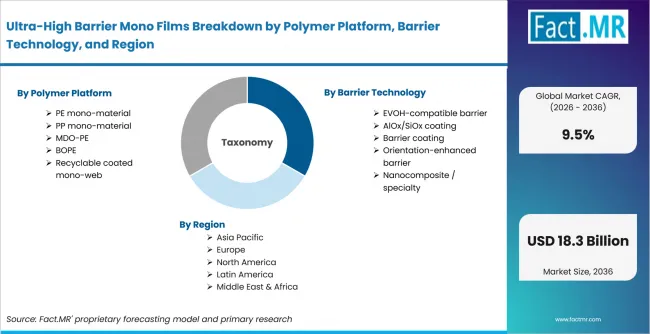
Ultra High Barrier Mono Films Breakdown By Polymer Platform, Barrier Technology, And Region | Source: Fact.MR
| Attribute | Details |
|---|---|
| Quantitative Units | USD billion |
| Market Definition | High-barrier flexible mono-material films designed around PE or PP recycling pathways while providing oxygen, moisture, aroma, light, or related protection for packaged products. |
| Polymer Platform | PE mono-material; PP mono-material; MDO-PE; BOPE; Recyclable coated mono-web |
| Barrier Technology | EVOH-compatible barrier; AlOx/SiOx coating; Barrier coating; Orientation-enhanced barrier; Nanocomposite / specialty |
| Format | Printed rollstock; Pouches; Flow wrap; Lidding web; Form-fill-seal film |
| End-use | Snacks; Fresh / frozen food; Pet food; Personal care; Household / other |
| Regions Covered | North America; Latin America; Western Europe; Eastern Europe; East Asia; South Asia & Pacific; Middle East & Africa |
| Countries Covered | United States; China; Germany; Japan; France |
| Key Companies Profiled | Amcor; Mondi; Coveris; Constantia Flexibles; ProAmpac |
| Forecast Period | 2026 to 2036 |
| Approach | Hybrid top-down and bottom-up review using packaged-food demand signals, film-converting requirements, recycling rules, segment shares, country growth, and provider portfolio validation. |
Source: Fact.MR analysis. Updated Sep 23, 2026
How is the market segmented?
-
By Polymer Platform:
- PE mono-material
- PP mono-material
- MDO-PE
- BOPE
- Recyclable coated mono-web
-
By Barrier Method:
- EVOH-compatible barrier
- AlOx/SiOx coating
- Barrier coating
- Orientation-enhanced barrier
- Nanocomposite / specialty
-
By Format:
- Printed rollstock
- Pouches
- Flow wrap
- Lidding web
- Form-fill-seal film
-
By End-use:
- Snacks
- Fresh / frozen food
- Pet food
- Personal care
- Household / other
-
By Region:
- North America
- Latin America
- Western Europe
- Eastern Europe
- East Asia
- South Asia & Pacific
- Middle East & Africa
Frequently Asked Questions
How big is the ultra-high barrier mono films market in 2026?
What is the CAGR of the ultra-high barrier mono films market from 2026 to 2036?
Which polymer platform leads the ultra-high barrier mono films market?
Which barrier method leads the ultra-high barrier mono films market?
Which firms are profiled in the ultra-high barrier mono films market?
Who worked on this report


Preview the report firsthand - request a free sample
Free SampleGet the brochure for pricing and purchase details
Download PDF