- Market Value (2025): USD 904.1 Mn
- Estimated Value (2026): USD 980.0 Mn
- Forecast Value (2036): USD 2195.4 Mn
- CAGR (2026-2036): 8.4%
What is the Umami Flavor Enhancers Market forecast to be worth by 2036?
USD 980.0 million in 2026 to USD 2195.4 million by 2036 at an 8.4% CAGR.
- The Umami Flavor Enhancers Market reached USD 904.1 million in 2025.
- Demand is projected to increase from USD 980.0 million in 2026 to USD 2195.4 million by 2036.
- The market is forecast to record 8.4% CAGR from 2026 to 2036 across seasoning houses, prepared-food producers and savory ingredient formulators.
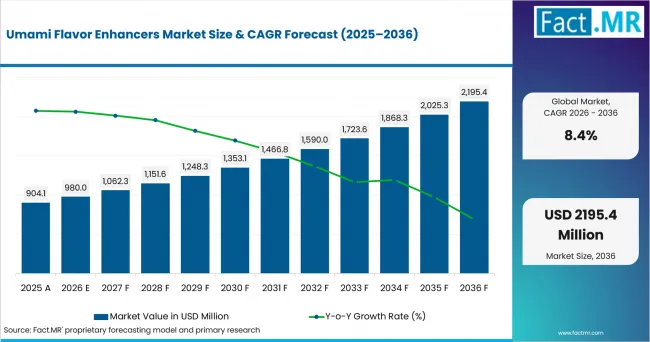
Umami Flavor Enhancers Market Value Analysis | Source: Fact.MR
What are the defining numbers behind Umami Flavor Enhancers Market growth?
An absolute opportunity of USD 1215.4 million is expected between 2026 and 2036.
- Demand Drivers in the Market
- Seasoning developers need reliable umami intensity where dry soup, noodle and sauce blends must keep a clear savory cue after salt reduction.
- Prepared-meal manufacturers use yeast extracts and nucleotide blends to keep cooked notes stable in frozen, chilled and shelf-stable formats.
- Sodium-reduction work creates a recurring formulation need. MHLW reported on December 2, 2025 that average salt intake in Japan’s 2024 National Health and Nutrition Survey was 9.6 g.
- Foodservice operators need concentrated brothy taste because central kitchens standardize sauces, bouillons and seasonings across many outlets.
- Clean-label brands use seaweed, mushroom and fermented ingredients when retail claims make artificial-flavor wording harder to defend.
- Key Segments Analyzed
- By Enhancer Type: Yeast extracts are expected to hold 34.00% share in 2026 owing to their umami, kokumi and salt-reduction support.
- By Label Positioning: Conventional savory enhancer is projected to account for 42.00% share in 2026 due to use in stock cubes, noodles and seasoning blends.
- By Application: Soups, sauces & seasonings are anticipated to capture 30.00% share in 2026 as formulation teams adjust broth depth and lingering taste.
- By Functional Goal: Umami intensity is estimated to represent 37.00% share in 2026 because formulators solve savory strength before claim or nutrition targets.
- Analyst Opinion at Fact.MR
- Shambhu Nath Jha at Fact.MR states, “Umami systems are being bought for formulation control as much as flavor lift. The market is expected to benefit as brands cut salt yet keep broth, meat or cooked notes. Suppliers with sensory proof and clean documentation fit savory briefs faster.”
- Strategic Implications
- Ingredient suppliers should show side-by-side sensory trials in soups, sauces, snacks and plant-based meat so formulators can judge dosage quickly.
- Flavor houses should build low-sodium toolkits around yeast extract, MSG, nucleotides and fermented seasonings instead of selling each input separately.
- Food manufacturers should prepare label and nutrition files early because FDA’s January 2025 front-of-package nutrition labeling proposal covers sodium on most packaged foods.
- Distributors should separate conventional savory systems from clean-label alternatives so regional buyers can compare price, performance and claim fit.
Japan is forecast to record 9.0% CAGR through 2036 where salt reduction meets familiar dashi-style taste cues. The USA is projected to post 8.4% CAGR with prepared foods and foodservice spending keeping reformulation active. Germany is anticipated to reach 8.0% CAGR through clean-label evaluation. France is estimated to advance at 7.6% CAGR as Nutri-Score updates push recipe review. The UK is expected to hold 6.5% CAGR driven by HFSS rules and savory reformulation needs.
How does the Umami Flavor Enhancers Market break down by segment?
Yeast extracts lead Enhancer Type at 34.0%; Conventional savory enhancer leads Label Positioning at 42.0%.
Which Enhancer Type dominates?
Yeast extracts are expected to hold 34.0% share in 2026.
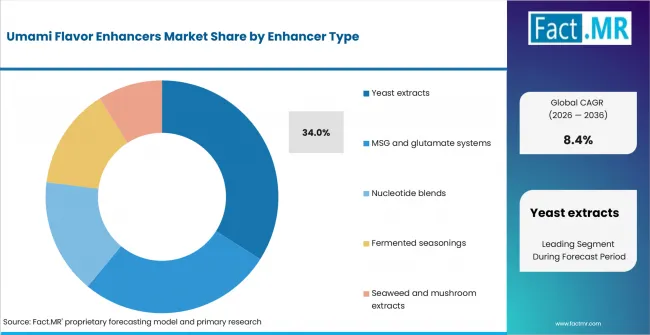
Umami Flavor Enhancers Market Analysis By Enhancer Type | Source: Fact.MR
Yeast extracts lead because they add mouthfulness and mild roasted depth. They also give brands a cleaner label route for lower-salt or animal-free savory bases.
Angel Yeast highlighted a next-generation flavor booster with a peptide-based umami enhancer at Fi India 2025, describing instant umami flavor from the first bite and a savory, long-lasting aftertaste. The company’s broader yeast-extract portfolio is positioned for natural taste enhancement and clean-label formulations, supporting the continued use of yeast-derived systems in savory applications.
What leads the Label Positioning segment?
Conventional savory enhancer is projected to account for 42.0% share in 2026.
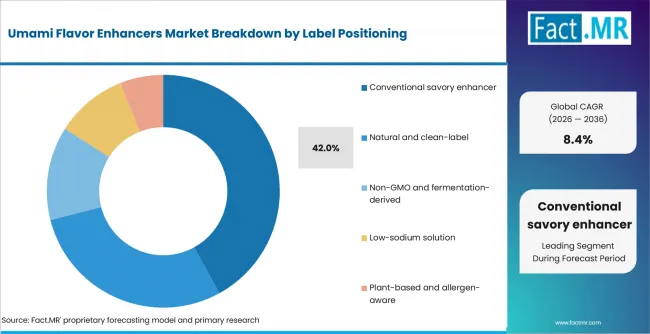
Umami Flavor Enhancers Market Analysis By Label Positioning | Source: Fact.MR
Conventional savory enhancer remains the main label position because MSG and glutamate systems offer predictable cost-in-use. Large-volume noodle, seasoning and soup brands need that consistency.
Ajinomoto Health & Nutrition North America launched Salt Answer™ and Palate Perfect™ in June 2025 to support sodium reduction, taste enhancement and formulation efficiency. Salt Answer draws on the company’s umami and kokumi technologies, reinforcing the role of savory taste-modulation systems in lower-sodium product formulation.
How does Application shape demand?
Soups, sauces & seasonings are anticipated to capture 30.0% share in 2026.
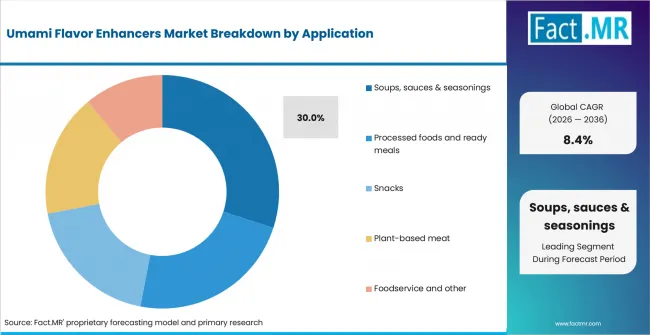
Umami Flavor Enhancers Market Analysis By Application | Source: Fact.MR
Soups, sauces and seasonings lead because enhancers work at the recipe base. Small dosage changes adjust broth depth, meatiness and lingering taste across many products.
Destatis reported that Germany produced 1.7 million tonnes of ready meals in 2024, valued at EUR 5.9 billion, highlighting the scale of the country’s prepared-food manufacturing base relevant to savory ingredient demand.
What supports Umami Intensity within Functional Goal?
Umami intensity is estimated to represent 37.0% share in 2026.
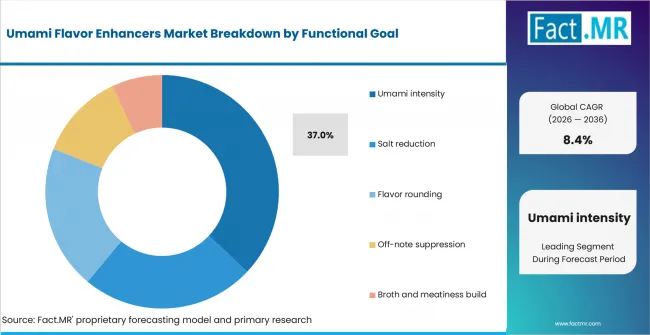
Umami Flavor Enhancers Market Analysis By Functional Goal | Source: Fact.MR
Umami intensity leads because formulators first need a clear savory signal. Yeast extracts, MSG systems and nucleotides often appear together in trials.
World Health Organization guidance recommends that adults consume less than 2,000 mg of sodium per day, equivalent to less than 5 g of salt. Its May 11, 2026 fact sheet states that 5 g of salt is equivalent to 2,000 mg of sodium.
What is accelerating Umami Flavor Enhancers Market adoption, and what is holding it back?
Demand is expected to rise through sodium reduction, clean-label reformulation and plant-based savory applications. Growth is constrained by label perception, ingredient cost and regulatory variation.
Drivers Impact Analysis
| DRIVER | (~) % IMPACT ON CAGR | GEOGRAPHIC RELEVANCE | IMPACT TIMELINE |
|---|---|---|---|
| Low-sodium savory reformulation | +1.5% | North America, Europe, East Asia | Short term (<= 2 years) |
| Clean-label and fermentation-derived positioning | +1.2% | Global | Medium term (2-4 years) |
| Plant-based meat and snack recipe work | +1.0% | Europe, North America, East Asia | Medium term (2-4 years) |
| Foodservice sauce and seasoning standardization | +0.8% | USA, Japan, UK | Short term (<= 2 years) |
Source: Fact.MR analysis. Updated Sep 7, 2026
- Low-sodium savory reformulation: Public-health labeling and sodium guidance push food brands to keep taste while lowering salt in soups, meals and seasonings.
- Clean-label and fermentation-derived positioning: Yeast extracts, mushroom extracts and fermented seasonings fit brands that need recognizable savory inputs with adequate intensity.
- Plant-based meat and snack recipe work: Protein bases often carry beany or cereal notes, so flavor rounding and broth build remain frequent development tasks.
Opportunity Impact Analysis
| OPPORTUNITY | (~) % IMPACT ON CAGR | GEOGRAPHIC RELEVANCE | IMPACT TIMELINE |
|---|---|---|---|
| Yeast extract and nucleotide blends for low-sodium foods | +1.1% | Global | Short term (<= 2 years) |
| Fermented seasoning concentrates for plant-based foods | +0.9% | Europe, East Asia | Medium term (2-4 years) |
| Natural and allergen-aware savory systems | +0.7% | North America, Western Europe | Long term (>= 4 years) |
Source: Fact.MR analysis. Updated Sep 7, 2026
- Yeast extract and nucleotide blends: Suppliers can gain share when they prove that lower sodium keeps broth, sauce or snack profiles full.
- Fermented seasoning concentrates: Fermentation routes create richer savory notes that help plant-based meat brands reduce bitter or earthy back notes.
- Natural and allergen-aware systems: Clear documentation on source, allergen status and claim fit can shorten customer approval cycles.
Restraints Impact Analysis
| RESTRAINT | (~) % IMPACT ON CAGR | GEOGRAPHIC RELEVANCE | IMPACT TIMELINE |
|---|---|---|---|
| MSG label perception in clean-label recipes | -0.6% | North America, Western Europe | Short term (<= 2 years) |
| Higher cost of specialty natural extracts | -0.5% | Japan, Europe | Medium term (2-4 years) |
| Country-specific additive and claim rules | -0.4% | Global | Long term (>= 4 years) |
Source: Fact.MR analysis. Updated Sep 7, 2026
- MSG label perception: Some retail briefs prefer yeast extract or mushroom language, which can limit the role of direct glutamate systems.
- Higher natural-extract cost: Specialty seaweed and mushroom materials can raise cost-in-use when brands move away from conventional enhancers.
- Country-specific rules: Different additive names, claim standards and allergen files create extra approval work for global savory platforms.
Which countries are scaling the Umami Flavor Enhancers Market through 2036?
- The country comparison spans 2.48 percentage points and forms three practical growth bands across the forecast period.
- Japan remains 0.59 percentage point above the USA through salt-reduction pressure and long-standing umami acceptance.
- The USA remains 0.42 percentage point above Germany as foodservice scale and packaged-food reformulation create wider trial volumes.
- Germany remains 0.42 percentage point above France through label scrutiny, meat-alternative formulation and mature savory manufacturing.
- France remains 1.05 percentage points above the UK as Nutri-Score updates make nutritional reformulation more visible.
- The UK closes the displayed range through HFSS rules and a large food manufacturing base.
Comparable CAGRs create different entry conditions due to salt targets, labeling rules, foodservice scale and local savory habits. Full report coverage includes North America, Latin America, Western Europe, Eastern Europe, East Asia, South Asia & Pacific, Middle East & Africa.
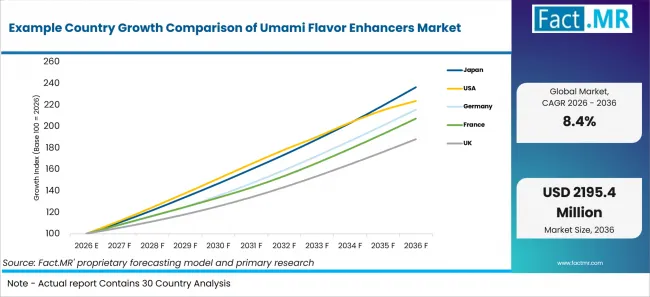
Example Country Growth Comparison Of Umami Flavor Enhancers Market | Source: Fact.MR
| Country | CAGR |
|---|---|
| Japan | 9.0% |
| USA | 8.4% |
| Germany | 8.0% |
| France | 7.6% |
| UK | 6.5% |
Source: Fact.MR analysis. Updated Sep 7, 2026
What supports Japan adoption?
9.0% CAGR, shaped by salt-reduction pressure and export-oriented savory food formulation.
Japan’s umami flavor enhancers market is shaped by food makers that understand dashi, kombu and mushroom notes as everyday savory cues. MAFF reported on February 3, 2026 that Japan’s agricultural, forestry, fishery and food exports reached JPY 1.7005 trillion in 2025, indicating substantial export activity across these sectors.
What supports USA adoption?
8.4% CAGR, supported by foodservice scale and sodium-focused package reformulation.
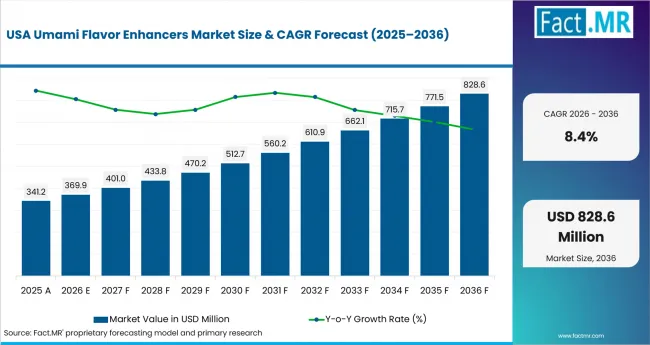
Umami Flavor Enhancers Market Country Value Analysis | Source: Fact.MR
U.S. demand is expected to build around high-volume foodservice recipes, frozen meals and shelf-stable savory products. USDA Economic Research Service reported on June 11, 2026, that U.S. food-away-from-home spending reached USD 1.41 trillion in 2025 and accounted for 56.3% of total food expenditures, highlighting the scale of the U.S. foodservice market relevant to savory formulation. FDA’s January 14, 2025 front-of-package nutrition labeling proposal covers saturated fat, sodium and added sugars on most packaged foods, creating a nutrition-focused context that may encourage voluntary product reformulation.
What supports Germany adoption?
8.0% CAGR, driven by clean-label evaluation and meat-alternative formulation.
German adoption is centered on documented savory ingredients that fit retailer label checks and meat-alternative recipe work. Destatis reported on January 14, 2026, that Germany produced 1.7 million tonnes of ready meals in 2024, valued at EUR 5.9 billion, highlighting the scale of the country’s prepared-food manufacturing base relevant to savory formulation. BMEL reported that, as of April 9, 2025, around 960 companies representing roughly 1,420 brands had registered to use Nutri-Score in Germany, demonstrating broad participation in a voluntary front-of-pack nutrition-labeling framework relevant to product and recipe review.
How is France scaling demand?
7.6% CAGR, backed by Nutri-Score updates and agri-food reformulation.
France’s market is expected to advance through prepared foods, sauces and culinary bases that protect taste under nutrition-led recipe review. Santé publique France reported on March 19, 2026, that the March 2025 Nutri-Score update is estimated to change the scores of 30% to 40% of products, creating a nutrition-focused context for product and recipe review among packaged-food manufacturers. Insee reported on July 21, 2026, that the production value of France’s agri-food industry reached EUR 203.464 billion in 2024, highlighting the scale of the country’s industrial base relevant to food-ingredient demand.
What supports UK growth?
6.5% CAGR, led by HFSS rules and savory food manufacturing demand.
UK growth is expected to come from reformulation in snacks, chilled meals and private-label savory ranges. The Office for National Statistics reported on July 24, 2026, that UK manufacturers’ product sales reached GBP 452.0 billion in 2025, with food manufacturing accounting for 22.9% of total sales, highlighting the scale of the country’s food-manufacturing base relevant to savory ingredient demand. GOV.UK guidance last updated on March 25, 2026 confirms advertising restrictions for less healthy food and drink, creating a regulatory context that may encourage product and recipe review among affected food and drink manufacturers.
Who leads the Umami Flavor Enhancers Market?
Ajinomoto is active in umami and sodium-reduction formulation through its taste and umami expertise. Ajinomoto Health & Nutrition North America launched Salt Answer and Palate Perfect on June 23, 2025 to address sodium reduction, taste enhancement and formulation efficiency.
Angel Yeast is active through yeast extract and peptide-based umami technology. Its September 2025 Fi India showcase included a next-generation flavor booster with a peptide-based umami enhancer designed to deliver instant umami and a savory, long-lasting aftertaste.
Lesaffre strengthened its savory ingredients position in June 2025 by forming a joint venture with Zilor following the acquisition of a 70% stake in Biorigin. The venture combines Biospringer by Lesaffre and Biorigin capabilities in yeast derivatives and savory ingredient solutions for food and feed markets.
Kerry Group competes through taste-modulation and sodium-reduction solutions, including its Tastesense™ Salt portfolio. dsm-firmenich contributes broader savory and reduced-salt formulation capabilities through salt and umami toolkits and dedicated savory solutions. Its October 2025 Van Marken Food Innovation Center announcement highlighted food innovation in areas including sugar substitutes, lactose-free products and plant-based alternatives. Givaudan participates through digital flavor-development tools such as Myromi™ and Customer Foresight.
Which companies are the key providers?
Key companies include Ajinomoto; Angel Yeast; Lesaffre; Kerry Group; DSM-Firmenich; and Givaudan.
- Ajinomoto
- Angel Yeast
- Lesaffre
- Kerry Group
- DSM-Firmenich
- Givaudan
Bibliography
- Ajinomoto Health & Nutrition North America, Inc. (2025, June 23). Ajinomoto Health & Nutrition North America, Inc. launches new product platforms tackling top food formulation challenges.
- Angel Yeast Co., Ltd. (2025, September 3). Angel Yeast unveils groundbreaking innovations at Fi India 2025.
- dsm-firmenich. (2025, October 2). dsm-firmenich opens global food innovation center in Delft, the Netherlands to accelerate diet transformation.
- Bundesministerium für Landwirtschaft, Ernährung und Heimat. (2025, June 4). Hilfestellung für Unternehmen – Verwendung des Nutri-Score.
- Statistisches Bundesamt (Destatis). (2026, January 14). Produktion von Fertiggerichten binnen fünf Jahren mengenmäßig um 25,6 % gestiegen.
- Givaudan. (2025, June 3). Givaudan to unveil the future of fragrance and flavour at VivaTech 2025: Reinventing olfactive ‘story-smelling’ in a digital era.
- Department of Health and Social Care, & Department for Culture, Media and Sport. (2024, December 3). Less healthy food or drink: Advertising and promotions restrictions.
- Institut national de la statistique et des études économiques. (2026, July 21). Indicateurs macroéconomiques de l’industrie agroalimentaire.
- Kerry. (2025, September 30). Kerry launches Smart Taste™ to help customers navigate market complexities without compromising on taste.
- Lesaffre. (2025, June 2). Lesaffre and Zilor enter a joint venture.
- Office for National Statistics. (2026, July 24). UK manufacturers’ sales by product: 2025.
- Ducrot, P., & Serry, A.-J. (2026, March 19). Evaluation of the Nutri-Score 2025 campaign. Santé publique France.
- Zeballos, E., & Sinclair, W. (2026, June 11). Total U.S. food spending reached $2.51 trillion in 2025. U.S. Department of Agriculture, Economic Research Service.
- U.S. Food and Drug Administration. (2025, January 14). FDA proposes requiring at-a-glance nutrition information on the front of packaged foods.
- World Health Organization. (2026, May 11). Sodium reduction.
This Report Answers
- The report explains where umami flavor enhancers are used across enhancer type, label positioning, application and functional goal.
- Segment analysis identifies the leading subsegments and the formulation reasons behind their use.
- Country analysis examines listed markets and the nutrition, labeling or culinary factors supporting adoption.
- Competitive analysis reviews current providers across glutamate systems, yeast extracts, fermented seasonings and taste-modulation tools.
- Application analysis assesses how savory intensity, salt reduction and off-note control influence purchase decisions.
What does the Umami Flavor Enhancers Market cover?
The Umami Flavor Enhancers Market covers ingredients and blends that strengthen savory taste in foods. It includes flavor enhancers, MSG systems, yeast extracts, nucleotides, mushroom extracts and seaweed-based ingredients used across sauces, soups, snacks and ready meals.
The assessment also covers adjacent food additives and sensory additives where savory taste is part of a wider formulation brief. Demand is reviewed by enhancer type, label positioning, application and functional goal.
What is included in the scope?
The scope includes ingredient systems used for umami intensity, salt reduction, flavor rounding and broth build. It covers salt content reduction ingredients, salt perception enhancing flavor modulators and fermented savory flavor concentrates where the product is used to rebuild savory taste.
It includes high nucleotide yeast extract, yeast based savory flavors, meat flavors and low sodium salt where they support the same food-formulation objective.
What is excluded from the scope?
The scope excludes sweet flavor enhancers, beverage-only taste systems, fragrance ingredients and pharmaceutical taste-masking systems sold outside food applications. It also excludes raw seaweed, raw mushrooms and bulk fermentation inputs sold with no defined savory-enhancement function.
General seasoning blends are excluded when they act only as finished consumer products. Restaurant condiments are also excluded when the manufacturer sells the finished sauce without supplying a flavor-enhancement ingredient system.
How Was the Analysis Built?
The analysis draws on 120+ sources, 35+ company portfolios, 25+ countries, and more than 20 industry interviews.
- Primary Research: Primary research includes discussions with manufacturers, service providers, technology developers, distributors, end users, and subject-matter experts. These conversations examine purchasing priorities, product adoption, operational challenges, approval requirements, competitive positioning, and the factors that influence wider market acceptance.
- Desk Research: Desk research covers government statistics, regulatory publications, company filings, trade data, technical studies, industry associations, standards, public policy, and other authoritative sources. Every source used in the analysis is documented in the bibliography.
- Market Sizing and Forecasting: Market estimates combine historical performance, demand indicators, pricing and volume trends, segment shares, company participation, country-level growth, adoption patterns, investment activity, and barriers to market expansion.
- Data Validation and Update Cycle: Findings are validated by comparing primary interviews with public data, company activity, regulatory changes, trade patterns, and industry developments. Regular updates review new product launches, capacity changes, partnerships, approvals, and shifts in commercial adoption.
Segmentation
What is the report’s scope and coverage?
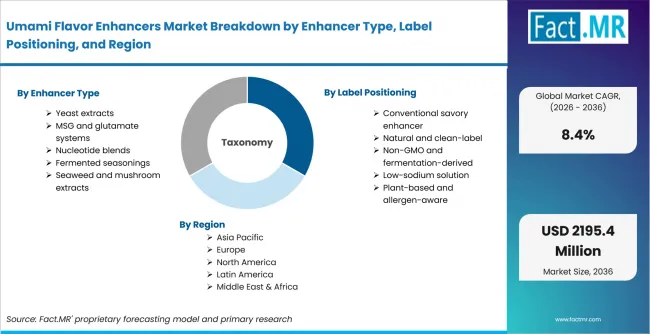
Umami Flavor Enhancers Market Breakdown By Enhancer Type, Label Positioning, And Region | Source: Fact.MR
| Attribute | Details |
|---|---|
| Quantitative Units | USD Million |
| Market Definition | Savory taste-enhancement systems used to build umami intensity, broth depth, meatiness, salt perception or off-note control in food and foodservice formulations. |
| Enhancer Type | Yeast extracts; MSG and glutamate systems; Nucleotide blends; Fermented seasonings; Seaweed and mushroom extracts |
| Label Positioning | Conventional savory enhancer; Natural and clean-label; Non-GMO and fermentation-derived; Low-sodium solution; Plant-based and allergen-aware |
| Application | Soups, sauces & seasonings; Processed foods and ready meals; Snacks; Plant-based meat; Foodservice and other |
| Functional Goal | Umami intensity; Salt reduction; Flavor rounding; Off-note suppression; Broth and meatiness build |
| Regions Covered | North America; Latin America; Western Europe; Eastern Europe; East Asia; South Asia & Pacific; Middle East & Africa |
| Countries Covered | Japan; USA; Germany; France; UK |
| Key Companies Profiled | Ajinomoto; Angel Yeast; Lesaffre; Kerry Group; DSM-Firmenich; Givaudan |
| Forecast Period | 2026 to 2036 |
| Approach | Hybrid top-down and bottom-up approach using savory formulation demand, sodium-reduction indicators, ingredient portfolios, application mix, country-level adoption and provider activity. |
Source: Fact.MR analysis. Updated Sep 7, 2026
How is the market segmented?
-
By Enhancer Type:
- Yeast extracts
- MSG and glutamate systems
- Nucleotide blends
- Fermented seasonings
- Seaweed and mushroom extracts
-
By Label Positioning:
- Conventional savory enhancer
- Natural and clean-label
- Non-GMO and fermentation-derived
- Low-sodium solution
- Plant-based and allergen-aware
-
By Application:
- Soups, sauces & seasonings
- Processed foods and ready meals
- Snacks
- Plant-based meat
- Foodservice and other
-
By Functional Goal:
- Umami intensity
- Salt reduction
- Flavor rounding
- Off-note suppression
- Broth and meatiness build
-
By Region:
- North America
- Latin America
- Western Europe
- Eastern Europe
- East Asia
- South Asia & Pacific
- Middle East & Africa
Frequently Asked Questions
How big is the umami flavor enhancers market in 2026?
What is the CAGR of the umami flavor enhancers market from 2026 to 2036?
Which enhancer type leads the umami flavor enhancers market?
Which label positioning leads the umami flavor enhancers market?
Who are the leading companies in the umami flavor enhancers market?
Who worked on this report


Preview the report firsthand - request a free sample
Free SampleGet the brochure for pricing and purchase details
Download PDF