- Market Value (2025): USD 1051.7 Mn
- Estimated Value (2026): USD 1220.0 Mn
- Forecast Value (2036): USD 5400.0 Mn
- CAGR (2026-2036): 16.0%
What is the Virtual Concierge Care Market forecast to be worth by 2036?
USD 1,220.0 million in 2026 to USD 5,400.0 million by 2036 at 16.0% CAGR.
- The virtual concierge care market reached USD 1,051.7 million in 2025.
- Demand is projected to increase from USD 1,220.0 million in 2026 to USD 5,400.0 million by 2036.
- The market is forecast to record 16.0% CAGR from 2026 to 2036 through faster access and coordinated care follow-through.
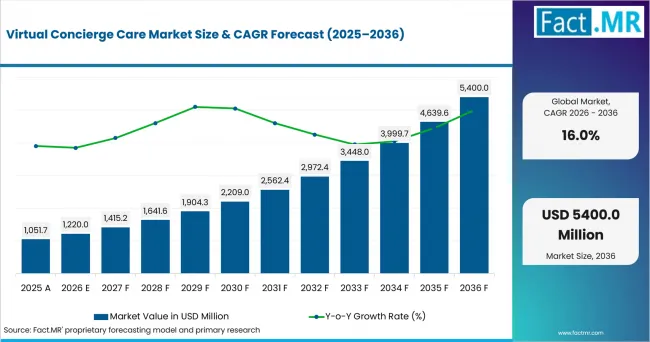
Virtual Concierge Care Market Value Analysis | Source: Fact.MR
What are the defining numbers behind Virtual Concierge Care Market growth?
USD 4,180.0 million in absolute opportunity is expected between 2026 and 2036. The forecast is led by Virtual-first concierge primary care and Premium individual membership alongside 24/7 clinician access and Employers.
- Demand Drivers in the Market
- Consumers need faster entry points to primary care when routine scheduling delays referrals and follow-up. Virtual concierge care is expected to answer that problem through direct clinician access and care coordination.
- Employers use care management solutions to reduce avoidable absence and help workers reach the right care. The service becomes more useful when it connects virtual visits with local examinations and referral support.
- High-net-worth individuals and families pay for continuity when they need quick answers across preventive care and chronic conditions. The membership model works best when the provider preserves clinical context over time.
- mHealth platforms make frequent contact easier to manage across a member base. Providers still need local clinical partners because physical examination and procedures remain outside the virtual channel.
- Key Segments Analyzed
- By Service Model: Virtual-first concierge primary care is expected to hold 38.8% share in 2026 because rapid first contact remains the visible promise of the service.
- By Membership Tier: Premium individual is projected to account for 45.8% share in 2026 as private-pay users place value on access and continuity.
- By Service Component: 24/7 clinician access is anticipated to capture 27.4% share in 2026 since urgent questions and fast triage define the member experience.
- By End User: Employers are estimated to represent 46.6% share in 2026 due to their ability to fund access for a defined workforce population.
- Analyst Opinion at Fact.MR
- Shambhu Nath Jha, Sr. Consultant at Fact.MR, states, “Virtual concierge care is expected to compete on dependable clinical response. Providers that make escalation and human responsibility clear are better positioned than services built only around message volume.”
- Strategic Implications
- Before membership expands, providers must establish reliable hybrid networks with local home healthcare partners and specialty clinics. These relationships maintain continuity when virtual care alone is not enough.
- Sponsors can frame program value around faster access and completed care pathways. Such positioning aligns concierge contracts with value-based service goals while reducing overlap with existing benefits.
- Workforce planning belongs at the start of implementation. Rapid enrollment may erode a high-touch model when physician availability and medical case management capacity fail to keep pace.
UAE is projected to record a 20.5% CAGR from 2026 to 2036. USA is forecast to record a 15.7% CAGR through employer sponsorship and private-pay access. UK is expected to post a 14.8% CAGR through care navigation around established public pathways. Canada is anticipated to record a 14.3% CAGR through localized referral design. Australia is estimated to record a 14.0% CAGR through remote-care familiarity and hybrid service needs.
How does the Virtual Concierge Care Market break down by segment?
Virtual-first concierge primary care is expected to lead Service Model at 38.8% share in 2026. Premium individual is projected to lead Membership Tier at 45.8% share in 2026.
Which service model dominates?
Virtual-first concierge primary care is projected to account for 38.8% share in 2026.
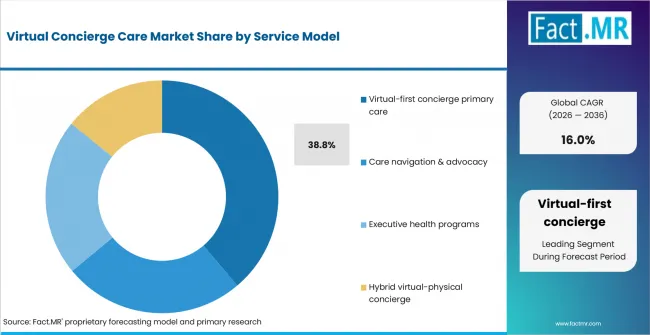
Virtual Concierge Care Market Analysis By Service Model | Source: Fact.MR
Virtual-first access gives members an immediate clinical entry point for routine concerns, follow-up needs and early assessment. The model can direct patients toward local examinations, laboratory testing or imaging when digital care is not sufficient. Care navigation remains important for referrals and appointment coordination. Hybrid virtual-physical concierge care also supports members with more complex needs. The leading share reflects demand for fast access without losing continuity across later stages of care.
What leads the Membership Tier segment?
Premium individual is expected to hold 45.8% share in 2026.
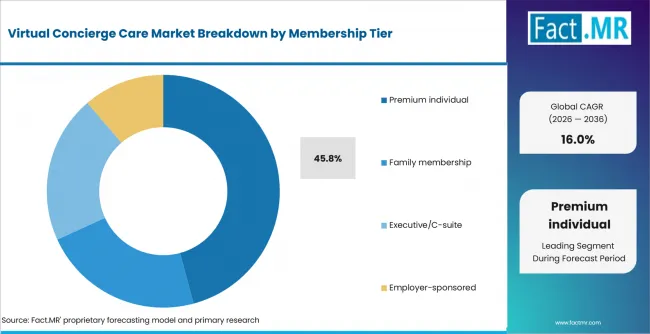
Virtual Concierge Care Market Analysis By Membership Tier | Source: Fact.MR
Premium individual plans offer a direct route for consumers seeking faster appointments, longer consultations and continuing care coordination. Members can access the service without depending on employer sponsorship or health-plan eligibility. Family memberships remain useful where several people need one coordinated arrangement. Executive plans serve users who expect broader screening and higher service intensity. The segment leads because direct payment gives providers a clear membership structure and allows benefits to be tailored around individual care expectations.
How does Service Component shape demand?
24/7 clinician access is anticipated to lead with 27.4% share in 2026.
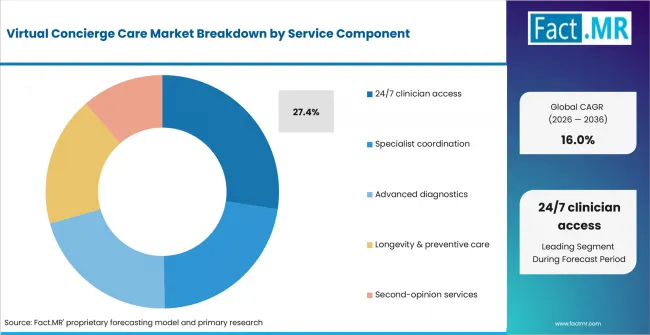
Virtual Concierge Care Market Analysis By Service Component | Source: Fact.MR
Round-the-clock clinician access gives members a clear and practical reason to pay for concierge care. It reduces waiting time for urgent questions and supports earlier decisions about treatment or escalation. Specialist coordination becomes more valuable when referrals are tracked through completion. Second-opinion services add support for complex diagnoses or treatment choices. Electronic health record access helps connect these services by giving clinicians a shared view of history, medications and previous recommendations across the care pathway.
What supports Employers within End User?
Employers are estimated to represent 46.6% share in 2026.
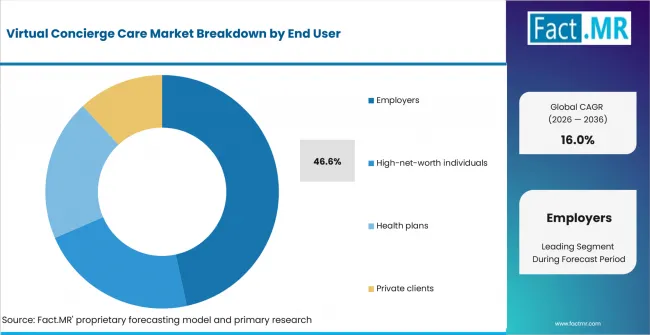
Virtual Concierge Care Market Analysis By End User | Source: Fact.MR
Employers can extend virtual concierge care across a defined workforce and connect the service with navigation, executive health and wellbeing benefits. Faster clinical access may reduce time spent searching for appointments or managing fragmented referrals. Large group contracts also give providers a more predictable enrollment base than individual membership alone. Health plans remain relevant where concierge support is tied to covered care. Private clients form a smaller segment where service depth depends mainly on personal payment capacity.
What is accelerating Virtual Concierge Care Market adoption, and what is holding it back?
Adoption is expected to be accelerated by primary-care access pressure and employer demand for navigation. Growth is expected to be restrained by workforce scalability and the risk of care fragmentation.
Drivers Impact Analysis
| DRIVER | (~) % IMPACT ON CAGR | GEOGRAPHIC RELEVANCE | IMPACT TIMELINE |
|---|---|---|---|
| Primary-care access pressure | +3.8% | Global | Short term (<=2 years) |
| Employer demand for navigation | +3.1% | USA and enterprise markets | Short term (<=2 years) |
| Consumer willingness to pay | +2.4% | UAE and private-pay markets | Medium term (2-4 years) |
| Virtual-care infrastructure | +1.9% | Hybrid care markets | Medium term (2-4 years) |
Source: Fact.MR analysis. Updated Jul 27, 2026
- Primary-care access pressure: Long waits and fragmented scheduling are expected to raise interest in membership access. Concierge models gain relevance when they provide a clear path from first contact to follow-up care.
- Employer demand for navigation: Sponsors want employees to reach appropriate care with less administrative friction. This creates room for services that coordinate appointments and specialist handoffs.
- Consumer willingness to pay: Some members value rapid access and care continuity enough to purchase a premium tier. The decision depends on trust in the clinician relationship.
- Virtual-care infrastructure: Messaging and video access are expected to support a broader service model. Hybrid networks remain necessary when testing or procedures are required.
Opportunity Impact Analysis
| OPPORTUNITY | (~) % IMPACT ON CAGR | GEOGRAPHIC RELEVANCE | IMPACT TIMELINE |
|---|---|---|---|
| Hybrid local networks | +1.6% | Global | Short term (<=2 years) |
| Family memberships | +1.1% | UAE and USA | Medium term (2-4 years) |
| Longitudinal care contracts | +0.9% | Employer and payer markets | Medium term (2-4 years) |
Source: Fact.MR analysis. Updated Jul 27, 2026
- Hybrid local networks: Physical partners can provide examinations and imaging without breaking virtual continuity. This helps providers turn convenience into a complete care pathway.
- Family memberships: Shared navigation and pediatric or elder-care coordination can broaden the value proposition. The format is most useful when one membership manages several care needs across a household.
- Longitudinal care contracts: Employer and payer models can move beyond amenities toward prevention and follow-up outcomes. Providers need outcome reporting that proves more than fast message response.
Restraints Impact Analysis
| RESTRAINT | (~) % IMPACT ON CAGR | GEOGRAPHIC RELEVANCE | IMPACT TIMELINE |
|---|---|---|---|
| Workforce scalability | -1.5% | Global | Short term (<=2 years) |
| Access inequity | -1.1% | Regulated and payer-funded markets | Medium term (2-4 years) |
| Care fragmentation | -0.8% | Global | Medium term (2-4 years) |
Source: Fact.MR analysis. Updated Jul 27, 2026
- Workforce scalability: A high-touch promise can fail if membership grows faster than clinician capacity. Providers therefore need hiring plans and coverage rules before commercial expansion.
- Access inequity: Premium pricing can widen differences in timely access when employer sponsorship is absent. Wider eligibility depends on models that move beyond private-pay membership alone.
- Care fragmentation: A concierge service can duplicate tests or advice when records do not flow to existing clinicians. Integration quality is therefore expected to influence sponsor confidence.
Which countries are scaling Virtual Concierge Care Market fastest?
The country comparison is defined more by payment route and provider capacity than by the overall CAGR spread. UAE forms the upper position through premium access demand. USA follows through employer sponsorship and private-pay care access. UK and Canada form a measured middle group. Australia records a steadier position where hybrid delivery remains necessary.
- UAE shows the highest listed rate because premium access demand fits membership-based virtual coordination. Providers still need local licensing and clear escalation routes into in-person care before expansion can hold.
- USA remains close to the global rate through employer-sponsored navigation and consumer willingness to pay for faster access. Provider selection is expected to depend on state coverage and clinical staffing.
- UK growth is shaped by private access demand around public pathways. Concierge models gain relevance when they reduce scheduling friction without creating parallel medical records.
- Canada is expected to scale through localized referral networks because provincial rules affect delivery. Providers with flexible referral coverage can respond better than one national template.
- Australia is supported by remote-care familiarity and geography that makes coordinated virtual access useful outside metro areas. Hybrid networks remain necessary because testing and examinations require local delivery.
Comparable CAGRs can therefore produce different market entry conditions across these countries. Deployment timing depends on provider coverage and care escalation. Commercial readiness also reflects workforce depth.
The full report provides country-level CAGR analysis across North America; Latin America; Europe; East Asia; South Asia; Oceania; and the Middle East and Africa.
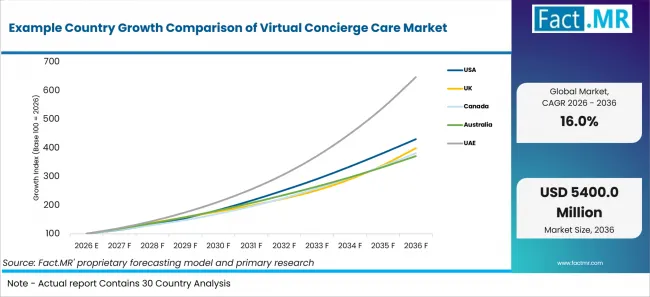
Example Country Growth Comparison Of Virtual Concierge Care Market | Source: Fact.MR
| COUNTRY | CAGR, 2026 to 2036 |
|---|---|
| UAE | 20.5% |
| USA | 15.7% |
| UK | 14.8% |
| Canada | 14.3% |
| Australia | 14.0% |
Source: Fact.MR analysis. Updated Jul 27, 2026
What factors are supporting rapid Virtual Concierge Care Market adoption in the UAE?
20.5% CAGR, supported by premium private care and rapid specialist access.
The UAE offers the strongest growth case because membership-based care fits a market already accustomed to paying for premium medical access. Virtual concierge providers can shorten the route from first consultation to diagnostics or specialist review by linking their platforms with private hospitals and local clinics. Success will depend on licensed clinical coverage and reliable physical-care escalation rather than virtual availability alone.
How are employer benefits and private memberships expanding the Virtual Concierge Care Market in the USA?
15.7% CAGR, driven by employer benefits and direct consumer membership.
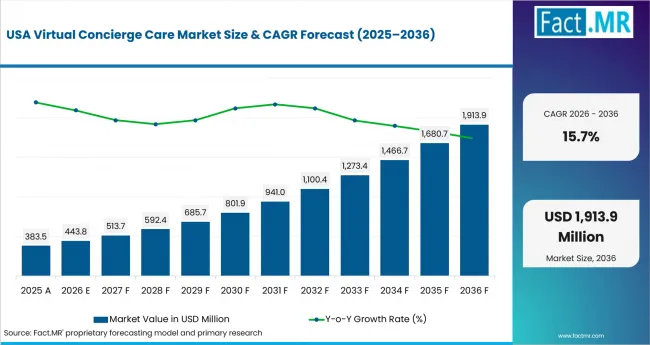
Virtual Concierge Care Market Country Value Analysis | Source: Fact.MR
The USA market develops through two distinct payment routes. Employers can purchase navigation and rapid-access services for defined worker populations, while individuals can subscribe directly for faster primary care and ongoing coordination. Expansion remains operationally complex because licensing, clinician coverage and insurance overlap vary by state. Providers with broad staffing networks and clear benefit boundaries are therefore better placed to scale.
What is shaping the growth outlook for the Virtual Concierge Care Market in the UK?
14.8% CAGR, backed by private navigation around established public-care pathways.
UK demand is tied less to replacing existing primary care and more to reducing the delays surrounding appointments, referrals and follow-up. Concierge services can gain relevance by helping members move through established healthcare pathways without creating a separate or incomplete clinical record. The strongest models will coordinate private access carefully while keeping communication aligned with a patient’s regular providers.
Why is the Virtual Concierge Care Market developing more gradually across Canada?
14.3% CAGR, led by provincial referral networks and employer-sponsored access.
Canada requires a localized operating model because professional rules and care pathways differ across provinces. A single national service design may struggle to provide consistent referrals, diagnostics and physical follow-up. Providers that build flexible regional partnerships can respond more effectively to local coverage conditions. Employer sponsorship may support enrollment, but care completion will still depend on province-specific clinical capacity.
How are distance and hybrid-care requirements supporting Virtual Concierge Care Market growth in Australia?
14.0% CAGR, backed by remote-care familiarity and the need for hybrid delivery.
Australia’s opportunity is shaped by distance and uneven access outside major metropolitan areas. Virtual concierge care can provide a faster clinical entry point for members who otherwise face long travel or appointment delays. The model becomes more valuable when digital consultations connect smoothly with nearby laboratories, imaging centers and clinics. Local physical-care partnerships therefore determine whether convenience develops into a complete care pathway.
Who are the leading providers in the Virtual Concierge Care Market?
One Medical has a strong position in hybrid membership-based primary care, while Premise Health/Crossover Health stands out in employer-funded healthcare delivery. Included Health competes through navigation and specialist support, whereas Private Medical and Sollis Health focus on premium individual and family care.
The competitive field contains several distinct operating models rather than one standard concierge format. One Medical links digital consultations with a physical clinic network, allowing members to continue care beyond the initial virtual interaction. Premise Health/Crossover Health builds its offering around employer populations and combines primary care, coaching and coordinated services. Included Health concentrates on helping members select providers, obtain expert opinions and manage complex care journeys. Private Medical delivers physician-led support for clients seeking deeper continuity. Sollis Health targets members who place greater value on rapid urgent-care access and direct specialist coordination.
Which companies are the key providers?
Key companies include One Medical (Amazon); Premise Health/Crossover Health; Included Health; Private Medical; Sollis Health.
- One Medical (Amazon)
- Premise Health/Crossover Health
- Included Health
- Private Medical
- Sollis Health
Bibliography
- Health Resources and Services Administration, Bureau of Primary Health Care. (2025, August). Impact of the Health Center Program.
- Centers for Medicare & Medicaid Services. (2026). Advanced primary care management services.
- Office for National Statistics. (2026, February 26). Experiences of GP services in England, thematic analysis: June to September 2025.
- One Medical. Primary care with Amazon One Medical.
- Crossover Health and Premise Health. (2026, March 5). Crossover Health and Premise Health complete merger.
- Included Health. Navigation, virtual care and specialty care services.
- Private Medical. Private, physician-led concierge medicine.
- Sollis Health. 24/7 concierge medical care.
This Report Answers
- The report provides strategic intelligence on the Virtual Concierge Care Market across Service Model and Membership Tier choices that shape membership-based care programs.
- Segment analysis covers Virtual-first concierge primary care and Premium individual membership as the share leaders within the 2026 market.
- Country outlook evaluates UAE and USA alongside UK and Canada. Australia completes the growth comparison across the profiled markets.
- Competitive analysis profiles One Medical and Premise Health/Crossover Health alongside Included Health and Private Medical. Sollis Health completes the provider set.
- Service assessment covers 24/7 clinician access and Specialist coordination. Advanced diagnostics and Second-opinion services complete the service view alongside preventive care.
What does the Virtual Concierge Care Market cover?
Virtual concierge care covers membership-based virtual or hybrid services where members receive faster clinician access and organized care navigation.
The Virtual Concierge Care Market covers virtual-first concierge primary care and hybrid virtual-physical concierge services. Coverage extends to care navigation and advocacy. Executive health programs are included when they use membership access and coordinated clinical support. The market includes 24/7 clinician access and specialist coordination. It covers advanced diagnostics and second-opinion routing where those services are part of the concierge model.
The market differs from general telehealth because commercial value comes from continuity and coordination after the first visit. Standalone urgent-care booking remains outside the boundary. Pure remote patient monitoring is excluded. Services based only on digital therapeutics are excluded unless they include concierge access and care coordination.
What is included in the scope?
Virtual concierge care is used by employers and premium individual members. High-net-worth individuals, health plans and private clients are included where the service includes care coordination.
The scope includes Service Model and Membership Tier alongside Service Component and End User. Coverage spans virtual-first concierge primary care and care navigation. Executive health programs and hybrid virtual-physical concierge services complete the service model scope. Premium individual and family membership are included. Executive/C-suite and employer-sponsored tiers follow the same membership-use rule.
What is excluded from the scope?
Standalone telehealth tools and unrelated virtual-care software remain outside the scope of this market.
The scope excludes services that do not provide membership-based access or care coordination. Standalone urgent-care booking tools are excluded. Pure remote patient monitoring is excluded when it does not include concierge care navigation. General telehealth therapy services remain outside the scope unless they directly support virtual concierge care delivery. Company revenue without a clear connection to concierge access is excluded.
How Was the Analysis Built?
The analysis draws on 120+ sources; 35+ company portfolios; 25+ countries; and more than 20 industry interviews.
- Primary Research: Primary research includes discussions with manufacturers; service providers; technology developers; distributors; end users; procurement teams; and subject-matter experts. These conversations examine purchasing priorities and product adoption. They review operational challenges and approval requirements. Competitive positioning and wider market acceptance are assessed during the same interviews.
- Desk Research: Desk research covers government statistics; regulatory publications; company filings; trade data; technical studies; industry associations; standards; public policy; and other authoritative sources. Every source used in the analysis is documented in the bibliography.
- Market Sizing and Forecasting: Market estimates combine historical performance with demand indicators and pricing patterns. Segment shares and company participation are reviewed with country-level growth. Adoption patterns and barriers to expansion are built into the forecast.
- Data Validation and Update Cycle: Findings are validated by comparing primary interviews with public data and company activity. Regulatory changes and trade patterns are reviewed during the same cycle. Regular updates review new product launches and capacity changes. Partnerships and approval activity are checked for shifts in commercial adoption.
Segmentation
What is the report’s scope and coverage?
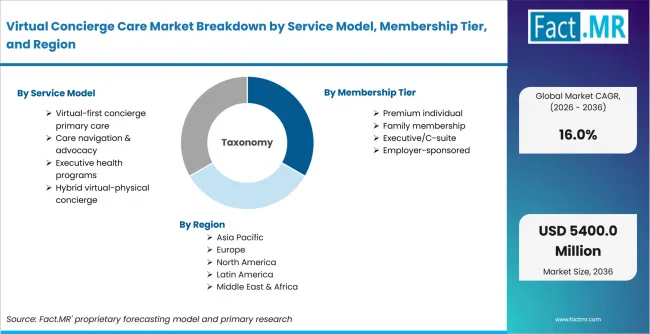
Virtual Concierge Care Market Breakdown By Service Model, Membership Tier, And Region | Source: Fact.MR
| Attribute | Details |
|---|---|
| Quantitative Units | USD 1,220.0 million in 2026 to USD 5,400.0 million by 2036 at 16.0% CAGR |
| Market Definition | Membership-based virtual care that provides rapid clinician access, care navigation, specialist coordination, preventive services, advanced diagnostics or second opinions |
| Service Model | Virtual-first concierge primary care; Care navigation and advocacy; Executive health programs; Hybrid virtual-physical concierge |
| Membership Tier | Premium individual; Family membership; Executive/C-suite; Employer-sponsored |
| Service Component | 24/7 clinician access; Specialist coordination; Advanced diagnostics; Longevity and preventive care; Second-opinion services |
| End User | Employers; High-net-worth individuals; Health plans; Private clients |
| Regions Covered | North America; Latin America; Europe; East Asia; South Asia and Pacific; Middle East and Africa; Oceania |
| Countries Covered | UAE; USA; UK; Canada; Australia |
| Key Companies Profiled | One Medical (Amazon); Premise Health/Crossover Health; Included Health; Private Medical; Sollis Health |
| Forecast Period | 2026 to 2036 |
| Approach | Hybrid top-down and bottom-up approach using membership demand; employer sponsorship; virtual access models; hybrid care networks; end-user adoption; country patterns; and company portfolio review |
Source: Fact.MR analysis. Updated Jul 27, 2026
How is the market segmented?
-
By Service Model:
- Virtual-first concierge primary care
- Care navigation and advocacy
- Executive health programs
- Hybrid virtual-physical concierge
-
By Membership Tier:
- Premium individual
- Family membership
- Executive/C-suite
- Employer-sponsored
-
By Service Component:
- 24/7 clinician access
- Specialist coordination
- Advanced diagnostics
- Longevity and preventive care
- Second-opinion services
-
By End User:
- Employers
- High-net-worth individuals
- Health plans
- Private clients
-
By Region:
- North America
- Europe
- Middle East and Africa
- Oceania
Frequently Asked Questions
Which Service Model leads the market?
Which Membership Tier leads the market?
Which Service Component category leads the market?
Which End User leads the market?
Which country records the highest listed CAGR?
What is the primary driver in this market?
What is the main restraint?
Why do employers lead demand?
Who worked on this report


Preview the report firsthand - request a free sample
Free SampleGet the brochure for pricing and purchase details
Download PDF