Volatile Semiochemical-Only Pest Disruption Market
Volatile Semiochemical-Only Pest Disruption Market Size and Share Forecast Outlook 2026 to 2036
Volatile semiochemical-only pest disruption market is projected to grow from USD 0.4 billion in 2026 to USD 1.3 billion by 2036, at a CAGR of 12.5%. Sex Pheromones will dominate with a 46.0% market share, while dispensers & emitters will lead the application format segment with a 42.0% share.
Volatile Semiochemical-Only Pest Disruption Market Forecast and Outlook 2026 to 2036
The global volatile semiochemical-only pest disruption market is projected to grow from USD 0.40 billion in 2026 to approximately USD 1.28 billion by 2036, recording a forecast CAGR of 12.5%. Sex pheromones lead the semiochemical type segment with a 46% share, dispensers & emitters dominate application format with 42%, and fruits & nuts command the crop type segment with a 38% market share.
Key Takeaways from the Volatile Semiochemical-Only Pest Disruption Market Report
- Volatile Semiochemical-Only Pest Disruption Market Value (2026): USD 0.40 billion
- Volatile Semiochemical-Only Pest Disruption Market Forecast Value (2036): USD 1.28 billion
- Volatile Semiochemical-Only Pest Disruption Market Forecast CAGR (2026 to 2036): 12.5%
- Leading Semiochemical Type: Sex Pheromones (46%)
- Leading Application Format: Dispensers & Emitters (42.0%)
- Leading Crop Type: Fruits & Nuts (38.00%)
- Key Growth Regions: North America, Latin America, Western Europe, Eastern Europe, East Asia, South Asia & Pacific, Middle East & Africa
- Key Players: Suterra LLC, ISCA Technologies, Shin-Etsu Chemical Co., Ltd., BASF SE, Russell IPM Ltd
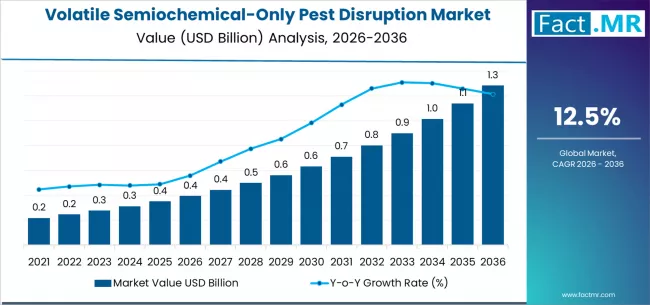
This growth is driven by an accelerating global transition to residue-free pest management in response to stringent regulatory restrictions on broad-spectrum insecticides. These volatile compounds, which manipulate pest behavior through mating disruption or repellence, provide a species-specific tool that preserves beneficial insect populations and aligns with organic and Integrated Pest Management (IPM) protocols.
Advancements in controlled-release formulation technology and synthetic chemistry are enhancing the field longevity and cost-effectiveness of semiochemical products. The rising economic burden of insecticide resistance in key perennial and high-value annual crops is compelling growers to adopt these sustainable alternatives. Market expansion is further supported by the growing premium for certified residue-free produce in global supply chains, particularly within the European and North American markets.
The integration of semiochemical strategies with monitoring traps and decision-support software creates comprehensive pest management systems, increasing their value proposition. This confluence of regulatory pressure, resistance management needs, and consumer-driven market demands positions behavior-based disruption as a cornerstone of future sustainable agriculture.
Volatile Semiochemical-Only Pest Disruption Market
| Metric | Value |
|---|---|
| Estimated Value (2026E) | USD 0.40 billion |
| Forecast Value (2036F) | USD 1.28 billion |
| Forecast CAGR (2026 to 2036) | 12.5% |
Category
| Category | Segments |
|---|---|
| Semiochemical Type | Sex Pheromones, Aggregation Pheromones, Alarm Pheromones, Kairomones, Others |
| Application Format | Dispensers & Emitters, Aerosol Puffers, Sprayable Volatile Blends, Microencapsulated Systems, Others |
| Crop Type | Fruits & Nuts, Vineyards, Vegetables, Plantation & Specialty Crops, Others |
| Region | North America, Latin America, Western Europe, Eastern Europe, East Asia, South Asia & Pacific, Middle East & Africa |
Segmental Analysis
How do Sex Pheromones Dominate amid Proven Mating Disruption Efficacy?
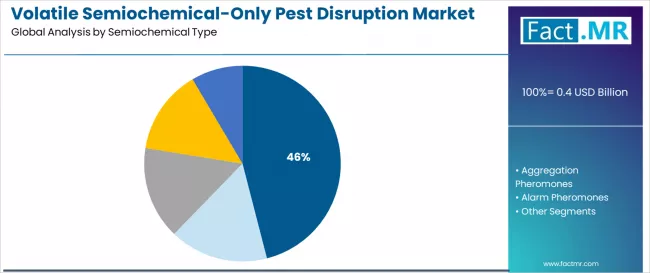
Sex pheromones hold a commanding 46% market share as the most established and widely deployed semiochemical. Their primary use in mating disruption confuses male insects, preventing them from locating females and thereby suppressing pest populations over subsequent generations. This method offers unparalleled target specificity, affecting only the intended pest species.
Extensive research and decades of commercial use against major lepidopteran pests in orchards and vineyards have generated a robust body of efficacy data, building strong grower and regulator confidence. The long-term economic and environmental benefits of breaking the pest reproduction cycle, compared to repeated insecticide applications, solidify sex pheromones as the foundational technology in behavior-based pest control.
What drives the Preference for Dispenser & Emitter Application Formats in Perennial Crops?
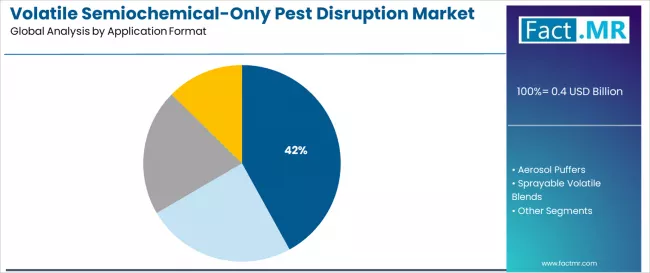
Dispensers and emitters are the leading application format with a 42% share, prized for providing consistent, long-lasting release of volatile compounds throughout a crop's critical pest vulnerability period. These passive devices, such as twist-ties, clips, or sealed tubes, are easily deployed in perennial systems like orchards and vineyards at the beginning of the season. They offer operational simplicity, requiring minimal labor after initial placement, and demonstrate reliable performance unaffected by rainfall or irrigation.
Their controlled-release kinetics ensure a stable behavioral disruption effect over weeks or months, which is essential for managing pests with extended flight periods. This reliability and ease of integration into existing farm workflows secure their position as the preferred delivery method.
How does the Fruits & Nuts Segment Anchor Demand for Quality Preservation?
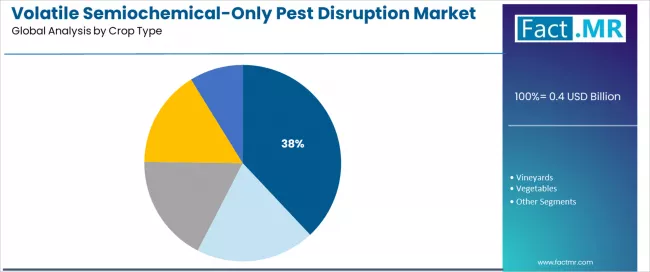
The fruits and nuts segment leads crop type with a 38% share due to the exceptionally high economic value of these crops and the zero-tolerance for pest damage or chemical residues in both fresh and processed markets. Pests like codling moth, oriental fruit moth, and various borers can cause direct cosmetic and internal damage, rendering produce unmarketable.
Semiochemical disruption provides a pre-emptive, season-long protective strategy that maintains cosmetic quality and eliminates residue concerns, which is critical for export certification and meeting retailer standards. The high revenue per acre in these crops justifies the investment in this premium pest management approach, driving consistent and growing demand.
What are the Drivers, Restraints, and Key Trends of the Volatile Semiochemical-Only Pest Disruption Market?
Growth is driven by irreversible regulatory bans on key insecticide classes, the rising economic impact of pest resistance, and powerful supply-chain demand for residue-free produce. The expansion of organic farming acreage globally also provides a direct demand channel. Primary restraints include the high initial cost per acre compared to conventional insecticides, which can deter adoption in lower-value crops. Efficacy is influenced by plot size, pest pressure, and wind patterns, requiring careful placement and sometimes area-wide management approaches. A slower visible knockdown effect compared to insecticides also challenges grower acceptance.
Key trends include the development of multi-species pheromone blends for controlling pest complexes in a single application. The integration of semiochemical emitters with IoT sensors for remote monitoring of dispenser function is emerging. There is also significant innovation in biodegradable and more affordable dispenser matrices to reduce environmental impact and cost.
Analysis of the Volatile Semiochemical-Only Pest Disruption Market by Key Countries
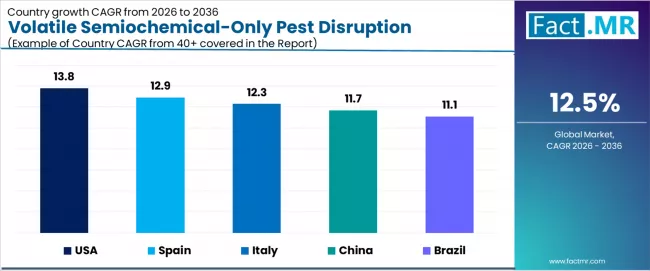
| Country | CAGR (2026-2036) |
|---|---|
| USA | 13.80% |
| Spain | 12.90% |
| Italy | 12.30% |
| China | 11.70% |
| Brazil | 11.10% |
How does the USA Lead with Large-Scale Adoption in Specialty Crops?
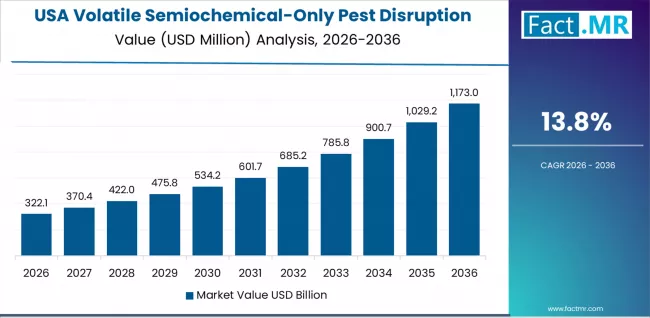
The USA exhibits the highest CAGR of 13.80%, driven by large-scale, high-value specialty crop production in states like California, Washington, and Florida. Strict pesticide regulations, particularly in water-quality protection areas, and powerful retailer mandates for sustainable practices compel widespread adoption.
The presence of major technology providers and extensive university extension networks facilitates grower education and trust in these systems. Mating disruption is now considered a standard practice in US pome fruit and nut production, with adoption expanding into new crops like berries and citrus.
What Fuels Spain's Market Growth in Intensive Mediterranean Horticulture?
Spain's market grows at a 12.90% CAGR, underpinned by its position as Europe's leading producer and exporter of fresh fruits and vegetables. Meeting stringent MRL requirements of Northern European retailers is a non-negotiable market access condition.
High incidence of pests in its intensive Mediterranean cropping systems and the regulatory pressure within the EU to reduce pesticide use make semiochemicals an essential tool. Their use in vineyards, citrus, and stone fruit orchards is well-established and continues to expand as a core IPM component.
Why does Italy Demonstrate Strong Adoption in Quality-Driven Viticulture and Orchards?
Italy follows with a 12.30% CAGR, where market growth is deeply connected to the premium quality demands of its wine and premium fruit sectors. Protecting the integrity and designation of origin status of these products is paramount.
Italian growers, particularly in northern regions, have pioneered the use of mating disruption in vineyards against the European grapevine moth. This success story, combined with national and EU incentives for sustainable practices, drives adoption across other high-value crops, including apples, peaches, and olives.
What drives China's Emerging Market Focused on Export and Safety Standards?
China's market expands at an 11.70% CAGR, fueled by the dual needs of its massive domestic fruit production and growing export-oriented horticulture. Increasing domestic consumer awareness of food safety is pushing for reduced pesticide use. For export crops, meeting international MRLs is critical.
Government policies promoting green pest control and the development of domestic semiochemical manufacturing capabilities are lowering costs and improving accessibility, enabling adoption in large-scale apple, pear, and citrus production systems.
How does Brazil's Export Agriculture Create a Compelling Use Case?
Brazil's CAGR of 11.10% is influenced by its dominant role as a global exporter of commodities like coffee, citrus, and apples, where residue compliance is a key market requirement. The tropical climate fosters high pest pressure and rapid resistance development to insecticides.
Semiochemicals offer a resistance-management solution and a way to ensure harvests meet the phytosanitary standards of importing countries. Adoption is growing most rapidly in the apple orchards of the south and the expanding citrus and coffee sectors.
Competitive Landscape of the Volatile Semiochemical-Only Pest Disruption Market
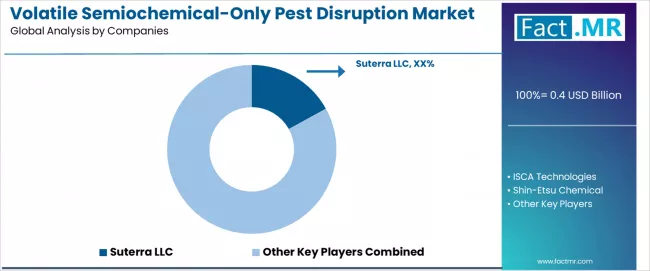
The competitive landscape consists of specialized semiochemical companies and the biocontrol divisions of major agricultural corporations. Competition is intense around proprietary synthesis methods, controlled-release formulation patents, and the development of effective blends for specific regional pest complexes. A core strategic focus is on building dense portfolios of registered pheromones for key crops across different geographical markets.
Companies invest significantly in agronomic field support and demonstration plots to educate growers on optimal deployment strategies, as success depends heavily on correct implementation. Strategic partnerships with local distributors possessing strong technical advisory capabilities are essential for market penetration. Innovation is directed towards creating more user-friendly, longer-lasting, and cost-effective dispenser technologies to expand the economic feasibility to a broader range of crops.
Key Players Profiled in the Volatile Semiochemical-Only Pest Disruption Market
- Suterra LLC
- ISCA Technologies
- Shin-Etsu Chemical Co., Ltd.
- BASF SE
- Russell IPM Ltd
Scope of the Report
| Items | Values |
|---|---|
| Quantitative Units (2026) | USD 0.40 Billion |
| Semiochemical Type | Sex Pheromones, Aggregation Pheromones, Alarm Pheromones, Kairomones, Others |
| Application Format | Dispensers & Emitters, Aerosol Puffers, Sprayable Volatile Blends, Microencapsulated Systems, Others |
| Crop Type | Fruits & Nuts, Vineyards, Vegetables, Plantation & Specialty Crops, Others |
| Regions Covered | North America, Latin America, Western Europe, Eastern Europe, East Asia, South Asia & Pacific, MEA |
| Countries Covered | USA, Spain, Italy, China, Brazil and others |
| Key Companies Profiled | Suterra LLC, ISCA Technologies, Shin-Etsu Chemical Co., Ltd., BASF SE, Russell IPM Ltd |
| Additional Attributes | Dollar sales by semiochemical type, application format, and crop type; regional demand analysis; competitive landscape; grower adoption patterns; regulatory impact analysis; formulation and delivery system innovation trends |
Key Segments List
-
Semiochemical Type :
- Sex Pheromones
- Aggregation Pheromones
- Alarm Pheromones
- Kairomones
- Others
-
Application Format :
- Dispensers & Emitters
- Aerosol Puffers
- Sprayable Volatile Blends
- Microencapsulated Systems
- Others
-
Crop Type :
- Fruits & Nuts
- Vineyards
- Vegetables
- Plantation & Specialty Crops
- Others
-
Region :
-
North America
- USA
- Canada
-
Latin America
- Brazil
- Mexico
- Argentina
- Chile
- Rest of Latin America
-
Western Europe
- Germany
- UK
- France
- Spain
- Italy
- BENELUX
- Rest of Western Europe
-
Eastern Europe
- Poland
- Czech Republic
- Austria
- Hungary
- Rest of Eastern Europe
-
East Asia
- China
- Japan
- South Korea
- Rest of East Asia
-
South Asia & Pacific
- India
- Indonesia
- Australia
- Rest of South Asia & Pacific
-
MEA
- Saudi Arabia
- UAE
- Türkiye
- Rest of MEA
-
Table of Content
- Executive Summary
- Global Market Outlook
- Demand to side Trends
- Supply to side Trends
- Technology Roadmap Analysis
- Analysis and Recommendations
- Market Overview
- Market Coverage / Taxonomy
- Market Definition / Scope / Limitations
- Market Background
- Market Dynamics
- Drivers
- Restraints
- Opportunity
- Trends
- Scenario Forecast
- Demand in Optimistic Scenario
- Demand in Likely Scenario
- Demand in Conservative Scenario
- Opportunity Map Analysis
- Product Life Cycle Analysis
- Supply Chain Analysis
- Investment Feasibility Matrix
- Value Chain Analysis
- PESTLE and Porter’s Analysis
- Regulatory Landscape
- Regional Parent Market Outlook
- Production and Consumption Statistics
- Import and Export Statistics
- Market Dynamics
- Global Market Analysis 2021 to 2025 and Forecast, 2026 to 2036
- Historical Market Size Value (USD Million) Analysis, 2021 to 2025
- Current and Future Market Size Value (USD Million) Projections, 2026 to 2036
- Y to o to Y Growth Trend Analysis
- Absolute $ Opportunity Analysis
- Global Market Pricing Analysis 2021 to 2025 and Forecast 2026 to 2036
- Global Market Analysis 2021 to 2025 and Forecast 2026 to 2036, By Semiochemical Type
- Introduction / Key Findings
- Historical Market Size Value (USD Million) Analysis By Semiochemical Type, 2021 to 2025
- Current and Future Market Size Value (USD Million) Analysis and Forecast By Semiochemical Type, 2026 to 2036
- Sex Pheromones
- Aggregation Pheromones
- Alarm Pheromones
- Kairomones
- Others
- Sex Pheromones
- Y to o to Y Growth Trend Analysis By Semiochemical Type, 2021 to 2025
- Absolute $ Opportunity Analysis By Semiochemical Type, 2026 to 2036
- Global Market Analysis 2021 to 2025 and Forecast 2026 to 2036, By Application Format
- Introduction / Key Findings
- Historical Market Size Value (USD Million) Analysis By Application Format, 2021 to 2025
- Current and Future Market Size Value (USD Million) Analysis and Forecast By Application Format, 2026 to 2036
- Dispensers & Emitters
- Aerosol Puffers
- Sprayable Volatile Blends
- Microencapsulated Systems
- Dispensers & Emitters
- Y to o to Y Growth Trend Analysis By Application Format, 2021 to 2025
- Absolute $ Opportunity Analysis By Application Format, 2026 to 2036
- Global Market Analysis 2021 to 2025 and Forecast 2026 to 2036, By Crop Type
- Introduction / Key Findings
- Historical Market Size Value (USD Million) Analysis By Crop Type, 2021 to 2025
- Current and Future Market Size Value (USD Million) Analysis and Forecast By Crop Type, 2026 to 2036
- Fruits & Nuts
- Vineyards
- Vegetables
- Plantation & Specialty Crops
- Others
- Fruits & Nuts
- Y to o to Y Growth Trend Analysis By Crop Type, 2021 to 2025
- Absolute $ Opportunity Analysis By Crop Type, 2026 to 2036
- Global Market Analysis 2021 to 2025 and Forecast 2026 to 2036, By Region
- Introduction
- Historical Market Size Value (USD Million) Analysis By Region, 2021 to 2025
- Current Market Size Value (USD Million) Analysis and Forecast By Region, 2026 to 2036
- North America
- Latin America
- Western Europe
- Eastern Europe
- East Asia
- South Asia and Pacific
- Middle East & Africa
- Market Attractiveness Analysis By Region
- North America Market Analysis 2021 to 2025 and Forecast 2026 to 2036, By Country
- Historical Market Size Value (USD Million) Trend Analysis By Market Taxonomy, 2021 to 2025
- Market Size Value (USD Million) Forecast By Market Taxonomy, 2026 to 2036
- By Country
- USA
- Canada
- Mexico
- By Semiochemical Type
- By Application Format
- By Crop Type
- By Country
- Market Attractiveness Analysis
- By Country
- By Semiochemical Type
- By Application Format
- By Crop Type
- Key Takeaways
- Latin America Market Analysis 2021 to 2025 and Forecast 2026 to 2036, By Country
- Historical Market Size Value (USD Million) Trend Analysis By Market Taxonomy, 2021 to 2025
- Market Size Value (USD Million) Forecast By Market Taxonomy, 2026 to 2036
- By Country
- Brazil
- Chile
- Rest of Latin America
- By Semiochemical Type
- By Application Format
- By Crop Type
- By Country
- Market Attractiveness Analysis
- By Country
- By Semiochemical Type
- By Application Format
- By Crop Type
- Key Takeaways
- Western Europe Market Analysis 2021 to 2025 and Forecast 2026 to 2036, By Country
- Historical Market Size Value (USD Million) Trend Analysis By Market Taxonomy, 2021 to 2025
- Market Size Value (USD Million) Forecast By Market Taxonomy, 2026 to 2036
- By Country
- Germany
- UK
- Italy
- Spain
- France
- Nordic
- BENELUX
- Rest of Western Europe
- By Semiochemical Type
- By Application Format
- By Crop Type
- By Country
- Market Attractiveness Analysis
- By Country
- By Semiochemical Type
- By Application Format
- By Crop Type
- Key Takeaways
- Eastern Europe Market Analysis 2021 to 2025 and Forecast 2026 to 2036, By Country
- Historical Market Size Value (USD Million) Trend Analysis By Market Taxonomy, 2021 to 2025
- Market Size Value (USD Million) Forecast By Market Taxonomy, 2026 to 2036
- By Country
- Russia
- Poland
- Hungary
- Balkan & Baltic
- Rest of Eastern Europe
- By Semiochemical Type
- By Application Format
- By Crop Type
- By Country
- Market Attractiveness Analysis
- By Country
- By Semiochemical Type
- By Application Format
- By Crop Type
- Key Takeaways
- East Asia Market Analysis 2021 to 2025 and Forecast 2026 to 2036, By Country
- Historical Market Size Value (USD Million) Trend Analysis By Market Taxonomy, 2021 to 2025
- Market Size Value (USD Million) Forecast By Market Taxonomy, 2026 to 2036
- By Country
- China
- Japan
- South Korea
- By Semiochemical Type
- By Application Format
- By Crop Type
- By Country
- Market Attractiveness Analysis
- By Country
- By Semiochemical Type
- By Application Format
- By Crop Type
- Key Takeaways
- South Asia and Pacific Market Analysis 2021 to 2025 and Forecast 2026 to 2036, By Country
- Historical Market Size Value (USD Million) Trend Analysis By Market Taxonomy, 2021 to 2025
- Market Size Value (USD Million) Forecast By Market Taxonomy, 2026 to 2036
- By Country
- India
- ASEAN
- Australia & New Zealand
- Rest of South Asia and Pacific
- By Semiochemical Type
- By Application Format
- By Crop Type
- By Country
- Market Attractiveness Analysis
- By Country
- By Semiochemical Type
- By Application Format
- By Crop Type
- Key Takeaways
- Middle East & Africa Market Analysis 2021 to 2025 and Forecast 2026 to 2036, By Country
- Historical Market Size Value (USD Million) Trend Analysis By Market Taxonomy, 2021 to 2025
- Market Size Value (USD Million) Forecast By Market Taxonomy, 2026 to 2036
- By Country
- Kingdom of Saudi Arabia
- Other GCC Countries
- Turkiye
- South Africa
- Other African Union
- Rest of Middle East & Africa
- By Semiochemical Type
- By Application Format
- By Crop Type
- By Country
- Market Attractiveness Analysis
- By Country
- By Semiochemical Type
- By Application Format
- By Crop Type
- Key Takeaways
- Key Countries Market Analysis
- USA
- Pricing Analysis
- Market Share Analysis, 2025
- By Semiochemical Type
- By Application Format
- By Crop Type
- Canada
- Pricing Analysis
- Market Share Analysis, 2025
- By Semiochemical Type
- By Application Format
- By Crop Type
- Mexico
- Pricing Analysis
- Market Share Analysis, 2025
- By Semiochemical Type
- By Application Format
- By Crop Type
- Brazil
- Pricing Analysis
- Market Share Analysis, 2025
- By Semiochemical Type
- By Application Format
- By Crop Type
- Chile
- Pricing Analysis
- Market Share Analysis, 2025
- By Semiochemical Type
- By Application Format
- By Crop Type
- Germany
- Pricing Analysis
- Market Share Analysis, 2025
- By Semiochemical Type
- By Application Format
- By Crop Type
- UK
- Pricing Analysis
- Market Share Analysis, 2025
- By Semiochemical Type
- By Application Format
- By Crop Type
- Italy
- Pricing Analysis
- Market Share Analysis, 2025
- By Semiochemical Type
- By Application Format
- By Crop Type
- Spain
- Pricing Analysis
- Market Share Analysis, 2025
- By Semiochemical Type
- By Application Format
- By Crop Type
- France
- Pricing Analysis
- Market Share Analysis, 2025
- By Semiochemical Type
- By Application Format
- By Crop Type
- India
- Pricing Analysis
- Market Share Analysis, 2025
- By Semiochemical Type
- By Application Format
- By Crop Type
- ASEAN
- Pricing Analysis
- Market Share Analysis, 2025
- By Semiochemical Type
- By Application Format
- By Crop Type
- Australia & New Zealand
- Pricing Analysis
- Market Share Analysis, 2025
- By Semiochemical Type
- By Application Format
- By Crop Type
- China
- Pricing Analysis
- Market Share Analysis, 2025
- By Semiochemical Type
- By Application Format
- By Crop Type
- Japan
- Pricing Analysis
- Market Share Analysis, 2025
- By Semiochemical Type
- By Application Format
- By Crop Type
- South Korea
- Pricing Analysis
- Market Share Analysis, 2025
- By Semiochemical Type
- By Application Format
- By Crop Type
- Russia
- Pricing Analysis
- Market Share Analysis, 2025
- By Semiochemical Type
- By Application Format
- By Crop Type
- Poland
- Pricing Analysis
- Market Share Analysis, 2025
- By Semiochemical Type
- By Application Format
- By Crop Type
- Hungary
- Pricing Analysis
- Market Share Analysis, 2025
- By Semiochemical Type
- By Application Format
- By Crop Type
- Kingdom of Saudi Arabia
- Pricing Analysis
- Market Share Analysis, 2025
- By Semiochemical Type
- By Application Format
- By Crop Type
- Turkiye
- Pricing Analysis
- Market Share Analysis, 2025
- By Semiochemical Type
- By Application Format
- By Crop Type
- South Africa
- Pricing Analysis
- Market Share Analysis, 2025
- By Semiochemical Type
- By Application Format
- By Crop Type
- USA
- Market Structure Analysis
- Competition Dashboard
- Competition Benchmarking
- Market Share Analysis of Top Players
- By Regional
- By Semiochemical Type
- By Application Format
- By Crop Type
- Competition Analysis
- Competition Deep Dive
- Suterra LLC
- Overview
- Product Portfolio
- Profitability by Market Segments (Product/Age /Sales Channel/Region)
- Sales Footprint
- Strategy Overview
- Marketing Strategy
- Product Strategy
- Channel Strategy
- ISCA Technologies
- Shin-Etsu Chemical
- BASF SE
- Russell IPM
- Suterra LLC
- Competition Deep Dive
- Assumptions & Acronyms Used
- Research Methodology
List Of Table
- Table 1: Global Market Value (USD Million) Forecast by Region, 2021 to 2036
- Table 2: Global Market Value (USD Million) Forecast by Semiochemical Type, 2021 to 2036
- Table 3: Global Market Value (USD Million) Forecast by Application Format, 2021 to 2036
- Table 4: Global Market Value (USD Million) Forecast by Crop Type, 2021 to 2036
- Table 5: North America Market Value (USD Million) Forecast by Country, 2021 to 2036
- Table 6: North America Market Value (USD Million) Forecast by Semiochemical Type, 2021 to 2036
- Table 7: North America Market Value (USD Million) Forecast by Application Format, 2021 to 2036
- Table 8: North America Market Value (USD Million) Forecast by Crop Type, 2021 to 2036
- Table 9: Latin America Market Value (USD Million) Forecast by Country, 2021 to 2036
- Table 10: Latin America Market Value (USD Million) Forecast by Semiochemical Type, 2021 to 2036
- Table 11: Latin America Market Value (USD Million) Forecast by Application Format, 2021 to 2036
- Table 12: Latin America Market Value (USD Million) Forecast by Crop Type, 2021 to 2036
- Table 13: Western Europe Market Value (USD Million) Forecast by Country, 2021 to 2036
- Table 14: Western Europe Market Value (USD Million) Forecast by Semiochemical Type, 2021 to 2036
- Table 15: Western Europe Market Value (USD Million) Forecast by Application Format, 2021 to 2036
- Table 16: Western Europe Market Value (USD Million) Forecast by Crop Type, 2021 to 2036
- Table 17: Eastern Europe Market Value (USD Million) Forecast by Country, 2021 to 2036
- Table 18: Eastern Europe Market Value (USD Million) Forecast by Semiochemical Type, 2021 to 2036
- Table 19: Eastern Europe Market Value (USD Million) Forecast by Application Format, 2021 to 2036
- Table 20: Eastern Europe Market Value (USD Million) Forecast by Crop Type, 2021 to 2036
- Table 21: East Asia Market Value (USD Million) Forecast by Country, 2021 to 2036
- Table 22: East Asia Market Value (USD Million) Forecast by Semiochemical Type, 2021 to 2036
- Table 23: East Asia Market Value (USD Million) Forecast by Application Format, 2021 to 2036
- Table 24: East Asia Market Value (USD Million) Forecast by Crop Type, 2021 to 2036
- Table 25: South Asia and Pacific Market Value (USD Million) Forecast by Country, 2021 to 2036
- Table 26: South Asia and Pacific Market Value (USD Million) Forecast by Semiochemical Type, 2021 to 2036
- Table 27: South Asia and Pacific Market Value (USD Million) Forecast by Application Format, 2021 to 2036
- Table 28: South Asia and Pacific Market Value (USD Million) Forecast by Crop Type, 2021 to 2036
- Table 29: Middle East & Africa Market Value (USD Million) Forecast by Country, 2021 to 2036
- Table 30: Middle East & Africa Market Value (USD Million) Forecast by Semiochemical Type, 2021 to 2036
- Table 31: Middle East & Africa Market Value (USD Million) Forecast by Application Format, 2021 to 2036
- Table 32: Middle East & Africa Market Value (USD Million) Forecast by Crop Type, 2021 to 2036
List Of Figures
- Figure 1: Global Market Pricing Analysis
- Figure 2: Global Market Value (USD Million) Forecast 2021 to 2036
- Figure 3: Global Market Value Share and BPS Analysis by Semiochemical Type, 2026 and 2036
- Figure 4: Global Market Y to o to Y Growth Comparison by Semiochemical Type, 2026 to 2036
- Figure 5: Global Market Attractiveness Analysis by Semiochemical Type
- Figure 6: Global Market Value Share and BPS Analysis by Application Format, 2026 and 2036
- Figure 7: Global Market Y to o to Y Growth Comparison by Application Format, 2026 to 2036
- Figure 8: Global Market Attractiveness Analysis by Application Format
- Figure 9: Global Market Value Share and BPS Analysis by Crop Type, 2026 and 2036
- Figure 10: Global Market Y to o to Y Growth Comparison by Crop Type, 2026 to 2036
- Figure 11: Global Market Attractiveness Analysis by Crop Type
- Figure 12: Global Market Value (USD Million) Share and BPS Analysis by Region, 2026 and 2036
- Figure 13: Global Market Y to o to Y Growth Comparison by Region, 2026 to 2036
- Figure 14: Global Market Attractiveness Analysis by Region
- Figure 15: North America Market Incremental Dollar Opportunity, 2026 to 2036
- Figure 16: Latin America Market Incremental Dollar Opportunity, 2026 to 2036
- Figure 17: Western Europe Market Incremental Dollar Opportunity, 2026 to 2036
- Figure 18: Eastern Europe Market Incremental Dollar Opportunity, 2026 to 2036
- Figure 19: East Asia Market Incremental Dollar Opportunity, 2026 to 2036
- Figure 20: South Asia and Pacific Market Incremental Dollar Opportunity, 2026 to 2036
- Figure 21: Middle East & Africa Market Incremental Dollar Opportunity, 2026 to 2036
- Figure 22: North America Market Value Share and BPS Analysis by Country, 2026 and 2036
- Figure 23: North America Market Value Share and BPS Analysis by Semiochemical Type, 2026 and 2036
- Figure 24: North America Market Y to o to Y Growth Comparison by Semiochemical Type, 2026 to 2036
- Figure 25: North America Market Attractiveness Analysis by Semiochemical Type
- Figure 26: North America Market Value Share and BPS Analysis by Application Format, 2026 and 2036
- Figure 27: North America Market Y to o to Y Growth Comparison by Application Format, 2026 to 2036
- Figure 28: North America Market Attractiveness Analysis by Application Format
- Figure 29: North America Market Value Share and BPS Analysis by Crop Type, 2026 and 2036
- Figure 30: North America Market Y to o to Y Growth Comparison by Crop Type, 2026 to 2036
- Figure 31: North America Market Attractiveness Analysis by Crop Type
- Figure 32: Latin America Market Value Share and BPS Analysis by Country, 2026 and 2036
- Figure 33: Latin America Market Value Share and BPS Analysis by Semiochemical Type, 2026 and 2036
- Figure 34: Latin America Market Y to o to Y Growth Comparison by Semiochemical Type, 2026 to 2036
- Figure 35: Latin America Market Attractiveness Analysis by Semiochemical Type
- Figure 36: Latin America Market Value Share and BPS Analysis by Application Format, 2026 and 2036
- Figure 37: Latin America Market Y to o to Y Growth Comparison by Application Format, 2026 to 2036
- Figure 38: Latin America Market Attractiveness Analysis by Application Format
- Figure 39: Latin America Market Value Share and BPS Analysis by Crop Type, 2026 and 2036
- Figure 40: Latin America Market Y to o to Y Growth Comparison by Crop Type, 2026 to 2036
- Figure 41: Latin America Market Attractiveness Analysis by Crop Type
- Figure 42: Western Europe Market Value Share and BPS Analysis by Country, 2026 and 2036
- Figure 43: Western Europe Market Value Share and BPS Analysis by Semiochemical Type, 2026 and 2036
- Figure 44: Western Europe Market Y to o to Y Growth Comparison by Semiochemical Type, 2026 to 2036
- Figure 45: Western Europe Market Attractiveness Analysis by Semiochemical Type
- Figure 46: Western Europe Market Value Share and BPS Analysis by Application Format, 2026 and 2036
- Figure 47: Western Europe Market Y to o to Y Growth Comparison by Application Format, 2026 to 2036
- Figure 48: Western Europe Market Attractiveness Analysis by Application Format
- Figure 49: Western Europe Market Value Share and BPS Analysis by Crop Type, 2026 and 2036
- Figure 50: Western Europe Market Y to o to Y Growth Comparison by Crop Type, 2026 to 2036
- Figure 51: Western Europe Market Attractiveness Analysis by Crop Type
- Figure 52: Eastern Europe Market Value Share and BPS Analysis by Country, 2026 and 2036
- Figure 53: Eastern Europe Market Value Share and BPS Analysis by Semiochemical Type, 2026 and 2036
- Figure 54: Eastern Europe Market Y to o to Y Growth Comparison by Semiochemical Type, 2026 to 2036
- Figure 55: Eastern Europe Market Attractiveness Analysis by Semiochemical Type
- Figure 56: Eastern Europe Market Value Share and BPS Analysis by Application Format, 2026 and 2036
- Figure 57: Eastern Europe Market Y to o to Y Growth Comparison by Application Format, 2026 to 2036
- Figure 58: Eastern Europe Market Attractiveness Analysis by Application Format
- Figure 59: Eastern Europe Market Value Share and BPS Analysis by Crop Type, 2026 and 2036
- Figure 60: Eastern Europe Market Y to o to Y Growth Comparison by Crop Type, 2026 to 2036
- Figure 61: Eastern Europe Market Attractiveness Analysis by Crop Type
- Figure 62: East Asia Market Value Share and BPS Analysis by Country, 2026 and 2036
- Figure 63: East Asia Market Value Share and BPS Analysis by Semiochemical Type, 2026 and 2036
- Figure 64: East Asia Market Y to o to Y Growth Comparison by Semiochemical Type, 2026 to 2036
- Figure 65: East Asia Market Attractiveness Analysis by Semiochemical Type
- Figure 66: East Asia Market Value Share and BPS Analysis by Application Format, 2026 and 2036
- Figure 67: East Asia Market Y to o to Y Growth Comparison by Application Format, 2026 to 2036
- Figure 68: East Asia Market Attractiveness Analysis by Application Format
- Figure 69: East Asia Market Value Share and BPS Analysis by Crop Type, 2026 and 2036
- Figure 70: East Asia Market Y to o to Y Growth Comparison by Crop Type, 2026 to 2036
- Figure 71: East Asia Market Attractiveness Analysis by Crop Type
- Figure 72: South Asia and Pacific Market Value Share and BPS Analysis by Country, 2026 and 2036
- Figure 73: South Asia and Pacific Market Value Share and BPS Analysis by Semiochemical Type, 2026 and 2036
- Figure 74: South Asia and Pacific Market Y to o to Y Growth Comparison by Semiochemical Type, 2026 to 2036
- Figure 75: South Asia and Pacific Market Attractiveness Analysis by Semiochemical Type
- Figure 76: South Asia and Pacific Market Value Share and BPS Analysis by Application Format, 2026 and 2036
- Figure 77: South Asia and Pacific Market Y to o to Y Growth Comparison by Application Format, 2026 to 2036
- Figure 78: South Asia and Pacific Market Attractiveness Analysis by Application Format
- Figure 79: South Asia and Pacific Market Value Share and BPS Analysis by Crop Type, 2026 and 2036
- Figure 80: South Asia and Pacific Market Y to o to Y Growth Comparison by Crop Type, 2026 to 2036
- Figure 81: South Asia and Pacific Market Attractiveness Analysis by Crop Type
- Figure 82: Middle East & Africa Market Value Share and BPS Analysis by Country, 2026 and 2036
- Figure 83: Middle East & Africa Market Value Share and BPS Analysis by Semiochemical Type, 2026 and 2036
- Figure 84: Middle East & Africa Market Y to o to Y Growth Comparison by Semiochemical Type, 2026 to 2036
- Figure 85: Middle East & Africa Market Attractiveness Analysis by Semiochemical Type
- Figure 86: Middle East & Africa Market Value Share and BPS Analysis by Application Format, 2026 and 2036
- Figure 87: Middle East & Africa Market Y to o to Y Growth Comparison by Application Format, 2026 to 2036
- Figure 88: Middle East & Africa Market Attractiveness Analysis by Application Format
- Figure 89: Middle East & Africa Market Value Share and BPS Analysis by Crop Type, 2026 and 2036
- Figure 90: Middle East & Africa Market Y to o to Y Growth Comparison by Crop Type, 2026 to 2036
- Figure 91: Middle East & Africa Market Attractiveness Analysis by Crop Type
- Figure 92: Global Market - Tier Structure Analysis
- Figure 93: Global Market - Company Share Analysis
- FAQs -
How big is the volatile semiochemical-only pest disruption market in 2026?
The global volatile semiochemical-only pest disruption market is estimated to be valued at USD 0.4 billion in 2026.
What will be the size of volatile semiochemical-only pest disruption market in 2036?
The market size for the volatile semiochemical-only pest disruption market is projected to reach USD 1.3 billion by 2036.
How much will be the volatile semiochemical-only pest disruption market growth between 2026 and 2036?
The volatile semiochemical-only pest disruption market is expected to grow at a 12.5% CAGR between 2026 and 2036.
What are the key product types in the volatile semiochemical-only pest disruption market?
The key product types in volatile semiochemical-only pest disruption market are sex pheromones, aggregation pheromones, alarm pheromones, kairomones and others.
Which application format segment to contribute significant share in the volatile semiochemical-only pest disruption market in 2026?
In terms of application format, dispensers & emitters segment to command 42.0% share in the volatile semiochemical-only pest disruption market in 2026.