Wearables Waterproof Film Lamination Market Size, Share, Growth and Forecast (2026 - 2036)
The Wearables Waterproof Film Lamination Market is segmented by Film Type, by Lamination Method, by End Product, by Performance, by Buyer Type and Region. Forecast for 2026 to 2036.
What is the wearables waterproof film lamination market forecast to be worth by 2036?
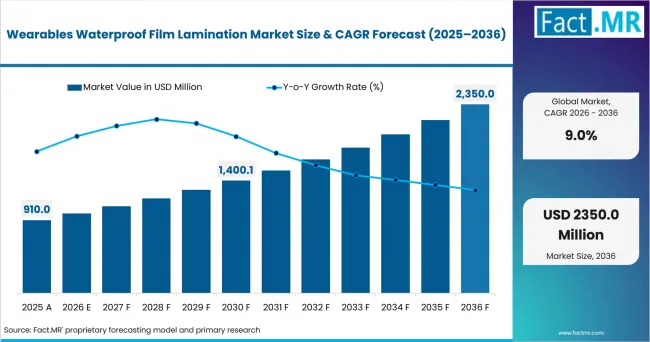
USD 990.0 million in 2026 to USD 2,350.0 million by 2036, at 9.0% CAGR.
- The wearables waterproof film lamination market crossed a valuation of USD 910.0 million in 2025.
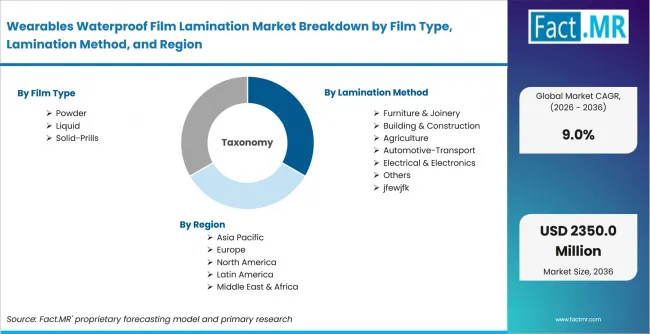
- Demand is expected to increase from USD 990.0 million in 2026 to USD 2,350.0 million by 2036.
- The market is forecast to record 9.0% CAGR from 2026 to 2036 due to sportswear, medical wearables and electronic textiles needing washable waterproof layers.
What are the defining numbers behind wearables waterproof film lamination growth?
USD 1,360.0 million absolute opportunity by 2036, led by China and India.
- Demand Drivers in the Market
- Sportswear brands need washable sensor pockets and sealed garment panels before electronics can be placed inside active garments.
- Medical wearable producers specify skin-safe barrier layers when sensors remain on the body during motion and sweat exposure.
- Outdoor apparel buyers are replacing fluorinated finishes with laminated waterproof layers after PFAS restrictions entered procurement checks.
- Electronic textile converters need adhesive systems that protect conductive traces during flexing and laundering.
- Key Segments Analyzed
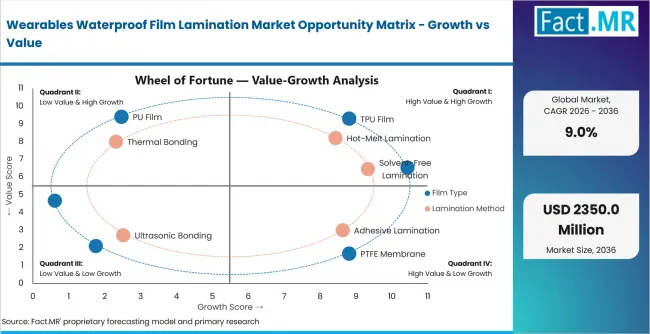
- By Film Type: TPU Film is expected to hold 34.0% share in 2026 due to stretch recovery and soft skin contact.
- By Lamination Method: Hot-Melt Lamination is projected to hold 32.0% share in 2026 due to cleaner bonding and shorter converter set-up time.
- By End Product: Sportswear is likely to account for 30.0% share in 2026 due to higher replacement cycles and active-use stress.
- By Performance: Waterproof and Breathable laminates are expected to hold 31.0% share in 2026 due to comfort requirements in body-worn use.
- By Buyer Type: Apparel Brands are projected to hold 34.0% share in 2026 because material choice is fixed before garment sampling.
- By Geography: China is projected to record 10.6% CAGR through 2036 due to textile converting depth and electronics manufacturing proximity.
- Analyst Opinion at Fact.MR
- Shambhu Nath Jha, Senior Analyst at Fact.MR, states, “I see waterproof film lamination moving from a back-end fabric treatment to an early design decision. A wearable garment fails when the laminate protects the sensor but feels stiff on the skin. Suppliers that help apparel and electronics teams qualify the same material stack before sampling will be better positioned.”
- Strategic Implications
- Film suppliers should build wearable-specific grades around stretch recovery, dry touch and repeated wash performance.
- Textile converters need documented lamination windows before medical wearable and sportswear buyers approve large programs.
- Apparel brands should screen PFAS exposure before selecting waterproof materials for 2026 collections.
- Medical wearable producers need skin-contact documentation and adhesive compatibility checks before moving into scale production.
Film lamination for wearables forms the protective layer between fabric, skin and electronics. Commission Regulation (EU) 2024/2462 restricts PFHxA-related substances in textiles such as outdoor clothing, leather, furs and hides. [1] This supports buyer movement toward non-fluorinated membranes, TPU films and converter-qualified adhesive systems.
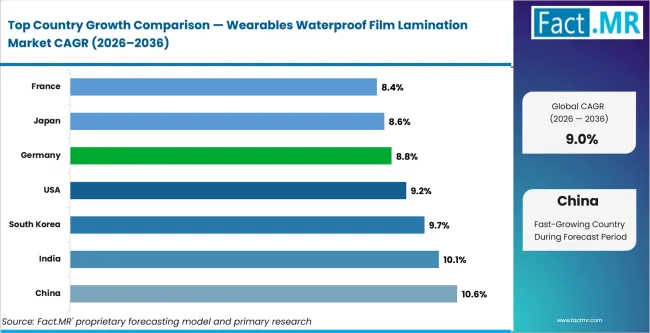
China is projected to record 10.6% CAGR through 2036 due to co-located textile conversion and electronics assembly. India is expected to expand at 10.1% CAGR due to export-oriented textile capacity and technical textile policy support. South Korea is forecast to grow at 9.7% CAGR as apparel electronics and specialty film users deepen local qualification. The United States is expected to advance at 9.2% CAGR due to PFAS apparel rules and premium outdoor brands. Germany is projected to rise at 8.8% CAGR through 2036 because EU chemical rules and technical textile converters shape buyer specifications.
How does the wearables waterproof film lamination market break down by segment?
TPU film leads at 34.0%; hot-melt lamination leads at 32.0%.
Which film type dominates?
TPU Film holds 34.0% share in 2026.
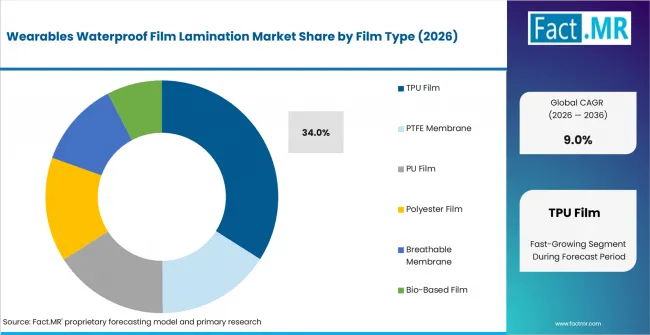
TPU film leads because it bends with fabric and bonds well in stretch panels. The wider polyurethane supply base gives converters access to soft film grades, adhesive tie layers and custom thickness options.
Medical wearable and sportswear buyers also compare TPU film with TPU elastomer inputs when they need stretch recovery and skin-contact comfort in the same stack.
Which lamination method dominates?
Hot-Melt Lamination holds 32.0% share in 2026.
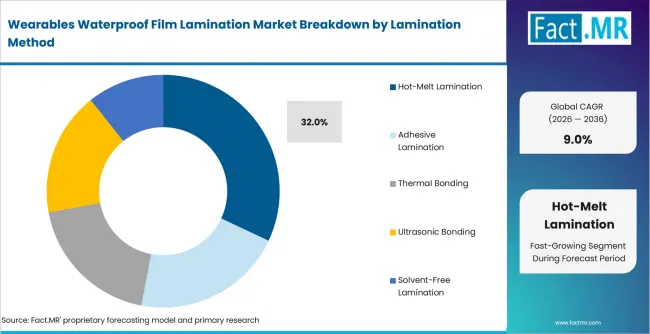
Hot-melt lamination leads because it reduces solvent handling and supports fast bonding on stretch fabrics. Buyers also assess textile adhesives when a laminate must survive heat pressing, bending and wash cycles.
Adhesive lamination remains important where buyers need fine bond control and low hand-feel change. Thermal bonding and ultrasonic bonding remain smaller routes because not every wearable textile can tolerate heat or pressure without damaging the conductive layer.
Which end product dominates?
Sportswear holds 30.0% share in 2026.
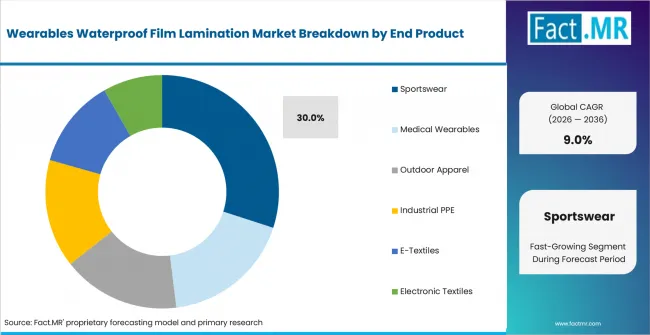
Sportswear leads because active garments expose films to sweat, stretch and repeated laundering. The link with performance apparel specifications is direct because brands need waterproof panels that do not restrict movement.
Medical wearables are a smaller but higher-validation end product. Suppliers also track stick-to-skin materials development because patches and body-worn sensors require comfort, adhesion and moisture control together.
Which performance class dominates?
Waterproof and Breathable performance holds 31.0% share in 2026.
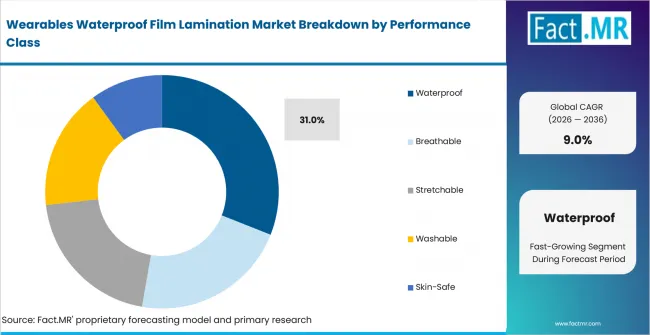
Waterproof and breathable laminates lead because buyers rarely accept moisture protection that traps heat. The need becomes sharper when conductive textile panels must protect signal paths without increasing wearer discomfort.
Stretchable and washable performance classes are expected to gain share through 2036. Skin-safe and antimicrobial finishes remain more regulated because suppliers must avoid claims that exceed test evidence.
Which buyer type dominates?
Apparel Brands hold 34.0% share in 2026.
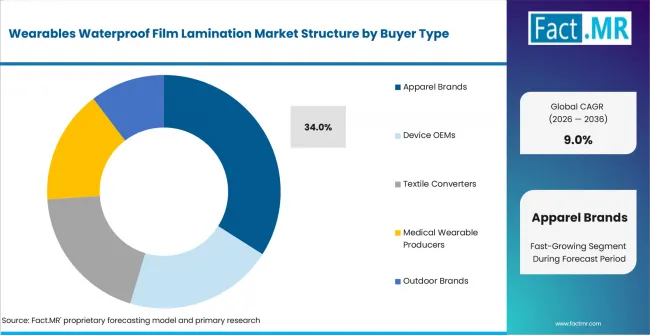
Apparel brands lead because material decisions are made before the final wearable device is assembled. Brands control garment comfort, waterproof claims and care-label risk. Device original equipment manufacturers account for a smaller but more technical buyer group because they focus on sensor protection and bond reliability.
The buyer mix overlaps with e-textile programs where garment teams and electronics teams must approve the same laminated structure.
What is accelerating wearables waterproof film lamination demand, and what is holding it back?
PFAS replacement, wearable comfort and converter qualification drive it; slow testing cycles restrain it.
The main driver is the shift away from fluorinated waterproof finishes. New York State Department of Environmental Conservation guidance states that the PFAS apparel prohibition takes effect on January 1, 2025. [2] Apparel buyers are responding by asking suppliers to prove that laminated barriers can deliver waterproofing without intentionally added PFAS.
A second driver is the need to protect electronics without turning apparel into a rigid device carrier. The same issue appears in technical textile sourcing because buyers want performance layers that keep garment feel and production yield under control.
The main restraint is slow converter qualification. Wearable laminates must pass stretch, sweat, wash and skin-contact review before a brand can scale. Small converters lose time when they cannot document bond conditions, film thickness control and performance after laundering.
Where do the biggest wearables waterproof film lamination opportunities sit?
PFAS replacement, medical wearable barriers and electronics-ready sportswear.
- PFAS Replacement: Suppliers can win outdoor apparel programs by offering laminated waterproof layers with clear chemical documentation.
- Medical Wearable Barriers: Film makers can target sensor patches and monitoring garments where sweat control and skin contact matter together.
- Electronics-Ready Sportswear: Converters can support brands that need sealed pockets, conductive trace protection and washable laminated panels.
Which countries are scaling wearables waterproof film lamination fastest?
China 10.6%, India 10.1%, South Korea 9.7%, United States 9.2%, Germany 8.8%, Japan 8.6%, France 8.4%.
Based on regional analysis, the wearables waterproof film lamination market is segmented into North America, Europe, East Asia, South Asia and Pacific, Latin America, and Middle East and Africa.
.webp)
| Country | CAGR |
|---|---|
| China | 10.6% |
| India | 10.1% |
| South Korea | 9.7% |
| United States | 9.2% |
| Germany | 8.8% |
| Japan | 8.6% |
| France | 8.4% |

What is powering China’s lead?
10.6% CAGR, backed by textile conversion depth and electronics assembly proximity.
China has the strongest co-location of apparel lamination, electronics assembly and component sourcing. Wearable garment programs can move from film selection to sample conversion with fewer handoffs. China is projected to record 10.6% CAGR through 2036 due to this supply-chain proximity. Suppliers with local converter partners are expected to gain better access to sportswear and e-textile programs.
Why is India an important lamination market?
10.1% CAGR, supported by textile export scale and technical textile policy support.
India combines apparel export capacity with policy attention on technical textiles. The Press Information Bureau reported in April 2026 that total textile exports including handicrafts increased from ₹3,09,859.3 crore in FY 2024-25 to ₹3,16,334.9 crore in FY 2025-26. [4] India is expected to expand at 10.1% CAGR through 2036 as export-focused converters add higher-value lamination capability.
What supports South Korea’s outlook?
9.7% CAGR, backed by specialty films and apparel electronics qualification.
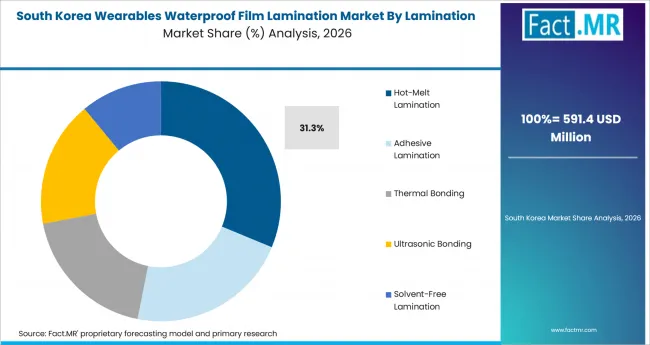
South Korea is important because its textile and electronics bases are close enough to support wearable material trials. Buyers can test waterproof films, conductive yarns and garment construction in a shorter loop than markets with separated supply chains. South Korea is forecast to grow at 9.7% CAGR through 2036. Demand is expected to favor suppliers that can work with apparel brands and electronics assemblers in the same qualification program.
What underpins United States demand?
9.2% CAGR, supported by PFAS apparel rules and premium outdoor specification activity.
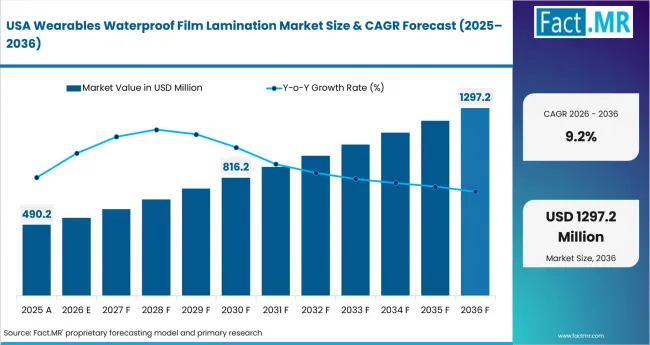
The United States is a high-value specification market for outdoor apparel and body-worn medical devices. The United States International Trade Commission reported in September 2024 that U.S. apparel imports totaled USD 79.3 billion in 2023. [3] The country is expected to advance at 9.2% CAGR through 2036 as apparel buyers replace fluorinated finishes and medical wearable producers require documented material performance.
How is Germany shaping European demand?
8.8% CAGR, backed by EU chemical rules and technical textile converter expertise.
Germany shapes European demand through technical textile know-how and strict buyer documentation. EU restrictions on PFHxA-related substances make waterproofing chemistry part of the material approval process. Germany is projected to rise at 8.8% CAGR through 2036 as apparel, industrial PPE and medical textile buyers use compliance evidence to compare laminates. Demand is expected to favor suppliers with local testing support and clear material declarations.
Why does Japan matter for wearable laminates?
8.6% CAGR, supported by high import reliance and quality-focused textile purchasing.
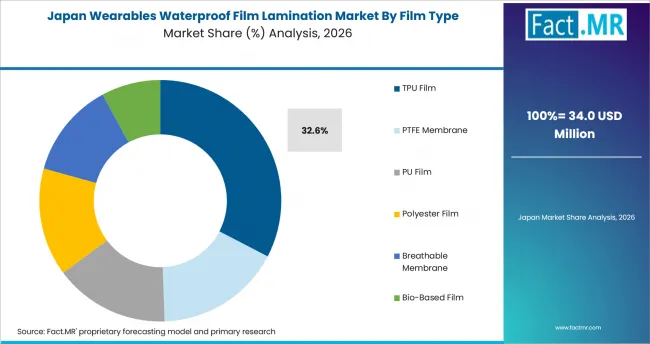
Japan matters because wearable products are often specified for quality, comfort and durability rather than lowest price. The Press Information Bureau reported in August 2025 that Japan imported USD 30,873 million in textile and apparel products from the world in 2024. [5] Japan is forecast at 8.6% CAGR through 2036 as brands seek thin laminates that can pass wash and comfort checks before commercial use.
How is France influencing waterproof apparel specifications?
8.4% CAGR, supported by premium apparel brands and EU chemical compliance.
France is a specification-led market because premium apparel brands influence material choices beyond domestic volume. The Centre for the Promotion of Imports from developing countries stated in March 2026 that Europe imported EUR 180.5 billion of apparel in 2024. [9] France is expected to post 8.4% CAGR through 2036 as premium outdoor and fashion-performance buyers shift waterproofing decisions into compliance and comfort review.
Who leads the wearables waterproof film lamination landscape?
Toray, W. L. Gore, Covestro, Amcor plc / Berry Global legacy and Mativ lead through films, membranes and specialty materials depth.
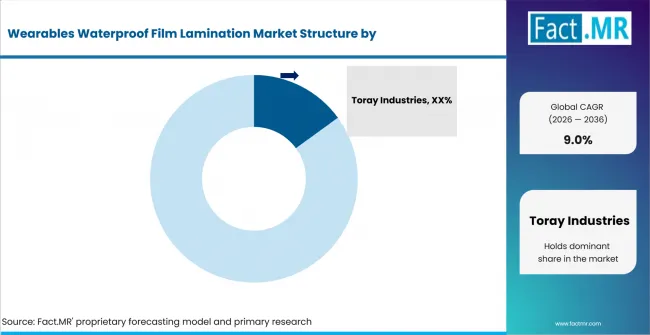
Wearables waterproof film lamination competition is shaped by materials capability and converter support. Toray Industries and W. L. Gore & Associates participate through membrane and performance textile know-how. Covestro supports wearable electronics through Platilon TPU films and highlighted TPU films for wearable health and wellness applications in February 2025. [6] Amcor plc / Berry Global legacy and Bemis Associates add film and bonding exposure where converters need roll goods and adhesive film support.
Mativ Holdings is used as the current company name after the Schweitzer-Mauduit and Neenah merger. Mativ states that its Filtration & Advanced Materials business manufactures engineered polymer, resin and fiber-based substrates, nets and films. [7] 3M is treated as a transition signal rather than a core current PFAS film supplier because its 2026 PFAS stewardship page says it completed its exit from PFAS manufacturing at the end of 2025. [8]
Providers that combine soft film chemistry, lamination process support and chemical documentation are expected to win higher-value programs. Specialist converters can compete when they prove wash durability and low hand-feel change. Large material groups remain better placed when buyers need global supply and multi-country compliance documentation.
Which companies are the key players?
Toray Industries, W. L. Gore & Associates, Covestro, Berry Global, Mativ, Bemis Associates and Nitto Denko.
- Toray Industries
- W. L. Gore & Associates
- Covestro AG
- Amcor plc / Berry Global legacy
- Mativ Holdings
- Bemis Associates
- Nitto Denko Corporation
Bibliography
- [1] Publications Office of the European Union. (2024, September 20). Commission Regulation (EU) 2024/2462 amending Annex XVII to Regulation (EC) No 1907/2006 as regards undecafluorohexanoic acid, its salts and PFHxA-related substances. Publications Office of the European Union.
- [2] New York State Department of Environmental Conservation. (2025). PFAS in apparel law. New York State Department of Environmental Conservation.
- [3] United States International Trade Commission. (2024, September 30). Apparel: Export competitiveness of certain foreign suppliers to the United States. United States International Trade Commission.
- [4] Press Information Bureau, Government of India. (2026, April 22). India’s textile exports register growth of 2.1% in FY 2025-26. Ministry of Textiles.
- [5] Press Information Bureau, Government of India. (2025, August 5). India-Japan textile trade and investment collaboration. Ministry of Textiles.
- [6] Covestro AG. (2025, February 18). Discover the future of stretchable printed electronics with TPU films. Covestro AG.
- [7] Mativ Holdings, Inc. (2026). Form 10-K for the fiscal year ended December 31, 2025. U.S. Securities and Exchange Commission.
- [8] 3M. (2026, February 6). PFAS uses and applications. 3M.
- [9] Centre for the Promotion of Imports from Developing Countries. (2026, March 11). What is the demand for apparel on the European market? CBI.
This Report Addresses
- Strategic intelligence on wearables waterproof film lamination across film type, lamination method and end product.
- Segment analysis covering TPU Film, Hot-Melt Lamination, Sportswear, Waterproof and Breathable performance, and Apparel Brands.
- Regional outlook covering China, India, South Korea, United States, Germany, Japan and France.
- Competitive analysis of Toray Industries, W. L. Gore & Associates, Covestro, Berry Global, Mativ, Bemis Associates and Nitto Denko.
- Material assessment covering TPU film, PTFE membrane, PU film, polyester film, breathable membrane and bio-based film.
- Policy assessment covering PFAS apparel rules, EU PFHxA restriction and converter documentation needs.
- Primary interviews, company checks, official source review and segment validation support the forecast.
What does the wearables waterproof film lamination market cover?
Waterproof and breathable film lamination materials for body-worn textiles and wearable electronics.
The market covers films, membranes and bonding systems used to make wearable textiles waterproof. It includes thermoplastic polyurethane film, polyurethane film, polytetrafluoroethylene membrane, breathable membrane and bio-based film where the material is laminated to fabric or electronic textile panels. The market differs from finished wearable devices because the service focus is material protection, converter qualification and performance approval.
What is included in the scope?
Film grades, lamination methods and converter services used in wearable textile panels.
The scope includes TPU film, PTFE membrane, PU film, polyester film, breathable membrane and bio-based film. It covers hot-melt lamination, adhesive lamination, thermal bonding, ultrasonic bonding and solvent-free lamination. It also includes laminated panels used in sportswear, medical wearables, outdoor apparel, industrial personal protective equipment and e-textiles.
What is excluded from the scope?
Finished wearable devices and textile coatings not linked to laminated waterproof barriers.
The scope excludes smartwatches, fitness trackers and medical devices sold as finished electronics. It excludes unlaminated fabric coatings unless the coating is supplied as part of a film-laminated barrier system. It also excludes rigid device housings, encapsulation compounds and generic apparel waterproofing services without wearable electronics or body-worn sensor use.
How was the analysis built?
100+ sources, 45+ company portfolios, 25+ countries, 20+ interviews.
- Primary Research: Primary research included discussions with textile converters, film suppliers, apparel sourcing teams and medical wearable material buyers. It tested how buyers compare stretch, breathability, wash durability and skin-contact comfort before approving laminates.
- Desk Research: Desk research reviewed chemical restriction sources, textile import signals, company product pages and official company announcements. The source review excluded commercial market research figures and replaced outdated supplier names with current legal names.
- Market-Sizing and Forecasting: Forecasting used 2025, 2026 and 2036 market estimates. The values were checked against technical textile exposure, film supplier portfolios, wearable textile use cases and PFAS replacement demand.
- Data Validation and Update Cycle: Forecasts were validated through segment share checks and country-level textile demand signals. Company references were screened for current legal identity, current product relevance and material exposure through June 2026.
What is the report’s scope and coverage?
| Attribute | Details |
|---|---|
| Quantitative Units | USD Million in 2026 to USD Million by 2036 at CAGR |
| Market Definition | Waterproof and breathable film lamination materials used in wearable textiles and body-worn electronic garments |
| Film Type | TPU Film, PTFE Membrane, PU Film, Polyester Film, Breathable Membrane, Bio-Based Film |
| Lamination Method | Hot-Melt Lamination, Adhesive Lamination, Thermal Bonding, Ultrasonic Bonding, Solvent-Free Lamination |
| End Product | Electronic Textiles, Sportswear, Medical Wearables, Outdoor Apparel, Industrial PPE, E-Textiles |
| Performance | Waterproof, Breathable, Stretchable, Washable, Skin-Safe, Antimicrobial, Conductive-Compatible |
| Buyer Type | Apparel Brands, Device OEMs, Textile Converters, Medical Wearable Producers, Outdoor Brands |
| Regions Covered | North America, Europe, East Asia, South Asia and Pacific, Latin America, Middle East and Africa |
| Countries Covered | China, India, South Korea, United States, Germany, Japan and France |
| Key Companies Profiled | Toray Industries, W. L. Gore & Associates, Covestro, Berry Global, Mativ, Bemis Associates and Nitto Denko |
| Forecast Period | 2026 to 2036 |
| Approach | Hybrid top-down and bottom-up approach using market estimates, film supplier portfolios, textile trade signals and converter validation |
How is the market segmented?
-
By Film Type:
- TPU Film
- PTFE Membrane
- PU Film
- Polyester Film
- Breathable Membrane
- Bio-Based Film
-
By Lamination Method:
- Hot-Melt Lamination
- Adhesive Lamination
- Thermal Bonding
- Ultrasonic Bonding
- Solvent-Free Lamination
-
By End Product:
- Electronic Textiles
- Sportswear
- Medical Wearables
- Outdoor Apparel
- Industrial PPE
- E-Textiles
-
By Performance:
- Waterproof
- Breathable
- Stretchable
- Washable
- Skin-Safe
- Antimicrobial
- Conductive-Compatible
-
By Buyer Type:
- Apparel Brands
- Device OEMs
- Textile Converters
- Medical Wearable Producers
- Outdoor Brands
-
By Region:
- North America
- United States
- Canada
- Mexico
- Latin America
- Brazil
- Argentina
- Rest of Latin America
- Europe
- Germany
- United Kingdom
- France
- Italy
- Spain
- Rest of Europe
- Asia Pacific
- China
- India
- Japan
- South Korea
- ASEAN
- Middle East & Africa
- GCC Countries
- South Africa
- UAE
- Rest of Middle East & Africa
- North America
- Frequently Asked Questions -
Which film type leads the Wearables Waterproof Film Lamination Market?
TPU Film leads with 34.0% share in 2026 due to stretch recovery, soft contact and bonding compatibility.
Which lamination method leads the Wearables Waterproof Film Lamination Market?
Hot-Melt Lamination leads with 32.0% share in 2026 due to cleaner processing and faster converter set-up.
Which country expands faster in the Wearables Waterproof Film Lamination Market?
China is projected to record 10.6% CAGR through 2036 due to textile conversion depth and electronics assembly proximity.
How does India perform in the Wearables Waterproof Film Lamination Market?
India is expected to expand at 10.1% CAGR through 2036 due to export textile scale and technical textile policy support.
How does South Korea perform in the Wearables Waterproof Film Lamination Market?
South Korea is forecast to grow at 9.7% CAGR through 2036 due to apparel electronics qualification and specialty film use.
How does the United States perform in the Wearables Waterproof Film Lamination Market?
The United States is expected to advance at 9.2% CAGR through 2036 due to PFAS apparel rules and premium outdoor specifications.
How does Germany perform in the Wearables Waterproof Film Lamination Market?
Germany is projected to rise at 8.8% CAGR through 2036 due to EU chemical rules and technical textile converter expertise.
What is the primary driver in the Wearables Waterproof Film Lamination Market?
The primary driver is the need to protect wearable electronics from sweat, wash cycles and rain exposure.
What is the main restraint in the Wearables Waterproof Film Lamination Market?
The main restraint is slow converter qualification because films must pass stretch, wash and skin-contact review before scale-up.
Why are sportswear applications important in this market?
Sportswear applications are important because active garments need waterproof panels that remain flexible during movement and washing.
Table of Content
- Key Takeaways
- Market Size and CAGR
- Top Growth Driver
- Fastest Growing Segment
- Leading Region
- Key Companies
- Emerging Opportunities
- Executive Summary
- Global Market Outlook
- Demand-side Trends
- Supply-side Trends
- Technology Roadmap Analysis
- Analysis and Recommendations
- Analyst Perspective (What is happening? Why now? What should investors know?)
- Key Questions Answered
- How large is the market?
- What is the CAGR?
- What are key trends?
- Which region dominates?
- Who are the leaders?
- Market Overview
- Market Coverage / Taxonomy
- Market Definition / Scope / Limitations
- Research Methodology
- Chapter Orientation
- Analytical Lens and Working Hypotheses
- Market Structure, Signals, and Trend Drivers
- Benchmarking and Cross-market Comparability
- Market Sizing, Forecasting, and Opportunity Mapping
- Research Design and Evidence Framework
- Desk Research Programme (Secondary Evidence)
- Expert Input and Fieldwork (Primary Evidence)
- Tooling, Models, and Reference Databases
- Data Engineering and Model Build
- Quality Assurance and Audit Trail
- Market Background
- Market Dynamics (Drivers, Restraints, Opportunity, Trends)
- Scenario Forecast (Optimistic, Likely, Conservative)
- Impact Analysis
- AI Impact
- Sustainability Impact
- Regulatory Impact
- Technology Impact
- Consumer / Buyer Analysis
- Purchase Drivers
- Adoption Barriers
- Buyer Journey
- Opportunity Map Analysis
- Product Life Cycle Analysis
- Supply Chain Analysis
- Investment Feasibility Matrix
- Value Chain Analysis
- PESTLE and Porter's Analysis
- Regulatory Landscape
- Regional Parent Market Outlook
- Production and Consumption Statistics
- Import and Export Statistics
- Global Market Analysis and Forecast, 2021 to 2036
- Historical Market Size Value (USD Million) Analysis, 2021 to 2025
- Current and Future Market Size Value (USD Million) Projections, 2026 to 2036
- Y-o-Y Growth Trend Analysis
- Absolute $ Opportunity Analysis
- Global Market Pricing Analysis, 2021 to 2036
- Global Market Analysis and Forecast, By Film Type, 2021 to 2036
- Introduction / Key Findings
- Historical Market Size Value (USD Million) Analysis By Film Type, 2021 to 2025
- Current and Future Market Size Value (USD Million) Analysis and Forecast By Film Type, 2026 to 2036
- TPU Film
- PTFE Membrane
- PU Film
- Polyester Film
- Breathable Membrane
- Bio-Based Film
- TPU Film
- Y-o-Y Growth Trend Analysis By Film Type, 2021 to 2025
- Absolute $ Opportunity Analysis By Film Type, 2026 to 2036
- Global Market Analysis and Forecast, By Lamination Method, 2021 to 2036
- Introduction / Key Findings
- Historical Market Size Value (USD Million) Analysis By Lamination Method, 2021 to 2025
- Current and Future Market Size Value (USD Million) Analysis and Forecast By Lamination Method, 2026 to 2036
- Hot-Melt Lamination
- Adhesive Lamination
- Thermal Bonding
- Ultrasonic Bonding
- Solvent-Free Lamination
- Hot-Melt Lamination
- Y-o-Y Growth Trend Analysis By Lamination Method, 2021 to 2025
- Absolute $ Opportunity Analysis By Lamination Method, 2026 to 2036
- Global Market Analysis and Forecast, By End Product, 2021 to 2036
- Introduction / Key Findings
- Historical Market Size Value (USD Million) Analysis By End Product, 2021 to 2025
- Current and Future Market Size Value (USD Million) Analysis and Forecast By End Product, 2026 to 2036
- Sportswear
- Medical Wearables
- Outdoor Apparel
- Industrial PPE
- E-Textiles
- Electronic Textiles
- Sportswear
- Y-o-Y Growth Trend Analysis By End Product, 2021 to 2025
- Absolute $ Opportunity Analysis By End Product, 2026 to 2036
- Global Market Analysis and Forecast, By Performance Class, 2021 to 2036
- Introduction / Key Findings
- Historical Market Size Value (USD Million) Analysis By Performance Class, 2021 to 2025
- Current and Future Market Size Value (USD Million) Analysis and Forecast By Performance Class, 2026 to 2036
- Waterproof
- Breathable
- Stretchable
- Washable
- Skin-Safe
- Waterproof
- Y-o-Y Growth Trend Analysis By Performance Class, 2021 to 2025
- Absolute $ Opportunity Analysis By Performance Class, 2026 to 2036
- Global Market Analysis and Forecast, By Buyer Type, 2021 to 2036
- Introduction / Key Findings
- Historical Market Size Value (USD Million) Analysis By Buyer Type, 2021 to 2025
- Current and Future Market Size Value (USD Million) Analysis and Forecast By Buyer Type, 2026 to 2036
- Apparel Brands
- Device OEMs
- Textile Converters
- Medical Wearable Producers
- Outdoor Brands
- Apparel Brands
- Y-o-Y Growth Trend Analysis By Buyer Type, 2021 to 2025
- Absolute $ Opportunity Analysis By Buyer Type, 2026 to 2036
- Global Market Analysis and Forecast, By Region, 2021 to 2036
- Introduction
- Historical Market Size Value (USD Million) Analysis By Region, 2021 to 2025
- Current Market Size Value (USD Million) Analysis and Forecast By Region, 2026 to 2036
- North America
- Latin America
- Western Europe
- Eastern Europe
- East Asia
- South Asia and Pacific
- Middle East & Africa
- Market Attractiveness Analysis By Region
- North America Market Analysis and Forecast, By Country, 2021 to 2036
- Historical Market Size Value (USD Million) Trend Analysis By Market Taxonomy, 2021 to 2025
- Market Size Value (USD Million) Forecast By Market Taxonomy, 2026 to 2036
- By Country
- USA
- Canada
- Mexico
- By Film Type
- By Lamination Method
- By End Product
- By Performance Class
- By Buyer Type
- By Country
- Market Attractiveness Analysis
- By Country
- By Film Type
- By Lamination Method
- By End Product
- By Performance Class
- By Buyer Type
- Key Takeaways
- Latin America Market Analysis and Forecast, By Country
- Historical Market Size Value (USD Million) Trend Analysis By Market Taxonomy, 2021 to 2025
- Market Size Value (USD Million) Forecast By Market Taxonomy, 2026 to 2036
- By Country
- Brazil
- Chile
- Rest of Latin America
- By Film Type
- By Lamination Method
- By End Product
- By Performance Class
- By Buyer Type
- By Country
- Market Attractiveness Analysis
- By Country
- By Film Type
- By Lamination Method
- By End Product
- By Performance Class
- By Buyer Type
- Key Takeaways
- Western Europe Market Analysis and Forecast, By Country
- Historical Market Size Value (USD Million) Trend Analysis By Market Taxonomy, 2021 to 2025
- Market Size Value (USD Million) Forecast By Market Taxonomy, 2026 to 2036
- By Country
- Germany
- UK
- Italy
- Spain
- France
- Nordic
- BENELUX
- Rest of Western Europe
- By Film Type
- By Lamination Method
- By End Product
- By Performance Class
- By Buyer Type
- By Country
- Market Attractiveness Analysis
- By Country
- By Film Type
- By Lamination Method
- By End Product
- By Performance Class
- By Buyer Type
- Key Takeaways
- Eastern Europe Market Analysis and Forecast, By Country
- Historical Market Size Value (USD Million) Trend Analysis By Market Taxonomy, 2021 to 2025
- Market Size Value (USD Million) Forecast By Market Taxonomy, 2026 to 2036
- By Country
- Russia
- Poland
- Hungary
- Balkan & Baltic
- Rest of Eastern Europe
- By Film Type
- By Lamination Method
- By End Product
- By Performance Class
- By Buyer Type
- By Country
- Market Attractiveness Analysis
- By Country
- By Film Type
- By Lamination Method
- By End Product
- By Performance Class
- By Buyer Type
- Key Takeaways
- East Asia Market Analysis and Forecast, By Country
- Historical Market Size Value (USD Million) Trend Analysis By Market Taxonomy, 2021 to 2025
- Market Size Value (USD Million) Forecast By Market Taxonomy, 2026 to 2036
- By Country
- China
- Japan
- South Korea
- By Film Type
- By Lamination Method
- By End Product
- By Performance Class
- By Buyer Type
- By Country
- Market Attractiveness Analysis
- By Country
- By Film Type
- By Lamination Method
- By End Product
- By Performance Class
- By Buyer Type
- Key Takeaways
- South Asia and Pacific Market Analysis and Forecast, By Country
- Historical Market Size Value (USD Million) Trend Analysis By Market Taxonomy, 2021 to 2025
- Market Size Value (USD Million) Forecast By Market Taxonomy, 2026 to 2036
- By Country
- India
- ASEAN
- Australia & New Zealand
- Rest of South Asia and Pacific
- By Film Type
- By Lamination Method
- By End Product
- By Performance Class
- By Buyer Type
- By Country
- Market Attractiveness Analysis
- By Country
- By Film Type
- By Lamination Method
- By End Product
- By Performance Class
- By Buyer Type
- Key Takeaways
- Middle East & Africa Market Analysis and Forecast, By Country
- Historical Market Size Value (USD Million) Trend Analysis By Market Taxonomy, 2021 to 2025
- Market Size Value (USD Million) Forecast By Market Taxonomy, 2026 to 2036
- By Country
- Kingdom of Saudi Arabia
- Other GCC Countries
- Turkiye
- South Africa
- Other African Union
- Rest of Middle East & Africa
- By Film Type
- By Lamination Method
- By End Product
- By Performance Class
- By Buyer Type
- By Country
- Market Attractiveness Analysis
- By Country
- By Film Type
- By Lamination Method
- By End Product
- By Performance Class
- By Buyer Type
- Key Takeaways
- Key Countries Market Analysis
- USA
- Pricing Analysis
- Market Share Analysis, 2025
- By Film Type
- By Lamination Method
- By End Product
- By Performance Class
- By Buyer Type
- Canada
- Pricing Analysis
- Market Share Analysis, 2025
- By Film Type
- By Lamination Method
- By End Product
- By Performance Class
- By Buyer Type
- Mexico
- Pricing Analysis
- Market Share Analysis, 2025
- By Film Type
- By Lamination Method
- By End Product
- By Performance Class
- By Buyer Type
- Brazil
- Pricing Analysis
- Market Share Analysis, 2025
- By Film Type
- By Lamination Method
- By End Product
- By Performance Class
- By Buyer Type
- Chile
- Pricing Analysis
- Market Share Analysis, 2025
- By Film Type
- By Lamination Method
- By End Product
- By Performance Class
- By Buyer Type
- Germany
- Pricing Analysis
- Market Share Analysis, 2025
- By Film Type
- By Lamination Method
- By End Product
- By Performance Class
- By Buyer Type
- UK
- Pricing Analysis
- Market Share Analysis, 2025
- By Film Type
- By Lamination Method
- By End Product
- By Performance Class
- By Buyer Type
- Italy
- Pricing Analysis
- Market Share Analysis, 2025
- By Film Type
- By Lamination Method
- By End Product
- By Performance Class
- By Buyer Type
- Spain
- Pricing Analysis
- Market Share Analysis, 2025
- By Film Type
- By Lamination Method
- By End Product
- By Performance Class
- By Buyer Type
- France
- Pricing Analysis
- Market Share Analysis, 2025
- By Film Type
- By Lamination Method
- By End Product
- By Performance Class
- By Buyer Type
- India
- Pricing Analysis
- Market Share Analysis, 2025
- By Film Type
- By Lamination Method
- By End Product
- By Performance Class
- By Buyer Type
- ASEAN
- Pricing Analysis
- Market Share Analysis, 2025
- By Film Type
- By Lamination Method
- By End Product
- By Performance Class
- By Buyer Type
- Australia & New Zealand
- Pricing Analysis
- Market Share Analysis, 2025
- By Film Type
- By Lamination Method
- By End Product
- By Performance Class
- By Buyer Type
- China
- Pricing Analysis
- Market Share Analysis, 2025
- By Film Type
- By Lamination Method
- By End Product
- By Performance Class
- By Buyer Type
- Japan
- Pricing Analysis
- Market Share Analysis, 2025
- By Film Type
- By Lamination Method
- By End Product
- By Performance Class
- By Buyer Type
- South Korea
- Pricing Analysis
- Market Share Analysis, 2025
- By Film Type
- By Lamination Method
- By End Product
- By Performance Class
- By Buyer Type
- Russia
- Pricing Analysis
- Market Share Analysis, 2025
- By Film Type
- By Lamination Method
- By End Product
- By Performance Class
- By Buyer Type
- Poland
- Pricing Analysis
- Market Share Analysis, 2025
- By Film Type
- By Lamination Method
- By End Product
- By Performance Class
- By Buyer Type
- Hungary
- Pricing Analysis
- Market Share Analysis, 2025
- By Film Type
- By Lamination Method
- By End Product
- By Performance Class
- By Buyer Type
- Kingdom of Saudi Arabia
- Pricing Analysis
- Market Share Analysis, 2025
- By Film Type
- By Lamination Method
- By End Product
- By Performance Class
- By Buyer Type
- Turkiye
- Pricing Analysis
- Market Share Analysis, 2025
- By Film Type
- By Lamination Method
- By End Product
- By Performance Class
- By Buyer Type
- South Africa
- Pricing Analysis
- Market Share Analysis, 2025
- By Film Type
- By Lamination Method
- By End Product
- By Performance Class
- By Buyer Type
- USA
- Market Structure Analysis
- Competition Dashboard
- Competition Benchmarking
- Market Share Analysis of Top Players
- By Regional
- By Film Type
- By Lamination Method
- By End Product
- By Performance Class
- By Buyer Type
- Emerging Startups
- Innovation Benchmarking
- Competition Analysis
- Competition Deep Dive
- Toray Industries
- Overview
- Product Portfolio
- Profitability by Market Segments (Product/Age /Sales Channel/Region)
- Sales Footprint
- Strategy Overview
- Marketing Strategy
- Product Strategy
- Channel Strategy
- W. L. Gore & Associates
- Covestro AG
- Amcor plc / Berry Global legacy
- Mativ Holdings
- Bemis Associates
- Nitto Denko Corporation
- Toray Industries
- Competition Deep Dive
- Case Studies
- Success Stories
- Recent Developments
- Assumptions & Acronyms Used
List Of Table
- Table 1: Global Market Value (USD Million) Forecast by Region, 2021 - 2036
- Table 2: Global Market Value (USD Million) Forecast by Film Type, 2021 - 2036
- Table 3: Global Market Value (USD Million) Forecast by Lamination Method, 2021 - 2036
- Table 4: Global Market Value (USD Million) Forecast by End Product, 2021 - 2036
- Table 5: Global Market Value (USD Million) Forecast by Performance Class, 2021 - 2036
- Table 6: Global Market Value (USD Million) Forecast by Buyer Type, 2021 - 2036
- Table 7: Global Market rma_anu Forecast by rma_anu, 2021 - 2036
- Table 8: North America Market Value (USD Million) Forecast by Country, 2021 - 2036
- Table 9: North America Market Value (USD Million) Forecast by Film Type, 2021 - 2036
- Table 10: North America Market Value (USD Million) Forecast by Lamination Method, 2021 - 2036
- Table 11: North America Market Value (USD Million) Forecast by End Product, 2021 - 2036
- Table 12: North America Market Value (USD Million) Forecast by Performance Class, 2021 - 2036
- Table 13: North America Market Value (USD Million) Forecast by Buyer Type, 2021 - 2036
- Table 14: Latin America Market Value (USD Million) Forecast by Country, 2021 - 2036
- Table 15: Latin America Market Value (USD Million) Forecast by Film Type, 2021 - 2036
- Table 16: Latin America Market Value (USD Million) Forecast by Lamination Method, 2021 - 2036
- Table 17: Latin America Market Value (USD Million) Forecast by End Product, 2021 - 2036
- Table 18: Latin America Market Value (USD Million) Forecast by Performance Class, 2021 - 2036
- Table 19: Latin America Market Value (USD Million) Forecast by Buyer Type, 2021 - 2036
- Table 20: Western Europe Market Value (USD Million) Forecast by Country, 2021 - 2036
- Table 21: Western Europe Market Value (USD Million) Forecast by Film Type, 2021 - 2036
- Table 22: Western Europe Market Value (USD Million) Forecast by Lamination Method, 2021 - 2036
- Table 23: Western Europe Market Value (USD Million) Forecast by End Product, 2021 - 2036
- Table 24: Western Europe Market Value (USD Million) Forecast by Performance Class, 2021 - 2036
- Table 25: Western Europe Market Value (USD Million) Forecast by Buyer Type, 2021 - 2036
- Table 26: Eastern Europe Market Value (USD Million) Forecast by Country, 2021 - 2036
- Table 27: Eastern Europe Market Value (USD Million) Forecast by Film Type, 2021 - 2036
- Table 28: Eastern Europe Market Value (USD Million) Forecast by Lamination Method, 2021 - 2036
- Table 29: Eastern Europe Market Value (USD Million) Forecast by End Product, 2021 - 2036
- Table 30: Eastern Europe Market Value (USD Million) Forecast by Performance Class, 2021 - 2036
- Table 31: Eastern Europe Market Value (USD Million) Forecast by Buyer Type, 2021 - 2036
- Table 32: East Asia Market Value (USD Million) Forecast by Country, 2021 - 2036
- Table 33: East Asia Market Value (USD Million) Forecast by Film Type, 2021 - 2036
- Table 34: East Asia Market Value (USD Million) Forecast by Lamination Method, 2021 - 2036
- Table 35: East Asia Market Value (USD Million) Forecast by End Product, 2021 - 2036
- Table 36: East Asia Market Value (USD Million) Forecast by Performance Class, 2021 - 2036
- Table 37: East Asia Market Value (USD Million) Forecast by Buyer Type, 2021 - 2036
- Table 38: South Asia and Pacific Market Value (USD Million) Forecast by Country, 2021 - 2036
- Table 39: South Asia and Pacific Market Value (USD Million) Forecast by Film Type, 2021 - 2036
- Table 40: South Asia and Pacific Market Value (USD Million) Forecast by Lamination Method, 2021 - 2036
- Table 41: South Asia and Pacific Market Value (USD Million) Forecast by End Product, 2021 - 2036
- Table 42: South Asia and Pacific Market Value (USD Million) Forecast by Performance Class, 2021 - 2036
- Table 43: South Asia and Pacific Market Value (USD Million) Forecast by Buyer Type, 2021 - 2036
- Table 44: Middle East & Africa Market Value (USD Million) Forecast by Country, 2021 - 2036
- Table 45: Middle East & Africa Market Value (USD Million) Forecast by Film Type, 2021 - 2036
- Table 46: Middle East & Africa Market Value (USD Million) Forecast by Lamination Method, 2021 - 2036
- Table 47: Middle East & Africa Market Value (USD Million) Forecast by End Product, 2021 - 2036
- Table 48: Middle East & Africa Market Value (USD Million) Forecast by Performance Class, 2021 - 2036
- Table 49: Middle East & Africa Market Value (USD Million) Forecast by Buyer Type, 2021 - 2036
List Of Figures
- Figure 1: Global Market Pricing Analysis
- Figure 2: Global Market Value (USD Million) Forecast 2021-2036
- Figure 3: Global Market Value Share and BPS Analysis by Film Type, 2026 and 2036
- Figure 4: Global Market Y-o-Y Growth Comparison by Film Type, 2026-2036
- Figure 5: Global Market Attractiveness Analysis by Film Type
- Figure 6: Global Market Value Share and BPS Analysis by Lamination Method, 2026 and 2036
- Figure 7: Global Market Y-o-Y Growth Comparison by Lamination Method, 2026-2036
- Figure 8: Global Market Attractiveness Analysis by Lamination Method
- Figure 9: Global Market Value Share and BPS Analysis by End Product, 2026 and 2036
- Figure 10: Global Market Y-o-Y Growth Comparison by End Product, 2026-2036
- Figure 11: Global Market Attractiveness Analysis by End Product
- Figure 12: Global Market Value Share and BPS Analysis by Performance Class, 2026 and 2036
- Figure 13: Global Market Y-o-Y Growth Comparison by Performance Class, 2026-2036
- Figure 14: Global Market Attractiveness Analysis by Performance Class
- Figure 15: Global Market Value Share and BPS Analysis by Buyer Type, 2026 and 2036
- Figure 16: Global Market Y-o-Y Growth Comparison by Buyer Type, 2026-2036
- Figure 17: Global Market Attractiveness Analysis by Buyer Type
- Figure 18: Global Market Value (USD Million) Share and BPS Analysis by Region, 2026 and 2036
- Figure 19: Global Market Y-o-Y Growth Comparison by Region, 2026-2036
- Figure 20: Global Market Attractiveness Analysis by Region
- Figure 21: North America Market Incremental Dollar Opportunity, 2026-2036
- Figure 22: Latin America Market Incremental Dollar Opportunity, 2026-2036
- Figure 23: Western Europe Market Incremental Dollar Opportunity, 2026-2036
- Figure 24: Eastern Europe Market Incremental Dollar Opportunity, 2026-2036
- Figure 25: East Asia Market Incremental Dollar Opportunity, 2026-2036
- Figure 26: South Asia and Pacific Market Incremental Dollar Opportunity, 2026-2036
- Figure 27: Middle East & Africa Market Incremental Dollar Opportunity, 2026-2036
- Figure 28: North America Market Value Share and BPS Analysis by Country, 2026 and 2036
- Figure 29: North America Market Value Share and BPS Analysis by Film Type, 2026 and 2036
- Figure 30: North America Market Y-o-Y Growth Comparison by Film Type, 2026-2036
- Figure 31: North America Market Attractiveness Analysis by Film Type
- Figure 32: North America Market Value Share and BPS Analysis by Lamination Method, 2026 and 2036
- Figure 33: North America Market Y-o-Y Growth Comparison by Lamination Method, 2026-2036
- Figure 34: North America Market Attractiveness Analysis by Lamination Method
- Figure 35: North America Market Value Share and BPS Analysis by End Product, 2026 and 2036
- Figure 36: North America Market Y-o-Y Growth Comparison by End Product, 2026-2036
- Figure 37: North America Market Attractiveness Analysis by End Product
- Figure 38: North America Market Value Share and BPS Analysis by Performance Class, 2026 and 2036
- Figure 39: North America Market Y-o-Y Growth Comparison by Performance Class, 2026-2036
- Figure 40: North America Market Attractiveness Analysis by Performance Class
- Figure 41: North America Market Value Share and BPS Analysis by Buyer Type, 2026 and 2036
- Figure 42: North America Market Y-o-Y Growth Comparison by Buyer Type, 2026-2036
- Figure 43: North America Market Attractiveness Analysis by Buyer Type
- Figure 44: Latin America Market Value Share and BPS Analysis by Country, 2026 and 2036
- Figure 45: Latin America Market Value Share and BPS Analysis by Film Type, 2026 and 2036
- Figure 46: Latin America Market Y-o-Y Growth Comparison by Film Type, 2026-2036
- Figure 47: Latin America Market Attractiveness Analysis by Film Type
- Figure 48: Latin America Market Value Share and BPS Analysis by Lamination Method, 2026 and 2036
- Figure 49: Latin America Market Y-o-Y Growth Comparison by Lamination Method, 2026-2036
- Figure 50: Latin America Market Attractiveness Analysis by Lamination Method
- Figure 51: Latin America Market Value Share and BPS Analysis by End Product, 2026 and 2036
- Figure 52: Latin America Market Y-o-Y Growth Comparison by End Product, 2026-2036
- Figure 53: Latin America Market Attractiveness Analysis by End Product
- Figure 54: Latin America Market Value Share and BPS Analysis by Performance Class, 2026 and 2036
- Figure 55: Latin America Market Y-o-Y Growth Comparison by Performance Class, 2026-2036
- Figure 56: Latin America Market Attractiveness Analysis by Performance Class
- Figure 57: Latin America Market Value Share and BPS Analysis by Buyer Type, 2026 and 2036
- Figure 58: Latin America Market Y-o-Y Growth Comparison by Buyer Type, 2026-2036
- Figure 59: Latin America Market Attractiveness Analysis by Buyer Type
- Figure 60: Western Europe Market Value Share and BPS Analysis by Country, 2026 and 2036
- Figure 61: Western Europe Market Value Share and BPS Analysis by Film Type, 2026 and 2036
- Figure 62: Western Europe Market Y-o-Y Growth Comparison by Film Type, 2026-2036
- Figure 63: Western Europe Market Attractiveness Analysis by Film Type
- Figure 64: Western Europe Market Value Share and BPS Analysis by Lamination Method, 2026 and 2036
- Figure 65: Western Europe Market Y-o-Y Growth Comparison by Lamination Method, 2026-2036
- Figure 66: Western Europe Market Attractiveness Analysis by Lamination Method
- Figure 67: Western Europe Market Value Share and BPS Analysis by End Product, 2026 and 2036
- Figure 68: Western Europe Market Y-o-Y Growth Comparison by End Product, 2026-2036
- Figure 69: Western Europe Market Attractiveness Analysis by End Product
- Figure 70: Western Europe Market Value Share and BPS Analysis by Performance Class, 2026 and 2036
- Figure 71: Western Europe Market Y-o-Y Growth Comparison by Performance Class, 2026-2036
- Figure 72: Western Europe Market Attractiveness Analysis by Performance Class
- Figure 73: Western Europe Market Value Share and BPS Analysis by Buyer Type, 2026 and 2036
- Figure 74: Western Europe Market Y-o-Y Growth Comparison by Buyer Type, 2026-2036
- Figure 75: Western Europe Market Attractiveness Analysis by Buyer Type
- Figure 76: Eastern Europe Market Value Share and BPS Analysis by Country, 2026 and 2036
- Figure 77: Eastern Europe Market Value Share and BPS Analysis by Film Type, 2026 and 2036
- Figure 78: Eastern Europe Market Y-o-Y Growth Comparison by Film Type, 2026-2036
- Figure 79: Eastern Europe Market Attractiveness Analysis by Film Type
- Figure 80: Eastern Europe Market Value Share and BPS Analysis by Lamination Method, 2026 and 2036
- Figure 81: Eastern Europe Market Y-o-Y Growth Comparison by Lamination Method, 2026-2036
- Figure 82: Eastern Europe Market Attractiveness Analysis by Lamination Method
- Figure 83: Eastern Europe Market Value Share and BPS Analysis by End Product, 2026 and 2036
- Figure 84: Eastern Europe Market Y-o-Y Growth Comparison by End Product, 2026-2036
- Figure 85: Eastern Europe Market Attractiveness Analysis by End Product
- Figure 86: Eastern Europe Market Value Share and BPS Analysis by Performance Class, 2026 and 2036
- Figure 87: Eastern Europe Market Y-o-Y Growth Comparison by Performance Class, 2026-2036
- Figure 88: Eastern Europe Market Attractiveness Analysis by Performance Class
- Figure 89: Eastern Europe Market Value Share and BPS Analysis by Buyer Type, 2026 and 2036
- Figure 90: Eastern Europe Market Y-o-Y Growth Comparison by Buyer Type, 2026-2036
- Figure 91: Eastern Europe Market Attractiveness Analysis by Buyer Type
- Figure 92: East Asia Market Value Share and BPS Analysis by Country, 2026 and 2036
- Figure 93: East Asia Market Value Share and BPS Analysis by Film Type, 2026 and 2036
- Figure 94: East Asia Market Y-o-Y Growth Comparison by Film Type, 2026-2036
- Figure 95: East Asia Market Attractiveness Analysis by Film Type
- Figure 96: East Asia Market Value Share and BPS Analysis by Lamination Method, 2026 and 2036
- Figure 97: East Asia Market Y-o-Y Growth Comparison by Lamination Method, 2026-2036
- Figure 98: East Asia Market Attractiveness Analysis by Lamination Method
- Figure 99: East Asia Market Value Share and BPS Analysis by End Product, 2026 and 2036
- Figure 100: East Asia Market Y-o-Y Growth Comparison by End Product, 2026-2036
- Figure 101: East Asia Market Attractiveness Analysis by End Product
- Figure 102: East Asia Market Value Share and BPS Analysis by Performance Class, 2026 and 2036
- Figure 103: East Asia Market Y-o-Y Growth Comparison by Performance Class, 2026-2036
- Figure 104: East Asia Market Attractiveness Analysis by Performance Class
- Figure 105: East Asia Market Value Share and BPS Analysis by Buyer Type, 2026 and 2036
- Figure 106: East Asia Market Y-o-Y Growth Comparison by Buyer Type, 2026-2036
- Figure 107: East Asia Market Attractiveness Analysis by Buyer Type
- Figure 108: South Asia and Pacific Market Value Share and BPS Analysis by Country, 2026 and 2036
- Figure 109: South Asia and Pacific Market Value Share and BPS Analysis by Film Type, 2026 and 2036
- Figure 110: South Asia and Pacific Market Y-o-Y Growth Comparison by Film Type, 2026-2036
- Figure 111: South Asia and Pacific Market Attractiveness Analysis by Film Type
- Figure 112: South Asia and Pacific Market Value Share and BPS Analysis by Lamination Method, 2026 and 2036
- Figure 113: South Asia and Pacific Market Y-o-Y Growth Comparison by Lamination Method, 2026-2036
- Figure 114: South Asia and Pacific Market Attractiveness Analysis by Lamination Method
- Figure 115: South Asia and Pacific Market Value Share and BPS Analysis by End Product, 2026 and 2036
- Figure 116: South Asia and Pacific Market Y-o-Y Growth Comparison by End Product, 2026-2036
- Figure 117: South Asia and Pacific Market Attractiveness Analysis by End Product
- Figure 118: South Asia and Pacific Market Value Share and BPS Analysis by Performance Class, 2026 and 2036
- Figure 119: South Asia and Pacific Market Y-o-Y Growth Comparison by Performance Class, 2026-2036
- Figure 120: South Asia and Pacific Market Attractiveness Analysis by Performance Class
- Figure 121: South Asia and Pacific Market Value Share and BPS Analysis by Buyer Type, 2026 and 2036
- Figure 122: South Asia and Pacific Market Y-o-Y Growth Comparison by Buyer Type, 2026-2036
- Figure 123: South Asia and Pacific Market Attractiveness Analysis by Buyer Type
- Figure 124: Middle East & Africa Market Value Share and BPS Analysis by Country, 2026 and 2036
- Figure 125: Middle East & Africa Market Value Share and BPS Analysis by Film Type, 2026 and 2036
- Figure 126: Middle East & Africa Market Y-o-Y Growth Comparison by Film Type, 2026-2036
- Figure 127: Middle East & Africa Market Attractiveness Analysis by Film Type
- Figure 128: Middle East & Africa Market Value Share and BPS Analysis by Lamination Method, 2026 and 2036
- Figure 129: Middle East & Africa Market Y-o-Y Growth Comparison by Lamination Method, 2026-2036
- Figure 130: Middle East & Africa Market Attractiveness Analysis by Lamination Method
- Figure 131: Middle East & Africa Market Value Share and BPS Analysis by End Product, 2026 and 2036
- Figure 132: Middle East & Africa Market Y-o-Y Growth Comparison by End Product, 2026-2036
- Figure 133: Middle East & Africa Market Attractiveness Analysis by End Product
- Figure 134: Middle East & Africa Market Value Share and BPS Analysis by Performance Class, 2026 and 2036
- Figure 135: Middle East & Africa Market Y-o-Y Growth Comparison by Performance Class, 2026-2036
- Figure 136: Middle East & Africa Market Attractiveness Analysis by Performance Class
- Figure 137: Middle East & Africa Market Value Share and BPS Analysis by Buyer Type, 2026 and 2036
- Figure 138: Middle East & Africa Market Y-o-Y Growth Comparison by Buyer Type, 2026-2036
- Figure 139: Middle East & Africa Market Attractiveness Analysis by Buyer Type
- Figure 140: Global Market - Tier Structure Analysis
- Figure 141: Global Market - Company Share Analysis