- Market Value (2025): USD 0.9 Bn
- Estimated Value (2026): USD 1.0 Bn
- Forecast Value (2036): USD 2.7 Bn
- CAGR (2026-2036): 10.2%
What is the Yeast-Based Texturizers Market forecast to be worth by 2036?
USD 1.0 billion in 2026 to USD 2.7 billion by 2036 at a 10.2% CAGR.
- The Yeast-Based Texturizers Market crossed a valuation of USD 0.9 billion in 2025.
- Demand is projected to increase from USD 1.0 billion in 2026 to USD 2.7 billion by 2036.
- The market is forecast to record 10.2% CAGR from 2026 to 2036 as plant-based food, sauce and bakery formulators use yeast-derived systems for cleaner mouthfeel control.
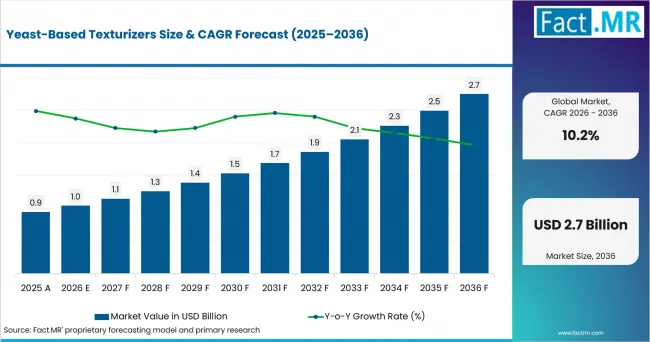
Yeast Based Texturizers Value Analysis | Source: Fact.MR
What are the defining numbers behind Yeast-Based Texturizers Market growth?
USD 1.7 billion absolute opportunity is expected between 2026 and 2036.
- Demand Drivers in the Market
- Plant-based food formulators need yeast fractions that improve bite and moisture where animal-protein reduction weakens texture.
- The U.S. Census Bureau reported in September 2026 that Food Manufacturing (NAICS 311) generated an estimated USD 1,054.3 billion in value of shipments in 2024, highlighting the substantial scale of the U.S. processed-food manufacturing base.
- Sauce and dressing developers use yeast-based systems for viscosity and body where stable pour, cling and coating behavior shape repeat formulation work.
- Nutrition brands value dry powder formats owing to easier blending, storage and fit with powdered mixes used in daily-use products.
- Key Segments Analyzed
- By Yeast Component: Cell-wall fractions are expected to hold 31.0% share in 2026 because they provide texture-active beta-glucan and mannoprotein functionality.
- By Texture Function: Viscosity / body is projected to account for 28.0% share in 2026, supported by sauces and plant-based foods that need mouthfeel restoration.
- By Application: Plant-based foods are anticipated to capture 27.0% share in 2026 due to formulation pressure around bite, juiciness and clean-label positioning.
- By Format: Dry powder is estimated to represent 38.0% share in 2026 owing to easier transport, dosing and storage for food processors.
- Analyst Opinion at Fact.MR
- Shambhu Nath Jha, Principal Consultant at Fact.MR, states, “Yeast-based texturizers draw attention because they connect fermentation familiarity with a practical recipe problem. Demand is projected to widen where brands need body, water binding and emulsion support while retaining recognizable ingredient systems. Suppliers that combine application testing, strain knowledge and consistent powder quality are better placed to win repeat formulation work.”
- Strategic Implications
- Ingredient manufacturers should document how cell-wall fractions affect viscosity, water retention and heat stability in each application base.
- Plant-based brands should test yeast-derived texture systems early because protein source, fat level and processing temperature change performance.
- Distributors should support smaller customers with application notes for sauces, dressings, bakery mixes and powdered nutrition formats.
- Defra reported in July 2026 that employment in the agri-food sector in Great Britain was 4.1 million over the 12-month period to the fourth quarter of 2025. The scale of the workforce supports broad-based technical training and application support across food-processing businesses.
The UK is expected to record 10.8% CAGR through 2036, led by food manufacturing scale and active reformulation work. Japan is projected to post 10.5% CAGR as processed-food manufacturers seek texture stability in convenience and health-positioned products. Germany is anticipated to advance at 10.1% CAGR, supported by ready-meal output and meat-alternative formulation. The USA is estimated to hold 9.7% CAGR because foodservice and food manufacturing create broad application demand. France is forecast to reach 9.4% CAGR, shaped by a large agri-food base and SME-led product development.
How does the Yeast-Based Texturizers Market break down by segment?
Cell-wall fractions lead at 31.0%; dry powder leads at 38.0%.
Which Yeast Component dominates?
Cell-wall fractions are expected to hold 31.0% share in 2026.
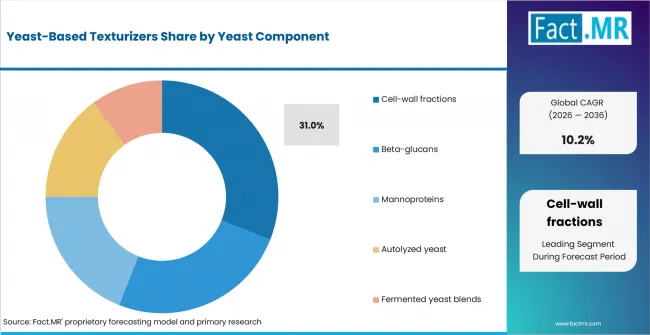
Yeast Based Texturizers Analysis By Yeast Component | Source: Fact.MR
Cell-wall fractions lead because they contain structural materials that influence water binding, viscosity and mouthfeel. Food teams use them where texture has to improve while avoiding unfamiliar synthetic-sounding ingredients. Their use is most visible in plant-based foods and sauces that need body after fat or animal protein is reduced.
Beta-glucans and mannoproteins remain closely linked to this segment. They help explain why yeast cell-wall materials are treated as texture ingredients and as flavor or nutrition inputs as well. The segment benefits when suppliers provide particle-size control and application testing for finished recipes.
What leads the Texture Function segment?
Viscosity / body is projected to account for 28.0% share in 2026.
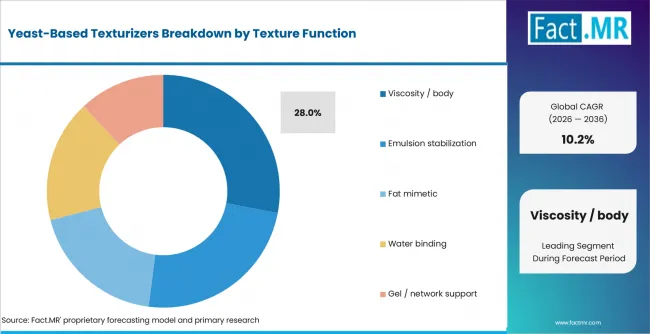
Yeast Based Texturizers Analysis By Texture Function | Source: Fact.MR
Viscosity / body leads because it is the easiest texture benefit to measure in finished products. Sauces, dressings, beverages and plant-based foods require flow control and smooth mouthfeel. Yeast-based texturizers compete when they provide body while preserving the expected flavor profile.
Emulsion stabilization and fat mimetic functions create additional demand. These functions are useful when brands cut fat, replace egg or reduce dairy inputs. A yeast-derived system becomes more attractive when it supports both mouthfeel and label simplicity within the same formulation.
How does Application shape demand?
Plant-based foods are anticipated to capture 27.0% share in 2026.
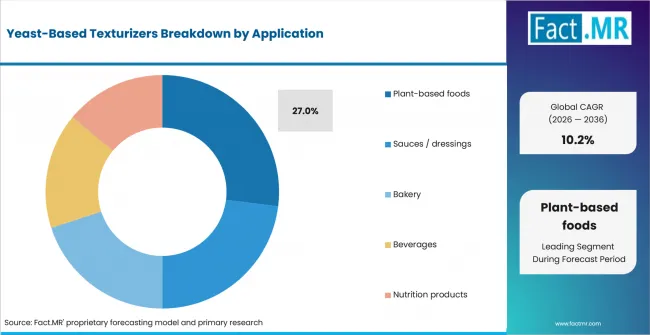
Yeast Based Texturizers Analysis By Application | Source: Fact.MR
Plant-based foods account for the largest application share because texture remains one of the hardest quality gaps in meat and dairy alternatives. Formulators need structure, juiciness and bite that remain stable after heating or chilling. Yeast components are evaluated where they can support those traits while fitting fermentation-based positioning.
Sauces / dressings and bakery applications broaden demand beyond meat alternatives. USDA ERS reported in June 2026 that inflation-adjusted U.S. food-away-from-home spending reached USD 1.41 trillion in 2025, highlighting the substantial scale of the U.S. foodservice market. That scale gives texture-system suppliers more application points across commercial kitchens and packaged foods.
What supports Dry powder within Format?
Dry powder is estimated to represent 38.0% share in 2026.
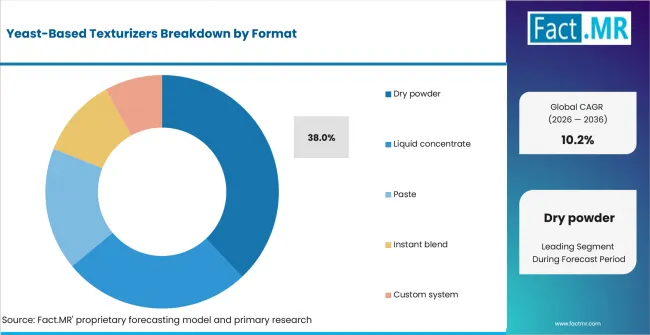
Yeast Based Texturizers Analysis By Format | Source: Fact.MR
Dry powder leads because it is easier to ship, store and dose in food plants. The format suits bakery mixes, dry nutrition systems and plant-based premixes where processors want predictable batch control. Powders also support wider distribution because they reduce cold-chain dependence for many customers.
Liquid concentrate, paste and instant blend formats remain useful for customers that value fast dispersion or lower dusting. Dry powder still carries an advantage where ingredient buyers need shelf stability and flexible use across more than one product line.
What is accelerating Yeast-Based Texturizers Market adoption, and what is holding it back?
Demand is expected to rise through plant-based reformulation, clean-label texture needs and food-processing scale. Growth is constrained by cost, labeling review and application variability.
Drivers Impact Analysis
| DRIVER | (~) % IMPACT ON CAGR | GEOGRAPHIC RELEVANCE | IMPACT TIMELINE |
|---|---|---|---|
| Plant-based texture correction in meat and dairy alternatives | +1.8% | North America, Western Europe, Japan | Short term (<= 2 years) |
| Sauce, dressing and bakery demand for body and water binding | +1.5% | Global | Medium term (2-4 years) |
| Clean-label interest in fermentation-derived ingredients | +1.2% | Western Europe, North America | Medium term (2-4 years) |
| Dry powder handling advantages in industrial food plants | +0.8% | Global | Long term (>= 4 years) |
Source: Fact.MR analysis. Updated Sep 16, 2026
Opportunity Impact Analysis
| OPPORTUNITY | (~) % IMPACT ON CAGR | GEOGRAPHIC RELEVANCE | IMPACT TIMELINE |
|---|---|---|---|
| Customized blends for plant-based foods | +1.3% | North America, Europe, East Asia | Medium term (2-4 years) |
| Dry powder systems for nutrition and bakery mixes | +1.0% | Global | Short term (<= 2 years) |
| Joint development between yeast suppliers and food formulators | +0.7% | Western Europe, USA, Japan | Long term (>= 4 years) |
Source: Fact.MR analysis. Updated Sep 16, 2026
Restraints Impact Analysis
| RESTRAINT | (~) % IMPACT ON CAGR | GEOGRAPHIC RELEVANCE | IMPACT TIMELINE |
|---|---|---|---|
| Higher cost versus commodity hydrocolloids and starches | -0.7% | Global | Short term (<= 2 years) |
| Recipe-specific performance variation | -0.5% | Global | Medium term (2-4 years) |
| Label and allergen review across food categories | -0.4% | Europe, North America, Japan | Medium term (2-4 years) |
Source: Fact.MR analysis. Updated Sep 16, 2026
Which countries are scaling the Yeast-Based Texturizers Market through 2036?
- The country comparison spans 1.4 percentage points and forms a tight growth band across the forecast period.
- The UK remains 0.3 percentage point above Japan through food manufacturing scale and plant-based reformulation.
- Japan remains 0.4 percentage point above Germany through processed-food demand and texture stability needs in convenience products.
- Germany remains 0.4 percentage point above the USA through ready-meal production and meat-alternative formulation.
- The USA remains 0.3 percentage point above France through foodservice exposure and packaged-food output.
- France closes the displayed range through agri-food processing depth and SME-led recipe development.
Comparable CAGRs create different entry conditions due to food-manufacturing scale, local labeling practice, plant-based product maturity and ingredient cost pressure. Full report coverage includes North America, Latin America, Western Europe, Eastern Europe, East Asia, South Asia & Pacific, Middle East & Africa.
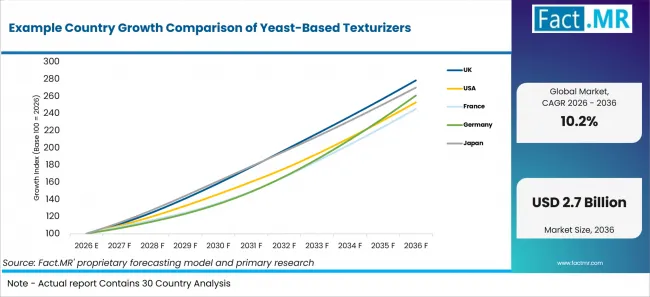
Example Country Growth Comparison Of Yeast Based Texturizers | Source: Fact.MR
| Country | CAGR (2026-2036) |
|---|---|
| United Kingdom | 10.8% |
| Japan | 10.5% |
| Germany | 10.1% |
| United States | 9.7% |
| France | 9.4% |
Source: Fact.MR analysis. Updated Sep 16, 2026
What supports the United Kingdom’s growth?
10.8% CAGR, supported by food manufacturing scale and plant-based reformulation.
UK food manufacturers have a broad base for texture-system trials because the Office for National Statistics reported in July 2026 that food manufacture represented 22.9% of total UK manufacturers’ sales in 2025. The country’s plant-based and bakery formulators use yeast cell-wall fractions to restore body in chilled meals, sauces and fillings. Dry powder formats are expected to fit plants that need stable storage and controlled dosing.
How is Japan developing demand?
10.5% CAGR, led by processed-food scale and convenience-format texture needs.
Japan’s processed-food base gives yeast-based texturizers a clear route into convenience meals and nutrition products. USDA FAS reported in April 2026 that Japan’s food processing sector totaled USD 174 billion in 2025. Beverage, bakery and prepared-food developers are expected to evaluate beta-glucans and autolyzed yeast where mouthfeel must remain familiar after shelf-stable processing or chilled storage.
What is supporting Germany’s adoption?
10.1% CAGR, supported by ready-meal output and alternative-protein formulation.
Germany’s ready-meal base supports texture-system use in sauces, fillings and meat-alternative meals. Destatis reported in January 2026 that Germany produced 1.7 million tonnes of ready meals in 2024. Yeast-based systems are expected to gain attention where plant proteins create dry or grainy texture and where bakery processors need powder formats that suit automated dosing.
How does the USA scale demand?
9.7% CAGR, supported by food spending scale and application breadth.
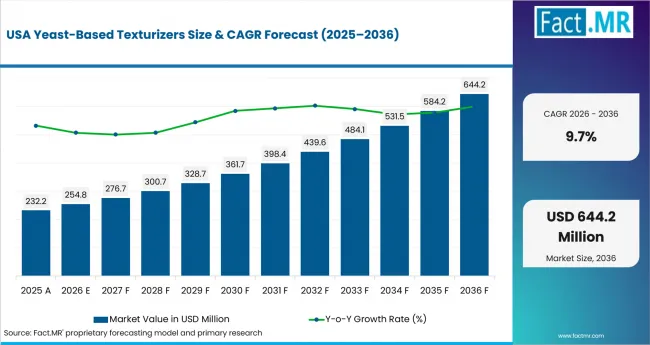
Yeast Based Texturizers Country Value Analysis | Source: Fact.MR
The USA offers a large commercial base for yeast-based texturizers across foodservice recipes and packaged foods. USDA ERS reported in June 2026 that total U.S. food spending reached USD 2.51 trillion in 2025. Plant-based food developers use yeast fractions to improve bite and moisture retention, while sauce and dressing brands value body because texture shapes pourability and cling.
What supports France’s growth?
9.4% CAGR, shaped by agri-food processing and SME recipe development.
France has a sizeable agri-food processing base for yeast-derived texture systems. INSEE reported in July 2026 that agri-food industry production value reached EUR 203.464 billion in 2024. Sauce, bakery and plant-based brands are expected to use yeast derivatives when they need mouthfeel improvement while retaining a fermentation-linked ingredient story for premium and clean-label products.
Who leads the Yeast-Based Texturizers Market?
Lesaffre is active through Biospringer and its broader fermentation-ingredient portfolio. Its June 2025 partnership with MicroBioGen adds yeast-biotechnology and strain-development capability for baking and food applications, combining MicroBioGen's yeast technology with Lesaffre's fermentation, R&D and production resources.
Angel Yeast participates through yeast-derived food ingredients and bakery solutions. Lallemand supports the field through plant-based, yeast-derived ingredients used for nutrition, flavor and texture. Kerry Group remain relevant through taste, texture and formulation capabilities for food and beverage manufacturers.
dsm-firmenich remains active through its broader Taste, Texture & Health portfolio. The company completed the divestment of its yeast-extract business to Lesaffre on October 1, 2024. Competition across these suppliers is supported by application-development capabilities, formulation expertise, sensory evaluation and ingredient-performance testing.
Which companies are the key providers?
Key companies profiled include Lesaffre; Angel Yeast; Lallemand; and Kerry Group.
- Lesaffre
- Angel Yeast
- Lallemand
- Kerry Group
Bibliography
- Aoki, S. (2026, April 1). Food processing ingredients annual (GAIN Report No. JA2026-0012). U.S. Department of Agriculture, Foreign Agricultural Service.
- Department for Environment, Food & Rural Affairs. (2026, September 3). Chapter 14: The food chain. GOV.UK.
- dsm-firmenich. (2025, February 28). Change in the scope of consolidation. In Integrated Annual Report 2024.
- Institut national de la statistique et des études économiques. (2026, July 21). Indicateurs macroéconomiques de l’industrie agroalimentaire: Données annuelles de 2010 à 2024.
- Lesaffre. (2025, June 12). MicroBioGen and Lesaffre establish exclusive global partnership to provide innovative yeast solutions for the global baking, food, and biochemicals markets.
- Office for National Statistics. (2026, July 24). UK manufacturers’ sales by product: 2025.
- Statistisches Bundesamt. (2026, January 14). Produktion von Fertiggerichten binnen fünf Jahren mengenmäßig um 25,6 % gestiegen.
- U.S. Census Bureau. (2026, September 3). Census Bureau releases new Annual Integrated Economic Survey data.
- U.S. Department of Agriculture, Economic Research Service. (2026, July 8). Food service industry - Market segments.
- Zeballos, E., & Sinclair, W. (2026, June 11). Total U.S. food spending reached $2.51 trillion in 2025. U.S. Department of Agriculture, Economic Research Service.
This Report Answers
- The report explains where yeast-based texturizers are used across yeast component, texture function, application and format.
- Segment analysis identifies the leading subsegments and the formulation reasons food developers prioritize them.
- Country analysis examines the listed markets and the food-processing conditions supporting yeast-derived texture systems.
- Competitive analysis reviews current providers across yeast derivatives, biotechnology, taste systems and texture solutions.
- Application analysis assesses how mouthfeel, water binding and emulsion behavior influence supplier selection.
What does the Yeast-Based Texturizers Market cover?
The yeast extract link is relevant where yeast-derived ingredients support savory background, mouthfeel and formulation balance in finished foods. The high nucleotide yeast extract connection applies where nucleotide-rich yeast ingredients overlap with food manufacturing and flavor-linked formulation systems.
Food texturizing agents provide adjacent reference points where formulators compare yeast systems with other ingredient families. Food thickening agents remain relevant where viscosity control overlaps with sauces, bakery fillings and beverage body.
What is included in the scope?
The scope includes yeast-derived commercial ingredients used in plant-based foods, sauces / dressings, bakery, beverages and nutrition products. Related coverage includes nutritional yeast where ingredient source and food-grade positioning overlap.
The analysis includes dry powder, liquid concentrate, paste, instant blend and custom system formats. It also considers adjacent functional food texture systems where texture performance is purchased as part of a wider formulation package.
What is excluded from the scope?
The scope excludes baker’s yeast sold only for leavening, yeast extract sold only as a flavor enhancer, animal-feed yeast products and pharmaceutical yeast derivatives. Generic starches, hydrocolloids and emulsifiers are counted only when they are sold with yeast-derived texture functionality.
Finished plant-based foods, sauces, bakery goods, beverages and nutrition products are separate downstream categories. Equipment, fermentation services and contract manufacturing are counted only when the sale is directly linked to a commercial yeast-based texture ingredient.
How Was the Analysis Built?
The analysis draws on 120+ sources, 35+ company portfolios, 25+ countries, and more than 20 industry interviews.
- Primary Research: Primary research includes discussions with manufacturers, service providers, technology developers, distributors, end users, and subject-matter experts. These conversations examine purchasing priorities, product adoption, operational challenges, approval requirements, competitive positioning, and the factors that influence wider market acceptance.
- Desk Research: Desk research covers government statistics, regulatory publications, company filings, trade data, technical studies, industry associations, standards, public policy, and other authoritative sources. Every source used in the analysis is documented in the bibliography.
- Market Sizing and Forecasting: Market estimates combine historical performance, demand indicators, pricing and volume trends, segment shares, company participation, country-level growth, adoption patterns, investment activity, and barriers to market expansion.
- Data Validation and Update Cycle: Findings are validated by comparing primary interviews with public data, company activity, regulatory changes, trade patterns, and industry developments. Regular updates review new product launches, capacity changes, partnerships, approvals, and shifts in commercial adoption.
Segmentation
What is the report’s scope and coverage?
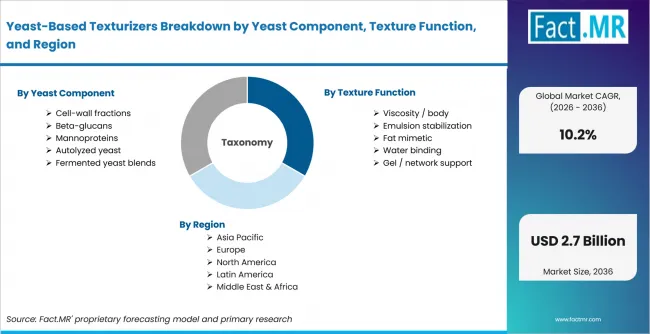
Yeast Based Texturizers Breakdown By Yeast Component, Texture Function, And Region | Source: Fact.MR
| Attribute | Details |
|---|---|
| Quantitative Units | USD billion |
| Market Definition | Yeast-derived ingredients used to modify body, viscosity, water binding, emulsion stability, fat mimicry or gel support in food and nutrition formulations. |
| Yeast Component | Cell-wall fractions; Beta-glucans; Mannoproteins; Autolyzed yeast; Fermented yeast blends |
| Texture Function | Viscosity / body; Emulsion stabilization; Fat mimetic; Water binding; Gel / network support |
| Application | Plant-based foods; Sauces / dressings; Bakery; Beverages; Nutrition products |
| Format | Dry powder; Liquid concentrate; Paste; Instant blend; Custom system |
| Regions Covered | North America; Latin America; Western Europe; Eastern Europe; East Asia; South Asia & Pacific; Middle East & Africa |
| Countries Covered | United Kingdom; Japan; Germany; United States; France |
| Key Companies Profiled | Lesaffre; Angel Yeast; Lallemand; Kerry Group |
| Forecast Period | 2026 to 2036 |
| Approach | Hybrid top-down and bottom-up approach using food processing indicators, application intensity, formulation needs, country adoption and provider portfolio review. |
Source: Fact.MR analysis. Updated Sep 16, 2026
How is the market segmented?
-
By Yeast Component:
- Cell-wall fractions
- Beta-glucans
- Mannoproteins
- Autolyzed yeast
- Fermented yeast blends
-
By Texture Function:
- Viscosity / body
- Emulsion stabilization
- Fat mimetic
- Water binding
- Gel / network support
-
By Application:
- Plant-based foods
- Sauces / dressings
- Bakery
- Beverages
- Nutrition products
-
By Format:
- Dry powder
- Liquid concentrate
- Paste
- Instant blend
- Custom system
-
By Region:
- North America
- Latin America
- Western Europe
- Eastern Europe
- East Asia
- South Asia & Pacific
- Middle East & Africa
Frequently Asked Questions
How big is the Yeast-Based Texturizers Market in 2026?
What is the CAGR of the Yeast-Based Texturizers Market from 2026 to 2036?
Which yeast component leads the Yeast-Based Texturizers Market?
Which format leads the Yeast-Based Texturizers Market?
Who are the key providers in the Yeast-Based Texturizers Market?
Who worked on this report


Preview the report firsthand - request a free sample
Free SampleGet the brochure for pricing and purchase details
Download PDF