Zoonotic Antivirals Market
Zoonotic Antivirals Market Size and Share Forecast Outlook 2026 to 2036
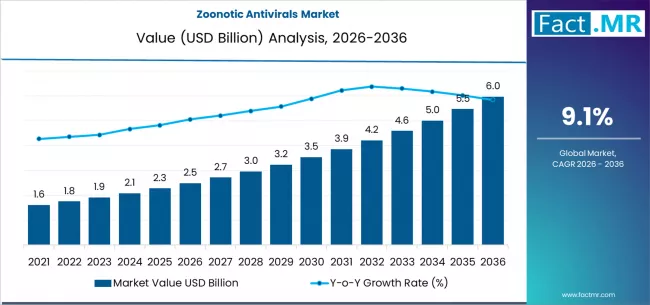
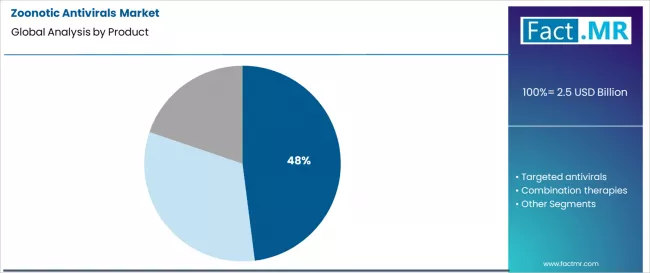
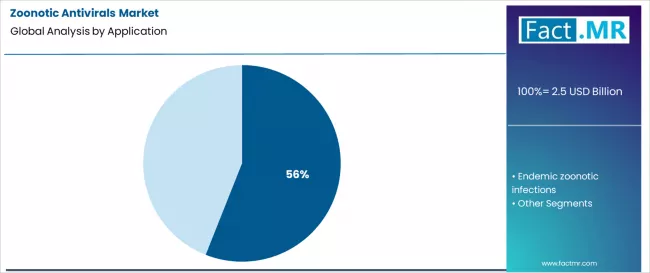
Zoonotic antivirals market is projected to grow from USD 2.5 billion in 2026 to USD 6.0 billion by 2036, at a CAGR of 9.1%. Broad-spectrum antivirals will dominate with a 48.0% market share, while emerging zoonoses will lead the application segment with a 56.0% share.
Zoonotic Antivirals Market Forecast and Outlook 2026 to 2036
The global zoonotic antivirals market is projected to grow from USD 2.49 billion in 2026 to USD 5.97 billion by 2036, progressing at a CAGR of 9.1%. This accelerated growth is a direct response to the escalating global threat posed by viruses that jump from animals to humans.
Key Takeaways from the Zoonotic Antivirals Market
- Market Value for 2026: USD 2.49 Billion
- Market Value for 2036: USD 5.97 Billion
- Forecast CAGR 2026 to 2036: 9.1%
- Leading Product Segment (2026): Broad-spectrum Antivirals (48.0%)
- Leading Application Segment (2026): Emerging Zoonoses (56.0%)
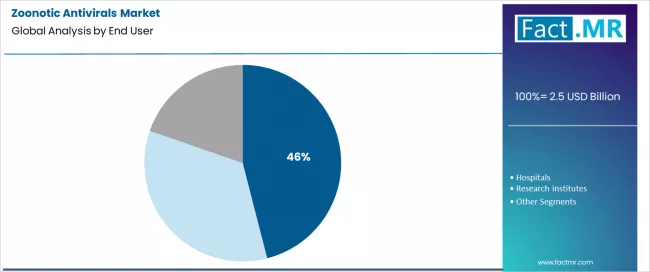
- Leading End-User Segment (2026): Government Stockpiles (46.0%)
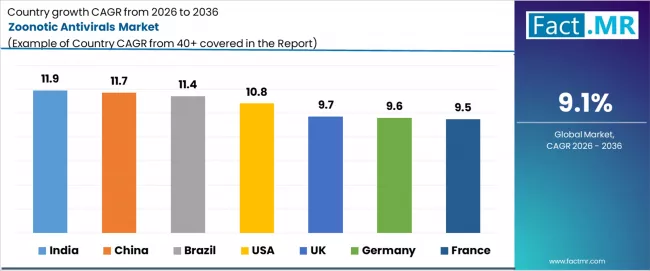
- Key Growth Countries: India (11.9% CAGR), China (11.7% CAGR), Brazil (11.4% CAGR), USA (10.8% CAGR), UK (9.7% CAGR), Germany (9.6% CAGR), France (9.5% CAGR)
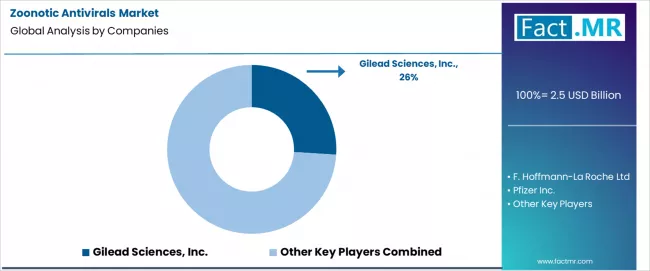
- Key Players in the Market: Gilead Sciences, Inc., F. Hoffmann-La Roche Ltd, Pfizer Inc., Merck & Co., Inc., Johnson & Johnson

Heightened pandemic preparedness initiatives, increased surveillance of animal reservoirs, and the persistent risk of new spillover events are primary market catalysts. The dominance of broad-spectrum antivirals reflects the urgent need for therapeutic agents that can be deployed rapidly against novel pathogens before strain-specific drugs are developed.
Investment is heavily focused on platform technologies capable of generating adaptable antiviral candidates. This includes mRNA-based approaches and small-molecule libraries designed for quick modification.
The market structure is uniquely shaped by the significant role of government and institutional purchasers who maintain strategic stockpiles. This creates a demand profile focused on procurement security, scalable manufacturing, and proven clinical efficacy against a range of viral families, positioning large pharmaceutical firms with robust R&D and production infrastructure as key market leaders.
Metric
| Metric | Value |
|---|---|
| Market Value (2026) | USD 2.49 Billion |
| Market Forecast Value (2036) | USD 5.97 Billion |
| Forecast CAGR 2026 to 2036 | 9.1% |
Category
| Category | Segments |
|---|---|
| Product | Broad-spectrum Antivirals, Targeted Antivirals, Combination Therapies |
| Application | Emerging Zoonoses, Endemic Zoonotic Infections |
| End User | Government Stockpiles, Hospitals, Research Institutes |
| Region | North America, Latin America, Western Europe, Eastern Europe, East Asia, South Asia & Pacific, Middle East & Africa |
Segmental Analysis
By Product, Which Segment is Prioritized for Pandemic Preparedness?

Broad-spectrum antivirals command a leading 48.0% share. Their primary advantage is activity against multiple viruses within a family, such as RNA viruses. This makes them invaluable first-line assets for treating unknown or novel zoonotic infections during early outbreak phases. Their development and stockpiling are strategic priorities for public health agencies, driving significant and stable procurement demand.
By Application, Which Segment Captures the Highest-Risk and Most Dynamic Threat Landscape?

Emerging zoonoses constitute the dominant application segment at 56.0%. This category includes novel viruses with pandemic potential, such as new strains of influenza or coronaviruses.
The high societal and economic impact of these threats justifies massive investment in prophylactic and therapeutic countermeasures, making this application the core driver of high-value R&D and advanced purchase agreements.
By End User, Which Purchaser is Fundamental to Market Stability and Scale?

Government stockpiles form the primary end-user segment at 46.0%. National health agencies and international bodies are the principal buyers, securing bulk quantities of promising antivirals for strategic reserves.
This channel provides the large-scale, predictable orders necessary to justify the high-risk development costs associated with these drugs, fundamentally shaping the market's commercial model.
What are the Principal Drivers, Constraints, and Evolving Dynamics of this Market?
The principal driver is the intensifying global focus on pandemic preparedness and health security, leading to increased government funding for the development and procurement of medical countermeasures against high-consequence zoonotic viruses. A major constraint is the exceptionally high cost and lengthy timeline for developing antivirals against pathogens that may not yet have caused a widespread outbreak, creating a significant commercial and scientific risk. A significant opportunity lies in the advancement of platform-based antiviral technologies, such as mRNA and broad-spectrum small-molecule platforms, which can be adapted rapidly to new threats, reducing response times. The dominant trend is the growing emphasis on creating end-to-end rapid response frameworks, integrating early pathogen discovery, agile clinical trial designs, and scalable manufacturing to compress the timeline from outbreak identification to therapeutic availability.
Analysis of the Zoonotic Antivirals Market by Key Countries

| Country | CAGR 2026 to 2036 |
|---|---|
| India | 11.9% |
| China | 11.7% |
| Brazil | 11.4% |
| USA | 10.8% |
| UK | 9.7% |
| Germany | 9.6% |
| France | 9.5% |
Does the USA's Market Leadership Stem from Strategic Government Initiatives like BARDA?
Substantial federal funding through agencies like the Biomedical Advanced Research and Development Authority (BARDA) propels the USA’s 10.8% CAGR. This drives partnerships with biopharma firms for advanced development and procurement of broad-spectrum antivirals for the national stockpile, creating a high-value, contract-driven market segment.
Can Brazil's Role as a Hotspot for Emerging Zoonoses Influence Its Market Strategy?
Brazil’s 11.4% CAGR is linked to its status as a key hotspot for emerging infectious diseases. Market growth involves building domestic surveillance and research capacity while navigating complex negotiations for access to globally developed antivirals. National strategies focus on securing technology transfer and local production capabilities for long-term health security.
Is China's Market Expansion Part of a Broader Biosecurity and Pharma Independence Agenda?
China’s 11.7% CAGR is a component of its national biosecurity strategy and push for pharmaceutical self-reliance. Growth is fueled by heavy state investment in domestic antiviral R&D, particularly for pathogens prevalent in the region. The market is characterized by parallel development of generic versions of established drugs and novel candidates for emerging threats.
Will India's Growth be Defined by Generic Manufacturing and Regional Health Security?
India’s leading 11.9% CAGR is underpinned by its generic manufacturing prowess and strategic aim to become a supplier of affordable antivirals to the Global South. Domestic growth is driven by government initiatives to bolster stockpiles against endemic and pandemic threats, while international growth stems from export opportunities for non-patented therapeutics.
Is Germany's Market Focused on EU-Level Health Security and Research Excellence?
Germany’s 9.6% CAGR is closely tied to its role in European Union-wide health security initiatives. Growth is channeled through funding pan-European research consortia and contributing to joint procurement mechanisms for the EU’s medical countermeasure stockpile, emphasizing high-quality research and coordinated defense.
Does France's Market Approach Balance National Sovereignty with Multilateral Cooperation?
France’s 9.5% CAGR reflects a dual strategy of investing in sovereign vaccine and antiviral capabilities while actively participating in global access initiatives. National research institutes and a focus on developing treatments for priority zoonotic diseases identified by French public health authorities support market growth.
Is the UK's Market Post-Brexit Strategy Centered on Independent Response Capabilities?
The UK’s 9.7% CAGR is shaped by its post-Brexit emphasis on building independent health security capabilities. This involves direct investment in antiviral discovery through its own agencies and forming bilateral partnerships for development and stockpiling, aiming for rapid, sovereign response capacity outside EU structures.
Competitive Landscape of the Zoonotic Antivirals Market

Large pharmaceutical corporations with the financial endurance and technical infrastructure to undertake high-risk, high-cost development programs for pathogens of pandemic potential dominate the competitive landscape.
Success is determined by securing large, forward-looking contracts with government agencies, demonstrating robust clinical efficacy data, and establishing scalable manufacturing supply chains. Competition is as much about forging strategic alliances with public health entities as it is about scientific innovation.
Given the pivotal role of public funding, companies compete on their ability to navigate complex procurement processes and meet stringent regulatory requirements for emergency use.
A key differentiator is the possession of versatile platform technologies that can generate pipeline candidates against multiple viral targets, offering governments a more resilient partnership. Portfolio depth across different viral families and the ability to engage in technology transfer for global production are also critical competitive factors.
Key Players in the Zoonotic Antivirals Market
- Gilead Sciences, Inc.
- F. Hoffmann-La Roche Ltd
- Pfizer Inc.
- Merck & Co., Inc.
- Johnson & Johnson
- Others
Scope of Report
| Items | Metrics |
|---|---|
| Quantitative Units | USD Billion |
| Product | Broad-spectrum Antivirals, Targeted Antivirals, Combination Therapies |
| Application | Emerging Zoonoses, Endemic Zoonotic Infections |
| End User | Government Stockpiles, Hospitals, Research Institutes |
| Key Countries | India, China, Brazil, USA, Germany, France, UK |
| Key Companies | Gilead Sciences, Roche, Pfizer, Merck, Johnson & Johnson, Others |
| Additional Analysis | Analysis of Animal Rule regulatory pathways for efficacy demonstration; economic models for stockpiling versus just-in-time production; collaboration models between public funders and private developers; antiviral resistance monitoring in animal reservoirs. |
Market by Segments
-
Product :
- Broad-spectrum Antivirals
- Targeted Antivirals
- Combination Therapies
-
Application :
- Emerging Zoonoses
- Endemic Zoonotic Infections
-
End User :
- Government Stockpiles
- Hospitals
- Research Institutes
-
Region :
-
North America
- USA
- Canada
-
Latin America
- Brazil
- Mexico
- Argentina
- Rest of Latin America
-
Western Europe
- Germany
- France
- UK
- Italy
- Spain
- BENELUX
- Rest of Western Europe
-
Eastern Europe
- Russia
- Poland
- Czech Republic
- Rest of Eastern Europe
-
East Asia
- China
- Japan
- South Korea
- Rest of East Asia
-
South Asia & Pacific
- India
- ASEAN
- Australia
- Rest of South Asia & Pacific
-
MEA
- GCC Countries
- South Africa
- Turkiye
- Rest of MEA
-
Bibliography
- Coalition for Epidemic Preparedness Innovations (CEPI). (2025).Strategy for the Development of Broad-Spectrum Antiviral Agents.
- U.S. Department of Health and Human Services (HHS). (2024).National Biodefense Strategy and Implementation Plan.
- World Health Organization (WHO). (2025).R&D Blueprint for Action to Prevent Epidemics: Priority Pathogen List.
- The Lancet Infectious Diseases. (2024).Series on Therapeutics for Emerging and Re-emerging Viruses.
Table of Content
- Executive Summary
- Global Market Outlook
- Demand to side Trends
- Supply to side Trends
- Technology Roadmap Analysis
- Analysis and Recommendations
- Market Overview
- Market Coverage / Taxonomy
- Market Definition / Scope / Limitations
- Market Background
- Market Dynamics
- Drivers
- Restraints
- Opportunity
- Trends
- Scenario Forecast
- Demand in Optimistic Scenario
- Demand in Likely Scenario
- Demand in Conservative Scenario
- Opportunity Map Analysis
- Product Life Cycle Analysis
- Supply Chain Analysis
- Investment Feasibility Matrix
- Value Chain Analysis
- PESTLE and Porter’s Analysis
- Regulatory Landscape
- Regional Parent Market Outlook
- Production and Consumption Statistics
- Import and Export Statistics
- Market Dynamics
- Global Market Analysis 2021 to 2025 and Forecast, 2026 to 2036
- Historical Market Size Value (USD Million) Analysis, 2021 to 2025
- Current and Future Market Size Value (USD Million) Projections, 2026 to 2036
- Y to o to Y Growth Trend Analysis
- Absolute $ Opportunity Analysis
- Global Market Pricing Analysis 2021 to 2025 and Forecast 2026 to 2036
- Global Market Analysis 2021 to 2025 and Forecast 2026 to 2036, By Product
- Introduction / Key Findings
- Historical Market Size Value (USD Million) Analysis By Product, 2021 to 2025
- Current and Future Market Size Value (USD Million) Analysis and Forecast By Product, 2026 to 2036
- Broad-spectrum antivirals
- Targeted antivirals
- Combination therapies
- Broad-spectrum antivirals
- Y to o to Y Growth Trend Analysis By Product, 2021 to 2025
- Absolute $ Opportunity Analysis By Product, 2026 to 2036
- Global Market Analysis 2021 to 2025 and Forecast 2026 to 2036, By Application
- Introduction / Key Findings
- Historical Market Size Value (USD Million) Analysis By Application, 2021 to 2025
- Current and Future Market Size Value (USD Million) Analysis and Forecast By Application, 2026 to 2036
- Emerging zoonoses
- Endemic zoonotic infections
- Emerging zoonoses
- Y to o to Y Growth Trend Analysis By Application, 2021 to 2025
- Absolute $ Opportunity Analysis By Application, 2026 to 2036
- Global Market Analysis 2021 to 2025 and Forecast 2026 to 2036, By End User
- Introduction / Key Findings
- Historical Market Size Value (USD Million) Analysis By End User, 2021 to 2025
- Current and Future Market Size Value (USD Million) Analysis and Forecast By End User, 2026 to 2036
- Government stockpiles
- Hospitals
- Research institutes
- Government stockpiles
- Y to o to Y Growth Trend Analysis By End User, 2021 to 2025
- Absolute $ Opportunity Analysis By End User, 2026 to 2036
- Global Market Analysis 2021 to 2025 and Forecast 2026 to 2036, By Region
- Introduction
- Historical Market Size Value (USD Million) Analysis By Region, 2021 to 2025
- Current Market Size Value (USD Million) Analysis and Forecast By Region, 2026 to 2036
- North America
- Latin America
- Western Europe
- Eastern Europe
- East Asia
- South Asia and Pacific
- Middle East & Africa
- Market Attractiveness Analysis By Region
- North America Market Analysis 2021 to 2025 and Forecast 2026 to 2036, By Country
- Historical Market Size Value (USD Million) Trend Analysis By Market Taxonomy, 2021 to 2025
- Market Size Value (USD Million) Forecast By Market Taxonomy, 2026 to 2036
- By Country
- USA
- Canada
- Mexico
- By Product
- By Application
- By End User
- By Country
- Market Attractiveness Analysis
- By Country
- By Product
- By Application
- By End User
- Key Takeaways
- Latin America Market Analysis 2021 to 2025 and Forecast 2026 to 2036, By Country
- Historical Market Size Value (USD Million) Trend Analysis By Market Taxonomy, 2021 to 2025
- Market Size Value (USD Million) Forecast By Market Taxonomy, 2026 to 2036
- By Country
- Brazil
- Chile
- Rest of Latin America
- By Product
- By Application
- By End User
- By Country
- Market Attractiveness Analysis
- By Country
- By Product
- By Application
- By End User
- Key Takeaways
- Western Europe Market Analysis 2021 to 2025 and Forecast 2026 to 2036, By Country
- Historical Market Size Value (USD Million) Trend Analysis By Market Taxonomy, 2021 to 2025
- Market Size Value (USD Million) Forecast By Market Taxonomy, 2026 to 2036
- By Country
- Germany
- UK
- Italy
- Spain
- France
- Nordic
- BENELUX
- Rest of Western Europe
- By Product
- By Application
- By End User
- By Country
- Market Attractiveness Analysis
- By Country
- By Product
- By Application
- By End User
- Key Takeaways
- Eastern Europe Market Analysis 2021 to 2025 and Forecast 2026 to 2036, By Country
- Historical Market Size Value (USD Million) Trend Analysis By Market Taxonomy, 2021 to 2025
- Market Size Value (USD Million) Forecast By Market Taxonomy, 2026 to 2036
- By Country
- Russia
- Poland
- Hungary
- Balkan & Baltic
- Rest of Eastern Europe
- By Product
- By Application
- By End User
- By Country
- Market Attractiveness Analysis
- By Country
- By Product
- By Application
- By End User
- Key Takeaways
- East Asia Market Analysis 2021 to 2025 and Forecast 2026 to 2036, By Country
- Historical Market Size Value (USD Million) Trend Analysis By Market Taxonomy, 2021 to 2025
- Market Size Value (USD Million) Forecast By Market Taxonomy, 2026 to 2036
- By Country
- China
- Japan
- South Korea
- By Product
- By Application
- By End User
- By Country
- Market Attractiveness Analysis
- By Country
- By Product
- By Application
- By End User
- Key Takeaways
- South Asia and Pacific Market Analysis 2021 to 2025 and Forecast 2026 to 2036, By Country
- Historical Market Size Value (USD Million) Trend Analysis By Market Taxonomy, 2021 to 2025
- Market Size Value (USD Million) Forecast By Market Taxonomy, 2026 to 2036
- By Country
- India
- ASEAN
- Australia & New Zealand
- Rest of South Asia and Pacific
- By Product
- By Application
- By End User
- By Country
- Market Attractiveness Analysis
- By Country
- By Product
- By Application
- By End User
- Key Takeaways
- Middle East & Africa Market Analysis 2021 to 2025 and Forecast 2026 to 2036, By Country
- Historical Market Size Value (USD Million) Trend Analysis By Market Taxonomy, 2021 to 2025
- Market Size Value (USD Million) Forecast By Market Taxonomy, 2026 to 2036
- By Country
- Kingdom of Saudi Arabia
- Other GCC Countries
- Turkiye
- South Africa
- Other African Union
- Rest of Middle East & Africa
- By Product
- By Application
- By End User
- By Country
- Market Attractiveness Analysis
- By Country
- By Product
- By Application
- By End User
- Key Takeaways
- Key Countries Market Analysis
- USA
- Pricing Analysis
- Market Share Analysis, 2025
- By Product
- By Application
- By End User
- Canada
- Pricing Analysis
- Market Share Analysis, 2025
- By Product
- By Application
- By End User
- Mexico
- Pricing Analysis
- Market Share Analysis, 2025
- By Product
- By Application
- By End User
- Brazil
- Pricing Analysis
- Market Share Analysis, 2025
- By Product
- By Application
- By End User
- Chile
- Pricing Analysis
- Market Share Analysis, 2025
- By Product
- By Application
- By End User
- Germany
- Pricing Analysis
- Market Share Analysis, 2025
- By Product
- By Application
- By End User
- UK
- Pricing Analysis
- Market Share Analysis, 2025
- By Product
- By Application
- By End User
- Italy
- Pricing Analysis
- Market Share Analysis, 2025
- By Product
- By Application
- By End User
- Spain
- Pricing Analysis
- Market Share Analysis, 2025
- By Product
- By Application
- By End User
- France
- Pricing Analysis
- Market Share Analysis, 2025
- By Product
- By Application
- By End User
- India
- Pricing Analysis
- Market Share Analysis, 2025
- By Product
- By Application
- By End User
- ASEAN
- Pricing Analysis
- Market Share Analysis, 2025
- By Product
- By Application
- By End User
- Australia & New Zealand
- Pricing Analysis
- Market Share Analysis, 2025
- By Product
- By Application
- By End User
- China
- Pricing Analysis
- Market Share Analysis, 2025
- By Product
- By Application
- By End User
- Japan
- Pricing Analysis
- Market Share Analysis, 2025
- By Product
- By Application
- By End User
- South Korea
- Pricing Analysis
- Market Share Analysis, 2025
- By Product
- By Application
- By End User
- Russia
- Pricing Analysis
- Market Share Analysis, 2025
- By Product
- By Application
- By End User
- Poland
- Pricing Analysis
- Market Share Analysis, 2025
- By Product
- By Application
- By End User
- Hungary
- Pricing Analysis
- Market Share Analysis, 2025
- By Product
- By Application
- By End User
- Kingdom of Saudi Arabia
- Pricing Analysis
- Market Share Analysis, 2025
- By Product
- By Application
- By End User
- Turkiye
- Pricing Analysis
- Market Share Analysis, 2025
- By Product
- By Application
- By End User
- South Africa
- Pricing Analysis
- Market Share Analysis, 2025
- By Product
- By Application
- By End User
- USA
- Market Structure Analysis
- Competition Dashboard
- Competition Benchmarking
- Market Share Analysis of Top Players
- By Regional
- By Product
- By Application
- By End User
- Competition Analysis
- Competition Deep Dive
- Gilead Sciences, Inc.
- Overview
- Product Portfolio
- Profitability by Market Segments (Product/Age /Sales Channel/Region)
- Sales Footprint
- Strategy Overview
- Marketing Strategy
- Product Strategy
- Channel Strategy
- F. Hoffmann-La Roche Ltd
- Pfizer Inc.
- Merck & Co., Inc.
- Johnson & Johnson
- Others
- Gilead Sciences, Inc.
- Competition Deep Dive
- Assumptions & Acronyms Used
- Research Methodology
List Of Table
- Table 1: Global Market Value (USD Million) Forecast by Region, 2021 to 2036
- Table 2: Global Market Value (USD Million) Forecast by Product, 2021 to 2036
- Table 3: Global Market Value (USD Million) Forecast by Application, 2021 to 2036
- Table 4: Global Market Value (USD Million) Forecast by End User, 2021 to 2036
- Table 5: North America Market Value (USD Million) Forecast by Country, 2021 to 2036
- Table 6: North America Market Value (USD Million) Forecast by Product, 2021 to 2036
- Table 7: North America Market Value (USD Million) Forecast by Application, 2021 to 2036
- Table 8: North America Market Value (USD Million) Forecast by End User, 2021 to 2036
- Table 9: Latin America Market Value (USD Million) Forecast by Country, 2021 to 2036
- Table 10: Latin America Market Value (USD Million) Forecast by Product, 2021 to 2036
- Table 11: Latin America Market Value (USD Million) Forecast by Application, 2021 to 2036
- Table 12: Latin America Market Value (USD Million) Forecast by End User, 2021 to 2036
- Table 13: Western Europe Market Value (USD Million) Forecast by Country, 2021 to 2036
- Table 14: Western Europe Market Value (USD Million) Forecast by Product, 2021 to 2036
- Table 15: Western Europe Market Value (USD Million) Forecast by Application, 2021 to 2036
- Table 16: Western Europe Market Value (USD Million) Forecast by End User, 2021 to 2036
- Table 17: Eastern Europe Market Value (USD Million) Forecast by Country, 2021 to 2036
- Table 18: Eastern Europe Market Value (USD Million) Forecast by Product, 2021 to 2036
- Table 19: Eastern Europe Market Value (USD Million) Forecast by Application, 2021 to 2036
- Table 20: Eastern Europe Market Value (USD Million) Forecast by End User, 2021 to 2036
- Table 21: East Asia Market Value (USD Million) Forecast by Country, 2021 to 2036
- Table 22: East Asia Market Value (USD Million) Forecast by Product, 2021 to 2036
- Table 23: East Asia Market Value (USD Million) Forecast by Application, 2021 to 2036
- Table 24: East Asia Market Value (USD Million) Forecast by End User, 2021 to 2036
- Table 25: South Asia and Pacific Market Value (USD Million) Forecast by Country, 2021 to 2036
- Table 26: South Asia and Pacific Market Value (USD Million) Forecast by Product, 2021 to 2036
- Table 27: South Asia and Pacific Market Value (USD Million) Forecast by Application, 2021 to 2036
- Table 28: South Asia and Pacific Market Value (USD Million) Forecast by End User, 2021 to 2036
- Table 29: Middle East & Africa Market Value (USD Million) Forecast by Country, 2021 to 2036
- Table 30: Middle East & Africa Market Value (USD Million) Forecast by Product, 2021 to 2036
- Table 31: Middle East & Africa Market Value (USD Million) Forecast by Application, 2021 to 2036
- Table 32: Middle East & Africa Market Value (USD Million) Forecast by End User, 2021 to 2036
List Of Figures
- Figure 1: Global Market Pricing Analysis
- Figure 2: Global Market Value (USD Million) Forecast 2021 to 2036
- Figure 3: Global Market Value Share and BPS Analysis by Product, 2026 and 2036
- Figure 4: Global Market Y to o to Y Growth Comparison by Product, 2026 to 2036
- Figure 5: Global Market Attractiveness Analysis by Product
- Figure 6: Global Market Value Share and BPS Analysis by Application, 2026 and 2036
- Figure 7: Global Market Y to o to Y Growth Comparison by Application, 2026 to 2036
- Figure 8: Global Market Attractiveness Analysis by Application
- Figure 9: Global Market Value Share and BPS Analysis by End User, 2026 and 2036
- Figure 10: Global Market Y to o to Y Growth Comparison by End User, 2026 to 2036
- Figure 11: Global Market Attractiveness Analysis by End User
- Figure 12: Global Market Value (USD Million) Share and BPS Analysis by Region, 2026 and 2036
- Figure 13: Global Market Y to o to Y Growth Comparison by Region, 2026 to 2036
- Figure 14: Global Market Attractiveness Analysis by Region
- Figure 15: North America Market Incremental Dollar Opportunity, 2026 to 2036
- Figure 16: Latin America Market Incremental Dollar Opportunity, 2026 to 2036
- Figure 17: Western Europe Market Incremental Dollar Opportunity, 2026 to 2036
- Figure 18: Eastern Europe Market Incremental Dollar Opportunity, 2026 to 2036
- Figure 19: East Asia Market Incremental Dollar Opportunity, 2026 to 2036
- Figure 20: South Asia and Pacific Market Incremental Dollar Opportunity, 2026 to 2036
- Figure 21: Middle East & Africa Market Incremental Dollar Opportunity, 2026 to 2036
- Figure 22: North America Market Value Share and BPS Analysis by Country, 2026 and 2036
- Figure 23: North America Market Value Share and BPS Analysis by Product, 2026 and 2036
- Figure 24: North America Market Y to o to Y Growth Comparison by Product, 2026 to 2036
- Figure 25: North America Market Attractiveness Analysis by Product
- Figure 26: North America Market Value Share and BPS Analysis by Application, 2026 and 2036
- Figure 27: North America Market Y to o to Y Growth Comparison by Application, 2026 to 2036
- Figure 28: North America Market Attractiveness Analysis by Application
- Figure 29: North America Market Value Share and BPS Analysis by End User, 2026 and 2036
- Figure 30: North America Market Y to o to Y Growth Comparison by End User, 2026 to 2036
- Figure 31: North America Market Attractiveness Analysis by End User
- Figure 32: Latin America Market Value Share and BPS Analysis by Country, 2026 and 2036
- Figure 33: Latin America Market Value Share and BPS Analysis by Product, 2026 and 2036
- Figure 34: Latin America Market Y to o to Y Growth Comparison by Product, 2026 to 2036
- Figure 35: Latin America Market Attractiveness Analysis by Product
- Figure 36: Latin America Market Value Share and BPS Analysis by Application, 2026 and 2036
- Figure 37: Latin America Market Y to o to Y Growth Comparison by Application, 2026 to 2036
- Figure 38: Latin America Market Attractiveness Analysis by Application
- Figure 39: Latin America Market Value Share and BPS Analysis by End User, 2026 and 2036
- Figure 40: Latin America Market Y to o to Y Growth Comparison by End User, 2026 to 2036
- Figure 41: Latin America Market Attractiveness Analysis by End User
- Figure 42: Western Europe Market Value Share and BPS Analysis by Country, 2026 and 2036
- Figure 43: Western Europe Market Value Share and BPS Analysis by Product, 2026 and 2036
- Figure 44: Western Europe Market Y to o to Y Growth Comparison by Product, 2026 to 2036
- Figure 45: Western Europe Market Attractiveness Analysis by Product
- Figure 46: Western Europe Market Value Share and BPS Analysis by Application, 2026 and 2036
- Figure 47: Western Europe Market Y to o to Y Growth Comparison by Application, 2026 to 2036
- Figure 48: Western Europe Market Attractiveness Analysis by Application
- Figure 49: Western Europe Market Value Share and BPS Analysis by End User, 2026 and 2036
- Figure 50: Western Europe Market Y to o to Y Growth Comparison by End User, 2026 to 2036
- Figure 51: Western Europe Market Attractiveness Analysis by End User
- Figure 52: Eastern Europe Market Value Share and BPS Analysis by Country, 2026 and 2036
- Figure 53: Eastern Europe Market Value Share and BPS Analysis by Product, 2026 and 2036
- Figure 54: Eastern Europe Market Y to o to Y Growth Comparison by Product, 2026 to 2036
- Figure 55: Eastern Europe Market Attractiveness Analysis by Product
- Figure 56: Eastern Europe Market Value Share and BPS Analysis by Application, 2026 and 2036
- Figure 57: Eastern Europe Market Y to o to Y Growth Comparison by Application, 2026 to 2036
- Figure 58: Eastern Europe Market Attractiveness Analysis by Application
- Figure 59: Eastern Europe Market Value Share and BPS Analysis by End User, 2026 and 2036
- Figure 60: Eastern Europe Market Y to o to Y Growth Comparison by End User, 2026 to 2036
- Figure 61: Eastern Europe Market Attractiveness Analysis by End User
- Figure 62: East Asia Market Value Share and BPS Analysis by Country, 2026 and 2036
- Figure 63: East Asia Market Value Share and BPS Analysis by Product, 2026 and 2036
- Figure 64: East Asia Market Y to o to Y Growth Comparison by Product, 2026 to 2036
- Figure 65: East Asia Market Attractiveness Analysis by Product
- Figure 66: East Asia Market Value Share and BPS Analysis by Application, 2026 and 2036
- Figure 67: East Asia Market Y to o to Y Growth Comparison by Application, 2026 to 2036
- Figure 68: East Asia Market Attractiveness Analysis by Application
- Figure 69: East Asia Market Value Share and BPS Analysis by End User, 2026 and 2036
- Figure 70: East Asia Market Y to o to Y Growth Comparison by End User, 2026 to 2036
- Figure 71: East Asia Market Attractiveness Analysis by End User
- Figure 72: South Asia and Pacific Market Value Share and BPS Analysis by Country, 2026 and 2036
- Figure 73: South Asia and Pacific Market Value Share and BPS Analysis by Product, 2026 and 2036
- Figure 74: South Asia and Pacific Market Y to o to Y Growth Comparison by Product, 2026 to 2036
- Figure 75: South Asia and Pacific Market Attractiveness Analysis by Product
- Figure 76: South Asia and Pacific Market Value Share and BPS Analysis by Application, 2026 and 2036
- Figure 77: South Asia and Pacific Market Y to o to Y Growth Comparison by Application, 2026 to 2036
- Figure 78: South Asia and Pacific Market Attractiveness Analysis by Application
- Figure 79: South Asia and Pacific Market Value Share and BPS Analysis by End User, 2026 and 2036
- Figure 80: South Asia and Pacific Market Y to o to Y Growth Comparison by End User, 2026 to 2036
- Figure 81: South Asia and Pacific Market Attractiveness Analysis by End User
- Figure 82: Middle East & Africa Market Value Share and BPS Analysis by Country, 2026 and 2036
- Figure 83: Middle East & Africa Market Value Share and BPS Analysis by Product, 2026 and 2036
- Figure 84: Middle East & Africa Market Y to o to Y Growth Comparison by Product, 2026 to 2036
- Figure 85: Middle East & Africa Market Attractiveness Analysis by Product
- Figure 86: Middle East & Africa Market Value Share and BPS Analysis by Application, 2026 and 2036
- Figure 87: Middle East & Africa Market Y to o to Y Growth Comparison by Application, 2026 to 2036
- Figure 88: Middle East & Africa Market Attractiveness Analysis by Application
- Figure 89: Middle East & Africa Market Value Share and BPS Analysis by End User, 2026 and 2036
- Figure 90: Middle East & Africa Market Y to o to Y Growth Comparison by End User, 2026 to 2036
- Figure 91: Middle East & Africa Market Attractiveness Analysis by End User
- Figure 92: Global Market - Tier Structure Analysis
- Figure 93: Global Market - Company Share Analysis
- FAQs -
How big is the zoonotic antivirals market in 2026?
The global zoonotic antivirals market is estimated to be valued at USD 2.5 billion in 2026.
What will be the size of zoonotic antivirals market in 2036?
The market size for the zoonotic antivirals market is projected to reach USD 6.0 billion by 2036.
How much will be the zoonotic antivirals market growth between 2026 and 2036?
The zoonotic antivirals market is expected to grow at a 9.1% CAGR between 2026 and 2036.
What are the key product types in the zoonotic antivirals market?
The key product types in zoonotic antivirals market are broad-spectrum antivirals, targeted antivirals and combination therapies.
Which application segment to contribute significant share in the zoonotic antivirals market in 2026?
In terms of application, emerging zoonoses segment to command 56.0% share in the zoonotic antivirals market in 2026.