- Base Value(2025): 528.01 Bn
- Estimated Value(2026): 568.14 Bn
- Forecast Value (2036): 1181.90 Bn
- CAGR (2026 - 2036): 7.6%
Automotive Tubeless Tires Market Size, Market Forecast and Outlook By FACT.MR
The automotive tubeless tires market was valued at USD 528.01 billion in 2025, projected to reach USD 568.14 billion in 2026, and is forecast to expand to USD 1181.90 billion by 2036 at a 7.6% CAGR. The absolute dollar opportunity of approximately USD 613.76 billion added over the forecast decade reflects the global vehicle fleet expansion, accelerating tire replacement cycles, and premiumization through performance-rated and EV-specific tire categories. FACT.MR opines that the convergence of electric vehicle adoption and mandatory tire labeling regulations across major markets is restructuring competitive dynamics within the tubeless tire sector.
Automotive tubeless tires have become the standard fitment across passenger cars, light commercial vehicles, and an increasing share of two-wheelers as manufacturers phase out tube-type configurations. Tire labeling regulations in the European Union (EU Regulation 2020/740), China (GB tire labeling), and other jurisdictions mandate rolling resistance, wet grip, and noise performance disclosure, influencing consumer purchase decisions at the point of sale. Electric vehicle-specific tires with optimized load ratings, reduced rolling resistance, and enhanced noise dampening represent a growing subsegment within the aftermarket channel. FACT.MR analysts note that the aftermarket replacement cycle generates the majority of tire sales revenue globally, with average tire life and driving distance patterns determining replacement frequency by region.
China dominates global tire production and consumption volumes, where domestic manufacturers such as Cheng Shin and Giti compete alongside international brands for both OEM and aftermarket share. India's two-wheeler and passenger car fleets are expanding rapidly, creating volume growth in both radial and bias tubeless tire categories. The United States aftermarket is characterized by high per-tire spending on performance and all-season categories, with independent tire dealers and retail chains managing the largest share of replacement sales. Germany's premium tire segment is influenced by autobahn-rated performance specifications and stringent EU tire labeling enforcement. As per FACT.MR, Japan's tire market reflects high technology content per unit, with fuel-efficient and low-noise tire categories commanding premium pricing across both OEM and replacement channels.
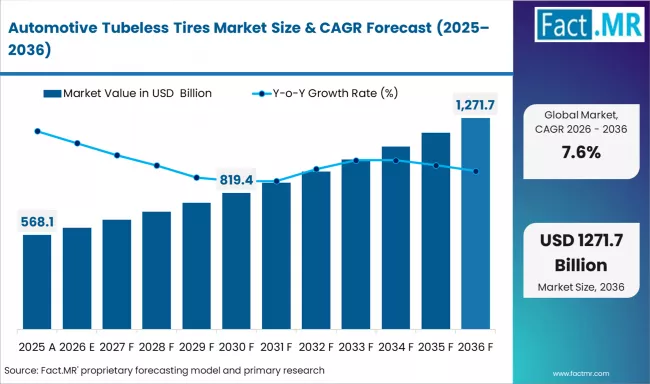
Automotive Tubeless Tires Market Market Value Analysis | Source: Fact.MR
Automotive Tubeless Tires Market Key Takeaways
| Metric | Details |
|---|---|
| Industry Size (2026) | USD 568.14 billion |
| Industry Value (2036) | USD 1181.90 billion |
| CAGR (2026 to 2036) | 7.6% |
Source: Fact.MR analysis. Updated Mar 18, 2026
Automotive Tubeless Tires Market Definition
Automotive tubeless tires are pneumatic tires that maintain air pressure through an airtight seal between the tire bead and the wheel rim, eliminating the need for an inner tube. The category covers radial and bias construction types across passenger car, two-wheeler, light commercial vehicle, and heavy commercial vehicle applications. Tubeless tires are sold through original equipment manufacturer (OEM) channels and the independent aftermarket.
Automotive Tubeless Tires Market Inclusions
Market scope covers global and regional sales volumes and values for automotive tubeless tires, forecast period from 2026 to 2036, segment breakdowns by product type, vehicle type, and sales channel. Tire labeling regulation impact analysis and EV-specific tire trend assessments are included.
Automotive Tubeless Tires Market Exclusions
The scope excludes tube-type tires, off-highway and agricultural tires, aircraft tires, and solid industrial tires. Tire retreading and recycling services, wheel rims, and tire pressure monitoring system hardware are excluded.
Automotive Tubeless Tires Market Research Methodology
- Primary Research: Analysts engaged with tire manufacturer regional directors, OEM procurement leads, and aftermarket distribution executives across 40 countries to validate shipment volumes and channel dynamics.
- Desk Research: Data collection aggregated national vehicle registration databases, tire labeling regulatory frameworks, and OEM production scheduling data from automotive industry associations.
- Market-Sizing and Forecasting: Baseline values derive from a bottom-up aggregation of OEM fitment and aftermarket shipment data, applying vehicle parc growth projections and replacement cycle assumptions by vehicle type.
- Data Validation and Update Cycle: Projections are cross-validated against publicly reported revenue data from major tire manufacturers and national tire industry association statistics.
Summary of Automotive Tubeless Tires Market
- Automotive Tubeless Tires Market Definition
- Automotive tubeless tires encompass pneumatic tires that seal directly against the wheel rim without an inner tube, covering radial and bias types across passenger, commercial, and two-wheeler applications, sold through OEM and aftermarket channels.
- Demand Drivers in the Market
- Expanding global vehicle fleets in India, China, and Southeast Asia generate both OEM fitment demand and a growing aftermarket replacement base as vehicles age into their first tire replacement cycle.
- EU, Chinese, and emerging-market tire labeling regulations create consumer awareness of rolling resistance and wet grip performance, shifting purchasing toward premium-rated tire categories.
- Electric vehicle adoption requires tire specifications with enhanced load capacity, reduced rolling resistance, and lower cabin noise, creating a new premium subsegment within the aftermarket.
- Key Segments Analyzed in the FACT.MR Report
- Radial construction holds 81.7% of product type share in 2026, reflecting the near-universal adoption of radial technology in passenger car and commercial vehicle tire manufacturing.
- Passenger Cars account for 46.3% of vehicle type demand, representing the largest single vehicle category in both OEM fitment and aftermarket replacement volumes.
- Aftermarket commands 58.4% of sales channel share, as tire replacement cycles generate higher cumulative revenue than initial OEM fitment over a vehicle's operational life.
- Analyst Opinion at FACT.MR
- FACT.MR analysts observe that the automotive tubeless tires market is a volume-driven sector where competitive positioning depends on manufacturing scale, raw material cost management, and distribution network breadth. Tire labeling regulations are shifting the competitive basis from price alone toward measurable performance metrics that favor brands with R&D investment in rolling resistance optimization and wet grip technology. Manufacturers that fail to develop EV-specific tire lines risk losing aftermarket share as electrified vehicle fleets reach their first replacement cycle within the forecast period.
- Strategic Implications / Executive Takeaways
- Tire manufacturers must accelerate EV-specific product development to capture the replacement demand that will emerge as first-generation electric vehicle fleets reach tire replacement mileage thresholds.
- Aftermarket distributors should invest in digital tire recommendation tools that translate labeling regulation performance ratings into consumer purchase guidance at the point of sale.
- Manufacturers targeting India and Southeast Asian two-wheeler markets need to expand tubeless tire production lines compatible with the rim specifications of locally produced motorcycles and scooters.
- Methodology
- Primary Research: FACT.MR conducted interviews with tire manufacturer directors, OEM procurement leads, and aftermarket distributors across 40 countries.
- Desk Research: Analysts aggregated vehicle registration data, tire labeling regulations, and OEM production schedules.
- Market-Sizing and Forecasting: Models apply a bottom-up methodology from OEM fitment and aftermarket shipment data, integrating vehicle parc growth and replacement cycles.
2020 to 2025 Revenue Analysis of Automotive Tubeless Tires Market vs. Growth Outlook 2026 to 2036
According to market research and competitive intelligence provider Fact.MR, the Automotive Tubeless Tires market experienced noteworthy growth, growing at a value CAGR of 3.5% from 2020 to 2025. Increase in sales of two wheelers and commercial vehicles have driven the global automotive tubeless tires market in past few years. Growth in automotive tubeless tire market will continue on account of the increasing demand for replacement of worn-out tires and low rolling resistance tires.
Rising in automobile ownership, demand for high-performance vehicles and the consequent increase in automotive production will contribute to the expansion of the automotive tire market. Leading companies are heavily investing in research and development to improve efficiency and produce premium quality tires. Soaring popularity of electric vehicles is encouraging them to create modified and lightweight tires, especially designed for electric and hybrid vehicles. Some of the market players are also collaborating with online retail services to increase customer reach, provide better service and increase revenue.
For instance, in July 2021, CEAT Tyres partnered with TyresnMore for online sales and home tire fitment and servicing. Customer will be able to buy genuine CEAT products like tyres and batteries from the TyresnMore website. The product will be home delivered and fitted by its service team without any hassle to the customer.
Key Market Drivers Influencing Automotive Tubeless Tires Industry Expansion
Thriving Automobile Industry to Foster Market Growth Prospects
Surge in production of automobiles and high demand for passenger cars across the globe are expected to drive the automotive tire industry during the forecast period. Sport utility vehicles (SUVs) are gaining momentum in India and China, thus providing lucrative opportunities for market growth.
As per the statistics from the International Organization of Motor Vehicle Manufacturers, around 55.83 million passenger cars and 21.78 million commercial vehicles were produced globally in 2020. Implementation of strict tire performance regulations and increasing demand for fuel efficient vehicles are encouraging market players towards developing new tires with superior wet grip and low rolling resistance. These factors are expected to accelerate the growth of the Automotive Tubeless Tires Market during the forecast period.
Leading tire manufacturers and automobile giants are entering into partnerships to incorporate new technology tires in the new launches to increase their market share and expand their product portfolio. For instance, Michelin tyres formed a technical partnership with Hyundai Motor towards developing next generation tires for electric and luxury vehicles. Luxury vehicle launches in emerging economies will open floodgates of opportunities for automotive tire original equipment manufacturers (OEMs).
Advent of New Technology Innovations to Propel Market Growth
The automotive tubeless tires market players are switching towards automation for automotive tire manufacturing, in order to boost efficiency and increase production to cater the rising demand. Advancement in the field of composite material and incorporation of carbon fiber and alloys in tire production will positively influence the automotive tubeless tires market over the analysis period.
Green tires are gaining traction among the younger population as they are eco-friendly and improve mileage especially in heavy motor vehicles. Green tires have low rolling resistance and are capable of increasing the fuel economy of vehicle by at least 2% in commercial vehicles. However, green tires are expensive but the cost will be recovered with savings on fuel expenses.
Pirelli launched world’s first Forest Stewardship Council (FSC)-certified P ZERO tire, in May 2021. This P ZERO tire was developed in accordance to BMWs performance requirements and Pirelli’s ‘perfect fit’ strategy. The tire is aimed to provide significant contribution to green philosophy of hybrid automotives.
Adoption of tubeless tires and development towards producing cheaper and sustainable green tires to reduce carbon emission will catapult the growth of the global automotive tubeless tire market.
Key Challenges encountered by Automotive Tubeless Tires Industry
Increased Demand for Airless Tires to Impede the Market Prospects
The increased demand for airless tires in some vehicles is one of the major factors that is expected to limit the growth of the automotive tubeless tires market during the forecast period. In addition, large capital investment for production and fluctuation in the prices of raw material are factors estimated to obstruct the market growth over the analysis period.
Surge in Raw Material Prices to Limit the Market Growth
The increased prices of raw materials such as fiber and composite metals are expected to hamper the growth of the automotive tubeless tires market in the near future. Also, the high cost of damage repair is a factor challenging automotive tubeless tires market during the forecast period.
Region-wise Analysis
Country-wise Forecast CAGRs for the Automotive Tubeless Tires Market
.webp "Top Country Growth Comparison Automotive Tubeless Tires Market Cagr (2026 2036)")
Top Country Growth Comparison Automotive Tubeless Tires Market Cagr (2026 2036) | Source: Fact.MR
| Country | CAGR |
|---|---|
| U.S | 7.5% |
| Japan | 7.3% |
| China | 7.1% |
| India | 7.2% |
| U.K | 7.0% |
Source: Fact.MR analysis. Updated Mar 18, 2026
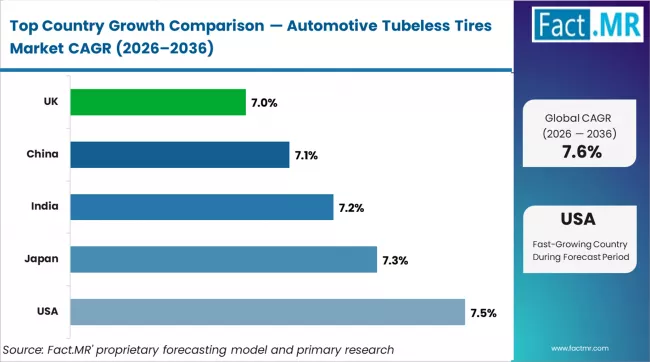
Automotive Tubeless Tires Market Cagr Analysis By Country | Source: Fact.MR
How will the Growth of Automotive Tubeless Tires Market Escalate across the U.S?
Advancements in Autonomous Vehicles to Broaden Market Growth Prospects in the Country
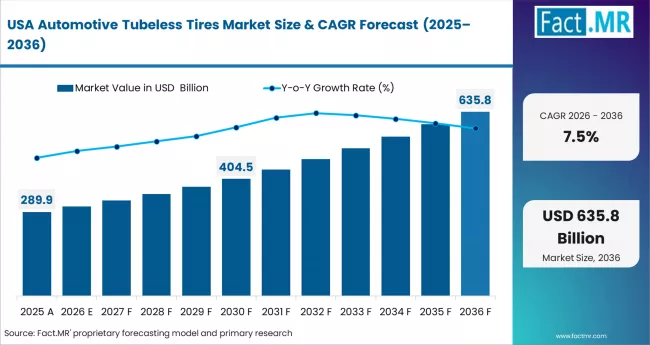
Automotive Tubeless Tires Market Country Value Analysis | Source: Fact.MR
As per Fact.MR, the U.S automotive tubeless tires market is slated to flourish at a CAGR of 7.5% until 2032. Rising sales of electric vehicles and development of technologically advance autonomous vehicles are stimulating the demand for automotive tubeless tires in the US. Change in taxation policy and shifting consumer preference towards safer, comfortable and more durable tires is fueling the market growth in the country.
Increasing production of automotives and growing popularity of pickup trucks and similar light commercial vehicles will further accelerate the market growth. Increasing investment towards developing green tires and rise in demand of rethread tires are boosting the automotive tire market sales in the country.
The U.S automotive tubeless tires market is very competitive and leading market players are employing inorganic strategies to increase their revenue generation rate and capture maximum market. The inorganic strategies include strategic collaboration and merger with automobile manufacturers.
How will Japan Perform in the Global Automotive Tubeless Tires Industry Landscape?
Introduction of New Tire Types in Japan to Boost the Market Growth
According to Fact.MR’s projections, the automotive tubeless tires market in Japan is forecast to expand at an impressive 7.3% value CAGR from 2022 to 2032. The Japan Automobile Manufacturers Association reports that around 7.70 million cars were produced in Japan in 2019 while more than 2.98 million cars were sold during the same period. Presence of leading automakers like Suzuki, Toyota, Nissan, Honda, and Mitsubishi and thriving online sales of tires at reduced price will positively influence the market growth.
Consistent development and introduction of new products by market players to expand their portfolio will continue to fuel the automotive tires market in Japan over the forecast period. For instance, in March 2021, Nihon Michelin Tire Co. Ltd. announced to launch its two new tires “the Pilot Exalto PE2” and “Primacy 3” for modern classic cars in Japan.
How is India Offering Increasing Opportunities for Manufacturers of Automotive Tubeless Tires?
Increase in Production of Motorcycles in India to Boost the Market Growth
As per Fact.MR, the Automotive Tubeless Tires Market in India is slated to flourish at a CAGR of 7.2% until 2032. India is expected to offer lucrative growth opportunities due to increasing production of motorcycles and commercial vehicles especially sport utility vehicle (SUV) across the region. According to the Society of Indian Automobile Manufacturers (SIAM), two-wheelers production across India surpassed 18.34 million units while commercial vehicle production reached around 6,24,939 units in 2020.
Strategic collaboration between tire manufacturers and automakers is an emerging trend. For instance, on 7th July 2021, one of the leading tire manufacturers JK Tyre entered into partnership with Hyundai Motor India, supplying tires to the all-new Hyundai Alcazar and other top variants. JK offers its latest UX Royale high performance tires developed with best-in-class technology, provides unmatchable performance, comfort, and smooth handling.
For instance, in February 2020, Maxxis India announced its partnership with Yamaha for supplying tyres for Yamaha’s 125 cc BSVI- compliant Ray ZR and Fascino range of scooters as well as BSVI-compliant model of Ray ZR Street Rally 125 FI in India.
Category-wise Insights
Will Radial Tires Segment remain Dominant in the Product Type Category?
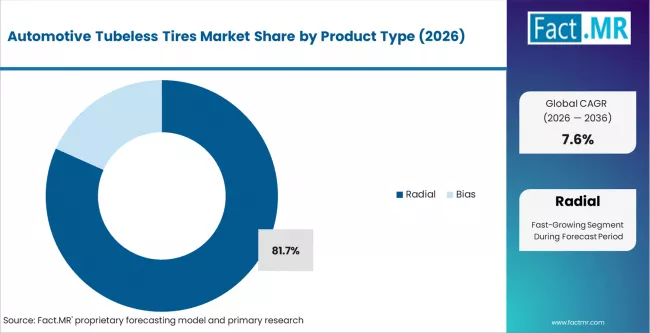
Automotive Tubeless Tires Market Analysis By Product Type | Source: Fact.MR
High Demand for Radial Tires Segment to Enhance Growth Prospects
By product type, demand for radial tires segment is likely to accelerate the fastest, documenting a value CAGR worth 7.4% from 2022 to 2032, according to Fact.MR.
Superior performance characteristics such as low rolling resistance, high heat dissipation, and long life are some of the factors encouraging radial tires sales especially in heavy commercial vehicles. In addition, low rolling resistance of radial tires enhances the flexibility of moving tire. These characteristics make radial tires a preferred choice for automotive tires.
Which is the Most Sought-after Vehicle Type Category?
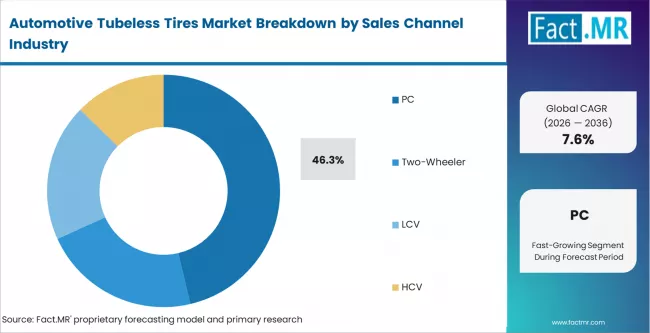
Automotive Tubeless Tires Market Analysis By Vehicle Type | Source: Fact.MR
Passenger Cars Segment to Dominate the Automotive Tubeless Tires Market
According to projections published by Fact.MR, by vehicle type, the passenger cars segment is forecast to register a whopping 7.3% value CAGR across the 2022 to 2032.
Passenger cars are generally equipped with 13”-15” rim size. Popular models like Volkswagen Polo and Volkswagen Rapid comes with 13”-15” rim size tires. Increasing demand of passenger vehicles in Asian countries like India and China will drive the passenger car tires market growth.
The growth of this segment can be attributed to increasing demand of retreaded tires in pickup trucks and other light commercial vehicles. Retreaded tires provide high mileage, are more than 30% cheaper, and have same warranties as to that of new tires.
Which Sales Channel Will Remain More Preferred?
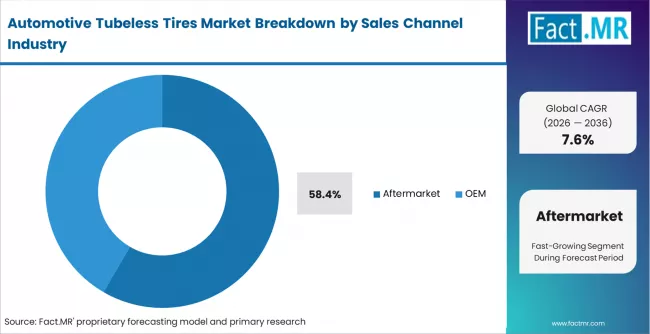
Automotive Tubeless Tires Market Analysis By Sales Channel | Source: Fact.MR
OEM segment is forecast to exhibit significant growth rate throughout the assessment period. Simultaneously aftermarket segment is poised to experience increase in sales as automobile manufacturers are collaborating with tire manufacturers to cater to their specific requirements.
Increasing demand for passenger vehicles and high demand for low rolling resistance tires will conducive environment for market players to develop more efficient and long-lasting tires to improve the safety of the vehicle and the passenger. Hence, the OEM segment is expected to exceed a CAGR of 7.4% during the forecast period.
The Start-Up Ecosystem: How key Players are opening Frontiers for Future Growth?
Automotive Tubeless Tires Market players such as Fleeca India, Tyrata, StatCap, Revvo Technologies, Nanjing SENASIC Electronic Technology, StreetScan, Wriggle Solutions, TyresNMore, TyrePlex, Crayon Motors, and Lords Automotive, among others, are adopting various marketing strategies such as new product launches, geographical expansion, merger and acquisitions, partnerships and collaboration to identify the interest of potential buyers and create a larger customer base. For instance,
- Fleeca India Pvt. Ltd, a Jaipur based startup, was founded in 2016, with an objective to provide India’s best tire management and fleet care services to Indian transportation and logistics businesses. The aim was to help fleet owners to leverage the merits of advanced technology in making their businesses more manageable and profitable in terms of efficiency and affordable tyre management services. Fleeca now operates in 21 states with more than 200+ staff. Fleeca is also recognised by the Rajasthan government’s iStart initiative and got a strategic investment of 25 Crores from Bridgestone.
- Founded in 2018, Revvo provides a sensor-enabled AI-based software platform to monitor vehicle tires. Its platform helps drivers and fleet managers better understand the overall health of the tires on their vehicles resulting in increased vehicle uptimes, optimized efficiency, and improved safety. Revvo is also applying a data science-centric approach to bring intelligence to the only part of the vehicle that touches the road.
- Established in 2015, Tyrata has developed a portfolio of IntelliTread products that monitor and predict tire wear for a real-time depot, and service lane, and contribute to consumer decision making. By expanding its market in Japan and Europe, Tyrata is planning to gain a first-mover advantage in the tread-detection space by being one of the initial companies in this domain.
Competitive Landscape
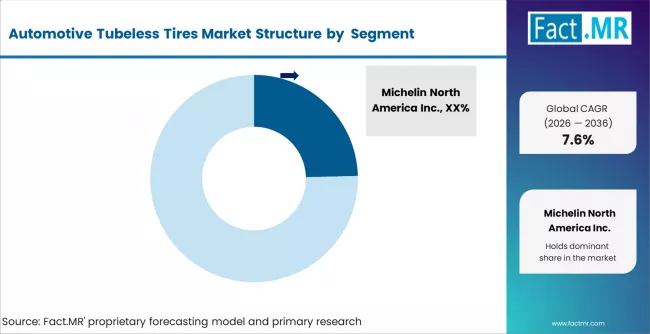
Automotive Tubeless Tires Market Analysis By Company | Source: Fact.MR
Prominent players in the Automotive Tubeless Tires Industry are taking advantage of the rapidly increasing demand for the Automotive Tubeless Tires in various applications. To further their outreach, players are relying on collaborations, partnerships and acquisitions with existing small, medium and large-scale vendors. Some prominent market developments are as follows:
- In October 2021, Apollo Tyres announced to launch a new range of tyres under its Dutch brand Vredestein in India, designed for luxury automobiles and high-performance bikes. With the launch of these new tires, the company aims to dominate the luxury car tire segment.
- In June 2021, Michelin launched its MICHELIN Primacy 4ST tyres in India. The tire provides excellent wet grip owing to its new tread pattern which provides 1.5X additional grooves to evacuate more water. The next generation Silent Rib Technology creates inter-locking bands between tread blocks resulting in smoother ride and high comfort. The new technology also limits the air pumping sounds during the rolling of tire.
Bibliography
- European Commission. (2024). Regulation (EU) 2020/740 on the labelling of tyres: Implementation report. EC.
- United Nations Economic Commission for Europe. (2024). UNECE Regulation No. 117: Tyre rolling resistance and noise requirements. UNECE.
- International Organization of Motor Vehicle Manufacturers (OICA). (2024). Global vehicle production statistics. OICA.
- Government of India, Ministry of Road Transport and Highways. (2024). Motor vehicle safety standards: Tyre specifications. MoRTH.
- Japan Automobile Tyre Manufacturers Association. (2024). Tyre industry statistics annual report. JATMA.
- European Tyre & Rubber Manufacturers Association. (2024). European tyre and rubber industry: Statistics 2024. ETRMA.
This bibliography is provided for reader reference. The full FACT.MR report contains the complete reference list with primary research documentation.
This Report Addresses
- Market sizing and quantitative forecast metrics detailing global automotive tubeless tire sales volumes and values through 2036.
- Segmentation analysis mapping demand patterns across construction types, vehicle categories, and sales channels.
- Regional deployment intelligence comparing high-volume emerging market growth against premiumization dynamics in developed economies.
- Regulatory compliance assessment analyzing tire labeling mandates, rolling resistance standards, and noise emission requirements across jurisdictions.
- Competitive landscape evaluation tracking manufacturing scale, raw material strategies, and distribution network positioning of major tire producers.
- Strategic product development guidance identifying EV-specific, low rolling resistance, and performance tire category investment priorities.
- Aftermarket distribution analysis identifying independent dealer, retail chain, and e-commerce channel dynamics by region.
- Custom data delivery formats encompassing interactive dashboards, raw Excel datasets, and comprehensive PDF narrative reports.
Segmentation
Scope of the Report
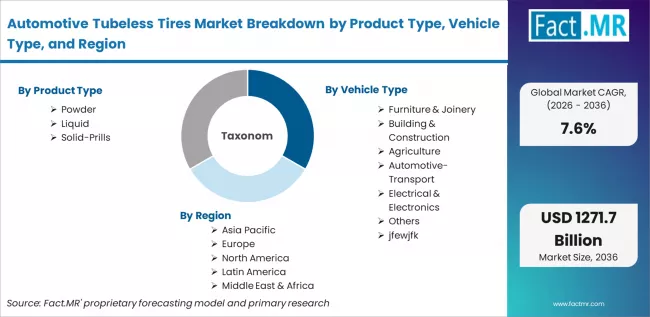
Automotive Tubeless Tires Market Breakdown By Product Type, Vehicle Type, And Region | Source: Fact.MR
| Metric | Value |
|---|---|
| Quantitative Units | USD 568.14 billion to USD 1181.90 billion, at a CAGR of 7.6% |
| Market Definition | Automotive tubeless tires encompass pneumatic tires that seal directly against the wheel rim without an inner tube, covering radial and bias types across passenger, commercial, and two-wheeler applications, sold through OEM and aftermarket channels. |
| Product Type Segmentation | Radial, Bias |
| Vehicle Type Segmentation | Passenger Cars, Two-Wheeler, LCV, HCV |
| Sales Channel Segmentation | Aftermarket, OEM |
| Regions Covered | North America, Latin America, Europe, East Asia, South Asia, Oceania, Middle East & Africa |
| Countries Covered | India, China, USA, Canada, UK, Germany, Japan, and 40 plus countries |
| Key Companies Profiled | Michelin North America Inc., Bridgestone Corporation, Continental AG, The Goodyear Tire & Rubber Company, Sumitomo Rubber Industries Ltd., The Yokohama Rubber Co., Ltd., Pirelli & C. S.p.A., MRF Ltd., Apollo Tyres Ltd., Cheng Shin Rubber Industry Co., Ltd. |
| Forecast Period | 2026 to 2036 |
| Approach | Forecasting models apply a bottom-up methodology starting with OEM fitment and aftermarket shipment data, integrating vehicle parc growth projections, tire replacement cycle assumptions, and EV-specific demand variables. |
Source: Fact.MR analysis. Updated Mar 18, 2026
Key Segments Covered in the Automotive Tubeless Tires Industry Survey
-
By Product Type :
- Radial
- Bias
-
By Vehicle Type :
- Two-Wheeler
- PC
- LCV
- HCV
-
By Sales Channel :
- OEM
- Aftermarket
-
By Technology :
- Standard
- Powered
- Heated
- Powered and Heated
-
By Region :
- North America
- Latin America
- Europe
- Japan
- APEJ
- Middle East & Africa
Frequently Asked Questions
How large is the demand for automotive tubeless tires in the global market in 2026?
What will be the market size of automotive tubeless tires by 2036?
What is the expected demand growth for automotive tubeless tires between 2026 and 2036?
Which product type is poised to lead by 2026?
How significant is the role of Passenger Cars in driving automotive tubeless tires demand?
What sales channel segment leads in 2026?
What is automotive tubeless tires and what is it mainly used for?
What is included in the scope of this report?
What is excluded from the scope of this report?
How does FACT.MR build and validate this forecast?
Does the report cover USA in its regional analysis?
Does the report cover Germany in its regional analysis?
Does the report cover India in its regional analysis?
Who worked on this report


Preview the report firsthand - request a free sample
Free SampleGet the brochure for pricing and purchase details
Download PDF