- Base Value(2025): 245.96 Mn
- Estimated Value(2026): 262.69 Mn
- Forecast Value (2036): 507.16 Mn
- CAGR (2026 - 2036): 6.8%
Peppermint Oil Market Size, Market Forecast and Outlook By FACT.MR
The peppermint oil market was valued at USD 245.96 million in 2025, projected to reach USD 262.69 million in 2026, and is forecast to expand to USD 507.16 million by 2036 at a 6.8% CAGR. The absolute dollar opportunity of approximately USD 244.48 million added over the forecast decade reflects expanding application of peppermint oil across food flavoring, therapeutic preparations, aromatherapy products, and oral care formulations. FACT.MR opines that the dual positioning of peppermint oil as both a functional therapeutic ingredient and a sensory flavoring agent sustains above-average growth relative to other essential oil categories.
Peppermint oil is steam-distilled from the leaves and flowering tops of Mentha piperita, with menthol and menthone as the primary bioactive components determining quality grading and therapeutic efficacy. India (particularly Uttar Pradesh) and the United States (Pacific Northwest) represent the largest production origins, with distinctly different varietal and quality profiles. The essential oil's applications span food and beverage flavoring, oral and digestive health preparations, aromatherapy diffusion and massage, and cosmetic and toiletry formulations. As per FACT.MR, the differentiation between natural distilled peppermint oil and synthetic menthol alternatives is becoming a primary purchasing criterion as clean-label and natural certification requirements tighten across food and personal care sectors.
India dominates global peppermint oil production volume, with the Barabanki district of Uttar Pradesh serving as the primary cultivation and distillation center. United States production in Oregon, Washington, and Idaho yields a distinct varietal profile (Mentha piperita var. vulgaris) preferred by premium confectionery and pharmaceutical buyers. China produces peppermint-type oils (primarily from Mentha arvensis) that serve as a menthol extraction feedstock for industrial applications. Germany's pharmaceutical and personal care sectors demand certified therapeutic-grade peppermint oil for regulated formulations. Based on FACT.MR's analysis, Japan's oral care and confectionery industries maintain consistent procurement of high-purity peppermint oil through established supply agreements with US and Indian distillers.
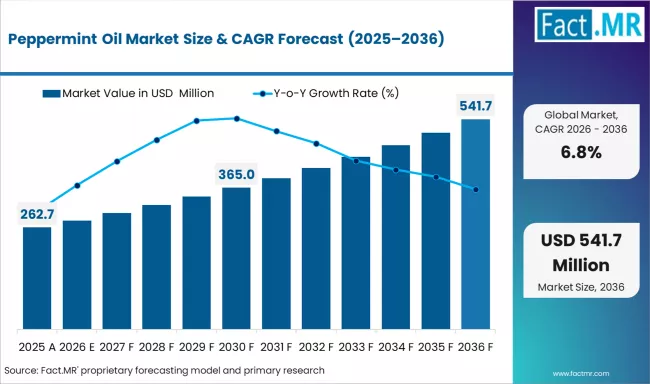
Peppermint Oil Market Market Value Analysis | Source: Fact.MR
Peppermint Oil Market Key Takeaways
| Metric | Details |
|---|---|
| Industry Size (2026) | USD 262.69 million |
| Industry Value (2036) | USD 507.16 million |
| CAGR (2026 to 2036) | 6.8% |
Source: Fact.MR analysis. Updated Mar 20, 2026
Peppermint Oil Market Definition
Peppermint oil is an essential oil steam-distilled from the leaves and flowering tops of the peppermint plant (Mentha piperita), containing menthol and menthone as primary bioactive components. It is classified by source (natural, organic), form (absolute/concentrate, blends), and extraction method. Peppermint oil is used in food and beverage flavoring, oral care products, digestive health preparations, aromatherapy, cosmetics, and household cleaning formulations.
Peppermint Oil Market Inclusions
Market scope covers global and regional trade volumes and values for peppermint oil, forecast period from 2026 to 2036, segment breakdowns by source, form, extraction method, and application. Menthol content quality analysis and origin-specific pricing trend assessments are included.
Peppermint Oil Market Exclusions
The scope excludes synthetic menthol manufactured from non-peppermint sources, cornmint oil (Mentha arvensis) unless blended with peppermint, dried peppermint leaf for tea infusions, and finished consumer products containing peppermint oil as an ingredient.
Peppermint Oil Market Research Methodology
- Primary Research: Analysts engaged with essential oil distillers, flavor and fragrance procurement managers, and aromatherapy brand formulators across 25 countries to validate production volumes and application-specific demand.
- Desk Research: Data collection aggregated national agricultural production statistics, essential oil trade databases, and pharmacopoeia monograph specifications for therapeutic-grade peppermint oil.
- Market-Sizing and Forecasting: Baseline values derive from a bottom-up aggregation of origin-country distillation output, applying application-specific demand curves and natural vs. organic grade migration trends.
- Data Validation and Update Cycle: Projections are cross-validated against essential oil industry association trade statistics and publicly reported revenue data from major flavor, fragrance, and aromatherapy companies.
Summary of Peppermint Oil Market
- Peppermint Oil Market Definition
- Peppermint oil encompasses steam-distilled essential oil from Mentha piperita containing menthol and menthone, classified by source, form, and extraction method, used in food flavoring, oral care, therapeutic preparations, aromatherapy, cosmetics, and cleaning products.
- Demand Drivers in the Market
- Food and beverage manufacturers require natural peppermint flavoring for confectionery, chewing gum, and beverage formulations where clean-label ingredient specifications prohibit synthetic menthol alternatives.
- Expanding aromatherapy and wellness product markets generate retail demand for certified pure and organic peppermint oil in diffuser blends, massage formulations, and topical therapeutic applications.
- Oral care product manufacturers incorporate peppermint oil as a functional flavoring and antimicrobial ingredient in toothpaste, mouthwash, and breath freshener formulations across global markets.
- Key Segments Analyzed in the FACT.MR Report
- Natural source holds 63.8% of source share in 2026, reflecting the dominant procurement preference for conventionally cultivated, non-organic peppermint oil across food flavoring and personal care applications.
- Absolute/Concentrate form commands 58.6% of form share, as concentrated peppermint oil delivers higher menthol content per unit volume for industrial flavoring and pharmaceutical applications.
- Distillation accounts for 71.4% of extraction method share, as steam distillation remains the standard commercial process for peppermint oil production across all major origin countries.
- Analyst Opinion at FACT.MR
- Shambhu Nath Jha, Principal Consultant, Fact MR, opines that the peppermint oil market benefits from dual-use positioning across food flavoring and therapeutic/wellness applications, creating a diversified demand base that insulates against single-sector downturns. Producers that invest in organic certification and GC-MS purity documentation capture the premium margins available in aromatherapy and pharmaceutical channels. The structural price differential between Indian high-volume production and US premium varietal output creates a tiered market where origin reputation and menthol content specifications govern buyer selection.
- Strategic Implications / Executive Takeaways
- Essential oil distillers must invest in organic certification and batch-level GC-MS testing documentation to qualify for the premium pricing tiers available in aromatherapy and pharmaceutical procurement channels.
- Flavor and fragrance companies should maintain dual-origin sourcing across India and the United States to balance cost optimization with varietal quality requirements for specific end-use applications.
- Aromatherapy brands expanding retail distribution need transparent origin labeling and third-party purity certification to meet the quality expectations of health-conscious consumers and e-commerce marketplace standards.
- Methodology
- Primary Research: FACT.MR conducted interviews with essential oil distillers, F&F procurement managers, and aromatherapy formulators across 25 countries.
- Desk Research: Analysts aggregated agricultural production statistics, essential oil trade databases, and pharmacopoeia specifications.
- Market-Sizing and Forecasting: Models apply a bottom-up methodology from origin distillation output, integrating application-specific demand and grade migration trends.
How Lucrative is the Peppermint Oil Business?
Rising Use of Peppermint Oil for Healing Purposes
Demand for essential oils is increasing across the globe. This can be due to the rising popularity of aromatherapies. For mental peace, many individuals are opting for aromatherapy to cut from their hectic work schedule. Also, people experiencing orthopedic pain opt for aromatherapy to lower the pain.
Essential oils such as mandarin oil, peppermint oil, citrus oil, argan oil, sandalwood oil, agarwood oil, clove leaf oil, eucalyptus oil, and lemon oil are widely used in aromatherapies for healing purposes. Thus, increasing the application of essential oils and soaps in aromatherapies is expected to uplift the sales of peppermint oil.
Increasing Popularity of Plant-based Flavors over Synthetic Variants Increasing Application of Peppermint Oil in Food & Beverages
Increasing awareness of health issues associated with the use of synthetic additives or artificial flavors in food and beverages is boosting the demand for various natural alternatives, such as plant-bioactive compounds and oils. The antibacterial and antioxidant features of plant-based oils including peppermint oil are expected to boost their applications in food and beverages.
Natural peppermint oil is used to add flavor and aroma to various food products. The move towards organic and natural food products is emerging as a notable peppermint oil market trend. Thus, the organic and clean-label trend is set to boost the profits of peppermint oil producers in the coming years.
What is Challenging Regional Companies from Expanding their Market Reach?
Presence of Oligopoly in Supply Chain
The presence of oligopoly is the prime aspect that is inhibiting the growth scope of the peppermint oil industry. Europe and North America are home to major exporters and producers of peppermint oil, which challenges the participation of other regional market players and impedes their market reach. Furthermore, the lack of raw materials required to produce peppermint oil is also expected to hinder market development in the long run.
Start-up Ecosystem
- Contes De Flore is a start-up based in India that offers sustainable products derived from cold-pressed oils, natural plant butter, plant extracts, powders, and herbs.
- CORE & PURE is an essential oil start-up based in India that specializes in the production of purest quality essential oils and products to promote holistic health, beauty, and wellness. The company provides 100% natural essential oils.
Country-wise Analysis
.webp "Top Country Growth Comparison Peppermint Oil Market Cagr (2026 2036)")
Top Country Growth Comparison Peppermint Oil Market Cagr (2026 2036) | Source: Fact.MR
Apart from the United States and Canada, peppermint oil suppliers are also targeting India, China, Japan, Germany, and the United Kingdom to bolster their global market presence and improve their sales potential as well.
- The North American peppermint oil market size is calculated to reach US$ 107.2 million by 2036.
- East Asia is expected to hold 22.2% of the global peppermint oil market share in 2026.
What’s Driving Sales of Peppermint Oil in the United States?
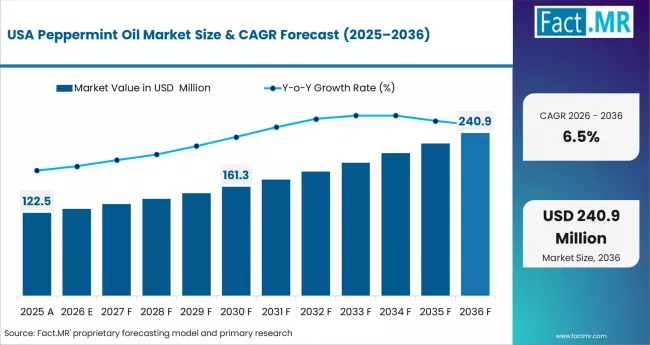
Peppermint Oil Market Country Value Analysis | Source: Fact.MR
Presence of Prominent Peppermint Oil Manufacturers
| Attribute | United States |
|---|---|
| Market Value (2026E) | US$ 24.2 Million |
| Growth Rate (2026 to 2036) | 7.2% CAGR |
| Projected Value (2036F) | US$ 48.6 Million |
Source: Fact.MR analysis. Updated Mar 20, 2026
The United States accounts for a leading share of the North American market and is projected to maintain a similar stance across the forecast period. Increasing demand and acceptance of mint-flavored products in the country are estimated to contribute to high sales of peppermint oil.
The presence of renowned peppermint oil manufacturers and the high amount of exports of the same are also extrapolated to introduce new developments in the country. Moreover, the surging awareness regarding the health benefits of peppermint oil is pushing pharmaceutical companies to use it in their drug formulations. Peppermint oil for nausea and peppermint oil for muscle pain are projected to be popular in the United States.
- In July 2023, Loving Essential Oils, a provider of essential oils based in the United States, announced the launch of a new roller blend for pain and nausea relief. The product features a mix of ginger and peppermint oil.
How will Peppermint Oil Manufacturers Fare in China?
High Demand for Traditional and Alternative Medicine
| Attribute | China |
|---|---|
| Market Value (2026E) | US$ 24.9 Million |
| Growth Rate (2026 to 2036) | 6.8% CAGR |
| Projected Value (2036F) | US$ 48.2 Million |
Source: Fact.MR analysis. Updated Mar 20, 2026
Growing awareness regarding the ill effects of modern medicine and pharmaceuticals on human health is pushing people in China to opt for alternative and traditional medicines. Chinese traditional medicine has been around for centuries and involves the use of medicinal herbs and essential oils to treat various health conditions.
Urbanization is leading to stressful lives and the people of China are turning to aromatherapy for relief, which is also anticipated to promulgate sales of peppermint oil in the country over the coming years. The high use of peppermint oil in the manufacturing of different products such as cosmetics, pharmaceuticals, nutritional supplements, and personal care products in China is also slated to open up profitable doors for key vendors.
Will European Countries Be Lucrative Markets for Peppermint Oil Companies?
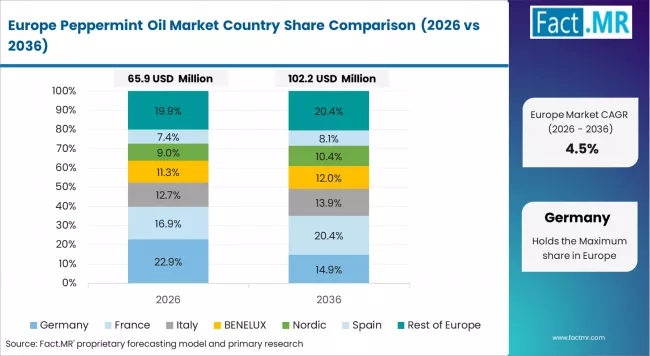
Peppermint Oil Market Europe Country Market Share Analysis, 2026 & 2036 | Source: Fact.MR
Expansion of Cosmetic Industry and Preference for Clean-label Ingredients in Germany and France
Europe is home to some of the most renowned cosmetic and personal care brands in the world and increasing adoption of peppermint essential oil in their products is slated to be the prime prospect driving market growth through 2036. A high focus on sustainability and eco-consciousness is giving impetus to the clean-label trend in European countries such as the United Kingdom, France, and Germany.
Evolving consumer preferences are further promoting sales of peppermint oil products in European countries. The growing popularity of aromatherapy and its benefits is also anticipated to boost the consumption of peppermint oil in these countries.
Category-wise Analysis
The trend of living clean with plant-based products is projected to uplift the sales of natural peppermint oil over the coming years. This Fact.MR research estimates that natural peppermint oil is estimated to capture 65.5% of the global market share in 2026.
Which Source is Widely Popular for Peppermint Oil Manufacturing?
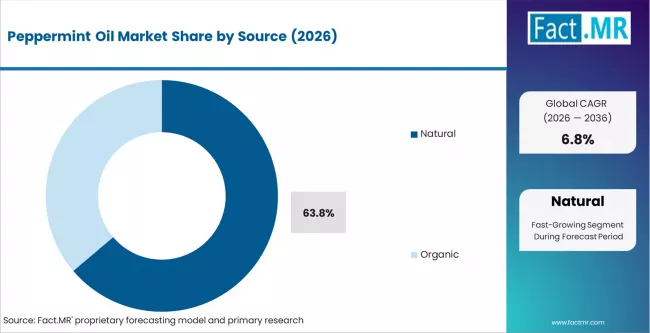
Peppermint Oil Market Analysis By Source | Source: Fact.MR
Natural Peppermint Oil Exhibiting High Applications across Industries
| Attribute | Natural Peppermint Oil |
|---|---|
| Segment Value (2026E) | US$ 105.8 Million |
| Growth Rate (2026 to 2036) | 6.9% CAGR |
| Projected Value (2036F) | US$ 293.5 Million |
Source: Fact.MR analysis. Updated Mar 20, 2026
Growing awareness regarding the benefits of natural ingredients and the rising popularity of plant-based products is projected to bolster shipments of natural peppermint oil products over the coming years. Increasing use of natural ingredients in cosmetics and personal care products is also projected to boost the demand for natural peppermint oil throughout the study period (2026 to 2036).
Why is Absolute/Concentrate Peppermint Oil Highly Sought After?
Absolute/Concentrate Peppermint Oil Widely Utilized Due to its Refreshing Aroma and Flavor
| Attribute | Absolute/Concentrate Peppermint Oil |
|---|---|
| Segment Value (2026E) | US$ 169 Million |
| Growth Rate (2026 to 2036) | 6.7% CAGR |
| Projected Value (2036F) | US$ 324.6 Million |
Source: Fact.MR analysis. Updated Mar 20, 2026
The demand for absolute/concentrate peppermint oil is high due to its versatile applications in pharma, cosmetics, food & beverages, and homecare products. Concentrated peppermint oil is one of the most popular flavoring agents in chewing gums, candies, and beverages. The refreshing aroma of peppermint oil is driving its application in personal care and home care products.
Competitive Landscape
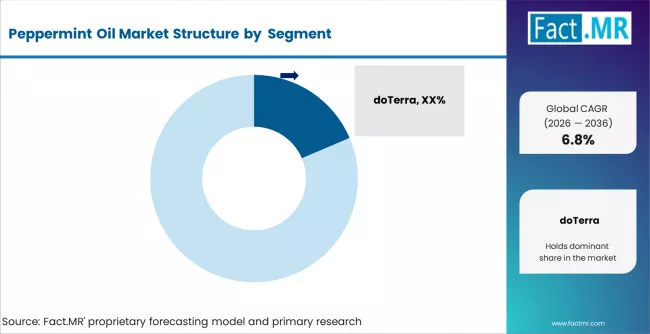
Peppermint Oil Market Analysis By Company | Source: Fact.MR
Leading peppermint oil providers are expanding their product portfolio by launching novel products to improve their sales and revenue generation potential. Key players in the peppermint oil industry are focusing on expanding their business operations in new countries and regions to improve their market share on a global scale.
- In February 2023, Zed Black, a renowned manufacturer of fragrance products in India, announced the launch of its new range of essential oils. The new exquisite range is labeled ‘Orva Naturals’ and consists of flavors such as peppermint, lavender, tea tree, rosemary, lemongrass, and orange.
- In June 2022, doTERRA, a leading producer of essential oils, announced the commencement of its expansion in South America with a new office in Chile. The company plans to capitalize on the changing consumer landscape in the region.
- In 2021, Alo, a leading provider of yoga clothing and accessories, announced the launch of a new range of essential oils to take the relaxation experience to a whole new level. Two of these six products contain peppermint as an ingredient.
Fact.MR provides detailed information about the price points of key producers of peppermint oil positioned across the world, sales growth, production capacity, and speculative technological expansion, in the recently updated market report.
Bibliography
- Food and Agriculture Organization of the United Nations. (2024). Herbs and spices: Global production data. FAO.
- International Federation of Essential Oils and Aroma Trades. (2024). Mint oils: Global market review. IFEAT.
- European Pharmacopoeia Commission. (2024). Monograph: Peppermint oil (Menthae piperitae aetheroleum). Ph. Eur.
- United States Pharmacopeia. (2024). USP monograph: Peppermint oil. USP.
- Government of India, Directorate of Arecanut and Spices Development. (2024). Mentha production statistics. DASD.
- International Organization for Standardization. (2024). ISO 856: Oil of peppermint (Mentha piperita L.). ISO.
This bibliography is provided for reader reference. The full FACT.MR report contains the complete reference list with primary research documentation.
This Report Addresses
- Market sizing and quantitative forecast metrics detailing global peppermint oil trade volumes and values through 2036.
- Segmentation analysis mapping demand across sources, forms, extraction methods, and end-use applications.
- Regional trade intelligence comparing Indian high-volume production against US premium varietal output and quality positioning.
- Regulatory compliance assessment analyzing pharmacopoeia monograph specifications and food-grade ingredient certification requirements.
- Competitive landscape evaluation tracking major distillers, essential oil distributors, and aromatherapy brand procurement strategies.
- Strategic sourcing guidance defining origin diversification, organic certification, and quality testing investment priorities.
- Pricing analysis identifying menthol content-driven quality differentials and origin-specific pricing tier structures.
- Custom data delivery formats encompassing interactive dashboards, raw Excel datasets, and comprehensive PDF narrative reports.
Segmentation
Scope of the Report
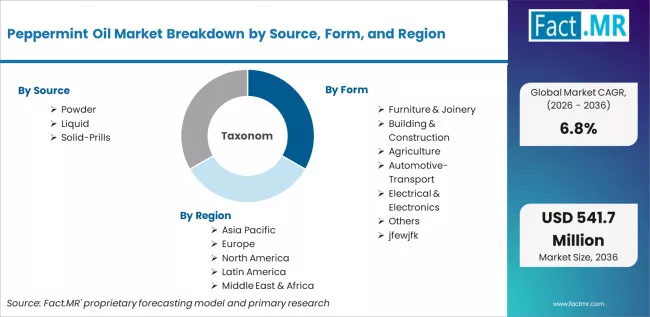
Peppermint Oil Market Breakdown By Source, Form, And Region | Source: Fact.MR
| Metric | Value |
|---|---|
| Quantitative Units | USD 262.69 million to USD 507.16 million, at a CAGR of 6.8% |
| Market Definition | Peppermint oil encompasses steam-distilled essential oil from Mentha piperita containing menthol and menthone, classified by source, form, and extraction method, used in food flavoring, oral care, therapeutic preparations, aromatherapy, cosmetics, and cleaning products. |
| Source Segmentation | Natural, Organic |
| Form Segmentation | Absolute/Concentrate, Blends |
| Method of Extraction Segmentation | Distillation, CO2 Extraction, Cold Press, Solvent Extraction, Others |
| Application Segmentation | Food & Beverages, Therapeutics, Aromatherapy, Cosmetics, Toiletries, Fragrances, Cleaning & Home, Others |
| Regions Covered | North America, Latin America, Europe, East Asia, South Asia, Oceania, Middle East & Africa |
| Countries Covered | India, China, USA, Canada, UK, Germany, Japan, and 40 plus countries |
| Key Companies Profiled | doTERRA International LLC, Plant Therapy Essential Oils, Lionel Hitchen Essential Oils Ltd., Greenleaf Extractions Pvt. Ltd., Young Living Essential Oils LC, Biolandes SAS, Synthite Industries Ltd., The Lebermuth Company Inc., Natures Natural India, Aromaaz International |
| Forecast Period | 2026 to 2036 |
| Approach | Forecasting models apply a bottom-up methodology starting with origin-country distillation output, integrating application-specific demand curves, natural vs. organic grade migration, and menthol content pricing differentials. |
Source: Fact.MR analysis. Updated Mar 20, 2026
Key Segments of Peppermint Oil Market Research
-
By Source :
- Organic
- Natural
-
By Form :
- Absolute/Concentrate
- Blends
-
By Method of Extraction :
- Distillation
- Carbon Dioxide Extraction
- Cold Press Extraction
- Solvent Extraction
- Others
-
By Application :
- Therapeutics
- Aromatherapy
- Food & Beverages
- Cosmetics
- Toiletries
- Fragrances
- Cleaning & Home
- Others
-
By Region :
- North America
- Latin America
- Western Europe
- Eastern Europe
- East Asia
- South Asia & Pacific
- Middle East & Africa
Frequently Asked Questions
How large is the demand for peppermint oil in the global market in 2026?
What will be the market size of peppermint oil by 2036?
What is the expected demand growth for peppermint oil between 2026 and 2036?
Which source is poised to lead by 2026?
How significant is the role of Absolute/Concentrate in driving peppermint oil demand?
What method of extraction segment leads in 2026?
What is peppermint oil and what is it mainly used for?
What is included in the scope of this report?
What is excluded from the scope of this report?
How does FMI build and validate this forecast?
Does the report cover USA in its regional analysis?
Does the report cover Germany in its regional analysis?
Does the report cover India in its regional analysis?
Who worked on this report


Preview the report firsthand - request a free sample
Free SampleGet the brochure for pricing and purchase details
Download PDF