- Base Value(2025): 10.50 Bn
- Estimated Value(2026): 11.05 Bn
- Forecast Value (2036): 18.34 Bn
- CAGR (2026 - 2036): 5.2%
Toilet Care Products Market Size, Market Forecast and Outlook By FACT.MR
The toilet care products market was valued at USD 10.50 billion in 2025, projected to reach USD 11.05 billion in 2026, and is forecast to expand to USD 18.34 billion by 2036 at a 5.2% CAGR. The absolute dollar opportunity of approximately USD 7.29 billion added over the forecast decade reflects steady household penetration gains in emerging economies and premiumization of cleaning formats in developed markets. FACT.MR opines that post-pandemic hygiene awareness has permanently elevated baseline consumption levels for toilet care formulations worldwide.
Household penetration rates for specialized toilet care products vary substantially across income tiers and geographic regions. Developed markets in North America and Western Europe exhibit near-universal adoption, where product innovation focuses on concentrated formats, eco-friendly formulations, and automated dosing systems. Emerging markets in South Asia and Sub-Saharan Africa present a penetration growth opportunity, with multinational brands adapting sachet-sized and value-tier product formats for price-sensitive consumers. FACT.MR analysts note that the regulatory landscape for biocidal product claims in the European Union directly affects formulation strategies and time-to-market for antibacterial toilet care products.
India and China lead volume growth in toilet care products, where rapid urbanization and expanding modern sanitation infrastructure multiply the addressable household base. United States demand concentrates on premium antibacterial and eco-certified formulations, with private-label products capturing incremental share in grocery channels. Germany enforces strict biocidal product regulation under EU Regulation 528/2012, requiring manufacturers to complete lengthy registration processes before claiming disinfectant efficacy. The United Kingdom market favors gel-format cleaners and rim block systems, with major retailers driving private-label competition. Japan maintains high per-capita consumption levels, with automated toilet systems creating demand for compatible cleaning formulations. As per FACT.MR, Brazil's expanding urban middle class generates incremental demand for branded toilet care products.
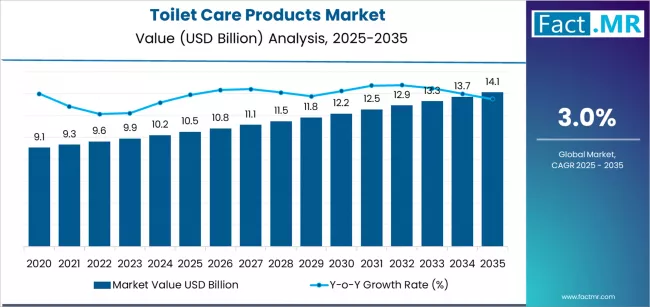
Toilet Care Products Market Market Value Analysis | Source: Fact.MR
Toilet Care Products Market Key Takeaways
| Metric | Details |
|---|---|
| Industry Size (2026) | USD 11.05 billion |
| Industry Value (2036) | USD 18.34 billion |
| CAGR (2026 to 2036) | 5.2% |
Source: Fact.MR analysis. Updated Mar 20, 2026
Toilet Care Products Market Definition
Toilet care products encompass specialized cleaning formulations, delivery systems, and accessories designed for sanitizing, deodorizing, and maintaining toilet fixtures in residential and commercial settings. Product categories include liquid and gel cleaners, rim blocks, in-cistern tablets, wipes, and brushes. These products serve both hygiene maintenance and aesthetic freshness purposes.
Toilet Care Products Market Inclusions
Market scope covers global and regional sales volumes and values for toilet care products, forecast period from 2026 to 2036, segment breakdowns by product type, distribution channel, and benefit claim category. Pricing analysis and formulation trend assessments are included.
Toilet Care Products Market Exclusions
The scope excludes general-purpose surface cleaners not specifically formulated for toilet application, bathroom fixture hardware, plumbing equipment, and industrial-grade sanitation chemicals used in commercial waste treatment. Personal hygiene products are excluded.
Toilet Care Products Market Research Methodology
- Primary Research: Analysts engaged with household care brand managers, retail category buyers, and consumer goods distribution leads across 40 countries to validate product adoption and channel dynamics.
- Desk Research: Data collection aggregated national retail audit data, biocidal product regulatory filings, and consumer household penetration surveys from public agencies.
- Market-Sizing and Forecasting: Baseline values derive from a bottom-up aggregation of retail sales data, applying household penetration curves and per-capita consumption trends by region.
- Data Validation and Update Cycle: Projections are cross-validated against publicly reported quarterly revenue data from major consumer goods manufacturers.
Summary of Toilet Care Products Market
- Toilet Care Products Market Definition
- Toilet care products encompass specialized cleaning formulations and delivery systems designed to sanitize, deodorize, and maintain toilet fixtures in residential and commercial environments.
- Demand Drivers in the Market
- Post-pandemic hygiene awareness has permanently elevated consumer expectations for antibacterial and disinfecting toilet care formulations across developed and emerging markets.
- Rapid urbanization and modern sanitation infrastructure expansion in India and Southeast Asia multiply the addressable household base for branded toilet care products.
- Retailer-driven private-label competition forces brand owners to invest in concentrated formats, eco-certified ingredients, and packaging differentiation to maintain shelf position.
- Key Segments Analyzed in the FACT.MR Report
- Liquid/Gel Cleaners hold 47.0% of product type share in 2026, preferred for application versatility across under-rim, bowl surface, and deep-cleaning occasions.
- Mass/Grocery channel commands 56.0% of distribution share, reflecting supermarket and hypermarket dominance in household cleaning product retail.
- Disinfecting/Antibacterial benefit claims account for 51.0% of benefit-category demand, elevated by sustained post-pandemic hygiene purchasing behavior.
- Analyst Opinion at FACT.MR
- FACT.MR analysts observe that the toilet care products market is transitioning from commodity cleaning toward a tiered product architecture where premium eco-certified and concentrated formats coexist with value-tier sachets targeting emerging market penetration. Manufacturers that cannot demonstrate auditable biodegradability claims risk losing shelf placement in European retail chains where sustainability scorecards govern category allocation. The competitive intensity of private-label expansion in mass grocery channels compresses branded manufacturer margins and accelerates reformulation cycles.
- Strategic Implications / Executive Takeaways
- Brand owners must invest in concentrated and refillable product formats to align with retailer sustainability targets and reduce packaging material costs per dose.
- Manufacturers targeting EU markets should initiate biocidal product registration processes early in the development cycle to avoid delayed market entry for disinfectant-claim products.
- Distribution strategies for South and Southeast Asian markets require sachet-format and value-tier product lines adapted to fragmented retail environments and price-sensitive consumer segments.
- Methodology
- Primary Research: FACT.MR conducted interviews with brand managers, retail category buyers, and distribution leads across 40 countries.
- Desk Research: Analysts aggregated retail audit data, biocidal product regulatory filings, and household penetration surveys.
- Market-Sizing and Forecasting: Models apply a bottom-up methodology from retail sales data, integrating household penetration curves and per-capita consumption trends.
Toilet Care Products Market Key Takeaways
| Metric | Value |
|---|---|
| Estimated Value in (2026E) | USD 10.5 billion |
| Forecast Value in (2036F) | USD 14.2 billion |
| Forecast CAGR (2026 to 2036) | 3.0% |
Source: Fact.MR analysis. Updated Mar 20, 2026
From 2030 to 2036, the market is forecast to grow from USD 12.2 billion to USD 14.2 billion, adding another USD 2.0 billion, which constitutes 54.1% of the overall ten-year expansion. This period is expected to be characterized by the expansion of eco-friendly and concentrated cleaning systems, the integration of digital marketing solutions, and the development of advanced formulation technologies for major retail chains. The growing adoption of environmental compliance programs and smart packaging initiatives will drive demand for toilet care products with enhanced cleaning efficiency and reduced environmental impact.
Between 2020 and 2026, the market experienced steady recovery growth, driven by increasing hygiene awareness recovery and growing recognition of toilet care products as essential household items for bathroom cleanliness and health safety. The market developed as consumers and institutions recognized the potential for specialized products to enhance cleaning efficiency while reducing maintenance costs and improving hygiene reliability. Technological advancement in antibacterial formulations and packaging systems began emphasizing the critical importance of maintaining cleaning effectiveness and user convenience in household cleaning operations.
Why is the Toilet Care Products Market Growing?
Market expansion is being supported by the increasing global hygiene awareness and the corresponding need for effective cleaning products that can maintain antibacterial reliability and odor control while supporting diverse household cleaning applications across various residential environments. Modern households and commercial facilities are increasingly focused on implementing cleaning solutions that can reduce maintenance time, minimize cleaning costs, and provide consistent performance in toilet cleaning operations. Toilet care products' proven ability to deliver enhanced cleaning efficiency, reliable antibacterial capabilities, and versatile bathroom cleaning applications make them essential products for contemporary household operations and commercial cleaning solutions.
The growing focus on hygiene modernization and cleaning efficiency is driving demand for toilet care products that can support high-frequency cleaning, reduce bacterial contamination, and enable efficient bathroom maintenance operations across varying household configurations. Consumer preference for products that combine effectiveness with convenience and cost-effectiveness is creating opportunities for innovative formulation implementations. The rising influence of environmental regulations and smart packaging technologies is also contributing to increased adoption of toilet care products that can provide advanced cleaning control without compromising performance or environmental compliance.
Opportunity Pathways - Toilet Care Products Market
The toilet care products market is poised for robust growth and transformation. As households and commercial facilities across both developed and emerging markets seek cleaning products that are effective, convenient, automated, and environmentally compliant, toilet care systems are gaining prominence not just as cleaning products but as strategic solutions for hygiene efficiency, maintenance reliability, user experience enhancement, and environmental compliance.
Rising hygiene awareness and household modernization in North America, Europe, and Asia Pacific amplify demand, while manufacturers are picking up on innovations in antibacterial formulations and eco-friendly technologies.
Pathways like eco-friendly adoption, automation integration, and smart packaging promise strong margin uplift, especially in developed markets. Geographic expansion and product diversification will capture volume, particularly where hygiene awareness is growing or household infrastructure requires modernization. Environmental pressures around chemical reduction, packaging efficiency, cleaning effectiveness, and carbon neutrality give structural support.
- Pathway A - Eco-Friendly & Concentrated Solutions. Households increasingly require products that reduce environmental impact and packaging waste. Product manufacturers who specialize in concentrated formulations or enhance biodegradable capabilities can command a premium. Expected revenue pool: USD 0.8-1.0 billion
- Pathway B - Antibacterial & Disinfecting Innovation. Advanced formulation systems - enhanced bacteria killing, virus elimination, long-lasting protection - improve cleaning effectiveness and reduce health risks. Opportunity: USD 0.7-0.9 billion
- Pathway C - Smart Packaging Integration. User-friendly designs, dosing control, and convenience features optimize product usage and enhance consumer experience. Systems with stronger packaging innovation and automated dispensing capabilities will allow premium pricing. Revenue lift: USD 0.5-0.7 billion
- Pathway D - Specialized Product Applications. Extending reach into commercial cleaning, institutional maintenance, and industrial toilet care. Facilities will look for product suppliers who provide reliable, effective cleaning solutions. Pool: USD 0.6-0.8 billion
- Pathway E - Emerging Market Expansion. Strong growth in developing hygiene markets, urbanization trends, and household income growth. Local partnerships and customized formulations help penetration. Expected upside: USD 0.5-0.7 billion
- Pathway F - Multi-Benefit Solutions. Products combining disinfecting, descaling, and deodorizing benefits help households reduce product variety and cleaning complexity. Multi-functional approaches benefit from consumer convenience preferences. USD 0.4-0.6 billion
- Pathway G - Premium Product Positioning. Enhanced cleaning performance, luxury fragrances, and superior packaging create differentiation and brand loyalty advantages. Pool: USD 0.3-0.5 billion
Segmental Analysis
The market is segmented by product, channel, and benefit. By product, the market is divided into liquid/gel cleaners, rim blocks & tablets, and wipes & accessories. By channel, it covers mass/grocery, online, and drug/specialty. By benefit, it is segmented into disinfecting/antibacterial, descaling/deodorizing, and eco/concentrates. Regionally, the market is divided into North America, Europe, Asia Pacific, Latin America, and Middle East & Africa.
By Product, the Liquid/Gel Cleaners Segment Accounts for 47.0% Market Share
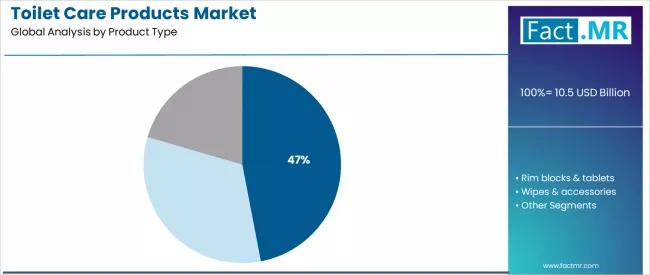
Toilet Care Products Market Analysis By Product Type | Source: Fact.MR
The liquid/gel cleaners segment is projected to account for 47.0% of the market in 2025, reaffirming its position as the leading product category. Household consumers and commercial facilities increasingly utilize liquid/gel cleaners for their proven effectiveness, established cleaning compatibility, and convenience in toilet maintenance operations across residential, institutional, and commercial cleaning applications. Liquid/gel cleaner technology's established application procedures and consistent cleaning output directly address the hygiene requirements for reliable toilet care and cleaning efficiency in diverse household environments.
This product segment forms the foundation of current household cleaning operations, as it represents the technology with the greatest cleaning reliability and established usage infrastructure across multiple applications and household scenarios. Consumer investments in enhanced liquid formulations and application optimization continue to strengthen adoption among households and institutions. With consumers prioritizing cleaning reliability and product availability, liquid/gel cleaners align with both hygiene effectiveness objectives and cost management requirements, making them the central component of comprehensive toilet care strategies.
By Channel, the Mass/Grocery Segment Accounts for 56.0% Market Share
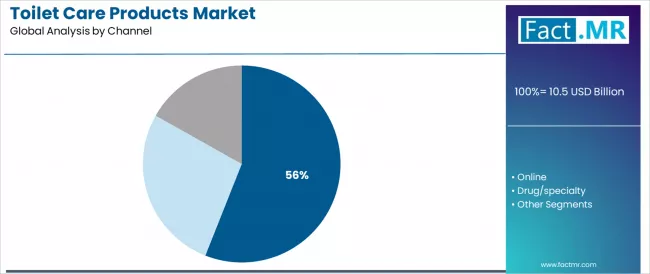
Toilet Care Products Market Analysis By Channel | Source: Fact.MR
Mass/grocery channels are projected to represent 56.0% of toilet care products distribution in 2025, highlighting their critical role as the primary retail channel for household consumers and institutional buyers. Mass/grocery retailers prefer toilet care products for their consistent demand, established inventory management, and ability to handle high-volume sales while supporting consumer convenience and accessibility requirements. Positioned as essential retail infrastructure for modern consumer markets, mass/grocery channels offer both distribution advantages and consumer benefits.
The segment is supported by continuous innovation in retail expansion and the growing availability of specialized product configurations that enable efficient distribution with enhanced consumer accessibility. Mass/grocery retailers are investing in inventory optimization to support large-scale operations and consumer service delivery. As consumer convenience becomes more prevalent and accessibility requirements increase, mass/grocery channels will continue to dominate the distribution market while supporting advanced product availability and consumer shopping strategies.
By Benefit, the Disinfecting/Antibacterial Segment Accounts for 51.0% Market Share
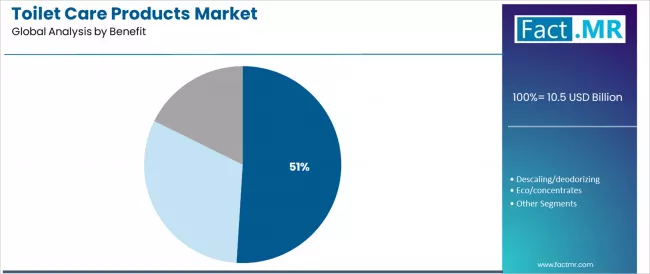
Toilet Care Products Market Analysis By Benefit | Source: Fact.MR
Disinfecting/antibacterial benefits are projected to represent 51.0% of toilet care products demand in 2025, highlighting their critical role as the primary consumer requirement for hygiene and health protection. Consumers prefer toilet care products with disinfecting/antibacterial capabilities for their health protection, germ elimination ability, and reliable performance in maintaining toilet hygiene while supporting family health and safety requirements. Positioned as essential health protection for modern households, disinfecting/antibacterial products offer both hygiene advantages and safety benefits.
The segment is supported by continuous innovation in antibacterial technology and the growing availability of specialized formulations that enable effective germ elimination with enhanced safety performance. Consumers are investing in health optimization to support family protection and hygiene delivery. As health consciousness becomes more prevalent and safety requirements increase, disinfecting/antibacterial benefits will continue to dominate the benefit market while supporting advanced hygiene protection and household health strategies.
What are the Drivers, Restraints, and Key Trends of the Toilet Care Products Market?
The toilet care products market is advancing steadily due to increasing hygiene awareness and growing adoption of cleaning efficiency infrastructure that provides enhanced toilet maintenance and health protection across diverse household applications. The market faces challenges, including ingredient cost fluctuations, specialized formulation requirements, and varying consumer preferences across different regional environments. Innovation in eco-friendly formulations and packaging technologies continues to influence product development and market expansion patterns.
Rising Global Hygiene Awareness and Household Modernization
The growing expansion of hygiene consciousness and household infrastructure development is enabling product manufacturers to develop toilet care systems that provide superior cleaning efficiency, enhanced antibacterial capabilities, and reliable performance in high-frequency cleaning environments. Advanced cleaning systems provide improved hygiene capacity while allowing more effective toilet maintenance and consistent safety delivery across various applications and household requirements. Manufacturers are increasingly recognizing the competitive advantages of modern cleaning capabilities for hygiene efficiency and household productivity positioning.
Eco-Friendly Innovation and Packaging Drive Product Development
Modern toilet care product manufacturers are incorporating biodegradable ingredients and recyclable packaging systems to enhance environmental compliance, reduce ecological impact, and ensure consistent performance delivery to household consumers. These technologies improve environmental compatibility while enabling new applications, including concentrated formulations and refillable packaging solutions. Advanced formulation integration also allows manufacturers to support premium product positioning and environmental optimization beyond traditional cleaning product supply.
Analysis of the Toilet Care Products Market by Key Countries
.webp "Top Country Growth Comparison Toilet Care Products Market Cagr (2026 2036)")
Top Country Growth Comparison Toilet Care Products Market Cagr (2026 2036) | Source: Fact.MR
| Country | CAGR (2026-2036) |
|---|---|
| USA | 3.2% |
| Germany | 2.6% |
| France | 2.5% |
| South Korea | 2.5% |
| United Kingdom | 2.4% |
| Japan | 2.3% |
| Mexico | 2.9% |
Source: Fact.MR analysis. Updated Mar 20, 2026
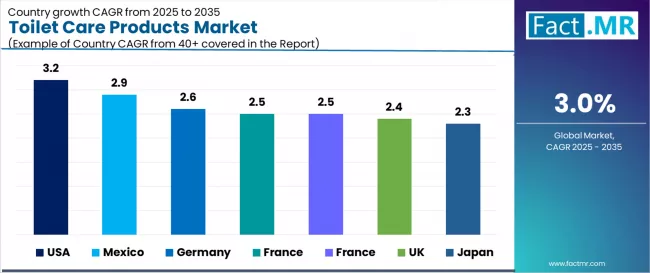
Toilet Care Products Market Cagr Analysis By Country | Source: Fact.MR
The market is experiencing steady growth globally, with the USA leading at a 3.2% CAGR through 2036, driven by extensive hygiene awareness programs, advanced retail infrastructure investments, and significant adoption of antibacterial cleaning solutions. Mexico follows at 2.9%, supported by growing urbanization trends, rapid household development, and growing adoption of modern cleaning technologies. Germany shows growth at 2.6%, emphasizing environmental compliance and advanced formulation capabilities. France records 2.5%, focusing on product innovation and consumer preference optimization. South Korea demonstrates 2.5% growth, supported by hygiene modernization and premium product adoption. The United Kingdom holds 2.4%, supported by retail modernization requirements and post-Brexit market optimization. Japan demonstrates 2.3% growth, supported by quality enhancement but constrained by market maturity.
The report covers an in-depth analysis of 40+ countries, top-performing countries are highlighted below.
USA Leads Global Market Growth with Hygiene Infrastructure Modernization
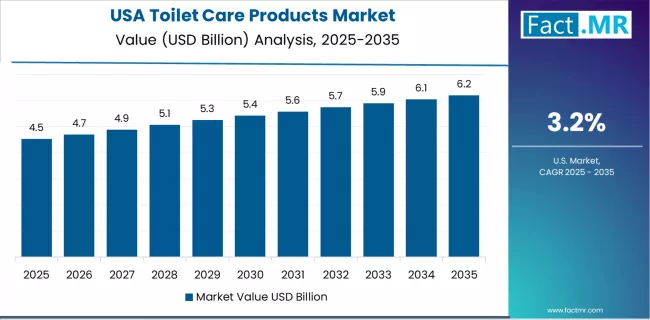
Toilet Care Products Market Country Value Analysis | Source: Fact.MR
The USA is projected to exhibit exceptional growth with a CAGR of 3.2% through 2036, driven by extensive hygiene awareness programs and rapidly growing adoption of antibacterial cleaning solutions supported by health regulations and consumer safety initiatives. The country's comprehensive retail infrastructure and increasing investment in product innovation technologies are creating robust demand for advanced toilet care product solutions. Major retailers and households are establishing comprehensive cleaning programs to serve both residential operations and commercial hygiene requirements.
Government support for health protection and environmental compliance is driving demand for advanced antibacterial technologies throughout major retail chains and household consumers. Strong consumer spending recovery and expanding network of retail channels are supporting the rapid adoption of premium cleaning technologies among consumers seeking enhanced hygiene effectiveness and health protection.
Mexico Demonstrates Strong Market Potential with Household Infrastructure Expansion
Mexico is expanding at a CAGR of 2.9%, supported by the country's growing urbanization trends, extensive household development, and increasing adoption of modern cleaning systems. The country's comprehensive economic growth and growing household income levels are driving sophisticated cleaning capabilities. Urban households and retail chains are establishing extensive product availability to address the growing demand for effective toilet maintenance and hygiene reliability.
Rising household income levels and expanding urban development are creating opportunities for product adoption across households, retailers, and cleaning service companies in major metropolitan corridors. Growing government focus on health modernization and hygiene development is driving adoption of advanced cleaning technologies among consumers seeking enhanced household cleanliness and family safety.
Germany Demonstrates Environmental Leadership with Advanced Product Technology
Germany is expanding at a CAGR of 2.6%, supported by the country's strong environmental regulations, advanced formulation capabilities, and comprehensive household modernization programs among cleaning consumers. The nation's mature consumer market and increasing focus on environmental compliance are driving sophisticated product capabilities throughout the cleaning market. Leading retailers and manufacturers are investing extensively in eco-friendly product development and technology integration to serve both domestic consumer needs and export markets.
Rising environmental compliance requirements and cleaning efficiency initiatives are creating demand for advanced eco-friendly technologies among consumers seeking reduced environmental impact and enhanced performance. Strong manufacturing expertise and growing awareness about formulation technologies are supporting adoption of advanced cleaning systems across households and retailers in major consumer regions.
France Shows Steady Growth with Innovation Focus
France is expanding at a CAGR of 2.5%, driven by continuous product innovation programs, environmental compliance initiatives, and established consumer market capabilities. The country's sophisticated retail landscape and consumer preference for premium cleaning solutions are supporting market expansion. French households demonstrate strong brand loyalty and willingness to invest in effective cleaning products that combine performance with environmental responsibility.
The market benefits from comprehensive distribution networks across hypermarkets and specialty retailers, enabling widespread product availability. Growing focus on ecofriendly packaging and biodegradable formulations aligns with consumer environmental consciousness, driving adoption of eco-friendly toilet care solutions across urban and suburban markets.
South Korea Exhibits Premium Product Adoption
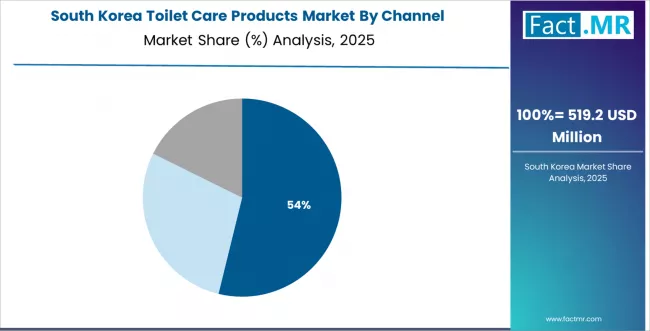
Toilet Care Products Market South Korea Market Share Analysis By Channel | Source: Fact.MR
South Korea is growing at a CAGR of 2.5%, supported by hygiene modernization trends, premium product adoption, and technological advancement in cleaning solutions. The country's tech-savvy consumers show strong preference for innovative products with enhanced antibacterial capabilities and convenient packaging features. Urban households prioritize quality and effectiveness, creating demand for premium toilet care solutions.
Rising disposable income levels and increasing health consciousness are driving market expansion. The integration of smart packaging technologies and advanced formulations appeals to Korean consumers seeking convenience and reliability in household cleaning products, supporting steady market growth.
United Kingdom Maintains Stable Growth Despite Market Challenges
The United Kingdom is expanding at a CAGR of 2.4%, supported by retail modernization requirements and consumer preference optimization but facing challenges from post-Brexit adjustments and market uncertainties. The country's established retail infrastructure and brand recognition continue to support market stability. Consumer focus on value-for-money products while maintaining cleaning effectiveness drives product positioning strategies.
Market growth is supported by increasing awareness of hygiene importance and the adoption of specialized cleaning solutions across diverse household types. Despite economic uncertainties, consistent demand for essential cleaning products maintains market resilience and supports steady expansion.
Japan Shows Mature Market Characteristics
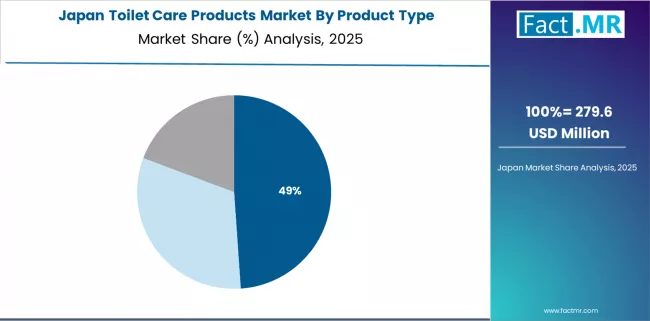
Toilet Care Products Market Japan Market Share Analysis By Product Type | Source: Fact.MR
Japan is growing at a CAGR of 2.3%, supported by quality enhancement initiatives but constrained by market maturity and demographic challenges. The country's aging population and established cleaning habits create stable demand patterns. Japanese consumers prioritize product quality, reliability, and environmental sustainability, supporting premium product segments.
Innovation in concentrated formulations and packaging efficiency addresses space constraints in Japanese households. The market benefits from strong brand loyalty and consumer preference for technologically advanced cleaning solutions that deliver superior performance while minimizing environmental impact.
Europe Market Split by Countries
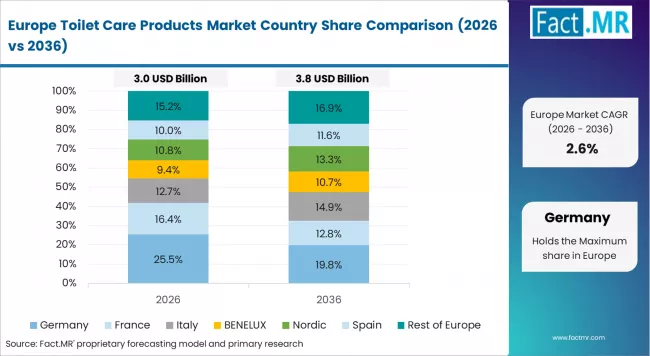
Toilet Care Products Market Europe Country Market Share Analysis, 2026 & 2036 | Source: Fact.MR
The toilet care products market in Europe is projected to grow from USD 2.8 billion in 2026 to USD 3.7 billion by 2036, registering a CAGR of 2.8% over the forecast period. Germany is expected to maintain its leadership position with a 28.5% market share in 2026, increasing to 29.1% by 2036, supported by its advanced retail infrastructure, comprehensive environmental regulations, and major consumer markets serving European and international customers.
France follows with a 22.4% share in 2026, projected to ease to 21.8% by 2036, driven by product innovation programs, environmental compliance initiatives, and established consumer market capabilities, but facing challenges from competitive pressures and market saturation constraints. United Kingdom holds a 18.7% share in 2026, expected to decline to 18.3% by 2036, supported by retail modernization requirements and consumer preference optimization but facing challenges from post-Brexit adjustments and market uncertainties. Italy commands a 12.6% share in 2026, projected to reach 12.8% by 2036, while Spain accounts for 10.2% in 2026, expected to reach 10.4% by 2036. The Rest of Europe region, including Nordic countries, Eastern European markets, Belgium, Netherlands, and other European countries, is anticipated to gain momentum, expanding its collective share from 7.6% to 7.6% by 2036, attributed to increasing consumer development across Nordic countries and growing household modernization across various European markets implementing hygiene upgrade programs.
Competitive Landscape of the Toilet Care Products Market
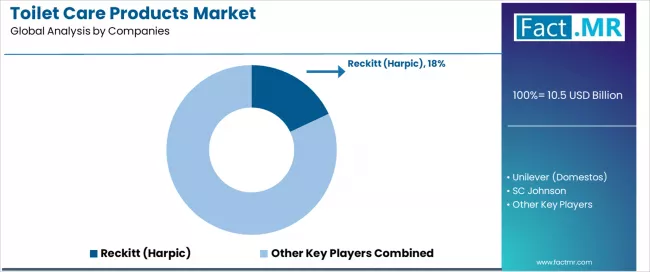
Toilet Care Products Market Analysis By Company | Source: Fact.MR
The market is characterized by competition among established consumer goods manufacturers, specialized cleaning technology providers, and integrated household product companies. Companies are investing in advanced formulation research, antibacterial technology development, packaging optimization, and comprehensive product portfolios to deliver effective, reliable, and environmentally compliant toilet care solutions. Innovation in eco-friendly ingredients, enhanced cleaning capabilities, and smart packaging technologies is central to strengthening market position and competitive advantage.
Reckitt leads the market with the Harpic brand, holding an 18.0% market share, offering specialized toilet cleaning products with a focus on antibacterial effectiveness and robust formulation design for household operations. Unilever provides comprehensive cleaning product portfolios through Domestos with an focus on innovation, brand recognition, and global distribution services. SC Johnson delivers specialized household products with a focus on cost-effective manufacturing and consumer adaptability. Henkel specializes in innovative cleaning solutions with focus on technology integration and operational efficiency. Procter & Gamble focuses on diverse consumer products with global market leadership and large-scale production capabilities. Clorox offers comprehensive household cleaning solutions with regional service networks and brand management solutions. Kao provides cleaning products with focus on Asian market leadership and manufacturing scale.
Key Players in the Toilet Care Products Market
- Reckitt (Harpic)
- Unilever (Domestos)
- SC Johnson
- Henkel
- Procter & Gamble
- Clorox
- Kao
- Lion
- Godrej
- Dabur
Bibliography
- European Commission. (2024). Biocidal Products Regulation (EU) 528/2012: Implementation report. EC.
- Organisation for Economic Co-operation and Development. (2024). Household chemical products: Safety and environmental assessment. OECD.
- United States Environmental Protection Agency. (2024). Antimicrobial product registration and labeling guidance. US EPA.
- World Health Organization. (2024). Water, sanitation, and hygiene (WASH) global status report. WHO.
- Government of India, Ministry of Housing and Urban Affairs. (2024). Swachh Bharat Mission: Urban sanitation progress report. MoHUA.
- United Kingdom, Department for Environment, Food and Rural Affairs. (2024). Household chemicals and environmental impact review. DEFRA.
This bibliography is provided for reader reference. The full FACT.MR report contains the complete reference list with primary research documentation.
This Report Addresses
- Market sizing and quantitative forecast metrics detailing global toilet care products sales volumes and values through 2036.
- Segmentation analysis mapping consumption patterns across product types, distribution channels, and benefit claim categories.
- Regional deployment intelligence comparing mature market premiumization trends against emerging economy penetration growth dynamics.
- Regulatory compliance assessment analyzing biocidal product registration requirements and antimicrobial claim labeling standards.
- Competitive landscape evaluation tracking the market positioning of major household care manufacturers and private-label growth.
- Strategic formulation guidance identifying eco-certification, concentration, and refill-format investment priorities.
- Supply chain and distribution analysis identifying channel-specific packaging format requirements for fragmented retail environments.
- Custom data delivery formats encompassing interactive dashboards, raw Excel datasets, and comprehensive PDF narrative reports.
Segmentation
Scope of the Report
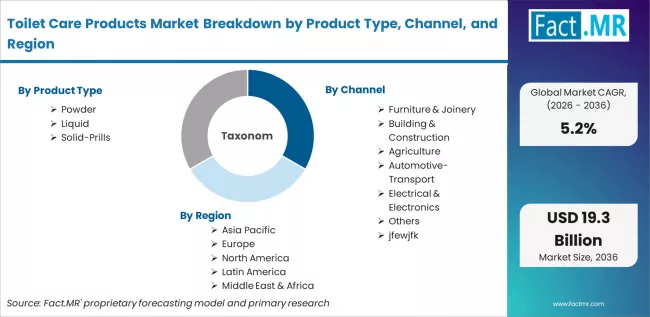
Toilet Care Products Market Breakdown By Product Type, Channel, And Region | Source: Fact.MR
| Metric | Value |
|---|---|
| Quantitative Units | USD 11.05 billion to USD 18.34 billion, at a CAGR of 5.2% |
| Market Definition | Toilet care products encompass specialized cleaning formulations and delivery systems designed to sanitize, deodorize, and maintain toilet fixtures in residential and commercial environments. |
| Product Type Segmentation | Liquid/Gel Cleaners, Rim Blocks & Tablets, Wipes & Accessories |
| Channel Segmentation | Mass/Grocery, Online, Drug/Specialty |
| Benefit Segmentation | Disinfecting/Antibacterial, Descaling/Deodorizing, Eco/Concentrates |
| Regions Covered | North America, Latin America, Europe, East Asia, South Asia, Oceania, Middle East & Africa |
| Countries Covered | India, China, USA, Canada, UK, Germany, Japan, and 40 plus countries |
| Key Companies Profiled | Reckitt Benckiser Group plc (Harpic), Unilever plc (Domestos), SC Johnson & Son Inc., Henkel AG & Co. KGaA, Procter & Gamble Co., The Clorox Company, Kao Corporation, Lion Corporation, Godrej Consumer Products Ltd. |
| Forecast Period | 2026 to 2036 |
| Approach | Forecasting models apply a bottom-up methodology starting with retail sales data, integrating household penetration curves, per-capita consumption trends, and regulatory compliance timelines by region. |
Source: Fact.MR analysis. Updated Mar 20, 2026
Toilet Care Products Market by Segments
-
Product Type:
- Liquid/gel cleaners
- Rim blocks & tablets
- Wipes & accessories
-
Channel:
- Mass/grocery
- Online
- Drug/specialty
-
Benefit:
- Disinfecting/antibacterial
- Descaling/deodorizing
- Eco/concentrates
-
Region:
-
North America
- United States
- Canada
- Mexico
-
Europe
- Germany
- United Kingdom
- France
- Italy
- Spain
- Nordic
- BENELUX
- Rest of Europe
-
Asia Pacific
- China
- Japan
- India
- South Korea
- ASEAN
- Australia & New Zealand
- Rest of Asia Pacific
-
Latin America
- Brazil
- Chile
- Rest of Latin America
-
Middle East & Africa
- Kingdom of Saudi Arabia
- Other GCC Countries
- Turkey
- South Africa
- Other African Union
- Rest of Middle East & Africa
-
Frequently Asked Questions
How large is the demand for toilet care products in the global market in 2026?
What will be the market size of toilet care products by 2036?
What is the expected demand growth between 2026 and 2036?
Which product type is poised to lead by 2026?
How significant is the role of Mass/Grocery in distribution?
Which benefit category leads demand?
What is driving demand growth?
What are toilet care products and what are they mainly used for?
What is included in the scope of this report?
What is excluded from the scope of this report?
How does FACT.MR build and validate this forecast?
Does the report cover India in its regional analysis?
Does the report cover Germany in its regional analysis?
Who worked on this report


Preview the report firsthand - request a free sample
Free SampleGet the brochure for pricing and purchase details
Download PDF