- Base Value(2024): 12.2 Bn
- Estimated Value(2026): 17.0 Bn
- Forecast Value (2036): 94.9 Bn
- CAGR (2026 - 2036): 18.8%
What is the 3D imaging market forecast to be worth by 2036?
- The 3D imaging market was valued at USD 12.2 billion in 2024.
- Based on Fact.MR analysis, demand for 3D imaging solutions is estimated at USD 14.4 billion in 2025 and USD 17.0 billion in 2026.
- The market is projected to reach USD 94.9 billion by 2036.
- Fact.MR projects a CAGR of 18.8% during the forecast period.
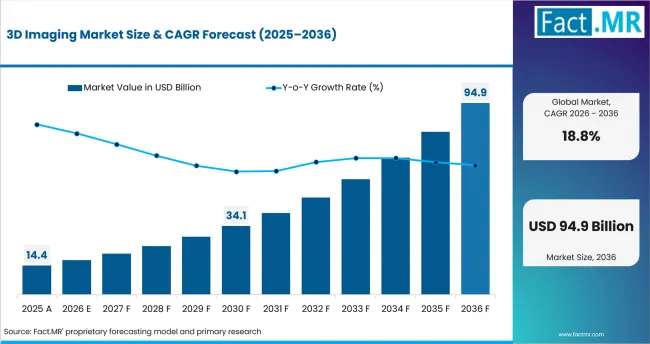
3d Imaging Market Value Analysis | Source: Fact.MR
| Metric | Value |
|---|---|
| Estimated Value in 2026 | USD 17.0 billion |
| Forecast Value in 2036 | USD 94.9 billion |
| Forecast CAGR (2026 to 2036) | 18.8% |
Source: Fact.MR analysis. Updated Jun 4, 2026
Summary of 3D Imaging Market
- Demand Drivers
- Diagnostic Imaging Demand: Healthcare providers are increasing use of advanced imaging technologies to improve diagnostic accuracy. Rising patient volumes and complex disease assessment support market growth.
- Industrial Automation Investment: Manufacturers are expanding deployment of 3D imaging systems to strengthen inspection and quality control processes. Demand is driven by precision manufacturing requirements and automation initiatives.
- Surgical Planning Adoption: Hospitals are increasing use of 3D visualization tools for treatment planning and procedural preparation. Improved clinical precision supports wider adoption across complex medical procedures.
- Key Segments Analyzed
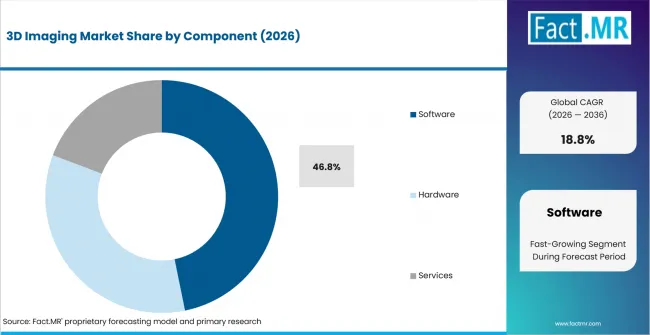
- By Component: Software accounts for 46.8% share in 2026 due to rising demand for image processing and analytics platforms.
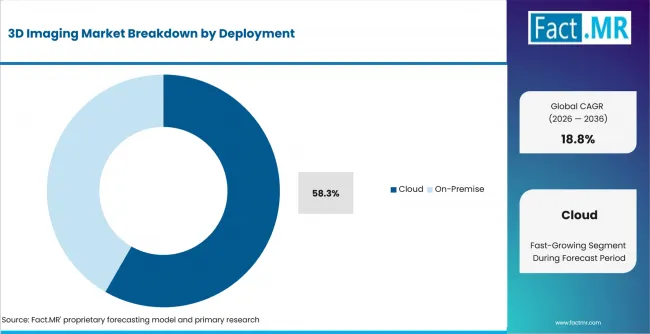
- By Deployment: Cloud holds 58.3% share in 2026 supported by scalable storage and remote collaboration requirements.
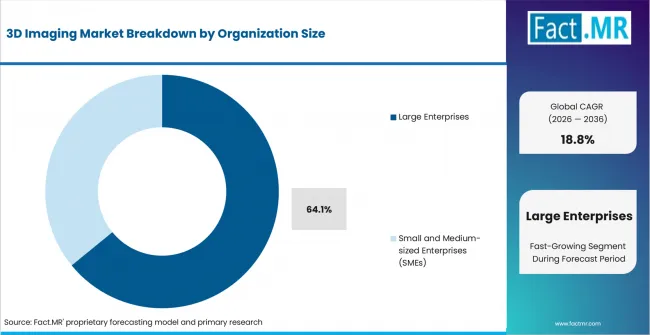
- By Organization Size: Large Enterprises capture 64.1% share in 2026 due to higher technology investment budgets.
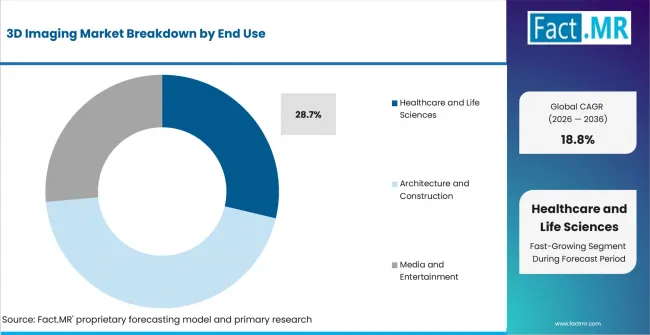
- By End Use: Healthcare and Life Sciences register 28.7% share in 2026 driven by diagnostic imaging services demand.
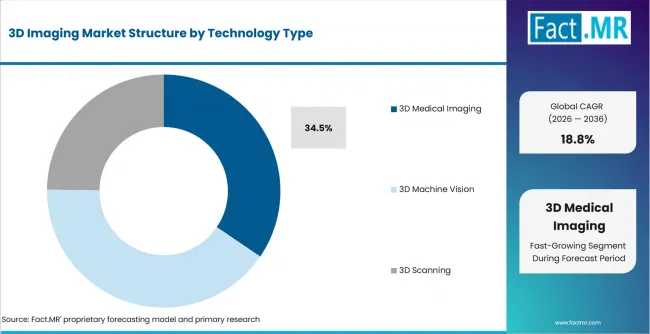
- By Technology Type: 3D Medical Imaging holds 34.5% share in 2026 supported by expanding clinical applications.
- By Geography: China is projected to record 21.4% CAGR through 2036 supported by industrial automation and healthcare investment.
- Analyst Opinion at Fact.MR
- Shambhu Nath Jha, Principal Consultant at Fact.MR, opines, ‘Imaging value is shifting toward intelligent interpretation platforms. Organizations that combine imaging hardware with analytics capability are positioned for stronger long-term growth.’
- Strategic Implications
- Healthcare technology suppliers should prioritize AI diagnostic imaging to improve diagnostic efficiency. Faster image interpretation supports higher clinical productivity.
- Imaging software developers should strengthen cloud integration capabilities across enterprise environments. Centralized data access improves workflow coordination and storage management.
- Equipment manufacturers should expand collaboration with healthcare providers and industrial organizations. Stronger commercial relationships can improve technology adoption and deployment opportunities.
Revenue generation is forecast to increase by approximately USD 77.9 billion between 2026 and 2036. The forecast reflects expanding use of 3D imaging across diagnostic imaging and industrial inspection. Growth is supported by AI integration and higher imaging volumes. Adoption is constrained by equipment costs and image processing complexity.
China is projected to expand at 21.4% CAGR through 2036 supported by industrial automation investment. India is expected to advance at 20.8% CAGR due to healthcare digitization programs. South Korea is forecast to grow at 19.9% CAGR driven by semiconductor inspection demand. The United States is estimated to witness 17.8% CAGR supported by medical imaging upgrades. Germany is likely to register 16.9% CAGR due to precision manufacturing requirements.
How does the 3D imaging market break down by segment?
3D Imaging Market Analysis by Component
3d Imaging Market Analysis By Component | Source: Fact.MR
Based on Fact.MR's 3D imaging market report, Software component is estimated to hold 46.8% share in 2026. The segment leads due to rising demand for image processing and visualization platforms. Alphatec Holdings (ATEC) launched EOS Insight, an end-to-end spine surgery platform powered by EOSedge imaging and AI, featuring automated alignment assessment and 3D surgical planning. The platform integrates advanced 3D imaging data across diagnosis, planning, surgery, and post-operative analytics to improve surgical precision and patient outcomes. [1]
- Software Demand: Healthcare systems and industrial operators are increasing investment in advanced imaging software to improve visualization accuracy.
- Analytics Adoption: Healthcare organizations are increasing use of advanced imaging analytics to improve diagnostic assessment and clinical decision making.
- Workflow Shift: Hospitals are allocating larger budgets toward imaging software upgrades than hardware replacement cycles.
3D Imaging Market Analysis by Deployment
3d Imaging Market Analysis By Deployment | Source: Fact.MR
Cloud deployment is estimated to account 58.3% share. Centralized data access improves collaboration across healthcare and industrial sites. Cloud infrastructure reduces local storage requirements and simplifies scaling. Siemens Healthineers received FDA clearance for CIARTIC Move, the industry's first self-driving mobile C-arm that automates 2D fluoroscopy and 3D cone-beam CT imaging workflows during surgery. The system enhances imaging efficiency, standardizes intraoperative 3D imaging procedures, and supports orthopedic, trauma, and spine surgeries. [2]
- Cloud Adoption: Organizations are shifting imaging workloads toward cloud-based platforms to improve data accessibility and storage efficiency.
- Data Accessibility: Imaging organizations require faster access to large imaging datasets. Cloud platforms support this requirement.
- Enterprise Integration: Industrial operators increasingly connect imaging systems with cloud analytics platforms.
3D Imaging Market Analysis by Organization Size
3d Imaging Market Analysis By Organization Size | Source: Fact.MR
Large Enterprises is estimated to capture 64.1% share. These organizations manage higher imaging volumes and larger technology budgets. Enterprise scale supports investment in advanced imaging infrastructure.
- Capital Allocation: Large hospital networks are increasing investment in imaging modernization programs. Multi-site deployments improve technology utilization. Scale advantages support adoption.
- Technology Rollout: Manufacturing groups are deploying imaging systems across multiple facilities. Standardized implementation improves operational consistency. Enterprise demand remains concentrated among larger organizations.
- Operational Efficiency: Large organizations seek workflow automation through imaging platforms. Productivity improvements support technology spending.
3D Imaging Market Analysis by End Use
3d Imaging Market Analysis By End Use | Source: Fact.MR
Healthcare and Life Sciences is estimated to register 28.7% share in 2026. Diagnostic imaging and surgical planning account for substantial demand. Clinical applications generate consistent imaging volumes. GE HealthCare launched CleaRecon DL, an AI-powered 3D reconstruction solution for cone-beam CT imaging that improves image quality and reduces motion-related artifacts during interventional procedures. The technology received FDA 510(k) clearance and CE mark approval, supporting wider adoption of advanced 3D image-guided therapies. [3]
- Diagnostic Expansion: Healthcare providers are increasing investment in advanced imaging systems to improve diagnostic efficiency.
- Surgical Planning: Three-dimensional visualization improves treatment preparation for complex surgical procedures.
- Research Activity: Life sciences organizations use advanced imaging for research applications.
3D Imaging Market Analysis by Technology Type
3d Imaging Market Analysis By Technology Type | Source: Fact.MR
3D Medical Imaging is estimated to hold 34.5% share in 2026. Healthcare providers require detailed visualization for diagnosis and treatment planning. Clinical demand supports leadership of this technology segment. ZEISS Industrial Quality Solutions introduced ScanPort, a semi-automated optical 3D metrology platform combining high-precision 3D scanner, automated measurement workflows, and ZEISS INSPECT software for industrial inspection and digital twin applications. The system expands access to advanced 3D imaging and measurement technologies across manufacturing, reverse engineering, 3D printing, and quality assurance environments. [4]
- Clinical Utilization: Medical imaging systems support radiology and oncology applications. Growing patient volumes increase system usage.
- Technology Innovation: Imaging vendors are improving software capabilities and visualization performance across advanced imaging platforms.
- Healthcare Investment: Hospitals continue investing in imaging modernization programs. Improved visualization capabilities support purchasing decisions.
What is accelerating 3D imaging adoption, and what is holding it back?
Fact.MR analysts observe that the market is moving beyond image capture toward image intelligence. Early adoption centered on visualization quality. Current demand focuses on faster interpretation and operational decision support. Market value reflects rising imaging volumes across healthcare and industrial environments.
The industry is shifting from standalone imaging systems toward integrated software ecosystems. Hospitals are seeking workflow efficiency through AI-enabled analysis tools. Industrial operators are investing in automated inspection systems. GE HealthCare unveiled Sonic DL for 3D, a deep-learning-enabled MRI technology designed to accelerate 3D volumetric imaging while enhancing image resolution and diagnostic confidence. The platform supports brain, spine, orthopedic, and body imaging applications with significantly faster 3D scan acquisition. [5]
- AI Imaging Expansion: Healthcare organizations are increasing use of AI-assisted imaging tools to improve image interpretation speed. Demand is driven by workflow efficiency and diagnostic accuracy requirements.
- Industrial Inspection Growth: Manufacturers are expanding deployment of 3D imaging systems for inspection and quality control. Growth is supported by precision production requirements and automation investment.
- Integration Cost Pressure: Enterprise deployment requires integration with existing software infrastructure. Adoption is constrained by implementation costs and technical training requirements. Organizations often phase deployment across multiple facilities.
Which countries are scaling 3D imaging demand fastest?
The 3D imaging market is assessed across North America, Europe, Asia Pacific, Latin America, and the Middle East & Africa. The study evaluates imaging technology adoption, healthcare infrastructure investment, industrial automation demand, and digital visualization deployment across major economies.
| Country | CAGR (2026 to 2036) |
|---|---|
| China | 21.4% |
| India | 20.8% |
| South Korea | 19.9% |
| United States | 17.8% |
| Germany | 16.9% |
Source: Fact.MR analysis. Updated Jun 4, 2026
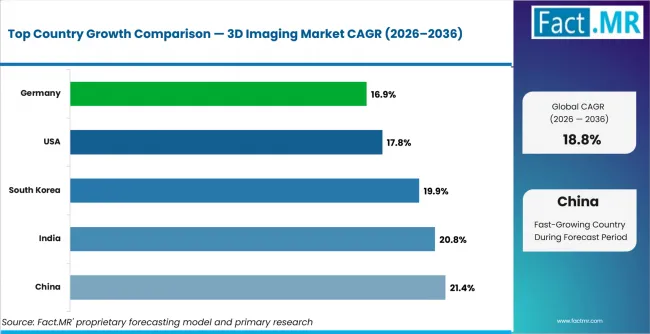
3d Imaging Market Cagr Analysis By Country | Source: Fact.MR
Asia Pacific 3D Imaging Market Analysis
Asia Pacific represents the leading growth opportunity for 3D imaging solution providers. Healthcare modernization and industrial automation investment are increasing technology deployment across the region. Advanced manufacturing programs are creating additional demand for imaging and inspection systems.
- China: China is projected to expand at 21.4% CAGR through 2036 supported by industrial automation investment and advanced manufacturing expansion. Semiconductor manufacturers are increasing deployment of imaging inspection systems. Healthcare modernization initiatives are strengthening adoption of advanced diagnostic technologies.
- India: India is expected to witness 20.8% CAGR driven by healthcare digitization and expansion of diagnostic infrastructure. Hospitals are increasing investment in advanced imaging equipment across public and private healthcare networks. Growing access to medical technology supports market development.
- South Korea: South Korea is forecast to grow at 19.9% CAGR due to strong demand from semiconductor and electronics manufacturing industries. Precision inspection requirements are increasing deployment of advanced imaging technologies. Industrial innovation continues supporting imaging investment.
North America 3D Imaging Market Analysis
North America remains a major revenue-generating region for imaging technology providers. High healthcare spending and strong adoption of advanced diagnostic systems support market expansion. Enterprise investment in industrial inspection solutions creates additional opportunities.
- United States: The United States is projected to expand at 17.8% CAGR by 2036 as healthcare organizations modernize imaging infrastructure and visualization platforms. Rising diagnostic imaging volumes support equipment upgrades. Workflow optimization initiatives are increasing adoption of advanced imaging solutions.
Europe 3D Imaging Market Analysis
Europe benefits from strong industrial automation adoption and advanced healthcare infrastructure. Demand is supported by precision manufacturing requirements and ongoing digital transformation initiatives. Technology investment remains concentrated in high-value industrial applications.
- Germany: Germany is anticipated to register 16.9% CAGR through 2036 supported by precision engineering and industrial inspection requirements. Manufacturing organizations are investing in advanced quality assurance technologies. Strong automation capabilities support continued imaging technology deployment.
Who leads the 3D imaging market landscape?
3d Imaging Market Analysis By Company | Source: Fact.MR
The competitive structure reflects a mix of medical imaging specialists and industrial imaging technology providers. Product differentiation is driven by software capability and imaging accuracy. Platform integration increasingly influences purchasing decisions. Organizations that combine hardware with analytics platforms hold stronger competitive positions across healthcare and industrial applications.
Companies with imaging software expertise hold stronger positioning because analytics capability creates higher value than hardware alone. Integrated platforms improve workflow efficiency and strengthen long-term customer retention. Established relationships with hospitals and manufacturing organizations provide an additional advantage. Broad product portfolios help suppliers address multiple imaging requirements through a unified platform.
Hospital systems and manufacturing organizations evaluate suppliers based on reliability and interoperability. Long deployment cycles create barriers for new entrants. Technology validation remains a critical purchasing criterion. Vendors that demonstrate compatibility with existing digital systems improve their chances of securing large contracts. Geographic presence supports service delivery and technical support. Organizations with global deployment capability improve access to multinational healthcare systems and industrial operators. Regional service networks improve implementation efficiency. Commercial success is increasingly linked to software ecosystem strength rather than hardware specifications. Rising imaging data volumes are increasing demand for analytics and workflow automation solutions.
Which companies are the key players?
- Alphatec Holdings, Inc.
- eCential Robotics
- FARO
- GE HealthCare
- Intrasense
Bibliography
- [1] Alphatec Holdings, Inc. (2024, October 1). ATEC launches EOS Insight™ an end-to-end spine surgery platform powered by EOS imaging and AI. Alphatec Holdings, Inc.
- [2] Siemens Healthineers. (2024, November 25). Siemens Healthineers receives FDA clearance for CIARTIC Move. Siemens Healthineers.
- [3] GE HealthCare. (2025, February 26). GE HealthCare launches CleaRecon DL introducing AI-based 3D reconstruction to the interventional suite. GE HealthCare.
- [4] ZEISS Industrial Quality Solutions. (2025). ZEISS introduces entry into automated 3D metrology. Metrology News.
- [5] GE HealthCare. (2024, November 27). GE HealthCare unveils Sonic DL for 3D expanding deep learning innovation in MRI. GE HealthCare.
This Report Addresses
- Analysis of 3D imaging demand across healthcare and industrial applications.
- Market forecast from USD 17.0 billion in 2026 to USD 94.9 billion by 2036 at 18.8% CAGR.
- Opportunity assessment across diagnostic imaging and industrial inspection activities.
- Segment forecasts covering component, deployment, organization size, end use, and technology type.
- Competitive assessment of imaging technology providers and software developers.
- Evaluation of AI imaging trends and cloud-based visualization platforms.
- Country-level analysis across China, India, South Korea, the United States, and Germany.
- Report delivery through PDF and Excel formats supported by primary interviews and industry analysis.
What does the 3D imaging market cover?
The 3D imaging market covers technologies that create digital three-dimensional representations of objects and environments. These systems capture depth information and generate detailed visual models for analysis. Applications span healthcare diagnostics, manufacturing inspection, construction planning, and entertainment production. Hospitals use 3D imaging for surgical planning and disease assessment. Industrial operators deploy these solutions for quality control and product design.
3D Imaging Market Inclusions
The study covers global and regional forecasts from 2026 to 2036 by component, deployment, organization size, end use, and technology type. It includes software platforms, imaging hardware, cloud deployment models, medical imaging systems, industrial inspection solutions, and visualization technologies used across healthcare and industrial environments.
3D Imaging Market Exclusions
The study excludes conventional 2D imaging systems that lack depth visualization capabilities. It omits consumer photography applications and basic image editing software. Standalone CAD software without 3D imaging functionality falls outside the defined scope. General display hardware not designed for imaging applications is not included.
3D Imaging Market Research Methodology
- Primary Research
- Interviews were conducted with imaging software providers, medical device manufacturers, healthcare administrators, industrial automation firms, and imaging technology specialists across major markets.
- Desk Research
- Analysis included company disclosures from GE HealthCare, FARO Technologies, Philips Healthcare, Siemens Healthineers, and official industry publications released during 2024 and 2025.
- Market-Sizing and Forecasting
- A hybrid model combines top-down healthcare and industrial spending analysis with bottom-up estimates derived from imaging equipment deployments and software adoption.
- Data Validation and Update Cycle
- Outputs were validated through company disclosures, technology deployment data, healthcare investment trends, and expert interviews.
Segmentation
What is the report’s scope and coverage?
| Attribute | Details |
|---|---|
| Quantitative Units | USD 17.0 billion (2026) to USD 94.9 billion (2036) at a CAGR of 18.8% |
| Market Definition | Technologies that create three-dimensional digital representations for healthcare, industrial, and visualization applications |
| Component Segmentation | Software, Hardware, Services |
| Deployment Segmentation | On-premise, Cloud |
| Organization Size Segmentation | Large Enterprises, Small and Medium-sized Enterprises (SMEs) |
| End Use Segmentation | Automotive and Transportation, Manufacturing, Healthcare and Life Sciences, Architecture and Construction, Media and Entertainment, Security & Surveillance, Others |
| Technology Type Segmentation | 3D Medical Imaging, 3D Machine Vision, 3D Scanning, 3D Modeling and Rendering, 3D Visualization Systems |
| Regions Covered | North America, Europe, Asia Pacific, Latin America, Middle East & Africa |
| Countries Covered | United States, Canada, Germany, United Kingdom, France, China, Japan, South Korea, India, Australia |
| Key Companies Profiled | Alphatec Holdings, eCential Robotics, FARO, GE HealthCare, Intrasense |
| Forecast Period | 2026 to 2036 |
| Approach | Hybrid top-down and bottom-up model using healthcare spending, industrial automation investment, and imaging technology adoption analysis |
Source: Fact.MR analysis. Updated Jun 4, 2026
How is the market segmented?
-
By Component:
- Software
- Hardware
- Services
-
By Deployment:
- On-premise
- Cloud
-
By Organization Size:
- Large Enterprises
- Small and Medium-sized Enterprises (SMEs)
-
By End Use:
- Automotive and Transportation
- Manufacturing
- Healthcare and Life Sciences
- Architecture and Construction
- Media and Entertainment
- Security & Surveillance
-
By Technology Type:
- 3D Medical Imaging
- 3D Machine Vision
- 3D Scanning
- 3D Modeling and Rendering
- 3D Visualization Systems
-
By Region:
- North America
- United States
- Canada
- Mexico
- Latin America
- Brazil
- Argentina
- Rest of Latin America
- Europe
- Germany
- United Kingdom
- France
- Italy
- Spain
- Rest of Europe
- Asia Pacific
- China
- Japan
- South Korea
- India
- ASEAN
- Australia and New Zealand
- Middle East & Africa
- Saudi Arabia
- UAE
- South Africa
- Rest of Middle East & Africa
- North America
Frequently Asked Questions
How large is the global 3D imaging market in 2025?
What will the 3D imaging market size be in 2026?
What is the projected 3D imaging market size by 2036?
What is the expected CAGR for the 3D imaging market from 2026 to 2036?
Which component is poised to lead 3D imaging demand?
Which country records the strongest expansion in the 3D imaging market?
Who worked on this report


Preview the report firsthand - request a free sample
Free SampleGet the brochure for pricing and purchase details
Download PDF