- Base Value(2025): 4.5 Bn
- Estimated Value(2026): 5.0 Bn
- Forecast Value (2036): 13.4 Bn
- CAGR (2026 - 2036): 10.4%
What is the 3D projector market forecast to be worth by 2036?
- In 2025, the 3D projector market was valued at USD 4.5 billion.
- Based on Fact.MR analysis, demand for 3D projectors is estimated to grow to USD 5.0 billion in 2026 and USD 13.4 billion by 2036.
- Fact.MR projects a CAGR of 10.4% during the forecast period.
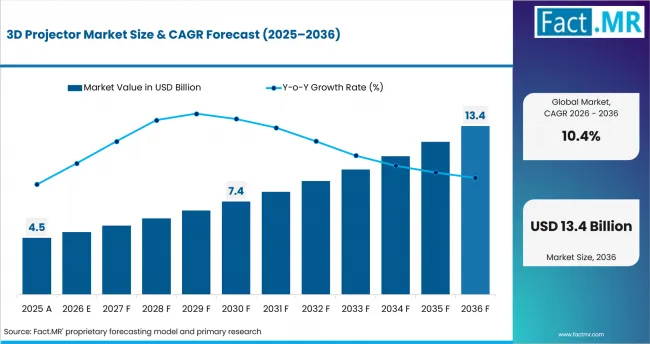
3d Projector Market Value Analysis | Source: Fact.MR
| Metric | Value |
|---|---|
| Estimated Value in 2026 | USD 5.0 billion |
| Forecast Value in 2036 | USD 13.4 billion |
| Forecast CAGR (2026 to 2036) | 10.4% |
Source: Fact.MR analysis. Updated Jun 8, 2026
Summary of the 3D Projector Market
- Demand Drivers
- Laser projection adoption is increasing across commercial installations. Longer operating life improves total ownership economics.
- Education institutions are expanding investment in digital learning infrastructure. Interactive visual learning supports projector demand.
- Enterprise organizations are upgrading presentation technology platforms. Higher image quality improves meeting and training environments.
- Key Segments Analyzed
- By Technology: DLP accounts for 45% share in 2026 due to strong image quality and commercial deployment advantages.
- By Brightness: 4,000–9,999 lumens register 38% share in 2026 supported by widespread use across classrooms and auditoriums.
- By Light Source: Laser capture 45% share in 2026 reflecting preference for lower maintenance requirements.
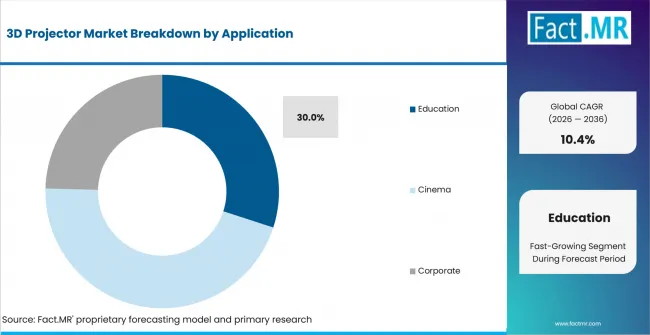
- By Application: Education hold 30% share in 2026 due to continued investment in classroom visualization systems.
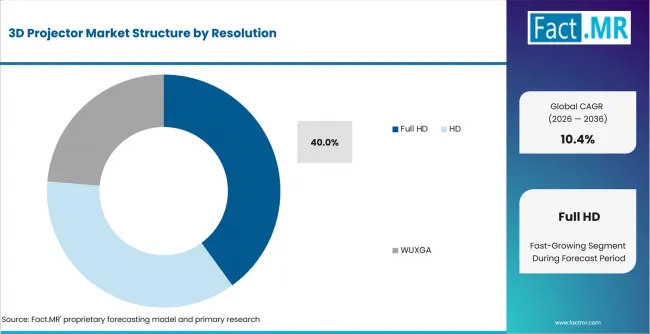
- By Resolution: Full HD accounts for 40% share in 2026 supported by affordability and broad commercial compatibility.
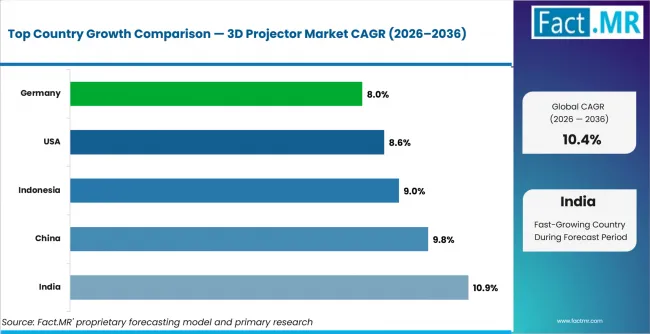
- By Geography: India is projected to record the highest CAGR at 10.9% through 2036 supported by digital education investment.
- Analyst Opinion at Fact.MR
- Shambhu Nath Jha, Principal Consultant at Fact.MR, opines, ‘Competitive advantage in the 3D projector market will increasingly depend on image quality improvements and operating efficiency. Suppliers with strong laser projection portfolios are expected to strengthen their position across education and commercial installations.’
- Strategic Implications
- Projector manufacturers should expand laser-based product portfolios for commercial applications. Longer equipment life improves adoption rates.
- Technology suppliers should strengthen integration capabilities across education platforms. Compatibility improves deployment opportunities.
- Display solution providers should expand distribution reach across high-growth Asian markets. Infrastructure investment creates additional demand.
The market is forecast to add approximately USD 8.4 billion in revenue between 2026 and 2036. Expansion reflects rising deployment of laser projection systems across education facilities, corporate environments, and entertainment venues. Demand is supported by replacement of lamp-based equipment with longer-life projection technologies. High installation costs constrain adoption across smaller institutions.
India is expected to record 10.9% CAGR supported by digital classroom investment and expanding education infrastructure. China is forecast to grow at 9.8% CAGR driven by commercial display modernization. Indonesia is projected to expand at 9.0% CAGR through 2036 as education technology spending increases. The United States is estimated to witness 8.6% CAGR due to enterprise display upgrades. Germany is likely to register 8.0% CAGR supported by corporate presentation technology demand. Japan is anticipated to grow at 7.8% CAGR driven by replacement demand from installed projection systems.
How does the 3D projector market break down by segment?
3D Projector Market Analysis by Technology
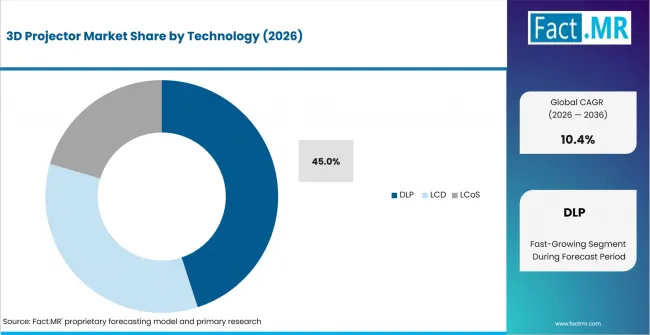
3d Projector Market Analysis By Technology | Source: Fact.MR
DLP is estimated to hold 45% share in 2026. DLP technology supports higher image quality and reliable performance across commercial projection environments. Strong deployment across education facilities and corporate installations strengthens segment demand. ViewSonic expanded its Luminous Superior Series with six new DLP laser projectors offering up to 8,500 ANSI lumens for large venues, museums, auditoriums, and professional installations. The launch strengthened ViewSonic's position in the professional projection market and expanded high-brightness projector offerings. [1]
- Image Quality: DLP technology delivers sharp visual output and strong color performance. Display quality supports adoption across presentation and learning environments.
- Commercial Preference: Education institutions and enterprise organizations prefer proven projection platforms. Reliability supports long-term deployment decisions.
- Technology Development: Manufacturers are improving DLP-based projection systems with enhanced brightness levels. Product development supports commercial demand expansion.
3D Projector Market Analysis by Brightness
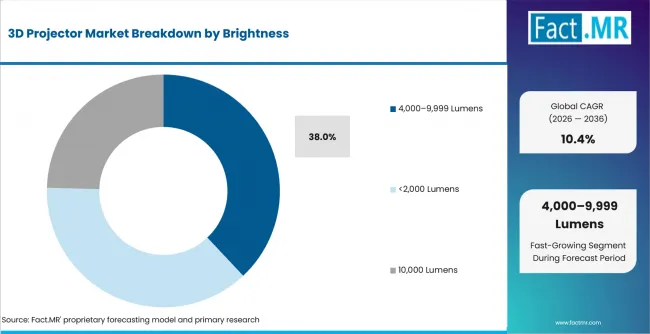
3d Projector Market Analysis By Brightness | Source: Fact.MR
4,000–9,999 lumens are estimated to accunt 38% share in 2026. The segment balances performance and cost across classrooms, conference facilities, and event venues. Broad deployment across mid-sized projection environments supports demand. Sony Group Corporation released SDK Version 2.5.0 for its Spatial Reality Display, adding enhanced OpenXR support, HDR compatibility, improved 3D rendering quality, and integration with Twinmotion, Autodesk VRED, Blender, and NVIDIA Omniverse. The update strengthens Sony's glasses-free 3D visualization ecosystem for engineering, design, healthcare, and immersive content applications. [2]
- Installation Flexibility: The brightness range supports multiple indoor projection applications. Commercial users benefit from wider deployment capability.
- Education Demand: Schools and universities require projection systems suitable for larger learning spaces. Brightness performance supports classroom visibility.
- Venue Adoption: Conference facilities and auditoriums increasingly utilize this brightness range. Demand reflects operational versatility.
3D Projector Market Analysis by Light Source
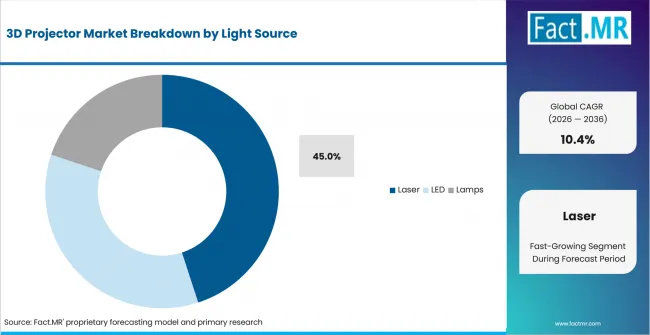
3d Projector Market Analysis By Light Source | Source: Fact.MR
Laser segment register 45% share in 2026. Laser projection systems provide longer operating life than conventional lamp technologies. Lower maintenance requirements strengthen commercial adoption.
- Lower Maintenance: Laser systems reduce replacement requirements over equipment life cycles. Operating efficiency supports purchasing decisions.
- Energy Efficiency: Commercial organizations seek technologies with lower operating costs. Energy performance improves value proposition.
- Product Innovation: Manufacturers are expanding laser projector portfolios across multiple application environments. Technology investment supports segment growth.
3D Projector Market Analysis by Application
3d Projector Market Analysis By Application | Source: Fact.MR
Education captures 30% share in 2026. Educational institutions are increasing investment in digital learning infrastructure. Visual learning technologies support classroom engagement and content delivery. ZEISS introduced the latest VELVET 4K digital projector featuring a contrast ratio of 5,000,000:1 for planetarium applications. The new generation delivers enhanced image quality, color reproduction, and projection performance for immersive 3D astronomical visualization. [4]
- Digital Learning: Schools are integrating visual presentation technologies into teaching environments. Technology adoption supports projector demand.
- Infrastructure Expansion: Education modernization programs include investment in classroom display equipment. Deployment activity supports market growth.
- Interactive Content: Educational content increasingly incorporates visual learning tools. Demand reflects changing teaching methods.
3D Projector Market Analysis by Resolution
3d Projector Market Analysis By Resolution | Source: Fact.MR
Based on Fact.MR's 3D projector market report, Full HD is estimated to hold 40% share in 2026. The resolution provides a balance between image quality and affordability. Broad compatibility supports deployment across commercial and educational applications. Christie Digital Systems introduced the Sapphire 4K40-RGBH, the world's first high-brightness hybrid RGB laser projector combining RGB pure laser and dual laser phosphor illumination technologies. The projector delivers native 4K resolution, 36,400 lumens, and support for all active and passive 3D formats, targeting immersive attractions, visualization powerwalls, live events. [5]
- Cost Balance: Full HD systems provide strong visual performance at accessible price points. Value positioning supports commercial adoption.
- Commercial Usage: Enterprise organizations continue deploying Full HD projectors across meeting and training facilities. Demand reflects practical performance requirements.
- Wide Compatibility: Content and device ecosystems support Full HD deployment. Compatibility strengthens purchasing confidence.
What is accelerating 3D projector adoption, and what is holding it back?
Fact.MR analysts observe that the market is transitioning from conventional lamp-based projection toward laser-enabled display systems. Early demand centered on cinema and corporate presentation applications. Demand is increasingly concentrated in education infrastructure and large venue installations. Market expansion reflects improving image quality and lower maintenance requirements.
Display technology investment is shifting toward systems that offer longer operating life and lower ownership costs. Education institutions and enterprise organizations are prioritizing equipment reliability and energy efficiency. Sony demonstrated its next-generation Spatial Reality Display integrated with Ameria's AI-powered Touchfree technology, enabling users to interact with and customize products in a glasses-free 3D environment using gestures, gaze, and proximity controls. The solution expands the use of immersive 3D visualization across retail, education, healthcare, architecture, and commercial display applications. [3]
- Laser Transition: Commercial facilities are replacing projector lamps with laser systems. Growth is supported by lower maintenance requirements and longer operating life.
- Education Investment: Schools and universities are expanding digital classroom infrastructure. Demand is driven by interactive learning requirements and technology modernization programs.
- Installation Cost Pressure: Adoption is constrained by higher upfront equipment costs. Budget limitations slow deployment across smaller organizations and institutions.
Which countries are scaling 3D projector demand fastest?
The 3D projector market is assessed across North America, Europe, Asia Pacific, Latin America, and the Middle East & Africa. The study evaluates projection system demand, display infrastructure investment, education technology adoption, and commercial display deployment across major economies.
| Country | CAGR (2026 to 2036) |
|---|---|
| India | 10.9% |
| China | 9.8% |
| Indonesia | 9.0% |
| United States | 8.6% |
| Germany | 8.0% |
Source: Fact.MR analysis. Updated Jun 8, 2026
Source: Fact.MR analysis, based on proprietary forecasting model and primary research.
3d Projector Market Cagr Analysis By Country | Source: Fact.MR
Asia Pacific 3D Projector Market Analysis
Asia Pacific represents leading growth opportunity for projector manufacturers. Education technology investment and display infrastructure expansion are strengthening demand across regional markets. Commercial modernization programs support adoption of advanced projection technologies.
- India: India is projected to expand at 10.9% CAGR through 2036 as digital classroom programs increase deployment of visual learning technologies. Education infrastructure investment supports projector demand across public and private institutions. Commercial facilities are upgrading presentation systems. Growth is attributable to expanding education technology adoption.
- China: China is forecast to grow at 9.8% CAGR through 2036 supported by commercial display modernization and entertainment venue investment. Organizations are increasing adoption of laser projection systems. Demand is concentrated in education and enterprise applications. Growth reflects strong domestic electronics manufacturing capability.
- Indonesia: Indonesia is expected to witness 9.0% CAGR driven by education infrastructure development and technology investment. Schools are increasing deployment of digital learning equipment. Commercial facilities are modernizing presentation environments. Growth is supported by rising technology expenditure.
- Japan: Japan is expected to advance at 7.8% CAGR through 2036 due to replacement demand from installed projector systems and commercial technology upgrades. Organizations prioritize high-quality display solutions. Demand reflects strong technology acceptance. Growth is supported by enterprise modernization initiatives.
North America 3D Projector Market Analysis
North America remains a major revenue-generating region for projector manufacturers. Enterprise technology upgrades and education modernization support market development. Premium display solutions account for a large share of regional demand.
- United States: The United States is projected to expand at 8.6% CAGR by 2036 as enterprise organizations upgrade presentation technology infrastructure. Education institutions replace aging projection systems. Demand reflects preference for advanced laser projection technologies. Market expansion is supported by replacement cycles and technology upgrades.
Europe 3D Projector Market Analysis
Europe benefits from established display infrastructure and strong enterprise technology spending. Commercial facilities continue investing in advanced visual communication systems. Education technology deployment supports regional demand.
- Germany: Germany is anticipated to register 8.0% CAGR through 2036 supported by corporate technology investment and industrial training requirements. Organizations are upgrading presentation and collaboration environments. Demand reflects strong enterprise adoption. Growth is attributable to commercial display modernization.
Who leads the 3D projector market landscape?
3d Projector Market Analysis By Company | Source: Fact.MR
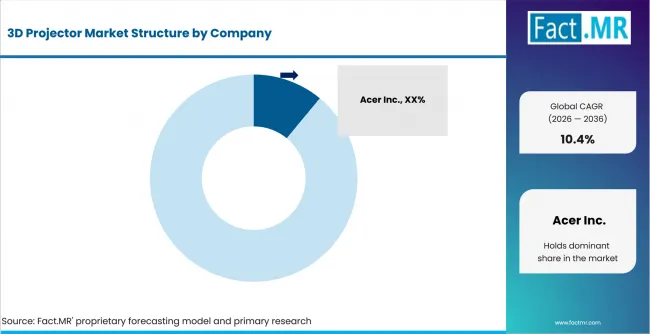
The competitive structure reflects a mix of global projection technology providers and display solution manufacturers. Image quality and operating efficiency influence purchasing decisions across commercial installations. Companies with strong laser projection portfolios hold stronger positions across education and enterprise applications. Product reliability supports long-term commercial relationships.
Technology leadership creates a competitive advantage across premium projection segments. Manufacturers investing in laser light sources and advanced image processing improve commercial positioning. Established distribution networks strengthen market access across major regions. Long equipment replacement cycles increase the importance of product performance.
Education institutions and enterprise organizations evaluate suppliers based on reliability and operating costs. Service capability influences supplier selection across large installations. Organizations increasingly prefer solutions that reduce maintenance requirements and improve energy efficiency. Product lifespan influences investment decisions.
Commercial success is increasingly linked to technology innovation and installation support. Companies with broad product portfolios improve coverage across multiple application environments. Demand is shifting toward advanced projection systems that provide lower ownership costs and improved visual performance.
Which companies are the key players?
- Acer Inc.
- Barco NV
- Delta Electronics, Inc.
- Panasonic Holdings Corporation
- Sony Group Corporation
Bibliography
- [1] ViewSonic Corp. (2024). ViewSonic launches high-brightness laser projector series with up to 8,500 ANSI lumens for large venues. ViewSonic.
- [2] Sony Corporation. (2025). Spatial Reality Display SDK version 2.5. Sony.
- [3] Sony Corporation. (2025). Sony showcases next-generation Spatial Reality Display combined with AI-powered touch-free technology for retail innovation. Sony.
- [4] Carl Zeiss AG. (2025). ZEISS introduces Velvet 4K projection technology. ZEISS.
- [5] Christie Digital Systems USA, Inc. (2025). Christie launches Sapphire 4K40-RGBH projection solution. Christie Digital.
This Report Addresses
- Analysis of projector demand across commercial, education, entertainment, and residential applications.
- Market forecast from USD 5.0 billion in 2026 to USD 13.4 billion by 2036 at 10.4% CAGR.
- Opportunity assessment across laser projection technologies and premium display solutions.
- Segment forecasts covering technology, brightness, light source, application, and resolution demand.
- Competitive assessment of projection technology manufacturers and display solution providers.
- Evaluation of display modernization trends and education technology investment activity.
- Country-level analysis across India, China, Indonesia, the United States, Germany, and Japan.
- Report delivery through PDF and Excel formats supported by primary interviews and industry analysis.
What does the 3D projector market cover?
The 3D projector market covers projection systems designed to display three-dimensional visual content across commercial and consumer environments. These systems utilize advanced imaging technologies such as DLP, LCD panel, and LCoS to deliver immersive viewing experiences. Applications include cinema projection, classroom learning, business presentations, gaming, and large venue entertainment.
3D Projector Market Inclusions
The study covers global and regional forecasts from 2026 to 2036 by technology, brightness, light source, application, and resolution. It includes commercial and consumer projection systems deployed across education, corporate, entertainment, and residential environments. The report evaluates adoption trends, technology transitions, and display infrastructure investment patterns.
3D Projector Market Exclusions
The study excludes flat-panel displays, video walls, digital signage screens, and television products. It omits projection accessories and standalone software platforms. Conventional two-dimensional projection systems are excluded unless directly associated with 3D projection applications and deployment environments.
3D Projector Market Research Methodology
- Primary Research
- Interviews were conducted with projector manufacturers, display technology suppliers, system integrators, education technology distributors, and enterprise audiovisual specialists.
- Desk Research
- Analysis included company disclosures, investor presentations, education technology reports, audiovisual industry publications, and display technology announcements released during 2024 and 2025.
- Market-Sizing and Forecasting
- Hybrid top-down and bottom-up model using projector shipment data, installed base assessments, enterprise technology spending, and education infrastructure investment analysis.
- Data Validation and Update Cycle
- Forecast was validated through manufacturer interviews, distributor feedback, installation data, and display technology deployment assessments.
Segmentation
What is the report’s scope and coverage?
| Attribute | Details |
|---|---|
| Quantitative Units | USD 5.0 billion (2026) to USD 13.4 billion (2036) at a CAGR of 10.4% |
| Market Definition | Projection systems designed to display three-dimensional visual content across commercial and consumer applications |
| Technology Segmentation | DLP, LCD, LCoS |
| Brightness Segmentation | <2,000 Lumens, 2,000–3,999 Lumens, 4,000–9,999 Lumens, >10,000 Lumens |
| Light Source Segmentation | Laser, LED, Lamps, Others |
| Application Segmentation | Cinema, Education, Corporate, Home Theater and Gaming, Events & Large Venues, Others |
| Resolution Segmentation | HD, Full HD, WUXGA, 4K UHD, Above 4K |
| Regions Covered | North America, Europe, Asia Pacific, Latin America, Middle East & Africa |
| Countries Covered | India, China, Indonesia, United States, Germany, Japan, Canada, United Kingdom |
| Key Companies Profiled | Acer Inc., Barco NV, Delta Electronics, Panasonic Holdings Corporation, Sony Group Corporation |
| Forecast Period | 2026 to 2036 |
| Approach | Hybrid top-down and bottom-up model using projector shipments, installed base analysis, and display infrastructure investment |
Source: Fact.MR analysis. Updated Jun 8, 2026
How is the market segmented?
-
By Technology
- DLP
- LCD
- LCoS
-
By Brightness
- <2,000 Lumens
- 2,000–3,999 Lumens
- 4,000–9,999 Lumens
- >10,000 Lumens
-
By Light Source
- Laser
- LED
- Lamps
- Others
-
By Application
- Cinema
- Education
- Corporate
- Home Theater and Gaming
- Events & Large Venues
-
By Resolution
- HD
- Full HD
- WUXGA
- 4K UHD
- Above 4K
-
By Region
- North America
- United States
- Canada
- Mexico
- Latin America
- Brazil
- Argentina
- Rest of Latin America
- Europe
- Germany
- United Kingdom
- France
- Italy
- Rest of Europe
- Asia Pacific
- China
- India
- Japan
- Indonesia
- ASEAN
- Middle East & Africa
- UAE
- Saudi Arabia
- South Africa
- Rest of Middle East & Africa
- North America
Frequently Asked Questions
How large is the global 3D projector market in 2025?
What will the 3D projector market size be in 2026?
What is the projected 3D projector market size by 2036?
What is the expected CAGR for the 3D projector market from 2026 to 2036?
Which technology segment is poised to lead market demand?
Which country records the fastest growth in the market?
Who worked on this report


Preview the report firsthand - request a free sample
Free SampleGet the brochure for pricing and purchase details
Download PDF