Voice Evacuation Systems Market Size, Share, Growth and Forecast (2026 - 2036)
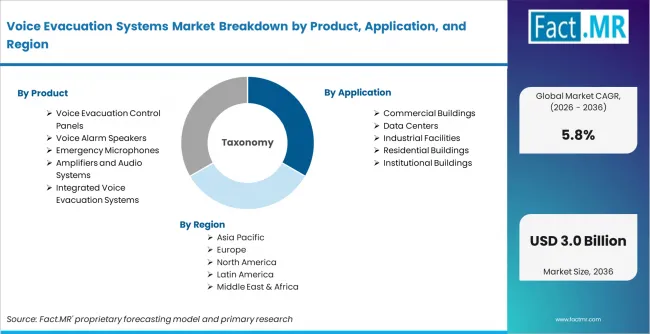
Voice Evacuation Systems Market is segmented by Product (Voice Evacuation Control Panels, Voice Alarm Speakers, Emergency Microphones, Amplifiers and Audio Systems, Integrated Voice Evacuation Systems), Application (Commercial Buildings, Data Centers, Industrial Facilities, Residential Buildings, Institutional Buildings), End Use (Commercial Sector, Information Technology Sector, Industrial Sector, Residential Sector, Institutional Sector), and Region, with forecasts covering the period from 2026 to 2036.
According to Fact.MR estimates, the global voice evacuation systems Market was valued at USD 1.6 billion in 2025. The market is projected to reach USD 1.7 billion in 2026 and is expected to grow to USD 3.0 billion by 2036, expanding at a CAGR of 5.8%. Voice Evacuation Control Panels is anticipated to account for 48.0% of the product segment in 2026, while Commercial Buildings is expected to remain the leading application with around 55.0% share.
Voice Evacuation Systems Market Analysis and Forecast by Fact.MR
- The global voice evacuation systems market covers integrated emergency communication platforms used for public address and emergency notification in commercial buildings, industrial facilities, transportation hubs, data centers, and institutional complexes.
- The category includes voice evacuation control panels, voice alarm speakers, emergency microphones, amplifiers and audio systems, and integrated voice evacuation systems.
- These platforms use panel core, audio distribution, network integration, and compliance monitoring technologies to deliver intelligible emergency instructions during fire, security, and evacuation events.
- Demand is shaped by building safety codes, fire protection regulations, commercial construction activity, data center expansion, and the growing adoption of networked emergency communication systems.

Summary of the Voice Evacuation Systems Market
- Market Snapshot
- In 2025, the global Voice Evacuation Systems Market was valued at approximately USD 1.6 billion.
- The market is estimated to reach USD 1.69 billion in 2026 and is projected to attain USD 2.97 billion by 2036.
- The voice evacuation systems market is likely to expand at a CAGR of 5.8% during the forecast period.
- The market is anticipated to create an absolute dollar opportunity of USD 1.28 billion between 2026 and 2036.
- Voice Evacuation Control Panels accounts for 48% of product share in 2026.
- USA (6.6%) and Mexico (6.2%) are the key growth markets during the forecast period.
- Demand and Growth Drivers
- Commercial building construction and retrofit activity is generating core demand for voice evacuation systems to meet fire safety code and emergency communication requirements.
- Data center expansion is driving adoption of integrated voice evacuation and notification systems for facility safety, zone-based alerts, and coordinated emergency response.
- Fire safety regulations requiring intelligible voice communication during evacuation events are mandating voice alarm systems in new commercial and public buildings.
- Industrial facility safety compliance is increasing procurement of voice evacuation systems for manufacturing plants, energy installations, and chemical processing environments.
- Transportation infrastructure including airports, metro stations, and railway terminals requires high-performance voice alarm systems for passenger safety and crowd management.
- Product and Segment View
- Voice Evacuation Control Panels account for 48% of the product segment in 2026, supported by broad applicability and established installed base across core end-use verticals.
- Commercial Buildings represents 55% of the application segment in 2026, with demand shaped by institutional procurement, regulatory requirements, and expanding professional adoption.
- Panel Core Technology accounts for 63% of the technology segment, reflecting its established position as the standard operational approach.
- Key segmentation includes:
- Product: Voice Evacuation Control Panels, Voice Alarm Speakers, Emergency Microphones, Amplifiers and Audio Systems, Integrated Voice Evacuation Systems
- Application: Commercial Buildings, Data Centers, Industrial Facilities, Residential Buildings, Institutional Buildings
- Distribution Channel: Direct Sales, Distributors, Retail Sales, Aftermarket Services
- These systems enable:
- Measurement, monitoring, or control functions across distributed operational environments.
- Remote management and data integration through connected platforms.
- Performance optimization in applications where precision and reliability are primary procurement criteria.
- Geography and Competitive Outlook
- North America shows stable demand supported by established end-use verticals, replacement cycles, and technology upgrade activity.
- Europe is experiencing steady growth from regulatory compliance, process modernization, and expanding professional adoption.
- North America is among the fastest-growing regions, with the USA (6.6%) and Mexico (6.2%) leading demand expansion.
- Key companies include Bosch Security Systems, Honeywell International Inc., Johnson Controls International plc, Eaton Corporation plc, Siemens AG, and TOA Corporation, Baldwin Boxall Communications Ltd., Kentec Electronics Ltd.
- Analyst Opinion
- Shambhu Nath Jha, Principal Consultant at Fact.MR, says 'The voice evacuation systems market is shaped by regulatory mandates, commercial construction cycles, and the shift toward networked emergency communication. Voice evacuation control panels lead because they are the central intelligence of every installation, with every speaker, microphone, and amplifier dependent on panel specification. Commercial buildings account for the largest application share because office towers, retail complexes, and mixed-use developments represent the highest density of voice evacuation installations. The U.S. and Mexico are the fastest-growing markets, driven by building code enforcement, commercial construction, and data center investment. The strategic shift is toward IP-networked systems that integrate voice evacuation with fire detection, building management, and mass notification platforms.'
Key Growth Drivers, Constraints, and Opportunities
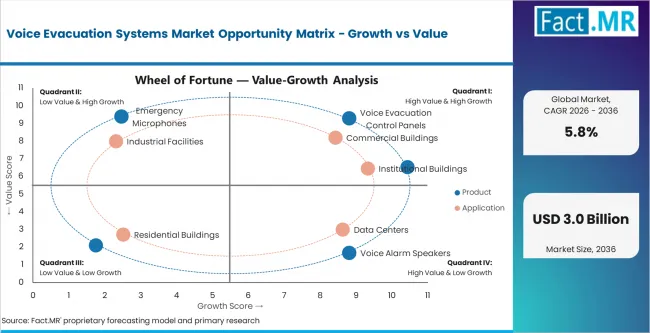
Key Factors Driving Growth
- The largest procurement volume for voice evacuation systems will be in the commercial building construction segment, with fire safety code compliance to protect occupants being the key driver.
- The demand for integrated voice alarm and notification systems based on zones, that are highly reliable and can be remotely monitored, is being driven by data center expansion.
- Mandatory adoption of voice evacuation systems in new and existing commercial, industrial and public buildings is being driven by fire safety regulation enforcement.
Key Market Constraints
- High installation cost and system complexity limit adoption in price-sensitive commercial and residential segments, especially in emerging markets with less stringent enforcement.
- Old buildings with limited wiring infrastructure present retrofit challenges that add to the project cost and installation timelines for voice evacuation upgrades.
- There are different regulatory standards in different regions and manufacturers selling systems in multiple regions face complex regulatory compliance issues .
Key Opportunity Areas
- Smart building projects are seeing strong demand for premium IP-networked voice evacuation systems that integrate with fire detection, building management and mass notification platforms.
- Data center safety requirements are creating a vertical market that is growing rapidly, with high specification standards and a recurring demand for upgrades.
- Cloud-enabled, remotely-managed voice evacuation platforms are enabling new service models with revenue from ongoing maintenance and ongoing compliance monitoring.
Segment-wise Analysis of the Voice Evacuation Systems Market
- Voice Evacuation Control Panels are expected to maintain 48% share of the product segment in 2026 due to their wide applicability, lesser complexity, and continued use across the largest end-use verticals.
- Commercial Buildings segment held the largest application share of 55% in 2026 as institutional demand, regulatory mandates, and professional adoption are the major demand channels.
- Panel Core Technology represents 63% of the technology segment, reflecting its established role in operations and large installed base.
The market is segmented on the basis of product, application, end use, technology, formulation, distribution channel and region. By product, the market includes Voice Evacuation Control Panels, Voice Alarm Speakers, Emergency Microphones, Amplifiers and Audio Systems, and Integrated Voice Evacuation Systems. Application Coverage Commercial Buildings Data Centers Industrial Facilities Residential Buildings Institutional Buildings Voice Evacuation Control Panels leads by value in the near term, with its installed base and broad applicability. Emerging segments are expected to drive the next phase of growth as requirements evolve.
Which Product Segment Dominates the Voice Evacuation Systems Market?
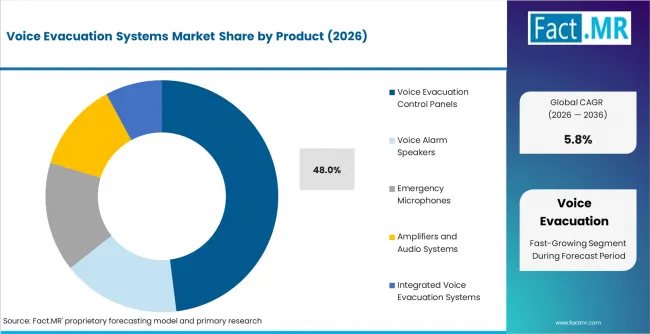
Voice evacuation control panels are anticipated to hold 48.0% of the product type segment in 2026. Their leadership is indicative of the key role that panels play in all voice evacuation installations, as the control unit that manages zone routing, message sequencing, amplifier supervision and emergency microphone priority. The specification of the panel determines the downstream selection of all other system components.Voice alarm speakers take the second largest share. This is because each installation requires multiple speaker zones, and high-intelligibility speakers are increasingly being specified for large, acoustically challenging spaces.
Which Application Segment Dominates the Voice Evacuation Systems Market?
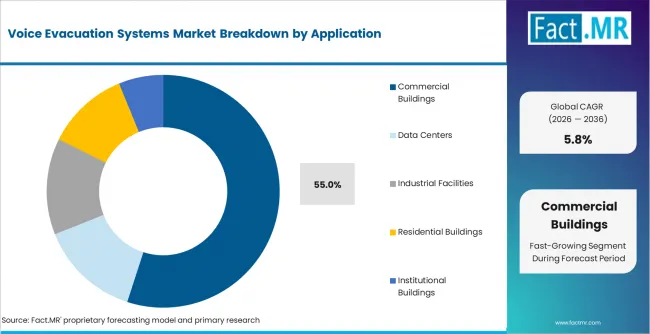
Commercial buildings are projected to dominate the application segment with a market share of 55.0% in 2026. This dominance reflects the sheer scale of fire safety compliance requirements across office towers, retail complexes, mixed use developments, hotels and conference centres where voice evacuation systems are mandated by building codes and insurance requirements.Data centers are the second fastest application. Demand is being driven by facility safety standards, multi-zone notification requirements and the integration of voice evacuation with other building management and security systems.
Which Product Trend is Shaping the Next Phase of Growth in the Voice Evacuation Systems Market?
IP-networked voice evacuation systems are the fastest-growing architecture in the market, even if they are not yet quite the biggest product category. Their share is expected to grow, as building owners and facility managers demand systems that integrate voice alarm with fire detection, mass notification and building management over unified network infrastructure.The transition to networked systems is part of a broader evolution in expectations of building safety. Operators want centralized monitoring, remote diagnostics and multi-site management capability, not standalone, site specific installations. Manufacturers with IP-based platforms that include cloud monitoring, automated compliance reporting and integration APIs are best positioned to capture an increasing share of new construction and major retrofit projects.
Regional Outlook Across Key Markets
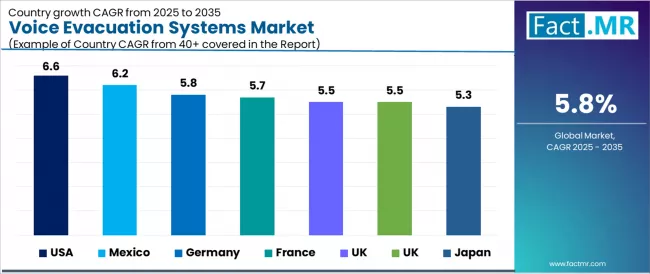
.webp)
- The USA was in the lead with 6.6% growth driven by increasing domestic demand, infrastructure investment and policy-driven adoption.
- North America shows strong growth supported by the USA at 6.6%, driven by infrastructure investment and replacement demand.
- European demand remains stable, with Germany at 5.8%, driven by regulatory compliance, process modernization and quality-driven procurement.
CAGR Table
| Country | CAGR (%) |
|---|---|
| USA | 6.6% |
| Mexico | 6.2% |
| Germany | 5.8% |
| France | 5.7% |
| UK | 5.5% |
| South Korea | 5.5% |
| Japan | 5.3% |
Source: Fact MR (FMR) analysis, based on proprietary forecasting model and primary research.
Market Outlook for Voice Evacuation Systems in the United States
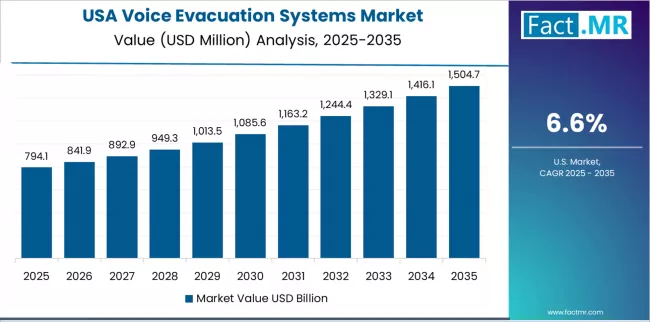
The U.S. voice evacuation systems market is projected to grow at a CAGR of 6.6% through 2036. Demand is shaped by commercial construction, data center expansion, fire code enforcement, and growing adoption of networked emergency communication systems.
- Commercial construction drives the largest installation volume.
- Data center expansion generates high-specification system demand.
- Fire code enforcement sustains mandatory adoption across building types.
Mexico Voice Evacuation Systems Demand Trends
The Mexico voice evacuation systems market is projected to grow at a CAGR of 6.2% through 2036. Demand is supported by commercial real estate development, tightening fire safety regulations, and growing investment in building safety infrastructure.
- Commercial development is driving new installation procurement.
- Fire safety regulation enforcement is increasing mandatory adoption.
- Building safety investment supports system upgrade activity.
Germany Voice Evacuation Systems Growth Assessment
The Germany voice evacuation systems market is projected to grow at a CAGR of 5.8% through 2036. Demand is supported by commercial building standards, industrial safety compliance, and strong adoption of EN 54-compliant voice alarm systems.
- Commercial building standards drive specification of compliant systems.
- Industrial safety compliance generates facility-level procurement.
- EN 54 adoption supports premium voice alarm system demand.
France Voice Evacuation Systems Market Demand Analysis
The France voice evacuation systems market is projected to grow at a CAGR of 5.7% through 2036. Demand is supported by commercial construction, public infrastructure safety, and regulatory requirements for emergency communication systems.
- Commercial construction generates core installation demand.
- Public infrastructure safety mandates voice alarm procurement.
- Regulatory requirements sustain compliance-driven system adoption.
United Kingdom Voice Evacuation Systems Market Outlook
The UK voice evacuation systems market is projected to grow at a CAGR of 5.5% through 2036. Demand is shaped by building regulation enforcement, commercial development, and growing adoption of networked voice alarm systems.
- Building regulation enforcement drives mandatory system installation.
- Commercial development sustains new project demand.
- Networked systems are gaining adoption in multi-site operations.
Japan Voice Evacuation Systems Growth Outlook
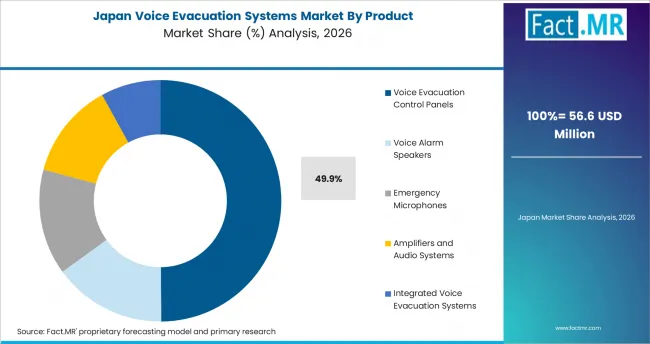
The Japan voice evacuation systems market is projected to grow at a CAGR of 5.3% through 2036. Demand is shaped by earthquake preparedness requirements, commercial building standards, and high-reliability system specification.
- Earthquake preparedness requirements support emergency communication demand.
- Commercial building standards sustain voice alarm procurement.
- High-reliability specification drives premium system adoption.
Competitive Benchmarking and Company Positioning
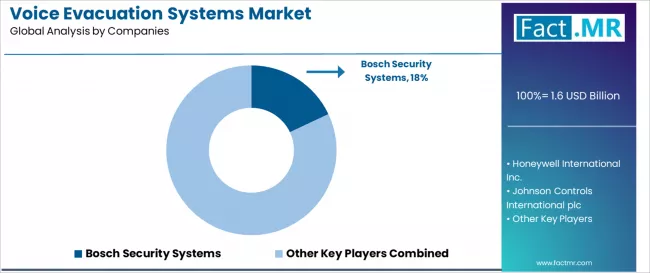
Voice Evacuation Systems Market Analysis By Company
- Bosch Security Systems, Honeywell, Johnson Controls, and Eaton hold strong positions in the global voice evacuation systems market through comprehensive product portfolios, fire safety certification coverage, and established specification relationships with building consultants and fire engineers.
- Siemens, TOA Corporation, Baldwin Boxall, and Kentec Electronics compete across specific system architectures, regional markets, and application verticals, with positioning shaped by audio quality, compliance certification, and system scalability.
- Competition is increasingly influenced by network integration capability and cloud monitoring features, with manufacturers offering IP-based platforms and remote diagnostics gaining specification advantage in data center and multi-site commercial projects.
The competitive landscape is moderately concentrated among global fire safety and building technology manufacturers. Bosch Security Systems and Honeywell compete through integrated fire and voice alarm portfolios, global certification, and established consultant relationships.
Johnson Controls, Eaton, and Siemens maintain strong positions through building management integration, broad product lines, and regional distribution strength.
TOA Corporation, Baldwin Boxall, Kentec Electronics, Potter Electric Signal, and Hacousto add competition through focused positioning in audio quality, compliance specialization, and niche applications.
Strategic priorities include expanding IP-networked system platforms, developing cloud-monitored voice evacuation solutions, strengthening data center safety product lines, and growing certification coverage across international fire safety standards.
Key Companies in the Voice Evacuation Systems Market
- Bosch Security Systems, Honeywell International Inc., Johnson Controls International plc, Eaton Corporation plc are among the leading players in the voice evacuation systems market globally, supported by strong brand visibility, broad product portfolios, and established positions across core end-use segments.
- Siemens AG, TOA Corporation, Baldwin Boxall Communications Ltd., Kentec Electronics Ltd. hold established positions across specific application verticals, geographic markets, and technology tiers, supported by product quality, distribution penetration, and category experience.
- Potter Electric Signal Company, LLC, Hacousto continue to compete through focused product offerings, price-point coverage, and niche strength in specific applications or regional markets.
Recent Industry Developments
- Bosch Security Systems – Technology Launch / Networked Voice Evacuation Platform (2025)
- Bosch continued to enhance its PRAESENSA IP-networked voice evacuation platform with software updates (e.g., V2.10 and later) adding improved call handling, remote monitoring, diagnostics, and integration with fire detection and building management systems. New hardware additions such as the End-of-Branch device were also introduced for expanded deployment flexibility.
- Honeywell International Inc. – Product Launch / Data Center Voice Alarm System (2025)
- Honeywell offers integrated voice evacuation and emergency communication solutions (as part of NOTIFIER and Connected Life Safety Services platforms) suitable for data centers, supporting zone-based notification, high-intelligibility messaging in noisy environments, and integration with facility management and fire detection systems. No dedicated new standalone data center voice alarm system was launched specifically in 2025.
- TOA Corporation – Product Line Expansion / EN 54 Compliant System (January 2026)
- TOA expanded its voice alarm portfolio with the new VM-4000 Series compact wall-mount voice alarm system. The system is EN 54 compliant and targets European commercial and institutional building safety applications, with launches and demonstrations highlighted around ISE 2026.
Leading Companies Shaping the Voice Evacuation Systems Market
- Bosch Security Systems
- Honeywell International Inc.
- Johnson Controls International plc
- Eaton Corporation plc
- Siemens AG
- TOA Corporation
- Baldwin Boxall Communications Ltd.
- Kentec Electronics Ltd.
- Potter Electric Signal Company, LLC
- Hacousto
Sources and Research References
- Bosch Security Systems. Networked voice evacuation platform and building safety updates.
- Honeywell International Inc. Data center voice alarm and emergency notification updates.
- TOA Corporation. EN 54 compliant voice alarm system product expansion.
- Fire safety regulation data, commercial construction statistics, data center investment reports, and building management system publications.
- Primary interviews with manufacturers, fire safety consultants, building owners, system integrators, and facility managers.
This bibliography is provided for reader reference and is not exhaustive. The full report contains the complete reference list and detailed citations.
Key Questions This Report Addresses
- What is the current and future size of the Voice Evacuation Systems Market?
- How fast is the Voice Evacuation Systems Market expected to grow between 2026 and 2036?
- Which product type is likely to lead the market by 2026?
- Which application segment is expected to account for the highest demand by 2026?
- What factors are driving demand for voice evacuation systems globally?
- How is the shift toward IP-networked systems influencing the market?
- Why are the U.S. and Mexico emerging as the fastest-growing markets?
- How are fire safety regulations and data center expansion supporting demand?
- Which countries are projected to show the fastest growth through 2036?
- Who are the key companies active in the Voice Evacuation Systems Market?
- How does Fact.MR estimate and validate the market forecast?
Voice Evacuation Systems Market Definition
The voice evacuation systems market covers integrated emergency communication platforms for commercial buildings, industrial facilities, data centers, transportation hubs, and institutional complexes across control panels, speakers, microphones, amplifiers, and integrated system configurations.
Voice Evacuation Systems Market Inclusions
- The scope covers global and regional market size and forecasts for 2026 to 2036 across product type, application, end use, technology, formulation, and distribution channel.
- It includes regional demand analysis based on commercial construction activity, fire safety regulation adoption, data center expansion, and building safety investment.
- The report covers technology trends, market drivers and constraints, and the competitive landscape, including product portfolios, certification coverage, and system integration capabilities.
- It includes pricing and cost analysis across standalone, networked, and integrated voice evacuation system categories.
Voice Evacuation Systems Market Exclusions
- The scope excludes standalone public address systems without emergency voice evacuation capability.
- It excludes fire detection panels, smoke detectors, and fire suppression systems sold independently without voice alarm integration.
- The report excludes residential smoke alarms, consumer intercom systems, and personal emergency communication devices.
- It also excludes mass notification systems designed exclusively for outdoor or campus-wide use without building-level voice evacuation functions.
Voice Evacuation Systems Market Research Methodology
- The methodology combines secondary research, primary interviews, and forecast modelling.
- It draws on 100+ secondary sources and benchmarks 50+ company product portfolios.
- Market sizing covers 30+ countries through a demand-side model, supported by top-down validation.
- Key inputs include application demand trends, regulatory activity, end-use adoption rates, pricing analysis, and distribution penetration.
- The model cross-checks demand with shipments, pricing trends, channel mix, and product launches.
- Primary validation includes 25+ interviews across manufacturers, distributors, end users, and industry participants.
- Final estimates go through trade-flow checks, sales-pattern review, and sensitivity testing.
Scope of Analysis

| Parameter | Details |
|---|---|
| Quantitative Units | USD 1.69 billion to USD 2.97 billion, at a CAGR of 5.8% |
| Market Definition | The voice evacuation systems market covers integrated emergency communication platforms for commercial buildings, industrial facilities, data centers, transportation hubs, and institutional complexes across control panels, speakers, microphones, amplifiers, and integrated system configurations. |
| Regions Covered | North America, Latin America, Europe, East Asia, South Asia and Pacific, Middle East and Africa |
| Countries Covered | USA, Mexico, Germany, France, UK, South Korea, Japan, 30 plus countries |
| Key Companies | Bosch Security Systems, Honeywell International Inc., Johnson Controls International plc, Eaton Corporation plc, Siemens AG, TOA Corporation, Baldwin Boxall Communications Ltd., Kentec Electronics Ltd., Potter Electric Signal Company, LLC, Hacousto |
| Forecast Period | 2026 to 2036 |
| Approach | Hybrid demand-side and top-down methodology built on country-level application demand, product benchmarking, pricing analysis, shipment validation, and primary interviews across manufacturers, distributors, and end users |
Voice Evacuation Systems Market Segmentation
-
Voice Evacuation Systems Market Segmented by Product:
- Voice Evacuation Control Panels
- Central Control Panels
- Analog Control Panels
- Digital Control Panels
- Distributed Control Panels
- Networked Control Panels
- Modular Control Panels
- Central Control Panels
- Voice Alarm Speakers
- Wall Mounted Speakers
- Indoor Wall Speakers
- Outdoor Wall Speakers
- Ceiling Mounted Speakers
- Flush Mount Ceiling Speakers
- Suspended Ceiling Speakers
- Wall Mounted Speakers
- Emergency Microphones
- Handheld Microphones
- Push To Talk Microphones
- Wireless Emergency Microphones
- Desktop Microphones
- Paging Console Microphones
- Control Room Microphones
- Handheld Microphones
- Amplifiers and Audio Systems
- Power Amplifiers
- Single Channel Amplifiers
- Multi Channel Amplifiers
- Audio Processing Units
- Signal Processing Systems
- Voice Clarity Enhancement Systems
- Power Amplifiers
- Integrated Voice Evacuation Systems
- Networked Evacuation Systems
- IP Based Evacuation Systems
- Centralized Monitoring Systems
- Standalone Evacuation Systems
- Compact Evacuation Units
- All In One Systems
- Networked Evacuation Systems
- Voice Evacuation Control Panels
-
Voice Evacuation Systems Market Segmented by Application:
- Commercial Buildings
- Office Spaces
- Corporate Offices
- Co Working Spaces
- Retail Spaces
- Shopping Malls
- Showrooms
- Office Spaces
- Data Centers
- Server Rooms
- Raised Floor Systems
- Cooling Airflow Floors
- Network Facilities
- Telecom Rooms
- IT Infrastructure Spaces
- Server Rooms
- Industrial Facilities
- Manufacturing Plants
- Assembly Areas
- Production Floors
- Warehousing Facilities
- Storage Areas
- Logistics Centers
- Manufacturing Plants
- Residential Buildings
- Apartments
- Living Area Flooring
- Bedroom Flooring
- Individual Houses
- Interior Flooring
- Basement Flooring
- Apartments
- Institutional Buildings
- Healthcare Facilities
- Hospital Flooring
- Clinic Flooring
- Educational Institutions
- School Buildings
- University Campuses
- Healthcare Facilities
- Commercial Buildings
-
Voice Evacuation Systems Market Segmented by End Use:
- Commercial Sector
- Corporate Offices
- Enterprise Offices
- Business Parks
- Retail Operators
- Mall Operators
- Showroom Owners
- Corporate Offices
- Information Technology Sector
- Data Center Operators
- Cloud Service Providers
- Colocation Providers
- Telecom Companies
- Network Operators
- Infrastructure Providers
- Data Center Operators
- Industrial Sector
- Manufacturing Companies
- Automotive Plants
- Electronics Manufacturing
- Logistics Companies
- Warehouse Operators
- Distribution Firms
- Manufacturing Companies
- Residential Sector
- Real Estate Developers
- Apartment Developers
- Housing Projects
- Homeowners
- Renovation Projects
- New Construction
- Real Estate Developers
- Institutional Sector
- Healthcare Providers
- Hospitals
- Clinics
- Educational Institutions
- Schools
- Universities
- Healthcare Providers
- Commercial Sector
-
Voice Evacuation Systems Market Segmented by Technology:
- Panel Core Technology
- Cement Core Technology
- Steel Cement Core Systems
- High Density Cement Core
- Calcium Sulphate Core
- Reinforced Sulphate Core
- High Strength Core Systems
- Cement Core Technology
- Surface Technology
- Laminate Surfaces
- High Pressure Laminate
- Decorative Laminate Surfaces
- Vinyl and Carpet Surfaces
- PVC Surface Panels
- Carpet Finished Panels
- Laminate Surfaces
- Structural Technology
- Reinforced Panel Structures
- Steel Reinforcement Systems
- Fiber Reinforcement Systems
- Lightweight Structures
- Honeycomb Structures
- Composite Lightweight Panels
- Reinforced Panel Structures
- Functional Technology
- Anti Static Technology
- Conductive Surface Systems
- Static Dissipative Systems
- Acoustic Technology
- Sound Absorption Panels
- Noise Control Systems
- Anti Static Technology
- Panel Core Technology
-
Voice Evacuation Systems Market Segmented by Formulation:
- Panel Systems
- Raised Floor Systems
- Steel Panel Systems
- Calcium Sulphate Systems
- Solid Floor Systems
- Concrete Panel Systems
- Wood Panel Systems
- Raised Floor Systems
- Material Systems
- Metal Based Systems
- Steel Panel Structures
- Aluminum Support Systems
- Non Metal Systems
- Wood Based Panels
- Composite Panel Systems
- Metal Based Systems
- Surface Systems
- Protective Coatings
- Anti Scratch Coatings
- Moisture Resistant Coatings
- Decorative Finishes
- Laminate Finishes
- Vinyl Finishes
- Protective Coatings
- Service Systems
- Installation Services
- On Site Installation
- System Integration
- Maintenance Services
- Repair Services
- Replacement Services
- Installation Services
- Panel Systems
-
Voice Evacuation Systems Market Segmented by Distribution Channel:
- Direct Sales
- Project Sales
- Commercial Projects
- Industrial Projects
- Developer Contracts
- Real Estate Developers
- Infrastructure Developers
- Project Sales
- Distributors
- Building Material Distributors
- Regional Supply Networks
- Wholesale Dealers
- Authorized Dealers
- Brand Dealers
- Specialized Flooring Suppliers
- Building Material Distributors
- Retail Sales
- Home Improvement Stores
- DIY Retail Chains
- Local Hardware Stores
- Online Sales
- E Commerce Platforms
- Brand Websites
- Home Improvement Stores
- Aftermarket Services
- Maintenance Services
- Repair Service Providers
- Replacement Services
- Upgrade Services
- Renovation Services
- Refurbishment Providers
- Maintenance Services
- Direct Sales
-
Voice Evacuation Systems Market by Region:
- North America
- USA
- Canada
- Mexico
- Latin America
- Brazil
- Chile
- Rest of Latin America
- Western Europe
- Germany
- UK
- Italy
- Spain
- France
- Nordic
- BENELUX
- Rest of Western Europe
- Eastern Europe
- Russia
- Poland
- Hungary
- Balkan & Baltic
- Rest of Eastern Europe
- East Asia
- China
- Japan
- South Korea
- South Asia and Pacific
- India
- ASEAN
- Australia & New Zealand
- Rest of South Asia and Pacific
- Middle East & Africa
- Kingdom of Saudi Arabia
- Other GCC Countries
- Turkiye
- South Africa
- Other African Union
- Rest of Middle East & Africa
- North America
- Frequently Asked Questions -
How big is the voice evacuation systems market in 2025?
The global voice evacuation systems market is estimated to be valued at USD 1.6 billion in 2025.
What will be the size of the voice evacuation systems market in 2036?
The market size is projected to reach USD 2.97 billion by 2036.
How much will the Voice Evacuation Systems Market grow between 2026 and 2036?
The voice evacuation systems market is expected to grow at a 5.8% CAGR between 2026 and 2036.
What are the key product types in the Voice Evacuation Systems Market?
The key product types are voice evacuation control panels, voice alarm speakers, emergency microphones, amplifiers, and integrated voice evacuation systems.
Which application segment will contribute significant share in the Voice Evacuation Systems Market in 2026?
Commercial buildings are expected to account for 55.0% share in the voice evacuation systems market in 2026.
Table of Content
- Executive Summary
- Global Market Outlook
- Demand to side Trends
- Supply to side Trends
- Technology Roadmap Analysis
- Analysis and Recommendations
- Market Overview
- Market Coverage / Taxonomy
- Market Definition / Scope / Limitations
- Research Methodology
- Chapter Orientation
- Analytical Lens and Working Hypotheses
- Market Structure, Signals, and Trend Drivers
- Benchmarking and Cross-market Comparability
- Market Sizing, Forecasting, and Opportunity Mapping
- Research Design and Evidence Framework
- Desk Research Programme (Secondary Evidence)
- Company Annual and Sustainability Reports
- Peer-reviewed Journals and Academic Literature
- Corporate Websites, Product Literature, and Technical Notes
- Earnings Decks and Investor Briefings
- Statutory Filings and Regulatory Disclosures
- Technical White Papers and Standards Notes
- Trade Journals, Industry Magazines, and Analyst Briefs
- Conference Proceedings, Webinars, and Seminar Materials
- Government Statistics Portals and Public Data Releases
- Press Releases and Reputable Media Coverage
- Specialist Newsletters and Curated Briefings
- Sector Databases and Reference Repositories
- Fact.MR Internal Proprietary Databases and Historical Market Datasets
- Subscription Datasets and Paid Sources
- Social Channels, Communities, and Digital Listening Inputs
- Additional Desk Sources
- Expert Input and Fieldwork (Primary Evidence)
- Primary Modes
- Qualitative Interviews and Expert Elicitation
- Quantitative Surveys and Structured Data Capture
- Blended Approach
- Why Primary Evidence is Used
- Field Techniques
- Interviews
- Surveys
- Focus Groups
- Observational and In-context Research
- Social and Community Interactions
- Stakeholder Universe Engaged
- C-suite Leaders
- Board Members
- Presidents and Vice Presidents
- R&D and Innovation Heads
- Technical Specialists
- Domain Subject-matter Experts
- Scientists
- Physicians and Other Healthcare Professionals
- Governance, Ethics, and Data Stewardship
- Research Ethics
- Data Integrity and Handling
- Primary Modes
- Tooling, Models, and Reference Databases
- Desk Research Programme (Secondary Evidence)
- Data Engineering and Model Build
- Data Acquisition and Ingestion
- Cleaning, Normalisation, and Verification
- Synthesis, Triangulation, and Analysis
- Quality Assurance and Audit Trail
- Market Background
- Market Dynamics
- Drivers
- Restraints
- Opportunity
- Trends
- Scenario Forecast
- Demand in Optimistic Scenario
- Demand in Likely Scenario
- Demand in Conservative Scenario
- Opportunity Map Analysis
- Product Life Cycle Analysis
- Supply Chain Analysis
- Investment Feasibility Matrix
- Value Chain Analysis
- PESTLE and Porter’s Analysis
- Regulatory Landscape
- Regional Parent Market Outlook
- Production and Consumption Statistics
- Import and Export Statistics
- Market Dynamics
- Global Market Analysis 2021 to 2025 and Forecast, 2026 to 2036
- Historical Market Size Value (USD Million) Analysis, 2021 to 2025
- Current and Future Market Size Value (USD Million) Projections, 2026 to 2036
- Y to o to Y Growth Trend Analysis
- Absolute $ Opportunity Analysis
- Global Market Pricing Analysis 2021 to 2025 and Forecast 2026 to 2036
- Global Market Analysis 2021 to 2025 and Forecast 2026 to 2036, By Product
- Introduction / Key Findings
- Historical Market Size Value (USD Million) Analysis By Product, 2021 to 2025
- Current and Future Market Size Value (USD Million) Analysis and Forecast By Product, 2026 to 2036
- Voice Evacuation Control Panels
- Central Control Panels
- Analog Control Panels
- Digital Control Panels
- Distributed Control Panels
- Networked Control Panels
- Modular Control Panels
- Voice Alarm Speakers
- Wall Mounted Speakers
- Indoor Wall Speakers
- Outdoor Wall Speakers
- Ceiling Mounted Speakers
- Flush Mount Ceiling Speakers
- Emergency Microphones
- Handheld Microphones
- Push To Talk Microphones
- Wireless Emergency Microphones
- Desktop Microphones
- Paging Console Microphones
- Amplifiers and Audio Systems
- Power Amplifiers
- Single Channel Amplifiers
- Multi Channel Amplifiers
- Audio Processing Value (USD Million)s
- Signal Processing Systems
- Integrated Voice Evacuation Systems
- Networked Evacuation Systems
- IP Based Evacuation Systems
- Centralized Monitoring Systems
- Standalone Evacuation Systems
- Compact Evacuation Value (USD Million)s
- Voice Evacuation Control Panels
- Y to o to Y Growth Trend Analysis By Product, 2021 to 2025
- Absolute $ Opportunity Analysis By Product, 2026 to 2036
- Global Market Analysis 2021 to 2025 and Forecast 2026 to 2036, By Application
- Introduction / Key Findings
- Historical Market Size Value (USD Million) Analysis By Application, 2021 to 2025
- Current and Future Market Size Value (USD Million) Analysis and Forecast By Application, 2026 to 2036
- Commercial Buildings
- Office Spaces
- Corporate Offices
- Co Working Spaces
- Retail Spaces
- Shopping Malls
- Showrooms
- Data Centers
- Server Rooms
- Raised Floor Systems
- Cooling Airflow Floors
- Network Facilities
- Telecom Rooms
- Industrial Facilities
- Manufacturing Plants
- Assembly Areas
- Production Floors
- Warehousing Facilities
- Storage Areas
- Residential Buildings
- Apartments
- Living Area Flooring
- Bedroom Flooring
- Individual Houses
- Interior Flooring
- Institutional Buildings
- Healthcare Facilities
- Hospital Flooring
- Clinic Flooring
- Educational Institutions
- School Buildings
- Commercial Buildings
- Y to o to Y Growth Trend Analysis By Application, 2021 to 2025
- Absolute $ Opportunity Analysis By Application, 2026 to 2036
- Global Market Analysis 2021 to 2025 and Forecast 2026 to 2036, By End Use
- Introduction / Key Findings
- Historical Market Size Value (USD Million) Analysis By End Use, 2021 to 2025
- Current and Future Market Size Value (USD Million) Analysis and Forecast By End Use, 2026 to 2036
- Commercial Sector
- Corporate Offices
- Enterprise Offices
- Business Parks
- Retail Operators
- Mall Operators
- Showroom Owners
- Information Technology Sector
- Data Center Operators
- Cloud Service Providers
- Colocation Providers
- Telecom Companies
- Network Operators
- Industrial Sector
- Manufacturing Companies
- Automotive Plants
- Electronics Manufacturing
- Logistics Companies
- Warehouse Operators
- Residential Sector
- Real Estate Developers
- Apartment Developers
- Housing Projects
- Homeowners
- Renovation Projects
- Institutional Sector
- Healthcare Providers
- Hospitals
- Clinics
- Educational Institutions
- Schools
- Commercial Sector
- Y to o to Y Growth Trend Analysis By End Use, 2021 to 2025
- Absolute $ Opportunity Analysis By End Use, 2026 to 2036
- Global Market Analysis 2021 to 2025 and Forecast 2026 to 2036, By Technology
- Introduction / Key Findings
- Historical Market Size Value (USD Million) Analysis By Technology, 2021 to 2025
- Current and Future Market Size Value (USD Million) Analysis and Forecast By Technology, 2026 to 2036
- Panel Core Technology
- Cement Core Technology
- Steel Cement Core Systems
- High Density Cement Core
- Calcium Sulphate Core
- Reinforced Sulphate Core
- High Strength Core Systems
- Surface Technology
- Laminate Surfaces
- High Pressure Laminate
- Decorative Laminate Surfaces
- Vinyl and Carpet Surfaces
- PVC Surface Panels
- Structural Technology
- Reinforced Panel Structures
- Steel Reinforcement Systems
- Fiber Reinforcement Systems
- Lightweight Structures
- Honeycomb Structures
- Functional Technology
- Anti Static Technology
- Conductive Surface Systems
- Static Dissipative Systems
- Acoustic Technology
- Sound Absorption Panels
- Panel Core Technology
- Y to o to Y Growth Trend Analysis By Technology, 2021 to 2025
- Absolute $ Opportunity Analysis By Technology, 2026 to 2036
- Global Market Analysis 2021 to 2025 and Forecast 2026 to 2036, By Formulation
- Introduction / Key Findings
- Historical Market Size Value (USD Million) Analysis By Formulation, 2021 to 2025
- Current and Future Market Size Value (USD Million) Analysis and Forecast By Formulation, 2026 to 2036
- Panel Systems
- Raised Floor Systems
- Steel Panel Systems
- Calcium Sulphate Systems
- Solid Floor Systems
- Concrete Panel Systems
- Wood Panel Systems
- Material Systems
- Metal Based Systems
- Steel Panel Structures
- Aluminum Support Systems
- Non Metal Systems
- Wood Based Panels
- Surface Systems
- Protective Coatings
- Anti Scratch Coatings
- Moisture Resistant Coatings
- Decorative Finishes
- Laminate Finishes
- Service Systems
- Installation Services
- On Site Installation
- System Integration
- Maintenance Services
- Repair Services
- Panel Systems
- Y to o to Y Growth Trend Analysis By Formulation, 2021 to 2025
- Absolute $ Opportunity Analysis By Formulation, 2026 to 2036
- Global Market Analysis 2021 to 2025 and Forecast 2026 to 2036, By Distribution Channel
- Introduction / Key Findings
- Historical Market Size Value (USD Million) Analysis By Distribution Channel, 2021 to 2025
- Current and Future Market Size Value (USD Million) Analysis and Forecast By Distribution Channel, 2026 to 2036
- Direct Sales
- Project Sales
- Commercial Projects
- Industrial Projects
- Developer Contracts
- Real Estate Developers
- Infrastructure Developers
- Distributors
- Building Material Distributors
- Regional Supply Networks
- Wholesale Dealers
- Authorized Dealers
- Brand Dealers
- Retail Sales
- Home Improvement Stores
- DIY Retail Chains
- Local Hardware Stores
- Online Sales
- E Commerce Platforms
- Aftermarket Services
- Maintenance Services
- Repair Service Providers
- Replacement Services
- Upgrade Services
- Renovation Services
- Direct Sales
- Y to o to Y Growth Trend Analysis By Distribution Channel, 2021 to 2025
- Absolute $ Opportunity Analysis By Distribution Channel, 2026 to 2036
- Global Market Analysis 2021 to 2025 and Forecast 2026 to 2036, By Region
- Introduction
- Historical Market Size Value (USD Million) Analysis By Region, 2021 to 2025
- Current Market Size Value (USD Million) Analysis and Forecast By Region, 2026 to 2036
- North America
- Latin America
- Western Europe
- Eastern Europe
- East Asia
- South Asia and Pacific
- Middle East & Africa
- Market Attractiveness Analysis By Region
- North America Market Analysis 2021 to 2025 and Forecast 2026 to 2036, By Country
- Historical Market Size Value (USD Million) Trend Analysis By Market Taxonomy, 2021 to 2025
- Market Size Value (USD Million) Forecast By Market Taxonomy, 2026 to 2036
- By Country
- USA
- Canada
- Mexico
- By Product
- By Application
- By End Use
- By Technology
- By Formulation
- By Distribution Channel
- By Country
- Market Attractiveness Analysis
- By Country
- By Product
- By Application
- By End Use
- By Technology
- By Formulation
- By Distribution Channel
- Key Takeaways
- Latin America Market Analysis 2021 to 2025 and Forecast 2026 to 2036, By Country
- Historical Market Size Value (USD Million) Trend Analysis By Market Taxonomy, 2021 to 2025
- Market Size Value (USD Million) Forecast By Market Taxonomy, 2026 to 2036
- By Country
- Brazil
- Chile
- Rest of Latin America
- By Product
- By Application
- By End Use
- By Technology
- By Formulation
- By Distribution Channel
- By Country
- Market Attractiveness Analysis
- By Country
- By Product
- By Application
- By End Use
- By Technology
- By Formulation
- By Distribution Channel
- Key Takeaways
- Western Europe Market Analysis 2021 to 2025 and Forecast 2026 to 2036, By Country
- Historical Market Size Value (USD Million) Trend Analysis By Market Taxonomy, 2021 to 2025
- Market Size Value (USD Million) Forecast By Market Taxonomy, 2026 to 2036
- By Country
- Germany
- UK
- Italy
- Spain
- France
- Nordic
- BENELUX
- Rest of Western Europe
- By Product
- By Application
- By End Use
- By Technology
- By Formulation
- By Distribution Channel
- By Country
- Market Attractiveness Analysis
- By Country
- By Product
- By Application
- By End Use
- By Technology
- By Formulation
- By Distribution Channel
- Key Takeaways
- Eastern Europe Market Analysis 2021 to 2025 and Forecast 2026 to 2036, By Country
- Historical Market Size Value (USD Million) Trend Analysis By Market Taxonomy, 2021 to 2025
- Market Size Value (USD Million) Forecast By Market Taxonomy, 2026 to 2036
- By Country
- Russia
- Poland
- Hungary
- Balkan & Baltic
- Rest of Eastern Europe
- By Product
- By Application
- By End Use
- By Technology
- By Formulation
- By Distribution Channel
- By Country
- Market Attractiveness Analysis
- By Country
- By Product
- By Application
- By End Use
- By Technology
- By Formulation
- By Distribution Channel
- Key Takeaways
- East Asia Market Analysis 2021 to 2025 and Forecast 2026 to 2036, By Country
- Historical Market Size Value (USD Million) Trend Analysis By Market Taxonomy, 2021 to 2025
- Market Size Value (USD Million) Forecast By Market Taxonomy, 2026 to 2036
- By Country
- China
- Japan
- South Korea
- By Product
- By Application
- By End Use
- By Technology
- By Formulation
- By Distribution Channel
- By Country
- Market Attractiveness Analysis
- By Country
- By Product
- By Application
- By End Use
- By Technology
- By Formulation
- By Distribution Channel
- Key Takeaways
- South Asia and Pacific Market Analysis 2021 to 2025 and Forecast 2026 to 2036, By Country
- Historical Market Size Value (USD Million) Trend Analysis By Market Taxonomy, 2021 to 2025
- Market Size Value (USD Million) Forecast By Market Taxonomy, 2026 to 2036
- By Country
- India
- ASEAN
- Australia & New Zealand
- Rest of South Asia and Pacific
- By Product
- By Application
- By End Use
- By Technology
- By Formulation
- By Distribution Channel
- By Country
- Market Attractiveness Analysis
- By Country
- By Product
- By Application
- By End Use
- By Technology
- By Formulation
- By Distribution Channel
- Key Takeaways
- Middle East & Africa Market Analysis 2021 to 2025 and Forecast 2026 to 2036, By Country
- Historical Market Size Value (USD Million) Trend Analysis By Market Taxonomy, 2021 to 2025
- Market Size Value (USD Million) Forecast By Market Taxonomy, 2026 to 2036
- By Country
- Kingdom of Saudi Arabia
- Other GCC Countries
- Turkiye
- South Africa
- Other African Union
- Rest of Middle East & Africa
- By Product
- By Application
- By End Use
- By Technology
- By Formulation
- By Distribution Channel
- By Country
- Market Attractiveness Analysis
- By Country
- By Product
- By Application
- By End Use
- By Technology
- By Formulation
- By Distribution Channel
- Key Takeaways
- Key Countries Market Analysis
- USA
- Pricing Analysis
- Market Share Analysis, 2025
- By Product
- By Application
- By End Use
- By Technology
- By Formulation
- By Distribution Channel
- Canada
- Pricing Analysis
- Market Share Analysis, 2025
- By Product
- By Application
- By End Use
- By Technology
- By Formulation
- By Distribution Channel
- Mexico
- Pricing Analysis
- Market Share Analysis, 2025
- By Product
- By Application
- By End Use
- By Technology
- By Formulation
- By Distribution Channel
- Brazil
- Pricing Analysis
- Market Share Analysis, 2025
- By Product
- By Application
- By End Use
- By Technology
- By Formulation
- By Distribution Channel
- Chile
- Pricing Analysis
- Market Share Analysis, 2025
- By Product
- By Application
- By End Use
- By Technology
- By Formulation
- By Distribution Channel
- Germany
- Pricing Analysis
- Market Share Analysis, 2025
- By Product
- By Application
- By End Use
- By Technology
- By Formulation
- By Distribution Channel
- UK
- Pricing Analysis
- Market Share Analysis, 2025
- By Product
- By Application
- By End Use
- By Technology
- By Formulation
- By Distribution Channel
- Italy
- Pricing Analysis
- Market Share Analysis, 2025
- By Product
- By Application
- By End Use
- By Technology
- By Formulation
- By Distribution Channel
- Spain
- Pricing Analysis
- Market Share Analysis, 2025
- By Product
- By Application
- By End Use
- By Technology
- By Formulation
- By Distribution Channel
- France
- Pricing Analysis
- Market Share Analysis, 2025
- By Product
- By Application
- By End Use
- By Technology
- By Formulation
- By Distribution Channel
- India
- Pricing Analysis
- Market Share Analysis, 2025
- By Product
- By Application
- By End Use
- By Technology
- By Formulation
- By Distribution Channel
- ASEAN
- Pricing Analysis
- Market Share Analysis, 2025
- By Product
- By Application
- By End Use
- By Technology
- By Formulation
- By Distribution Channel
- Australia & New Zealand
- Pricing Analysis
- Market Share Analysis, 2025
- By Product
- By Application
- By End Use
- By Technology
- By Formulation
- By Distribution Channel
- China
- Pricing Analysis
- Market Share Analysis, 2025
- By Product
- By Application
- By End Use
- By Technology
- By Formulation
- By Distribution Channel
- Japan
- Pricing Analysis
- Market Share Analysis, 2025
- By Product
- By Application
- By End Use
- By Technology
- By Formulation
- By Distribution Channel
- South Korea
- Pricing Analysis
- Market Share Analysis, 2025
- By Product
- By Application
- By End Use
- By Technology
- By Formulation
- By Distribution Channel
- Russia
- Pricing Analysis
- Market Share Analysis, 2025
- By Product
- By Application
- By End Use
- By Technology
- By Formulation
- By Distribution Channel
- Poland
- Pricing Analysis
- Market Share Analysis, 2025
- By Product
- By Application
- By End Use
- By Technology
- By Formulation
- By Distribution Channel
- Hungary
- Pricing Analysis
- Market Share Analysis, 2025
- By Product
- By Application
- By End Use
- By Technology
- By Formulation
- By Distribution Channel
- Kingdom of Saudi Arabia
- Pricing Analysis
- Market Share Analysis, 2025
- By Product
- By Application
- By End Use
- By Technology
- By Formulation
- By Distribution Channel
- Turkiye
- Pricing Analysis
- Market Share Analysis, 2025
- By Product
- By Application
- By End Use
- By Technology
- By Formulation
- By Distribution Channel
- South Africa
- Pricing Analysis
- Market Share Analysis, 2025
- By Product
- By Application
- By End Use
- By Technology
- By Formulation
- By Distribution Channel
- USA
- Market Structure Analysis
- Competition Dashboard
- Competition Benchmarking
- Market Share Analysis of Top Players
- By Regional
- By Product
- By Application
- By End Use
- By Technology
- By Formulation
- By Distribution Channel
- Competition Analysis
- Competition Deep Dive
- Bosch Security Systems
- Overview
- Product Portfolio
- Profitability by Market Segments (Product/Age /Sales Channel/Region)
- Sales Footprint
- Strategy Overview
- Marketing Strategy
- Product Strategy
- Channel Strategy
- Honeywell International Inc.
- Johnson Controls International plc
- Eaton Corporation plc
- Siemens AG
- TOA Corporation
- Baldwin Boxall Communications Ltd.
- Kentec Electronics Ltd.
- Potter Electric Signal Company, LLC
- Hacousto
- Bosch Security Systems
- Competition Deep Dive
- Assumptions & Acronyms Used
List Of Table
- Table 1: Global Market Value (USD Million) Forecast by Region, 2021 to 2036
- Table 2: Global Market Value (USD Million) Forecast by Product, 2021 to 2036
- Table 3: Global Market Value (USD Million) Forecast by Application, 2021 to 2036
- Table 4: Global Market Value (USD Million) Forecast by End Use, 2021 to 2036
- Table 5: Global Market Value (USD Million) Forecast by Technology, 2021 to 2036
- Table 6: Global Market Value (USD Million) Forecast by Formulation, 2021 to 2036
- Table 7: Global Market Value (USD Million) Forecast by Distribution Channel, 2021 to 2036
- Table 8: North America Market Value (USD Million) Forecast by Country, 2021 to 2036
- Table 9: North America Market Value (USD Million) Forecast by Product, 2021 to 2036
- Table 10: North America Market Value (USD Million) Forecast by Application, 2021 to 2036
- Table 11: North America Market Value (USD Million) Forecast by End Use, 2021 to 2036
- Table 12: North America Market Value (USD Million) Forecast by Technology, 2021 to 2036
- Table 13: North America Market Value (USD Million) Forecast by Formulation, 2021 to 2036
- Table 14: North America Market Value (USD Million) Forecast by Distribution Channel, 2021 to 2036
- Table 15: Latin America Market Value (USD Million) Forecast by Country, 2021 to 2036
- Table 16: Latin America Market Value (USD Million) Forecast by Product, 2021 to 2036
- Table 17: Latin America Market Value (USD Million) Forecast by Application, 2021 to 2036
- Table 18: Latin America Market Value (USD Million) Forecast by End Use, 2021 to 2036
- Table 19: Latin America Market Value (USD Million) Forecast by Technology, 2021 to 2036
- Table 20: Latin America Market Value (USD Million) Forecast by Formulation, 2021 to 2036
- Table 21: Latin America Market Value (USD Million) Forecast by Distribution Channel, 2021 to 2036
- Table 22: Western Europe Market Value (USD Million) Forecast by Country, 2021 to 2036
- Table 23: Western Europe Market Value (USD Million) Forecast by Product, 2021 to 2036
- Table 24: Western Europe Market Value (USD Million) Forecast by Application, 2021 to 2036
- Table 25: Western Europe Market Value (USD Million) Forecast by End Use, 2021 to 2036
- Table 26: Western Europe Market Value (USD Million) Forecast by Technology, 2021 to 2036
- Table 27: Western Europe Market Value (USD Million) Forecast by Formulation, 2021 to 2036
- Table 28: Western Europe Market Value (USD Million) Forecast by Distribution Channel, 2021 to 2036
- Table 29: Eastern Europe Market Value (USD Million) Forecast by Country, 2021 to 2036
- Table 30: Eastern Europe Market Value (USD Million) Forecast by Product, 2021 to 2036
- Table 31: Eastern Europe Market Value (USD Million) Forecast by Application, 2021 to 2036
- Table 32: Eastern Europe Market Value (USD Million) Forecast by End Use, 2021 to 2036
- Table 33: Eastern Europe Market Value (USD Million) Forecast by Technology, 2021 to 2036
- Table 34: Eastern Europe Market Value (USD Million) Forecast by Formulation, 2021 to 2036
- Table 35: Eastern Europe Market Value (USD Million) Forecast by Distribution Channel, 2021 to 2036
- Table 36: East Asia Market Value (USD Million) Forecast by Country, 2021 to 2036
- Table 37: East Asia Market Value (USD Million) Forecast by Product, 2021 to 2036
- Table 38: East Asia Market Value (USD Million) Forecast by Application, 2021 to 2036
- Table 39: East Asia Market Value (USD Million) Forecast by End Use, 2021 to 2036
- Table 40: East Asia Market Value (USD Million) Forecast by Technology, 2021 to 2036
- Table 41: East Asia Market Value (USD Million) Forecast by Formulation, 2021 to 2036
- Table 42: East Asia Market Value (USD Million) Forecast by Distribution Channel, 2021 to 2036
- Table 43: South Asia and Pacific Market Value (USD Million) Forecast by Country, 2021 to 2036
- Table 44: South Asia and Pacific Market Value (USD Million) Forecast by Product, 2021 to 2036
- Table 45: South Asia and Pacific Market Value (USD Million) Forecast by Application, 2021 to 2036
- Table 46: South Asia and Pacific Market Value (USD Million) Forecast by End Use, 2021 to 2036
- Table 47: South Asia and Pacific Market Value (USD Million) Forecast by Technology, 2021 to 2036
- Table 48: South Asia and Pacific Market Value (USD Million) Forecast by Formulation, 2021 to 2036
- Table 49: South Asia and Pacific Market Value (USD Million) Forecast by Distribution Channel, 2021 to 2036
- Table 50: Middle East & Africa Market Value (USD Million) Forecast by Country, 2021 to 2036
- Table 51: Middle East & Africa Market Value (USD Million) Forecast by Product, 2021 to 2036
- Table 52: Middle East & Africa Market Value (USD Million) Forecast by Application, 2021 to 2036
- Table 53: Middle East & Africa Market Value (USD Million) Forecast by End Use, 2021 to 2036
- Table 54: Middle East & Africa Market Value (USD Million) Forecast by Technology, 2021 to 2036
- Table 55: Middle East & Africa Market Value (USD Million) Forecast by Formulation, 2021 to 2036
- Table 56: Middle East & Africa Market Value (USD Million) Forecast by Distribution Channel, 2021 to 2036
List Of Figures
- Figure 1: Global Market Pricing Analysis
- Figure 2: Global Market Value (USD Million) Forecast 2021 to 2036
- Figure 3: Global Market Value Share and BPS Analysis by Product, 2026 and 2036
- Figure 4: Global Market Y-o-Y Growth Comparison by Product, 2026 to 2036
- Figure 5: Global Market Attractiveness Analysis by Product
- Figure 6: Global Market Value Share and BPS Analysis by Application, 2026 and 2036
- Figure 7: Global Market Y-o-Y Growth Comparison by Application, 2026 to 2036
- Figure 8: Global Market Attractiveness Analysis by Application
- Figure 9: Global Market Value Share and BPS Analysis by End Use, 2026 and 2036
- Figure 10: Global Market Y-o-Y Growth Comparison by End Use, 2026 to 2036
- Figure 11: Global Market Attractiveness Analysis by End Use
- Figure 12: Global Market Value Share and BPS Analysis by Technology, 2026 and 2036
- Figure 13: Global Market Y-o-Y Growth Comparison by Technology, 2026 to 2036
- Figure 14: Global Market Attractiveness Analysis by Technology
- Figure 15: Global Market Value Share and BPS Analysis by Formulation, 2026 and 2036
- Figure 16: Global Market Y-o-Y Growth Comparison by Formulation, 2026 to 2036
- Figure 17: Global Market Attractiveness Analysis by Formulation
- Figure 18: Global Market Value Share and BPS Analysis by Distribution Channel, 2026 and 2036
- Figure 19: Global Market Y-o-Y Growth Comparison by Distribution Channel, 2026 to 2036
- Figure 20: Global Market Attractiveness Analysis by Distribution Channel
- Figure 21: Global Market Value (USD Million) Share and BPS Analysis by Region, 2026 and 2036
- Figure 22: Global Market Y-o-Y Growth Comparison by Region, 2026 to 2036
- Figure 23: Global Market Attractiveness Analysis by Region
- Figure 24: North America Market Incremental Dollar Opportunity, 2026 to 2036
- Figure 25: Latin America Market Incremental Dollar Opportunity, 2026 to 2036
- Figure 26: Western Europe Market Incremental Dollar Opportunity, 2026 to 2036
- Figure 27: Eastern Europe Market Incremental Dollar Opportunity, 2026 to 2036
- Figure 28: East Asia Market Incremental Dollar Opportunity, 2026 to 2036
- Figure 29: South Asia and Pacific Market Incremental Dollar Opportunity, 2026 to 2036
- Figure 30: Middle East & Africa Market Incremental Dollar Opportunity, 2026 to 2036
- Figure 31: North America Market Value Share and BPS Analysis by Country, 2026 and 2036
- Figure 32: North America Market Value Share and BPS Analysis by Product, 2026 and 2036
- Figure 33: North America Market Y-o-Y Growth Comparison by Product, 2026 to 2036
- Figure 34: North America Market Attractiveness Analysis by Product
- Figure 35: North America Market Value Share and BPS Analysis by Application, 2026 and 2036
- Figure 36: North America Market Y-o-Y Growth Comparison by Application, 2026 to 2036
- Figure 37: North America Market Attractiveness Analysis by Application
- Figure 38: North America Market Value Share and BPS Analysis by End Use, 2026 and 2036
- Figure 39: North America Market Y-o-Y Growth Comparison by End Use, 2026 to 2036
- Figure 40: North America Market Attractiveness Analysis by End Use
- Figure 41: North America Market Value Share and BPS Analysis by Technology, 2026 and 2036
- Figure 42: North America Market Y-o-Y Growth Comparison by Technology, 2026 to 2036
- Figure 43: North America Market Attractiveness Analysis by Technology
- Figure 44: North America Market Value Share and BPS Analysis by Formulation, 2026 and 2036
- Figure 45: North America Market Y-o-Y Growth Comparison by Formulation, 2026 to 2036
- Figure 46: North America Market Attractiveness Analysis by Formulation
- Figure 47: North America Market Value Share and BPS Analysis by Distribution Channel, 2026 and 2036
- Figure 48: North America Market Y-o-Y Growth Comparison by Distribution Channel, 2026 to 2036
- Figure 49: North America Market Attractiveness Analysis by Distribution Channel
- Figure 50: Latin America Market Value Share and BPS Analysis by Country, 2026 and 2036
- Figure 51: Latin America Market Value Share and BPS Analysis by Product, 2026 and 2036
- Figure 52: Latin America Market Y-o-Y Growth Comparison by Product, 2026 to 2036
- Figure 53: Latin America Market Attractiveness Analysis by Product
- Figure 54: Latin America Market Value Share and BPS Analysis by Application, 2026 and 2036
- Figure 55: Latin America Market Y-o-Y Growth Comparison by Application, 2026 to 2036
- Figure 56: Latin America Market Attractiveness Analysis by Application
- Figure 57: Latin America Market Value Share and BPS Analysis by End Use, 2026 and 2036
- Figure 58: Latin America Market Y-o-Y Growth Comparison by End Use, 2026 to 2036
- Figure 59: Latin America Market Attractiveness Analysis by End Use
- Figure 60: Latin America Market Value Share and BPS Analysis by Technology, 2026 and 2036
- Figure 61: Latin America Market Y-o-Y Growth Comparison by Technology, 2026 to 2036
- Figure 62: Latin America Market Attractiveness Analysis by Technology
- Figure 63: Latin America Market Value Share and BPS Analysis by Formulation, 2026 and 2036
- Figure 64: Latin America Market Y-o-Y Growth Comparison by Formulation, 2026 to 2036
- Figure 65: Latin America Market Attractiveness Analysis by Formulation
- Figure 66: Latin America Market Value Share and BPS Analysis by Distribution Channel, 2026 and 2036
- Figure 67: Latin America Market Y-o-Y Growth Comparison by Distribution Channel, 2026 to 2036
- Figure 68: Latin America Market Attractiveness Analysis by Distribution Channel
- Figure 69: Western Europe Market Value Share and BPS Analysis by Country, 2026 and 2036
- Figure 70: Western Europe Market Value Share and BPS Analysis by Product, 2026 and 2036
- Figure 71: Western Europe Market Y-o-Y Growth Comparison by Product, 2026 to 2036
- Figure 72: Western Europe Market Attractiveness Analysis by Product
- Figure 73: Western Europe Market Value Share and BPS Analysis by Application, 2026 and 2036
- Figure 74: Western Europe Market Y-o-Y Growth Comparison by Application, 2026 to 2036
- Figure 75: Western Europe Market Attractiveness Analysis by Application
- Figure 76: Western Europe Market Value Share and BPS Analysis by End Use, 2026 and 2036
- Figure 77: Western Europe Market Y-o-Y Growth Comparison by End Use, 2026 to 2036
- Figure 78: Western Europe Market Attractiveness Analysis by End Use
- Figure 79: Western Europe Market Value Share and BPS Analysis by Technology, 2026 and 2036
- Figure 80: Western Europe Market Y-o-Y Growth Comparison by Technology, 2026 to 2036
- Figure 81: Western Europe Market Attractiveness Analysis by Technology
- Figure 82: Western Europe Market Value Share and BPS Analysis by Formulation, 2026 and 2036
- Figure 83: Western Europe Market Y-o-Y Growth Comparison by Formulation, 2026 to 2036
- Figure 84: Western Europe Market Attractiveness Analysis by Formulation
- Figure 85: Western Europe Market Value Share and BPS Analysis by Distribution Channel, 2026 and 2036
- Figure 86: Western Europe Market Y-o-Y Growth Comparison by Distribution Channel, 2026 to 2036
- Figure 87: Western Europe Market Attractiveness Analysis by Distribution Channel
- Figure 88: Eastern Europe Market Value Share and BPS Analysis by Country, 2026 and 2036
- Figure 89: Eastern Europe Market Value Share and BPS Analysis by Product, 2026 and 2036
- Figure 90: Eastern Europe Market Y-o-Y Growth Comparison by Product, 2026 to 2036
- Figure 91: Eastern Europe Market Attractiveness Analysis by Product
- Figure 92: Eastern Europe Market Value Share and BPS Analysis by Application, 2026 and 2036
- Figure 93: Eastern Europe Market Y-o-Y Growth Comparison by Application, 2026 to 2036
- Figure 94: Eastern Europe Market Attractiveness Analysis by Application
- Figure 95: Eastern Europe Market Value Share and BPS Analysis by End Use, 2026 and 2036
- Figure 96: Eastern Europe Market Y-o-Y Growth Comparison by End Use, 2026 to 2036
- Figure 97: Eastern Europe Market Attractiveness Analysis by End Use
- Figure 98: Eastern Europe Market Value Share and BPS Analysis by Technology, 2026 and 2036
- Figure 99: Eastern Europe Market Y-o-Y Growth Comparison by Technology, 2026 to 2036
- Figure 100: Eastern Europe Market Attractiveness Analysis by Technology
- Figure 101: Eastern Europe Market Value Share and BPS Analysis by Formulation, 2026 and 2036
- Figure 102: Eastern Europe Market Y-o-Y Growth Comparison by Formulation, 2026 to 2036
- Figure 103: Eastern Europe Market Attractiveness Analysis by Formulation
- Figure 104: Eastern Europe Market Value Share and BPS Analysis by Distribution Channel, 2026 and 2036
- Figure 105: Eastern Europe Market Y-o-Y Growth Comparison by Distribution Channel, 2026 to 2036
- Figure 106: Eastern Europe Market Attractiveness Analysis by Distribution Channel
- Figure 107: East Asia Market Value Share and BPS Analysis by Country, 2026 and 2036
- Figure 108: East Asia Market Value Share and BPS Analysis by Product, 2026 and 2036
- Figure 109: East Asia Market Y-o-Y Growth Comparison by Product, 2026 to 2036
- Figure 110: East Asia Market Attractiveness Analysis by Product
- Figure 111: East Asia Market Value Share and BPS Analysis by Application, 2026 and 2036
- Figure 112: East Asia Market Y-o-Y Growth Comparison by Application, 2026 to 2036
- Figure 113: East Asia Market Attractiveness Analysis by Application
- Figure 114: East Asia Market Value Share and BPS Analysis by End Use, 2026 and 2036
- Figure 115: East Asia Market Y-o-Y Growth Comparison by End Use, 2026 to 2036
- Figure 116: East Asia Market Attractiveness Analysis by End Use
- Figure 117: East Asia Market Value Share and BPS Analysis by Technology, 2026 and 2036
- Figure 118: East Asia Market Y-o-Y Growth Comparison by Technology, 2026 to 2036
- Figure 119: East Asia Market Attractiveness Analysis by Technology
- Figure 120: East Asia Market Value Share and BPS Analysis by Formulation, 2026 and 2036
- Figure 121: East Asia Market Y-o-Y Growth Comparison by Formulation, 2026 to 2036
- Figure 122: East Asia Market Attractiveness Analysis by Formulation
- Figure 123: East Asia Market Value Share and BPS Analysis by Distribution Channel, 2026 and 2036
- Figure 124: East Asia Market Y-o-Y Growth Comparison by Distribution Channel, 2026 to 2036
- Figure 125: East Asia Market Attractiveness Analysis by Distribution Channel
- Figure 126: South Asia and Pacific Market Value Share and BPS Analysis by Country, 2026 and 2036
- Figure 127: South Asia and Pacific Market Value Share and BPS Analysis by Product, 2026 and 2036
- Figure 128: South Asia and Pacific Market Y-o-Y Growth Comparison by Product, 2026 to 2036
- Figure 129: South Asia and Pacific Market Attractiveness Analysis by Product
- Figure 130: South Asia and Pacific Market Value Share and BPS Analysis by Application, 2026 and 2036
- Figure 131: South Asia and Pacific Market Y-o-Y Growth Comparison by Application, 2026 to 2036
- Figure 132: South Asia and Pacific Market Attractiveness Analysis by Application
- Figure 133: South Asia and Pacific Market Value Share and BPS Analysis by End Use, 2026 and 2036
- Figure 134: South Asia and Pacific Market Y-o-Y Growth Comparison by End Use, 2026 to 2036
- Figure 135: South Asia and Pacific Market Attractiveness Analysis by End Use
- Figure 136: South Asia and Pacific Market Value Share and BPS Analysis by Technology, 2026 and 2036
- Figure 137: South Asia and Pacific Market Y-o-Y Growth Comparison by Technology, 2026 to 2036
- Figure 138: South Asia and Pacific Market Attractiveness Analysis by Technology
- Figure 139: South Asia and Pacific Market Value Share and BPS Analysis by Formulation, 2026 and 2036
- Figure 140: South Asia and Pacific Market Y-o-Y Growth Comparison by Formulation, 2026 to 2036
- Figure 141: South Asia and Pacific Market Attractiveness Analysis by Formulation
- Figure 142: South Asia and Pacific Market Value Share and BPS Analysis by Distribution Channel, 2026 and 2036
- Figure 143: South Asia and Pacific Market Y-o-Y Growth Comparison by Distribution Channel, 2026 to 2036
- Figure 144: South Asia and Pacific Market Attractiveness Analysis by Distribution Channel
- Figure 145: Middle East & Africa Market Value Share and BPS Analysis by Country, 2026 and 2036
- Figure 146: Middle East & Africa Market Value Share and BPS Analysis by Product, 2026 and 2036
- Figure 147: Middle East & Africa Market Y-o-Y Growth Comparison by Product, 2026 to 2036
- Figure 148: Middle East & Africa Market Attractiveness Analysis by Product
- Figure 149: Middle East & Africa Market Value Share and BPS Analysis by Application, 2026 and 2036
- Figure 150: Middle East & Africa Market Y-o-Y Growth Comparison by Application, 2026 to 2036
- Figure 151: Middle East & Africa Market Attractiveness Analysis by Application
- Figure 152: Middle East & Africa Market Value Share and BPS Analysis by End Use, 2026 and 2036
- Figure 153: Middle East & Africa Market Y-o-Y Growth Comparison by End Use, 2026 to 2036
- Figure 154: Middle East & Africa Market Attractiveness Analysis by End Use
- Figure 155: Middle East & Africa Market Value Share and BPS Analysis by Technology, 2026 and 2036
- Figure 156: Middle East & Africa Market Y-o-Y Growth Comparison by Technology, 2026 to 2036
- Figure 157: Middle East & Africa Market Attractiveness Analysis by Technology
- Figure 158: Middle East & Africa Market Value Share and BPS Analysis by Formulation, 2026 and 2036
- Figure 159: Middle East & Africa Market Y-o-Y Growth Comparison by Formulation, 2026 to 2036
- Figure 160: Middle East & Africa Market Attractiveness Analysis by Formulation
- Figure 161: Middle East & Africa Market Value Share and BPS Analysis by Distribution Channel, 2026 and 2036
- Figure 162: Middle East & Africa Market Y-o-Y Growth Comparison by Distribution Channel, 2026 to 2036
- Figure 163: Middle East & Africa Market Attractiveness Analysis by Distribution Channel
- Figure 164: Global Market - Tier Structure Analysis
- Figure 165: Global Market - Company Share Analysis