- Base Value(2025): 1.6 Bn
- Estimated Value(2026): 1.7 Bn
- Forecast Value (2036): 3.7 Bn
- CAGR (2026 - 2036): 8.1%
Acoustic Neuroma Market What is the acoustic neuroma market forecast to be worth by 2036?t and Outlook by Fact.MR
- In 2025, the acoustic neuroma market was valued at USD 1.6 billion.
- Based on Fact.MR analysis, demand for acoustic neuroma treatment and diagnosis is estimated to grow to USD 1.7 billion in 2026 and USD 3.7 billion by 2036.
- Fact.MR projects the market to expand at 8.1% CAGR from 2026 to 2036.
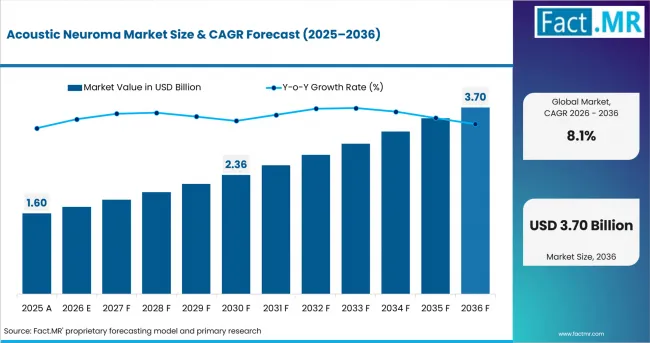
Acoustic Neuroma Market Value Analysis | Source: Fact.MR
Summary of the Acoustic Neuroma Market
- Demand Drivers
- MRI utilization is increasing and improving diagnosis rates. Greater recognition of hearing and balance disorders supports demand.
- Key Segments Analyzed
- By Diagnosis Type: Imaging Diagnosis accounts for 42.0% share in 2026 due to the central role of MRI evaluation.
- By Treatment Type: Stereotactic radiosurgery is projected to register 38.5% share in 2026 supported by minimally invasive treatment benefits.
- By Tumor Size: Medium Tumors capture 44.2% share in 2026 as diagnosis commonly occurs before advanced progression.
- By End User: Hospitals hold 57.8% share in 2026 due to access to multidisciplinary treatment teams.
- By Treatment Stage: Early-Stage Management accounts for 46.7% share in 2026 supported by improving diagnostic capability.
- By Geography: India is projected to record 9.4% CAGR from 2026 to 2036 due to expanding neurodiagnostic infrastructure.
- Analyst Opinion at Fact.MR
- Shambhu Nath Jha, Principal Consultant at Fact.MR, opines, "Clinical success increasingly depends on earlier diagnosis and hearing preservation outcomes. Healthcare providers with advanced imaging and radiosurgery capability are positioned to strengthen treatment leadership."
- Strategic Implications
- Healthcare providers should expand access to advanced neuroimaging services. Earlier diagnosis improves treatment outcomes.
- Specialty treatment centers should strengthen radiosurgery capability. Minimally invasive procedures improve patient acceptance.
- Hospital networks should invest in multidisciplinary neurological care programs. Integrated treatment pathways improve clinical efficiency.
The market is forecast to add approximately USD 2.0 billion in revenue between 2026 and 2036. Expansion reflects increasing access to advanced MRI diagnostic systems and wider use of stereotactic radiosurgery. Treatment costs and specialist availability constrain adoption across developing healthcare systems. Rising awareness of vestibular disorders supports earlier diagnosis and intervention.
India is projected to expand at 9.4% CAGR from 2026 to 2036 supported by improving neurodiagnostic infrastructure. China is expected to grow at 8.9% CAGR by 2036 driven by hospital investment in advanced imaging systems. South Korea is forecast to witness 8.4% CAGR through 2036 due to strong adoption of precision radiosurgery. The United States is anticipated to register 7.3% CAGR by 2036 supported by established neuro-oncology care networks. Germany is estimated to advance at 6.9% CAGR from 2026 to 2036 due to growing utilization of specialized hearing preservation treatments.
How does the acoustic neuroma market break down by segment?
Acoustic Neuroma Market Analysis by Diagnosis Type
Imaging diagnosis is estimated to account for 42.0% share in 2026. MRI remains the primary diagnostic tool due to its ability to detect small tumors and support treatment planning. Growing access to advanced imaging systems strengthens segment leadership. SonoClear completed clinical enrollment for its Breakthrough Device-designated SonoClear® System, designed to improve intraoperative ultrasound system during brain tumor surgery. The technology may support more precise neurosurgical procedures relevant to acoustic neuroma and other intracranial tumors.
- Diagnostic Accuracy: MRI provides detailed visualization of tumor location and size. Accurate assessment supports treatment selection.
- Early Detection: Imaging identifies tumors before significant neurological impairment occurs. Earlier diagnosis improves clinical outcomes.
- Monitoring Support: Imaging remains essential during post-treatment surveillance. Follow-up evaluation supports long-term patient management.
Acoustic Neuroma Market Analysis by Treatment Type
Stereotactic radiosurgery is estimated to hold 38.5% share. The procedure offers targeted treatment with limited recovery requirements. Clinical effectiveness supports adoption across specialized treatment centers.
- Minimally Invasive Care: Radiosurgery avoids open surgical procedures in selected cases. Lower treatment burden supports patient preference.
- Hearing Preservation: Targeted treatment helps reduce damage to surrounding structures. Outcome improvement supports utilization.
- Hospital Efficiency: Radiosurgery reduces hospitalization requirements. Operational benefits support procedure growth.
Acoustic Neuroma Market Analysis by Tumor Size
Medium tumors are estimated to capture 44.2% share in 2026. Many patients receive diagnosis during this stage due to increasing use of advanced imaging. Treatment intervention remains common before tumors reach larger sizes. Fortis Memorial Research Institute launched South Asia's first Leksell Gamma Knife Esprit, an advanced radiosurgery platform designed to treat brain tumors including acoustic neuromas with sub-millimeter precision. The non-invasive technology enables single-session treatment while minimizing radiation exposure to surrounding healthy brain tissue.
- Diagnosis Patterns: Improved imaging identifies tumors during moderate growth stages. Detection timing supports segment leadership.
- Treatment Eligibility: Medium tumors are suitable for multiple treatment approaches. Clinical flexibility supports demand.
- Outcome Optimization: Earlier intervention improves long-term management outcomes. Treatment planning benefits from timely diagnosis.
Acoustic Neuroma Market Analysis by End User
Hospitals are estimated to account for 57.8% share in 2026. Comprehensive treatment capability supports segment dominance. Multidisciplinary care improves diagnosis and treatment coordination. ZAP Surgical Systems announced that it will showcase its ZAP-X Gyroscopic Radiosurgery Platform at ASTRO 2025. The system is designed for high-precision stereotactic radiosurgery, a widely used treatment approach for acoustic neuromas and other intracranial tumors.
- Integrated Care: Hospitals provide imaging, surgery, and rehabilitation services. Consolidated care pathways support patient management.
- Technology Access: Advanced diagnostic and treatment equipment is concentrated in hospitals. Infrastructure availability supports demand.
- Specialist Availability: Hospitals employ experienced neurology and oncology professionals. Clinical expertise strengthens treatment capacity.
Acoustic Neuroma Market Analysis by Treatment Stage
Early-stage management registers 46.7% share in 2026. Growing awareness and improved diagnostics support earlier intervention. Healthcare providers increasingly emphasize monitoring and treatment before symptom progression.
- Monitoring Programs: Early management supports observation and treatment planning. Structured follow-up improves clinical oversight.
- Patient Outcomes: Timely intervention reduces long-term complications. Outcome improvement supports segment growth.
- Healthcare Awareness: Better recognition of hearing and balance symptoms encourages earlier diagnosis. Awareness initiatives strengthen demand.
What is accelerating acoustic neuroma market growth, and what is holding it back?
The acoustic neuroma market has shifted toward earlier intervention strategies. Diagnostic imaging improvements have increased identification of smaller tumors. Healthcare providers are emphasizing hearing preservation and reduced treatment burden. These factors support market expansion across developed and emerging healthcare systems. Elekta received U.S. FDA 510(k) clearance in July 2025 for an expanded indication on its Leksell Gamma Knife radiosurgery system. Gamma Knife is one of the most widely used stereotactic radiosurgery platforms for treating acoustic neuromas (vestibular schwannomas) and other intracranial disorders.
Treatment pathways are evolving toward precision radiosurgery and active monitoring for selected patients. Clinical decision making increasingly focuses on balancing treatment effectiveness with quality-of-life outcomes. Advanced diagnostic capability supports this transition.
- Diagnostic Advancement: MRI accessibility is improving across healthcare systems. Earlier detection supports higher treatment volumes and patient monitoring activity.
- Precision Treatment: Radiosurgery technologies reduce recovery requirements and treatment burden. Clinical outcomes support wider procedure adoption.
- Specialist Access Constraints: Limited availability of experienced neurosurgical and radiosurgical specialists restricts treatment access in developing healthcare markets.
Which countries are scaling acoustic neuroma treatment demand fastest?
The acoustic neuroma market is assessed across North America, Europe, Asia Pacific, Latin America, and the Middle East and Africa. The study evaluates diagnostic imaging adoption, treatment availability, healthcare spending, and specialist care infrastructure across major healthcare economies.
| Country | CAGR (2026 to 2036) |
|---|---|
| India | 9.4% |
| China | 8.9% |
| South Korea | 8.4% |
| United States | 7.3% |
| Germany | 6.9% |
Source: Fact.MR analysis, based on proprietary forecasting model and primary research.
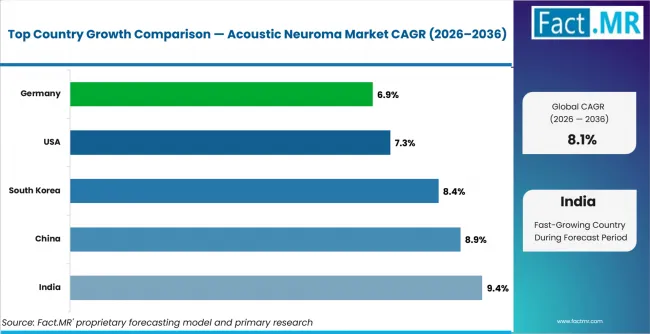
Acoustic Neuroma Market Cagr Analysis By Country | Source: Fact.MR
Asia Pacific Acoustic Neuroma Market Analysis
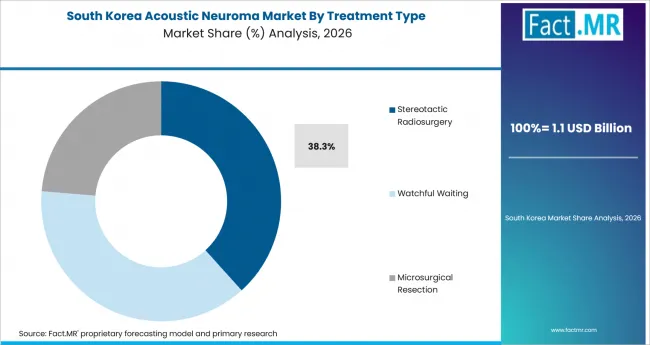
Acoustic Neuroma Market South Korea Market Share Analysis By Treatment Type | Source: Fact.MR
Asia Pacific presents significant growth opportunities due to improving healthcare access and rising investment in advanced diagnostic technologies. Expansion of specialist neurological care supports treatment availability across regional markets.
- India: India is projected to expand at 9.4% CAGR from 2026 to 2036 as tertiary hospitals increase investment in advanced MRI systems and neurological care services. Greater access to specialist diagnosis is improving patient identification rates. Growth is attributable to expanding neurodiagnostic infrastructure and healthcare modernization.
- China: Large-scale hospital modernization programs are expected to support China at 8.9% CAGR through 2036. Healthcare providers are increasing deployment of advanced imaging technologies for neurological diagnosis. Demand reflects growing access to specialized treatment services. Growth is supported by investment in hospital-based diagnostic capability.
- South Korea: South Korea is forecast to witness 8.4% CAGR driven by strong adoption of precision radiosurgery and advanced neuroimaging technologies. Specialized treatment centers are expanding access to minimally invasive procedures. Demand reflects the country's advanced healthcare infrastructure. Growth is attributable to innovation in neurological treatment delivery.
North America Acoustic Neuroma Market Analysis
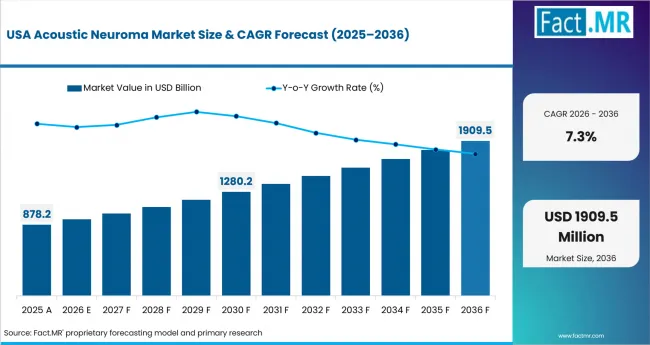
Acoustic Neuroma Market Country Value Analysis | Source: Fact.MR
North America remains a major revenue-generating region due to established healthcare infrastructure and high awareness of neurological disorders. Advanced treatment availability supports market development.
- United States: The United States is projected to expand at 7.3% CAGR by 2036 as hospitals strengthen access to advanced radiosurgery and neuro-oncology services. Early diagnosis rates remain high globally. Demand is driven by established specialist care networks and advanced imaging utilization.
Europe Acoustic Neuroma Market Analysis
Europe benefits from strong healthcare systems and increasing focus on precision treatment approaches. Advanced diagnostic capability supports clinical management across major markets.
- Germany: Rising utilization of specialized neurological care is expected to support Germany at 6.9% CAGR through 2036. Healthcare providers are expanding access to hearing preservation and precision treatment approaches. Demand reflects increasing diagnosis of vestibular disorders. Growth is attributable to advanced clinical infrastructure and specialist treatment availability.
Who leads the acoustic neuroma market landscape?
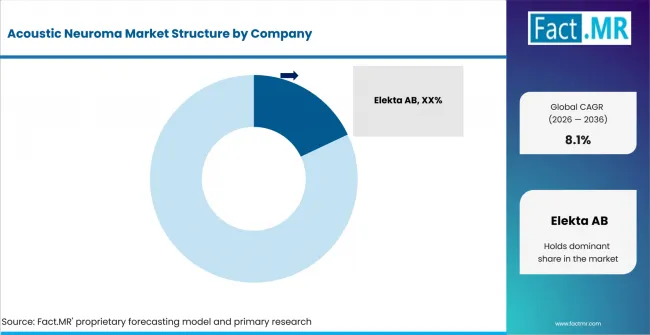
Acoustic Neuroma Market Analysis By Company | Source: Fact.MR
The competitive structure reflects a mix of medical technology companies, radiosurgery platform providers, imaging system manufacturers, treatment-planning software providers, and specialized healthcare institutions. Diagnostic accuracy influences treatment selection across acoustic neuroma management pathways. Companies with advanced imaging and treatment portfolios hold stronger positions across neurology care networks. Clinical outcome performance strengthens long-term adoption.
Organizations that combine diagnostic imaging with precision treatment solutions benefit from broader market participation. Integrated care pathways improve patient management and treatment planning. Technology innovation supports competitive differentiation across healthcare providers. Treatment precision remains an important purchasing criterion. Hospitals evaluate technology suppliers based on diagnostic capability and treatment outcomes. Specialty clinics prioritize workflow efficiency and patient safety. Academic centers focus on clinical evidence and long-term effectiveness. Established treatment expertise creates barriers for new participants.
Commercial success is increasingly linked to imaging quality and precision treatment capability. Demand is shifting toward providers that deliver comprehensive diagnostic and therapeutic solutions. Hearing preservation outcomes are emerging as a major differentiator across acoustic neuroma treatment markets.
Which companies are the key players?
- Elekta AB
- Accuray Incorporated
- ZAP Surgical Systems, Inc.
- Brainlab AG
Bibliography
- MedlinePlus. (2024, May 2). Acoustic neuroma. National Library of Medicine.
- Fortis Memorial Research Institute. (2024, June 13). Fortis Memorial Research Institute, Gurugram unveils South Asia’s first Gamma Knife Esprit for advanced radiosurgery treatment. Fortis Healthcare.
- ZAP Surgical Systems, Inc. (2025, September 10). ZAP Surgical to debut its groundbreaking ZAP-X® Gyroscopic Radiosurgery® Platform at ASTRO 2025.
- Elekta AB. (2025, July 23). Elekta receives U.S. FDA 510(k) clearance for its Gamma Knife radiosurgery system to treat patients with refractory drug-resistant mesial temporal lobe epilepsy.
- SonoClear AS. (2026, May 12). SonoClear AS completes clinical enrollment for Breakthrough Device-designated SonoClear® System.
This Report Addresses
- Analysis of acoustic neuroma diagnosis and treatment demand across healthcare settings.
- Opportunity assessment across imaging diagnostics and precision radiosurgery technologies.
- Segment forecasts covering diagnosis type, treatment type, tumor size, end user, and treatment stage.
- Competitive assessment of medical technology providers and healthcare institutions.
- Evaluation of diagnostic innovation and treatment adoption trends.
- Country-level analysis across India, China, South Korea, the United States, and Germany.
- Report delivery through PDF and Excel formats supported by primary interviews and healthcare industry analysis.
What does the acoustic neuroma market cover?
The acoustic neuroma market covers the diagnosis, monitoring, and treatment of benign tumors that develop on the vestibulocochlear nerve. These tumors affect hearing and balance functions and may require imaging assessment, surgical intervention, radiosurgery, or long-term monitoring. The market includes diagnostic technologies, treatment procedures, and healthcare services used across hospitals and specialty neurology centers.
Acoustic Neuroma Market Inclusions
The study covers global and regional forecasts from 2026 to 2036 by diagnosis type, treatment type, tumor size, end user, and treatment stage. It includes MRI-based diagnosis, audiological testing, radiosurgery procedures, microsurgical interventions, outpatient rehabilitation services, and patient monitoring activities across major healthcare markets.
Acoustic Neuroma Market Exclusions
The study excludes malignant brain tumors, metastatic neurological cancers, general hearing disorders unrelated to acoustic neuroma, and pharmaceutical treatments for unrelated neurological conditions. Revenue from broad oncology care services is excluded unless directly associated with acoustic neuroma diagnosis or treatment.
Acoustic Neuroma Market Research Methodology
- Primary Research
- Interviews were conducted with neurosurgeons, neurotologists, radiologists, hospital administrators, and specialty clinic directors across major healthcare markets.
- Desk Research
- Analysis included hospital reports, medical association publications, regulatory updates, company disclosures, and clinical research released during 2024 and 2025.
- Market-Sizing and Forecasting
- A hybrid forecasting model combined patient incidence estimates with procedure volume analysis and healthcare expenditure trends.
- Data Validation and Update Cycle
- Forecast outputs were validated through specialist interviews, treatment volume assessments, hospital procedure databases, and annual healthcare reviews.
What is the report’s scope and coverage?
| Attribute | Details |
|---|---|
| Quantitative Units | USD billion (2026) to USD billion (2036) at CAGR |
| Market Definition | Diagnostic and treatment solutions used for acoustic neuroma management |
| Diagnosis Type Segmentation | Imaging Diagnosis, Audiological Evaluation, Neurological Assessment, Genetic Testing |
| Treatment Type Segmentation | Stereotactic Radiosurgery, Microsurgical Resection, Watchful Waiting, Drug Therapy, Rehabilitation Therapy |
| Tumor Size Segmentation | Small Tumors, Medium Tumors, Large Tumors |
| End User Segmentation | Hospitals, Specialty Clinics, Ambulatory Surgical Centers, Cancer Treatment Centers, Academic Research Institutes |
| Treatment Stage Segmentation | Initial Diagnosis, Early-Stage Management, Active Treatment, Post-Treatment Monitoring, Long-Term Follow-Up |
| Regions Covered | North America, Europe, Asia Pacific, Latin America, Middle East & Africa |
| Countries Covered | India, China, South Korea, United States, Germany |
| Key Companies Profiled | Elekta AB, Accuray Incorporated, ZAP Surgical Systems, Inc., Brainlab AG |
| Forecast Period | 2026 to 2036 |
| Approach | Hybrid top-down and bottom-up model using treatment volume and healthcare expenditure analysis. |
How is the market segmented?
-
By Diagnosis Type
- Imaging Diagnosis
- Audiological Evaluation
- Neurological Assessment
- Genetic Testing
-
By Treatment Type
- Stereotactic Radiosurgery
- Microsurgical Resection
- Watchful Waiting
- Drug Therapy
- Rehabilitation Therapy
-
By Tumor Size
- Small Tumors
- Medium Tumors
- Large Tumors
-
By End User
- Hospitals
- Specialty Clinics
- Ambulatory Surgical Centers
- Cancer Treatment Centers
- Academic Research Institutes
-
By Treatment Stage
- Initial Diagnosis
- Early-Stage Management
- Active Treatment
- Post-Treatment Monitoring
- Long-Term Follow-Up
-
By Region
-
North America
- United States
- Canada
-
Latin America
- Brazil
- Argentina
- Mexico
- Rest of Latin America
-
Europe
- Germany
- United Kingdom
- France
- Italy
- Rest of Europe
-
Asia Pacific
- China
- India
- South Korea
- Japan
- ASEAN
-
Middle East & Africa
- GCC Countries
- South Africa
- UAE
- Rest of Middle East & Africa
-