- Base Value(2025): 4.7 Bn
- Estimated Value(2026): 5.0 Bn
- Forecast Value (2036): 9.2 Bn
- CAGR (2026 - 2036): 6.2%
Active Aero Flap and Grille Shutter Actuator Modules Market Forecast and Outlook by Fact.MR
- The active aero flap and grille shutter actuator modules market was valued at USD 4.7 billion in 2025.
- According to Fact.MR, demand is projected to reach USD 5.0 billion in 2026 and expand to USD 9.2 billion by 2036, reflecting a CAGR of 6.2% during the forecast period.
- The market is expected to create an absolute opportunity of USD 4.22 billion between 2026 and 2036, supported by increasing focus on aerodynamic efficiency across vehicle platforms.
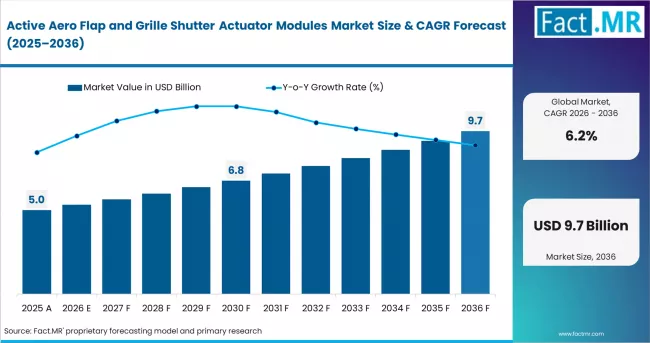
Active Aero Flap And Grille Shutter Actuator Modules Market Value Analysis | Source: Fact.MR
| Metric | Value |
|---|---|
| Estimated Value in 2026 | USD 5.0 billion |
| Forecast Value in 2036 | USD 9.2 billion |
| Forecast CAGR (2026 to 2036) | 6.2% |
Source: Fact.MR analysis. Updated May 12, 2026
Summary of the Active Aero Flap and Grille Shutter Actuator Modules Market
- Market Definition
- The active aero flap and grille shutter actuator modules market includes the powered front-end hardware that changes airflow and drag in response to vehicle operating conditions.
- Demand Drivers
- OEMs need better balance between aerodynamic drag reduction and cooling performance.
- EV and hybrid programs place more value on range-supporting front-end airflow control.
- SUVs and larger vehicles create stronger commercial logic for active front aero hardware.
- Key Segments Analyzed
- By Product Type: Active Grille Shutter Actuator Modules are expected to account for 42.0% share in 2026, supported by their broad commercial use in current vehicle programs.
- By Vehicle Type: Passenger Cars are projected to hold 59.0% share in 2026 because AGS penetration remains strongest in mainstream and premium passenger vehicles.
- By Application: Drag Reduction is expected to capture 36.0% share in 2026 because the clearest supplier value proposition remains aerodynamic improvement.
- By Geography: China leads growth with a 6.8% CAGR through 2036.
- Analyst Opinion at Fact.MR
- Shambhu Nath Jha, Senior Analyst at Fact.MR, notes the strongest shift in this market is that the actuator module is becoming the real control center of active front aerodynamics. Once airflow has to respond dynamically to range needs, cooling demand, and noise or drag targets, the actuator is no longer a simple motion part. It becomes a strategic front-end efficiency component.”
- Strategic Implications
- Suppliers that combine compact packaging, durability, and flexible mounting will be better placed in next-generation vehicle programs.
- OEMs need actuator vendors that support both aero and thermal-management integration rather than isolated motion hardware supply.
- Aftermarket participants gain more from exact fitment and OE-quality replacement than from low-cost generic substitution.
- Methodology
- Market sizing used vehicle production, AGS penetration, and EV/SUV mix as baseline anchors.
- Analysis incorporated supplier positioning around active grille shutters, front aero actuators, and modular active-aero systems.
- Forecasts were checked against current product disclosures and aerodynamic value statements from leading suppliers.
Growth remains firm because front-end aerodynamic management is gaining stronger commercial importance across combustion, hybrid, and electric vehicles. Valeo states that active grille shutters are designed to operate under varying airflow conditions and help improve drag coefficient, contributing to range extension and fuel efficiency. Röchling Automotive highlights that AGS systems balance cooling performance when open with aerodynamic drag reduction when closed, with modular designs suitable for multiple powertrain types. Magna also positions its grille shutter actuators around compact packaging, durability, and efficiency gains. Commercial value is increasingly tied to airflow control precision and system integration. Manufacturers are adopting actuator modules that improve thermal management, reduce drag, and support energy efficiency targets, reinforcing steady market expansion. [1]
China is projected to remain the fastest-growing country, with a CAGR of 6.8% through 2036, followed by Germany at 6.3% and the United States at 6.0%. Japan is expected to expand at 5.6%, South Korea at 5.5%. Fact.MR views this spread as a reflection of differences in EV output, SUV production, and the speed at which OEMs move from passive front-end airflow management toward actuator-driven aerodynamic hardware. Supplier positioning from Valeo, Magna, and Röchling supports that direction.
Segmental Analysis
Active Aero Flap and Grille Shutter Actuator Modules Market Analysis by Product Type
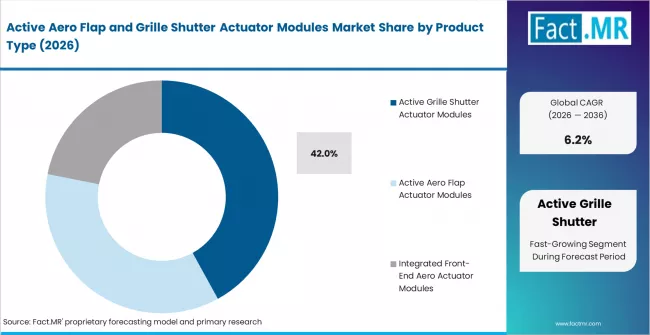
Active Aero Flap And Grille Shutter Actuator Modules Market Analysis By Product Type | Source: Fact.MR
Active grille shutter actuator modules are expected to hold 42.0% share in 2026. Their lead comes from the fact that active grille shutters are the most established active front-end aero format in current supplier portfolios. Valeo describes AGS as a system that controls and adjusts airflow to improve aerodynamics and thermal performance, while Röchling highlights AGS as a modular solution for both combustion and electric vehicles. Magna goes one level deeper by marketing the grille shutter actuator itself as a distinct compact and durable product. That makes the actuator module for AGS the clearest commercial center of this market. [3]
- Execution maturity: AGS is the clearest commercially established active front-end aero format.
- Dual-value logic: The actuator supports both drag reduction and cooling airflow management.
- Broad fitment: The module format works across passenger cars, SUVs, and electrified vehicles.
Active Aero Flap and Grille Shutter Actuator Modules Market Analysis by Vehicle Type
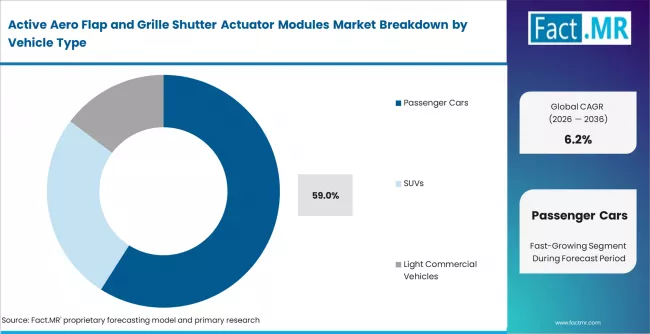
Active Aero Flap And Grille Shutter Actuator Modules Market Analysis By Vehicle Type | Source: Fact.MR
Passenger cars are projected to hold 59.0% share in 2026, as the broadest current spread of active grille shutter systems across mainstream and premium passenger-vehicle platforms. Valeo’s current AGS materials explicitly position the technology around passenger cars, and Magna’s active-aero references also include passenger-vehicle applications in lower-ride vehicles. Passenger cars remain the clearest commercial base because fuel-economy, CO2, and EV-range improvements can be scaled across large production volumes. SUVs remain highly relevant because larger front areas create stronger drag-reduction opportunity, and Röchling’s news materials explicitly connect active aerodynamics to growing SUV penetration. Even so, passenger cars stay ahead because they combine larger total volume with broader current AGS commercialization. [4]
- Volume leverage: Passenger cars provide the broadest base for scaling active-aero actuator content.
- Efficiency pull: Aerodynamic improvements translate directly into fuel-economy and range benefits.
- Commercial visibility: Current AGS product positioning is strongest in passenger-vehicle applications.
Active Aero Flap and Grille Shutter Actuator Modules Market Analysis by Application
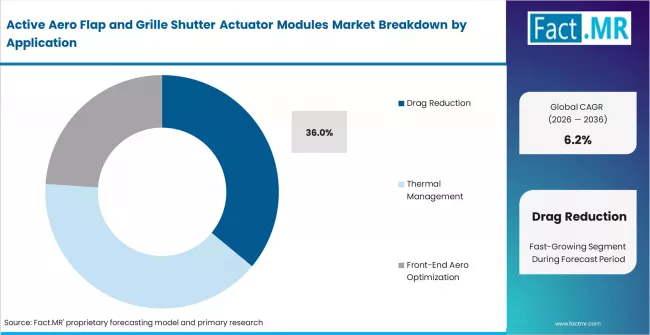
Active Aero Flap And Grille Shutter Actuator Modules Market Analysis By Application | Source: Fact.MR
Drag reduction is expected to capture 36.0% share in 2026. This lead comes from the fact that nearly every major supplier description begins with aerodynamic benefit rather than cooling alone. Valeo’s materials cite reduced drag coefficient and EV autonomy gains, Röchling highlights drag control and CO₂ reduction when shutters are closed, and Magna says its grille shutter actuators are designed to reduce vehicle drag. That makes drag reduction the clearest commercial anchor for actuator-module demand in this market.
- Cross-powertrain relevance: Drag reduction matters in combustion, hybrid, and electric vehicles alike.
- Commercial clarity: Supplier value propositions are strongest around aerodynamic benefit.
- Range and economy link: Lower drag supports both fuel savings and EV range extension.
Active Aero Flap and Grille Shutter Actuator Modules Market Drivers, Restraints, and Opportunities
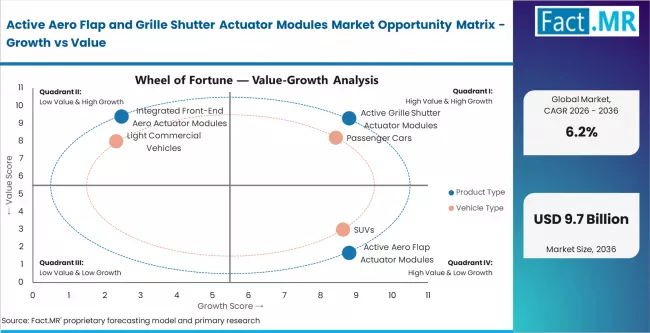
Active Aero Flap And Grille Shutter Actuator Modules Market Opportunity Matrix Growth Vs Value | Source: Fact.MR
The strongest market driver is the need to improve aerodynamic efficiency without losing cooling performance. Valeo’s product materials describe AGS as balancing air circulation and thermal performance while improving drag, and Röchling says AGS provides maximum cooling when open and drag control when closed. That combination gives actuator modules strong commercial pull because they are what make this balance possible in real vehicle operation.
The main restraint is integration complexity under packaging and durability pressure. Magna’s actuator materials emphasize compact size and durability, which shows that the front-end environment leaves limited room for large or fragile actuator packages. As more active flaps and shutters are added to the front module, OEMs must maintain reliability under dirt, splash, vibration, and thermal variation.
Opportunities in the Active Aero Flap and Grille Shutter Actuator Modules Market
- EV range support: AGS and related aero actuators gain more value where range extension matters commercially. Valeo and Röchling both explicitly support this pathway.
- SUV aero optimization: Larger vehicles create more room for front-end active aerodynamic hardware such as AGS and Active Speedlips. Röchling’s SUV-focused aero materials support this opportunity.
- Modular front-end systems: Magna’s modular and scalable active grille shutter assembly and flexible actuator mounting suggest further room for wider platform adoption.
Regional Analysis
Based on the regional analysis, the Active Aero Flap and Grille Shutter Actuator Modules Market is segmented into East Asia, Europe, North America, South Asia and Pacific, Latin America, and Middle East and Africa across 40 plus countries.
.webp "Top Country Growth Comparison Active Aero Flap And Grille Shutter Actuator Modules Market Cagr (2026 2036)")
Top Country Growth Comparison Active Aero Flap And Grille Shutter Actuator Modules Market Cagr (2026 2036) | Source: Fact.MR
| Country | CAGR (2026 to 2036) |
|---|---|
| China | 6.8% |
| Germany | 6.3% |
| United States | 6.0% |
| Japan | 5.6% |
| South Korea | 5.5% |
Source: Fact.MR analysis. Updated May 12, 2026
Source: Fact.MR analysis, based on proprietary forecasting model and primary research
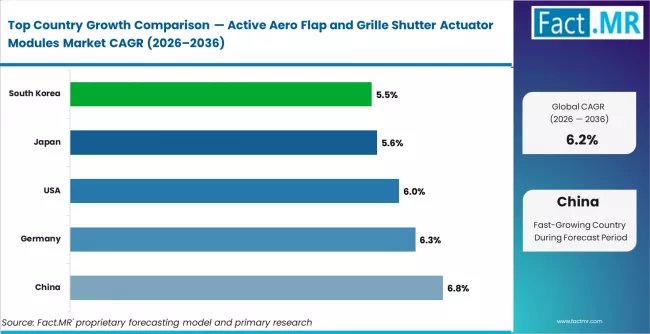
Active Aero Flap And Grille Shutter Actuator Modules Market Cagr Analysis By Country | Source: Fact.MR
East Asia Active Aero Flap and Grille Shutter Actuator Modules Market Analysis
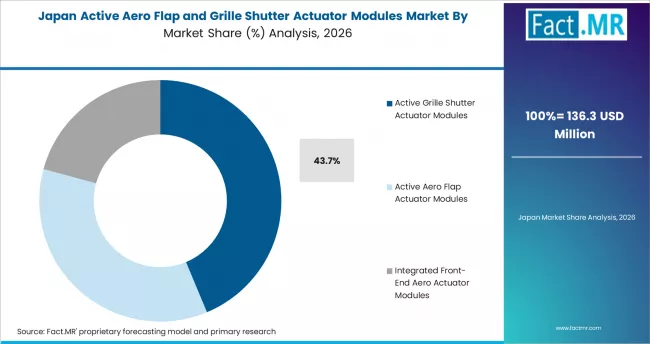
Active Aero Flap And Grille Shutter Actuator Modules Market Japan Market Share Analysis By Product Type | Source: Fact.MR
East Asia remains the strongest production and adoption base for this market. The region combines high vehicle output with growing EV penetration and increasing use of aerodynamic efficiency features. Supplier materials from Valeo, Magna, and Röchling all support the relevance of active front-end aerodynamics in both combustion and electric vehicles, which strengthens East Asia’s role as a major growth base.
- China: Active aero flap and grille shutter actuator modules demand in China is projected to grow at a CAGR of 6.8% through 2036. The market benefits from high EV output and stronger commercial need for range-supporting aerodynamic hardware.
- Japan: Japanese demand is projected to expand at a CAGR of 5.6% through 2036. Growth is steadier because the market is more mature and places greater emphasis on durable, tightly packaged front-end systems. [5]
- South Korea: South Korea is expected to grow at a CAGR of 5.5% through 2036. Its role is tied to electronics-rich vehicles and stronger aero-efficiency expectations in both EV and premium passenger-car programs.
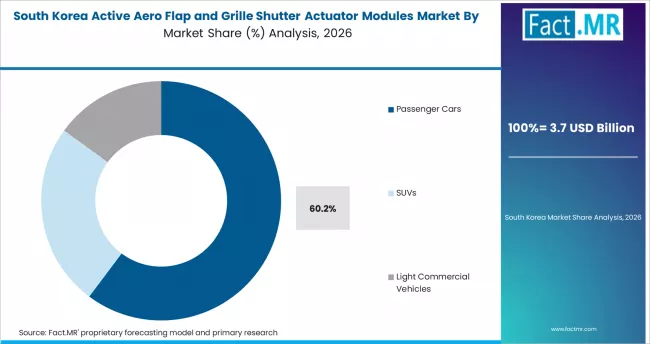
Active Aero Flap And Grille Shutter Actuator Modules Market South Korea Market Share Analysis By Vehicle Type | Source: Fact.MR
Fact.MR’s report also covers ASEAN, Australia and New Zealand, and other South Asia and Pacific markets. These countries matter where EV and passenger-vehicle production continue to broaden and front-end aero content spreads into wider vehicle lines.
North America Active Aero Flap and Grille Shutter Actuator Modules Market Analysis
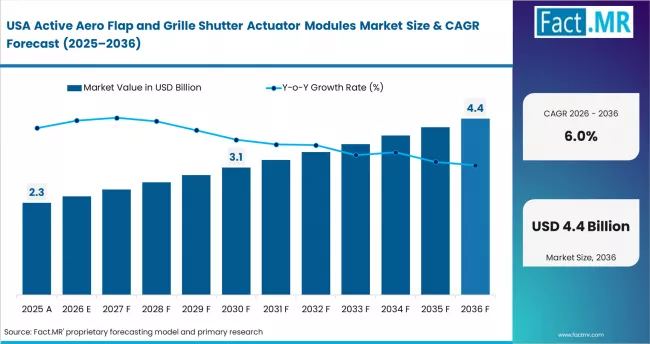
Active Aero Flap And Grille Shutter Actuator Modules Market Country Value Analysis | Source: Fact.MR
North America is shaped by strong SUV and pickup demand, larger vehicle footprints, and a clear need to balance drag reduction with cooling requirements. Magna’s active-aero materials are especially relevant here because they explicitly reference pickup trucks and SUVs, while Röchling’s SUV aero messaging also fits the regional product mix. That creates a strong regional case for actuator modules that support active front-end airflow management.
- United States: Active aero flap and grille shutter actuator modules demand in the United States is projected to rise at a CAGR of 6.0% through 2036. The market is supported by large-vehicle applications and growing EV range-management needs.
Fact.MR’s report also includes Canada and the broader North American front-end systems ecosystem. Additional value comes from active aero use in SUVs, pickups, and EV platforms where drag control and cooling must be balanced carefully.
Europe Active Aero Flap and Grille Shutter Actuator Modules Market Analysis
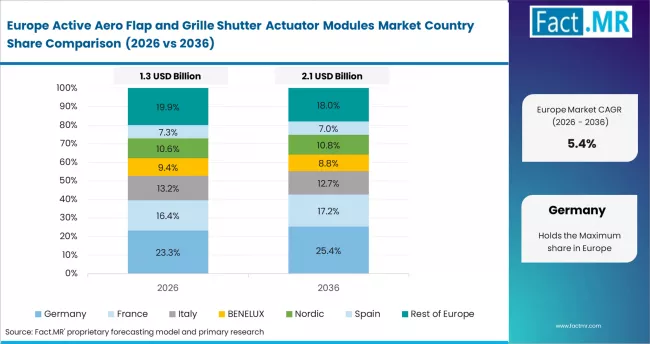
Active Aero Flap And Grille Shutter Actuator Modules Market Europe Country Market Share Analysis, 2026 & 2036 | Source: Fact.MR
Europe remains a high-discipline market rather than the fastest-growing one. Vehicle makers in the region place strong weight on CO₂ reduction, aerodynamic efficiency, and modular front-end integration. Valeo and Röchling both emphasize CO₂ and aerodynamic benefits, while Magna’s scalable active grille shutter references support the same direction from a systems angle. That keeps Europe strategically important as an engineering and commercialization center for AGS and active front-end aerodynamics.
- Germany: Germany is projected to expand at a CAGR of 6.3% through 2036. Strong vehicle engineering depth and a focus on performance optimization support its importance in this market. Demand is driven by increasing integration of aerodynamic components with thermal-management systems, particularly in EVs and high-efficiency passenger vehicles. OEMs and suppliers emphasize precision design, lightweight materials, and system-level integration, which strengthens the role of advanced hardware solutions in improving energy efficiency and vehicle performance.
Fact.MR’s report also covers France, Italy, the United Kingdom, Spain, and the rest of Europe. These markets add commercial depth through continued emphasis on fuel economy, emissions, and EV-range efficiency.
Competitive Aligners for Market Players
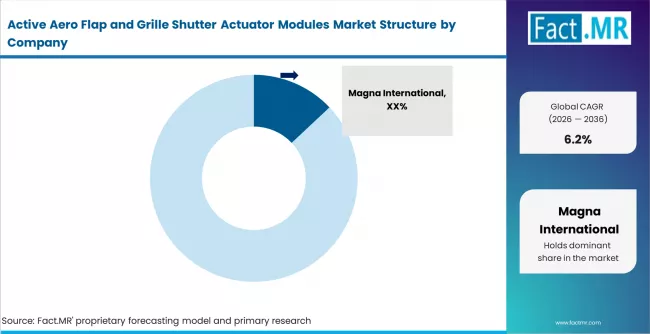
Active Aero Flap And Grille Shutter Actuator Modules Market Analysis By Company | Source: Fact.MR
The active aero flap and grille shutter actuator modules market is moderately consolidated. Buyers do not choose suppliers only on motor torque. They choose on packaging efficiency, durability, flexible mounting, aerodynamic benefit, and integration with thermal-management strategy. Magna, Valeo, and Röchling are the clearest names in current official source material because they each present active front-end airflow management as a systems proposition rather than a single part.
Incumbents hold an advantage because actuator-module performance is difficult to separate from the full active front-end assembly. A challenger may offer a workable motor drive, but replicating OEM confidence is harder when drag performance, cooling response, and front-end package constraints all depend on integrated system behavior. Magna’s modular active grille shutter materials and Röchling’s AGS/front-end carrier integration make that logic clear. Buyer power still matters, though it is limited by packaging dependence and OE integration cost. OEMs want efficiency gains, but they also want low risk in front-end systems that must survive harsh operating conditions. Through 2036, Fact.MR expects competition to remain rational, with stronger selectivity in compact AGS actuator modules, EV-oriented front-end aero systems, and integrated front-end carrier solutions.
Key Players in Active Aero Flap and Grille Shutter Actuator Modules Market
- Magna International
- Valeo
- Röchling Automotive
- SRG Global / active aero related suppliers
- HBPO / front-end systems participants
- Brose / motion-system related suppliers
- Bosch / actuator-related suppliers
Bibliography
- [1] Valeo. Active Grill Shutters: enhanced performance and comfort. Official page explaining airflow control for aerodynamic and thermal performance.
- [2] Magna. Active Grille Shutter and active aero materials. Official PDF and related references covering passenger vehicles and SUVs/pickups.
- [3] Valeo. Active Grille Shutters. 2024 catalogue page listing aerodynamic drag and range benefits, torque, and speed-related specifications.
- [4] Röchling Automotive. Optimized aerodynamic with Active Speedlips, Active Grille Shutter and more. Official article linking SUV growth with active aero optimization.
- [5] Magna. Actuators - Mirrors / Grill Shutter Actuator. Official page describing grille shutter actuators, compact size, durability, and drag reduction benefits.
This Report Addresses
- Strategic demand outlook for active aero flap and grille shutter actuator modules across front-end aerodynamic systems.
- Market forecast from USD 5.0 billion in 2026 to USD 9.2 billion by 2036.
- The growing role of AGS actuator modules in drag reduction, cooling airflow control, and EV range support.
- The effect of SUVs, EVs, and modular front-end systems on actuator-module demand.
- OEM versus aftermarket demand patterns in a fitment- and packaging-sensitive aero category.
- Regional differences in vehicle output, EV adoption, and supplier depth.
- Competitive positioning of suppliers active in active grille shutters, aero flaps, and front-end actuator systems.
- Segment analysis by product type, vehicle type, application, sales channel, and geography.
Active Aero Flap and Grille Shutter Actuator Modules Market Definition
The market covers actuator modules that physically move grille shutters, front aero flaps, and related front-end aerodynamic devices to optimize airflow according to vehicle operating conditions. These modules typically include the motor, gear train, housing, linkage output, and associated integration hardware needed to open, close, or position aerodynamic elements.
Active Aero Flap and Grille Shutter Actuator Modules Market Inclusions
The market includes grille shutter actuators, active aero flap actuators, front air-deflector actuator modules, integrated aerodynamic motion units, and related compact drive assemblies used in front-end airflow and drag-management systems. Magna explicitly markets grille shutter actuators as a distinct product with compact packaging and flexible mounting, while Valeo and Röchling position AGS systems as modular products used across passenger vehicles, SUVs, and EVs. [2]
Active Aero Flap and Grille Shutter Actuator Modules Market Exclusions
The market excludes passive grille shutters with no powered motion, non-adjustable front spoilers, full front-end carriers where actuator value cannot be isolated, and unrelated body-motion actuators outside airflow management. The focus remains on modules that directly move aerodynamic shutters or flaps to change airflow in real vehicle operation. Magna’s and Röchling’s materials both separate active aero systems from general exterior structures, which supports this narrower boundary.
Active Aero Flap and Grille Shutter Actuator Modules Market Research Methodology
- Primary Research
- Interviews with exterior-systems engineers, thermal-management specialists, front-end module integration teams, aero development engineers, and aftermarket repair distributors.
- Desk Research
- Review of official AGS and active-aero product pages, supplier brochures, and public technical references from Valeo, Magna, and Röchling.
- Market-Sizing and Forecasting
- Fact.MR used a blended model based on vehicle production, AGS and active-aero penetration, EV and SUV mix, front-end thermal-management complexity, and replacement demand in the installed vehicle parc.
- Data Validation and Update Cycle
- Forecasts were cross-checked through current supplier positioning around drag reduction, thermal control, and actuator packaging in active front-end aerodynamic systems.
Segmentation
Scope of the Report
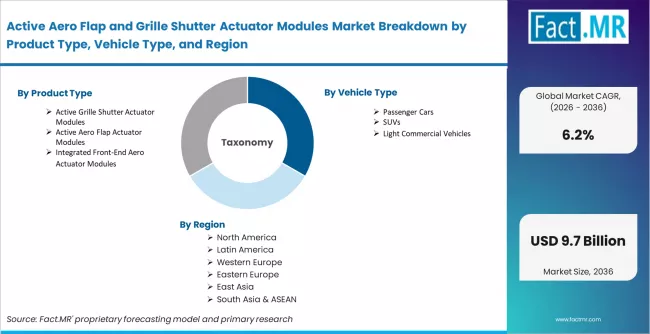
Active Aero Flap And Grille Shutter Actuator Modules Market Breakdown By Product Type, Vehicle Type, And Region | Source: Fact.MR
| Attribute | Details |
|---|---|
| Quantitative Units | USD 5.0 billion in 2026 to USD 9.2 billion in 2036, at a CAGR of 6.2% |
| Market Definition | Active aero flap and grille shutter actuator modules that physically change front-end airflow to support drag reduction and thermal management. |
| Product Type Segmentation | Active Grille Shutter Actuator Modules, Active Aero Flap Actuator Modules, Integrated Front-End Aero Actuator Modules, Active Air Deflector Actuator Modules, Others |
| Vehicle Type Segmentation | Passenger Cars, SUVs, Light Commercial Vehicles, Electric Vehicles |
| Application Segmentation | Cooling Air Management, Drag Reduction, Thermal Management, Front-End Aero Optimization |
| Regions Covered | East Asia, Europe, North America, South Asia and Pacific, Latin America, Middle East and Africa |
| Countries Covered | China, Germany, United States, Japan, South Korea, India, Mexico, and 40+ countries |
| Key Companies Profiled | Magna, Valeo, Röchling and other active-aero and front-end module suppliers |
| Forecast Period | 2026 to 2036 |
| Approach | Fact.MR combined primary interviews with aero and thermal-management stakeholders, desk research across official supplier materials, and a forecast model anchored in vehicle production, AGS penetration, and EV/SUV mix. |
Source: Fact.MR analysis. Updated May 12, 2026
Active Aero Flap and Grille Shutter Actuator Modules Market by Segments
-
By Product Type:
- Active Grille Shutter Actuator Modules
- Active Aero Flap Actuator Modules
- Integrated Front-End Aero Actuator Modules
- Active Air Deflector Actuator Modules
- Others
-
By Vehicle Type:
- Passenger Cars
- SUVs
- Light Commercial Vehicles
- Electric Vehicles
-
By Application:
- Cooling Air Management
- Drag Reduction
- Thermal Management
- Front-End Aero Optimization
-
By Sales Channel:
- OEM
- Aftermarket
-
By Region:
- North America
- United States
- Canada
- Mexico
- Latin America
- Brazil
- Argentina
- Rest of Latin America
- Europe
- Germany
- France
- United Kingdom
- Italy
- Spain
- Rest of Europe
- East Asia
- China
- Japan
- South Korea
- South Asia and Pacific
- India
- ASEAN
- Australia and New Zealand
- Rest of South Asia and Pacific
- Middle East and Africa
- GCC Countries
- South Africa
- Turkey
- Rest of Middle East and Africa
- North America
Frequently Asked Questions
What is the estimated size of the active aero flap and grille shutter actuator modules market in 2026?
How large is the market expected to become by 2036?
What is the forecast CAGR for 2026 to 2036?
Which product type leads the market?
Which vehicle type dominates demand?
Why does the OEM channel dominate?
Why are active aero actuator modules important here?
What is the strongest demand driver?
What is the key restraint?
Which country is growing fastest?
Why is China ahead?
How do EVs affect this market?
Is this a fragmented supplier market?
What do OEM buyers prioritize?
Which companies are most visible in this market?
What is the broader outlook through 2036?
Who worked on this report


Preview the report firsthand - request a free sample
Free SampleGet the brochure for pricing and purchase details
Download PDF