- Base Value(2025): 3.9 Bn
- Forecast Value (2036): 7.3 Bn
- CAGR (2036): 6.4%
Active Grille Shutters Market Forecast and Outlook 2026 to 2036
In 2025, the active grille shutters market was valued at USD 3.9 billion. Based on Fact.MR analysis, demand is estimated to reach approximately USD 4.2 billion in 2026 and expand to USD 7.3 billion by 2036, registering a CAGR of 6.4% over the forecast period. Market expansion reflects growing penetration across mass market passenger cars and SUVs as OEMs standardise shutter systems to manage engine warm up, cooling airflow, and aerodynamic drag under mixed driving conditions.
Rolling CAGR analysis shows stronger momentum between 2026 and 2031, driven by wider OEM fitment on new platforms, particularly SUVs and crossover models where frontal area and cooling demand are higher. From 2031 onward, growth moderates but remains steady as replacement demand and integration with broader thermal management modules sustain value expansion. Supplier scale, manufacturing discipline, and integration capability are central to competitiveness in this segment. In this context, Swamy Kotagiri, Chief Executive Officer of Magna International, stated,
“We closed 2025 with a strong fourth quarter, successfully navigating another dynamic year in our industry. Our disciplined execution and commitment to operational excellence enabled us to deliver financial results that were in line with, or exceeded, our February 2025 Outlook across all key metrics.” [1]
Fact.MR analysis views this as indicative of how leading Tier 1 suppliers maintain margin stability while scaling active aerodynamic systems across global vehicle platforms.
China records the fastest growth at 7.2% CAGR, supported by aggressive fuel efficiency compliance and high SUV production volumes. India follows at 6.9%, driven by tightening efficiency norms and platform upgrades. Thailand (6.4%) and Mexico (6.0%) benefit from export oriented vehicle assembly, while South Korea grows at 5.9% through technology intensive OEM adoption. Mature markets including the United States (5.7%), Germany (5.1%), and Japan (4.6%) remain replacement and refresh led, constrained by longer model cycles and earlier penetration of shutter systems.
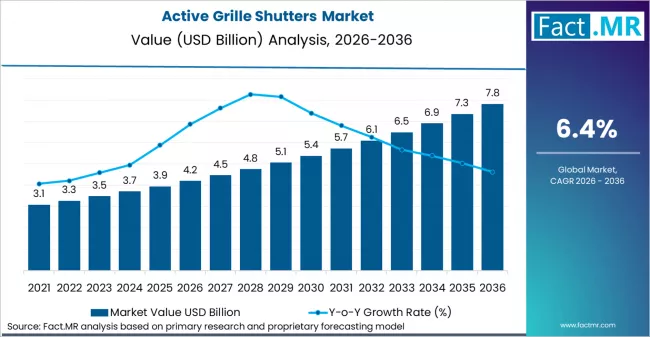
Active Grille Shutters Market Market Value Analysis | Source: Fact.MR
Active Grille Shutters Market Definition
The active grille shutters market covers electromechanical systems installed behind the front grille of vehicles to control airflow into the engine compartment. These shutters open and close based on vehicle speed, engine temperature, and cooling demand, which helps regulate airflow and thermal conditions. By limiting unnecessary air intake, the system supports engine warm up and vehicle efficiency targets. Functional use and vehicle integration of such systems fall under fuel economy and vehicle safety regulations issued by the US National Highway Traffic Safety Administration and UNECE vehicle construction rules [2]. Active grille shutters are supplied mainly for passenger and light commercial vehicles.
Active Grille Shutters Market Inclusions
The report covers global and regional market size estimates in volume and value terms with a forecast period from 2026 to 2036. Segmentation includes shutter type by actuation mechanism, material type such as plastic and composite systems, application by vehicle category, and end use covering original equipment fitment and replacement demand. The scope also includes regional demand patterns, pricing benchmarks, and international trade flows for automotive airflow management components.
Active Grille Shutters Market Exclusions
The scope excludes fixed grille designs, decorative grille inserts, and passive airflow control components without active movement. Cooling fans, radiators, intercoolers, and engine thermal management software are not included. Complete front end modules sold as integrated assemblies are excluded. Motorsport specific airflow devices, prototype systems without road certification, laboratory testing equipment, and vehicle aerodynamics simulation services are also outside the scope.
Active Grille Shutters Market Research Methodology
- Primary Research: Primary research involved interviews with active grille shutter manufacturers, automotive OEM suppliers, thermal system engineers, and vehicle platform integration teams.
- Desk Research: Desk research used vehicle efficiency and construction regulations issued by the US National Highway Traffic Safety Administration and UNECE, vehicle production data from national transport authorities, customs trade statistics, and company annual reports and technical product disclosures filed with securities regulators.
- Market Sizing and Forecasting: Market sizing applied a hybrid top down and bottom up model using vehicle production volumes, grille shutter fitment rates by vehicle segment, and platform level adoption trends.
Data Validation and Update Cycle
Outputs were cross checked against vehicle registration data, regulatory compliance records, trade statistics, and OEM supply disclosures, with updates applied when verified public data sources issue revisions.
Summary of Active Grille Shutters Market
Market Definition
- The active grille shutters market comprises electromechanical airflow control systems installed behind vehicle grilles to regulate cooling airflow, improve aerodynamic efficiency, and support thermal management in passenger cars and light commercial vehicles.
Demand Drivers
- OEMs are adopting active grille shutters to meet fleet-level fuel efficiency and CO₂ reduction targets by lowering aerodynamic drag during cruising conditions.
- Increasing SUV and crossover production is raising frontal area and cooling demand, making shutter-based airflow control a standard platform requirement.
- Integration of shutters with powertrain and thermal management systems is expanding as electrified vehicles require tighter temperature control for batteries and power electronics.
Key Segments Analyzed
- By product type, standard active grille shutters account for the majority of demand due to widespread OEM fitment across mass-market platforms.
- By actuation, electric motor-driven systems lead adoption because they enable precise, software-controlled positioning and fast response.
- By geography, Asia Pacific is the fastest-growing region, driven by fuel efficiency regulations and high vehicle production volumes in China and India.
Analyst Opinion at Fact.MR
- Shambhu Nath Jha, Principal Consultant at Fact.MR, opines, ‘CXOs will find this report useful for understanding how aerodynamic compliance pressures, thermal management integration, and SUV platform proliferation are redefining sourcing priorities and scale advantages in the active grille shutters market.
Strategic Implications / Executive Takeaways
- Suppliers should prioritise scalable shutter architectures that can be standardised across multiple vehicle platforms to secure long-term OEM programs.
- Investment in actuator reliability and electronics integration is critical as shutters increasingly interface with vehicle control software.
- Aftermarket opportunities remain secondary, with OEM fitment and platform wins driving most value creation.
Methodology
- Market sizing combined top-down vehicle production analysis with bottom-up shutter fitment rates by segment.
- Regulatory impacts were validated against fuel economy and vehicle construction frameworks. [3]
- Regional adoption assumptions were cross-checked using vehicle type approval and efficiency rules.
Segmental Analysis
Active Grille Shutters Market Analysis by Product Type
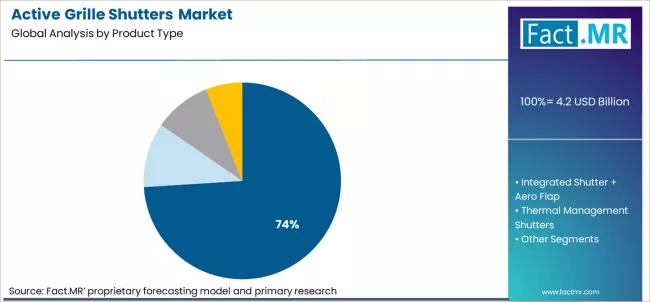
Active Grille Shutters Market Analysis By Product Type | Source: Fact.MR
Based on Fact.MR analysis, consumption of active grille shutters is estimated to hold 74.0% share of the global market in 2026. Fact.MR analysts note that this product type leads because it regulates airflow to the radiator based on cooling demand, improving aerodynamic efficiency and warm-up performance. As per Fact.MR, active grille shutters address OEM requirements for fuel efficiency improvement and thermal control while fitting within existing front-end module architectures used across passenger vehicle platforms.
- Regulatory linkage: Vehicle fuel economy and emission compliance frameworks encourage aerodynamic drag reduction measures such as active grille shutters.
- Platform adoption: Fact.MR analysts reference widespread installation of active grille shutters in passenger vehicle front modules to support engine cooling and drag reduction functions.
- Design integration: OEMs increasingly specify shutter systems as standalone modules that interface with powertrain and thermal management controls.
Active Grille Shutters Market Analysis by Actuation
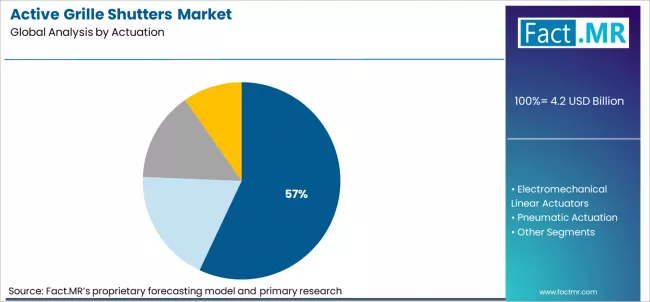
Active Grille Shutters Market Analysis By Actuation | Source: Fact.MR
Based on Fact.MR analysis, consumption of electric motor actuated grille shutters is estimated to hold 57% share of the global market in 2026. Fact.MR opines that electric motor actuation leads due to precise position control, fast response times, and direct integration with vehicle electronic control units. As per Fact.MR, this actuation method addresses manufacturer needs for reliable shutter movement under varying temperature and speed conditions without reliance on vacuum or pneumatic systems.
- Regulatory framework: International vehicle regulations governing fuel efficiency and emissions indirectly support the adoption of electronically controlled aerodynamic devices.
- System control: Fact.MR analysts note electric motor actuators enable closed-loop control of grille shutters based on real-time vehicle operating data.
- Manufacturing preference: Electric actuation supports standardized assembly and reduced system complexity across vehicle platforms.
Active Grille Shutters Market Drivers, Restraints, And Opportunities
Fact.MR analysis indicates that the active grille shutters market exists as an automotive thermal and aerodynamic performance component segment, driven by fuel-efficiency targets, emission regulations, and vehicle thermal management objectives. As per Fact.MR assessment, active grille shutters are actuated louver systems placed ahead of the radiator that regulate airflow based on engine cooling demands and speed, helping vehicles meet regulatory fuel consumption and emission standards such as U.S. EPA fuel economy and greenhouse gas (GHG) standards for light-duty vehicles, which set combined fuel economy and CO₂ limits for passenger cars and light trucks.
Fact.MR analysts observe that the market size is supported by OEM adoption in mainstream and premium segments where improved aerodynamic efficiency contributes to compliance with evolving regional CAFE (Corporate Average Fuel Economy) and GHG requirements.
Fact.MR is of the opinion that current market dynamics reflect a transition toward integration of active grille shutter systems with engine management and vehicle aerodynamics strategies as manufacturers seek to balance cooling efficiency with drag reduction. Based on Fact.MR assessment, conventional fixed grille designs persist in basic vehicle trims due to cost considerations, but demand for active modules grows where vehicle programmes prioritise fuel-efficiency gains supported by regulatory mechanisms.
Active grille shutter systems generally carry higher per-unit pricing because of actuator, sensor, and control module complexity, meaning realised value can increase even where shipment volumes grow at a measured pace. Fact.MR analysis suggests this mix of moderate volume uptake and higher unit cost profiles shapes near-term market performance.
- Regulatory fuel economy and emission standards: Fact.MR analysts note that compliance with U.S. EPA fuel economy and GHG standards for light-duty vehicles influences OEM specification of active grille shutter systems in models targeted for regulated markets.
- Aerodynamic and thermal efficiency requirements: Based on Fact.MR assessment, integration of active grille shutters helps reduce aerodynamic drag at higher speeds and manage engine temperature demands, supporting fuel-efficiency and performance strategies.
- Asia Pacific automotive production growth: Fact.MR opines that expanding vehicle manufacturing and tightening regional fuel-efficiency policies in China, India, and Southeast Asia support regional adoption of active grille shutter systems in both OEM and mid-tier vehicle programmes.
Regional Analysis
Based on regional assessment, the active grille shutters sector is analyzed across North America, Latin America, Europe, East Asia, South Asia, and other major automotive manufacturing regions, spanning more than 40 countries. Regional performance varies according to fuel efficiency regulations, adoption of aerodynamic vehicle components, and integration of active thermal management systems in passenger and commercial vehicles. The report also presents a comparative market attractiveness evaluation grounded in region-specific demand trends.
Active Grille Shutters Market CAGR Analysis by Country (2026-2036)
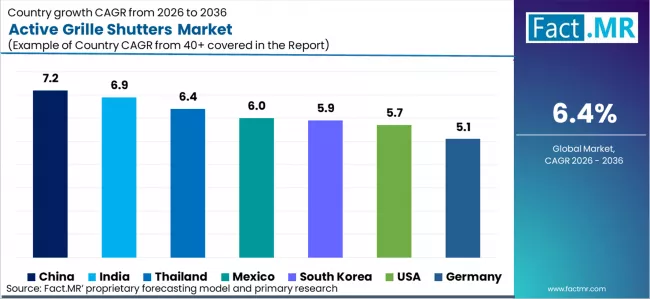
Active Grille Shutters Market Cagr Analysis By Country | Source: Fact.MR
| Country | CAGR |
|---|---|
| China | 7.2% |
| India | 6.9% |
| Thailand | 6.4% |
| Mexico | 6.0% |
| South Korea | 5.9% |
| United States | 5.7% |
| Germany | 5.1% |
| Japan | 4.6% |
Source: Fact.MR analysis. Updated Feb 18, 2026
Source: Fact.MR analysis, based on proprietary forecasting models and primary research.
Asia Pacific Active Grille Shutters Market Analysis
Asia Pacific operates as a regulation- and production-driven automotive aerodynamics components region for active grille shutters. Demand is governed by fuel efficiency standards, emissions regulations, and OEM vehicle certification requirements. Adoption is enforced through vehicle type approval systems and compliance with national fuel consumption and emissions norms applied to passenger vehicles and light commercial vehicles across domestic and export-oriented manufacturing bases.
- China: Demand for active grille shutters in China is projected to rise at 7.2% CAGR through 2036. Application follows fuel consumption limits under GB standards revised in 2021 and reinforced through OEM compliance with national vehicle type approval systems, as per Fact.MR.
- India: Demand for active grille shutters in India is projected to rise at 6.9% CAGR through 2036. Fitment is linked to fuel efficiency compliance under CAFE norms implemented from 2022 and reinforced through OEM adoption in passenger vehicles produced during 2022-2023, according to Fact.MR.
- Thailand: Demand for active grille shutters in Thailand is projected to rise at 6.4% CAGR through 2036. Use is governed by eco-car program efficiency requirements and reinforced through domestic vehicle assembly and certification processes applied during 2021-2022, as per Fact.MR.
- South Korea: Demand for active grille shutters in South Korea is projected to rise at 5.9% CAGR through 2036. Application follows national fuel economy standards enforced through vehicle certification systems and reinforced through domestic OEM compliance during 2021-2022, according to Fact.MR.
Fact.MR’s analysis of the Active Grille Shutters Market in Asia Pacific consists of country-wise assessment that includes China, India, Thailand, and South Korea. Readers can find fuel efficiency standards, homologation frameworks, and production-linked compliance references.
Latin America Active Grille Shutters Market Analysis
Latin America functions as an OEM- and efficiency-regulation-aligned automotive components region for active grille shutters. Demand is tied to vehicle assembly volumes and adoption of fuel economy regulations aligned with export and domestic market requirements. Adoption is governed by homologation rules, efficiency testing procedures, and production standards applied to passenger vehicles manufactured for regional and export markets.
- Mexico: Demand for active grille shutters in Mexico is projected to rise at 6.0% CAGR through 2036. Application follows fuel economy and emissions requirements under NOM standards and reinforced through export-oriented OEM production serving North American markets during 2022-2023, according to Fact.MR.
North America Active Grille Shutters Market Analysis
North America operates as a standards-led automotive efficiency market where active grille shutters are adopted to meet fuel economy and emissions requirements. Demand is shaped by federal efficiency regulations, OEM compliance strategies, and vehicle certification processes. Fitment is linked to aerodynamic performance improvements validated during regulatory testing and applied across passenger vehicle and light truck platforms.
- United States: Demand for active grille shutters in the United States is projected to rise at 5.7% CAGR through 2036. Application follows CAFE standards enforced by NHTSA and EPA and reinforced through OEM compliance in vehicle certification programs applied during 2021-2022, as per Fact.MR.
Fact.MR’s analysis of the Active Grille Shutters Market in North America consists of country-wise assessment that includes the United States. Readers can find federal efficiency regulations and certification references.
Europe Active Grille Shutters Market Analysis
Europe functions as a regulation-led automotive efficiency market where active grille shutters are governed by CO₂ emissions limits and vehicle type approval frameworks. Adoption is enforced through EU fleet-wide emissions targets, conformity assessments, and OEM compliance strategies applied across passenger vehicle platforms.
- Germany: Demand for active grille shutters in Germany is projected to rise at 5.1% CAGR through 2036. Application follows EU CO₂ emissions regulations and type approval rules applied in vehicle manufacturing and certification cycles during 2021-2022, according to Fact.MR.
- Japan: Demand for active grille shutters in Japan is projected to rise at 4.6% CAGR through 2036. Fitment is governed by fuel efficiency provisions under the Top Runner Program and enforced through national vehicle certification systems applied during 2021-2022, as per Fact.MR.
Fact.MR’s analysis of the Active Grille Shutters Market in Europe consists of country-wise assessment that includes Germany and Japan. Readers can find emissions regulations, efficiency targets, and compliance references.
Competitive Landscape of Active Grille Shutters Market
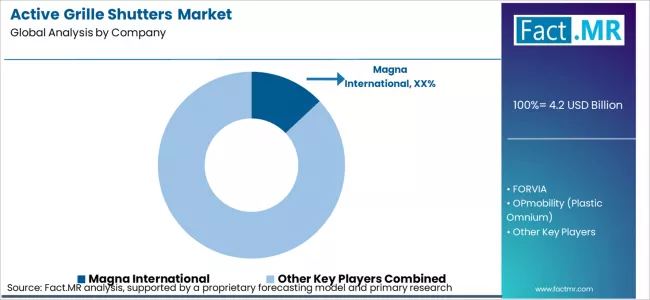
Active Grille Shutters Market Analysis By Company | Source: Fact.MR
As per Fact.MR analysis, the 2026 active grille shutters market is defined by validated aerodynamic performance, system integration, and OEM alignment, which determine competitive advantage. Magna International and FORVIA lead with high-precision modules that optimize airflow, cooling efficiency, and thermal management, which strengthens adoption in both premium and mass-market vehicles. OPmobility (Plastic Omnium) and Valeo emphasize lightweight shutter mechanisms with verified actuation speed and material durability, which improves vehicle fuel efficiency, reduces emissions, and ensures compliance with global regulatory standards. Continental and Hyundai Mobis focus on integrating shutters with vehicle sensor networks and HVAC systems, which enhances real-time system responsiveness, reduces calibration cycles, and enables predictive thermal management.
Aisin and SL Corporation offer precision-engineered shutters with validated reliability across varied climatic conditions, which supports consistent performance and reduces warranty claims. IAC Group and Denso provide modular, validated designs that simplify OEM installation and accelerate program qualification, which increases adoption across regional platforms. Market adoption is also influenced by verified energy-saving benefits, noise reduction performance, and life-cycle durability, which reinforce the value proposition for both OEMs and end-users. Across the market, validated aerodynamic gains, robust system integration, multi-region compliance, and supply chain reliability collectively form enduring competitive moats, reducing reliance on pricing or isolated component claims, and ensuring long-term leadership in this segment.
Recent Industry Developments
- Magna’s "Modular & Scalable" AGS Breakthrough (Late 2024 - 2025): Magna International recently ramped up production for its "Modular & Scalable" Active Grille Shutter assembly. This development allows automakers to create up to 90 unique grille configurations using a single standardized base. The system is specifically optimized for EV platforms, where it reduces drag by up to 9%, significantly extending electric driving range. [4]
- Ford’s Patent for "Light-Through-Shutter" Technology (September 2025): In September 2025, Ford Motor Company published a patent for a vehicle flow control system that integrates lighting directly behind or through active grille shutters. This allows future EVs to maintain a sleek, aerodynamic profile with the shutters closed, while still utilizing the area for emergency signals, off-road lighting, or branding when the shutters are operational. [5]
- Valeo’s Next-Gen AGS for European EVs (July 2025): At the IAA Mobility preview in July 2025, Valeo debuted its next generation of active grille shutters. These units are designed to work in tandem with "Predict4Range" software, which uses AI to anticipate cooling needs based on GPS data. This hardware-software integration allows for more precise shutter movements, recovering up to 24% of electric range that would otherwise be lost to thermal inefficiency.[6]
Key Players in Active Grille Shutters Market
- Magna International
- FORVIA
- OPmobility (Plastic Omnium)
- Valeo
- Continental
- Hyundai Mobis
- Aisin
- SL Corporation
- IAC Group
- Denso
Bibliography
- [1] Magna International Inc. (2026). Magna reports fourth quarter and full year 2025 results and provides 2026 outlook. Magna International Investor Relations.
- [2] U.S. Department of Transportation, National Highway Traffic Safety Administration. (2023). Laws and regulations: Vehicle fuel economy and safety standards. NHTSA; United Nations Economic Commission for Europe. (2023). Vehicle construction and efficiency regulations. UNECE.
- [3] U.S. Department of Transportation, National Highway Traffic Safety Administration. (2023). Fuel economy, emissions, and vehicle construction regulatory framework. NHTSA.
- [4] Magna International Inc. (2024). Advancing active aerodynamics: Modular and scalable active grille shutter systems. Magna International Technology & Innovation.
- [5] Ford Motor Company. (2025). Vehicle flow control system with lighting integration for active grille shutters (U.S. Patent publication). United States Patent and Trademark Office.
- [6] Valeo SA. (2025). Next-generation vehicle technologies showcased at IAA Mobility 2025. Valeo Group Press & Innovation Communications.
Segmentation
Scope of the Report
| Metric | Value |
|---|---|
| Quantitative Units | USD 4.2 billion (2026) to USD 7.3 billion (2036), CAGR 6.4% |
| Market Definition | The active grille shutters market covers electromechanical louver systems installed behind vehicle front grilles to control airflow into engine compartments. These systems regulate radiator cooling, reduce aerodynamic drag, and support fuel efficiency and thermal management. Functional and vehicle integration requirements follow U.S. NHTSA fuel economy regulations and UNECE vehicle construction rules. Active grille shutters are supplied to passenger and light commercial vehicles. |
| Product Type Segmentation | Active Grille Shutters, Integrated Shutter + Aero Flap, Thermal Management Shutters, Other |
| Actuation Segmentation | Electric Motor Actuation, Electromechanical Linear Actuators, Pneumatic Actuation, Other |
| Vehicle Type | Passenger Cars, SUVs/Crossovers, Light Commercial Vehicles, Other |
| Sales Channel | OEM Fitment, Service Replacement, Aftermarket, Other |
| Regions Covered | Asia Pacific, Europe, North America, Latin America, Middle East & Africa |
| Countries Covered | China, India, Thailand, Mexico, South Korea, United States, Germany, Japan |
| Key Companies Profiled | Magna International, FORVIA, OPmobility (Plastic Omnium), Valeo, Continental, Hyundai Mobis, Aisin, SL Corporation, IAC Group, Denso |
| Forecast Period | 2026 to 2036 |
| Approach | Hybrid top-down and bottom-up modeling using vehicle production, grille shutter fitment rates by segment, and platform-level adoption trends. Desk research used UNECE, NHTSA, UN Comtrade data, and OEM disclosures. Primary interviews involved grille shutter manufacturers, OEM suppliers, thermal engineers, and platform integration teams. |
Source: Fact.MR analysis. Updated Feb 18, 2026
Active Grille Shutters Market Analysis by Segments
-
By Product Type :
- Active Grille Shutters
- Integrated Shutter + Aero Flap
- Thermal Management Shutters
- Other
-
By Actuation :
- Electric Motor Actuation
- Electromechanical Linear Actuators
- Pneumatic Actuation
- Other
-
By Vehicle Type :
- Passenger Cars
- SUVs/Crossovers
- Light Commercial Vehicles
- Other
-
By Sales Channel :
- OEM Fitment
- Service Replacement
- Aftermarket
- Other
-
Region :
- Asia Pacific
- India
- China
- Japan
- South Korea
- Indonesia
- Australia & New Zealand
- ASEAN
- Rest of Asia Pacific
- Europe
- Germany
- Italy
- France
- United Kingdom
- Spain
- Benelux
- Nordics
- Central & Eastern Europe
- Rest of Europe
- North America
- United States
- Canada
- Mexico
- Latin America
- Brazil
- Argentina
- Chile
- Rest of Latin America
- Middle East & Africa
- Kingdom of Saudi Arabia
- United Arab Emirates
- South Africa
- Turkey
- Rest of Middle East & Africa
- Asia Pacific
Frequently Asked Questions
What is the active grille shutters market size in 2026?
What is the forecast market value by 2036?
What CAGR is expected during 2026–2036?
What was the market value in 2025?
What is the core demand anchor for active grille shutters?
Why are OEMs standardising active grille shutters across mass-market vehicles?
How does the growth profile change across the forecast period?
Which vehicle categories are most linked to higher adoption rates?
Which country is expected to grow fastest through 2036?
What is India’s expected growth rate and what drives it?
How does Thailand perform in the forecast window?
What is Mexico’s expected CAGR and what underpins it?
What is the growth outlook for South Korea?
How fast is the United States market expected to grow?
What is the growth profile for Germany?
How does Japan compare to other mature markets?
Which product type dominates market demand in 2026?
Why do standard active grille shutters lead over integrated shutter + aero flap configurations?
Which actuation technology leads in 2026?
Why is electric motor actuation preferred over pneumatic actuation in modern platforms?
Who worked on this report


Preview the report firsthand - request a free sample
Free SampleGet the brochure for pricing and purchase details
Download PDF