- Base Value(2025): 516.0 Mn
- Estimated Value(2026): 543.0 Mn
- Forecast Value (2036): 901.2 Mn
- CAGR (2026 - 2036): 5.2%
Adaptogenic Distillates Market Overview, Growth Outlook, and Forecast by Fact.MR
- In 2025, the adaptogenic distillates market was valued at USD 516.0 million.
- Demand for adaptogenic distillate products is projected to grow to USD 543.0 million in 2026 and reach USD 901.2 million by 2036.
- The market is expected to expand at a CAGR of 5.2% during the forecast period.
- The market is projected to create an absolute dollar opportunity of USD 358.0 million between 2026 and 2036.
- Market growth is driven by increasing consumer demand for functional beverages, rising awareness regarding stress-management and mental wellness solutions, and growing adoption of adaptogenic botanical ingredients in nutraceuticals and wellness formulations.
- Expanding interest in clean-label, plant-based, and beverage-compatible botanical extracts, along with the rising popularity of mushroom adaptogens and herbal wellness products, is further supporting market expansion globally.
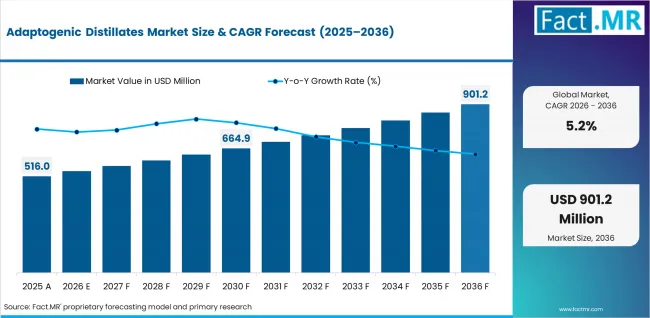
Adaptogenic Distillates Market Value Analysis | Source: Fact.MR
Summary of the Adaptogenic Distillates Market
- Market Snapshot
- Global adaptogenic distillates market revenue stood at USD 543.0 million in 2026 and is forecast to reach USD 901.2 million by 2036.
- At a CAGR of 5.2% from 2026 to 2036, the market is projected to expand nearly 1.7x, creating an absolute dollar opportunity of USD 358.0 Million.
- The growth in the market is attributed to increasing consumer demand for functional wellness drinks, growing awareness about stress-management foods and beverages, and the inclusion of adaptogenic botanical ingredients in the nutraceutical and wellness formulations.
- Growing demand for clean-label botanical extracts, plant based-wellness products and beverage-friendly adaptogenic ingredients is driving growth in both developed and emerging regions.
- The growth of premium functional beverages, botanical wellness, higher-yield extraction technology and e-commerce supplement platforms all continue to support further global expansion.
- Demand and Growth Drivers
- Growing incidence of stress lifestyle disorders and increasing consumer inclination toward natural wellness products
- Growing awareness about the use of adaptogenic ingredients instead of synthetic stress management formulations
- Increasing usage of Ashwagandha, Panax Ginseng, Holy Basil, Rhodiola Rosea, Reishi, and Cordyceps in beverage and nutraceuticals
- Development in functional beverages, liquid wellness, botanical mocktails and personalized nutraceuticals segments
- Increasing demand for:
- Natural stress-management support
- Relaxation and cognitive wellness benefits
- Clean-label and plant-based formulations
- High-bioavailability botanical ingredients
- Convenient liquid wellness delivery formats
- Functional and preventive nutrition alternatives
- Product and Segment View
- Herbal Adaptogenic Distillates account for 74.9% of source share in 2026, driven by strong commercial adoption of Ashwagandha, Ginseng, Tulsi, and Rhodiola-based formulations across beverages and nutraceutical products.
- Functional Beverages hold 33.8% of application share in 2026, supported by increasing consumer demand for wellness drinks, relaxation beverages, botanical mocktails, and clean-label functional beverage formulations.
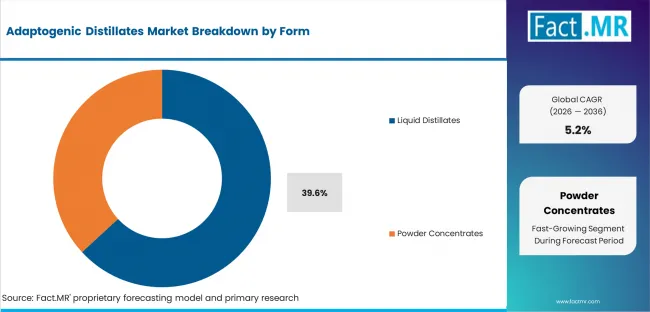
- Liquid Distillates represent 39.6% of form share in 2026, reflecting rising utilization in beverage-grade formulations, wellness shots, tinctures, and liquid nutraceutical products.
- Botanical Distillates capture 32.6% of product type share in 2026, supported by growing demand for concentrated herbal extracts and premium botanical wellness ingredients.
- Geography and Competitive Outlook
- Rising adoption of functional beverages, growing awareness regarding botanical wellness products, and increasing demand for clean-label adaptogenic ingredients are driving strong market growth across East Asia, South Asia & Pacific, and North America.
- Key growth markets in the Adaptogenic Distillates Market include India (8.4% CAGR), Japan (7.2% CAGR), China (6.9% CAGR), Canada (6.1% CAGR), United States (4.4% CAGR), United Kingdom (4.1% CAGR), and Germany (3.5% CAGR) during the forecast period.
- The growth of the market can be attributed to:
- Increasing consumer expenditure on wellness and functional nutritional products.
- Demand for adaptogenic drinks and botanically-based nutraceuticals is on the rise.
- Rising demand for mushroom adaptogens and herbal wellness products.
- Growth in the premium functional drink and clean-label nutrition segments.
- Growing popularity of direct-to-consumer wellness platforms.
- Increase in preventive health care & holistic wellness.
- Prominent players operating in the market include Organic India, Himalaya Wellness Company, Natreon Inc., PLT Health Solutions, Ixoreal Biomed, Sabinsa Corporation, Gaia Herbs, Arjuna Natural, Bio-Botanica Inc., and Givaudan Naturex.
- Analyst Opinion
- Shambhu Nath Jha, Principal Consultant at Fact.MR, opines, “The CXO leaders need to be aware of the fact that for gaining any competitive edge in the future in the Adaptogenic Distillates Market, there is going to be an increased reliance on developing high bioavailability botanical extracts systems, enhancing beverage grade adaptogenic ingredients portfolio, making use of trends related to clean labels and plant based wellness, and functional beverages and direct consumer marketing approaches.
Adaptogenic Distillates Market — At a Glance
| Attribute | Details |
|---|---|
| Market Value 2025 | USD 516.0 Million |
| Market Value 2026 | USD 543.0 Million |
| Market Value 2036 | USD 901.2 Million |
| Absolute Dollar Opportunity | USD 358.0 Million |
| Total Growth | 65.90% |
| CAGR | 5.20% |
| Growth Multiple | 1.7x |
| Key Demand Theme | Rising demand for functional wellness beverages and botanical stress-management solutions |
| Leading Source Segment | Herbal Adaptogenic Distillates |
| Source Segment Share | 74.90% |
| Leading Product Type | Botanical Distillates |
| Product Type Share | 32.60% |
| Leading Form Segment | Liquid Distillates |
| Form Segment Share | 39.60% |
| Leading Application | Functional Beverages |
| Application Share | 33.80% |
| Leading Extraction Technology | Steam Distillation |
| Extraction Technology Share | 26.80% |
| Leading End User | Beverage Manufacturers |
| End User Share | 35.40% |
| Key Growth Regions | East Asia, South Asia & Pacific, North America |
| Key Companies | Organic India, Natreon Inc., Sabinsa Corporation, Ixoreal Biomed, Arjuna Natural |
| Segmentation by Source | Herbal Adaptogenic Distillates, Mushroom Adaptogenic Distillates |
| Segmentation by Product Type | Botanical Distillates, Essential Adaptogenic Oils, Water-Soluble Distillates, Full-Spectrum Distillates, Standardized Extract Distillates, Organic Distillates |
| Segmentation by Form | Liquid Distillates, Oils, Powder Concentrates, Water-Soluble Extracts, Semi-solid Extracts |
| Segmentation by Application | Functional Beverages, Nutraceuticals & Dietary Supplements, Food Industry, Cosmetics & Personal Care, Pharmaceuticals, Sports Nutrition |
| Segmentation by Extraction Technology | Steam Distillation, CO₂ Extraction, Ethanol Extraction, Cold Extraction, Vacuum Distillation, Nano-Extraction Technologies |
| Segmentation by End User | Beverage Manufacturers, Nutraceutical Companies, Cosmetic Companies, Pharmaceutical & Herbal Medicine Firms |
| Segmentation by Region | North America, Latin America, East Asia, South Asia & Pacific, Western Europe, Eastern Europe, Middle East & Africa |
Source: Fact.MR analysis. Updated May 22, 2026
Key Growth Drivers, Constraints, and Opportunities
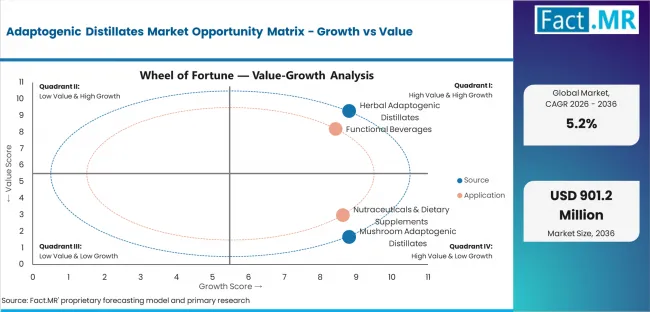
Adaptogenic Distillates Market Opportunity Matrix Growth Vs Value | Source: Fact.MR
Key Factors Driving Growth
- Increasing demand from consumers for functional wellness drinks, stress-relief solutions, and preventive health care is accelerating the adoption of adaptogenic distillates globally.
- The trend towards clean-label, plant-based and high-bioavailability botanical ingredients rather than synthetic wellness formulations is driving market growth within the nutraceutical and beverage industry.
- The rapid growth of adaptogens including Ashwagandha, Ginseng, Rhodiola in functional drinks, liquid wellness and personalized nutrition solutions is contributing to the overall market growth.
| Growth Driver | Demand Impact | Time Horizon | Key Impact Area | Fact.MR Insight |
|---|---|---|---|---|
| Rising consumer demand for functional wellness beverages | High | Short–Mid Term | Demand for adaptogenic drinks & liquid wellness products | Increasing consumer preference for stress-management beverages and botanical wellness formulations is accelerating demand for beverage-grade adaptogenic distillates globally. |
| Growing preference for clean-label and plant-based wellness products | High | Short–Mid Term | Clean-label nutraceuticals & botanical ingredient adoption | Consumers are increasingly shifting toward natural, high-bioavailability botanical extracts and plant-based preventive wellness solutions across nutraceutical and functional beverage industries. |
| Expanding adoption of adaptogenic ingredients in functional nutrition | Medium–High | Mid–Long Term | Product innovation & premium wellness positioning | Adaptogens such as Ashwagandha, Ginseng, Rhodiola, Reishi, and Cordyceps are witnessing strong commercialization across wellness beverages, nutraceuticals, and personalized nutrition products. |
| Increasing penetration of e-commerce wellness platforms | Medium–High | Mid–Long Term | Digital wellness retail & consumer accessibility | Rapid expansion of direct-to-consumer supplement brands and online wellness platforms is improving global accessibility of adaptogenic distillate products. |
| Rising development of advanced extraction technologies | Medium–High | Mid–Long Term | Scientific substantiation & premium product development | Increasing investment in CO₂ extraction, nano-extraction technologies, and water-soluble botanical formulations is supporting commercialization of high-purity adaptogenic distillates. |
Source: Fact.MR analysis. Updated May 22, 2026
Key Market Constraints
- Botanical ingredient approvals, functional health claims and standardization of extracts are subject to complex legislation, which may limit commercialization in some countries.
- Differences in quality of raw materials, concentration of active compounds and botanical origin pose formulation and supply chain challenges to the manufacturers.
- The lack of clinical support for some adaptogenic ingredients might influence consumer confidence and wider acceptance within medical circles.
Key Opportunity Areas
- The growing consumer preference for preventive wellness and stress management solutions will further aid the long-term growth of adaptogenic distillate manufacturers.
- The rising demand for beverage-friendly botanical extracts, personalized wellness solutions and scientifically proved adaptogenic products is driving up opportunities for product innovation in the premium space.
- Increase in demand for functional beverages, herbal mocktails, mushroom wellness products and liquid nutraceutical products will help in rapid penetration among younger generations of consumers.
Segment-wise Analysis of the Adaptogenic Distillates Market
- Herbal Adaptogenic Distillates account for 74.9% share of the source segment in 2026, driven by strong commercial adoption of Ashwagandha, Panax Ginseng, Holy Basil, and Rhodiola-based formulations across functional beverages, nutraceuticals, and botanical wellness products globally.
- Botanical Distillates represent 32.6% share of the product type segment in 2026, supported by rising demand for concentrated herbal extracts, premium botanical wellness ingredients, and increasing incorporation into functional nutrition and beverage-grade formulations.
- Functional Beverages account for 33.8% share of the application segment in 2026, driven by increasing consumer demand for stress-management drinks, botanical mocktails, relaxation beverages, and clean-label functional wellness products.
The Adaptogenic Distillates Market is segmented by source, product type, form, application, extraction technology, end user, and region.
Which Source Segment Topped the Adaptogenic Distillates Market?
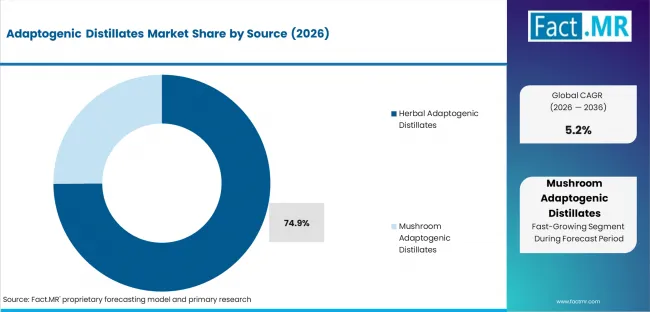
Adaptogenic Distillates Market Analysis By Source | Source: Fact.MR
The herbal adaptogenic distillates segment is anticipated to hold the largest share of 74.9% in the Adaptogenic Distillates Market by 2026. This is attributed to the growing demand for herbal stress-management products across the world, increasing adoption of adaptogenic formulations based on Ashwagandha, Panax Ginseng, Holy Basil, Rhodiola, and the application of these herbal adaptogens in functional beverages, nutraceuticals, botanical wellness products, and preventive healthcare products.
Which Product Type Segment Accounts for the Highest Share in the Market?
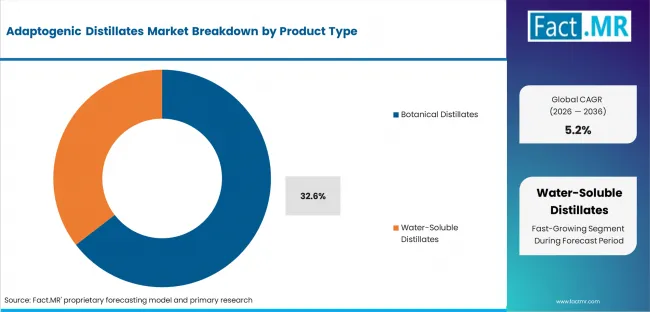
Adaptogenic Distillates Market Analysis By Product Type | Source: Fact.MR
Botanical Distillates are projected to dominate the product type segment with 32.6% of the share in 2026. This dominance is attributed to increasing demand for concentrated botanical extracts, premium wellness formulations, high-purity herbal ingredients and widening application of botanical distillates in functional beverages, liquid nutraceuticals, and clean label wellness products across the world.
Which Form Segment Leads the Market?
Adaptogenic Distillates Market Analysis By Form | Source: Fact.MR
Liquid Distillates are expected to account for the largest 39.6% share of the market in 2026, due to the rising consumer preference for beverage-able wellness ingredients, liquid nutraceuticals, tinctures, wellness shots, and botanical formulations with high bioavailability. The segment growth is also driven by rising demand for functional beverages and easy to consume liquid wellness delivery systems.
Which End User Segment Holds the Largest Share in the Market?
Adaptogenic Distillates Market Analysis By End User | Source: Fact.MR
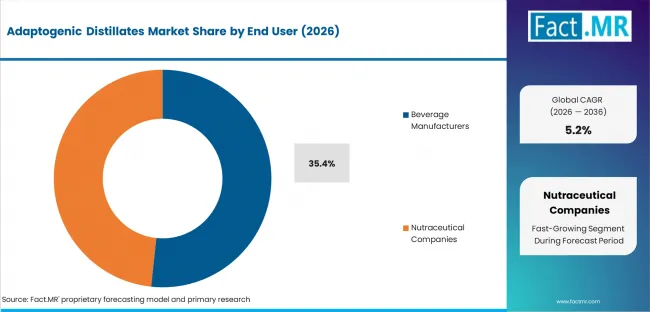
The end use segment of beverage manufacturers is anticipated to hold the largest share of 35.4% in 2026. This surge growth is led by the growth of functional wellness beverages, adaptogenic drink innovations, botanical mocktails, and clean-label beverage formulations. Rising consumer’s taste for convenient wellness beverages is additionally driving the demand from the beverage manufacturers globally.
Regional Outlook Across Key Markets
North America, Latin America, Western Europe, Eastern Europe, East Asia, South Asia & Pacific, and Middle East & Africa are the regions covered in this report. It includes detailed analysis of consumer demand for functional wellness beverages, adoption of adaptogenic botanical ingredients, expansion of nutraceutical and botanical wellness industries, growth of e-commerce and direct-to-consumer wellness platforms, increasing preference for clean-label and plant-based formulations, advancements in botanical extraction technologies, regulatory developments related to herbal wellness products, and rising consumption of adaptogenic distillates across functional nutrition, preventive healthcare, and beverage-grade wellness applications globally.
.webp "Top Country Growth Comparison Adaptogenic Distillates Market Cagr (2026 2036)")
Top Country Growth Comparison Adaptogenic Distillates Market Cagr (2026 2036) | Source: Fact.MR
CAGR Table
| Country | CAGR (%) |
|---|---|
| India | 8.4% |
| Japan | 7.2% |
| China | 6.9% |
| United Kingdom | 4.1% |
| United States | 4.4% |
| Germany | 3.5% |
| Canada | 6.1% |
Source: Fact.MR analysis. Updated May 22, 2026
Source: Fact.MR (FMR) analysis, based on proprietary forecasting model and primary research.
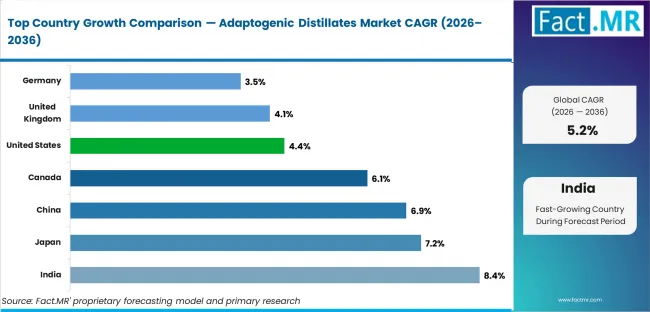
Adaptogenic Distillates Market Cagr Analysis By Country | Source: Fact.MR
North America Adaptogenic Distillates Market
Adaptogenic Distillates Market Country Value Analysis | Source: Fact.MR
North America represents one of the most commercially mature regions in the Adaptogenic Distillates Market owing to strong demand for functional wellness beverages, rising adoption of botanical nutraceuticals, increasing consumer focus on stress-management solutions, and expanding penetration of clean-label wellness products. Growth in direct-to-consumer supplement platforms, premium botanical beverage brands, and beverage-compatible adaptogenic ingredients continues to strengthen regional demand.
- United States: Demand for adaptogenic distillates in the U.S. is projected to rise at 4.4% CAGR through 2036. Growth is driven by increasing consumption of functional beverages, rising demand for stress-management wellness products, expansion of premium botanical nutraceuticals, and growing adoption of preventive wellness solutions.
- Canada: Demand for adaptogenic distillates in Canada is projected to grow at 6.1% CAGR through 2036, supported by rising consumer preference for mushroom adaptogens, increasing clean-label wellness spending, and growing adoption of plant-based functional nutrition products.
Europe Adaptogenic Distillates Market
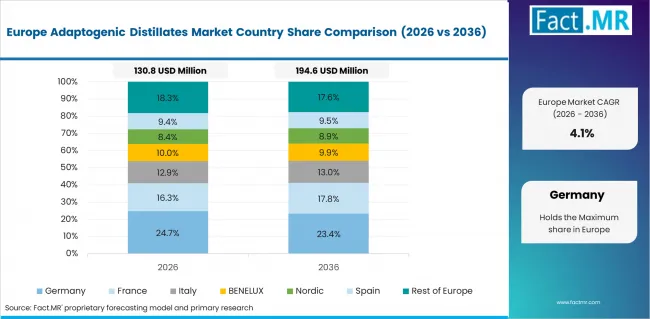
Adaptogenic Distillates Market Europe Country Market Share Analysis, 2026 & 2036 | Source: Fact.MR
Europe accounts for a strong botanical wellness and herbal nutraceutical market due to increasing consumer preference for natural healthcare products, growing demand for premium botanical extracts, and rising adoption of preventive wellness formulations. The region is witnessing increasing commercialization of clean-label functional beverages, herbal wellness products, and high-bioavailability botanical ingredients. Companies including Himalaya Wellness, Sabinsa Corporation, and regional botanical wellness brands are strengthening their market position through premium adaptogenic extract portfolios and beverage-grade ingredient innovations.
- Germany: Demand for adaptogenic distillates in Germany is projected to rise steadily through 2036, supported by increasing demand for scientifically validated botanical extracts, functional nutrition products, and premium herbal wellness formulations.
- United Kingdom: Demand for adaptogenic distillates in the United Kingdom is projected to rise at 4.1% CAGR through 2036, driven by increasing adoption of functional beverages, clean-label nutraceuticals, and botanical stress-management solutions.
East Asia Adaptogenic Distillates Market
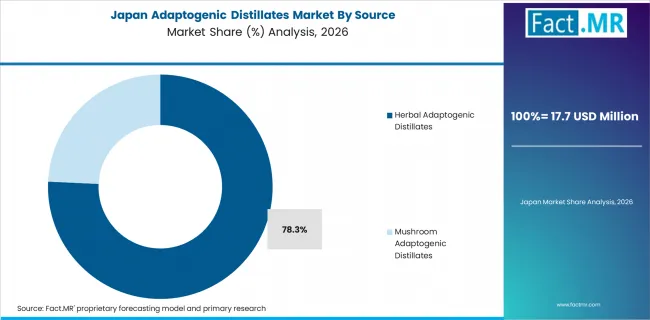
Adaptogenic Distillates Market Japan Market Share Analysis By Source | Source: Fact.MR
East Asia is estimated to dominate the market over the forecast period due to the strong cultural roots of traditional herbal medicines, growing functional beverage consumption, increasing disposable income of middle class towards wellness, and expanding consumer base for adaptogenic wellness products. Regional producers are focusing more on mushroom adaptogens, botanicals extracts that are compatible with beverages, and personalized wellness nutrition solutions.
- China: Demand for adaptogenic distillates in China is projected to rise at 6.9% CAGR through 2036, driven by growing herbal supplement consumption, increasing functional beverage demand, rising preventive healthcare awareness, and expansion of botanical wellness product commercialization.
- Japan: Demand for adaptogenic distillates in Japan is expected to grow at 7.2% CAGR through 2036 due to rising demand for functional wellness beverages, increasing aging population wellness requirements, growing adoption of stress-management formulations, and expansion of premium nutraceutical categories.
- South Korea: Demand for adaptogenic distillates in South Korea is projected to rise steadily through 2036, supported by increasing demand for cognitive wellness products, mushroom adaptogens, and clean-label functional nutrition solutions.
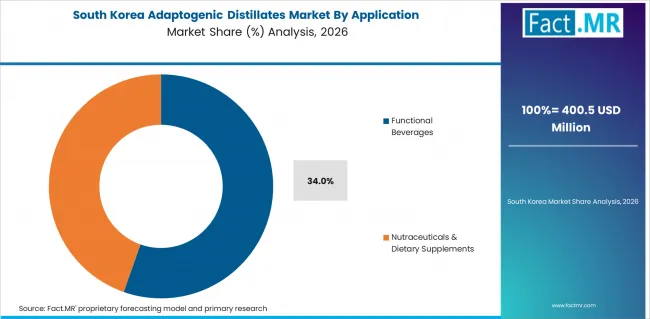
Adaptogenic Distillates Market South Korea Market Share Analysis By Application | Source: Fact.MR
South Asia & Pacific Adaptogenic Distillates Market
South Asia & Pacific is anticipated to be the fastest-growing region in the Adaptogenic Distillates Market due to strong Ayurvedic heritage, expanding herbal supplement industries, increasing wellness spending, and rising adoption of botanical stress-management products. Regional companies are aggressively commercializing adaptogen-infused beverages, liquid wellness products, and clean-label botanical nutraceuticals.
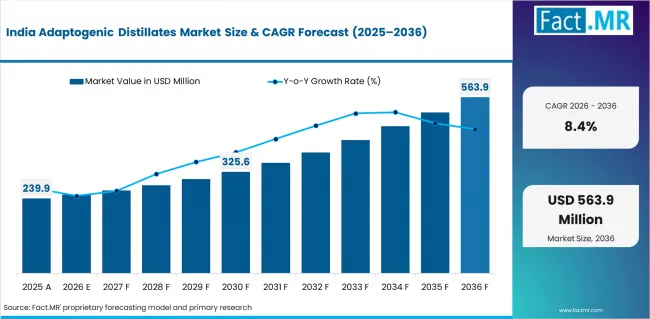
- India: Demand for adaptogenic distillates in India is projected to rise at 8.4% CAGR through 2036, driven by increasing adoption of Ayurvedic wellness products, rapid expansion of herbal nutraceutical brands, growing demand for Ashwagandha-based formulations, and rising consumer preference for preventive healthcare solutions.
Latin America Adaptogenic Distillates Market
Growth of botanical wellness products in Latin America is supported by increasing awareness regarding preventive wellness, expanding herbal nutraceutical distribution channels, and growing demand for functional beverages and plant-based supplements. Urban consumer populations are increasingly adopting adaptogenic wellness products and clean-label botanical formulations.
- Brazil: Demand for adaptogenic distillates in Brazil is projected to rise steadily through 2036, supported by increasing demand for herbal wellness supplements, rising functional beverage consumption, and growing consumer preference for natural stress-management solutions.
The Fact.MR report provides a thorough analysis of the trends, competitive benchmark, extraction technology, commercializing of botanical ingredients, consumer wellness behavior, regulatory schemas, and long-term growth opportunities within North America, Latin America, Europe, East Asia, South Asia & Pacific, and Middle East& Africa. Readers will learn about the expansion of functional beverages, the use of adaptogenic ingredients, clean-label wellness trends, the progression of e-commerce, and the potential opportunities for growth in global botanical wellness and preventive healthcare markets in the future.
Competitive Benchmarking and Company Positioning
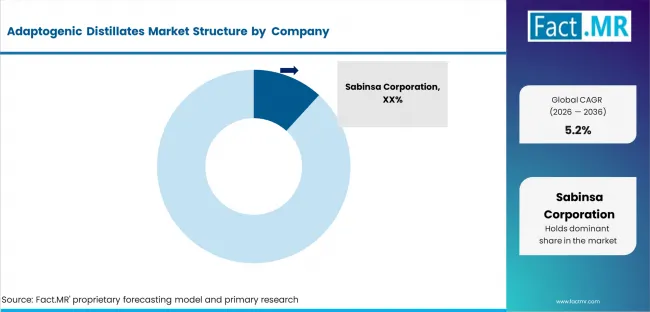
Adaptogenic Distillates Market Analysis By Company | Source: Fact.MR
Leading Companies Shaping the Adaptogenic Distillates Market
The market is divided and the leading players in the market arePure Indian FoodsAncient Wisdom, Organic India, Himalaya Wellness Company, Natreon Inc, PLT Health Solutions, Ixoreal Biomed, Sabinsa Corporation, Gaia Herbs, Arjuna Natural, Bio-Botanica Inc, and DSM – Firmenich. Competitive differentiation is based on extraction technology, ingredient standardization, beverage system compatibility, clean-label positioning and source transparency in botanicals. Prominent players are expanding their market reach through high-bioavailability adaptogenic extracts, mushroom wellness formulations, premium botanicals beverages and functional nutrition inventions.
More companies are producing beverage-grade botanical ingredients, liquid wellness products, stress management formulations, personalized nutraceutical systems and more. On the other hand, local and upstart companies are competing with ayurvedic product lines, direct-to-consumer wellness platforms, affordable botanical formulations, and rapid product launches of functional wellness beverages globally.
Recent Industry Developments
- Arjuna Natural – Showcase of Botanical Innovations at HI Japan 2025 (October 2025)
- Arjuna Natural showcased its clinically studied botanical extracts and nutraceutical innovations at HI Japan 2025, highlighting science-backed herbal ingredients, adaptogenic wellness solutions, and functional nutrition applications. The participation strengthened the company’s visibility in the Asia-Pacific botanical ingredient market and reinforced its positioning in premium wellness and preventive healthcare formulations. [1]
- Sabinsa Corporation – Introduction of LactoBeet™ and C3 Reduct® at Vitafoods Europe 2025 (April 2025)
- Sabinsa Corporation introduced LactoBeet™ and showcased C3 Reduct® at Vitafoods Europe 2025 to expand its science-backed botanical ingredient portfolio for nutraceutical and functional wellness applications. The initiative strengthened Sabinsa’s market presence in beverage-compatible botanical extracts, high-bioavailability wellness ingredients, and premium adaptogenic formulations targeting preventive healthcare and functional nutrition markets. [2]
- Four Sigmatic – Launch of 11 New Functional Mushroom and Adaptogen Products (February 2025)
- Four Sigmatic announced the launch of 11 new functional mushroom and adaptogen-based products, including lion’s mane coffee blends and wellness beverage formulations targeting cognitive wellness, focus, and stress-management applications. The expansion strengthened the company’s commercialization strategy in mushroom adaptogens and functional wellness beverages while supporting rising global demand for clean-label botanical nutrition products. [3]
- Arjuna Natural – Expansion of India’s Botanical Manufacturing and Nutraceutical Ecosystem (July 2025)
- Arjuna Natural highlighted India’s growing role as a global nutraceutical and botanical manufacturing hub, emphasizing expansion of botanical extract production, wellness ingredient commercialization, and science-backed herbal formulations. The initiative reinforced the company’s position in adaptogenic ingredient manufacturing and supported rising international demand for functional wellness and preventive healthcare products. [4]
- Arjuna Natural – Participation at Bharat Nutraverse Expo 2025 (September 2025)
- Arjuna Natural showcased its nutraceutical and botanical extract innovations at Bharat Nutraverse Expo 2025 in New Delhi, highlighting clinically studied botanical ingredients, functional wellness formulations, and science-backed nutraceutical solutions for global wellness and preventive healthcare markets. The initiative strengthened the company’s visibility across adaptogenic wellness, functional beverage, and botanical ingredient commercialization sectors. [5]
Leading Companies Shaping the Adaptogenic Distillates Market
- Organic India
- Himalaya Wellness Company
- Natreon Inc.
- PLT Health Solutions
- Ixoreal Biomed
- Sabinsa Corporation
- Gaia Herbs
- Arjuna Natural
- Bio-Botanica Inc.
- Givaudan Naturex
Sources and Research References
- [1] Arjuna Natural, “Arjuna Natural Showcases Botanical Innovations at HI Japan 2025”, October 2025
- [2] Sabinsa Corporation, “Sabinsa to Introduce LactoBeet™ and Showcase C3 Reduct® at Vitafoods Europe 2025”, April 2025
- [3] Four Sigmatic, “Four Sigmatic To Debut 11 New Products By Summer 2025”, February 2025
- [4] Arjuna Natural, “India’s Rise in Nutraceuticals & Botanicals Manufacturing”, July 2025
- [5] Arjuna Natural, “At the Bharat Nutraverse Expo 2025”, September 2025
Adaptogenic Distillates Market Definition
Adaptogenic distillates market is a segment of the botanical ingredient market and pertains to concentrated adaptogenic extracts which find use in stress relief, mental health, relaxation, and as cognitive supportive and functional nutrition ingredients. These products are made from botanical and Mushroom Adaptogens like Ashwagandha, Ginseng, Rhodiola, Reishi, Cordyceps and more in liquid distillates, oils, powders and extracts that are compatible with beverages. The market encompasses the world functional beverages, nutraceuticals, herbal wellness, cosmetics, and preventive healthcare sectors and is growing as the demand for clean-label, plant-based, and high-bioavailability wellness formulations keep increasing.
Adaptogenic Distillates Market Inclusions
The report covers the global and regional market with an in-depth analysis for the 2026–2036 years. It provides a detailed analysis of the major market segments by source, product type, form, application, extraction technology, distribution channel, and end user and analyzes region-wise adoption trends, competitive landscape, consumer wellness preferences, extraction innovations and development of botanical ingredients. It also underlines new trends such as functional wellness beverages, beverage-grade botanical extracts, mushroom adaptogens, clean-label formulations, ingredients with high bioavailability, products for preventive healthcare, and the expansion of direct-to-consumer wellness platforms.
Adaptogenic Distillates Market Exclusions
This evaluation is for botanical distillates, adaptogen extracts and concentrated formulations based on herbs and mushrooms for stress management, functional wellness, cognitive support, relaxation, and preventive nutrition markets. To be sure, the analysis does not cover synthetic pharmaceutical ingredients, therapeutic products that require a prescription, psychiatric drugs, or chemical wellness formulations that are not botanical. The report also excludes general nutritionals positioned at sports performance, immunity, weight management, digestive health or traditional vitamin and mineral supplementation, unless they include adaptogenic distillates or botanical wellness ingredients for application in functional health or stress applications.
Adaptogenic Distillates Market Research Methodology
- Primary Research
- For analyzing the size of Adaptogenic Distillates Market, top-down and bottom-up approaches were used from the global perspective. Multiple rounds of primary interviews were conducted with manufacturers of botanical extracts, adaptogenic ingredients and functional beverages, nutraceutical brands, wellness product formulators, distributors, retailers, and industry consultants to confirm market trends, pricing models, innovation strategies, demand forecasts, and regional adoption trends relating to applications in wellness and functional nutrition.
- Desk Research
- The report includes information obtained from company annual reports and investor presentations, botanical extract industry publications, nutraceutical journals, white papers on the wellness market, studies on adaptogens, government health databases, documentation from regulatory bodies, trade statistics, as well as functional beverage reports. Other references were the scientific literature regarding herbal adaptogens, extraction technologies, clean label wellness ingredients, preventive healthcare products, and global trends in plant-based nutrition and functional wellness formulations.
- Market-Sizing and Forecasting
- The market sizing calculation estimates the value of sales manufactured adaptogenic distillates, botanical extracts, and functional wellness ingredients by ingredient manufacturers, applying bottom-up analysis, cross-validated with top-down market assessment across the broader space of adaptogens, botanical extracts, nutraceuticals, and functional beverages. The forecast took into account regional demand trends, consumption at application level, penetration of extraction technologies, trends in ingredient commercialization, and evolving consumer preference for beverage-compatible and clean-label botanical solutions.
- Data Validation and Update Cycle
- Market forecasts were verified by triangulating primary interviews, company financial analysis, ingredient demand analysis, wellness retail trends, e-commerce penetration, regional botanical usage, and historical performance of the adaptogen market. Projections are subject to periodic revision in response to evolving consumer wellness behavior, regulatory progress, extraction technology advances, product innovation, scientific substantiation of adaptogenic ingredients, growth of direct-to-consumer wellness platforms, and global preventive healthcare and functional beverage trends.
Segmentation
Scope of Analysis
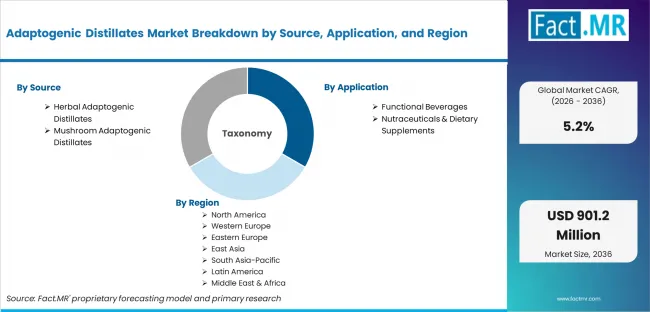
Adaptogenic Distillates Market Breakdown By Source, Application, And Region | Source: Fact.MR
Parameter |
Details |
|---|---|
| Quantitative Units | USD 516.0 million (2025) to USD 901.2 million (2036) |
| Market Definition | The Adaptogenic Distillates Market comprises concentrated botanical and mushroom-based adaptogenic extracts used in functional beverages, nutraceuticals, wellness formulations, cosmetics, and preventive healthcare products for stress-management, cognitive wellness, relaxation, and functional nutrition applications. |
| Regions Covered | North America, Latin America, East Asia, South Asia & Pacific, Western Europe, Eastern Europe, Middle East & Africa |
| Countries Covered | USA, Canada, Germany, United Kingdom, China, Japan, India, Brazil, South Korea |
| Key Companies | Organic India, Himalaya Wellness Company, Natreon Inc., PLT Health Solutions, Ixoreal Biomed, Sabinsa Corporation, Gaia Herbs, Arjuna Natural, Bio-Botanica Inc., DSM-Firmenich |
| Forecast Period | 2026 to 2036 |
| Approach | Hybrid demand-side and top-down market estimation methodology supported by primary interviews, company analysis, extraction technology assessment, wellness consumption trends, and botanical ingredient commercialization analysis |
Source: Fact.MR analysis. Updated May 22, 2026
Analysis by Source, Product Type, Form, Application, Extraction Technology, End User, and Region
-
Adaptogenic Distillates Market by Source
- Herbal Adaptogenic Distillates
- Ashwagandha
- Panax Ginseng
- Holy Basil
- Rhodiola Rosea
- Schisandra
- Astragalus
- Mushroom Adaptogenic Distillates
- Reishi
- Cordyceps
- Lion’s Mane
- Chaga
- Herbal Adaptogenic Distillates
-
Adaptogenic Distillates Market by Product Type
- Botanical Distillates
- Essential Adaptogenic Oils
- Water-Soluble Distillates
- Full-Spectrum Distillates
- Standardized Extract Distillates
- Organic Distillates
-
Adaptogenic Distillates Market by Form
- Liquid Distillates
- Oils
- Powder Concentrates
- Water-Soluble Extracts
- Semi-solid Extracts
-
Adaptogenic Distillates Market by Application
- Functional Beverages
- Wellness Drinks
- Relaxation Beverages
- Energy Tonics
- Non-alcoholic Botanical Spirits
- Nutraceuticals & Dietary Supplements
- Capsules
- Gummies
- Tinctures
- Liquid Shots
- Food Industry
- Functional Snacks
- Protein Blends
- Herbal Foods
- Cosmetics & Personal Care
- Anti-stress Skincare
- Botanical Serums
- Wellness Beauty Products
- Pharmaceuticals
- Herbal Therapeutic Formulations
- Stress-management Formulations
- Sports Nutrition
- Recovery Support
- Performance Enhancement
- Endurance Products
- Functional Beverages
-
Adaptogenic Distillates Market by Extraction Technology
- Steam Distillation
- CO₂ Extraction
- Ethanol Extraction
- Cold Extraction
- Vacuum Distillation
- Nano-Extraction Technologies
-
Adaptogenic Distillates Market by End User
- Beverage Manufacturers
- Nutraceutical Companies
- Cosmetic Companies
- Pharmaceutical & Herbal Medicine Firms
-
Adaptogenic Distillates Market by Region
- North America
- USA
- Canada
- Mexico
- Latin America
- Brazil
- Chile
- Rest of LATAM
- East Asia
- China
- Japan
- South Korea
- Taiwan
- South Asia & Pacific
- India
- Singapore
- Australia
- ASEAN
- Western Europe
- Germany
- France
- U.K.
- Italy
- Spain
- BENELUX
- Nordic
- Rest of Western Europe
- Eastern Europe
- Poland
- Hungary
- Czech Republic
- Balkan & Baltics
- Rest of Eastern Europe
- Middle East and Africa
- Kingdom of Saudi Arabia
- United Arab Emirates
- South Africa
- Rest of Middle East and Africa
- North America
Frequently Asked Questions
How large is the demand for Adaptogenic Distillates in the global market in 2025?
What will be the market size of the Adaptogenic Distillates Market by 2036?
What is the expected demand growth for the Adaptogenic Distillates Market between 2026 and 2036?
How significant is the growth outlook for India in this market?
Which company is identified as a leading player in the Adaptogenic Distillates Market?
Who worked on this report


Preview the report firsthand - request a free sample
Free SampleGet the brochure for pricing and purchase details
Download PDF