- Market Value (2025): USD 4.0 Bn
- Estimated Value (2026): USD 4.6 Bn
- Forecast Value (2036): USD 18.8 Bn
- CAGR (2026-2036): 15.1%
What is the Adversarial Algorithmic Competition and Defensive AI Market forecast to be worth by 2036?
The market is projected to grow from USD 4.6 billion in 2026 to USD 18.8 billion by 2036, registering a CAGR of 15.1%.
- The Adversarial Algorithmic Competition and Defensive AI market reached USD 4.0 billion in 2025.
- Demand is forecast to increase from USD 4.6 billion in 2026 to USD 18.8 billion by 2036.
- The market is expected to advance at a CAGR of 15.1% from 2026 to 2036.
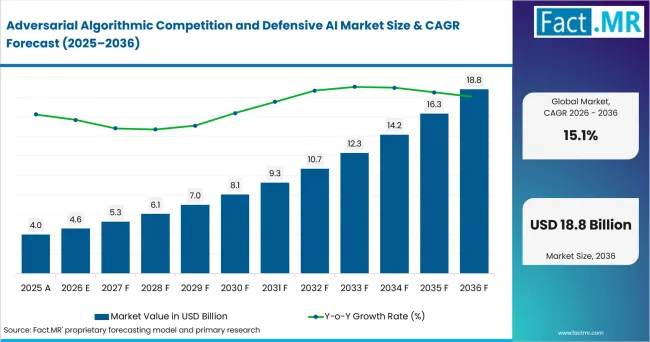
Adversarial Algorithmic Competition And Defensive Ai Market Value Analysis | Source: Fact.MR
What are the defining numbers behind Adversarial Algorithmic Competition and Defensive AI Market growth?
An absolute dollar opportunity of USD 14.2 billion is expected between 2026 and 2036.
- Demand Drivers in the Market
- Organizations are transferring operational authority to AI systems that make decisions, move money, and trigger business actions, which creates a directly attackable surface. NIST’s adversarial machine learning taxonomy, published in March 2025, catalogs attacks against predictive and generative AI at every lifecycle stage, from data poisoning and evasion to prompt injection and model extraction.
- The attack surface widens sharply when a model can access proprietary data, invoke tools, or act through agents. Prompt injection and tool misuse can turn a trusted assistant into an unintended operator, which is pushing security teams to test model behavior before release and monitor it continuously after deployment.
- Regulatory pressure is converting voluntary security practice into compliance obligations. The EU AI Act entered its main application phase in August 2026, and national frameworks such as Australia’s Voluntary AI Safety Standard and Japan’s AI Guidelines for Business now ask developers and deployers to manage AI-specific risk, including adversarial testing and incident readiness.
- Cloud and platform vendors are embedding defensive controls directly into AI development and runtime environments. Cisco launched AI Defense in January 2025, Google Cloud introduced AI Protection in March 2025, and AWS extended Bedrock Guardrails with automated reasoning checks in December 2024, normalizing the purchase of defensive AI alongside model services.
- Frontier and enterprise model evaluation is becoming institutionalized. The UK established its AI Security Institute in February 2025 with a criminal misuse team, Canada launched its Artificial Intelligence Safety Institute in November 2024 with CAD 50 million over five years, and Singapore’s IMDA released Project Moonshot in May 2024 as an open-source red-teaming toolkit.
- Generative AI adoption across IT, telecom, financial services, and the public sector is creating large, recurring demand for validation. Microsoft open-sourced PyRIT in February 2024 to automate generative AI red teaming, placing repeatable adversarial tests inside developer and security workflows before models reach production.
- Key Segments Analyzed
- Defensive AI Platforms anchor the Solution Type segment with a 38.0% share in 2026, as buyers consolidate discovery, testing, policy, and runtime monitoring under one operating layer.
- Cloud Deployment leads the Deployment Model segment at 44.0% in 2026, since model access, data pipelines, and application orchestration increasingly run through cloud services and APIs.
- IT & Telecommunications is the largest End-use Industry, taking 41.0% of demand in 2026, because network operators and technology firms run the highest density of AI workloads and face the broadest attack exposure.
- Large Enterprises anchor the Customer Category segment with a 43.0% share in 2026.
- Adversarial Detection Models anchor the AI Security Framework segment with a 39.0% share in 2026.
- Analyst Opinion at Fact.MR
- Shambhu Nath Jha, Sr. Consultant at Fact.MR, opines: “Defensive AI spend depends on whether a buyer can test model and agent behavior against real access paths, tools, and data. Predeployment testing that never connects to runtime enforcement leaves security teams with evidence but no control. The stronger platforms link discovery, adversarial testing, policy enforcement, and response so teams can make a defensible release decision and contain unsafe behavior after deployment.”
- Strategic Implications
- Platform vendors should unify discovery, adversarial testing, policy enforcement, and runtime monitoring in one policy layer, because buyers increasingly consolidate defensive AI spend instead of buying separate point tools.
- Testing providers should map their attack libraries to the NIST AI 100-2e2025 taxonomy and the NIST AI Risk Management Framework generative AI profile, since reproducible, standards-aligned evidence is becoming a purchasing requirement.
- Cloud-first delivery should be the default for new products, with private and on-premise options retained for regulated buyers that require data residency and strict control over model endpoints.
- Vendors should invest in agentic AI coverage, including tool-use monitoring and prompt-injection defense, because agent deployments are the fastest-growing source of new attack surface.
- Incident response and red-teaming services should be packaged with platform licenses, as recurring revenue depends on continuous validation rather than one-time assessments.
How does the Adversarial Algorithmic Competition and Defensive AI Market break down by segment?
The report evaluates Solution Type, Deployment Model, End-use Industry, Customer Category, AI Security Framework, and Region. Solution Type includes Defensive AI Platforms, Red Teaming Services, Model Validation Services, and Security Monitoring. Deployment Model covers Cloud Deployment, Edge Deployment, On-premises Deployment, and Critical Infrastructure. End-use Industry includes IT & Telecommunications, Banking & Financial Services, Healthcare, and Government & Defense. Customer Category covers Large Enterprises, Financial Institutions, Healthcare Providers, and Public Sector Agencies. AI Security Framework includes Adversarial Detection Models, Adversarial Training, Explainable AI Security, Decision Integrity Monitoring, and Continuous AI Monitoring. The regional structure follows North America, Latin America, Western Europe, Eastern Europe, East Asia, South Asia and Pacific, and Middle East & Africa.
Why do Defensive AI Platforms lead Solution Type?
Defensive AI Platforms is projected to account for a 38.0% share in 2026.
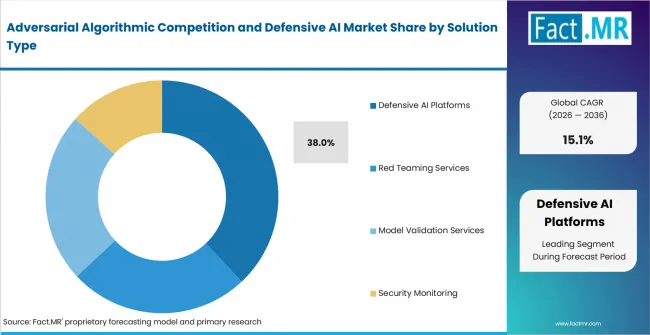
Adversarial Algorithmic Competition And Defensive Ai Market Analysis By Solution Type | Source: Fact.MR
Enterprise buyers need one operating layer across the control lifecycle, supporting discovery, adversarial testing, policy enforcement, runtime monitoring, and response. Separate tools can identify narrow issues, but they leave evidence and ownership fragmented. An integrated platform gives the security team a shared inventory and a consistent enforcement path across model providers, and it can connect predeployment test findings to runtime controls. Cisco announced AI Defense in January 2025 with AI discovery, automated model validation, algorithmic red teaming, and runtime security in one enterprise offer, illustrating how the platform model is displacing point solutions.
Why does Cloud Deployment lead Deployment Model?
Cloud Deployment is projected to account for a 44.0% share in 2026.
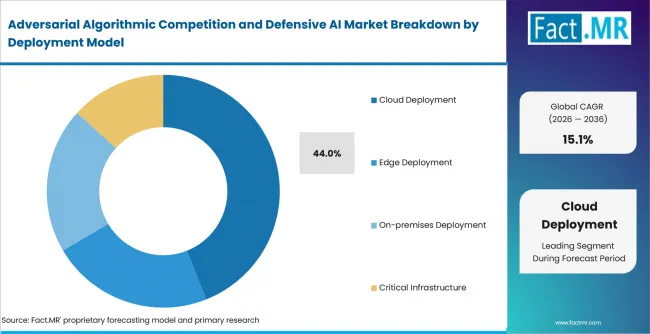
Adversarial Algorithmic Competition And Defensive Ai Market Analysis By Deployment Model | Source: Fact.MR
Foundation model access, data pipelines, and application orchestration increasingly run through cloud services and APIs, so security controls placed close to these interfaces can inspect prompts and responses without a separate appliance for every application. Central updates let providers respond to new attack patterns across all customers at once, and subscription pricing tracks model usage and the number of protected applications. Google Cloud introduced AI Protection in March 2025 with AI inventory, virtual red teaming, Model Armor, and threat response integrated into Security Command Center. Microsoft released PyRIT in February 2024 to automate generative AI red teaming across varied model architectures, reinforcing the cloud-native testing workflow.
Why do IT & Telecommunications lead End-use Industry?
IT & Telecommunications is projected to account for a 41.0% share in 2026.
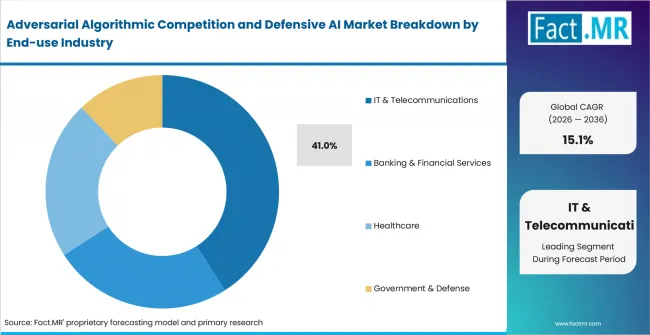
Adversarial Algorithmic Competition And Defensive Ai Market Analysis By End Use Industry | Source: Fact.MR
Technology and telecommunications companies run the highest density of AI workloads, integrate models into customer-facing products, and operate the network and cloud infrastructure that carries AI traffic. They are therefore the earliest adopters of defensive AI, buying platform licenses, red-teaming services, and runtime controls at enterprise scale. Their position at the center of the AI supply chain also exposes them to supply-chain and third-party model risk, which NIST’s adversarial machine learning taxonomy addresses by mapping attacks across predictive and generative AI lifecycles. As these buyers standardize AI security into their security operations, they create a reference architecture that other industries subsequently adopt.
Why do Large Enterprises lead Customer Category?
Large Enterprises are projected to account for a 43.0% share in 2026.
Large enterprises run more AI applications across departments, cloud accounts, and data environments, so they need common testing standards and central policy controls. Their security teams can connect red-team findings, approvals, and runtime alerts across multiple model providers rather than evaluate every application in isolation.
Why do Adversarial Detection Models lead AI Security Framework?
Adversarial Detection Models are projected to account for a 39.0% share in 2026.
Adversarial detection models help teams identify prompt injection, unsafe requests, anomalous outputs, and behavior that falls outside approved policy. They are useful during testing and in production, where teams need a signal that can trigger review, enforcement, or response without stopping every normal interaction.
What is accelerating Adversarial Algorithmic Competition and Defensive AI Market adoption, and what is holding it back?
Drivers Impact Analysis
| Driver | Relative Impact | Geographic Relevance | Impact Timeline |
|---|---|---|---|
| Expansion of AI into data-rich workflows that trigger business actions. | High | Global | Near term |
| Regulatory obligations and security frameworks increase demand for documented AI risk controls. | High | North America and Europe | Near term |
| Agentic AI and tool-use attacks expand the security boundary around models and applications. | High | Global | Mid term |
| Cloud and platform vendors embed defensive controls into model services. | Moderate | Global | Long term |
Source: Fact.MR analysis. Updated Aug 10, 2026
Restraints Impact Analysis
| Restraint | Relative Impact | Geographic Relevance | Impact Timeline |
|---|---|---|---|
| Teams struggle to compare test results across models and changing application architectures. | High | Global | Mid term |
| Probabilistic model behavior requires repeated testing and detailed context, raising service cost. | Moderate | Global | Mid term |
| Specialist adversarial-AI and red-teaming talent remains limited. | Moderate | North America and Europe | Near term |
Source: Fact.MR analysis. Updated Aug 10, 2026
Which countries are scaling the Adversarial Algorithmic Competition and Defensive AI Market fastest?
- USA is projected to post the highest CAGR at 16.4% through 2036.
- UK, Germany, Japan, and Canada follow at 15.9%, 15.3%, 14.8%, and 14.2%, respectively.
- Singapore and Australia are projected to grow at 13.7% and 13.1%, respectively.
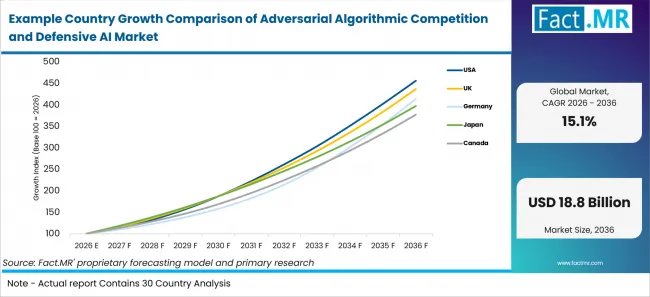
Example Country Growth Comparison Of Adversarial Algorithmic Competition And Defensive Ai Market | Source: Fact.MR
Country-wise CAGR Forecast (2026-2036)
| Country | CAGR |
|---|---|
| USA | 16.4% |
| UK | 15.9% |
| Germany | 15.3% |
| Japan | 14.8% |
| Canada | 14.2% |
| Singapore | 13.7% |
| Australia | 13.1% |
Source: Fact.MR analysis. Updated Aug 10, 2026
What is driving the Adversarial Algorithmic Competition and Defensive AI Market in the USA?
USA is projected to register a 16.4% CAGR through 2036.
U.S. buyers are likely to move first where AI applications already access enterprise data, cloud services, and business tools. Security teams need controls that fit established governance, testing, and response processes. The country value chart shows the market reaching USD 7.7 billion in 2036.
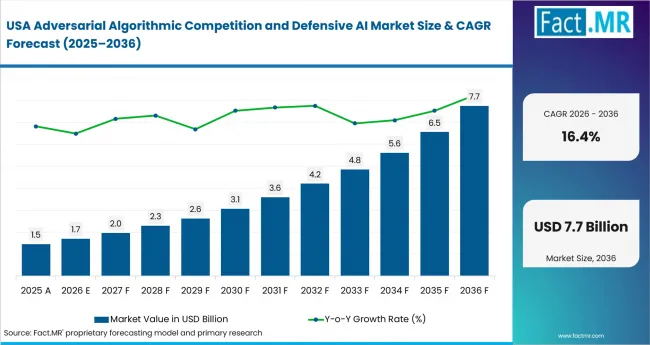
Adversarial Algorithmic Competition And Defensive Ai Market Country Value Analysis | Source: Fact.MR
What is driving the Adversarial Algorithmic Competition and Defensive AI Market in the UK?
The UK is projected to register a 15.9% CAGR through 2036.
UK organizations are expected to assess AI security alongside enterprise cyber assurance and model-evaluation requirements. Suppliers need to show how adversarial testing, evidence capture, and remediation fit the existing security operation.
What is driving the Adversarial Algorithmic Competition and Defensive AI Market in Germany?
Germany is projected to register a 15.3% CAGR through 2036.
German buyers are likely to place weight on technical documentation, secure lifecycle processes, and clear operating accountability. Platform vendors need evidence that controls can be implemented without losing traceability across the model lifecycle.
What is driving the Adversarial Algorithmic Competition and Defensive AI Market in Japan?
Japan is projected to register a 14.8% CAGR through 2036.
Japanese enterprises are expected to rely on formal deployment guidance and trusted integration partners when extending AI into core operations. Controls that keep responsibility, approvals, and exception handling visible will be easier to adopt.
What is driving the Adversarial Algorithmic Competition and Defensive AI Market in Canada?
Canada is projected to register a 14.2% CAGR through 2036.
Canadian adoption is likely to develop through enterprises that combine local AI expertise with North American cloud environments. The commercial test is whether a defensive platform works across multiple model providers and can support controlled enterprise deployment.
What is driving the Adversarial Algorithmic Competition and Defensive AI Market in Singapore?
Singapore is projected to register a 13.7% CAGR through 2036.
Singapore's role as a regional technology and financial hub creates demand for AI security practices that can work across regional operations. Buyers will compare prompt monitoring, model testing, and policy controls before selecting a platform.
What is driving the Adversarial Algorithmic Competition and Defensive AI Market in Australia?
Australia is projected to register a 13.1% CAGR through 2036.
Australian buyers in government, finance, and critical infrastructure are expected to focus on defined assurance outcomes and specialist support. Early projects will favor deployments where teams can show what was tested, who approved release, and how unsafe behavior is contained.
Who leads the Adversarial Algorithmic Competition and Defensive AI Market?
Competition spans cloud and model-ecosystem vendors, enterprise security vendors, and specialist AI-security providers. The strongest offerings combine predeployment testing with runtime controls, so buyers can connect a red-team finding to a policy decision or incident response action after deployment.
Microsoft Corporation, Google LLC, Amazon Web Services, Inc., and NVIDIA Corporation provide controls close to model development and cloud runtime. Palo Alto Networks, Inc., Cisco Systems, Inc., Darktrace Holdings Limited, and CrowdStrike Holdings, Inc. extend AI-security coverage into enterprise security operations. International Business Machines Corporation supports validation and agent-security testing for enterprise deployments.
Which companies are the key providers?
Key companies profiled in the Adversarial Algorithmic Competition and Defensive AI market include Microsoft Corporation, Google LLC, Amazon Web Services, Inc., NVIDIA Corporation, Palo Alto Networks, Inc., Cisco Systems, Inc., Darktrace Holdings Limited, CrowdStrike Holdings, Inc., and International Business Machines Corporation.
- Cloud and Model Lifecycle Security
- Microsoft Corporation
- Google LLC
- Amazon Web Services, Inc.
- NVIDIA Corporation
- Enterprise AI Security and Security Operations
- Palo Alto Networks, Inc.
- Cisco Systems, Inc.
- Darktrace Holdings Limited
- CrowdStrike Holdings, Inc.
- Validation and AI Security Testing
- International Business Machines Corporation
Bibliography
- National Institute of Standards and Technology. (2025, March 24). Adversarial Machine Learning: A Taxonomy and Terminology of Attacks and Mitigations.
- National Institute of Standards and Technology. (2024, July 26). Artificial Intelligence Risk Management Framework: Generative Artificial Intelligence Profile.
- European Commission. (2026, July 27). Navigating the AI Act.
- UK Department for Science, Innovation and Technology. (2025, February 14). Tackling AI Security Risks to Unleash Growth and Deliver Plan for Change.
- Federal Office for Information Security. (2024, January 16). Reinforcement Learning Security in a Nutshell.
- Ministry of Economy, Trade and Industry and Ministry of Internal Affairs and Communications. (2025, March 28). AI Guidelines for Business Version 1.1.
- Innovation, Science and Economic Development Canada. (2024, November 12). Canada Launches Canadian Artificial Intelligence Safety Institute.
- Infocomm Media Development Authority. (2024, May 31). Singapore Launches Project Moonshot.
- Australian Government Department of Industry, Science and Resources. (2024, September 5). Voluntary AI Safety Standard.
- Microsoft Corporation. (2024, February 22). Announcing Microsoft’s Open Automation Framework to Red Team Generative AI Systems.
- International Business Machines Corporation. (2024, October 21). IBM Introduces Granite 3.0: High Performing AI Models Built for Business.
- Cisco Systems, Inc. (2025, January 15). Cisco Unveils AI Defense to Secure the AI Transformation of Enterprises.
- Palo Alto Networks, Inc. (2025, July 22). Palo Alto Networks Completes Acquisition of Protect AI.
- Google Cloud. (2025, March 6). Introducing AI Protection: Security for the AI Era.
- Amazon Web Services, Inc. (2024, December 3). Amazon Bedrock Guardrails Now Supports Automated Reasoning Checks.
- NVIDIA Corporation. (2025, July 17). Safeguard Agentic AI Systems with the NVIDIA Safety Recipe.
- CrowdStrike Holdings, Inc. (2025, September 2). Secure AI at Machine Speed: Defending the Growing Attack Surface.
- Darktrace Holdings Limited. (2026, February 3). Introducing Darktrace / SECURE AI – Complete AI Security Across Your Enterprise.
- International Business Machines Corporation. (n.d.). LLM Agent Vulnerability Testing - IBM watsonx Orchestrate ADK.
This Report Answers
- The report evaluates Solution Type, Deployment Model, End-use Industry, Customer Category, AI Security Framework, and regional demand for defensive AI.
- Defensive AI Platforms lead Solution Type with a 38.0% share in 2026. Cloud Deployment leads Deployment Model at 44.0%.
- IT & Telecommunications leads End-use Industry at 41.0%, while Large Enterprises lead Customer Category and Adversarial Detection Models lead AI Security Framework.
- The regional outlook covers USA, UK, Germany, Japan, Canada, Singapore, and Australia, with country-wise forecasts through 2036.
- Competitive analysis assesses cloud and model-lifecycle vendors, enterprise security vendors, and AI-security testing providers active in the category.
What does the Adversarial Algorithmic Competition and Defensive AI Market cover?
The Adversarial Algorithmic Competition and Defensive AI Market covers platforms, services, and software used to test, monitor, harden, govern, and respond to risks affecting AI models, applications, and agents.
The scope follows Solution Type, Deployment Model, End-use Industry, Customer Category, AI Security Framework, and Region across the 2026-2036 forecast period.
What is included in the scope?
Coverage includes Defensive AI Platforms, Red Teaming Services, Model Validation Services, and Security Monitoring; cloud, edge, on-premises, and critical-infrastructure deployments; IT & Telecommunications, Banking & Financial Services, Healthcare, and Government & Defense end users; large enterprises, financial institutions, healthcare providers, and public sector agencies; and adversarial detection, adversarial training, explainable AI security, decision integrity monitoring, and continuous AI monitoring frameworks.
What is excluded from the scope?
General-purpose AI software, unrelated cybersecurity products, commodity infrastructure, and services not configured to protect AI models, applications, or agent workflows are outside scope.
How was the analysis built?
The analysis considers public company disclosures, product documentation, government and regulatory material, industry publications, and market conditions across the defined segments, regions, and forecast period.
Segmentation
What is the report’s scope and coverage?
| Attribute | Details |
|---|---|
| Forecast Period | 2026-2036 |
| Base Year | 2025 |
| Market Value, 2026 | USD 4.6 billion |
| Market Value, 2036 | USD 18.8 billion |
| CAGR, 2026-2036 | 15.1% |
| Absolute Dollar Opportunity | USD 14.2 billion |
| Key Regions Covered | USA, UK, Germany, Japan, Canada, Singapore, Australia, and more than twenty-three additional countries in the full report |
Source: Fact.MR analysis. Updated Aug 10, 2026
How is the market segmented?
-
Solution Type
- Defensive AI Platforms
- Threat Detection Systems
- AI Model Hardening
- Red Teaming Services
- Simulated AI Attacks
- AI Vulnerability Assessment
- Model Validation Services
- AI Compliance Testing
- Regulatory Validation
- Security Monitoring
- AI Behavior Monitoring
- Incident Response
- Defensive AI Platforms
-
Deployment Model
- Cloud Deployment
- Public Cloud
- Private Cloud
- Edge Deployment
- On-premises Edge
- Hybrid Edge
- On-premises Deployment
- Private Data Centers
- Local Infrastructure
- Critical Infrastructure
- Energy Infrastructure
- Transportation Systems
- Cloud Deployment
-
End-use Industry
- IT & Telecommunications
- Network Infrastructure
- Cloud Computing
- Banking & Financial Services
- Digital Payments
- Investment Management
- Healthcare
- Hospitals
- Life Sciences
- Government & Defense
- Defense Organizations
- Public Safety
- IT & Telecommunications
-
Customer Category
- Large Enterprises
- Fortune 1000 Companies
- Government Organizations
- Financial Institutions
- Banks & Insurance Providers
- FinTech Companies
- Healthcare Providers
- Pharmaceutical Companies
- Research Institutes
- Public Sector Agencies
- National Security Agencies
- Critical Infrastructure Operators
- Large Enterprises
-
AI Security Framework
- Adversarial Detection Models
- Real-time Threat Detection
- Model Robustness Testing
- Adversarial Training
- AI Attack Simulation
- Attack Surface Analysis
- Explainable AI Security
- Model Explainability
- Decision Integrity Monitoring
- Continuous AI Monitoring
- AI Risk Analytics
- Security Operations Automation
- Adversarial Detection Models
-
Region
- North America
- Latin America
- Western Europe
- Eastern Europe
- East Asia
- South Asia and Pacific
- Middle East & Africa
Frequently Asked Questions
What is the Adversarial Algorithmic Competition and Defensive AI market size in 2026?
At what CAGR is the Adversarial Algorithmic Competition and Defensive AI market expected to grow?
What is the projected Adversarial Algorithmic Competition and Defensive AI market size by 2036?
Which country leads the Adversarial Algorithmic Competition and Defensive AI market?
Which is the leading segment in the Adversarial Algorithmic Competition and Defensive AI market?
What is driving growth in the Adversarial Algorithmic Competition and Defensive AI Market?
Who are the key players in the Adversarial Algorithmic Competition and Defensive AI Market?
Who worked on this report


Preview the report firsthand - request a free sample
Free SampleGet the brochure for pricing and purchase details
Download PDF