- Base Value(2025): 0.4 Bn
- Estimated Value(2026): 0.6 Bn
- Forecast Value (2036): 4.9 Bn
- CAGR (2026 - 2036): 23.2%
Learning Analytics Solution Market Forecast and Outlook By Fact.MR
In 2025, the learning analytics solution market was valued at USD 0.4 billion. Based on Fact.MR analysis, demand for learning analytics solutions is estimated to grow to USD 0.6 billion in 2026 and USD 4.9 billion by 2036. FACT.MR projects a CAGR of 23.2% during the forecast period.
During this period, the market is expected to generate USD 4.3 billion in new revenue opportunities a more than eight-fold expansion from 2026 baseline value. This transformational trajectory reflects accelerating AI integration into LMS platforms, government digital education programme mandates requiring data-driven learner outcome reporting, and corporate L&D buyers investing in analytics-enabled training platforms to prove ROI on workforce development spending. Growth is moderated by learner data privacy regulation compliance costs under FERPA, GDPR, and national equivalents, institutional change management barriers to analytics adoption, and educator digital skills gaps in interpreting and acting on learner insight data.
Country growth reflects digital education programme investment, government EdTech mandates, and LMS platform adoption maturity. The United States leads at 11.5% CAGR driven by Title IV institution compliance requirements and AI learning tool investment at large university systems. The United Kingdom follows at 11.0% through Jisc learning analytics adoption framework and UKRI digital skills research funding. The European Union records 10.7% through EU Digital Education Action Plan institutional analytics investment. Japan grows at 10.4% through MEXT GIGASchool digital learning expansion. South Korea advances at 10.1% via KERIS national EdTech platform learning analytics deployment, with mature markets constrained by GDPR-equivalent learner data privacy compliance costs that slow analytics programme expansion at privacy-conservative institutions.
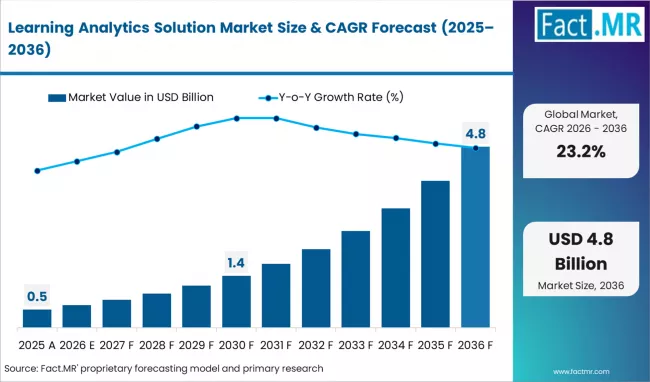
Learning Analytics Solution Market Market Value Analysis | Source: Fact.MR
| Metric | Value |
|---|---|
| Estimated Value in 2026 | USD 0.6 billion |
| Forecast Value in 2036 | USD 4.9 billion |
| Forecast CAGR (2026 to 2036) | 23.2% |
Source: Fact.MR analysis. Updated Mar 17, 2026
Learning Analytics Solution Market Definition
The learning analytics solution market includes software platforms and services that analyse learner data to personalise instruction, predict outcomes, and measure programme performance in education and corporate training.
Market Inclusions
Includes global and regional forecasts from 2026 to 2036 by solution, deployment mode, service, and end user. Covers analytics platforms integrated with LMS systems across education and corporate training environments.
Market Exclusions
Excludes general BI tools not designed for education data, standalone LMS without analytics modules, student information systems without behavioural analytics, and consumer tutoring apps.
Research Methodology
- Primary Research: Interviews with university CIOs, school technology directors, corporate L&D managers, and learning analytics product specialists.
- Desk Research: Analysis of US Department of Education programmes, EU Digital Education Action Plan reports, Jisc analytics adoption data, and company earnings disclosures.
- Market Sizing and Forecasting: Hybrid model using LMS subscription revenue, analytics module adoption rates, digital education investments, and corporate training technology spending.
- Data Validation and Update Cycle: Forecasts validated with OEM revenue disclosures, Educause surveys, Jisc adoption reports, and interviews with institutional technology buyers.
Learning Analytics Solution Market Summary
- Market Definition
- The learning analytics solution market includes AI-driven platforms that analyse learner engagement and performance data to improve learning outcomes.
- Demand Drivers
- US higher education institutions are investing in predictive analytics to meet federal student outcome reporting requirements.
- EU Digital Education Action Plan funding is supporting LMS platforms with integrated analytics capabilities.
- Corporate training departments are adopting analytics-enabled platforms to measure workforce learning ROI.
- Key Segments Analysed
- By Solution: Adaptive learning analytics leads with about 37% share in 2026 due to AI-based personalised learning.
- By Deployment Mode: Cloud deployment leads with around 64% share in 2026 due to scalable SaaS platforms.
- By End User: Large organisations generate the highest revenue due to complex analytics needs and larger budgets.
- Analyst Opinion at FACT.MR
- Shambhu Nath Jha, Principal Consultant at Fact.MR, notes that vendors with AI-powered insights, privacy-compliant data systems, and adaptive learning tools will gain stronger market positions.
- Strategic Implications
- Vendors should prioritise FERPA and GDPR compliance to qualify for institutional procurement.
- Companies should add AI-based reporting tools that simplify analytics insights for educators.
- Platforms should integrate directly with major LMS systems such as Canvas, Blackboard, and Moodle.
- Methodology
- Market sizing used LMS subscription data and analytics module adoption rates validated with industry financial disclosures.
- Education technology programme data and adoption surveys supported regional analysis.
- Forecasts considered AI adoption trends, corporate training investment growth, and privacy compliance costs.
Segmental Analysis
Learning Analytics Solution Market Analysis by Solution
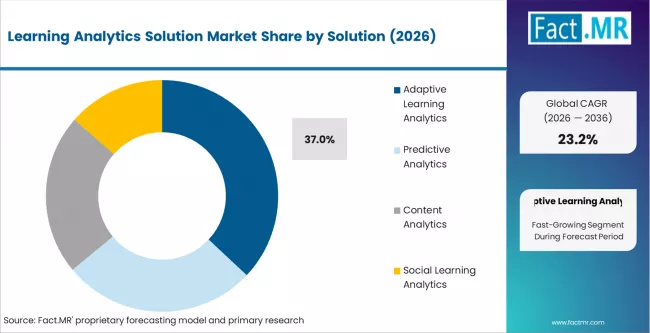
Learning Analytics Solution Market Analysis By Solution | Source: Fact.MR
Adaptive learning analytics is expected to hold about 37% share in 2026 due to its ability to personalise learning paths using real-time performance data.
- D2L Adaptive Solution Investment: D2L launched Brightspace Lumi AI, providing real-time adaptive learning recommendations and automated at-risk student alerts. [5]
- Knewton Predictive Technology: Knewton updated its Alta platform with predictive analytics to forecast learner progress and mastery levels. [6]
- Social Analytics Adoption Trend: Educause reported growing institutional interest in social learning analytics to measure collaboration and engagement. [7]
Learning Analytics Solution Market Analysis by Deployment Mode
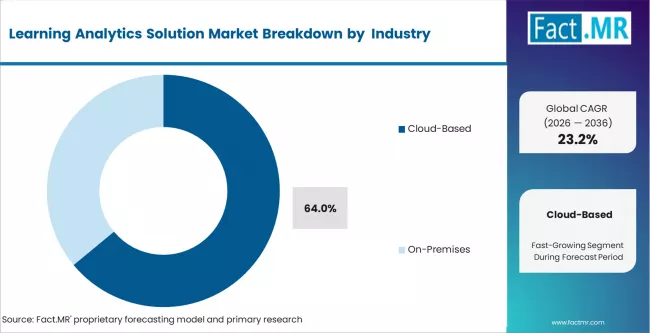
Learning Analytics Solution Market Analysis By Deployment Mode | Source: Fact.MR
Cloud-based deployment is projected to hold about 64% share in 2026 due to strong adoption of SaaS-based LMS and analytics platforms.
- Google for Education Cloud Investment: Google introduced AI-powered Learning Insights within Google Classroom to provide cloud-based engagement analytics. [8]
- Microsoft Cloud Analytics Technology: Microsoft launched Education Insights Premium with AI-based early warning analytics for Teams for Education. [9]
- Cloud Deployment Shift Trend: Jisc reported that 71% of UK universities deploying learning analytics use cloud-based platforms. [10]
Drivers, Restraints, and Opportunities
FACT.MR analysts observe that the learning analytics solution market is an early-stage but rapidly growing segment driven by the increasing use of LMS data in education and corporate training. Most institutions already collect large volumes of learner engagement data, but many lack advanced analytics tools to convert this data into actionable insights. This gap is creating strong demand for learning analytics platforms that transform raw learning data into measurable performance improvements.
The market is shifting from basic reporting tools toward predictive and adaptive analytics. Traditional dashboards that only track past activity are being replaced by AI-driven platforms that identify at-risk learners, recommend personalized content, and trigger timely interventions. These advanced capabilities command higher pricing and are increasing institutional willingness to invest in analytics-driven learning systems.
- US EdTech Accountability Mandate: The US Department of Education encourages learning analytics adoption to help institutions track student outcomes and address performance gaps. [2]
- EU Digital Education Action Plan: EU digital education funding programmes include learning analytics as a required capability in national LMS deployments. [3]
- South Korea KERIS Platform: South Korea plans nationwide AI-driven learning analytics deployment through the KERIS education platform by 2027. [4]
Regional Analysis
The learning analytics solution market is analysed across Asia Pacific, Europe, North America, Latin America, and Middle East and Africa, covering 40+ countries with distinct demand profiles shaped by government digital education programme investment, data privacy regulatory frameworks, LMS platform adoption maturity, and institutional data governance capacity. The full report offers market attractiveness analysis based on EdTech investment flows, government analytics mandate timelines, and institutional AI adoption readiness benchmarks.
.webp "Top Country Growth Comparison Learning Analytics Solution Market Cagr (2026 2036)")
Top Country Growth Comparison Learning Analytics Solution Market Cagr (2026 2036) | Source: Fact.MR
| Country / Region | CAGR (2026-2036) |
|---|---|
| United States | 11.5% |
| United Kingdom | 11.0% |
| European Union | 10.7% |
| Japan | 10.4% |
| South Korea | 10.1% |
Source: Fact.MR analysis. Updated Mar 17, 2026
Source: Fact.MR (FACT.MR) analysis, based on proprietary forecasting model and primary research
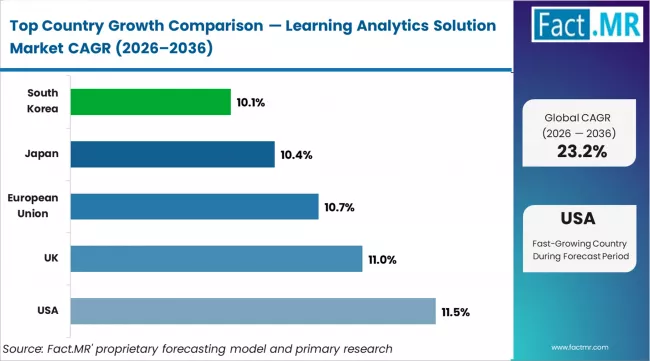
Learning Analytics Solution Market Cagr Analysis By Country | Source: Fact.MR
North America Learning Analytics Solution Market Analysis
North America represents the most mature market for learning analytics platforms, supported by strong institutional data infrastructure, federal education accountability policies, and the presence of major EdTech platform vendors.
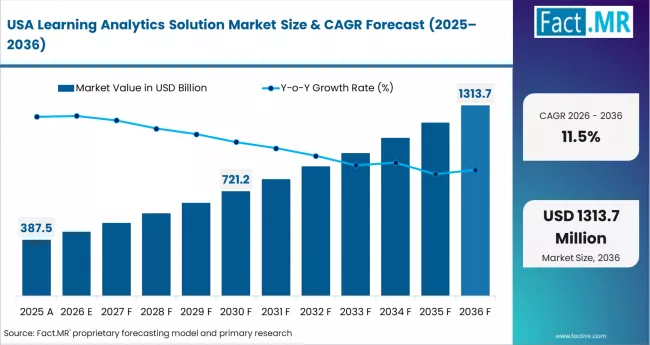
Learning Analytics Solution Market Country Value Analysis | Source: Fact.MR
- United States: United States, the learning analytics solution market is expected to expand at a CAGR of 11.5% through 2036. Federal education initiatives increasingly encourage institutions to use analytics platforms to track student outcomes and improve academic performance metrics. Universities are integrating analytics tools with LMS platforms such as Canvas to monitor engagement and learning progress across multiple campuses. Additional investments from foundations and education programmes supporting student success initiatives are also accelerating adoption of learning analytics technologies across higher education systems.
FACT.MR’s assessment of the learning analytics solution market in North America includes country-level analysis for the United States, Canada, and Mexico, focusing on LMS analytics adoption trends, regulatory reporting requirements, and institutional investment in data-driven education technologies.
Europe Learning Analytics Solution Market Analysis
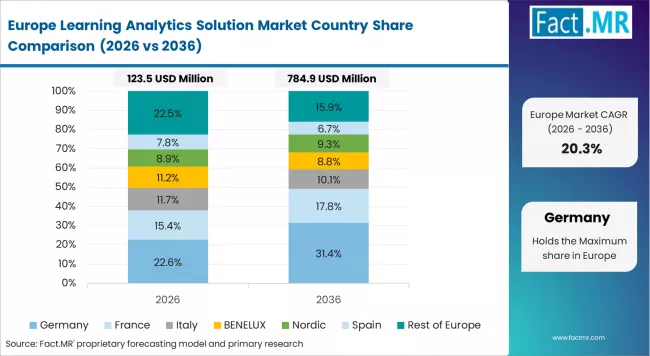
Learning Analytics Solution Market Europe Country Market Share Analysis, 2026 & 2036 | Source: Fact.MR
Europe is a policy-driven market for learning analytics, where data governance frameworks and digital education programmes strongly influence institutional technology adoption.
- United Kingdom: The United Kingdom learning analytics market is projected to grow at a CAGR of 11.0% through 2036. Universities across the country are increasingly deploying analytics platforms to track student engagement, improve retention rates, and support evidence-based teaching strategies. Sector-wide governance frameworks for responsible data usage have encouraged institutions to adopt structured analytics platforms that align with regulatory and ethical standards.
- European Union: European Union, the learning analytics market is forecast to grow at a CAGR of 10.7% through 2036. EU digital education initiatives are encouraging schools and universities to integrate analytics capabilities into learning management platforms. Governments are also introducing standards for data protection and interoperability, which is strengthening demand for analytics solutions that comply with European data governance regulations.
FACT.MR’s analysis of the learning analytics solution market in Europe includes Germany, France, the United Kingdom, Italy, Spain, Nordic countries, BENELUX, and the rest of Western Europe, examining digital education investment programmes and regulatory compliance requirements.
Asia Pacific Learning Analytics Solution Market Analysis
Asia Pacific is emerging as a high-growth region for learning analytics adoption, supported by government education digitalization programmes and increasing use of AI-powered learning platforms.
- Japan: Japan’s learning analytics solution market is expected to grow at a CAGR of 10.4% through 2036. National digital education initiatives are promoting the adoption of cloud-based learning platforms with integrated analytics capabilities in schools and universities. Education technology companies are also developing AI-based learning tools that analyse study behaviour and provide personalised learning recommendations.
- South Korea: South Korea’s learning analytics market is projected to grow at a CAGR of 10.1% through 2036. Government-led education technology programmes are introducing AI-powered analytics tools across public schools to support personalized learning and performance monitoring. Investment in national digital education platforms is creating strong demand for analytics technologies across both academic institutions and corporate training environments.
FACT.MR’s study of the learning analytics solution market in Asia Pacific covers Japan, South Korea, China, India, ASEAN, Australia and New Zealand, and the rest of South Asia and Pacific, analysing government EdTech investment and analytics platform adoption trends.
Competitive Aligners for Market Players
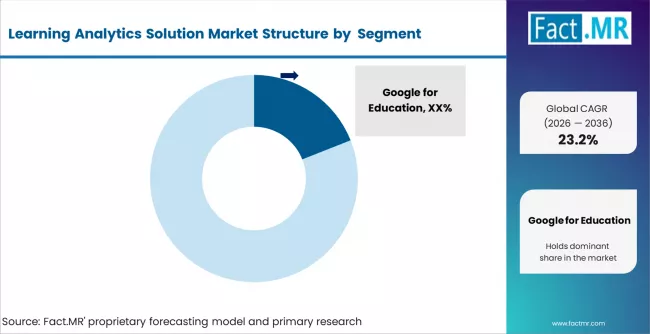
Learning Analytics Solution Market Analysis By Company | Source: Fact.MR
The global learning analytics solution market is highly fragmented, especially at the standalone analytics tool level. Numerous specialised vendors compete with major LMS providers that are increasingly integrating analytics directly into their platforms. Companies such as Instructure (Canvas), Anthology (Blackboard), and D2L maintain strong positions because their analytics tools are built into widely used learning management systems. At the same time, technology giants like Google for Education and Microsoft Education are expanding their presence by embedding analytics capabilities within their productivity platforms used by schools and universities worldwide.
As the market evolves, competition is shifting away from basic dashboard reporting toward advanced AI capabilities that can predict student outcomes and recommend timely learning interventions. Google and Microsoft benefit from a structural advantage because their ecosystems already power the daily digital workflow of educators and students. Platforms such as Google Classroom and Microsoft Teams automatically generate large volumes of learning data, allowing analytics features to be integrated without additional data setup.
This bundled approach creates pricing pressure for independent analytics vendors. Meanwhile, providers such as D2L differentiate themselves through deeper analytics insights and adaptive learning tools designed to improve student retention and learning outcomes.
Key Players
- Google for Education
- Microsoft Education
- Blackboard Inc.
- IBM Watson Education
- D2L (Desire2Learn)
- Pearson
- Knewton
- Instructure (Canvas LMS)
- SAP Litmos
- Smart Sparrow
Bibliography
- [1] US Department of Education. (2024). National Education Technology Plan 2024: Learning Analytics for Equity and Accountability, Title IV Institution Data System Investment Guidance, and ESSA Learner Outcome Reporting Requirements. January 2024. tech.ed.gov
- [2] European Commission. (2024). EU Digital Education Action Plan 2021-2027 Progress Report: Learning Analytics Infrastructure Investment Funding, Member State Implementation Status, and Digital Education Hub Interoperability Standards Update. September 2024. education.ec.europa.eu/focus-topics/digital-education
- [3] Korea Education and Research Information Service. (2024). AI-Powered Education Platform Roadmap 2025: National AI Tutoring Platform Learning Analytics Deployment, Digital Education Innovation Programme KRW 850 Billion Investment, and Public School Coverage Timeline. September 2024. keris.or.kr
- [4] D2L Corporation. (2024). Product Launch Press Release: Brightspace Lumi AI Adaptive Learning Analytics Engine Real-Time Course Adjustment, At-Risk Notifications, and Course Completion Rate Pilot Data. October 2024. d2l.com/news
- [5] Knewton (Wiley). (2024). Product Update: Alta Adaptive Courseware Platform Enhanced Predictive Analytics Learner Mastery Timeline Forecasting and Instructor Pre-emptive Review Scheduling for STEM Higher Education Courses. September 2024. knewton.com/resources
- [6] Educause. (2024). 2024 Horizon Report: Teaching and Learning Edition Social Learning Analytics Institutional Priority Survey Data, Higher Education CIO Analytics Deployment Plans, and Collaborative Skill Development Outcome Tracking. May 2024. educause.edu/horizon-report
- [7] Google LLC. (2025). Google for Education Product Announcement: Google Classroom AI-Powered Learning Insights General Availability for Workspace for Education — Global User Coverage and Cloud Analytics Integration. January 2025. edu.google.com/intl/ALL_us/why-google/news
- [8] Microsoft Corporation. (2024). Microsoft Education Product Update: Education Insights Premium Launch with Azure ML Early Alert Analytics for Teams for Education — At-Risk Student Identification from Engagement Data. November 2024. microsoft.com/en-us/education/blog
- [9] Jisc. (2024). Learning Analytics Survey 2024: UK Higher Education Cloud Deployment Rate, Institutional Adoption Growth 2022-2024, and Ethical Analytics Code of Practice Compliance Data. October 2024. jisc.ac.uk/learning-analytics
This Report Addresses
- Strategic insights on global learning analytics demand shaped by US Title IV accountability mandates, EU Digital Education Action Plan funding, UK Jisc analytics guidelines, Japan GIGASchool Phase 2 roadmap, and South Korea KERIS AI education platform rollout.
- Market forecast from USD 0.6 billion in 2026 to USD 4.9 billion by 2036, growing at a 23.2% CAGR, segmented by solution type, deployment mode, service, and end user.
- Growth opportunities across US university analytics compliance demand, UK Jisc-certified analytics platforms, EU digital education investments, Japan GIGASchool analytics adoption, and South Korea KERIS AI platform expansion.
- Country CAGR outlook including United States 11.5%, United Kingdom 11.0%, European Union 10.7%, Japan 10.4%, and South Korea 10.1%.
- Competitive analysis of Google for Education, Microsoft Education, Blackboard, IBM Watson Education, D2L, Pearson, Knewton, Instructure, SAP Litmos, and Smart Sparrow.
- Technology tracking covering adaptive AI learning engines, natural language analytics reporting, IMS Global Caliper and xAPI standards, predictive alert systems, and social learning analytics tools.
- Regulatory analysis covering US FERPA student data privacy rules, EU GDPR learner data regulations, UK ICO guidance, Jisc analytics standards, and South Korea PIPA compliance requirements.
- Report delivered in PDF, Excel, PowerPoint, and dashboard formats supported by industry financial disclosures, Educause surveys, government programme data, and primary research interviews.
Segmentation
Scope of Report
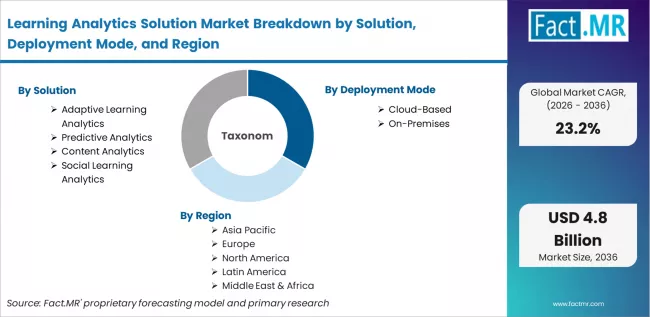
Learning Analytics Solution Market Breakdown By Solution, Deployment Mode, And Region | Source: Fact.MR
| Attribute | Details |
|---|---|
| Quantitative Units | USD 0.6 billion (2026) to USD 4.9 billion (2036), at a CAGR of 23.2% |
| Market Definition | Software solutions and services that collect, process, and visualise learner data to enable educational institutions and training organisations to personalise instruction, predict outcomes, and improve learner engagement. |
| Solution Segmentation | Predictive Analytics, Content Analytics, Adaptive Learning Analytics (37%), Social Learning Analytics |
| Deployment Mode Segmentation | On-Premises, Cloud-Based (64%) |
| Service Segmentation | Consulting, Implementation & Integration, Maintenance |
| End User Segmentation | Small Institutes, Medium Institutes, Large Organizations |
| Application Coverage | Student performance prediction, at-risk learner identification, personalised content recommendation, curriculum effectiveness analysis, instructor feedback optimisation, and corporate L&D programme analytics. |
| Regions Covered | Asia Pacific, Europe, North America, Latin America, Middle East and Africa |
| Countries Covered | China, Japan, South Korea, India, Australia and New Zealand, ASEAN, Germany, UK, France, Italy, Spain, Nordic, BENELUX, Rest of Western Europe, USA, Canada, Mexico, Brazil, Rest of Latin America, Saudi Arabia, GCC, Turkey, South Africa, Rest of MEA |
| Key Companies Profiled | Google for Education, Microsoft Education, Blackboard Inc., IBM Watson Education, D2L (Desire2Learn), Pearson, Knewton, Instructure (Canvas LMS), SAP Litmos, Smart Sparrow |
| Forecast Period | 2026 to 2036 |
| Approach | Hybrid top-down and bottom-up model using LMS platform subscription revenue data, edtech investment flows, government digital education programme values, and primary interviews with institutional CIOs and learning technology procurement leads. |
Source: Fact.MR analysis. Updated Mar 17, 2026
Learning Analytics Solution Market by Segments
-
By Solution:
- Predictive Analytics
- Content Analytics
- Adaptive Learning Analytics
- Social Learning Analytics
-
By Deployment Mode:
- On-Premises
- Cloud-Based
-
By Service:
- Consulting
- Implementation & Integration
- Maintenance
-
By End User:
- Small Institutes
- Medium Institutes
- Large Organizations
-
By Region:
- North America
- United States
- Canada
- Mexico
- Latin America
- Brazil
- Rest of Latin America
- Western Europe
- Germany
- United Kingdom
- France
- Italy
- Spain
- Nordic
- BENELUX
- Rest of Western Europe
- Eastern Europe
- Russia
- Poland
- Rest of Eastern Europe
- East Asia
- China
- Japan
- South Korea
- South Asia and Pacific
- India
- ASEAN
- Australia and New Zealand
- Rest of South Asia and Pacific
- Middle East and Africa
- Kingdom of Saudi Arabia
- Other GCC Countries
- Turkey
- South Africa
- Other African Union
- Rest of Middle East and Africa
- North America
Frequently Asked Questions
How large is the learning analytics solution market in 2025?
What will the market size be in 2026?
What is the projected market size by 2036?
What is the expected CAGR?
Which solution segment leads?
Which deployment mode dominates?
Which country shows the fastest growth?
What is a learning analytics solution?
What factors are driving the growth of the learning analytics solution market?
Who are the primary users of learning analytics solutions?
How does learning analytics improve student performance?
Who worked on this report


Preview the report firsthand - request a free sample
Free SampleGet the brochure for pricing and purchase details
Download PDF