Frontier AI Red-Teaming & Evaluation Services Market Size, Share, Growth and Forecast (2026 - 2036)
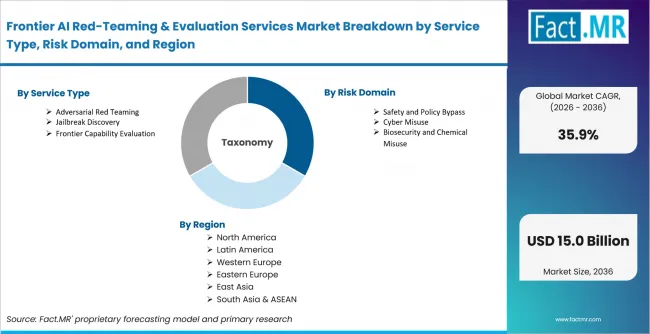
The Frontier AI Red-Teaming & Evaluation Services Market is segmented by Service Type, by Risk Domain, by Customer Type, by Delivery Model, by Deployment Stage, and Region. Forecast for 2026 to 2036.
Frontier AI Red-Teaming & Evaluation Services Market Size, Market Forecast and Outlook by Fact.MR
- The frontier AI red-teaming and evaluation services market crossed a valuation of USD 0.5 billion in 2025. Demand is expected to increase from USD 0.7 billion in 2026 to USD 15.0 billion by 2036.
- The market is forecast to record 35.9% CAGR from 2026 to 2036 as advanced AI systems require independent testing before deployment.
- Independent adversarial testing, jailbreak discovery and capability evaluation services for AI models and agents, mandated for high-risk and frontier systems.
- The market is different from cybersecurity pen-testing because the test target is model behavior, agent action and misuse capability. EU AI Act rules create stronger obligations for general-purpose AI providers and high-risk AI systems. [1]
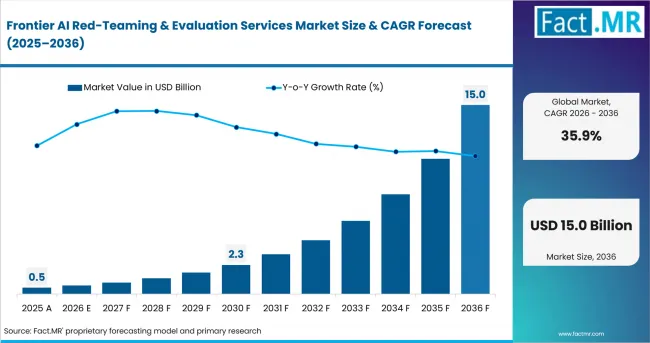
Summary of Frontier AI red-teaming and evaluation services market
- Demand Drivers in the Market
- Model safety leads need independent red-team findings before public model release.
- AI security heads need jailbreak testing before agents connect with tools and data.
- Enterprise AI procurement managers need third-party evaluation reports before vendor approval.
- Compliance teams need evidence that model risks were tested before deployment.
- Key Segments Analyzed
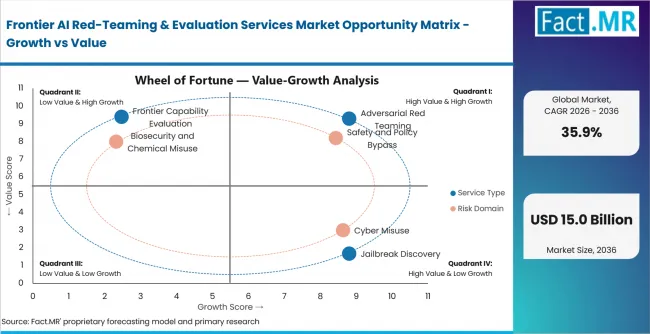
- By Service Type: Adversarial Red Teaming is expected to hold 34.0% share in 2026 because jailbreak and misuse testing are the first paid service needs.
- By Risk Domain: Safety and Policy Bypass leads because refusal failures create visible release risk. The segment is projected to capture 32.0% share in 2026.
- By Customer Type: Frontier Model Developers are expected to account for 44.0% share in 2026 because model release cycles create early evaluation demand.
- By Delivery Model: Independent Assessment Projects hold 40.0% share in 2026 as firms prefer project-based reviews before ongoing testing.
- By Deployment Stage: Pre-Deployment Testing is expected to capture 48.0% share in 2026 since frontier systems need testing before public release.
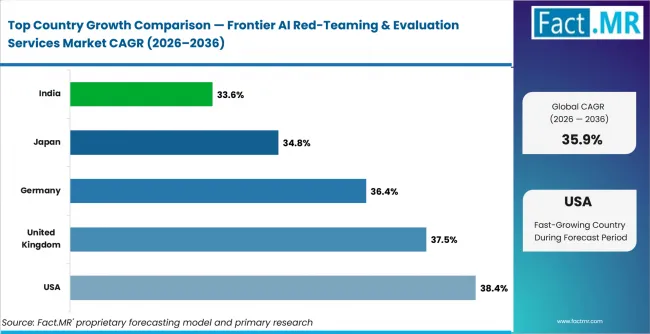
- By Geography: The United States is projected to grow at 38.4% CAGR through 2036 because frontier labs and enterprise AI buyers scale independent evaluations faster.
- Analyst Opinion at Fact.MR
- Shambhu Nath Jha, Senior Analyst at Fact.MR, states, “Frontier AI red-teaming will become a release gate for advanced models and agents. Internal testing will not satisfy every enterprise or regulator. Model developers will need independent findings and clear remediation records before high-risk deployment.”
- Strategic Implications
- Model developers should schedule independent evaluations before major releases.
- Enterprise AI teams need red-team reports before connecting agents to internal systems.
- Cybersecurity providers should separate AI model testing from standard pen-testing.
- Safety teams need retesting cycles after model updates and guardrail changes.
| Metric | Details |
|---|---|
| Market Size in 2026 | USD 0.7 billion |
| Market Forecast in 2036 | USD 15.0 billion |
| CAGR 2026 to 2036 | 35.9% |
The United States is expected to record 38.4% CAGR through 2036 as frontier model developers and enterprise AI deployers expand external testing. The United Kingdom is likely to post 37.5% CAGR as AI Security Institute activity supports independent evaluation norms. Germany is set to advance at 36.4% CAGR by 2036 as EU AI Act compliance drives formal testing. Japan is projected to grow at 34.8% CAGR as quality-sensitive firms require safer AI release paths. India is forecast to record 33.6% CAGR as enterprise AI service providers add evaluation delivery.
Segmental Analysis
Frontier AI Red-Teaming & Evaluation Services Market Analysis by Service Type
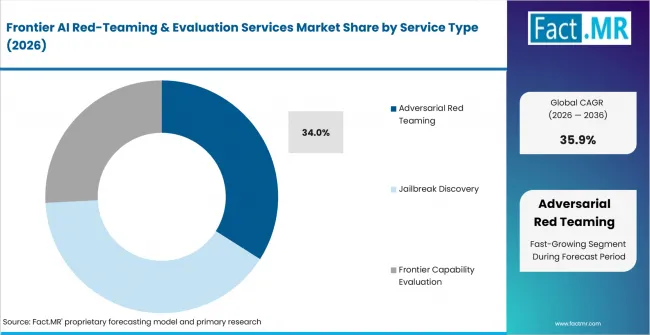
Adversarial red teaming is expected to dominate with 34.0% share in 2026. The segment leads because AI developers need jailbreak and misuse testing before models are released. Red teaming helps identify unsafe prompts and possible abuse routes early. Frontier capability evaluation adds another demand layer as advanced models need deeper risk checks. Agentic risk testing will also grow as AI systems gain tools and more autonomy.
- Adversarial Red Teaming: Adversarial red teaming tests model behavior under hostile prompts and misuse attempts.
- Jailbreak Discovery: Jailbreak discovery finds ways to bypass guardrails before public release.
- Frontier Capability Evaluation: Capability evaluation tests advanced model skills that may create higher risk.
Frontier AI Red-Teaming & Evaluation Services Market Analysis by Risk Domain
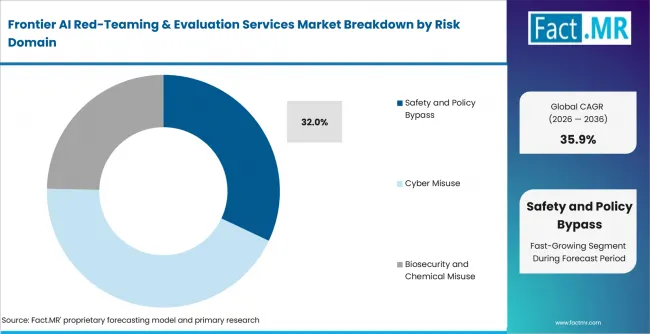
Safety and policy bypass is projected to lead with 32.0% share in 2026. The segment leads because refusal failures and bypass routes create clear release risk for AI developers. Policy bypass testing is also easier to procure early because teams can test prompts, safeguards and misuse patterns before launch. Cyber misuse follows as frontier models gain stronger coding and tool-use ability. Autonomous agent behavior testing will grow as agents begin acting across enterprise workflows.
- Safety and Policy Bypass: Safety testing checks whether guardrails fail under adversarial use.
- Cyber Misuse: Cyber misuse testing reviews whether models can support harmful technical activity.
- Autonomous Agent Behavior: Agent behavior testing checks unsafe action chains across connected tools.
Frontier AI Red-Teaming & Evaluation Services Market Analysis by Customer Type
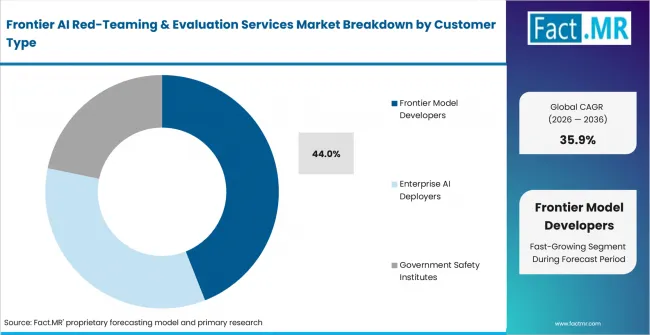
Frontier Model Developers are expected to account for 44.0% share in 2026 because model release cycles create early evaluation demand. Enterprise AI deployers follow as procurement teams require proof before tool rollout. Government safety institutes support evaluation science and public-interest testing. AI platform vendors need assurance for hosted models and APIs.
- Frontier Model Developers: Model developers need pre-release testing and remediation records.
- Enterprise AI Deployers: Enterprise deployers need third-party proof before high-risk AI use.
- Government Safety Institutes: Safety institutes support shared evaluation methods for advanced models.
Frontier AI Red-Teaming & Evaluation Services Market Analysis by Delivery Model
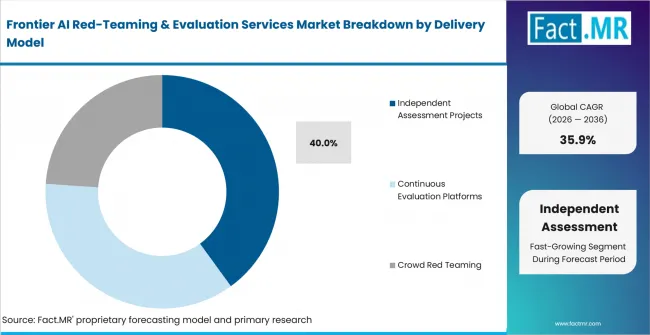
Independent Assessment Projects are expected to dominate with 40.0% share in 2026. The segment leads because firms prefer project-based reviews before committing to continuous testing programs. These reviews help teams test model risks, document findings and prepare for launch decisions. Continuous evaluation platforms follow as model updates become more frequent. Crowd red teaming gains demand through expert tester communities.
- Independent Assessment Projects: Independent assessments provide external findings before release or procurement.
- Continuous Evaluation Platforms: Continuous platforms retest models after updates and guardrail changes.
- Crowd Red Teaming: Crowd red teaming uses expert researchers to find hard-to-predict failures.
Frontier AI Red-Teaming & Evaluation Services Market Analysis by Deployment Stage
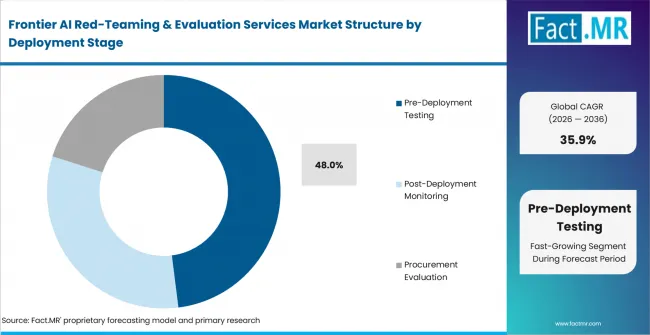
Pre-Deployment Testing is expected to capture 48.0% share in 2026 because frontier systems need testing before public release. Post-deployment monitoring follows because risks can appear after model updates. Procurement evaluation is rising as enterprises ask vendors for external evidence.
- Pre-Deployment Testing: Pre-deployment testing checks risk before model or agent release.
- Post-Deployment Monitoring: Monitoring retests systems after updates and new attack patterns.
- Procurement Evaluation: Procurement evaluation gives enterprise teams third-party assurance before purchase.
Frontier AI Red-Teaming & Evaluation Services Market Drivers, Restraints, and Opportunities

The main driver is regulatory pressure around frontier and high-risk AI testing. The GPAI Code of Practice adds practical guidance for safety and security risk management. [2] This pushes model developers to document testing, identify systemic risks and review safeguards before release. Enterprises deploying advanced AI also need independent checks so they can show stronger control over misuse, policy bypass and harmful outputs. The UK AI Security Institute has published lessons from frontier AI evaluations and noted the role of third-party evaluators. [3]
The main restraint is test reliability. AI red-teaming can find serious failures but cannot prove that all risks are solved. Attack methods change as models and agent tools change. Providers must show repeatable methods and clear severity grading so enterprise teams can act on findings.
Opportunities in the Frontier AI Red-Teaming & Evaluation Services Market
- Agent Red-Teaming: Providers can test tool-use agents before they act on enterprise data.
- Procurement Evaluation: Enterprises can use third-party reports before approving AI vendors.
- Continuous Retesting: Service firms can retest models after releases and guardrail changes.
Regional Analysis
Based on regional analysis, the frontier AI red-teaming and evaluation services market is segmented into North America, Europe, East Asia, South Asia and Pacific, Latin America, and Middle East and Africa.
.webp)
| Country | CAGR 2026 to 2036 |
|---|---|
| United States | 38.4% |
| United Kingdom | 37.5% |
| Germany | 36.4% |
| Japan | 34.8% |
| India | 33.6% |

North America Frontier AI Red-Teaming & Evaluation Services Market Analysis

North America demand is led by the United States because frontier model developers and enterprise AI deployers are building stronger release controls.
- United States: United States demand starts from frontier model developers and enterprise AI deployers that need external testing before wider release. The market is projected to record 38.4% CAGR by 2036 as safety teams seek independent jailbreak discovery and capability evaluation. Cisco completed the acquisition of Robust Intelligence in 2024 to strengthen security for AI applications, which shows AI security moving into larger enterprise platforms [4]. Crowd testing providers also give AI teams access to specialist researchers.
Europe Frontier AI Red-Teaming & Evaluation Services Market Analysis

Europe demand is driven by AI Act compliance and independent evaluation needs. The United Kingdom leads through safety institute activity while Germany grows through EU compliance planning.
- United Kingdom: United Kingdom demand is shaped by AI Security Institute activity and a strong services base. The market is likely to post 37.5% CAGR through 2036 as frontier evaluations influence enterprise assurance norms. Model developers and deployers need testing that covers harmful capability and jailbreak behavior. Consulting teams can package evaluation evidence into procurement reviews. Providers that translate technical findings into board-level risk language can gain faster acceptance.
- Germany: Germany reflects a compliance-led adoption path because EU AI Act obligations push formal risk management and testing. The country is set to advance at 36.4% CAGR from 2026 to 2036 as enterprises request evidence before using high-risk AI systems. Industrial firms will need evaluations for agents used in engineering and production support. Providers must document test coverage and remediation steps in a format legal teams can review. German demand will favor structured assessment reports and local-language support.
Asia Pacific Frontier AI Red-Teaming & Evaluation Services Market Analysis

Asia Pacific demand is split between quality-focused deployment and services-led delivery. Japan grows through controlled enterprise AI adoption while India grows through AI service delivery.
- Japan: Japan is projected to grow at 34.8% CAGR through 2036 as quality-sensitive enterprises require safer AI release paths. Banks and manufacturers will test models carefully before allowing agents into customer or engineering workflows. Frontier capability evaluation can support executive confidence because internal teams may lack deep adversarial testing skills. Providers can gain by offering careful documentation and human-led review. Japan will favor trusted evaluators that can explain failure cases without overstating safety. Long approval cycles may slow early adoption but can create durable service relationships after initial validation.
- India: India is forecast to record 33.6% CAGR through 2036 as enterprise AI service providers add evaluation delivery to implementation work. Large technology services firms can build red-teaming teams for global clients and domestic banks. Cost pressure will support standardized testing playbooks and managed retesting. AI deployers will need checks for chatbots and internal agents before connecting them to customer data. Providers that combine red-team testing with deployment support can win faster.
Competitive Aligners for Market Providers

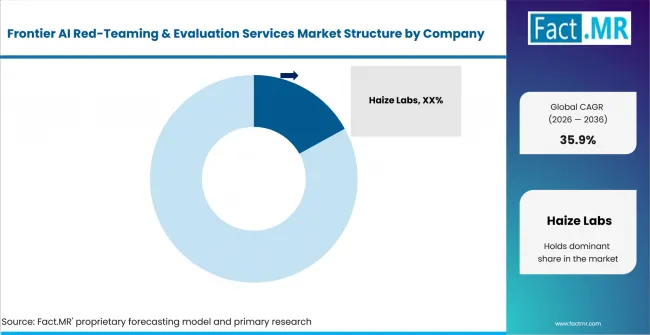
The frontier AI red-teaming and evaluation services market is split between specialist AI safety firms and enterprise security providers. Haize Labs and Gray Swan AI focus on adversarial AI testing and model stress tests. Check Point / Lakera supports AI red-teaming and runtime protection for GenAI applications. Cisco brings Robust Intelligence into a wider enterprise security portfolio. HackerOne supports human-led and agent-assisted AI red teaming. Apollo Research focuses on frontier AI evaluation and loss-of-control risks.
Competition is moving beyond basic jailbreak lists. Model developers need tests that reflect deployment context. Enterprise AI teams need findings that map to remediation. This makes methodology clarity as important as attack creativity.
Provider strength through 2036 will come from repeatable evaluations and credible independence. Specialists can win frontier model work through deep test design. Cybersecurity firms can win enterprise accounts through existing security relationships. The strongest providers will combine adversarial testing with clear retesting and remediation support.
Key Companies in Frontier AI Red-Teaming & Evaluation Services Market
- Haize Labs
- Gray Swan AI
- Check Point / Lakera
- Cisco (Robust Intelligence)
- HackerOne
- Apollo Research
Bibliography
- [1]. European Parliament and Council of the European Union. (2024, June 13). Regulation (EU) 2024/1689 laying down harmonised rules on artificial intelligence.
- [2]. European Commission. (2025, July 10). General-Purpose AI Code of Practice now available.
- [3]. AI Security Institute. (2024, October 24). Early lessons from evaluating frontier AI systems.
- [4] Cisco. (2024). Fortifying the future of security for AI: Cisco announces intent to acquire Robust Intelligence.
This Report Addresses
- Strategic intelligence on frontier AI red-teaming and evaluation services.
- Forecast mapping from USD 0.7 billion in 2026 to USD 15.0 billion by 2036.
- Segment analysis covering Adversarial Red Teaming and Safety and Policy Bypass.
- Customer review covering Frontier Model Developers and Enterprise AI Deployers.
- Regional outlook covering the United States, United Kingdom, Germany, Japan and India.
- Competitive analysis of Haize Labs, Gray Swan AI, Check Point / Lakera, Cisco, HackerOne and Apollo Research.
- Opportunity review across agent red-teaming and procurement evaluation.
- Market distinction from traditional cybersecurity pen-testing.
Frontier AI Red-Teaming & Evaluation Services Market Definition
The frontier AI red-teaming and evaluation services market covers independent services that test advanced AI models and agents for safety and capability risks. It includes jailbreak discovery and agentic misuse testing. It includes frontier capability evaluation before model release. The market differs from traditional cybersecurity testing because the central risk is AI behavior under adversarial prompts and real deployment context.
Frontier AI Red-Teaming & Evaluation Services Market Inclusions
The scope covers adversarial prompt testing and jailbreak discovery. It includes pre-deployment frontier model evaluations and agentic risk testing. It covers crowd red-teaming programs for AI applications. It includes independent evaluation reports used in enterprise procurement and policy review. It also includes continuous testing for models after deployment.
Frontier AI Red-Teaming & Evaluation Services Market Exclusions
The scope excludes basic cybersecurity penetration testing with no AI model evaluation. It excludes generic AI governance software unless it includes adversarial testing. It excludes internal safety testing that is not sold as a service. It excludes content moderation tools unless they test model or agent behavior under attack.
Frontier AI Red-Teaming & Evaluation Services Market Research Methodology
- Primary Research: Primary research includes discussions with model safety leads and AI security heads. Enterprise AI procurement managers are reviewed separately.
- Desk Research: Desk research reviews AI Act obligations and AI safety institute publications. Official company pages support provider-side validation.
- Market-Sizing and Forecasting: Market estimates are developed through frontier model release activity and enterprise AI deployment volume. External evaluation spend supports service sizing.
- Data Validation and Update Cycle: Forecasts are checked through provider activity and AI safety guidance. Enterprise procurement signals support validation.
Scope of the Report

| Attribute | Details |
|---|---|
| Quantitative Units | USD 0.7 billion in 2026 to USD 15.0 billion by 2036 at 35.9% CAGR |
| Market Definition | Independent adversarial testing and capability evaluation services for AI models and agents |
| Service Type | Adversarial Red Teaming / Jailbreak Discovery / Frontier Capability Evaluation / Agentic Risk Testing / Continuous Model Evaluation |
| Risk Domain | Safety and Policy Bypass / Cyber Misuse / Biosecurity and Chemical Misuse / Autonomous Agent Behavior / Data Leakage |
| Customer Type | Frontier Model Developers / Enterprise AI Deployers / Government Safety Institutes / AI Platform Vendors / Regulated Sector Deployers |
| Delivery Model | Independent Assessment Projects / Continuous Evaluation Platforms / Crowd Red Teaming / Managed Testing Retainers / Certification Support |
| Deployment Stage | Pre-Deployment Testing / Post-Deployment Monitoring / Procurement Evaluation / Regulatory Filing Support / Incident Retesting |
| Regions Covered | North America / Europe / East Asia / South Asia and Pacific / Latin America / Middle East and Africa |
| Countries Covered | United States / United Kingdom / Germany / Japan / India |
| Key Companies Profiled | Haize Labs, Gray Swan AI, Check Point / Lakera, Cisco (Robust Intelligence), HackerOne and Apollo Research |
| Forecast Period | 2026 to 2036 |
| Approach | Hybrid top-down and bottom-up approach using model release activity, enterprise AI deployment volume, evaluation service intensity and regulatory pressure |
Frontier AI Red-Teaming & Evaluation Services Market Analysis by Segments
-
By Service Type:
- Adversarial Red Teaming
- Jailbreak Discovery
- Frontier Capability Evaluation
- Agentic Risk Testing
- Continuous Model Evaluation
-
By Risk Domain:
- Safety and Policy Bypass
- Cyber Misuse
- Biosecurity and Chemical Misuse
- Autonomous Agent Behavior
- Data Leakage
-
By Customer Type:
- Frontier Model Developers
- Enterprise AI Deployers
- Government Safety Institutes
- AI Platform Vendors
- Regulated Sector Deployers
-
By Delivery Model:
- Independent Assessment Projects
- Continuous Evaluation Platforms
- Crowd Red Teaming
- Managed Testing Retainers
- Certification Support
-
By Deployment Stage:
- Pre-Deployment Testing
- Post-Deployment Monitoring
- Procurement Evaluation
- Regulatory Filing Support
- Incident Retesting
-
Region:
- North America
- United States
- Europe
- United Kingdom
- Germany
- East Asia
- Japan
- South Asia and Pacific
- India
- Latin America
- Middle East and Africa
- North America
- Frequently Asked Questions -
What is the Frontier AI Red-Teaming & Evaluation Services Market size in 2026?
The frontier AI red-teaming and evaluation services market is estimated at USD 0.7 billion in 2026.
What will the Frontier AI Red-Teaming & Evaluation Services Market be worth by 2036?
The market is projected to reach USD 15.0 billion by 2036 as independent AI evaluations become routine before deployment.
What CAGR is projected for the Frontier AI Red-Teaming & Evaluation Services Market?
The market is forecast to record 35.9% CAGR from 2026 to 2036 through independent model evaluation demand.
Which service type leads the Frontier AI Red-Teaming & Evaluation Services Market?
Adversarial Red Teaming leads with 34.0% share in 2026 because jailbreak and misuse testing are the first paid needs.
Which country grows fastest in the Frontier AI Red-Teaming & Evaluation Services Market?
The United States grows fastest at 38.4% CAGR through 2036 due to frontier lab activity and enterprise AI deployment.
How does the United Kingdom perform in the Frontier AI Red-Teaming & Evaluation Services Market?
The United Kingdom is projected to post 37.5% CAGR through 2036 as AI Security Institute activity supports evaluation norms.
How does Germany perform in the Frontier AI Red-Teaming & Evaluation Services Market?
Germany is expected to advance at 36.4% CAGR through 2036 as EU AI Act compliance supports formal testing.
How does Japan perform in the Frontier AI Red-Teaming & Evaluation Services Market?
Japan is projected to grow at 34.8% CAGR through 2036 as quality-sensitive firms require safer AI release paths.
How does India perform in the Frontier AI Red-Teaming & Evaluation Services Market?
India is forecast to record 33.6% CAGR through 2036 as AI service providers add evaluation delivery.
What drives the Frontier AI Red-Teaming & Evaluation Services Market?
The market is driven by release risk for frontier models and enterprise demand for third-party AI assurance.
What restrains the Frontier AI Red-Teaming & Evaluation Services Market?
The main restraint is test reliability. Red teams can uncover failures but cannot prove that all risks are removed.
What is the main opportunity in the Frontier AI Red-Teaming & Evaluation Services Market?
The main opportunity is agent red-teaming for AI systems that use tools and enterprise data.
Table of Content
- Executive Summary
- Global Market Outlook
- Demand to side Trends
- Supply to side Trends
- Technology Roadmap Analysis
- Analysis and Recommendations
- Market Overview
- Market Coverage / Taxonomy
- Market Definition / Scope / Limitations
- Research Methodology
- Chapter Orientation
- Analytical Lens and Working Hypotheses
- Market Structure, Signals, and Trend Drivers
- Benchmarking and Cross-market Comparability
- Market Sizing, Forecasting, and Opportunity Mapping
- Research Design and Evidence Framework
- Desk Research Programme (Secondary Evidence)
- Company Annual and Sustainability Reports
- Peer-reviewed Journals and Academic Literature
- Corporate Websites, Product Literature, and Technical Notes
- Earnings Decks and Investor Briefings
- Statutory Filings and Regulatory Disclosures
- Technical White Papers and Standards Notes
- Trade Journals, Industry Magazines, and Analyst Briefs
- Conference Proceedings, Webinars, and Seminar Materials
- Government Statistics Portals and Public Data Releases
- Press Releases and Reputable Media Coverage
- Specialist Newsletters and Curated Briefings
- Sector Databases and Reference Repositories
- Fact.MR Internal Proprietary Databases and Historical Market Datasets
- Subscription Datasets and Paid Sources
- Social Channels, Communities, and Digital Listening Inputs
- Additional Desk Sources
- Expert Input and Fieldwork (Primary Evidence)
- Primary Modes
- Qualitative Interviews and Expert Elicitation
- Quantitative Surveys and Structured Data Capture
- Blended Approach
- Why Primary Evidence is Used
- Field Techniques
- Interviews
- Surveys
- Focus Groups
- Observational and In-context Research
- Social and Community Interactions
- Stakeholder Universe Engaged
- C-suite Leaders
- Board Members
- Presidents and Vice Presidents
- R&D and Innovation Heads
- Technical Specialists
- Domain Subject-matter Experts
- Scientists
- Physicians and Other Healthcare Professionals
- Governance, Ethics, and Data Stewardship
- Research Ethics
- Data Integrity and Handling
- Primary Modes
- Tooling, Models, and Reference Databases
- Desk Research Programme (Secondary Evidence)
- Data Engineering and Model Build
- Data Acquisition and Ingestion
- Cleaning, Normalisation, and Verification
- Synthesis, Triangulation, and Analysis
- Quality Assurance and Audit Trail
- Market Background
- Market Dynamics
- Drivers
- Restraints
- Opportunity
- Trends
- Scenario Forecast
- Demand in Optimistic Scenario
- Demand in Likely Scenario
- Demand in Conservative Scenario
- Opportunity Map Analysis
- Product Life Cycle Analysis
- Supply Chain Analysis
- Investment Feasibility Matrix
- Value Chain Analysis
- PESTLE and Porter’s Analysis
- Regulatory Landscape
- Regional Parent Market Outlook
- Production and Consumption Statistics
- Import and Export Statistics
- Market Dynamics
- Global Market Analysis 2021 to 2025 and Forecast, 2026 to 2036
- Historical Market Size Value (USD Million) Analysis, 2021 to 2025
- Current and Future Market Size Value (USD Million) Projections, 2026 to 2036
- Y to o to Y Growth Trend Analysis
- Absolute $ Opportunity Analysis
- Global Market Pricing Analysis 2021 to 2025 and Forecast 2026 to 2036
- Global Market Analysis 2021 to 2025 and Forecast 2026 to 2036, By Service Type
- Introduction / Key Findings
- Historical Market Size Value (USD Million) Analysis By Service Type , 2021 to 2025
- Current and Future Market Size Value (USD Million) Analysis and Forecast By Service Type , 2026 to 2036
- Adversarial Red Teaming
- Jailbreak Discovery
- Frontier Capability Evaluation
- Adversarial Red Teaming
- Y to o to Y Growth Trend Analysis By Service Type , 2021 to 2025
- Absolute $ Opportunity Analysis By Service Type , 2026 to 2036
- Global Market Analysis 2021 to 2025 and Forecast 2026 to 2036, By Risk Domain
- Introduction / Key Findings
- Historical Market Size Value (USD Million) Analysis By Risk Domain, 2021 to 2025
- Current and Future Market Size Value (USD Million) Analysis and Forecast By Risk Domain, 2026 to 2036
- Safety and Policy Bypass
- Cyber Misuse
- Biosecurity and Chemical Misuse
- Safety and Policy Bypass
- Y to o to Y Growth Trend Analysis By Risk Domain, 2021 to 2025
- Absolute $ Opportunity Analysis By Risk Domain, 2026 to 2036
- Global Market Analysis 2021 to 2025 and Forecast 2026 to 2036, By Customer Type
- Introduction / Key Findings
- Historical Market Size Value (USD Million) Analysis By Customer Type, 2021 to 2025
- Current and Future Market Size Value (USD Million) Analysis and Forecast By Customer Type, 2026 to 2036
- Frontier Model Developers
- Enterprise AI Deployers
- Government Safety Institutes
- Frontier Model Developers
- Y to o to Y Growth Trend Analysis By Customer Type, 2021 to 2025
- Absolute $ Opportunity Analysis By Customer Type, 2026 to 2036
- Global Market Analysis 2021 to 2025 and Forecast 2026 to 2036, By Delivery Model
- Introduction / Key Findings
- Historical Market Size Value (USD Million) Analysis By Delivery Model, 2021 to 2025
- Current and Future Market Size Value (USD Million) Analysis and Forecast By Delivery Model, 2026 to 2036
- Independent Assessment Projects
- Continuous Evaluation Platforms
- Crowd Red Teaming
- Independent Assessment Projects
- Y to o to Y Growth Trend Analysis By Delivery Model, 2021 to 2025
- Absolute $ Opportunity Analysis By Delivery Model, 2026 to 2036
- Global Market Analysis 2021 to 2025 and Forecast 2026 to 2036, By Deployment Stage
- Introduction / Key Findings
- Historical Market Size Value (USD Million) Analysis By Deployment Stage, 2021 to 2025
- Current and Future Market Size Value (USD Million) Analysis and Forecast By Deployment Stage, 2026 to 2036
- Pre-Deployment Testing
- Post-Deployment Monitoring
- Procurement Evaluation
- Pre-Deployment Testing
- Y to o to Y Growth Trend Analysis By Deployment Stage, 2021 to 2025
- Absolute $ Opportunity Analysis By Deployment Stage, 2026 to 2036
- Global Market Analysis 2021 to 2025 and Forecast 2026 to 2036, By Region
- Introduction
- Historical Market Size Value (USD Million) Analysis By Region, 2021 to 2025
- Current Market Size Value (USD Million) Analysis and Forecast By Region, 2026 to 2036
- North America
- Latin America
- Western Europe
- Eastern Europe
- East Asia
- South Asia and Pacific
- Middle East & Africa
- Market Attractiveness Analysis By Region
- North America Market Analysis 2021 to 2025 and Forecast 2026 to 2036, By Country
- Historical Market Size Value (USD Million) Trend Analysis By Market Taxonomy, 2021 to 2025
- Market Size Value (USD Million) Forecast By Market Taxonomy, 2026 to 2036
- By Country
- USA
- Canada
- Mexico
- By Service Type
- By Risk Domain
- By Customer Type
- By Delivery Model
- By Deployment Stage
- By Country
- Market Attractiveness Analysis
- By Country
- By Service Type
- By Risk Domain
- By Customer Type
- By Delivery Model
- By Deployment Stage
- Key Takeaways
- Latin America Market Analysis 2021 to 2025 and Forecast 2026 to 2036, By Country
- Historical Market Size Value (USD Million) Trend Analysis By Market Taxonomy, 2021 to 2025
- Market Size Value (USD Million) Forecast By Market Taxonomy, 2026 to 2036
- By Country
- Brazil
- Chile
- Rest of Latin America
- By Service Type
- By Risk Domain
- By Customer Type
- By Delivery Model
- By Deployment Stage
- By Country
- Market Attractiveness Analysis
- By Country
- By Service Type
- By Risk Domain
- By Customer Type
- By Delivery Model
- By Deployment Stage
- Key Takeaways
- Western Europe Market Analysis 2021 to 2025 and Forecast 2026 to 2036, By Country
- Historical Market Size Value (USD Million) Trend Analysis By Market Taxonomy, 2021 to 2025
- Market Size Value (USD Million) Forecast By Market Taxonomy, 2026 to 2036
- By Country
- Germany
- UK
- Italy
- Spain
- France
- Nordic
- BENELUX
- Rest of Western Europe
- By Service Type
- By Risk Domain
- By Customer Type
- By Delivery Model
- By Deployment Stage
- By Country
- Market Attractiveness Analysis
- By Country
- By Service Type
- By Risk Domain
- By Customer Type
- By Delivery Model
- By Deployment Stage
- Key Takeaways
- Eastern Europe Market Analysis 2021 to 2025 and Forecast 2026 to 2036, By Country
- Historical Market Size Value (USD Million) Trend Analysis By Market Taxonomy, 2021 to 2025
- Market Size Value (USD Million) Forecast By Market Taxonomy, 2026 to 2036
- By Country
- Russia
- Poland
- Hungary
- Balkan & Baltic
- Rest of Eastern Europe
- By Service Type
- By Risk Domain
- By Customer Type
- By Delivery Model
- By Deployment Stage
- By Country
- Market Attractiveness Analysis
- By Country
- By Service Type
- By Risk Domain
- By Customer Type
- By Delivery Model
- By Deployment Stage
- Key Takeaways
- East Asia Market Analysis 2021 to 2025 and Forecast 2026 to 2036, By Country
- Historical Market Size Value (USD Million) Trend Analysis By Market Taxonomy, 2021 to 2025
- Market Size Value (USD Million) Forecast By Market Taxonomy, 2026 to 2036
- By Country
- China
- Japan
- South Korea
- By Service Type
- By Risk Domain
- By Customer Type
- By Delivery Model
- By Deployment Stage
- By Country
- Market Attractiveness Analysis
- By Country
- By Service Type
- By Risk Domain
- By Customer Type
- By Delivery Model
- By Deployment Stage
- Key Takeaways
- South Asia and Pacific Market Analysis 2021 to 2025 and Forecast 2026 to 2036, By Country
- Historical Market Size Value (USD Million) Trend Analysis By Market Taxonomy, 2021 to 2025
- Market Size Value (USD Million) Forecast By Market Taxonomy, 2026 to 2036
- By Country
- India
- ASEAN
- Australia & New Zealand
- Rest of South Asia and Pacific
- By Service Type
- By Risk Domain
- By Customer Type
- By Delivery Model
- By Deployment Stage
- By Country
- Market Attractiveness Analysis
- By Country
- By Service Type
- By Risk Domain
- By Customer Type
- By Delivery Model
- By Deployment Stage
- Key Takeaways
- Middle East & Africa Market Analysis 2021 to 2025 and Forecast 2026 to 2036, By Country
- Historical Market Size Value (USD Million) Trend Analysis By Market Taxonomy, 2021 to 2025
- Market Size Value (USD Million) Forecast By Market Taxonomy, 2026 to 2036
- By Country
- Kingdom of Saudi Arabia
- Other GCC Countries
- Turkiye
- South Africa
- Other African Union
- Rest of Middle East & Africa
- By Service Type
- By Risk Domain
- By Customer Type
- By Delivery Model
- By Deployment Stage
- By Country
- Market Attractiveness Analysis
- By Country
- By Service Type
- By Risk Domain
- By Customer Type
- By Delivery Model
- By Deployment Stage
- Key Takeaways
- Key Countries Market Analysis
- USA
- Pricing Analysis
- Market Share Analysis, 2025
- By Service Type
- By Risk Domain
- By Customer Type
- By Delivery Model
- By Deployment Stage
- Canada
- Pricing Analysis
- Market Share Analysis, 2025
- By Service Type
- By Risk Domain
- By Customer Type
- By Delivery Model
- By Deployment Stage
- Mexico
- Pricing Analysis
- Market Share Analysis, 2025
- By Service Type
- By Risk Domain
- By Customer Type
- By Delivery Model
- By Deployment Stage
- Brazil
- Pricing Analysis
- Market Share Analysis, 2025
- By Service Type
- By Risk Domain
- By Customer Type
- By Delivery Model
- By Deployment Stage
- Chile
- Pricing Analysis
- Market Share Analysis, 2025
- By Service Type
- By Risk Domain
- By Customer Type
- By Delivery Model
- By Deployment Stage
- Germany
- Pricing Analysis
- Market Share Analysis, 2025
- By Service Type
- By Risk Domain
- By Customer Type
- By Delivery Model
- By Deployment Stage
- UK
- Pricing Analysis
- Market Share Analysis, 2025
- By Service Type
- By Risk Domain
- By Customer Type
- By Delivery Model
- By Deployment Stage
- Italy
- Pricing Analysis
- Market Share Analysis, 2025
- By Service Type
- By Risk Domain
- By Customer Type
- By Delivery Model
- By Deployment Stage
- Spain
- Pricing Analysis
- Market Share Analysis, 2025
- By Service Type
- By Risk Domain
- By Customer Type
- By Delivery Model
- By Deployment Stage
- France
- Pricing Analysis
- Market Share Analysis, 2025
- By Service Type
- By Risk Domain
- By Customer Type
- By Delivery Model
- By Deployment Stage
- India
- Pricing Analysis
- Market Share Analysis, 2025
- By Service Type
- By Risk Domain
- By Customer Type
- By Delivery Model
- By Deployment Stage
- ASEAN
- Pricing Analysis
- Market Share Analysis, 2025
- By Service Type
- By Risk Domain
- By Customer Type
- By Delivery Model
- By Deployment Stage
- Australia & New Zealand
- Pricing Analysis
- Market Share Analysis, 2025
- By Service Type
- By Risk Domain
- By Customer Type
- By Delivery Model
- By Deployment Stage
- China
- Pricing Analysis
- Market Share Analysis, 2025
- By Service Type
- By Risk Domain
- By Customer Type
- By Delivery Model
- By Deployment Stage
- Japan
- Pricing Analysis
- Market Share Analysis, 2025
- By Service Type
- By Risk Domain
- By Customer Type
- By Delivery Model
- By Deployment Stage
- South Korea
- Pricing Analysis
- Market Share Analysis, 2025
- By Service Type
- By Risk Domain
- By Customer Type
- By Delivery Model
- By Deployment Stage
- Russia
- Pricing Analysis
- Market Share Analysis, 2025
- By Service Type
- By Risk Domain
- By Customer Type
- By Delivery Model
- By Deployment Stage
- Poland
- Pricing Analysis
- Market Share Analysis, 2025
- By Service Type
- By Risk Domain
- By Customer Type
- By Delivery Model
- By Deployment Stage
- Hungary
- Pricing Analysis
- Market Share Analysis, 2025
- By Service Type
- By Risk Domain
- By Customer Type
- By Delivery Model
- By Deployment Stage
- Kingdom of Saudi Arabia
- Pricing Analysis
- Market Share Analysis, 2025
- By Service Type
- By Risk Domain
- By Customer Type
- By Delivery Model
- By Deployment Stage
- Turkiye
- Pricing Analysis
- Market Share Analysis, 2025
- By Service Type
- By Risk Domain
- By Customer Type
- By Delivery Model
- By Deployment Stage
- South Africa
- Pricing Analysis
- Market Share Analysis, 2025
- By Service Type
- By Risk Domain
- By Customer Type
- By Delivery Model
- By Deployment Stage
- USA
- Market Structure Analysis
- Competition Dashboard
- Competition Benchmarking
- Market Share Analysis of Top Players
- By Regional
- By Service Type
- By Risk Domain
- By Customer Type
- By Delivery Model
- By Deployment Stage
- Competition Analysis
- Competition Deep Dive
- Haize Labs
- Overview
- Product Portfolio
- Profitability by Market Segments (Product/Age /Sales Channel/Region)
- Sales Footprint
- Strategy Overview
- Marketing Strategy
- Product Strategy
- Channel Strategy
- Gray Swan AI
- Check Point / Lakera
- Cisco (Robust Intelligence)
- HackerOne
- Apollo Research
- Haize Labs
- Competition Deep Dive
- Assumptions & Acronyms Used
List Of Table
- Table 1: Global Market Value (USD Million) Forecast by Region, 2021 to 2036
- Table 2: Global Market Value (USD Million) Forecast by Service Type , 2021 to 2036
- Table 3: Global Market Value (USD Million) Forecast by Risk Domain, 2021 to 2036
- Table 4: Global Market Value (USD Million) Forecast by Customer Type, 2021 to 2036
- Table 5: Global Market Value (USD Million) Forecast by Delivery Model, 2021 to 2036
- Table 6: Global Market Value (USD Million) Forecast by Deployment Stage, 2021 to 2036
- Table 7: North America Market Value (USD Million) Forecast by Country, 2021 to 2036
- Table 8: North America Market Value (USD Million) Forecast by Service Type , 2021 to 2036
- Table 9: North America Market Value (USD Million) Forecast by Risk Domain, 2021 to 2036
- Table 10: North America Market Value (USD Million) Forecast by Customer Type, 2021 to 2036
- Table 11: North America Market Value (USD Million) Forecast by Delivery Model, 2021 to 2036
- Table 12: North America Market Value (USD Million) Forecast by Deployment Stage, 2021 to 2036
- Table 13: Latin America Market Value (USD Million) Forecast by Country, 2021 to 2036
- Table 14: Latin America Market Value (USD Million) Forecast by Service Type , 2021 to 2036
- Table 15: Latin America Market Value (USD Million) Forecast by Risk Domain, 2021 to 2036
- Table 16: Latin America Market Value (USD Million) Forecast by Customer Type, 2021 to 2036
- Table 17: Latin America Market Value (USD Million) Forecast by Delivery Model, 2021 to 2036
- Table 18: Latin America Market Value (USD Million) Forecast by Deployment Stage, 2021 to 2036
- Table 19: Western Europe Market Value (USD Million) Forecast by Country, 2021 to 2036
- Table 20: Western Europe Market Value (USD Million) Forecast by Service Type , 2021 to 2036
- Table 21: Western Europe Market Value (USD Million) Forecast by Risk Domain, 2021 to 2036
- Table 22: Western Europe Market Value (USD Million) Forecast by Customer Type, 2021 to 2036
- Table 23: Western Europe Market Value (USD Million) Forecast by Delivery Model, 2021 to 2036
- Table 24: Western Europe Market Value (USD Million) Forecast by Deployment Stage, 2021 to 2036
- Table 25: Eastern Europe Market Value (USD Million) Forecast by Country, 2021 to 2036
- Table 26: Eastern Europe Market Value (USD Million) Forecast by Service Type , 2021 to 2036
- Table 27: Eastern Europe Market Value (USD Million) Forecast by Risk Domain, 2021 to 2036
- Table 28: Eastern Europe Market Value (USD Million) Forecast by Customer Type, 2021 to 2036
- Table 29: Eastern Europe Market Value (USD Million) Forecast by Delivery Model, 2021 to 2036
- Table 30: Eastern Europe Market Value (USD Million) Forecast by Deployment Stage, 2021 to 2036
- Table 31: East Asia Market Value (USD Million) Forecast by Country, 2021 to 2036
- Table 32: East Asia Market Value (USD Million) Forecast by Service Type , 2021 to 2036
- Table 33: East Asia Market Value (USD Million) Forecast by Risk Domain, 2021 to 2036
- Table 34: East Asia Market Value (USD Million) Forecast by Customer Type, 2021 to 2036
- Table 35: East Asia Market Value (USD Million) Forecast by Delivery Model, 2021 to 2036
- Table 36: East Asia Market Value (USD Million) Forecast by Deployment Stage, 2021 to 2036
- Table 37: South Asia and Pacific Market Value (USD Million) Forecast by Country, 2021 to 2036
- Table 38: South Asia and Pacific Market Value (USD Million) Forecast by Service Type , 2021 to 2036
- Table 39: South Asia and Pacific Market Value (USD Million) Forecast by Risk Domain, 2021 to 2036
- Table 40: South Asia and Pacific Market Value (USD Million) Forecast by Customer Type, 2021 to 2036
- Table 41: South Asia and Pacific Market Value (USD Million) Forecast by Delivery Model, 2021 to 2036
- Table 42: South Asia and Pacific Market Value (USD Million) Forecast by Deployment Stage, 2021 to 2036
- Table 43: Middle East & Africa Market Value (USD Million) Forecast by Country, 2021 to 2036
- Table 44: Middle East & Africa Market Value (USD Million) Forecast by Service Type , 2021 to 2036
- Table 45: Middle East & Africa Market Value (USD Million) Forecast by Risk Domain, 2021 to 2036
- Table 46: Middle East & Africa Market Value (USD Million) Forecast by Customer Type, 2021 to 2036
- Table 47: Middle East & Africa Market Value (USD Million) Forecast by Delivery Model, 2021 to 2036
- Table 48: Middle East & Africa Market Value (USD Million) Forecast by Deployment Stage, 2021 to 2036
List Of Figures
- Figure 1: Global Market Pricing Analysis
- Figure 2: Global Market Value (USD Million) Forecast 2021-2036
- Figure 3: Global Market Value Share and BPS Analysis by Service Type , 2026 and 2036
- Figure 4: Global Market Y-o-Y Growth Comparison by Service Type , 2026-2036
- Figure 5: Global Market Attractiveness Analysis by Service Type
- Figure 6: Global Market Value Share and BPS Analysis by Risk Domain, 2026 and 2036
- Figure 7: Global Market Y-o-Y Growth Comparison by Risk Domain, 2026-2036
- Figure 8: Global Market Attractiveness Analysis by Risk Domain
- Figure 9: Global Market Value Share and BPS Analysis by Customer Type, 2026 and 2036
- Figure 10: Global Market Y-o-Y Growth Comparison by Customer Type, 2026-2036
- Figure 11: Global Market Attractiveness Analysis by Customer Type
- Figure 12: Global Market Value Share and BPS Analysis by Delivery Model, 2026 and 2036
- Figure 13: Global Market Y-o-Y Growth Comparison by Delivery Model, 2026-2036
- Figure 14: Global Market Attractiveness Analysis by Delivery Model
- Figure 15: Global Market Value Share and BPS Analysis by Deployment Stage, 2026 and 2036
- Figure 16: Global Market Y-o-Y Growth Comparison by Deployment Stage, 2026-2036
- Figure 17: Global Market Attractiveness Analysis by Deployment Stage
- Figure 18: Global Market Value (USD Million) Share and BPS Analysis by Region, 2026 and 2036
- Figure 19: Global Market Y-o-Y Growth Comparison by Region, 2026-2036
- Figure 20: Global Market Attractiveness Analysis by Region
- Figure 21: North America Market Incremental Dollar Opportunity, 2026-2036
- Figure 22: Latin America Market Incremental Dollar Opportunity, 2026-2036
- Figure 23: Western Europe Market Incremental Dollar Opportunity, 2026-2036
- Figure 24: Eastern Europe Market Incremental Dollar Opportunity, 2026-2036
- Figure 25: East Asia Market Incremental Dollar Opportunity, 2026-2036
- Figure 26: South Asia and Pacific Market Incremental Dollar Opportunity, 2026-2036
- Figure 27: Middle East & Africa Market Incremental Dollar Opportunity, 2026-2036
- Figure 28: North America Market Value Share and BPS Analysis by Country, 2026 and 2036
- Figure 29: North America Market Value Share and BPS Analysis by Service Type , 2026 and 2036
- Figure 30: North America Market Y-o-Y Growth Comparison by Service Type , 2026-2036
- Figure 31: North America Market Attractiveness Analysis by Service Type
- Figure 32: North America Market Value Share and BPS Analysis by Risk Domain, 2026 and 2036
- Figure 33: North America Market Y-o-Y Growth Comparison by Risk Domain, 2026-2036
- Figure 34: North America Market Attractiveness Analysis by Risk Domain
- Figure 35: North America Market Value Share and BPS Analysis by Customer Type, 2026 and 2036
- Figure 36: North America Market Y-o-Y Growth Comparison by Customer Type, 2026-2036
- Figure 37: North America Market Attractiveness Analysis by Customer Type
- Figure 38: North America Market Value Share and BPS Analysis by Delivery Model, 2026 and 2036
- Figure 39: North America Market Y-o-Y Growth Comparison by Delivery Model, 2026-2036
- Figure 40: North America Market Attractiveness Analysis by Delivery Model
- Figure 41: North America Market Value Share and BPS Analysis by Deployment Stage, 2026 and 2036
- Figure 42: North America Market Y-o-Y Growth Comparison by Deployment Stage, 2026-2036
- Figure 43: North America Market Attractiveness Analysis by Deployment Stage
- Figure 44: Latin America Market Value Share and BPS Analysis by Country, 2026 and 2036
- Figure 45: Latin America Market Value Share and BPS Analysis by Service Type , 2026 and 2036
- Figure 46: Latin America Market Y-o-Y Growth Comparison by Service Type , 2026-2036
- Figure 47: Latin America Market Attractiveness Analysis by Service Type
- Figure 48: Latin America Market Value Share and BPS Analysis by Risk Domain, 2026 and 2036
- Figure 49: Latin America Market Y-o-Y Growth Comparison by Risk Domain, 2026-2036
- Figure 50: Latin America Market Attractiveness Analysis by Risk Domain
- Figure 51: Latin America Market Value Share and BPS Analysis by Customer Type, 2026 and 2036
- Figure 52: Latin America Market Y-o-Y Growth Comparison by Customer Type, 2026-2036
- Figure 53: Latin America Market Attractiveness Analysis by Customer Type
- Figure 54: Latin America Market Value Share and BPS Analysis by Delivery Model, 2026 and 2036
- Figure 55: Latin America Market Y-o-Y Growth Comparison by Delivery Model, 2026-2036
- Figure 56: Latin America Market Attractiveness Analysis by Delivery Model
- Figure 57: Latin America Market Value Share and BPS Analysis by Deployment Stage, 2026 and 2036
- Figure 58: Latin America Market Y-o-Y Growth Comparison by Deployment Stage, 2026-2036
- Figure 59: Latin America Market Attractiveness Analysis by Deployment Stage
- Figure 60: Western Europe Market Value Share and BPS Analysis by Country, 2026 and 2036
- Figure 61: Western Europe Market Value Share and BPS Analysis by Service Type , 2026 and 2036
- Figure 62: Western Europe Market Y-o-Y Growth Comparison by Service Type , 2026-2036
- Figure 63: Western Europe Market Attractiveness Analysis by Service Type
- Figure 64: Western Europe Market Value Share and BPS Analysis by Risk Domain, 2026 and 2036
- Figure 65: Western Europe Market Y-o-Y Growth Comparison by Risk Domain, 2026-2036
- Figure 66: Western Europe Market Attractiveness Analysis by Risk Domain
- Figure 67: Western Europe Market Value Share and BPS Analysis by Customer Type, 2026 and 2036
- Figure 68: Western Europe Market Y-o-Y Growth Comparison by Customer Type, 2026-2036
- Figure 69: Western Europe Market Attractiveness Analysis by Customer Type
- Figure 70: Western Europe Market Value Share and BPS Analysis by Delivery Model, 2026 and 2036
- Figure 71: Western Europe Market Y-o-Y Growth Comparison by Delivery Model, 2026-2036
- Figure 72: Western Europe Market Attractiveness Analysis by Delivery Model
- Figure 73: Western Europe Market Value Share and BPS Analysis by Deployment Stage, 2026 and 2036
- Figure 74: Western Europe Market Y-o-Y Growth Comparison by Deployment Stage, 2026-2036
- Figure 75: Western Europe Market Attractiveness Analysis by Deployment Stage
- Figure 76: Eastern Europe Market Value Share and BPS Analysis by Country, 2026 and 2036
- Figure 77: Eastern Europe Market Value Share and BPS Analysis by Service Type , 2026 and 2036
- Figure 78: Eastern Europe Market Y-o-Y Growth Comparison by Service Type , 2026-2036
- Figure 79: Eastern Europe Market Attractiveness Analysis by Service Type
- Figure 80: Eastern Europe Market Value Share and BPS Analysis by Risk Domain, 2026 and 2036
- Figure 81: Eastern Europe Market Y-o-Y Growth Comparison by Risk Domain, 2026-2036
- Figure 82: Eastern Europe Market Attractiveness Analysis by Risk Domain
- Figure 83: Eastern Europe Market Value Share and BPS Analysis by Customer Type, 2026 and 2036
- Figure 84: Eastern Europe Market Y-o-Y Growth Comparison by Customer Type, 2026-2036
- Figure 85: Eastern Europe Market Attractiveness Analysis by Customer Type
- Figure 86: Eastern Europe Market Value Share and BPS Analysis by Delivery Model, 2026 and 2036
- Figure 87: Eastern Europe Market Y-o-Y Growth Comparison by Delivery Model, 2026-2036
- Figure 88: Eastern Europe Market Attractiveness Analysis by Delivery Model
- Figure 89: Eastern Europe Market Value Share and BPS Analysis by Deployment Stage, 2026 and 2036
- Figure 90: Eastern Europe Market Y-o-Y Growth Comparison by Deployment Stage, 2026-2036
- Figure 91: Eastern Europe Market Attractiveness Analysis by Deployment Stage
- Figure 92: East Asia Market Value Share and BPS Analysis by Country, 2026 and 2036
- Figure 93: East Asia Market Value Share and BPS Analysis by Service Type , 2026 and 2036
- Figure 94: East Asia Market Y-o-Y Growth Comparison by Service Type , 2026-2036
- Figure 95: East Asia Market Attractiveness Analysis by Service Type
- Figure 96: East Asia Market Value Share and BPS Analysis by Risk Domain, 2026 and 2036
- Figure 97: East Asia Market Y-o-Y Growth Comparison by Risk Domain, 2026-2036
- Figure 98: East Asia Market Attractiveness Analysis by Risk Domain
- Figure 99: East Asia Market Value Share and BPS Analysis by Customer Type, 2026 and 2036
- Figure 100: East Asia Market Y-o-Y Growth Comparison by Customer Type, 2026-2036
- Figure 101: East Asia Market Attractiveness Analysis by Customer Type
- Figure 102: East Asia Market Value Share and BPS Analysis by Delivery Model, 2026 and 2036
- Figure 103: East Asia Market Y-o-Y Growth Comparison by Delivery Model, 2026-2036
- Figure 104: East Asia Market Attractiveness Analysis by Delivery Model
- Figure 105: East Asia Market Value Share and BPS Analysis by Deployment Stage, 2026 and 2036
- Figure 106: East Asia Market Y-o-Y Growth Comparison by Deployment Stage, 2026-2036
- Figure 107: East Asia Market Attractiveness Analysis by Deployment Stage
- Figure 108: South Asia and Pacific Market Value Share and BPS Analysis by Country, 2026 and 2036
- Figure 109: South Asia and Pacific Market Value Share and BPS Analysis by Service Type , 2026 and 2036
- Figure 110: South Asia and Pacific Market Y-o-Y Growth Comparison by Service Type , 2026-2036
- Figure 111: South Asia and Pacific Market Attractiveness Analysis by Service Type
- Figure 112: South Asia and Pacific Market Value Share and BPS Analysis by Risk Domain, 2026 and 2036
- Figure 113: South Asia and Pacific Market Y-o-Y Growth Comparison by Risk Domain, 2026-2036
- Figure 114: South Asia and Pacific Market Attractiveness Analysis by Risk Domain
- Figure 115: South Asia and Pacific Market Value Share and BPS Analysis by Customer Type, 2026 and 2036
- Figure 116: South Asia and Pacific Market Y-o-Y Growth Comparison by Customer Type, 2026-2036
- Figure 117: South Asia and Pacific Market Attractiveness Analysis by Customer Type
- Figure 118: South Asia and Pacific Market Value Share and BPS Analysis by Delivery Model, 2026 and 2036
- Figure 119: South Asia and Pacific Market Y-o-Y Growth Comparison by Delivery Model, 2026-2036
- Figure 120: South Asia and Pacific Market Attractiveness Analysis by Delivery Model
- Figure 121: South Asia and Pacific Market Value Share and BPS Analysis by Deployment Stage, 2026 and 2036
- Figure 122: South Asia and Pacific Market Y-o-Y Growth Comparison by Deployment Stage, 2026-2036
- Figure 123: South Asia and Pacific Market Attractiveness Analysis by Deployment Stage
- Figure 124: Middle East & Africa Market Value Share and BPS Analysis by Country, 2026 and 2036
- Figure 125: Middle East & Africa Market Value Share and BPS Analysis by Service Type , 2026 and 2036
- Figure 126: Middle East & Africa Market Y-o-Y Growth Comparison by Service Type , 2026-2036
- Figure 127: Middle East & Africa Market Attractiveness Analysis by Service Type
- Figure 128: Middle East & Africa Market Value Share and BPS Analysis by Risk Domain, 2026 and 2036
- Figure 129: Middle East & Africa Market Y-o-Y Growth Comparison by Risk Domain, 2026-2036
- Figure 130: Middle East & Africa Market Attractiveness Analysis by Risk Domain
- Figure 131: Middle East & Africa Market Value Share and BPS Analysis by Customer Type, 2026 and 2036
- Figure 132: Middle East & Africa Market Y-o-Y Growth Comparison by Customer Type, 2026-2036
- Figure 133: Middle East & Africa Market Attractiveness Analysis by Customer Type
- Figure 134: Middle East & Africa Market Value Share and BPS Analysis by Delivery Model, 2026 and 2036
- Figure 135: Middle East & Africa Market Y-o-Y Growth Comparison by Delivery Model, 2026-2036
- Figure 136: Middle East & Africa Market Attractiveness Analysis by Delivery Model
- Figure 137: Middle East & Africa Market Value Share and BPS Analysis by Deployment Stage, 2026 and 2036
- Figure 138: Middle East & Africa Market Y-o-Y Growth Comparison by Deployment Stage, 2026-2036
- Figure 139: Middle East & Africa Market Attractiveness Analysis by Deployment Stage
- Figure 140: Global Market - Tier Structure Analysis
- Figure 141: Global Market - Company Share Analysis