- Market Value (2025): USD 4.9 Bn
- Estimated Value (2026): USD 5.8 Bn
- Forecast Value (2036): USD 30.6 Bn
- CAGR (2026-2036): 18.1%
What is the Agentic Artificial Intelligence in Legal and Regulatory Tech Market forecast to be worth by 2036?
The market is projected to grow from USD 5.8 billion in 2026 to USD 30.6 billion by 2036, registering a CAGR of 18.1%.
- The Agentic Artificial Intelligence in Legal and Regulatory Tech market reached USD 4.9 billion in 2025.
- Demand is forecast to increase from USD 5.8 billion in 2026 to USD 30.6 billion by 2036.CAGR of 18.1%
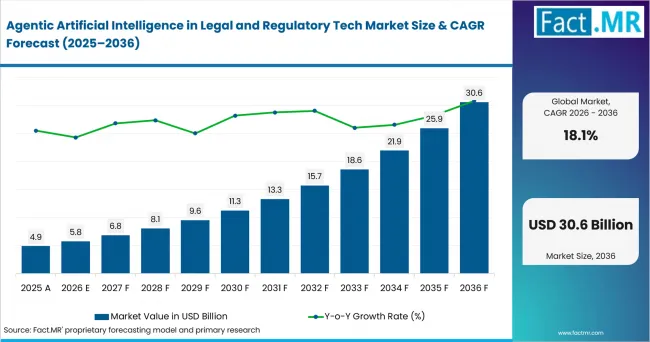
Agentic Artificial Intelligence In Legal And Regulatory Tech Market Value Analysis | Source: Fact.MR
What are the defining numbers behind Agentic Artificial Intelligence in Legal and Regulatory Tech Market growth?
An absolute dollar opportunity of USD 24.8 billion is expected between 2026 and 2036.
- Demand Drivers in the Market
- The pressure appears where legal work repeats faster than teams can add specialists. Contract queues, discovery sets, and regulatory updates all create structured work that an agent can plan and route, making the driver fundamentally operational.
- Buyer expectations are shifting from AI that generates text to AI that completes a workflow. LexisNexis reported in February 2025 that 80% of surveyed professionals said generative AI met or exceeded expectations, and buyers now ask whether that productivity can extend across an entire matter.
- Legal intelligence providers are building agentic research grounded in authoritative content. Thomson Reuters launched CoCounsel Legal in August 2025 with Deep Research and agentic guided workflows grounded in Westlaw content, and LexisNexis launched the next evolution of Lexis+ with Protégé in May 2026.
- Contract and document workflows are being automated end to end. DocuSign introduced AI contract agents in April 2025 that analyze agreements and flag risks for human review, turning agreement data into an operational control layer.
- Enterprise platforms are embedding governed legal agents. Microsoft announced Copilot Tuning and multi-agent orchestration in May 2025, and enterprise identity, document, and governance controls are being applied to legal workflows.
- Professional guidance is clarifying responsible use. The American Bar Association issued its first formal ethics guidance on AI tools in July 2024, and the EU AI Omnibus entered into force in July 2026, giving legal teams a clear governance framework for deployment.
- Key Segments Analyzed
- Legal Research Agents anchor the Agent Function segment with a 36.0% share in 2026, because their outputs can be checked against cited legal authority.
- Contract Lifecycle Management leads the Legal Use Case segment, taking 34.0% of demand in 2026, since its repeated stages have defined inputs and approval points.
- Law Firms is the dominant End-use Sector at 39.0% in 2026, reflecting the volume of research, drafting, and review work in private practice.
- Large Enterprises lead the Organization Type segment with a 44.0% share in 2026, as they hold the workflow volume and governance resources for agentic deployment.
- Cloud-native Agents anchors the Deployment Architecture segment with a 46.0% share in 2026.
- Analyst Opinion at Fact.MR
- Shambhu Nath Jha, Sr. Consultant at Fact.MR, opines: “Legal and regulatory work is information-heavy and highly repetitive, which makes it a compelling fit for agentic AI, but professional responsibility means a lawyer remains accountable for the result. Legal Research Agents already hold 36.0% of the market in 2026 because their cited outputs can be checked, and Contract Lifecycle Management leads on use case because its stages have clear approval points. Confidentiality, hallucination risk, and professional responsibility slow approval for autonomous use, so auditable agents that combine proprietary legal content with enterprise controls and clear review boundaries will capture the largest share of spend.”
- Strategic Implications
- Legal intelligence providers should make source grounding and traceable reasoning core, because outputs that cannot be checked against authority will not gain approval.
- Workflow specialists should connect contract and discovery agents to established approval and signing workflows, so redlines and recommendations can be traced to a policy source.
- Enterprise vendors should apply identity, governance, and document controls to legal agents, because confidentiality, data location, and permission control gate every deployment.
- Channel and service investment should follow the fastest-growing country markets, including the USA, UK, and Singapore, while adapting to professional rules and judicial guidance.
- Providers should invest in workflow redesign and integration support, since return depends on connecting systems to trusted data rather than merely selling user access.
How does the Agentic Artificial Intelligence in Legal and Regulatory Tech Market break down by segment?
The market is segmented by Agent Function, Legal Use Case, End-use Sector, Organization Type, Deployment Architecture, and Region. Agent Function includes Legal Research Agents, Compliance Monitoring Agents, Document Intelligence Agents, and Risk Assessment Agents. Legal Use Case covers Contract Lifecycle Management, Regulatory Compliance, eDiscovery, and Intellectual Property Management. End-use Sector includes Law Firms, Financial Services, Government & Public Sector, and Corporate Legal Departments. Organization Type covers Large Enterprises, Regulated Enterprises, Government Agencies, and Multinational Corporations. Deployment Architecture includes Cloud-native Agents, On-premises Deployment, Edge-enabled AI, and the supporting orchestration and retrieval layers. Regional analysis spans North America, Latin America, Western Europe, Eastern Europe, East Asia, South Asia and Pacific, and Middle East & Africa.
Why do Legal Research Agents lead Agent Function?
Legal Research Agents is projected to account for a 36.0% share in 2026.
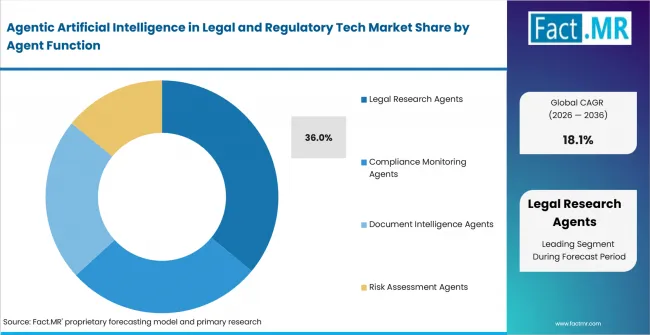
Agentic Artificial Intelligence In Legal And Regulatory Tech Market Analysis By Agent Function | Source: Fact.MR
Legal research offers a bounded path for agentic execution. The system can interpret a question, plan sub-queries, retrieve primary authority, and compare positions before returning a cited synthesis, and a lawyer can inspect both the sources and the reasoning steps before use. This review path is clearer than fully autonomous legal judgment and fits an established subscription model for legal information. Their value grows when they connect case law and regulations with internal memoranda and matter context. Thomson Reuters launched CoCounsel Legal in August 2025 with Deep Research and agentic guided workflows grounded in Westlaw content, illustrating how research agents expand within existing budgets and interfaces.
Why does Contract Lifecycle Management lead Legal Use Case?
Contract Lifecycle Management is projected to account for a 34.0% share in 2026.
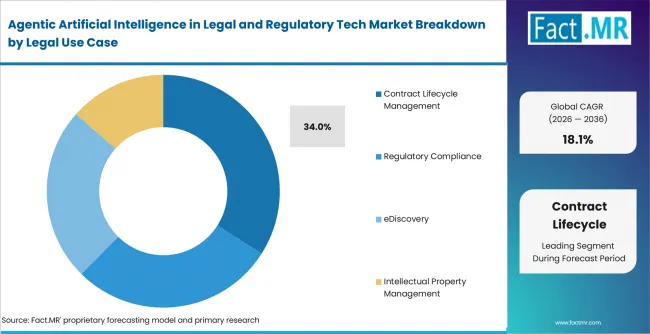
Agentic Artificial Intelligence In Legal And Regulatory Tech Market Analysis By Legal Use Case | Source: Fact.MR
Contract lifecycle management contains repeated stages that suit agentic coordination. An agent can ingest an agreement, identify clauses, compare positions with a playbook, route exceptions, and monitor obligations after signature, with each stage having a defined input and an approval point. This structure makes value easier to measure through cycle time, risk flags, and reduced manual handoffs. Legal teams also hold large stores of agreement data that can ground the agent in company-specific terms. DocuSign introduced AI contract agents in April 2025 that analyze agreements and flag risks for human review, and buyers remain cautious when redlines cannot be traced to a policy source.
Why do Law Firms lead End-use Sector?
Law Firms is projected to account for a 39.0% share in 2026.
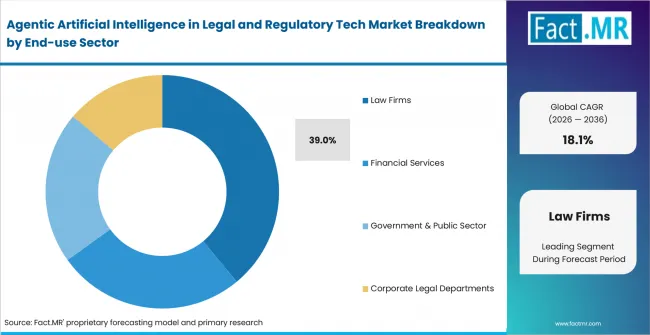
Agentic Artificial Intelligence In Legal And Regulatory Tech Market Analysis By End Use Sector | Source: Fact.MR
Law firms lead the End-use Sector because they process the highest volume of research, drafting, and review work, and they monetize time directly, which gives them an immediate incentive to reduce cycle time. They also must operate under professional responsibility rules that require supervision of any AI output, so they favor agents whose cited and traceable outputs can be checked by a lawyer. The ABA’s first formal ethics guidance on AI tools in July 2024 and the Courts and Tribunals Judiciary’s October 2025 guidance reinforce this supervised adoption pattern, making law firms the earliest and largest buyers of agents that preserve professional accountability.
Why do Large Enterprises lead Organization Type?
Large Enterprises is projected to account for a 44.0% share in 2026.
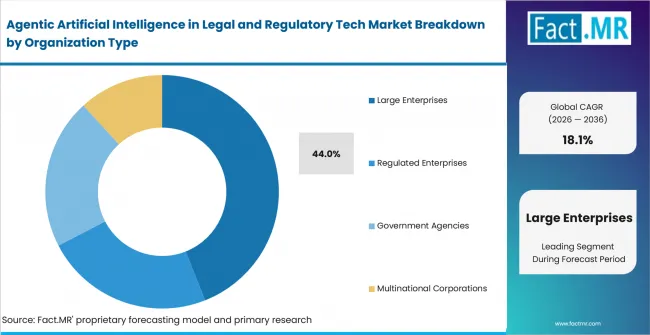
Agentic Artificial Intelligence In Legal And Regulatory Tech Market Analysis By Organization Type | Source: Fact.MR
Large enterprises have the workflow volume and governance resources needed for agentic deployment. Their legal teams process contracts and policies across business units and handle investigations and regulatory changes, creating enough repetition to justify integration and training costs. Enterprises can connect agents to identity controls, document repositories, approval systems, and internal knowledge for grounding. Procurement is slower because security, privacy, and legal operations teams must agree on the design, but the commercial advantage appears after the first workflow is approved and a common platform can support additional tasks. In May 2025, Microsoft announced Copilot Tuning and multi-agent orchestration for domain-specific agents inside the Microsoft 365 service boundary.
Why do Cloud-native Agents lead Deployment Architecture?
Cloud-native Agents are projected to account for a 46.0% share in 2026.
Cloud-native deployment lets legal teams integrate shared identity, permissions, retrieval, and governance controls across research and document workflows. Buyers still assess data location, confidentiality, auditability, and the scope of human review before moving matter-sensitive work into a shared environment.
What is accelerating Agentic Artificial Intelligence in Legal and Regulatory Tech Market adoption, and what is holding it back?
Drivers
| Driver | Relative Impact | Geographic Relevance | Impact Timeline |
|---|---|---|---|
| Legal teams need faster research, contract review, and regulatory monitoring with less manual coordination. | High | Global | Near term |
| Authoritative legal content and trusted sources support grounded agentic workflows. | High | North America, Europe | Near term |
| Contract lifecycle management offers measurable workflow and risk-control benefits. | Medium | Global | Mid term |
| Enterprise identity and governance controls support production deployment. | Medium | North America, Europe, Asia Pacific | Long term |
Source: Fact.MR analysis. Updated Aug 10, 2026
Restraints
| Restraint | Relative Impact | Geographic Relevance | Impact Timeline |
|---|---|---|---|
| Professional responsibility keeps the lawyer accountable for every AI-assisted result. | High | Global | Mid term |
| Confidentiality risk, hallucinations, and uncertain audit trails can delay approval. | High | Global | Near term |
| Integration and review time can offset savings when workflows are not redesigned. | Medium | North America, Europe | Mid term |
Source: Fact.MR analysis. Updated Aug 10, 2026
Which countries are scaling the Agentic Artificial Intelligence in Legal and Regulatory Tech Market fastest?
The USA, UK, Singapore, Canada, and Germany are the countries shown in the comparative outlook. Legal buyers assess agentic workflows against professional responsibility, confidentiality, source-grounding, and governance requirements.
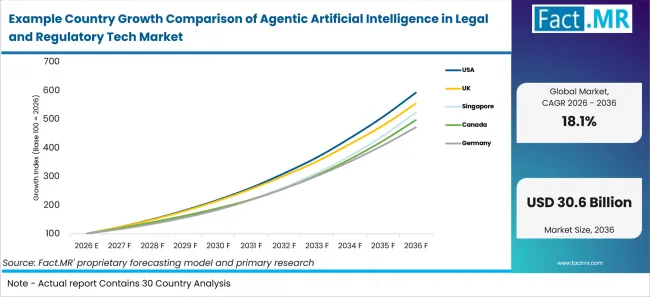
Example Country Growth Comparison Of Agentic Artificial Intelligence In Legal And Regulatory Tech Market | Source: Fact.MR
Country-wise CAGR Forecast (2026-2036)
| Country | CAGR |
| USA | 19.5% |
| UK | 18.7% |
| Singapore | 18.0% |
| Canada | 17.4% |
| Germany | 16.8% |
| Australia | 16.1% |
| Japan | 15.6% |
Source: Fact.MR analysis. Updated Aug 10, 2026
What is driving the Agentic Artificial Intelligence in Legal and Regulatory Tech Market in the USA?
USA is projected to register a 19.5% CAGR through 2036.
Law firms and corporate legal teams assess agents for research, drafting, and contract review that remain under lawyer supervision. ABA ethics guidance provides a reference point for preserving professional accountability.
What is driving the Agentic Artificial Intelligence in Legal and Regulatory Tech Market in the UK?
The UK is projected to register an 18.7% CAGR through 2036.
British buyers often prefer tools that fit established research and document workflows. Judicial guidance emphasizes personal responsibility, confidentiality, and caution about hallucinations.
What is driving the Agentic Artificial Intelligence in Legal and Regulatory Tech Market in Singapore?
Singapore is projected to register an 18.0% CAGR through 2036.
Centralized legal infrastructure and policy support for responsible experimentation inform controlled deployment in research and contract work.
What is driving the Agentic Artificial Intelligence in Legal and Regulatory Tech Market in Canada?
Canada is projected to register a 17.4% CAGR through 2036.
Legal buyers operate across federal and provincial rules and typically require secure deployment and strong data controls before moving beyond pilots.
What is driving the Agentic Artificial Intelligence in Legal and Regulatory Tech Market in Germany?
Germany is projected to register a 16.8% CAGR through 2036.
Confidentiality, independent professional judgment, and European AI requirements shape the controls that buyers expect from legal agents.
What is driving the Agentic Artificial Intelligence in Legal and Regulatory Tech Market in Australia?
Australia is projected to register a 16.1% CAGR through 2036.
Court-specific practice rules and professional guidance shape responsible-use and disclosure expectations for legal AI.
What is driving the Agentic Artificial Intelligence in Legal and Regulatory Tech Market in Japan?
Japan is projected to register a 15.6% CAGR through 2036.
Organizations assess agents for internal legal and contract support while maintaining clear boundaries around regulated legal services.
Who leads the Agentic Artificial Intelligence in Legal and Regulatory Tech Market?
Competition is organized around three positions. Legal intelligence providers combine authoritative content with research, drafting, and analytics. Enterprise technology providers supply cloud infrastructure, agent orchestration, and identity and governance controls. Workflow specialists concentrate on contracts and eDiscovery, managing legal holds and practice operations. The positions increasingly overlap as providers extend into agentic workflows.
Legal intelligence and practice platforms: Thomson Reuters Corporation, RELX PLC, LexisNexis, and Clio compete through legal content, analytics, and matter-context workflows. Enterprise AI and governance platforms: Microsoft Corporation, Google LLC, IBM Corporation, and Oracle Corporation compete through cloud reach, orchestration, and control frameworks. Workflow specialists: OpenText Corporation, DocuSign, Inc., and Ironclad, Inc. add eDiscovery, agreement, and matter operations.
Which companies are the key providers?
Key companies profiled in the Agentic Artificial Intelligence in Legal and Regulatory Tech market include Thomson Reuters Corporation, RELX PLC, LexisNexis, Clio, Microsoft Corporation, Google LLC, IBM Corporation, Oracle Corporation, OpenText Corporation, DocuSign, Inc., and Ironclad, Inc.
- Thomson Reuters Corporation
- RELX PLC
- LexisNexis
- Clio
- Microsoft Corporation
- Google LLC
- IBM Corporation
- Oracle Corporation
- OpenText Corporation
- DocuSign, Inc.
- Ironclad, Inc.
Bibliography
- American Bar Association. (2024, July 29). ABA Issues First Ethics Guidance on a Lawyer’s Use of AI Tools.
- Courts and Tribunals Judiciary. (2025, October 31). Artificial Intelligence (AI) - Judicial Guidance (October 2025).
- Singapore Ministry of Law. (2026, March 6). Launch of Guide for Using Generative Artificial Intelligence in the Legal Sector.
- Department of Justice Canada. (2026, March 13). Department of Justice Canada’s 2026-2027 Departmental Plan.
- Bundesrechtsanwaltskammer. (2025, January 9). Künstliche Intelligenz in Anwaltskanzleien: BRAK veröffentlicht Leitfaden.
- Federal Court of Australia. (2026, April 16). Use of Generative Artificial Intelligence Practice Note (GPN-AI).
- Ministry of Economy, Trade and Industry of Japan. (2025, February 18). AI Use and Development Contract Checklist.
- European Commission. (2026, July 27). AI Omnibus Enters into Force.
- LexisNexis. (2025, February 11). 2025 Future of Work Report Reveals Active Exploration and Adoption of Generative AI.
- Thomson Reuters. (2025, August 5). Thomson Reuters Launches CoCounsel Legal: Transforming Legal Work with Agentic AI and Deep Research.
- Docusign. (2025, April 16). Docusign Ushers in a New Era of AI Contract Agents to Transform Business.
- Clio. (2025, November 10). Clio Completes Landmark $1B vLex Acquisition.
- LexisNexis. (2026, May 7). LexisNexis Launches Next Evolution of Lexis+ with Protégé.
- Microsoft. (2025, May 19). Microsoft Build 2025: The Age of AI Agents and Building the Open Agentic Web.
- OpenText. (2025, March 14). OpenText to Showcase AI-powered eDiscovery Innovation at Legalweek New York.
This Report Answers
- The report examines the Agentic Artificial Intelligence in Legal and Regulatory Tech Market by Agent Function, Legal Use Case, End-use Sector, Organization Type, Deployment Architecture, and Region.
- Legal Research Agents lead Agent Function with a 36.0% share in 2026.
- The country outlook compares the USA, UK, Singapore, Canada, and Germany, with additional coverage of Australia and Japan.
- Competitive analysis profiles Thomson Reuters Corporation, RELX PLC, LexisNexis, Clio, Microsoft Corporation, Google LLC, IBM Corporation, Oracle Corporation, OpenText Corporation, DocuSign, Inc., and Ironclad, Inc.
- The assessment evaluates market value and share across the defined segment groups.
What does the Agentic Artificial Intelligence in Legal and Regulatory Tech Market cover?
The Agentic Artificial Intelligence in Legal and Regulatory Tech Market covers software, platforms, and related services that plan, retrieve, assess, and route legal or regulatory work under professional review. The scope follows Agent Function, Legal Use Case, End-use Sector, Organization Type, Deployment Architecture, and Region.
What is included in the scope?
Coverage includes legal-research, compliance-monitoring, document-intelligence, and risk-assessment agents; contract lifecycle management, regulatory compliance, eDiscovery, and intellectual-property workflows; and deployments used by law firms, financial services organizations, government and public-sector bodies, and corporate legal departments. The scope also includes the organization types, deployment architectures, and regions defined in the report segmentation.
What is excluded from the scope?
General-purpose AI tools, unrelated enterprise software, commodity infrastructure, and services not configured for the defined legal and regulatory use cases are outside the scope.
How was the analysis built?
The analysis draws on public company disclosures, product documentation, professional and regulatory guidance, industry publications, and interviews with relevant market participants. These inputs are assessed alongside the report's defined market scope, segment structure, regional coverage, and forecast period.
Segmentation
What is the report’s scope and coverage?
| Attribute | Details |
|---|---|
| Forecast Period | 2026-2036 |
| Base Year | 2025 |
| Market Value, 2026 | USD 5.8 billion |
| Market Value, 2036 | USD 30.6 billion |
| CAGR, 2026-2036 | 18.1% |
| Absolute Dollar Opportunity | USD 24.8 billion |
| Key Regions Covered | USA, UK, Singapore, Canada, Germany, Australia, Japan, and more than twenty-three additional countries in the full report |
Source: Fact.MR analysis. Updated Aug 10, 2026
How is the market segmented?
-
Agent Function:
- Legal Research Agents
- Case Law Research Agents
- Regulatory Research Agents
- Compliance Monitoring Agents
- Regulatory Change Tracking
- Audit Readiness Agents
- Document Intelligence Agents
- Document Classification
- Clause Extraction
- Risk Assessment Agents
- Litigation Risk Analysis
- Contract Risk Scoring
- Legal Research Agents
-
Legal Use Case:
- Contract Lifecycle Management
- Contract Drafting
- Contract Review
- Regulatory Compliance
- Policy Compliance
- Audit Documentation
- eDiscovery
- Evidence Collection
- Legal Hold Management
- Intellectual Property Management
- Patent Management
- Trademark Portfolio Management
- Contract Lifecycle Management
-
End-use Sector:
- Law Firms
- International Law Firms
- Boutique Law Firms
- Financial Services
- Banking & Financial Institutions
- Insurance Companies
- Government & Public Sector
- Regulatory Authorities
- Judicial Organizations
- Corporate Legal Departments
- Fortune 500 Companies
- Compliance Departments
- Law Firms
-
Organization Type:
- Large Enterprises
- Global Enterprises
- Mid-sized Enterprises
- Regulated Enterprises
- Banks
- Insurance Providers
- Government Agencies
- Public Institutions
- Courts
- Multinational Corporations
- In-house Legal Teams
- Enterprise Legal Operations
- Large Enterprises
-
Deployment Architecture:
- Cloud-native Agents
- Public Cloud
- Private Cloud
- Hybrid AI Architecture
- On-premises Deployment
- Edge-enabled AI
- Multi-agent Framework
- Agent Orchestration
- Context-aware Reasoning
- Autonomous Decision Engine
- Knowledge Graph Integration
- Vector-based Retrieval
- Cloud-native Agents
-
Region:
- North America
- Latin America
- Western Europe
- Eastern Europe
- East Asia
- South Asia and Pacific
- Middle East & Africa
Frequently Asked Questions
What is the Agentic Artificial Intelligence in Legal and Regulatory Tech market size in 2026?
At what CAGR is the Agentic Artificial Intelligence in Legal and Regulatory Tech market expected to grow?
What is the projected Agentic Artificial Intelligence in Legal and Regulatory Tech market size by 2036?
Which country leads the Agentic Artificial Intelligence in Legal and Regulatory Tech market?
Which is the leading segment in the Agentic Artificial Intelligence in Legal and Regulatory Tech market?
What is driving growth in the Agentic Artificial Intelligence in Legal and Regulatory Tech Market?
Who are the key players in the Agentic Artificial Intelligence in Legal and Regulatory Tech Market?
Who worked on this report


Preview the report firsthand - request a free sample
Free SampleGet the brochure for pricing and purchase details
Download PDF