- Market Value (2025): USD 26.4 Bn
- Estimated Value (2026): USD 31.8 Bn
- Forecast Value (2036): USD 205.3 Bn
- CAGR (2026-2036): 20.5%
What is the Cloud Native Storage Market forecast to be worth by 2036?
USD 31.8 billion in 2026 to USD 205.3 billion by 2036, at a 20.5% CAGR.
Enterprise adoption should be read beside Fact.MR's Cloud Managed Services Market, because storage operations often move with broader managed cloud spend.
- The cloud native storage market reached USD 26.4 billion in 2025 as platform engineering teams and enterprise IT buyers spent against a clear use case: persistent, scalable and portable storage for stateful containerized workloads across Kubernetes, public-cloud and hybrid environments.
- Demand is projected to increase from USD 31.8 billion in 2026 to USD 205.3 billion by 2036, at a 20.5% CAGR.
- The market is forecast to record 20.5% CAGR from 2026 to 2036. The forecast reflects wider use of managed storage for stateful Kubernetes workloads, analytics data stores and hybrid-cloud recovery processes.
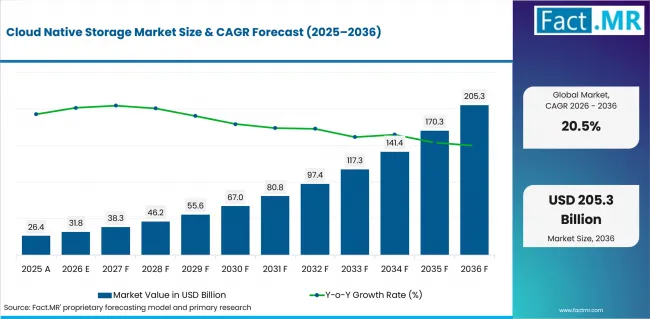
Cloud Native Storage Market Value Analysis | Source: Fact.MR
What are the defining numbers behind Cloud Native Storage Market growth?
USD 173.5 billion absolute opportunity is expected by 2036.
Industrial data movement connects with Fact.MR's Industrial DataOps Frameworks Market, where pipeline reliability makes persistent storage more valuable.
- Demand Drivers in the Market
- Block storage leads because databases, message queues and transactional workloads need predictable latency and persistent volumes. Container adoption creates storage demand only when the workload carries state.
- Containerized environments lead application demand because Kubernetes and related platforms require persistent volumes, storage classes, snapshots and CSI-aligned integration for real production workloads.
- IT and telecommunications lead as these buyers operate distributed applications, high data volumes and demanding service-level requirements. Their storage choices are shaped by uptime, migration and operational control.
- Public cloud leads deployment because teams can provision volumes, snapshots and managed storage quickly.
- Key Segments Analyzed
- By Product Type: Block Storage is projected to hold 35.7% share in 2026. Block storage leads because many stateful cloud-native workloads need low-latency volumes with clear performance and recovery behavior.
- By Application: Containerized Environments is projected to hold 31.0% share in 2026. Containerized environments lead because Kubernetes workloads need persistent volumes, storage classes, snapshots and CSI-aligned integration before production applications can move safely.
- By End User: IT and Telecommunications is projected to hold 29.2% share in 2026. IT and telecommunications lead as these organizations run high-volume digital services where storage failure directly affects availability and revenue.
- By Distribution Channel: Direct Sales is projected to hold 30.0% share in 2026. Direct sales lead as enterprise buyers need architecture review, migration support, service-level commitments and integration guidance.
- By Deployment Model: Public Cloud is projected to hold 47.0% share in 2026. Public cloud leads because managed volume provisioning, elastic capacity and snapshot services reduce the time needed to support new workloads.
- Analyst Opinion at Fact.MR
- Shambhu Nath Jha, Sr. Consultant at Fact.MR, opines, "Cloud-native storage becomes critical when container platforms start running databases, queues and analytics workloads, not only stateless apps. Buyers will favor providers that make persistent volumes, snapshots, recovery objectives and cost controls predictable across Kubernetes and hybrid cloud estates."
- Strategic Implications
- Vendors should prove performance, backup behavior, snapshot consistency and failure recovery in Kubernetes language.
- Cloud teams should treat storage classes, volume policies and recovery objectives as platform standards, not per-application afterthoughts.
- Managed service providers can win by packaging migration, observability and cost governance around stateful workloads.
USA continues to be a leading market and is projected to grow at a CAGR of 26.67%; other key markets include Canada, Germany, Australia, UK, Japan and South Korea.
How does the Cloud Native Storage Market break down by segment?
Block Storage leads Product Type at 35.7%.
Analytics demand should be compared with Fact.MR's MLDW Technology Market, since model and warehouse workloads need scalable cloud-native storage.
Why does Block Storage lead Product Type?
Block Storage is projected to account for 35.7% share in 2026.
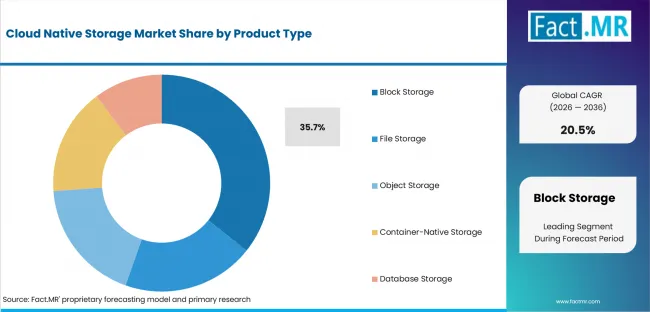
Cloud Native Storage Market Analysis By Product Type | Source: Fact.MR
Block storage leads because many stateful cloud-native workloads need low-latency volumes with clear performance and recovery behavior.
Why does Containerized Environments lead Application?
Containerized Environments is projected to account for 31.0% share in 2026.
Containerized environments lead because Kubernetes workloads need persistent volumes, storage classes, snapshots and CSI-aligned integration before production applications can move safely.
Why does IT and Telecommunications lead End User?
IT and Telecommunications is projected to account for 29.2% share in 2026.
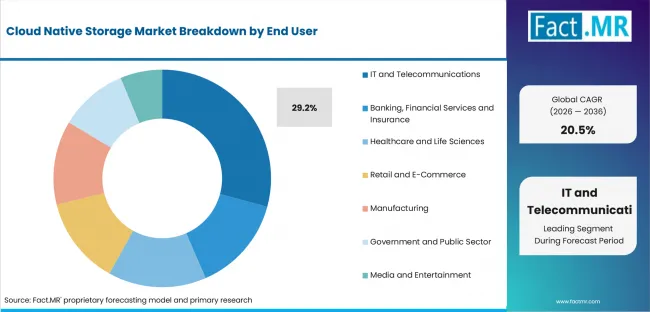
Cloud Native Storage Market Analysis By End User | Source: Fact.MR
IT and telecommunications lead as these organizations run high-volume digital services where storage failure directly affects availability and revenue.
Why does Direct Sales lead Distribution Channel?
Direct Sales is projected to account for 30.0% share in 2026.
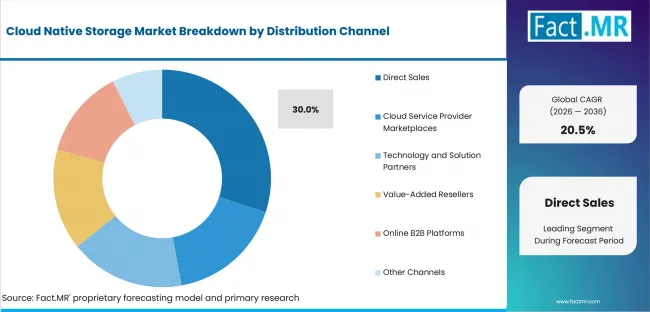
Cloud Native Storage Market Analysis By Distribution Channel | Source: Fact.MR
Direct sales lead as enterprise buyers need architecture review, migration support, service-level commitments and integration guidance.
Why does Public Cloud lead Deployment Model?
Public Cloud is projected to account for 47.0% share in 2026.
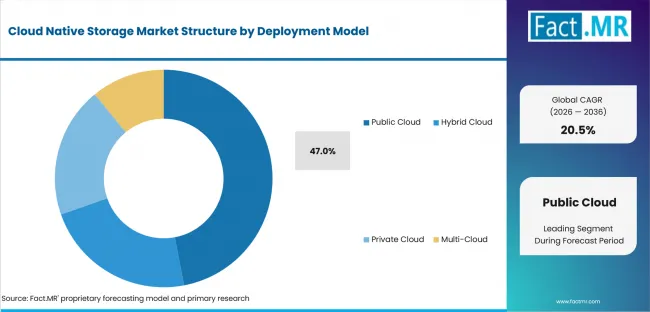
Cloud Native Storage Market Analysis By Deployment Model | Source: Fact.MR
Public cloud leads because managed volume provisioning, elastic capacity and snapshot services reduce the time needed to support new workloads.
What is accelerating Cloud Native Storage Market adoption, and what is holding it back?
Demand is strongest where Kubernetes platforms run databases, queues, analytics pipelines or regulated workloads that cannot lose state. The main drag is migration risk, latency uncertainty, recovery design and cloud-storage cost visibility.
AI workload growth links to Fact.MR's Natural Language Processing Market, where training and inference create new pressure on data access.
Drivers Impact Analysis
| DRIVER | QUALITATIVE RELEVANCE | GEOGRAPHIC RELEVANCE | IMPACT TIMELINE |
|---|---|---|---|
| Stateful Kubernetes workloads | High | South Korea | Short term (<=2 years) |
| Block storage performance demand | High | USA | Short term (<=2 years) |
| Public-cloud managed provisioning | Moderate | Canada | Medium term (2-4 years) |
| Hybrid workload portability | Selective | Germany | Medium term (2-4 years) |
Source: Fact.MR analysis. Updated Jul 30, 2026
- Stateful Kubernetes workloads: Block storage leads because databases, message queues and transactional workloads need predictable latency and persistent volumes. Container adoption creates storage demand only when the workload carries state.
- Block storage performance demand: Containerized environments lead application demand because Kubernetes and related platforms require persistent volumes, storage classes, snapshots and CSI-aligned integration for real production workloads.
- Public-cloud managed provisioning: IT and telecommunications lead as these buyers operate distributed applications, high data volumes and demanding service-level requirements. Their storage choices are shaped by uptime, migration and operational control.
- Hybrid workload portability: Public cloud leads deployment because teams can provision volumes, snapshots and managed storage quickly.
Opportunity Impact Analysis
| OPPORTUNITY | QUALITATIVE RELEVANCE | GEOGRAPHIC RELEVANCE | IMPACT TIMELINE |
|---|---|---|---|
| Kubernetes backup and recovery | High | South Korea | Medium term (2-4 years) |
| Multi-cloud storage policy control | Moderate | USA | Medium term (2-4 years) |
| AI and analytics persistent volumes | Selective | Canada | Medium term (2-4 years) |
Source: Fact.MR analysis. Updated Jul 30, 2026
- Kubernetes backup and recovery: Storage platforms that simplify backup, restore and disaster recovery for Kubernetes clusters can gain budget from platform teams.
- Multi-cloud storage policy control: Hybrid and multi-cloud portability creates demand for policy-driven storage management across different infrastructure estates.
- AI and analytics persistent volumes: AI and analytics workloads can expand high-performance persistent storage demand when teams need throughput, snapshots and data locality.
Restraints Impact Analysis
| RESTRAINT | QUALITATIVE RELEVANCE | GEOGRAPHIC RELEVANCE | IMPACT TIMELINE |
|---|---|---|---|
| Legacy stateful workload complexity | High | South Korea | Short term (<=2 years) |
| Cloud storage cost leakage | Moderate | USA | Medium term (2-4 years) |
| Kubernetes storage skills gaps | Selective | Germany | Medium term (2-4 years) |
Source: Fact.MR analysis. Updated Jul 30, 2026
- Legacy stateful workload complexity: Stateful workload migration is difficult when applications have legacy database dependencies, fixed latency expectations or complex recovery requirements.
- Cloud storage cost leakage: Cloud storage cost leakage can slow expansion if teams overprovision volumes, snapshots or data-transfer paths.
- Kubernetes storage skills gaps: Skills gaps around Kubernetes storage, CSI drivers and backup policy can make buyers delay standardization.
Which countries are scaling Cloud Native Storage Market fastest?
Country rates show where buying conditions and supplier proof are already stronger.
Automation at the infrastructure edge connects with Fact.MR's Micro Agents Market, especially where small agents act on logs, policies and storage events.
- South Korea: The market is expected to grow at a CAGR of 16.41% from 2026 to 2036. South Korea's growth is supported by cloud-first digital services, telecom workload modernization and platform engineering maturity.
- USA: The market is expected to grow at a CAGR of 26.67% from 2026 to 2036. USA demand is shaped by hyperscale cloud use, large Kubernetes estates and enterprise pressure to modernize databases and analytics platforms.
- Canada: The market is expected to grow at a CAGR of 18.49% from 2026 to 2036. Canada benefits from steady enterprise cloud migration and regulated-sector interest in managed storage with clear recovery controls.
- Germany: The market is expected to grow at a CAGR of 22.56% from 2026 to 2036. Germany's adoption is guided by data-location, compliance and hybrid-cloud architecture needs. Buyers test recovery and observability before widening deployment.
- Australia: The market is expected to grow at a CAGR of 14.33% from 2026 to 2036. Australia's growth is linked to public-cloud modernization and distributed application teams that need reliable backup across remote operations.
- UK: The market is expected to grow at a CAGR of 20.52% from 2026 to 2036. UK demand is driven by financial services, telecom and digital public-service workloads that require persistent cloud-native infrastructure with governance.
- Japan: The market is expected to grow at a CAGR of 24.64% from 2026 to 2036. Japan's outlook is shaped by conservative enterprise migration and demand for highly reliable storage, migration support and vendor accountability.
The full report provides country-level CAGR analysis across North America, Latin America, Europe, East Asia, South Asia and Oceania, and the Middle East and Africa.
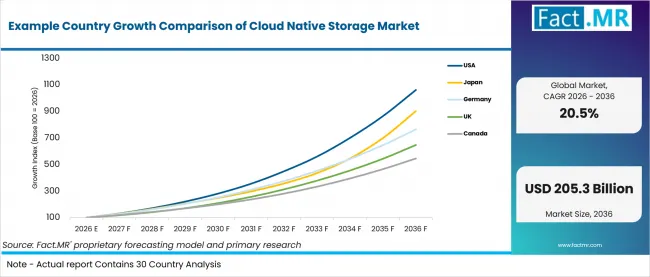
Example Country Growth Comparison Of Cloud Native Storage Market | Source: Fact.MR
| Country | CAGR (2026-2036) |
|---|---|
| South Korea | 16.41% |
| USA | 26.67% |
| Canada | 18.49% |
| Germany | 22.56% |
| Australia | 14.33% |
| UK | 20.52% |
| Japan | 24.64% |
Source: Fact.MR analysis. Updated Jul 30, 2026
What is shaping South Korea's outlook through 2036?
16.41% CAGR from 2026 to 2036.
South Korea's growth is supported by cloud-first digital services, telecom workload modernization and platform engineering maturity.
What is shaping USA's outlook through 2036?
26.67% CAGR from 2026 to 2036.
USA demand is shaped by hyperscale cloud use, large Kubernetes estates and enterprise pressure to modernize databases and analytics platforms.
What is shaping Canada's outlook through 2036?
18.49% CAGR from 2026 to 2036.
Canada benefits from steady enterprise cloud migration and regulated-sector interest in managed storage with clear recovery controls.
What is shaping Germany's outlook through 2036?
22.56% CAGR from 2026 to 2036.
Germany's adoption is guided by data-location, compliance and hybrid-cloud architecture needs. Buyers test recovery and observability before widening deployment.
What is shaping Australia's outlook through 2036?
14.33% CAGR from 2026 to 2036.
Australia's growth is linked to public-cloud modernization and distributed application teams that need reliable backup across remote operations.
Who leads the Cloud Native Storage Market?
Microsoft Corporation; Dell Technologies Inc.; Amazon Web Services, Inc.; International Business Machines Corporation are among the visible providers in the cloud native storage market.
Microsoft Corporation and Dell Technologies Inc. are among the most visible providers. Competition is shaped by product proof, channel access and buyer trust.
Between 2026 and 2036, market rivalry is likely to center on clearer positioning around Block Storage, stronger documentation and better support at the point of purchase.
Which companies are the key providers?
Key companies include Microsoft Corporation; Dell Technologies Inc.; Amazon Web Services, Inc.; International Business Machines Corporation; Google LLC (Google Cloud); Broadcom Inc. (VMware); NetApp, Inc.; Pure Storage, Inc.
- Microsoft Corporation
- Dell Technologies Inc.
- Amazon Web Services, Inc.
- International Business Machines Corporation
- Google LLC (Google Cloud)
- Broadcom Inc. (VMware)
- NetApp, Inc.
- Pure Storage, Inc.
Bibliography
- Kubernetes Documentation, Persistent Volumes.
- Kubernetes Documentation, Volumes.
- NIST SP 800-145, The NIST Definition of Cloud Computing.
- CNCF Cloud Native Definition.
- Container Storage Interface Specification.
- Fact.MR, Cloud Managed Services Market.
This Report Answers
- The report provides strategic intelligence on the Cloud Native Storage Market across segment choices that shape the 2026 market structure.
- Segment analysis covers Block Storage and Containerized Environments as the share leaders within the 2026 market.
- Country outlook evaluates the listed markets by CAGR and explains the adoption conditions in each country.
- Competitive analysis profiles the named providers and evaluates competition around product proof, channel access and buyer trust.
- Related coverage connects this report with adjacent cloud managed services, data infrastructure and natural-language processing markets.
What does the Cloud Native Storage Market cover?
The Cloud Native Storage Market covers block, file, object and container-native storage platforms, persistent volume services, CSI-enabled storage, backup, snapshot and recovery tools used with cloud-native workloads.
The Cloud Native Storage Market covers block, file, object and container-native storage platforms, persistent volume services, CSI-enabled storage, backup, snapshot and recovery tools used with cloud-native workloads.
Adjacent spending is included only when it is part of the same purchase decision or operating use case.
What is included in the scope?
The scope includes Product Type, Application, End User, Distribution Channel, Deployment Model and regional demand.
Coverage includes adjacent segment options only when they are purchased for the same defined market use.
What is excluded from the scope?
consumer cloud storage, endpoint backup, non-container data-center storage sold without cloud-native integration, and application software without storage-management functionality.
The scope excludes consumer cloud storage, endpoint backup, non-container data-center storage sold without cloud-native integration, and application software without storage-management functionality.
How Was the Analysis Built?
The analysis combines primary research with desk research focused on the cloud native storage market, its segment structure and country-level demand.
- Primary Research: Interviews and validation discussions test buyer priorities, adoption barriers, pricing logic and operating requirements.
- Desk Research: The assessment reviews company disclosures, public datasets, regulatory material, technical literature and industry records relevant to the market.
- Market Sizing and Forecasting: Estimates combine top-down and bottom-up checks across demand signals, segment shares, country activity, company participation and adoption constraints.
- Data Validation and Update Cycle: Findings are validated against public evidence, company activity and country-level adoption patterns before final use.
Segmentation
What is the report's scope and coverage?
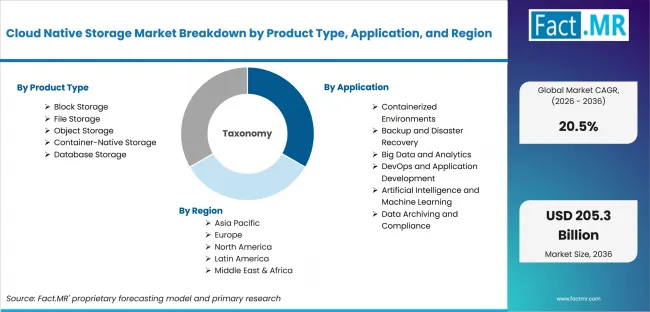
Cloud Native Storage Market Breakdown By Product Type, Application, And Region | Source: Fact.MR
| Attribute | Details |
|---|---|
| Quantitative Units | USD 31.8 billion in 2026 to USD 205.3 billion by 2036, at a 20.5% CAGR. |
| Market Definition | Cloud Native Storage Market covers block, file, object and container-native storage platforms, persistent volume services, CSI-enabled storage, backup, snapshot and recovery tools used with cloud-native workloads. |
| Product Type | Block Storage; Direct Attached Storage; Storage Area Network; File Storage; Distributed File Systems; Network Attached Storage; Object Storage; S3-Compatible Object Storage; Distributed Object Storage; Container-Native Storage; Kubernetes Persistent Storage; Container-Attached Storage; Database Storage; Cloud-Native Database Storage; Disaggregated Database Storage |
| Application | Containerized Environments; Kubernetes Workloads; Containerized Enterprise Applications; Backup and Disaster Recovery; Cloud Backup; Disaster Recovery and Replication; Big Data and Analytics; Data Lakes and Data Warehousing; Real-Time Analytics; DevOps and Application Development; Continuous Integration and Deployment; Application Testing and Development; Artificial Intelligence and Machine Learning; AI Model Training; Machine Learning Data Pipelines; Data Archiving and Compliance; Long-Term Data Archiving; Regulatory Data Retention |
| End User | IT and Telecommunications; Cloud Service Providers; Telecommunications Operators; Banking, Financial Services and Insurance; Retail Banking; Insurance and Financial Services; Healthcare and Life Sciences; Hospitals and Healthcare Networks; Pharmaceutical and Life Sciences Companies; Retail and E-Commerce; E-Commerce Platforms; Online Retailers; Manufacturing; Discrete Manufacturing; Process Manufacturing; Government and Public Sector; Federal and National Government; Local and Municipal Government; Media and Entertainment; Streaming and Digital Media; Gaming and Content Providers |
| Distribution Channel | Direct Sales; Direct Enterprise Sales; Long-Term Enterprise Contracts; Cloud Service Provider Marketplaces; Amazon Web Services Marketplace; Microsoft Azure Marketplace; Technology and Solution Partners; Cloud Systems Integrators; Managed Service Providers; Value-Added Resellers; Enterprise IT Resellers; Specialized Storage Resellers; Online B2B Platforms; Digital Procurement Platforms; Online Enterprise Software Marketplaces; Other Channels; Independent IT Consultants; Industry-Specific Solution Providers |
| Deployment Model | Public Cloud; Hyperscale Public Cloud; Multi-Tenant Cloud Storage; Hybrid Cloud; Hybrid Cloud Infrastructure; On-Premises and Cloud Integrated Storage; Private Cloud; Enterprise Private Cloud; Software-Defined Private Cloud; Multi-Cloud; Cross-Cloud Storage; Multi-Cloud Data Management |
| Regions Covered | North America; Latin America; Europe; East Asia; South Asia and Oceania; Middle East and Africa |
| Countries Covered | South Korea; USA; Canada; Germany; Australia; UK; Japan |
| Key Companies Profiled | Microsoft Corporation; Dell Technologies Inc.; Amazon Web Services, Inc.; International Business Machines Corporation; Google LLC (Google Cloud); Broadcom Inc. (VMware); NetApp, Inc.; Pure Storage, Inc. |
| Forecast Period | 2026 to 2036 |
| Approach | Hybrid top-down and bottom-up assessment using demand indicators, segment mix, country growth, company participation and public evidence relevant to the category. |
Source: Fact.MR analysis. Updated Jul 30, 2026
How is the market segmented?
-
By Product Type:
- Block Storage
- Direct Attached Storage
- Storage Area Network
- File Storage
- Distributed File Systems
- Network Attached Storage
- Object Storage
- S3-Compatible Object Storage
- Distributed Object Storage
- Container-Native Storage
- Kubernetes Persistent Storage
- Container-Attached Storage
- Database Storage
- Cloud-Native Database Storage
- Disaggregated Database Storage
-
By Application:
- Containerized Environments
- Kubernetes Workloads
- Containerized Enterprise Applications
- Backup and Disaster Recovery
- Cloud Backup
- Disaster Recovery and Replication
- Big Data and Analytics
- Data Lakes and Data Warehousing
- Real-Time Analytics
- DevOps and Application Development
- Continuous Integration and Deployment
- Application Testing and Development
- Artificial Intelligence and Machine Learning
- AI Model Training
- Machine Learning Data Pipelines
- Data Archiving and Compliance
- Long-Term Data Archiving
- Regulatory Data Retention
-
By End User:
- IT and Telecommunications
- Cloud Service Providers
- Telecommunications Operators
- Banking, Financial Services and Insurance
- Retail Banking
- Insurance and Financial Services
- Healthcare and Life Sciences
- Hospitals and Healthcare Networks
- Pharmaceutical and Life Sciences Companies
- Retail and E-Commerce
- E-Commerce Platforms
- Online Retailers
- Manufacturing
- Discrete Manufacturing
- Process Manufacturing
- Government and Public Sector
- Federal and National Government
- Local and Municipal Government
- Media and Entertainment
- Streaming and Digital Media
- Gaming and Content Providers
-
By Distribution Channel:
- Direct Sales
- Direct Enterprise Sales
- Long-Term Enterprise Contracts
- Cloud Service Provider Marketplaces
- Amazon Web Services Marketplace
- Microsoft Azure Marketplace
- Technology and Solution Partners
- Cloud Systems Integrators
- Managed Service Providers
- Value-Added Resellers
- Enterprise IT Resellers
- Specialized Storage Resellers
- Online B2B Platforms
- Digital Procurement Platforms
- Online Enterprise Software Marketplaces
- Other Channels
- Independent IT Consultants
- Industry-Specific Solution Providers
-
By Deployment Model:
- Public Cloud
- Hyperscale Public Cloud
- Multi-Tenant Cloud Storage
- Hybrid Cloud
- Hybrid Cloud Infrastructure
- On-Premises and Cloud Integrated Storage
- Private Cloud
- Enterprise Private Cloud
- Software-Defined Private Cloud
- Multi-Cloud
- Cross-Cloud Storage
- Multi-Cloud Data Management
-
By Region:
- North America
- Latin America
- Europe
- East Asia
- South Asia and Oceania
- Middle East and Africa
Frequently Asked Questions
Which Product Type leads the market?
Which Application leads the market?
Which End User leads the market?
Which Distribution Channel leads the market?
Which Deployment Model leads the market?
Which country records the highest listed CAGR?
What is the primary driver in this market?
What is the main restraint?
Who worked on this report


Preview the report firsthand - request a free sample
Free SampleGet the brochure for pricing and purchase details
Download PDF