- Market Value (2025): USD 4.6 Bn
- Estimated Value (2026): USD 5.6 Bn
- Forecast Value (2036): USD 41.2 Bn
- CAGR (2026-2036): 22.1%
What is the Agentic Artificial Intelligence Frameworks Market forecast to be worth by 2036?
The market is projected to grow from USD 5.6 billion in 2026 to USD 41.2 billion by 2036, registering a CAGR of 22.1%.
- The Agentic Artificial Intelligence Frameworks market reached USD 4.6 billion in 2025.
- Demand is forecast to increase from USD 5.6 billion in 2026 to USD 41.2 billion by 2036 at a CAGR of 22.1%.
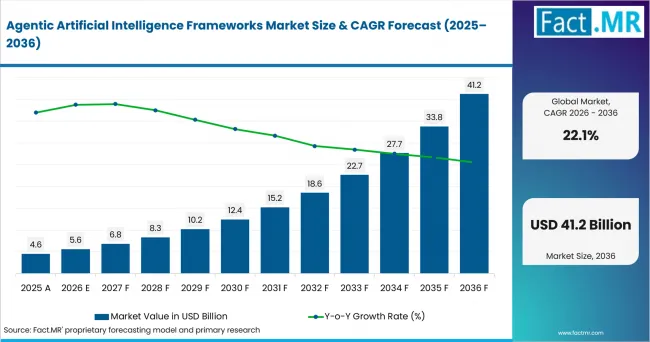
Agentic Artificial Intelligence Frameworks Market Value Analysis | Source: Fact.MR
What are the defining numbers behind Agentic Artificial Intelligence Frameworks Market growth?
An absolute dollar opportunity of USD 35.6 billion is expected between 2026 and 2036.
- Demand Drivers in the Market
- The addressable buyer base expands as AI use spreads from individual tasks into business functions. The U.S. Census Bureau reported in May 2026 that overall business AI use ranged from 17% to 20% during the prior six months, with use higher among larger firms and knowledge-intensive sectors.
- Once organizations move beyond drafting and search, they need a framework that can coordinate tools and maintain state across a process. That requirement changes the purchase from a model subscription into an operating layer with support, monitoring, and integration revenue.
- Enterprise teams need Agentic orchestration, because building agent logic case-by-case does not scale across business units and applications.
- Open-source frameworks and open interoperability protocols are lowering entry cost and reducing vendor lock-in. Google introduced its open-source Agent Development Kit in April 2025, and the Linux Foundation launched the Agent2Agent Protocol project in June 2025 to enable secure communication between AI agents.
- Cloud computing makes production deployment simpler. Microsoft made Azure AI Foundry Agent Service generally available in May 2025 with multi-agent orchestration and enterprise security features, giving enterprises a managed path to production.
- AI governance is clarifying how agents must be governed. Singapore’s IMDA launched its Model AI Governance Framework for Agentic AI in January 2026, and Japan’s METI published AI Guidelines for Business Version 1.2 in March 2026.
- Key Segments Analyzed
- Open-source Agentic Framework anchors the Framework Type segment with a 41.0% share in 2026, as engineering teams prioritize inspectable logic and architectural control.
- Cloud Deployment leads the Deployment Model segment, taking 46.0% of demand in 2026, because it shortens the path from a working agent to a production service.
- IT & Telecommunications is the largest End-use Industry at 38.0% in 2026, reflecting the technical readiness and enterprise workload density of technology firms.
- Large Enterprises anchors the Organization Size segment with a 44.0% share in 2026.
- LLM Orchestration Engine anchors the Core Component segment with a 40.0% share in 2026.
- Analyst Opinion at Fact.MR
- Shambhu Nath Jha, Sr. Consultant at Fact.MR, opines: “The agentic AI frameworks market is shifting from raw model capability to the orchestration layer that turns a capable model into a dependable business process. Buyers must prove reliability, permissions, and return on integration before granting agents operational authority, so the framework’s governance and observability features become the deciding factor. Open-source Agentic Framework already holds 41.0% of the market in 2026, and open protocols are extending that influence by connecting specialized agents across vendor boundaries. Vendors that combine framework openness with a supported production path and clear permission controls will capture the largest share of enterprise spend.”
- Strategic Implications
- Vendors should lead with open protocols and governed marketplaces that can connect specialized agents across vendor boundaries, since interoperability is becoming a core purchasing requirement.
- Framework providers should build AI agent audit capabilities around permissions, traceability, and observability, because buyers must prove reliability and control before agents gain access to enterprise data and tools.
- Cloud and model platform vendors should package managed runtimes with enterprise security, private networking, and customer-controlled data stores to extend adoption into regulated workloads.
- Channel and service investment should follow the fastest-growing country markets, including the USA, Singapore, and the UK, while adapting packaging to local governance expectations.
- Providers should track governance and security requirements closely, because production approval depends on demonstrating that autonomous execution remains observable, permissioned, and adaptable across changing models and enterprise systems.
How does the Agentic Artificial Intelligence Frameworks Market break down by segment?
The market is segmented by Framework Type, Deployment Model, End-use Industry, Organization Size, Core Component, and Region. Framework Type covers Open-source Agentic Framework, Enterprise Agent Platform, Low-code Agent Builder, and Developer SDKs, with Multi-agent Framework, Single-agent Framework, Visual Agent Designer, No-code Agent Templates, Python SDK, and Java SDK among the sub-segments. Deployment Model includes Cloud Deployment, On-premises Deployment, Edge Deployment, and Hybrid AI Workflow; End-use Industry covers IT & Telecommunications, BFSI, Healthcare & Life Sciences, and Manufacturing. Organization Size spans Large Enterprises, Small & Medium Enterprises, Public Sector Organizations, and Startups, while Core Component includes LLM Orchestration Engine, Reasoning Engine, Model Integration Layer, and AI Governance Module. Regional analysis covers North America, Latin America, Western Europe, Eastern Europe, East Asia, South Asia and Pacific, and Middle East & Africa.
Why does Open-source Agentic Framework lead Framework Type?
Open-source Agentic Framework is projected to account for a 41.0% share in 2026.
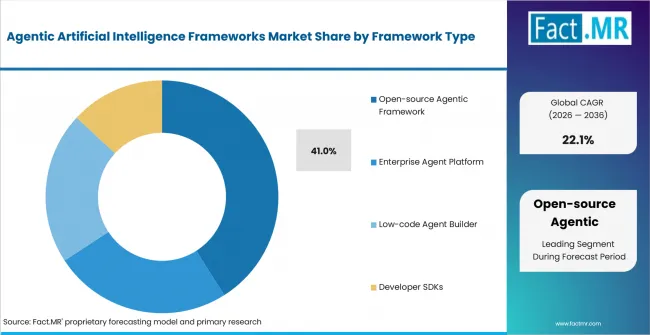
Agentic Artificial Intelligence Frameworks Market Analysis By Framework Type | Source: Fact.MR
Open-source frameworks let engineering teams inspect execution logic and adapt connectors without waiting for a proprietary roadmap, and they reduce the cost of testing different models and orchestration patterns. This flexibility matters because early production designs often change after security review or user testing. Commercial revenue forms around hosted runtimes, managed evaluation, and integration services, so the segment combines community distribution with paid operating layers. Google introduced the open-source Agent Development Kit in April 2025 to support code-first development of agents and multi-agent systems, illustrating how open tooling anchors the developer workflow.
Why does Cloud Deployment lead Deployment Model?
Cloud Deployment is projected to account for a 46.0% share in 2026.
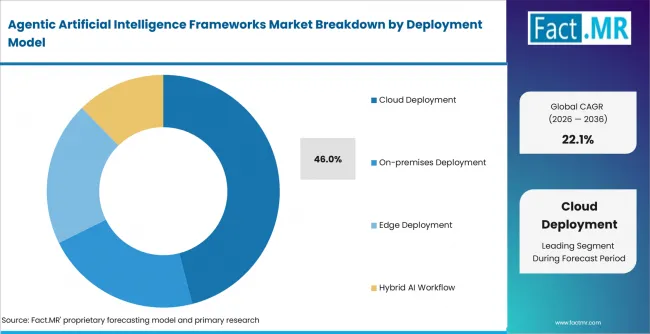
Agentic Artificial Intelligence Frameworks Market Analysis By Deployment Model | Source: Fact.MR
Cloud deployment shortens the path from a working agent to a production service. Buyers can combine model endpoints with identity controls and managed storage, and event services and monitoring can remain under an existing cloud account. The same environment can scale intermittent workloads without reserving permanent capacity, which reduces infrastructure work but does not remove integration or governance obligations. Microsoft made Azure AI Foundry Agent Service generally available in May 2025 with multi-agent orchestration and enterprise security features, and vendors that offer private networking and customer-controlled data stores can extend this advantage into regulated workloads.
Why do IT & Telecommunications lead End-use Industry?
IT & Telecommunications is projected to account for a 38.0% share in 2026.
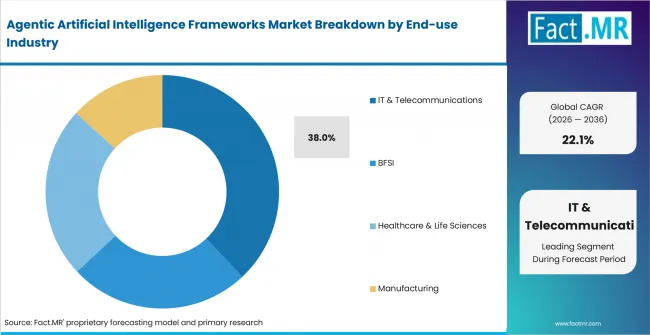
Agentic Artificial Intelligence Frameworks Market Analysis By End Use Industry | Source: Fact.MR
Technology and telecommunications companies deploy models at the highest density and have the developer talent to adopt AI agentic platforms quickly. Their internal orchestration and cloud estates generate the multi-step, multi-model workloads where frameworks deliver the most value, and they act as early reference adopters whose patterns financial services, manufacturing, and the public sector subsequently follow. Their strong API and integration capabilities also lower the cost of connecting agents to enterprise identity, data, and collaboration tools.
What is accelerating Agentic Artificial Intelligence Frameworks Market adoption, and what is holding it back?
Drivers Impact Analysis
| Driver | Relative Impact | Geographic Relevance | Impact Timeline |
|---|---|---|---|
| Need for reusable orchestration across models, tools, and data | High | Global | Near term |
| Growth in business AI use | High | Global | Mid term |
| Open-source frameworks and interoperability protocols | Medium | Global | Near term |
| Managed cloud runtimes for production deployment | Medium | North America, Europe | Mid term |
Source: Fact.MR analysis. Updated Aug 10, 2026
Restraints Impact Analysis
| Restraint | Relative Impact | Geographic Relevance | Impact Timeline |
|---|---|---|---|
| Reliability, permission, and control requirements | High | Global | Mid term |
| Integration effort and inconsistent task completion | High | Global | Mid term |
| Underestimated monitoring and change-management costs | Medium | North America, Europe | Near term |
Source: Fact.MR analysis. Updated Aug 10, 2026
Which countries are scaling the Agentic Artificial Intelligence Frameworks Market fastest?
- The USA is projected to lead the country comparison. U.S. Census data show that 37% of firms with at least 250 employees reported AI use in business operations.
- Singapore's Model AI Governance Framework for Agentic AI, launched in January 2026, gives buyers a current policy reference on human accountability and agent controls.
- In the UK, production deployment depends on governance, data handling, and integration capability alongside cloud and sector-led transformation programs.
- Germany's federal cabinet approved draft legislation for national implementation of the EU AI Act in February 2026, keeping governance and documentation central to buyer evaluation.
- METI published AI Guidelines for Business Version 1.2 in March 2026, giving Japanese organizations a current reference for AI governance.
- Canada launched the Canadian Artificial Intelligence Safety Institute in November 2024 with an initial CAD 50 million commitment over five years.
- Australia's National AI Centre released Guidance for AI Adoption in October 2025, setting out six essential practices for AI adoption.
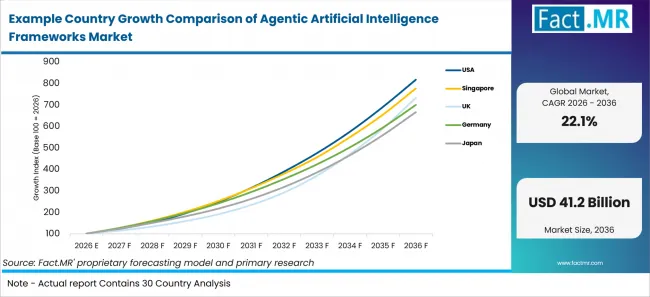
Example Country Growth Comparison Of Agentic Artificial Intelligence Frameworks Market | Source: Fact.MR
Country-wise CAGR Forecast (2026-2036)
| Country | CAGR |
|---|---|
| USA | 23.4% |
| Singapore | 22.8% |
| UK | 22.1% |
| Germany | 21.5% |
| Japan | 20.9% |
| Canada | 20.2% |
| Australia | 19.6% |
Source: Fact.MR analysis. Updated Aug 10, 2026
What is driving the Agentic Artificial Intelligence Frameworks Market in the USA?
USA is projected to register a 23.4% CAGR through 2036.
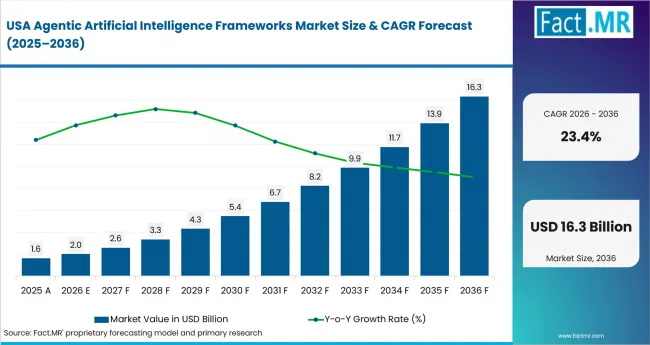
Agentic Artificial Intelligence Frameworks Market Country Value Analysis | Source: Fact.MR
Enterprise platform teams often build with cloud services and open developer tools before standardizing an agent stack. U.S. Census data show that 37% of firms with at least 250 employees used AI in business operations, indicating a large base of organizations already familiar with business AI.
What is driving the Agentic Artificial Intelligence Frameworks Market in Singapore?
Singapore is projected to register a 22.8% CAGR through 2036.
IMDA launched its Model AI Governance Framework for Agentic AI in January 2026. It emphasizes human accountability, controls on agent powers, and human checkpoints, giving buyers a current reference for reviewing agent deployment.
What is driving the Agentic Artificial Intelligence Frameworks Market in the UK?
The UK is projected to register a 22.1% CAGR through 2036.
UK organizations are pursuing cloud programs and sector-led transformation initiatives, but production deployment still depends on governance, data handling, and integration capability. Framework vendors need to document controls and support implementation before trials can move into production use.
What is driving the Agentic Artificial Intelligence Frameworks Market in Germany?
Germany is projected to register a 21.5% CAGR through 2036.
Germany's federal cabinet approved draft legislation for national implementation of the EU AI Act in February 2026. The policy environment keeps documented governance, auditability, and data controls relevant to enterprise framework evaluations.
What is driving the Agentic Artificial Intelligence Frameworks Market in Japan?
Japan is projected to register a 20.9% CAGR through 2036.
Buyers often favor controlled integration with existing quality processes and enterprise systems. METI published AI Guidelines for Business Version 1.2 in March 2026, providing a current public reference for organizations reviewing AI governance.
What is driving the Agentic Artificial Intelligence Frameworks Market in Canada?
Canada is projected to register a 20.2% CAGR through 2036.
Canada launched the Canadian Artificial Intelligence Safety Institute in November 2024 with an initial CAD 50 million commitment over five years. The institute provides a national reference point for AI safety research and evaluation.
What is driving the Agentic Artificial Intelligence Frameworks Market in Australia?
Australia is projected to register a 19.6% CAGR through 2036.
Australia's National AI Centre released Guidance for AI Adoption in October 2025. The guidance sets out six essential practices for AI adoption and gives organizations a structured starting point for evaluating agent deployments.
Who leads the Agentic Artificial Intelligence Frameworks Market?
Competition varies by the layer each supplier controls. Microsoft Corporation, Google LLC, Amazon Web Services, Inc., and OpenAI, LLC offer agent-development tools, hosted runtimes, or model-linked orchestration. IBM Corporation, Oracle Corporation, Salesforce, Inc., ServiceNow, Inc., and SAP SE extend agent functions into enterprise data and workflow systems. NVIDIA Corporation provides accelerated-computing and deployment tooling for AI workloads.
Which companies are the key providers?
Key companies profiled in the Agentic Artificial Intelligence Frameworks market include Microsoft Corporation, Google LLC, Amazon Web Services, Inc., OpenAI, LLC, IBM Corporation, Oracle Corporation, Salesforce, Inc., ServiceNow, Inc., SAP SE, and NVIDIA Corporation.
- Microsoft Corporation
- Google LLC
- Amazon Web Services, Inc.
- OpenAI, LLC
- IBM Corporation
- Oracle Corporation
- Salesforce, Inc.
- ServiceNow, Inc.
- SAP SE
- NVIDIA Corporation
Bibliography
- U.S. Census Bureau. (2026, May 26). Large Firms With at Least 20 Employees Biggest AI Users.
- Infocomm Media Development Authority. (2026, January 22). Singapore Launches New Model AI Governance Framework for Agentic AI.
- UK Department for Science, Innovation and Technology. (2026, June 8). AI Adoption Plan: Digital and Technologies.
- German Federal Government. (2026, February 11). Einheitliche Regeln für Künstliche Intelligenz in der EU.
- Japan Ministry of Economy, Trade and Industry. (2026, March 31). AI Guidelines for Business Version 1.2.
- Innovation, Science and Economic Development Canada. (2024, November 12). Canada Launches Canadian Artificial Intelligence Safety Institute.
- Australian National Artificial Intelligence Centre. (2025, October 21). Guidance for AI Adoption: Foundations.
- Microsoft Corporation. (2025, May 19). Announcing General Availability of Azure AI Foundry Agent Service.
- Google LLC. (2025, April 9). Making It Easy to Build Multi-Agent Applications.
- The Linux Foundation. (2025, June 23). Linux Foundation Launches the Agent2Agent Protocol Project to Enable Secure, Intelligent Communication Between AI Agents.
- IBM Corporation. (2025, March 18). IBM Contributes Key Open-Source Projects to Linux Foundation to Advance AI Community Participation.
- Oracle Corporation. (2025, March 20). Oracle Introduces AI Agent Studio.
- NVIDIA Corporation. (2025, March 18). NVIDIA Launches Family of Open Reasoning AI Models for Developers and Enterprises to Build Agentic AI Platforms.
- ServiceNow, Inc. (2025, December 15). ServiceNow Completes Acquisition of Moveworks.
- OpenAI, LLC. (2026, April 15). The Next Evolution of the Agents SDK.
This Report Answers
- The report examines the Agentic Artificial Intelligence Frameworks Market by Framework Type, Deployment Model, End-use Industry, Organization Size, Core Component, and Region.
- Open-source Agentic Framework leads Framework Type with a 41.0% share in 2026.
- The country outlook compares the USA, Singapore, UK, Germany, Japan, Canada, and Australia.
- The competitive section profiles Microsoft Corporation, Google LLC, Amazon Web Services, Inc., OpenAI, LLC, IBM Corporation, Oracle Corporation, Salesforce, Inc., ServiceNow, Inc., SAP SE, and NVIDIA Corporation.
- The analysis presents market value and share across the defined segments.
What does the Agentic Artificial Intelligence Frameworks Market cover?
The market covers software frameworks, runtimes, and platforms used to build, deploy, govern, and operate AI agents that carry out multi-step tasks across models, tools, and enterprise data.
Coverage is organized by Framework Type, Deployment Model, End-use Industry, Organization Size, Core Component, and Region for the 2026-2036 forecast period. It includes Open-source Agentic Framework, Enterprise Agent Platform, Low-code Agent Builder, Developer SDKs, Cloud Deployment, On-premises Deployment, Edge Deployment, and Hybrid AI Workflow, alongside the associated industry, organization-size, and component categories.
The market excludes standalone general-purpose software, commodity components, and services without a primary role in enterprise agent development, deployment, governance, or operations.
What is included in the scope?
Frameworks, runtimes, and platforms used to build, deploy, govern, and operate enterprise AI agents.
Included offerings support agent orchestration, planning, memory, model and tool integration, governance, monitoring, and multi-agent coordination. The scope also covers their deployment across the defined industry, organization-size, and regional categories.
What is excluded from the scope?
General-purpose software, hardware, and services that are not sold or configured for enterprise agent workflows.
Adjacent software categories, commodity components, and general technology services remain outside the scope unless their principal commercial function supports enterprise agent development, deployment, governance, or operations.
How was the analysis built?
The analysis considers public company documentation, technical publications, regulatory material, and market activity relevant to agentic AI frameworks.
- Desk Research:
- Relevant product launches, partnerships, technical documentation, and corporate disclosures are considered.
- Primary Research:
- Market feedback from technology suppliers, system integrators, procurement specialists, and enterprise users informs the assessment.
- Data Validation and Update Cycle:
- The assessment reviews adoption patterns, deployment models, end-use demand, technology substitution, and regional conditions.
- Market-Sizing and Forecasting:
- Company disclosures, product documentation, standards, regulatory material, and industry publications inform the assessment.
Segmentation
What is the report’s scope and coverage?
| Attribute | Details |
|---|---|
| Forecast Period | 2026-2036 |
| Base Year | 2025 |
| Market Value, 2026 | USD 5.6 billion |
| Market Value, 2036 | USD 41.2 billion |
| CAGR, 2026-2036 | 22.1% |
| Absolute Dollar Opportunity | USD 35.6 billion |
| Key Regions Covered | USA, Singapore, UK, Germany, Japan, Canada, Australia, and more than twenty-five additional countries in the full report |
Source: Fact.MR analysis. Updated Aug 10, 2026
How is the market segmented?
-
Framework Type
- Open-source Agentic Framework
- Multi-agent Framework
- Single-agent Framework
- Enterprise Agent Platform
- Autonomous Workflow Platform
- Intelligent Automation Platform
- Low-code Agent Builder
- Visual Agent Designer
- No-code Agent Templates
- Developer SDKs
- Python SDK
- Java SDK
- Open-source Agentic Framework
-
Deployment Model
- Cloud Deployment
- Public Cloud
- Private Cloud
- On-premises Deployment
- Dedicated Infrastructure
- Hybrid Infrastructure
- Edge Deployment
- Edge AI Nodes
- Distributed Edge Systems
- Hybrid AI Workflow
- Cloud-Edge Orchestration
- Federated Deployment
- Cloud Deployment
-
End-use Industry
- IT & Telecommunications
- Software & IT Services
- Telecommunications
- BFSI
- Banking
- Insurance
- Healthcare & Life Sciences
- Hospitals
- Pharmaceutical Companies
- Manufacturing
- Industrial Automation
- Automotive
- IT & Telecommunications
-
Organization Size
- Large Enterprises
- Global Enterprises
- Multinational Organizations
- Small & Medium Enterprises
- Mid-sized Enterprises
- Growth-stage Companies
- Public Sector Organizations
- Government Agencies
- Public Research Institutes
- Startups
- AI-native Companies
- Digital Transformation Teams
- Large Enterprises
-
Core Component
- LLM Orchestration Engine
- Agent Orchestrator
- Task Planner
- Reasoning Engine
- Context Manager
- Memory Module
- Model Integration Layer
- Vector Database Integration
- API Gateway
- AI Governance Module
- Compliance Engine
- Monitoring & Observability
- LLM Orchestration Engine
-
Region
- North America
- Latin America
- Western Europe
- Eastern Europe
- East Asia
- South Asia and Pacific
- Middle East & Africa
Frequently Asked Questions
What is the Agentic Artificial Intelligence Frameworks market size in 2026?
At what CAGR is the Agentic Artificial Intelligence Frameworks market expected to grow?
What is the projected Agentic Artificial Intelligence Frameworks market size by 2036?
Which country leads the Agentic Artificial Intelligence Frameworks market?
Which is the leading segment in the Agentic Artificial Intelligence Frameworks market?
What is driving growth in the Agentic Artificial Intelligence Frameworks Market?
Who are the key players in the Agentic Artificial Intelligence Frameworks Market?
Who worked on this report


Preview the report firsthand - request a free sample
Free SampleGet the brochure for pricing and purchase details
Download PDF