- Market Value (2025): USD 7.5 Bn
- Estimated Value (2026): USD 8.9 Bn
- Forecast Value (2036): USD 49.4 Bn
- CAGR (2026-2036): 18.7%
What is the Agentic Artificial Intelligence in Media Entertainment Content Creation Market forecast to be worth by 2036?
The market is projected to reach USD 49.4 billion by 2036.CAGR 18.7%
- The Agentic Artificial Intelligence in Media Entertainment Content Creation market reached USD 7.5 billion in 2025.
- Demand is forecast to increase from USD 8.9 billion in 2026 to USD 49.4 billion by 2036.CAGR 18.7%
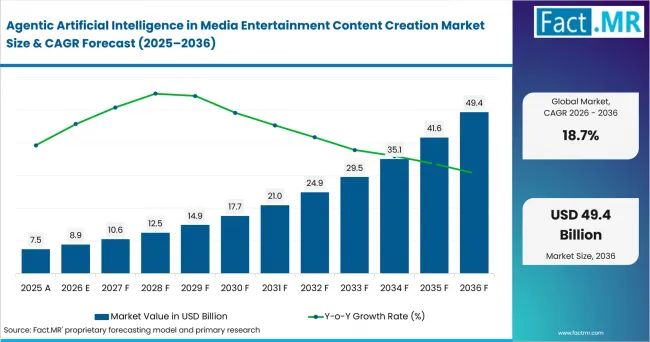
Agentic Artificial Intelligence In Media Entertainment Content Creation Market Value Analysis | Source: Fact.MR
What are the defining numbers behind Agentic Artificial Intelligence in Media Entertainment Content Creation Market growth?
An absolute dollar opportunity of USD 40.5 billion is expected between 2026 and 2036.
- Demand Drivers in the Market
- The main driver is production volume. In June 2026, the UK AI Adoption Plan for Creative Industries reported that 51% of creative businesses used AI and that larger firms moved faster than smaller companies, reflecting the productivity pressure across the sector.
- Content teams now manage more channels and shorter campaign cycles, and agents can translate one approved concept into different lengths, languages, and placements, raising output without expanding every specialist team at the same rate.
- Video generation is creating the largest new workload, and suppliers are extending video capability. Google released Veo 3.1 updates in Flow in October 2025 with richer audio and more precise editing controls, and Amazon expanded Nova Reel to multi-shot videos in April 2025.
- Creative software is embedding agentic workflows directly into production tools. Adobe added AI-assisted masking and Firefly Boards integration to Premiere and After Effects in January 2026, and Runway introduced Agent 2.0 in June 2026 to analyze campaign performance and build new creative within one conversation.
- Enterprise studios are spreading integration and governance costs across large production slates, concentrating demand on systems that fit existing editing and asset-management environments.
- Regulators are clarifying the copyright and transparency rules that shape production, supporting governed deployment. The U.S. Copyright Office issued guidance on copyright and AI in January 2025, and the European Commission published guidelines for general-purpose AI providers in November 2025.
- Key Segments Analyzed
- Creative Content Agents anchor the Agent Capability segment with a 38.0% share in 2026, because they coordinate one controlled workflow instead of several separate applications.
- Video Content Generation leads the Content Application segment, taking 35.0% of demand in 2026, since each approved video can be adapted across several channels.
- Media & Entertainment is the dominant End-use Industry at 41.0% in 2026, reflecting the scale and cadence of studio and platform production.
- Enterprise Studios anchors the User Category segment with a 45.0% share in 2026.
- Cloud-based AI Agents anchors the Deployment Environment segment with a 47.0% share in 2026.
- Analyst Opinion at Fact.MR
- Shambhu Nath Jha, Sr. Consultant at Fact.MR, opines: “Media production is shifting from generating single assets to coordinating complete workflows, and agents that sit closest to the brief are capturing the most value. Creative Content Agents already hold 38.0% of the market in 2026, and Video Content Generation leads applications because every approved clip can be adapted across channels. The binding constraint is not model quality; it is approval. Copyright and talent consent extend approval cycles, and brand safety and client restrictions add further review. Vendors that combine strong generation with governed workflows, rights provenance, and private data handling will capture the largest share of studio spend.”
- Strategic Implications
- Foundation-model providers should pair generation quality with identity, policy, and creative-software integration, because a strong clip still needs enterprise approval to reach final deliverables.
- Enterprise creative platforms should build workflows that preserve characters, brand assets, and narrative intent across repeated use, since consistency and reuse drive the team economics.
- Vendors should embed rights provenance and approval checkpoints into the workflow, because copyright and talent consent are the primary gating factor for public content.
- Channel and service investment should follow the fastest-growing country markets, including the USA, UK, and South Korea, while adapting to local copyright guidance.
- Providers should connect agents to existing editing and asset-management environments, because return depends on fitting current pipelines rather than adding another isolated application.
How does the Agentic Artificial Intelligence in Media Entertainment Content Creation Market break down by segment?
The market is segmented by Agent Capability, Content Application, End-use Industry, User Category, Deployment Environment, and Region. Agent Capability includes Creative Content Agents, Visual Production Agents, Audio Production Agents, and Content Optimization Agents. Content Application covers Video Content Generation, Image & Graphic Generation, Music Composition, and Content Personalization. End-use Industry includes Media & Entertainment, Advertising & Marketing, Gaming, Music Production, and Streaming Services. User Category covers Enterprise Studios, Creative Agencies, Content Creators, Game Developers, Music Labels, and OTT Platforms. Deployment Environment includes Cloud-based AI Agents, On-premises Deployment, Edge-enabled AI, and the supporting orchestration and integration layers. Regional analysis spans North America, Latin America, Western Europe, Eastern Europe, East Asia, South Asia and Pacific, and Middle East & Africa.
Why do Creative Content Agents lead Agent Capability?
Creative Content Agents is projected to account for a 38.0% share in 2026.
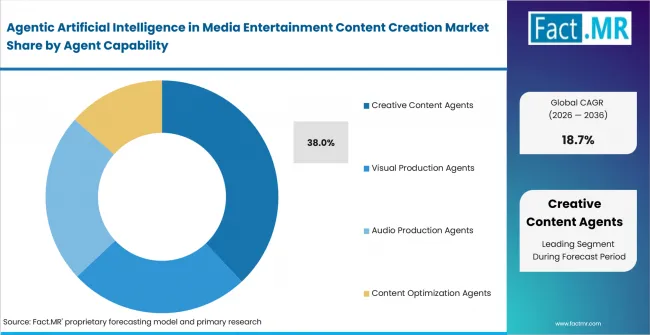
Agentic Artificial Intelligence In Media Entertainment Content Creation Market Analysis By Agent Capability | Source: Fact.MR
Creative Content Agents sit closest to the brief. They can interpret intent before assigning work to script and storyboard tools, then direct image, video, or audio tools, which helps buyers manage one controlled workflow instead of several separate applications. Their value increases when the agent can preserve brand context and track revisions, so the leading position is tied to coordination rather than the quality of a single generated asset. Runway introduced Agent 2.0 in June 2026 to analyze campaign performance and build new creative within one conversation, illustrating how agents orchestrate rather than merely generate.
Why does Video Content Generation lead Content Application?
Video Content Generation is projected to account for a 35.0% share in 2026.
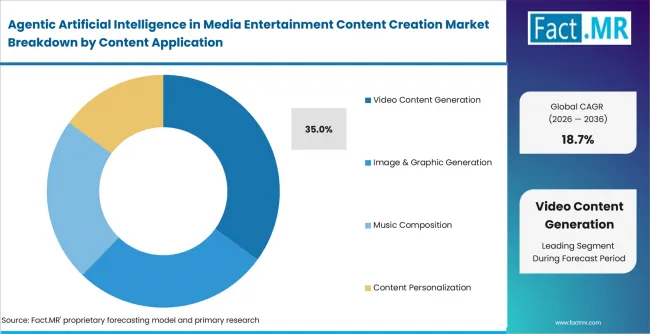
Agentic Artificial Intelligence In Media Entertainment Content Creation Market Analysis By Content Application | Source: Fact.MR
Video combines scripting with visual composition, and motion, sound, and editing add further steps, creating more handoffs than a static asset. Agentic systems reduce those handoffs by generating story options and extending approved scenes into multiple formats. Short-form platforms also require frequent changes in aspect ratio and duration, so buyers measure savings through faster previsualization and more campaign variants. Human editors still control final continuity and narrative quality. Google released Veo 3.1 updates in Flow in October 2025 with richer audio and more precise editing controls, and each approved video can be adapted across several channels.
Why does Media & Entertainment lead End-use Industry?
Media & Entertainment is projected to account for a 41.0% share in 2026.
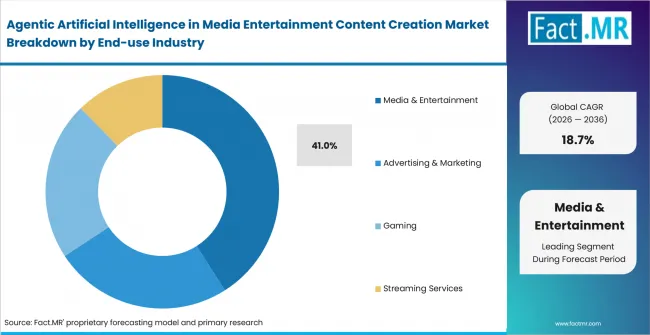
Agentic Artificial Intelligence In Media Entertainment Content Creation Market Analysis By End Use Industry | Source: Fact.MR
Media and entertainment companies operate under the highest production volume and the shortest campaign cycles, and they monetize content directly, giving them an immediate incentive to shorten time to deliverable. Studios, streaming platforms, labels, and game developers all produce variants and localizations at scale, which agentic workflows can coordinate. They also face the most direct copyright and talent-consent exposure, so they demand the governance and rights controls that justify ongoing agent spend. The UK AI Adoption Plan for Creative Industries, which reported that 51% of creative businesses used AI in June 2026, underscores the sector’s leadership in adoption.
Why do Enterprise Studios lead User?
Enterprise Studios is projected to account for a 45.0% share in 2026.
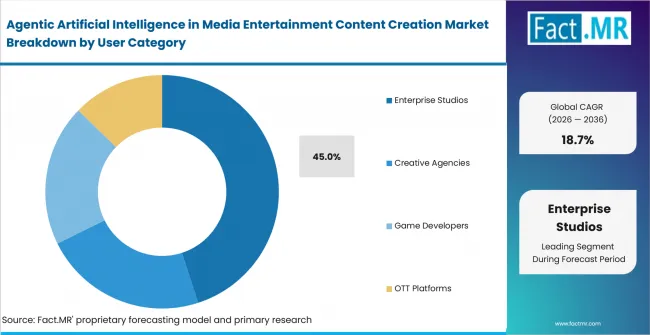
Agentic Artificial Intelligence In Media Entertainment Content Creation Market Analysis By User Category | Source: Fact.MR
Enterprise studios can spread integration and governance costs across large production slates. They have legal, security, and procurement teams that can define approved models and talent rules, and once a workflow passes review, the studio can reuse it across departments and franchises. Smaller buyers may adopt faster at first, but they often lack the budget to build the same control layer. Enterprise demand therefore concentrates around systems that fit existing editing and asset-management environments. Adobe added AI-assisted masking and Firefly Boards integration to Premiere and After Effects in January 2026, supporting the enterprise studio workflow.
Why do Cloud-based AI Agents lead Deployment Environment?
Cloud-based AI Agents are projected to account for a 47.0% share in 2026.
Cloud deployment gives creative teams access to model updates, shared workspaces, and centralized controls without requiring every studio to operate specialist infrastructure. Buyers still evaluate data access, identity management, rights handling, and integration with editing and asset-management systems before moving production workloads into a shared environment.
What is accelerating Agentic Artificial Intelligence in Media Entertainment Content Creation Market adoption, and what is holding it back?
Drivers
| Driver | Relative Impact | Geographic Relevance | Impact Timeline |
|---|---|---|---|
| Studios and agencies need more approved content variants across shorter campaign cycles. | High | Global | Near term |
| Video generation reduces handoffs and supports multi-format adaptation of approved scenes. | High | Global | Near term |
| Creative software is embedding agentic workflows directly into production tools. | Medium | North America, Europe | Mid term |
| Enterprise studios can spread integration and governance costs across large production slates. | Medium | North America, Europe, Asia Pacific | Long term |
Source: Fact.MR analysis. Updated Aug 10, 2026
Restraints
| Restraint | Relative Impact | Geographic Relevance | Impact Timeline |
|---|---|---|---|
| Copyright and talent consent can extend approval cycles and confine AI to internal concepts. | High | Global | Mid term |
| Brand-safety and client restrictions add legal review and data-control requirements. | Medium | North America, Europe | Near term |
| Review, rework, and compute costs can raise the cost per final deliverable. | Medium | Global | Mid term |
Source: Fact.MR analysis. Updated Aug 10, 2026
Which countries are scaling the Agentic Artificial Intelligence in Media Entertainment Content Creation Market fastest?
The USA, UK, South Korea, Japan, and Canada are the countries shown in the comparative outlook. Studios, agencies, and production platforms assess agentic workflows against local rights, disclosure, and production-governance requirements.
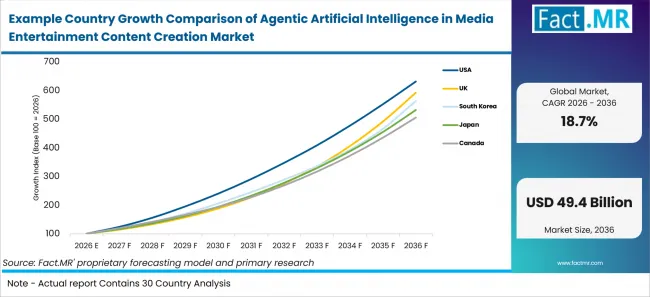
Example Country Growth Comparison Of Agentic Artificial Intelligence In Media Entertainment Content Creation Market | Source: Fact.MR
Country-wise CAGR Forecast (2026-2036)
| Country | CAGR |
|---|---|
| USA | 20.3% |
| UK | 19.5% |
| South Korea | 18.9% |
| Japan | 18.2% |
| Canada | 17.6% |
| Germany | 17.0% |
| Australia | 16.4% |
Source: Fact.MR analysis. Updated Aug 10, 2026
What is driving the Agentic Artificial Intelligence in Media Entertainment Content Creation Market in the USA?
USA is projected to register a 20.3% CAGR through 2036.
American studios and streaming platforms manage large production slates and evaluate governed agent workflows for creative operations. Copyright guidance gives production teams a reference point for managing rights risk when deploying generative tools.
What is driving the Agentic Artificial Intelligence in Media Entertainment Content Creation Market in the UK?
The UK is projected to register a 19.5% CAGR through 2036.
Creative businesses are adopting AI across a range of production and campaign workflows. The AI Adoption Plan for Creative Industries provides current context for how firms are approaching these tools.
What is driving the Agentic Artificial Intelligence in Media Entertainment Content Creation Market in South Korea?
South Korea is projected to register an 18.9% CAGR through 2036.
Content exporters evaluate generative workflows against copyright guidance and the requirements of global distribution. Published guidance on generative-AI outputs helps studios frame rights and review requirements.
What is driving the Agentic Artificial Intelligence in Media Entertainment Content Creation Market in Japan?
Japan is projected to register an 18.2% CAGR through 2036.
Studios and producers align AI use with copyright expectations and stakeholder dialogue. Buyers need governance that distinguishes assisted creative work from uses that require further rights review.
What is driving the Agentic Artificial Intelligence in Media Entertainment Content Creation Market in Canada?
Canada is projected to register a 17.6% CAGR through 2036.
Production companies balance adoption with ongoing copyright consultation. Policy developments inform how studios assess generative agents in film and content-production workflows.
What is driving the Agentic Artificial Intelligence in Media Entertainment Content Creation Market in Germany?
Germany is projected to register a 17.0% CAGR through 2036.
Media companies assess AI within cultural and creative-economy transformation programs. Interoperability, rights management, and structured procurement remain relevant to production teams.
What is driving the Agentic Artificial Intelligence in Media Entertainment Content Creation Market in Australia?
Australia is projected to register a 16.4% CAGR through 2036.
Screen producers are formalizing transparency expectations for AI use. These requirements shape review and disclosure practices in film and television production.
Who leads the Agentic Artificial Intelligence in Media Entertainment Content Creation Market?
Competition is organized around three positions. Foundation-model providers compete on image and video capabilities, with audio and reasoning expanding that offer. Enterprise platforms compete on identity, private data access, policy controls, and creative-software integration. Specialist production vendors compete on high-control media workflows and acceleration infrastructure. The strongest commercial position connects these layers, because a model may generate a strong clip but still require enterprise approval, and a workflow suite may control assets but depend on external models.
Foundation and generative media models: OpenAI, Google, Meta, Stability AI, and ByteDance. Enterprise creative workflow and cloud platforms: Microsoft, Adobe, Amazon Web Services, and Canva. Production infrastructure and specialist media systems: NVIDIA and Runway.
Which companies are the key providers?
Key companies profiled in the Agentic Artificial Intelligence in Media Entertainment Content Creation market include OpenAI, Inc., Google LLC, Meta Platforms, Inc., Stability AI Ltd., ByteDance Ltd., Microsoft Corporation, Adobe Inc., Amazon Web Services, Inc., Canva Pty Ltd., NVIDIA Corporation, and Runway AI, Inc.
- OpenAI, Inc.
- Google LLC
- Meta Platforms, Inc.
- Stability AI Ltd.
- ByteDance Ltd.
- Microsoft Corporation
- Adobe Inc.
- Amazon Web Services, Inc.
- Canva Pty Ltd.
- NVIDIA Corporation
- Runway AI, Inc.
Bibliography
- U.S. Copyright Office. (2025, January 29). Copyright and Artificial Intelligence.
- UK Department for Science, Innovation and Technology. (2026, June 8). AI Adoption Plan: Creative Industries.
- Ministry of Culture, Sports and Tourism, Republic of Korea. (2025, November 3). Two English Guides on Generative AI Outputs and Copyright.
- Agency for Cultural Affairs, Japan. (2025, June). Copyright: General Understanding on AI and Copyright and Stakeholder Dialogue.
- Innovation, Science and Economic Development Canada. (2025, February). What We Heard Report: Consultation on Copyright in the Age of Generative Artificial Intelligence.
- Press and Information Office of the German Federal Government. (2025, October 20). AI, Bureaucracy Reduction and Transformation in the Cultural and Creative Economy.
- Screen Australia. (2026, March 10). AI Transparency Statement.
- European Commission. (2025, November 11). Guidelines on Obligations for General-Purpose AI Providers.
- Google. (2025, October 15). Introducing Veo 3.1 and Advanced Capabilities in Flow.
- Adobe. (2026, January 20). New AI-Powered Video Editing Tools in Premiere and After Effects.
- Runway. (2026, June 25). Introducing Agent 2.0.
- Canva. (2026, February 23). Welcoming MangoAI and Cavalry as Canva Expands AI Capabilities.
- Microsoft. (2025, February 27). New Models, Customization Tools and Enterprise Agent Upgrades in Azure AI Foundry.
- Amazon Web Services. (2025, April 7). Amazon Nova Reel 1.1: Up to Two-Minute Multi-Shot Videos.
- ByteDance Seed. (2025, June 11). Technical Report of Seedance 1.0 Is Publicly Available.
This Report Answers
- The report examines the Agentic Artificial Intelligence in Media Entertainment Content Creation Market by Agent Capability, Content Application, End-use Industry, User Category, Deployment Environment, and Region.
- Creative Content Agents lead Agent Capability with a 38.0% share in 2026.
- The country outlook compares the USA, UK, South Korea, Japan, and Canada, with additional coverage of Germany and Australia.
- Competitive analysis profiles OpenAI, Inc., Google LLC, Meta Platforms, Inc., Stability AI Ltd., ByteDance Ltd., Microsoft Corporation, Adobe Inc., Amazon Web Services, Inc., Canva Pty Ltd., NVIDIA Corporation, and Runway AI, Inc.
- The assessment evaluates market value and share across the defined segment groups.
What does the Agentic Artificial Intelligence in Media Entertainment Content Creation Market cover?
The Agentic Artificial Intelligence in Media Entertainment Content Creation Market covers software, platforms, and related services that coordinate multi-step creative workflows. The scope follows Agent Capability, Content Application, End-use Industry, User Category, Deployment Environment, and Region.
What is included in the scope?
Coverage includes creative, visual-production, audio-production, and content-optimization agents; video, image, graphic, music, and personalization applications; and deployments used by media and entertainment companies, advertising and marketing firms, gaming businesses, music producers, streaming services, studios, agencies, creators, developers, labels, and OTT platforms. The scope also includes the deployment and integration environments defined in the market segmentation and the regions profiled in the report.
What is excluded from the scope?
General-purpose AI tools, unrelated enterprise software, commodity infrastructure, and services not configured for the defined media and entertainment content-creation use cases are outside the scope.
How was the analysis built?
The analysis draws on public company disclosures, product documentation, copyright and regulatory material, industry publications, and interviews with relevant market participants. These inputs are assessed alongside the report's defined market scope, segment structure, regional coverage, and forecast period.
Segmentation
What is the report’s scope and coverage?
| Attribute | Details |
|---|---|
| Forecast Period | 2026-2036 |
| Base Year | 2025 |
| Market Value, 2026 | USD 8.9 billion |
| Market Value, 2036 | USD 49.4 billion |
| CAGR, 2026-2036 | 18.7% |
| Absolute Dollar Opportunity | USD 40.5 billion |
| Key Regions Covered | USA, UK, South Korea, Japan, Canada, Germany, Australia, and more than twenty-five additional countries in the full report |
Source: Fact.MR analysis. Updated Aug 10, 2026
How is the market segmented?
-
Agent Capability:
- Creative Content Agents
- Script Generation Agents
- Storyboard Generation Agents
- Visual Production Agents
- AI Image Generation Agents
- AI Video Editing Agents
- Audio Production Agents
- AI Voice Generation Agents
- AI Sound Design Agents
- Content Optimization Agents
- SEO Optimization Agents
- Content Performance Agents
- Creative Content Agents
-
Content Application:
- Video Content Generation
- Short-form Video Creation
- Animation Production
- Image & Graphic Generation
- Brand Asset Creation
- Social Media Content
- Music Composition
- Podcast Production
- Audio Localization
- Content Personalization
- Audience Engagement
- Content Recommendation
- Video Content Generation
-
End-use Industry:
- Media & Entertainment
- Film Production
- Animation Studios
- Advertising & Marketing
- Digital Advertising
- Social Media Platforms
- Gaming
- Game Studios
- Music Production
- Streaming Services
- Digital Media Platforms
- Broadcasting
- Media & Entertainment
-
User Category:
- Enterprise Studios
- Movie Studios
- Animation Houses
- Creative Agencies
- Marketing Agencies
- Content Creators
- Game Developers
- Independent Developers
- Music Labels
- OTT Platforms
- Content Distributors
- Television Networks
- Enterprise Studios
-
Deployment Environment:
- Cloud-based AI Agents
- Public Cloud
- Private Cloud
- Hybrid AI Infrastructure
- On-premises Deployment
- Edge-enabled AI
- Multi-agent Collaboration
- Agent Orchestration
- Context-aware AI
- Foundation Model Integration
- Knowledge Graph Integration
- Vector Retrieval Pipeline
- Cloud-based AI Agents
-
Region:
- North America
- Latin America
- Western Europe
- Eastern Europe
- East Asia
- South Asia and Pacific
- Middle East & Africa
Frequently Asked Questions
What is the Agentic Artificial Intelligence in Media Entertainment Content Creation market size in 2026?
At what CAGR is the Agentic Artificial Intelligence in Media Entertainment Content Creation market expected to grow?
What is the projected Agentic Artificial Intelligence in Media Entertainment Content Creation market size by 2036?
Which country leads the Agentic Artificial Intelligence in Media Entertainment Content Creation market?
Which is the leading segment in the Agentic Artificial Intelligence in Media Entertainment Content Creation market?
What is driving growth in the Agentic Artificial Intelligence in Media Entertainment Content Creation Market?
Who are the key players in the Agentic Artificial Intelligence in Media Entertainment Content Creation Market?
Who worked on this report


Preview the report firsthand - request a free sample
Free SampleGet the brochure for pricing and purchase details
Download PDF